
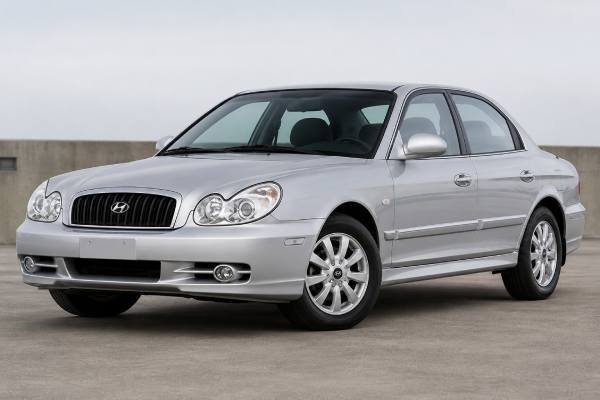
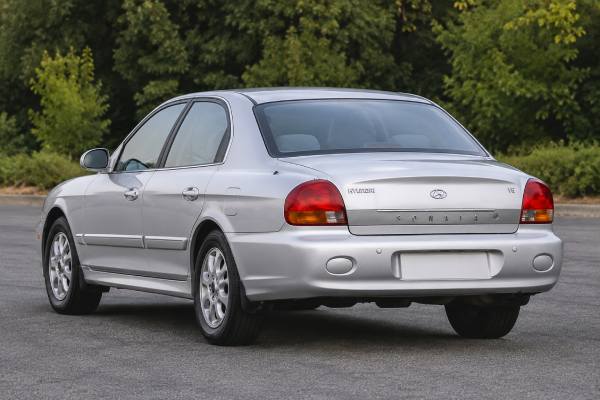
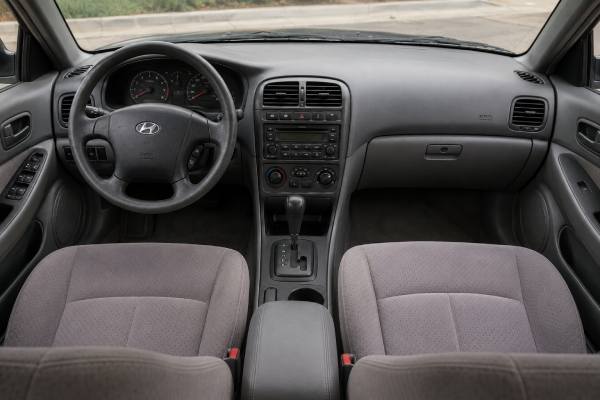
The Hyundai SONATA EF facelift with the Sirius II 2.4-liter engine is a simple, comfortable midsize sedan from the last years of the EF generation. In most 2004–2005 markets, the 138 hp version was the practical four-cylinder choice: less powerful than the V6, but cheaper to maintain, easier on fuel, and usually less expensive to buy used.
This guide focuses on the late EF/EF-B facelift sedan with the 2.4L Sirius II inline-four, especially the 2004–2005 North American GL and closely related export-market versions. Exact equipment, tire sizes, emissions hardware, and service parts can vary by VIN and country, but the core ownership picture is consistent: a roomy front-wheel-drive sedan with a timing-belt four-cylinder, conventional automatic or manual transmission, and a fairly straightforward maintenance profile.
Owner Snapshot
- Strong points are comfort, cabin space, low purchase cost, and simple mechanical layout.
- The 2.4L Sirius II engine is durable when oil, coolant, and timing-belt service are kept current.
- Main ownership caveats are age-related leaks, suspension wear, rust, and neglected timing belts.
- A sensible timing-belt service window is about 96,000 km / 60,000 miles or earlier if history is unknown.
- Real-world mixed fuel use is typically around 9.5–11.0 L/100 km depending on transmission, traffic, and condition.
Table of Contents
- Hyundai Sonata EF Model Snapshot
- Hyundai Sonata EF 2.4 Specs
- Hyundai Sonata EF Trims and Safety
- Reliability Problems and Recalls
- Maintenance and Buying Advice
- Road Performance and Fuel Use
- Rival Sedan Comparison
Hyundai Sonata EF Model Snapshot
The facelift Hyundai SONATA EF is a conventional midsize sedan built around comfort, value, and mechanical simplicity. It is not a sporty car in the modern sense, but it was designed to compete with the Toyota Camry, Honda Accord, Nissan Altima, Kia Optima/Magentis, Ford Taurus, and other family sedans of the early 2000s.
The late EF facelift is often referred to as the EF-B update. It brought revised exterior styling, a more mature cabin, improved safety equipment, and a wider rear track compared with earlier EF models. The car kept a 2,700 mm wheelbase and used a front double-wishbone suspension with a rear multi-link layout, which was a strong chassis specification for its price class.
The covered engine is Hyundai’s Sirius II 2.4-liter four-cylinder, commonly identified as G4JS in many service and parts references. It is a naturally aspirated, multi-point fuel-injected, DOHC 16-valve inline-four with a toothed timing belt and balance shafts. Factory output for the 138 hp version is 138 hp at 5,500 rpm and 147 lb-ft at 3,000 rpm, equal to about 103 kW and 199 Nm.
In the U.S. market, the 2.4L engine was primarily associated with the GL trim, while GLS and LX models commonly used the 2.7L V6. In other markets, trim names and engine availability differed. Some export versions used similar 2.4-liter engines with different power ratings, emissions calibrations, or badging, so buyers should verify the VIN, engine label, and registration data rather than relying only on trim badges.
The SONATA EF 2.4 is best understood as a low-stress used sedan. It suits drivers who want a roomy, inexpensive car for commuting, highway travel, and basic family use. It is not ideal for buyers seeking modern driver assistance, high crash-test performance by current standards, sharp handling, or luxury-grade interior materials. Its strengths are more practical: affordable parts, conventional mechanical systems, a large trunk, good ride comfort, and a powertrain that most independent workshops can understand.
The biggest ownership variable is maintenance history. A well-kept SONATA EF 2.4 can still be a useful budget car, but neglected examples can become poor value quickly. Timing-belt age, cooling-system condition, automatic transmission fluid history, rust, and front suspension condition matter more than mileage alone. A clean car with records is usually worth more than a cheaper one with unknown belt service and visible corrosion.
Hyundai Sonata EF 2.4 Specs
The figures below focus on the 2004–2005 facelift SONATA EF 2.4L 138 hp specification. Where public factory brochures list U.S. model-year data, those figures are used. Some service values are market-dependent, so always verify against the VIN-specific service manual before ordering parts or tightening critical fasteners.
Powertrain and Efficiency
| Item | Hyundai SONATA EF 2.4 Sirius II |
|---|---|
| Engine code | Sirius II 2.4; commonly referenced as G4JS |
| Layout | Inline-4, 4 cylinders, DOHC, 4 valves per cylinder |
| Bore × stroke | 86.5 × 100.0 mm (3.41 × 3.94 in) |
| Displacement | 2.4 L; 2,351 cc |
| Induction | Naturally aspirated |
| Fuel system | Multi-point programmed fuel injection |
| Compression ratio | 10.0:1 |
| Maximum power | 138 hp (103 kW) at 5,500 rpm |
| Maximum torque | 199 Nm (147 lb-ft) at 3,000 rpm |
| Timing drive | Toothed timing belt |
| Rated fuel economy | Automatic: 10.7 L/100 km combined equivalent from 22 mpg US; manual: 10.2 L/100 km from 23 mpg US |
| Real-world highway at 120 km/h | Usually about 8.0–9.0 L/100 km if healthy; more with roof racks, old tires, poor alignment, or heavy A/C use |
Transmission and Chassis
| Item | Specification |
|---|---|
| Transmission | 5-speed manual standard on many GL 2.4 models; 4-speed Shiftronic automatic optional or market-dependent |
| Drive type | Front-wheel drive |
| Differential | Open front differential |
| Front suspension | Double wishbone with anti-roll bar |
| Rear suspension | Independent multi-link with anti-roll bar |
| Steering | Power-assisted rack and pinion; about 14.1:1 overall ratio in common published specifications |
| Brakes | Power-assisted four-wheel discs; ABS optional in many markets |
| Brake rotor size | Common service listing: front about 279 mm (11.0 in), rear about 262 mm (10.3 in); verify by VIN |
| Popular tire sizes | 205/65R15 on 15-inch wheels for GL; 205/60R16 on 16-inch wheels on higher trims or market variants |
Dimensions, Weight, and Capacity
| Item | Measurement |
|---|---|
| Length | 4,747 mm (186.9 in) |
| Width | 1,820–1,821 mm (71.7 in) |
| Height | 1,422 mm (56.0 in) |
| Wheelbase | 2,700 mm (106.3 in) |
| Turning circle | About 10.5 m (34.4 ft), curb-to-curb |
| Ground clearance | About 160 mm (6.3 in) in many export listings; verify market specification |
| Curb weight | About 1,443 kg (3,181 lb) manual; about 1,459 kg (3,217 lb) automatic |
| GVWR | Typically around 1,920–2,020 kg (4,233–4,453 lb), market-dependent |
| Fuel tank | 65 L (17.2 US gal / 14.3 UK gal) |
| Cargo volume | About 399 L (14.1 ft³) by U.S. brochure method; some export listings quote about 430 L |
Performance and Service Capacities
| Item | Typical figure or specification |
|---|---|
| 0–100 km/h | About 10.8 s manual; about 11.9 s automatic in common published figures |
| Top speed | About 194–197 km/h (121–122 mph), transmission-dependent |
| Towing capacity | Up to about 907 kg (2,000 lb) where rated; verify local tow rating and cooling equipment |
| Engine oil | API SL-era specification or better; commonly 5W-20, 5W-30, or 10W-30 depending on climate; about 4.3 L (4.5 US qt) with filter |
| Manual transaxle oil | 75W-85 API GL-4; about 1.9 L (2.0 US qt) |
| Automatic transaxle fluid | Hyundai-approved ATF SP-III; total capacity about 7.8 L (8.24 US qt), with drain-and-fill quantity lower |
| Coolant | Ethylene-glycol coolant mixed with demineralized water, commonly 50/50; capacity varies by market and service procedure |
| Key torque values | Oil drain plug about 39 Nm (29 lb-ft); wheel nuts commonly around 90–110 Nm (65–80 lb-ft), verify service manual |
Hyundai Sonata EF Trims and Safety
The trim structure depends heavily on country, but the late EF 2.4 was usually positioned as the value-focused four-cylinder version. In the U.S., the 2005 GL was the key 2.4L trim. GLS and LX were more commonly V6-equipped, although markets outside North America used different names such as CDX, Elite, Base, or locally specific packages.
Trim and equipment identifiers
A typical 2.4L GL has cloth seating, 15-inch wheels with covers, a 5-speed manual or optional 4-speed automatic, air conditioning, cruise control, power windows, power locks, power mirrors, remote keyless entry, front fog lamps, and an AM/FM/CD audio system. The 60/40 split-folding rear seat is useful for long items, although the sedan trunk opening is not as flexible as a hatchback.
Higher trims often add 16-inch alloy wheels, upgraded audio with cassette, heated mirrors, better seat cloth, woodgrain-style trim, a rear center armrest, carpeted floor mats, and chrome exterior inserts. LX-style equipment may include leather seating, automatic climate control, an electrochromic mirror, HomeLink, and an 8-way power driver’s seat.
Quick identifiers include the engine label under the hood, the emissions sticker, the VIN, and the shift pattern. A true 2.4L Sirius II car should not be confused with the V6 version, because the V6 has different timing-belt parts, more crowded service access, and different running costs. The 2.4L engine bay is easier to work in and generally cheaper for timing-belt, plug, accessory belt, and leak repairs.
Safety ratings and structure
By modern standards, the EF is an older design. It has useful passive safety features for its era, but it lacks the stronger crash structures, head-protecting curtain airbags, stability systems, and active driver assistance expected in newer midsize sedans.
IIHS ratings for the 1999–2005 Sonata show an Acceptable overall result in the moderate overlap front test, with a Marginal structure rating. The original side-impact result was Poor overall, and the head restraint and seat result was also Poor for tested GL seats. That does not mean the car is unsafe in every scenario, but it does mean buyers should not compare it directly with later vehicles tested under newer standards.
Safety equipment on many 2004–2005 cars includes dual front airbags, front seat-mounted side-impact airbags, three-point belts for all seating positions, front belt pretensioners with force limiters, rear child locks, rear LATCH anchors, rear tether anchors, front and rear crumple zones, side-impact door beams, and an energy-absorbing steering column. ABS was often optional, and traction control was linked to ABS packages on some trims. There is no modern AEB, adaptive cruise control, lane keeping assistance, blind-spot monitoring, rear cross-traffic alert, traffic-sign recognition, or camera-based ADAS suite.
For families, the rear-seat LATCH provisions are useful, but the age of the car matters. Seat belts should retract firmly, buckles should latch cleanly, and any SRS light should be treated as a real repair item rather than a nuisance. After crash repair, suspension work, steering rack replacement, or front-end body work, confirm that ABS sensors, airbag wiring, and seat-belt pretensioner connectors have not been damaged or bypassed.
Reliability Problems and Recalls
A late SONATA EF 2.4 can be reliable, but by now every example is an old used car. Age, heat cycles, corrosion, cheap replacement parts, and skipped maintenance are usually bigger threats than design complexity.
| Issue | Prevalence | Severity | Typical symptoms | Recommended remedy |
|---|---|---|---|---|
| Unknown timing-belt history | Common | High | No records, belt noise, cracked belt, oil contamination | Replace timing belt, balance-shaft belt if fitted, tensioners, idlers, water pump, and seals as a complete job |
| Oil leaks | Common | Low to medium | Burning-oil smell, wet valve-cover area, oil near timing cover | Replace valve-cover gasket, cam/crank seals, oil pan gasket or sealant as diagnosed |
| Cooling-system aging | Common | Medium to high | Coolant smell, rising temperature, crusted radiator tanks, soft hoses | Pressure-test system; replace radiator, thermostat, cap, hoses, and coolant as needed |
| Automatic shift harshness | Occasional | Medium | Delayed engagement, flares, harsh 2–3 shift, dark ATF | Check fluid level and condition; use SP-III fluid; diagnose solenoids and mounts before condemning gearbox |
| Front suspension wear | Common | Medium | Clunks, wandering, uneven tire wear | Inspect control arms, ball joints, tie rods, struts, sway-bar links, and alignment |
| Rust and underbody corrosion | Climate-dependent | Medium to high | Soft jacking points, rusty brake lines, crusted subframes | Inspect on a lift; avoid structurally rusty cars unless repair costs are justified |
Engine-specific concerns
The Sirius II 2.4 is not a modern direct-injection engine, so intake-valve carbon buildup is not a major design issue in the way it can be on later DI engines. Its bigger needs are simple: clean oil, stable cooling, fresh belts, and leak control. Listen for timing-cover noises, accessory-belt squeal, hydraulic lifter ticking that does not settle, and exhaust leaks near the manifold.
A failed or neglected timing belt is the most important mechanical risk. Even if the car runs well, a missing timing-belt receipt should be treated as “due now.” Oil leaks near the timing area also matter because oil can degrade belt material. When replacing the belt, it is wise to handle the water pump, front seals, tensioner, idler pulleys, thermostat if accessible, and accessory belts together.
Driveline and chassis aging
The 4-speed automatic is generally conventional and serviceable, but it dislikes neglected fluid and overheating. Use Hyundai-approved SP-III-type fluid rather than generic “universal” ATF unless the product clearly meets the required specification. A flare, thump, or delayed reverse engagement may be a fluid, mount, solenoid, range switch, or internal wear issue. Diagnosis matters because many old cars have been driven for years with tired mounts and dirty fluid.
Front suspension bushings, ball joints, sway-bar links, struts, rear links, wheel bearings, and engine mounts are normal reconditioning items. A car that feels loose at highway speed often needs a complete front-end inspection rather than just tires.
Recalls, service actions, and verification
For U.S. 2005 Sonata listings, public recall summaries often show no open safety recalls for the standard 2005 model, while some region-specific or related Hyundai campaigns affected certain model years, markets, or early 2006 vehicles. One documented Hyundai de Puerto Rico campaign covered a stop-lamp switch issue on certain 2005–2007 Hyundai models, including Sonata, where brake lamps or shift-interlock behavior could be affected.
The practical advice is simple: check the VIN through an official Hyundai recall lookup and the relevant national safety database before purchase. Do not rely only on year and model. Dealer service history is more valuable than a seller saying “there are no recalls.”
Maintenance and Buying Advice
A good maintenance plan for the SONATA EF 2.4 is conservative rather than complicated. The car is old enough that age-based servicing is just as important as mileage-based servicing.
| Service item | Suggested interval | Notes |
|---|---|---|
| Engine oil and filter | 5,000–7,500 km or 3,000–5,000 miles; 6 months for severe use | Use climate-appropriate viscosity and quality filter; check level weekly on older engines |
| Engine air filter | 15,000–30,000 km or 10,000–20,000 miles | Shorten interval in dusty areas |
| Cabin air filter | 12 months or as airflow drops | Some cars have market-dependent filter fitment |
| Timing belt system | About 96,000 km / 60,000 miles, or immediately if unknown | Replace belt, tensioner, idlers, water pump, seals, and accessory belts together where practical |
| Spark plugs | 48,000–96,000 km or 30,000–60,000 miles depending on plug type | Use correct heat range and torque; inspect coils and wires if misfiring |
| Coolant | Every 2–3 years | Inspect radiator tanks, hoses, cap, thermostat, and heater performance |
| Automatic transmission fluid | 48,000–60,000 km or 30,000–40,000 miles for older cars | Use approved SP-III fluid; avoid power flushing a neglected high-mileage unit without diagnosis |
| Manual transaxle oil | 60,000–100,000 km or 40,000–60,000 miles | Use 75W-85 GL-4 fluid |
| Brake fluid | Every 2 years | Important for ABS-equipped cars and caliper longevity |
| Tire rotation and alignment check | 8,000–10,000 km or 5,000–6,000 miles | Uneven wear often points to worn bushings or poor alignment |
| 12 V battery | Test yearly after 3 years | Weak batteries can cause odd electrical symptoms |
What to inspect before buying
Start with the timing belt. A receipt showing date, mileage, parts, and workshop is ideal. A sticker alone is useful but not enough if the job cannot be verified. Next, check coolant condition and temperature stability. The engine should reach normal temperature, hold it in traffic, and show no coolant smell or bubbling.
Inspect the underside on a lift. Pay close attention to jacking points, rocker panels, rear wheel arches, brake lines, fuel lines, front and rear subframes, exhaust hangers, and suspension mounting areas. Surface rust is normal in many climates; structural rust is not.
During the test drive, the automatic should engage Drive and Reverse without a long delay, shift without harsh bangs, and kick down predictably. A manual should not grind into second or third, and clutch take-up should be smooth. Listen for front-end clunks over broken pavement, wheel-bearing growl at steady speed, and brake pulsation during gentle stops.
The best examples are usually unmodified, rust-free, and boring: working air conditioning, clean fluids, no warning lights, matching tires, documented timing-belt service, and a seller who can explain the maintenance history. Avoid cars with overheats, coolant loss, severe rust, SRS lights, missing title history, or “minor” timing-belt uncertainty.
Road Performance and Fuel Use
The SONATA EF 2.4 drives like a comfort-biased family sedan. The ride is generally soft, stable, and forgiving on poor pavement. The long wheelbase helps highway tracking, while the double-wishbone front suspension gives the car a more composed front end than some budget sedans of the same period.
Steering is light to moderate, with limited road feel but predictable response. It is not a sharp driver’s car, yet it does not feel crude when the suspension is healthy. Worn struts, old tires, and tired bushings change the character dramatically; a properly sorted car feels much more settled than a neglected one.
The 2.4L engine has enough torque for daily driving, but performance is modest. The engine pulls best from the midrange and prefers planned passing rather than last-second overtakes. Manual cars feel more responsive because the driver can keep the engine in its useful range. Automatic cars are easier in traffic but can feel slow to downshift, especially on hills or with passengers aboard.
Expect roughly 10–11 seconds to 60 mph in typical four-cylinder form, depending on transmission, condition, and test method. The automatic 0–100 km/h figure is commonly listed around 11.9 seconds, while manual versions can be closer to 10.8 seconds. Top speed is around 194–197 km/h, though this is not especially relevant for real ownership.
Fuel use depends heavily on condition. A healthy automatic may return around 11–13 L/100 km in city driving, 8–9 L/100 km on steady highways, and 9.5–11 L/100 km mixed. Manual cars can do slightly better. Cold weather, short trips, dragging brakes, old oxygen sensors, low tire pressure, and poor alignment can easily push consumption higher.
Braking feel is adequate when the discs, pads, calipers, hoses, and fluid are fresh. ABS was optional in many versions, so buyers should confirm whether the specific car has it. Cars without ABS require more driver care in panic braking, especially on wet roads.
Towing should be approached conservatively. Even where the car is rated up to about 907 kg / 2,000 lb, it is an old front-wheel-drive sedan with modest torque, modest cooling reserve, and aging brakes. If towing is planned, install the correct hitch, service the transmission and cooling system, keep loads light, and avoid long steep grades in hot weather.
Rival Sedan Comparison
The SONATA EF 2.4’s strongest rival advantage is value. It usually costs less than a similar-year Camry or Accord, while offering generous standard equipment and a comfortable cabin. Its weakness is that it does not match the best rivals for crash-test performance, resale value, steering precision, or long-term parts depth in every market.
| Model | Why consider it | Where Sonata EF 2.4 differs |
|---|---|---|
| Toyota Camry 2.4 | Excellent reputation, smooth powertrain, strong resale | Sonata is usually cheaper, but Camry has broader buyer confidence |
| Honda Accord 2.4 | Sharper handling, strong engine, better enthusiast appeal | Sonata is softer and often less expensive, but Accord feels more precise |
| Nissan Altima 2.5 | Stronger acceleration and roominess | Sonata feels more conservative; Altima may have more engine-related concerns depending on year |
| Kia Optima/Magentis | Closely related platform and often similar pricing | Condition and service history matter more than badge; many parts and traits overlap |
| Ford Taurus | Cheap to buy, common parts in North America | Sonata is smaller and more efficient; Taurus may be easier to source locally in some U.S. areas |
Choose the SONATA EF 2.4 if the car is clean, documented, rust-free, and priced well below stronger-brand rivals. Do not choose it simply because it is the cheapest running sedan available. At this age, the lowest purchase price often hides delayed maintenance.
Compared with later Sonatas, the EF has fewer electronic systems, less power, and older safety engineering. That simplicity can be an advantage for low-cost ownership, but only if the structure and drivetrain are sound. For a buyer who wants basic transportation and can budget for preventive work, the 2.4L EF facelift remains a reasonable used-car choice. For a buyer prioritizing crash safety, modern stability control, and driver assistance, a newer midsize sedan is the better direction.
References
- 2005 HYUNDAI SONATA CONTINUES TO BE THE SMART BUY 2004 (Manufacturer Publication)
- Hyundai Sonata 2005 2005 (Brochure)
- Gas Mileage of 2005 Hyundai Sonata 2026 (Fuel Economy Database)
- 2005 Hyundai Sonata 2026 (Safety Rating)
- 09V-280 Hyundai de Puerto Rico 2009 (Recall Database)
Disclaimer
This article is for informational purposes only and is not a substitute for professional diagnosis, inspection, or repair. Specifications, torque values, service intervals, fluid capacities, procedures, and safety equipment can vary by VIN, market, production date, and installed equipment. Always verify details against official service documentation and a qualified technician before buying parts or performing repairs.
If this guide helped you, please consider sharing it on Facebook, X/Twitter, or your preferred automotive community to support our work.