
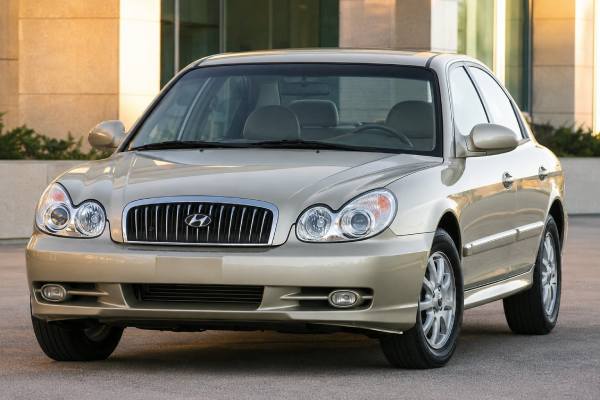
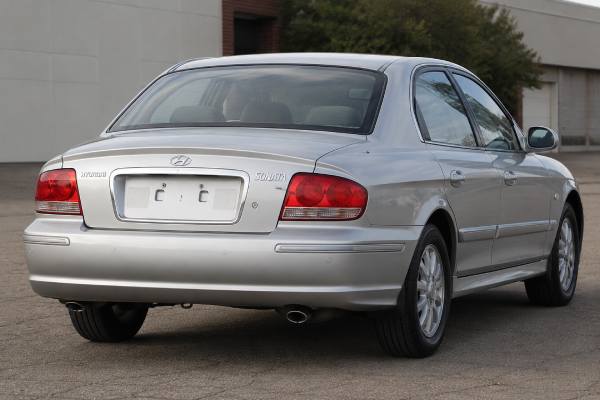
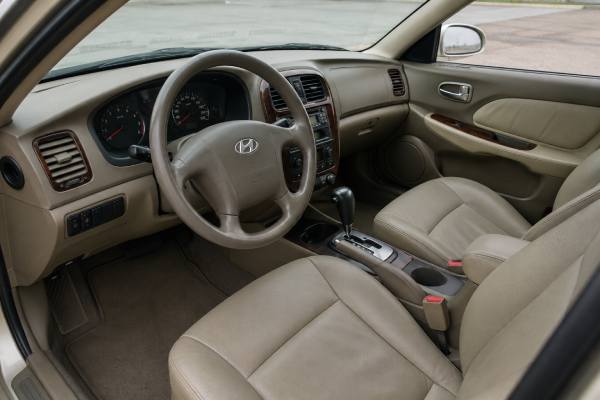
The facelifted Hyundai Sonata EF with the Sirius II 2.4-liter four-cylinder engine is a straightforward midsize sedan from the early 2000s: roomy, simple to service, comfortable on the highway, and usually cheaper to buy than comparable Toyota Camry, Honda Accord, or Nissan Altima models of the same age. The 2002–2003 facelift brought updated styling, a revised interior, improved equipment, and a more mature chassis tune while keeping the basic EF platform and front-wheel-drive layout.
This guide focuses on the 2.4-liter Sirius II version commonly listed at 149 hp, with notes where U.S. 2003 listings show the later corrected 138 hp rating. It covers the practical details that matter when maintaining or buying one today: specifications, trims, safety, common failures, service intervals, road manners, and how it compares with period rivals.
Quick Overview
- Comfortable ride, generous cabin space, and simple naturally aspirated four-cylinder ownership make the Sonata EF easy to live with.
- The Sirius II 2.4 uses a timing belt, not a chain, and belt history is one of the first things to verify.
- Rust inspection is critical, especially the front subframe, brake lines, suspension mounts, and lower body seams in salt-belt climates.
- Typical timing belt service is every 60,000 miles / 96,000 km or 48 months.
- EPA-rated 2003 2.4 fuel economy is about 22–23 mpg US combined, depending on transmission.
Table of Contents
- Hyundai Sonata EF 2002–2003 Profile
- Hyundai Sonata EF 2.4 Specs
- Hyundai Sonata EF Trims and Safety
- Reliability, Issues and Recalls
- Maintenance and Buying Advice
- Driving Feel and Efficiency
- Sonata EF Against Rivals
Hyundai Sonata EF 2002–2003 Profile
The 2002–2003 Hyundai Sonata EF facelift, often called the EF-B in some markets, was Hyundai’s value-focused midsize sedan during a period when the brand was working hard to improve perceived quality, warranty coverage, safety equipment, and refinement. The facelift changed more than the nose and tail. It brought new front and rear sheet metal, a revised dashboard, updated door panels, improved trunk hardware, and suspension changes intended to make the car feel more settled than the earlier 1999–2001 EF.
The 2.4-liter Sirius II engine is the simpler choice in the range. It is a naturally aspirated inline-four with dual overhead camshafts, four valves per cylinder, hydraulic lash adjusters, a toothed timing belt, and balance shafts. It does not have direct injection, turbocharging, variable lift, complex emissions hardware, or a modern multi-speed transmission. That simplicity is one of its main advantages now. A well-serviced example can still be a practical low-cost commuter, but neglect can quickly make a cheap Sonata expensive.
The covered engine is commonly quoted at 149 hp at 5,500 rpm and 156 lb-ft at 3,000 rpm. Some U.S. 2003 references list the same basic 2.4 engine at 138 hp and 147 lb-ft after Hyundai’s early-2000s horsepower rating correction. For buying and maintenance, this difference matters less than condition: compression, timing belt history, oil leaks, cooling system health, and automatic transmission behavior are far more important than the printed horsepower figure.
The facelift Sonata’s core strengths are comfort, equipment, and price. It has a soft ride, a reasonably quiet cabin for its era, simple controls, and enough interior room for four adults. The trunk is useful, the rear seat folds, and the driving position is easy to adapt to. Compared with many European sedans of the period, it is less sharp and less premium-feeling. Compared with Japanese rivals, it usually feels softer, less refined in detail, and less valuable on the used market, but it can be much cheaper to buy.
The biggest ownership question is not whether the car was good value when new. It is whether a specific example has survived two decades of age, weather, and maintenance habits. A clean, dry-climate Sonata EF with documented timing belt services, fresh fluids, good tires, and no subframe corrosion can be an honest budget car. A neglected one with rusty structure, old belts, slipping shifts, and cooling leaks is best avoided unless it is nearly free and intended as a project.
Hyundai Sonata EF 2.4 Specs
The Sonata EF 2.4 is a conventional front-wheel-drive sedan with a transverse engine, manual or four-speed automatic transmission, independent suspension, and hydraulic power steering. Market equipment varies, so use the tables below as a practical reference for the 2002–2003 facelift 2.4-liter version, then verify VIN-specific data before ordering parts.
Powertrain and Efficiency
| Item | Specification |
|---|---|
| Engine code | Sirius II 2.4, commonly G4JS family |
| Layout | Transverse inline-4, 4 cylinders, DOHC, 4 valves per cylinder |
| Bore × stroke | 86.5 × 100.0 mm / 3.41 × 3.94 in |
| Displacement | 2.4 L / 2,351 cc |
| Induction | Naturally aspirated |
| Fuel system | Multi-point fuel injection |
| Compression ratio | 10.0:1 |
| Max power | 149 hp / 111 kW @ 5,500 rpm; some U.S. 2003 listings show 138 hp / 103 kW |
| Max torque | 156 lb-ft / 211 Nm @ 3,000 rpm; some U.S. 2003 listings show 147 lb-ft / 199 Nm |
| Timing drive | Timing belt with related balance-shaft belt components |
| Rated efficiency | About 10.7–10.2 L/100 km combined / 22–23 mpg US / 26–28 mpg UK, transmission dependent |
| Real-world highway at 120 km/h / 75 mph | Typically about 8.5–9.5 L/100 km / 25–28 mpg US / 30–34 mpg UK when healthy |
Transmission, Chassis and Dimensions
| Item | Specification |
|---|---|
| Transmission | 5-speed manual; optional 4-speed electronically controlled automatic with Shiftronic in many markets |
| Automatic family | F4A42-family unit; confirm by VIN/build plate |
| Drive type | Front-wheel drive |
| Differential | Open front differential |
| Suspension | Front double-wishbone; rear independent multi-link |
| Steering | Hydraulic power-assisted rack and pinion; ratio varies by rack specification |
| Brakes | Front vented discs, commonly about 257–280 mm / 10.1–11.0 in; rear drums on many 2.4 base cars or solid rear discs on higher/optional brake packages |
| Common tyre sizes | P205/65R15; P205/60R16 on some trims/options |
| Ground clearance | About 160–170 mm / 6.3–6.7 in, market dependent |
| Length / width / height | 4,747 / 1,821 / 1,422 mm; 186.9 / 71.7 / 56.0 in |
| Wheelbase | 2,700 mm / 106.3 in |
| Turning circle | About 10.5–10.8 m / 34.4–35.4 ft |
| Curb weight | About 1,410–1,460 kg / 3,110–3,220 lb, depending on transmission and equipment |
| GVWR | About 2,020 kg / 4,453 lb in markets where published |
| Fuel tank | 65 L / 17.2 US gal / 14.3 UK gal |
| Cargo volume | About 399 L / 14.1 ft³, seats up; sedan trunk measurement |
Performance, Capability and Fluids
| Item | Specification |
|---|---|
| 0–100 km/h / 0–62 mph | Typically about 10.0–11.0 seconds, depending on transmission, condition, tyres, and rating method |
| Top speed | About 190–200 km/h / 118–124 mph where gearing and market calibration allow |
| 100–0 km/h braking | Not consistently published; expect roughly 43–47 m / 141–154 ft with good tyres and healthy brakes |
| Towing capacity | Market dependent; up to about 907 kg / 2,000 lb braked where rated, lower or not recommended in some manuals |
| Payload | About 500–600 kg / 1,100–1,320 lb, depending on curb weight and GVWR |
| Engine oil | API SH/SG or later suitable grade; commonly 5W-30, 10W-30, 10W-40 depending on climate; about 4.3 L / 4.5 US qt with filter |
| Coolant | Ethylene-glycol coolant suitable for aluminum components, typically 50/50 mix; about 7.3 L / 7.7 US qt for many 2.4 applications |
| Automatic transmission fluid | Hyundai/Kia ATF SP-III specification; total about 7.8 L / 8.2 US qt, drain-and-fill usually less |
| Manual transmission oil | API GL-4 75W-90; about 2.1 L / 4.4 US pt on many 5-speed units |
| A/C refrigerant | R-134a; commonly about 680–700 g / 24–25 oz, confirm under-hood label |
| A/C compressor oil | PAG46 / FD46XG-type, about 150 mL / 5.1 fl oz, confirm compressor label |
| Key torque values | Wheel nuts about 88–108 Nm / 65–80 lb-ft; oil drain plug about 39 Nm / 29 lb-ft; always verify service manual data |
Hyundai Sonata EF Trims and Safety
The 2.4-liter Sonata was usually the base or value-oriented engine, while the 2.7-liter Delta V6 was common in GLS and LX trims. Exact trim names vary by country, but the North American structure is a useful baseline: base Sonata with the 2.4 four-cylinder, GLS with more equipment and often the V6, and LX as the higher-content model.
On many 2002–2003 cars, the base 2.4 included air conditioning, cruise control, power windows, power locks, power mirrors, keyless entry, an alarm, a CD stereo, split-folding rear seatbacks, and 15-inch wheels. Higher trims brought 16-inch alloy wheels, more audio equipment, cabin air filtration, leather upholstery, power driver’s seat, automatic climate control, power moonroof availability, and four-wheel disc brakes.
Mechanical differences matter more than badges. The most important things to identify are transmission, brake package, wheel size, ABS/traction-control equipment, and whether the car has rear discs or rear drums. On a used Sonata EF, the badge alone may not tell the full story because options, market packages, and previous owner modifications can blur trim boundaries.
Quick Identifiers
Useful ways to identify the exact configuration include:
- Engine bay label and VIN decoding: confirms engine family, emissions market, and build period.
- Wheel and brake package: 15-inch steel wheels usually point to a lower trim; 16-inch alloys often suggest GLS/LX equipment or an option package.
- Interior features: leather, power driver’s seat, automatic climate control, and upgraded audio usually indicate a higher-content trim.
- ABS/TCS indicators: cars with ABS and traction control should show warning lamps at key-on, then extinguish after self-check.
- Rear brake hardware: rear drums versus rear discs affect parts ordering and braking feel.
Safety Ratings and Equipment
For this generation, safety ratings should be read in period context. The 2003 Sonata was not tested under modern small-overlap, updated side-impact, pedestrian, or active-safety scoring systems. It also does not have today’s automatic emergency braking, adaptive cruise control, lane keeping, blind-spot monitoring, rear cross-traffic alert, or traffic-sign recognition.
IIHS ratings for the 1999–2005 Sonata show an Acceptable result in the original moderate-overlap front test, but a Poor side-impact result in the original side test and Poor head-restraint/seat performance. That does not mean the car was unusual for its era, but it does mean buyers should not expect modern midsize-sedan crash protection.
Standard and available safety features included:
- Dual front airbags.
- Front seat-mounted side airbags on many facelift cars.
- Front seatbelt pretensioners and load limiters.
- LATCH child-seat anchors introduced for 2002 models.
- Child-protection rear door locks.
- ABS optional on many versions.
- Traction control paired with ABS on some trims.
There are no ADAS calibration issues after windshield or bumper work because this car predates camera- and radar-based driver assistance. However, ABS wheel-speed sensors, steering components, brake hydraulics, and airbag warning lights still require proper diagnosis after collision repair or suspension work.
Reliability, Issues and Recalls
The Sonata EF 2.4 can be durable, but age is now the dominant factor. Rubber, seals, belts, bushings, sensors, wiring connectors, brake lines, and cooling parts often matter more than the engine’s basic design. The best cars are not necessarily the lowest-mile examples; they are the ones with consistent service history and minimal corrosion.
| Issue | Prevalence | Severity | Typical Signs | Best Remedy |
|---|---|---|---|---|
| Timing belt overdue | Common | High | No records, belt noise, unknown mileage | Replace belt, tensioner, idlers, balance-shaft belt, and usually water pump |
| Front subframe corrosion | Common in salt climates | High | Steering pull, clunks, alignment changes, visible perforation | Inspect carefully; verify recall/campaign completion; replace unsafe structure |
| Oil leaks | Common | Low to medium | Burning oil smell, wet valve cover, cam/crank seal seepage | Replace gaskets and seals; check PCV system |
| Cooling system aging | Common | Medium to high | Overheating, coolant odor, plastic tank cracks, water pump seepage | Replace radiator, hoses, thermostat, cap, and pump as needed |
| Automatic shift flare or harsh shifts | Occasional | Medium | Delayed engagement, flare on 2–3 shift, dirty ATF | Service with correct SP-III fluid; diagnose solenoids and speed sensors |
| Ignition misfires | Occasional | Medium | Check-engine light, rough idle, catalyst overheating if ignored | Replace plugs, wires/coils as needed; repair oil intrusion |
| Suspension wear | Common with age | Medium | Clunks, wandering, uneven tyre wear | Inspect control arms, ball joints, bushings, struts, and wheel bearings |
| Interior chrome handle peeling | Known recall item | Low to medium | Sharp peeling chrome on inside door handle | Replace affected handle; verify recall completion |
Timing Belt and Engine Concerns
The Sirius II 2.4’s timing belt is the single most important service item. If the belt breaks or jumps, engine damage is possible. A proper belt job should include the timing belt, balance-shaft belt, tensioner, idlers, front seals if leaking, accessory belts, and usually the water pump. A receipt that says only “belt replaced” is less reassuring than an invoice listing the full kit.
Oil leaks are common after many years. Valve cover gaskets, cam seals, crank seals, balance-shaft seals, oil pan sealing, and the PCV system should all be checked. A small seep is not unusual, but oil contamination on the timing belt area is a reason to repair immediately.
Cooling system weakness is also age-related. The radiator, cap, thermostat, hoses, heater hoses, coolant reservoir, and water pump should be treated as consumables on an old example. Any overheating history is a warning sign because aluminum cylinder heads dislike repeated heat cycles.
Driveline, Chassis and Corrosion
The four-speed automatic is not a modern gearbox, but it can be acceptable if serviced with the correct Hyundai/Kia SP-III fluid. Avoid cars that slam into gear, flare badly between shifts, shudder under light throttle, or show burnt fluid. Speed sensors and solenoids can cause symptoms, but a worn transmission can exceed the value of the car.
Manual cars are simpler but should be checked for clutch slip, noisy bearings, worn synchros, and gear oil leaks. A vague shift feel may come from worn linkage bushings rather than internal failure.
Corrosion deserves more attention than almost anything else. Inspect the front subframe, lower control-arm mounting points, rocker panels, rear suspension mounts, brake and fuel lines, floor edges, trunk floor, jacking points, and wheel arches. In salt-belt areas, front subframe corrosion was serious enough to be covered by recall action on affected vehicles. A clean body on top does not guarantee safe structure underneath.
Known recall themes for this era include front subframe corrosion in certain salt-belt vehicles, interior chrome door handle peeling that could create sharp edges, and fuel tank assembly valve concerns on some 2002–2003 production ranges. Always check the VIN through an official recall database and ask for dealer completion records, because age, region, import history, and registration location can affect campaign coverage.
Maintenance and Buying Advice
A Sonata EF 2.4 is at its best when maintained preventively rather than reactively. Because purchase prices are usually low, some owners defer work until something fails. That is exactly what a buyer should avoid. A cheap old sedan with a fresh timing belt, clean fluids, solid structure, and good tires is better than a shiny one with unknown service history.
| Service Item | Typical Interval | Notes |
|---|---|---|
| Engine oil and filter | 7,500 miles / 12,000 km or 6 months normal; 3,000 miles / 4,800 km or 3 months severe | Use climate-appropriate viscosity; check level between services |
| Timing belt system | 60,000 miles / 96,000 km or 48 months | Include balance-shaft belt, tensioners, idlers, and inspect water pump |
| Spark plugs | 60,000 miles / 96,000 km or 48 months | Replace earlier if misfiring or oil-contaminated |
| Engine air filter | Inspect about every 15,000 miles / 24,000 km; replace as needed | Dusty conditions shorten the interval |
| Cabin air filter | Every 12–24 months | More often in dusty or pollen-heavy areas |
| Coolant | About every 2–3 years after initial service | Use correct ethylene-glycol mix; bleed air carefully |
| Automatic transmission fluid | 30,000–60,000 miles / 48,000–96,000 km depending on use | Use SP-III specification; avoid universal fluid unless explicitly compatible |
| Manual transmission oil | 60,000 miles / 96,000 km or when shifting quality declines | Use GL-4 75W-90; avoid incompatible GL-5 if synchronizer compatibility is uncertain |
| Brake fluid | Every 2 years | Flush if dark, moisture-contaminated, or after hydraulic work |
| Tyre rotation and pressure | Every 7,500 miles / 12,000 km | Factory cold pressure is commonly 30 psi / 207 kPa for standard tyres |
| Alignment check | Annually or after suspension work | Essential if tyres show uneven wear or the car pulls |
| 12 V battery | Test yearly after 3 years; replace typically at 4–6 years | Weak batteries can create false electrical symptoms |
Buyer’s Inspection Checklist
Before buying, check the car cold, warmed up, and on a proper road test. Start with paperwork: timing belt invoices, oil change history, coolant and ATF service records, recall completion, and any rust repair documentation. Missing records are not an automatic rejection, but they reduce the car’s value and increase immediate service needs.
Inspect these areas closely:
- Front subframe, lower control-arm mounts, brake lines, fuel lines, rockers, jacking points, rear wheel arches, and trunk floor for rust.
- Timing belt cover area for oil leaks, belt noise, and missing service stickers.
- Radiator tanks, coolant hoses, thermostat housing, water pump area, and heater performance.
- Automatic transmission engagement from Park to Drive and Reverse, hot shifting, kickdown, and fluid color.
- Suspension clunks over small bumps and wandering on straight roads.
- Airbag, ABS, check-engine, and charging lights at key-on and after startup.
- A/C cooling, blower operation, power windows, central locking, and instrument lighting.
- Tyre date codes, mismatched tyres, uneven wear, and brake pedal pulsation.
The best version to buy is usually the cleanest, least rusty, best-documented car rather than a specific trim. A 2.4 with manual transmission can be appealing for simplicity, but many markets have more automatics. Higher trims offer nicer equipment, yet they also add more age-sensitive features. For a daily driver, prioritize structure, maintenance, and working safety equipment over leather, sunroof, or audio upgrades.
Long-term durability is fair to good when the timing belt, fluids, cooling system, and rust prevention are handled. The engine itself is not the usual reason these cars leave the road. Corrosion, neglected transmissions, overheating, and deferred maintenance are the larger threats.
Driving Feel and Efficiency
The Sonata EF 2.4 drives like a comfort-biased early-2000s midsize sedan. It is not sporty, but it is relaxed and easy. The steering is hydraulic and reasonably predictable, though not especially communicative. The suspension favors compliance over body control, so the car is comfortable on ordinary roads but can feel soft when pushed hard or loaded heavily.
At city speeds, the 2.4 has enough low- and mid-range torque for normal traffic. It is not quick by modern standards, but the engine’s 3,000 rpm torque peak makes it more flexible than smaller four-cylinder sedans of the same era. Throttle response is straightforward because there is no turbocharger and no complex drive-mode tuning. The engine becomes louder when revved, but it is generally smooth enough when maintained.
The automatic transmission suits gentle driving. It shifts smoothly when healthy, but it has only four ratios, so it may downshift noticeably on hills or during passing. The manual mode can help hold a gear, but it does not make the car sporty. A 5-speed manual version feels more direct and can make better use of the engine, although clutch and linkage condition are now more important than the original specification.
Ride, Handling and Braking
Straight-line stability is good for a car of this age if the suspension and tyres are fresh. Worn struts, tired rear links, soft bushings, and old tyres can make the car feel floaty or imprecise. The rear multi-link suspension helps ride quality, but it has several wear points that should not be ignored.
Cornering balance is safe and understeer-led. The car resists sudden direction changes more than sharper rivals such as the Mazda6, but it is predictable. Braking performance depends heavily on whether the car has rear drums or rear discs, ABS condition, tyre quality, and brake fluid age. A firm, straight stop is expected; vibration, pulling, or a sinking pedal needs repair.
Fuel Economy in Real Use
For a healthy 2.4, expect roughly:
- City: 11.5–13.5 L/100 km / 17–20 mpg US / 20–24 mpg UK.
- Highway at 100–110 km/h: 7.8–8.8 L/100 km / 27–30 mpg US / 32–36 mpg UK.
- Highway at 120 km/h / 75 mph: about 8.5–9.5 L/100 km / 25–28 mpg US / 30–34 mpg UK.
- Mixed driving: 9.8–10.8 L/100 km / 22–24 mpg US / 26–29 mpg UK.
Cold weather, short trips, dragging brakes, old oxygen sensors, low tyre pressure, and neglected ignition parts can all reduce economy. The 2.4 is not unusually thirsty for its period, but a modern midsize sedan will be much more efficient.
For towing or full-load use, the 2.4 can manage light utility work where legally rated, but it is not the ideal choice for regular towing. Heat management, brake condition, tyre load rating, and transmission fluid condition become critical. Expect a fuel-use penalty of 20–40 percent under moderate load or trailer use.
Sonata EF Against Rivals
The Sonata EF’s strongest argument is value. It usually costs less than the Toyota Camry and Honda Accord, while offering a roomy cabin, decent comfort, and simple servicing. It does not match the best rivals for resale value, chassis polish, interior finish, or long-term reputation, but a well-kept Sonata can still be a sensible budget choice.
| Model | Main Advantage | Main Trade-Off | Best For |
|---|---|---|---|
| Hyundai Sonata EF 2.4 | Low purchase price, comfort, simple engine | Rust risk, softer dynamics, weaker resale | Budget commuting with careful inspection |
| Toyota Camry 2.4 | Excellent durability and parts support | Higher used prices, often high mileage | Low-drama ownership |
| Honda Accord 2.4 | Sharper drive, strong engine, better interior feel | Costs more; automatic transmission history needs attention on some years | Drivers who value refinement and handling |
| Nissan Altima 2.5 | Stronger performance and roomy cabin | More engine and catalyst concerns on some examples | Buyers wanting more pace |
| Mazda6 2.3 | Best handling feel among many rivals | Rust concerns and firmer ride | Drivers who prefer sharper steering |
| Kia Optima/Magentis | Closely related platform and similar value | Same basic age and corrosion concerns | Similar budget choice with different styling |
A good Camry or Accord is usually the safer long-term bet, but it may cost significantly more. The Sonata makes sense when it is substantially cheaper and demonstrably well maintained. It is less attractive when priced close to cleaner Japanese rivals, especially if timing belt history or rust condition is uncertain.
The final buying rule is simple: buy the example, not the badge. A documented Sonata EF 2.4 from a dry region can be a better purchase than a neglected Camry with hidden rust or a tired transmission. But if the Sonata has structural corrosion, overheating history, old belts, or harsh automatic shifts, walk away. The low entry price only works when the car does not need a full mechanical reset immediately after purchase.
References
- 2002 HYUNDAI SONATA OFFERS PERFORMANCE, STYLE AND VALUE 2002 (Manufacturer Publication)
- HYUNDAI 2003 SONATA OWNER’S MANUAL Pdf Download | ManualsLib 2003 (Owner’s Manual) ([ManualsLib][1])
- Gas Mileage of 2003 Hyundai Sonata 2003 (Fuel Economy) ([Fuel Economy][2])
- 2003 Hyundai Sonata 2003 (Safety Rating) ([IIHS][3])
- Check for Recalls: Vehicle, Car Seat, Tire, Equipment | NHTSA 2026 (Recall Database) ([NHTSA][4])
Disclaimer
This article is for informational purposes only and is not a substitute for professional diagnosis, repair, inspection, or official service information. Specifications, torque values, service intervals, fluids, procedures, recall applicability, and equipment can vary by VIN, market, production date, and trim. Always verify details against the official owner’s manual, service manual, under-hood labels, parts catalog, and qualified technician guidance for the specific vehicle.
If this guide helped you, please consider sharing it on Facebook, X/Twitter, or your preferred automotive community to support our work.