
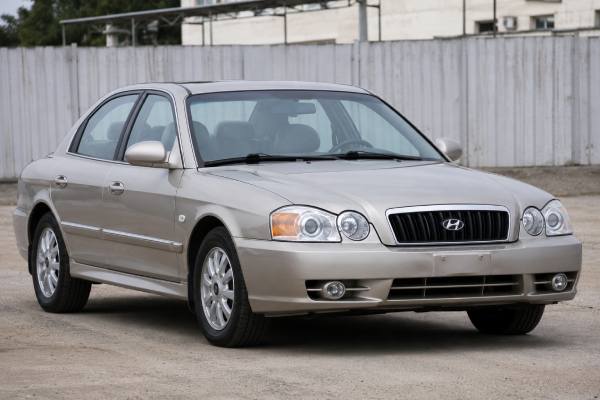
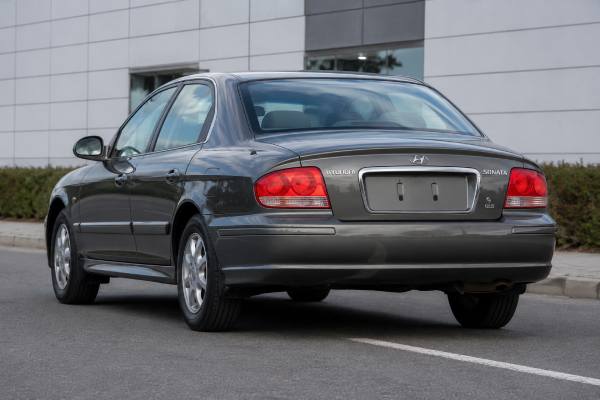
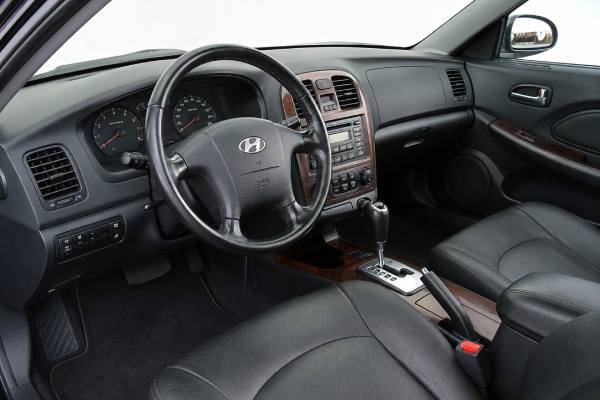
The facelift Hyundai Sonata EF with the Delta 2.7-liter V6 is a practical, comfort-focused midsize sedan from the last years of Hyundai’s fourth-generation Sonata. In 2004–2005 form, it offered a simple naturally aspirated V6, front-wheel drive, a roomy cabin, and a value-led equipment list that often undercut Japanese rivals of the same period.
This guide focuses on the 170 hp 2.7 V6 version, especially the late EF facelift sold in 2004 and 2005. Equipment, safety features, emissions details, and service parts can vary by market, but the core ownership picture is clear: this is an affordable older sedan that can still be dependable when rust is controlled, the timing belt has been replaced on schedule, and the automatic transmission has received the correct fluid.
Quick Specs and Notes
- Smooth, simple 2.7L naturally aspirated V6 with multi-port fuel injection and no turbocharger or direct injection.
- Comfortable ride, roomy cabin, and useful standard equipment on GLS and LX trims.
- Timing-belt history is critical; missing proof should be treated as an immediate maintenance cost.
- Salt-climate rust inspection matters, especially around the front subframe, lower structure, brake lines, and suspension mounts.
- Typical oil service is about 7,500 miles / 12,000 km in normal use, or 3,000 miles / 4,800 km in severe service.
Table of Contents
- Hyundai Sonata EF late-facelift guide
- Hyundai Sonata EF V6 specifications
- Hyundai Sonata EF trims and safety
- Reliability issues and service actions
- Maintenance schedule and buying advice
- Driving feel and real-world performance
- How the Sonata EF compares
Hyundai Sonata EF late-facelift guide
The Hyundai Sonata EF facelift belongs to the period when Hyundai was moving from budget-brand perception toward more competitive mainstream family cars. The EF Sonata was not the sharpest midsize sedan in its class, and it was not the most refined at high speed, but it delivered a lot of space, comfort, and equipment for the money. The 2004–2005 facelift cars are the most mature versions of this generation.
The 2.7-liter Delta V6 is the most desirable engine for buyers who want relaxed acceleration and smoother highway performance than the four-cylinder models. It is an all-aluminum, DOHC, 24-valve V6 with multi-port fuel injection. In this Sonata application, it produces 170 hp at 6,000 rpm and 181 lb-ft of torque at 4,000 rpm. That output is modest by modern standards, but it suits the car’s calm character.
Most V6 examples are paired with Hyundai’s 4-speed automatic transmission with Shiftronic manual selection. This transmission is not especially quick or modern, but it is simple and generally durable when serviced with the correct SP-III fluid. At this age, the quality of maintenance matters far more than brochure performance.
The Sonata EF is best understood as a used comfort sedan rather than a sport sedan. Its double-wishbone front suspension and multi-link rear suspension give it a composed ride, and the cabin is large enough for family use. The car’s strengths are simple mechanicals, low purchase prices, affordable parts, and a relaxed driving experience.
Its weaknesses are typical of older midsize sedans from the early 2000s: rust in harsh climates, aging rubber components, tired suspension bushings, oil leaks, cooling-system wear, and neglected timing belts. Safety is also period-correct rather than modern. Front airbags and front seat-mounted side airbags were important equipment for the time, but there is no modern driver-assistance suite such as automatic emergency braking, adaptive cruise control, lane keeping, or blind-spot monitoring.
For a buyer today, the best Sonata EF V6 is not necessarily the lowest-mileage example. A clean, rust-free car with documented timing-belt service, smooth automatic shifts, no overheating history, and working safety systems is far more attractive than a neglected car with cosmetic shine. Because market values are low, one major repair can exceed the value of the vehicle.
The 2004–2005 Sonata EF V6 makes the most sense for someone who wants cheap, comfortable transportation and is willing to inspect carefully before buying. It is not the best choice for someone expecting modern crash protection, cutting-edge fuel economy, or sporty handling. It can, however, be a sensible older used car when bought cheaply and maintained realistically.
Hyundai Sonata EF V6 specifications
The following specifications focus on the 2004–2005 Hyundai Sonata EF facelift with the Delta 2.7 V6. Figures are mainly representative of U.S.-market GLS/LX automatic models, with notes where equipment or values may vary by market.
Powertrain and efficiency
| Item | Hyundai Sonata EF 2.7 V6 data |
|---|---|
| Engine code / family | Hyundai Delta 2.7 V6 |
| Engine layout | Naturally aspirated V6, aluminum alloy block and heads |
| Valvetrain | DOHC, 24 valves, 4 valves per cylinder |
| Bore × stroke | 86.7 × 75.0 mm / 3.41 × 2.95 in |
| Displacement | 2.7 L / 2,656 cc |
| Induction | Naturally aspirated |
| Fuel system | Multi-port programmed fuel injection |
| Compression ratio | 10.0:1 |
| Max power | 170 hp / 127 kW at 6,000 rpm |
| Max torque | 245 Nm / 181 lb-ft at 4,000 rpm |
| Timing drive | Timing belt |
| Official fuel economy | About 12.4 L/100 km city and 8.7 L/100 km highway / 19 city and 27 highway mpg US / 22.8 city and 32.4 highway mpg UK |
| Real-world highway at 120 km/h / 75 mph | Typically about 9.0–10.5 L/100 km / 22–26 mpg US / 27–31 mpg UK, depending on condition, tyres, load, and weather |
The V6 is simple by modern standards. It does not have direct injection, forced induction, cylinder deactivation, a hybrid system, or a particulate filter. That simplicity helps long-term serviceability, but it also means fuel economy is only average for a midsize V6 sedan of this era.
Transmission, driveline, and chassis
| Item | Specification |
|---|---|
| Transmission | 4-speed automatic with Shiftronic manual mode; F4A42-2 family on many V6 automatic models |
| Gear ratios | 1st 2.842, 2nd 1.529, 3rd 1.000, 4th 0.712, reverse 2.480 |
| Final drive | 3.770:1 on common V6 automatic specification |
| Drive type | Front-wheel drive |
| Differential | Open front differential |
| Front suspension | Double wishbone with stabilizer bar |
| Rear suspension | Multi-link with stabilizer bar |
| Steering | Power-assisted rack and pinion; exact ratio is not consistently listed in open U.S. brochure data |
| Front brakes | Ventilated discs, about 280 mm / 11.0 in |
| Rear brakes | Discs, about 262 mm / 10.3 in |
| Common wheel and tyre size | 16-inch alloy wheels with P205/60HR16 tyres on GLS/LX |
| Base wheel and tyre size | 15-inch wheels with P205/65R15 tyres on lower trims in some markets |
| Turning circle | 10.5 m / 34.4 ft, kerb-to-kerb |
The car uses conventional front-wheel drive. There is no AWD version, no limited-slip differential, and no off-road hardware. The chassis is tuned more for ride comfort than fast response, which fits the Sonata’s family-sedan role.
Dimensions and capacities
| Item | Specification |
|---|---|
| Body style | 4-door, 5-passenger sedan |
| Length | 4,747 mm / 186.9 in |
| Width | 1,821 mm / 71.7 in |
| Height | 1,422 mm / 56.0 in |
| Wheelbase | 2,700 mm / 106.3 in |
| Front / rear track | 1,539 / 1,529 mm approx. / 60.6 / 60.2 in |
| Curb weight | About 1,457–1,476 kg / 3,212–3,254 lb, depending on trim |
| Fuel tank | 65 L / 17.2 US gal / 14.3 UK gal |
| Cargo volume | About 399 L / 14.1 ft³, seats up |
| Seating | 5 passengers |
| Ground clearance | Not consistently published in open U.S. brochure data |
| GVWR and payload | Vary by market and certification label; verify on the door-jamb plate |
The EF Sonata is a true midsize sedan for its era. The trunk is useful, the rear seat is adult-friendly, and the cabin feels more spacious than the car’s low used prices may suggest.
Performance and capability
| Item | Typical figure |
|---|---|
| 0–100 km/h / 0–62 mph | Roughly mid-9-second range for the 2.7 V6 automatic, condition dependent |
| 0–60 mph | Around high-8 to low-9-second range in typical published estimates |
| Top speed | Around 205–212 km/h / 127–132 mph, market and gearing dependent |
| 100–0 km/h braking distance | Not consistently published for the exact 2004–2005 EF V6 in open manufacturer data |
| Towing capacity | Market dependent; verify the local owner’s manual and tow-label information |
| Payload | Market dependent; verify the certification label |
Performance is adequate rather than quick. The V6’s main advantage is smoothness and passing flexibility, not outright speed.
Fluids and service capacities
| System | Specification / capacity |
|---|---|
| Engine oil | Climate-dependent viscosity; common compatible grades include 5W-30 or 10W-30 depending on temperature and specification. Capacity about 4.5 L / 4.76 US qt with filter |
| Coolant | Aluminum-safe ethylene-glycol coolant, typically mixed 50/50 with distilled water. Capacity about 8.6 L / 9.1 US qt |
| Automatic transmission fluid | Diamond ATF SP-III / Hyundai-Kia SP-III equivalent. Total capacity about 7.8 L / 8.2 US qt |
| Brake fluid | DOT 3 or DOT 4 |
| Power steering fluid | About 1.1 L / 1.05 US qt, specification varies by market |
| A/C refrigerant | R-134a, about 600 g / 21.2 oz on many specifications |
| A/C compressor oil | PAG-type oil, commonly FD46XG; about 150 mL / 5.1 fl oz |
| Wheel nut torque | 90–110 Nm / 66–81 lb-ft |
| Engine oil drain plug torque | About 39 Nm / 29 lb-ft; verify by service manual for the exact pan and plug |
For a car this old, the correct fluid is often more important than the brand. The automatic transmission in particular should not be filled with a random universal fluid unless that product clearly meets the SP-III requirement.
Hyundai Sonata EF trims and safety
The late EF Sonata V6 was commonly sold in GL, GLS, and LX-style trim structures, though exact names and equipment varied by country. In the U.S. market, the GLS and LX were the main V6-focused versions, with the V6 also available in some lower-trim configurations.
Trims and option differences
The GL was the value trim. Depending on market and year, it could be found with the four-cylinder engine or optional V6. It usually had simpler wheel and interior equipment than GLS or LX models. A V6 GL can be a good buy if it is clean and well-maintained, but it may lack features buyers expect, such as alloy wheels, ABS, traction control, or higher-grade interior trim.
The GLS is often the practical sweet spot. It commonly included the 2.7 V6, 4-speed automatic with Shiftronic, 16-inch alloy wheels, upgraded tyres, air conditioning, power accessories, and a stronger equipment package than the base car. For most used buyers, a clean GLS with maintenance records is the best balance of price, equipment, and simplicity.
The LX was the higher-trim version. Typical equipment included leather seating, a power driver’s seat, automatic climate control, a more upscale interior finish, and additional convenience features. LX models are pleasant when everything works, but extra age-related failures can include power-seat motors, climate-control faults, worn leather, and sunroof or electrical issues where fitted.
Quick identifiers include V6 badging, 16-inch alloy wheels, Shiftronic automatic gear selector markings, leather trim on LX models, and the equipment sticker or VIN/build information. Because older cars are often modified, repaired, or rebadged, it is wise to confirm the engine, trim, and option package from the VIN and original build data when available.
Safety ratings and structure
The EF Sonata’s safety performance must be judged by early-2000s standards. It is not comparable to a modern midsize sedan with advanced crash structures and active safety systems.
IIHS ratings for the 1999–2005 Sonata show an Acceptable rating in the moderate-overlap front test, a Poor rating in the original side-impact test, and a Poor rating for head restraints and seats. These results are important for shoppers because they show a clear difference between the Sonata’s basic frontal protection and its weaker side-impact and whiplash performance.
Euro NCAP data for this exact late EF V6 specification is not a useful primary comparison point in many markets, because the directly matching test record is not as readily applicable as the IIHS information for U.S.-market cars. NHTSA also used older test protocols during this period, so any old rating should not be compared directly with newer “overall vehicle score” results.
Safety systems and driver assistance
Standard and optional safety equipment varies by market and trim, but typical late EF Sonata equipment includes:
- Dual front airbags.
- Front seat-mounted side airbags on many U.S.-market late cars.
- Three-point seatbelts.
- Child-seat anchors and tether provisions.
- Four-wheel disc brakes.
- Optional ABS on some trims.
- Optional traction control when paired with ABS on some versions.
Modern ADAS is not part of this generation. There is no factory automatic emergency braking, adaptive cruise control, lane-keeping assistance, blind-spot monitoring, rear cross-traffic alert, traffic-sign recognition, or driver-monitoring system. Headlight performance was also not rated under modern IIHS headlight testing.
After crash repairs, steering work, suspension replacement, or windshield work, there are no modern ADAS calibration procedures to worry about. However, basic safety repairs still matter. Airbag warning lights, ABS faults, damaged seatbelt pretensioners, and incorrect steering-wheel clock-spring repairs should be treated seriously, not ignored because the car is inexpensive.
Reliability issues and service actions
The 2.7 V6 Sonata EF can be durable, but age now matters more than mileage alone. These cars are old enough that rubber, plastic, wiring, corrosion protection, and previous repair quality often decide whether a car is dependable or frustrating.
| Issue area | Prevalence | Severity / cost | Typical signs | Best remedy |
|---|---|---|---|---|
| Timing belt, tensioner, idlers, water pump | Common if history is unknown | High | No service proof, belt noise, coolant seepage, misfire after belt work | Replace full timing-belt kit, tensioner, idlers, and usually water pump |
| Valve-cover gasket leaks | Common | Low to medium | Burning oil smell, oil in plug wells, misfires | Replace valve-cover gaskets and inspect plugs, wires, and coils |
| Cooling-system aging | Common | Medium to high | Overheating, coolant smell, radiator seepage, weak heat | Pressure test, replace worn radiator, hoses, thermostat, water pump as needed |
| Automatic transmission neglect | Occasional | Medium to high | Delayed engagement, shift flare, harsh shifts, dark fluid | Diagnose, service with SP-III fluid, inspect mounts/solenoids/valve body |
| Front suspension wear | Common | Medium | Clunks, wandering, uneven tyre wear | Replace worn control arms, bushings, ball joints, tie rods, struts |
| Salt-climate corrosion | Common in harsh climates | High | Subframe rust, brake-line corrosion, rocker rust, suspension mount rust | Thorough underbody inspection; avoid severe structural rust |
| Sensors and electrical faults | Occasional | Low to medium | Check-engine light, stalling, rough idle, ABS/airbag lights | Scan diagnostics, repair root cause rather than replacing parts blindly |
Engine and timing-belt concerns
The Delta V6’s most important service item is the timing belt. A neglected belt can turn a low-priced car into an uneconomical repair. Even when the engine seems to run well, age alone can crack the belt or weaken tensioner components. If there is no dated receipt showing a complete timing-belt job, budget for it immediately.
A proper service should include the belt, hydraulic or mechanical tensioning components as applicable, idlers, cam and crank seals if leaking, and usually the water pump. Replacing only the belt is false economy on an older V6 because labor overlap is significant.
Oil leaks are also common with age. Valve-cover gaskets can leak onto the exhaust or into spark-plug wells. Rear-bank access is more involved, so many owners delay the repair until misfires appear. A burning smell after parking, visible seepage, or oil-soaked plug boots are good reasons to inspect.
Transmission and driveline behavior
The 4-speed automatic is not a performance gearbox, but it can last well when serviced correctly. The main warning signs are cold delayed engagement, a flare between gears, harsh downshifts, or shudder under light throttle. Bad engine or transmission mounts can make shifts feel worse than they are, so diagnosis should include mounts as well as fluid condition.
Use SP-III-compatible fluid. Incorrect universal fluid can cause shift quality problems. A car with black fluid, no service history, and harsh shifts is a risk unless it is cheap enough to justify possible transmission work.
Corrosion and recall awareness
Corrosion is one of the biggest threats to long-term ownership. Salt-belt cars should be inspected underneath on a lift. Pay close attention to the front subframe, lower control-arm mounting areas, brake and fuel lines, rocker panels, rear wheel arches, strut-tower areas, exhaust hangers, and rear suspension mounts.
Some earlier EF Sonata vehicles were covered by salt-belt front subframe corrosion recall actions. The affected range does not automatically include every 2004–2005 car, and recall eligibility depends on VIN, build date, market, and registration history. Do not rely on memory or online lists alone. Check the VIN through Hyundai and NHTSA, and ask for dealer completion records.
A separate stop-lamp switch recall affected some 2005 Sonata vehicles in certain markets. Symptoms can include brake lamps not working correctly, brake lamps staying on, cruise-control problems, or shift-interlock issues. Again, VIN verification is the only safe way to know whether a specific car is affected.
Pre-purchase records to request
Before buying, ask for:
- Timing-belt and water-pump service receipt with mileage and date.
- Automatic transmission fluid service records showing correct fluid.
- Coolant service history and any radiator, thermostat, or hose repairs.
- Recall and campaign completion records.
- Evidence of regular oil changes.
- Recent brake, tyre, suspension, and alignment work.
- A scan report showing no active airbag, ABS, or powertrain faults.
A clean history does not guarantee a perfect car, but it greatly reduces the chance that you are buying years of deferred maintenance.
Maintenance schedule and buying advice
A late Sonata EF V6 rewards basic maintenance. It does not need exotic parts, but it does need regular fluids, a correct timing-belt interval, and careful corrosion control. Because market values are low, the best approach is preventive maintenance on a good car rather than rescuing a neglected one.
Practical maintenance schedule
| Item | Practical interval | Notes |
|---|---|---|
| Engine oil and filter | 7,500 miles / 12,000 km normal; 3,000 miles / 4,800 km severe | Use correct viscosity for climate. Short trips, heat, dust, and city use justify shorter intervals |
| Engine air filter | 30,000 miles / 48,000 km, sooner in dust | A clogged filter can reduce performance and economy |
| Cabin air filter | Inspect annually or about every 12,000 miles / 20,000 km | Replace when airflow drops or odors appear |
| Spark plugs | About 60,000 miles / 96,000 km, or per local manual | Inspect wires/coils and valve-cover leaks at the same time |
| Timing belt | Replace around 60,000 miles / 96,000 km or by time interval | Replace idlers, tensioner, and usually water pump |
| Accessory belts and hoses | Inspect every 30,000 miles / 48,000 km | Replace cracked, glazed, swollen, or oil-soaked parts |
| Coolant | About 30,000 miles / 48,000 km or 2–3 years | Use aluminum-safe coolant mixed correctly |
| Automatic transmission fluid | Inspect 15,000 miles / 24,000 km; service about 30,000 miles / 48,000 km in severe use | Use SP-III-compatible fluid |
| Brake fluid | Every 2–3 years is sensible | Use DOT 3 or DOT 4; flush if dark or moisture-contaminated |
| Brake pads and rotors | Inspect every 15,000 miles / 24,000 km | Check caliper slide pins and parking-brake operation |
| Tyre rotation | 6,000–7,500 miles / 10,000–12,000 km | Combine with pressure check and tread inspection |
| Wheel alignment | Check annually or after suspension/tyre wear issues | Important for tyre life and straight-line stability |
| Fuel filter | Market dependent; verify service information | Replace if pressure or flow issues appear |
| 12V battery | Test yearly after 3 years; replace commonly at 4–6 years | Weak batteries can cause misleading electrical symptoms |
| A/C system | Inspect if cooling drops | Do not recharge without leak diagnosis |
Essential inspection checklist
A buyer should inspect the car cold, warm, parked, and during a road test. Start with the basics: oil level, coolant condition, ATF color, belt condition, and visible leaks. Then look underneath. Structural rust is a bigger problem than cosmetic rust because it can make repairs uneconomical.
Important checks include:
- Front subframe rust, especially around mounting and control-arm areas.
- Brake-line corrosion and dampness near fittings.
- Lower rocker panels, rear wheel arches, and trunk floor edges.
- Coolant stains around the radiator, water pump area, hoses, and thermostat housing.
- Oil leaks from valve covers, cam seals, crank seal, and oil pan.
- Smooth cold start without rattling, misfire, or excessive smoke.
- Stable idle with A/C on and steering turned.
- Automatic engagement into Drive and Reverse without a long delay.
- Smooth 1–2, 2–3, and 3–4 shifts at light and moderate throttle.
- No ABS, airbag, charging, or check-engine warning lights after startup.
- Even braking without steering pull or pedal pulsation.
- No clunks over bumps or wandering at highway speed.
Best versions to buy
A 2005 GLS or LX with a complete service history is usually the most attractive version. The GLS gives most of the useful V6 equipment without too much extra complexity. The LX is nicer inside, but only if the leather, climate control, power seat, and electrical equipment are still in good shape.
A 2004 model can also be a good car, but rust and recall verification deserve extra care. In salt-heavy regions, condition is more important than model year. A clean, southern or dry-climate 2004 may be a much better purchase than a rusty 2005 with lower mileage.
Avoid cars with no timing-belt proof, overheating history, structural corrosion, harsh transmission behavior, or persistent airbag/ABS lights. Also be careful with cars that have been cheaply repaired after front-end damage, because poor repairs can affect cooling, alignment, crash protection, and electrical reliability.
Durability outlook
With a sound body, regular oil changes, fresh coolant, correct ATF, and timely timing-belt service, the Sonata EF V6 can cover high mileage at modest cost. The main limit is economic rather than mechanical. At today’s values, a transmission rebuild, serious rust repair, or neglected timing-belt failure can exceed the car’s worth.
The smartest ownership strategy is simple: buy the cleanest body you can find, verify the big maintenance items, fix small leaks early, and avoid turning a cheap sedan into an expensive restoration project.
Driving feel and real-world performance
The Sonata EF V6 drives like a traditional early-2000s family sedan. It is comfortable, quiet enough at normal speeds, and easy to operate. It does not feel sporty, but it feels relaxed when in good condition.
Ride, handling, and steering
The ride is one of the Sonata’s better qualities. The suspension absorbs rough pavement well, especially on the common 16-inch wheel and 205/60 tyre package. Compared with firmer rivals, the Sonata feels softer and more relaxed over broken city roads.
Handling is predictable rather than sharp. In corners, the car leans more than a Mazda6 or Accord, and the front tyres give up first if pushed hard. Steering effort is light to moderate, which makes parking easy but limits road feel. On a good alignment with fresh suspension parts, straight-line stability is acceptable. On worn struts, tired bushings, or mismatched tyres, the car can wander and feel vague.
Brake feel is adequate when the system is healthy. Because these cars are old, braking performance depends heavily on rotor condition, caliper-slide lubrication, tyre quality, and brake-fluid age. A long pedal, pull under braking, or vibration from speed should be repaired before relying on the car for daily highway use.
Powertrain character
The Delta V6 is smooth and reasonably quiet. It does not deliver strong low-rpm punch like a larger V6, but it is more relaxed than the four-cylinder engine when merging or climbing grades. Peak torque arrives at 4,000 rpm, so the engine often needs a downshift for quick passing.
The 4-speed automatic is the main reason the car feels older than modern sedans. It has wider gear spacing than newer 5-, 6-, or 8-speed automatics, so the engine may rev noticeably during kickdown. The Shiftronic manual gate is useful for holding a gear on hills, but it does not transform the car into a sporty sedan.
A healthy example should shift smoothly, idle cleanly, and accelerate without hesitation. Rough idle, surging, delayed shifts, or hard engagement usually points to maintenance needs rather than normal character.
Fuel economy in real use
Official economy for the V6 automatic is about 19 mpg city and 27 mpg highway under older U.S. EPA-style figures. In metric terms, that is roughly 12.4 L/100 km city and 8.7 L/100 km highway.
In real driving, expect:
- City: about 12.5–15.0 L/100 km / 16–19 mpg US / 19–23 mpg UK.
- Mixed use: about 10.0–12.0 L/100 km / 20–24 mpg US / 24–28 mpg UK.
- Highway at 100–120 km/h: about 8.5–10.5 L/100 km / 22–28 mpg US / 27–34 mpg UK.
Cold weather, short trips, old oxygen sensors, dragging brakes, underinflated tyres, and poor alignment can all make fuel economy worse. The V6 is not unusually thirsty for its era, but it cannot match modern four-cylinder turbo or hybrid midsize sedans.
Load, passengers, and highway use
With passengers aboard, the V6 helps the Sonata feel less strained than a four-cylinder EF. The cabin remains reasonably comfortable, and the trunk is large enough for luggage. On long trips, the car’s soft ride and simple controls are strengths.
Towing is not the car’s main purpose. Some markets may list small tow ratings, but any towing should be guided by the local owner’s manual, hitch rating, cooling-system condition, brake condition, and legal limits. For an older V6 automatic, heat management and transmission condition are more important than theoretical pulling power.
How the Sonata EF compares
The 2004–2005 Hyundai Sonata EF V6 competes with used midsize sedans such as the Toyota Camry V6, Honda Accord V6, Nissan Altima 3.5, Mazda6 V6, and Kia Optima/Magentis. Its strongest argument is value, not class-leading performance.
| Rival | Where the Sonata EF V6 is stronger | Where the rival may be stronger |
|---|---|---|
| Toyota Camry V6 | Usually cheaper to buy; comfortable ride; simple equipment | Better resale, stronger reputation, smoother refinement |
| Honda Accord V6 | Lower purchase price; softer ride | More power, sharper handling, better overall polish |
| Nissan Altima 3.5 | More relaxed and less aggressive; often cheaper to insure/buy | Much quicker acceleration, stronger engine character |
| Mazda6 V6 | More comfort-focused ride | Better steering and handling, more engaging chassis |
| Kia Optima / Magentis | Similar mechanical simplicity; Hyundai may have stronger trim availability | Kia may be cheaper; condition matters more than badge |
The Camry is the safer conservative choice for many buyers, especially if resale value and parts availability are priorities. The Accord V6 is more rewarding to drive and more powerful, but some V6 automatic examples from that era require careful transmission inspection. The Altima 3.5 is much quicker, though it can feel rougher and more torque-steer prone. The Mazda6 is the driver’s choice but can suffer from rust and has a tighter cabin.
Against these cars, the Sonata EF V6 works best when it is significantly cheaper and better preserved. It is not worth paying Camry or Accord money for one unless the condition is exceptional. But as a low-cost family sedan with a smooth V6, working equipment, and documented maintenance, it can still make sense.
The final verdict is practical: buy on condition, not reputation. A rust-free Sonata EF V6 with timing-belt proof, clean fluids, good tyres, working safety systems, and smooth transmission behavior is a reasonable older used car. A rusty or neglected example is usually a false bargain, even at a very low price.
References
- 2005 HYUNDAI SONATA CONTINUES TO BE THE SMART BUY IN THE MID-SIZE SEGMENT 2004 (Manufacturer Specification Release) ([Hyundai News][1])
- Hyundai Sonata 2005 2005 (Sales Brochure) ([auto-brochures.com][2])
- 2005 Hyundai Sonata 2026 (Safety Rating) ([IIHS][3])
- Check for Recalls: Vehicle, Car Seat, Tire, Equipment | NHTSA 2026 (Recall Database) ([NHTSA][4])
- Hyundai – Recalls 2026 (VIN Recall Tool) ([autoservice.hyundaiusa.com][5])
Disclaimer
This article is for informational purposes only and is not a substitute for professional diagnosis, repair, or inspection. Specifications, torque values, service intervals, fluids, capacities, recalls, and procedures can vary by VIN, market, production date, equipment, and previous repairs. Always verify critical information against the official owner’s manual, factory service documentation, certification labels, dealer records, and a qualified technician’s inspection.
If this guide helped you, please consider sharing it on Facebook, X/Twitter, or another platform to support our work.