
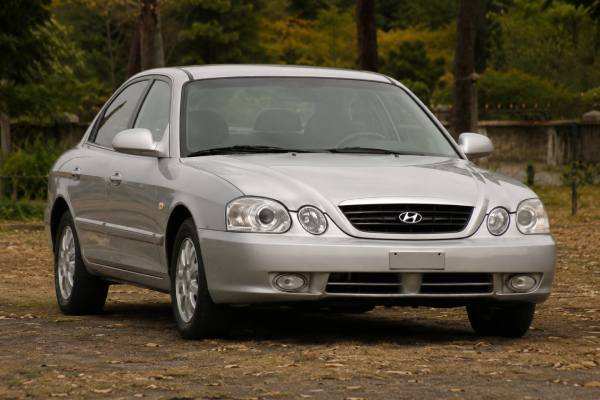
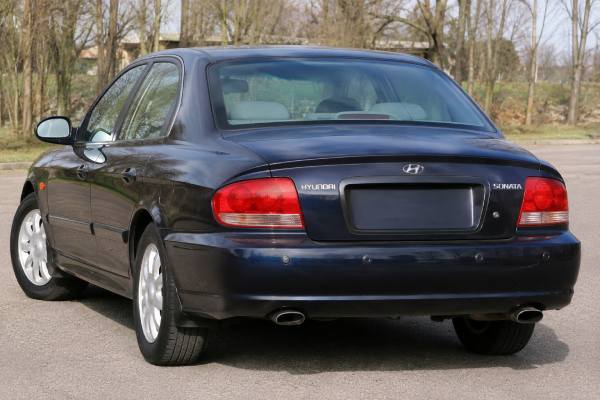
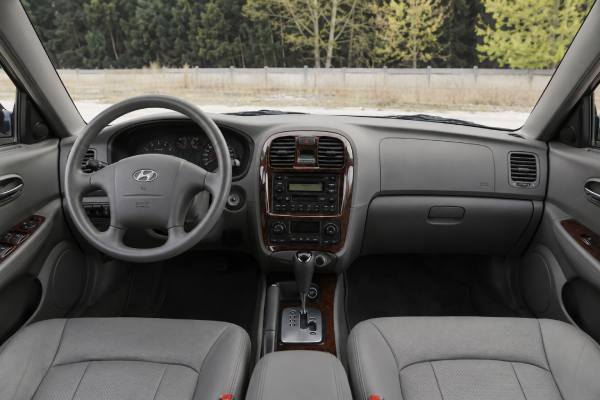
The facelifted Hyundai Sonata EF with the Delta 2.7 V6 is an older midsize sedan that still appeals to buyers who want a roomy, simple, naturally aspirated car without the complexity of modern turbocharging or advanced driver-assistance systems. Sold in many markets around 2002–2003, this version brought revised styling, a larger V6, improved rear suspension tuning, and better standard equipment than earlier EF models.
The key to buying one today is condition. The Delta V6 can be durable when serviced on time, but neglecting the timing belt, cooling system, automatic transmission fluid, or rust inspection can turn a cheap sedan into an expensive project. This guide focuses on the 2.7-liter V6 facelift model and covers the practical facts that matter most: specifications, trims, safety, reliability, maintenance, driving feel, and how it compares with period rivals.
Owner Snapshot
- Smooth 2.7-liter DOHC V6 gives the Sonata stronger midrange performance than the four-cylinder EF models.
- Comfortable ride, large cabin, and generous equipment make it a good-value used midsize sedan.
- Simple naturally aspirated engine and conventional automatic/manual driveline are easier to service than many newer cars.
- Timing belt neglect and front subframe corrosion are the two checks that matter most before buying.
- Replace the timing belt about every 60,000 miles / 96,000 km or 48 months, depending on market guidance and service history.
Table of Contents
- Hyundai Sonata EF Facelift Guide
- Hyundai Sonata EF 2.7 V6 Specs
- Hyundai Sonata EF Trims and Safety
- Common Issues and Recalls
- Maintenance and Buying Checks
- Driving Feel and Performance
- Rivals and Used-Car Value
Hyundai Sonata EF Facelift Guide
The Hyundai Sonata EF facelift is the revised version of Hyundai’s fourth-generation Sonata. In North America and several export markets, the 2002 model year brought new front and rear styling, a more upscale cabin, revised suspension details, and the larger 2.7-liter Delta V6 in place of the earlier 2.5-liter V6. The car remained a front-wheel-drive, four-door, five-seat midsize sedan aimed at buyers comparing value, warranty coverage, interior space, and comfort rather than sharp handling.
The “181 hp” label is important but needs a careful note. Early 2002 Hyundai material listed the 2.7 V6 at 181 hp and 177 lb-ft. For 2003, many U.S. listings show a corrected output of 170 hp and 181 lb-ft after Hyundai revised previously stated horsepower figures. In practical ownership terms, the engine hardware is essentially the same Delta-family V6, so a 2002 and 2003 V6 Sonata feel very similar when healthy. For buyers, maintenance condition matters far more than the rating printed in a brochure.
This model is best understood as a comfortable, well-equipped, value-focused sedan. The V6 gives it relaxed highway pace, and the cabin is spacious enough for family use. The facelift also improved visual presence, with a more formal grille, reshaped lighting, and available 16-inch alloy wheels on higher trims. Many cars were sold with an automatic transmission, although a five-speed manual existed in some markets and trims.
Its strengths are straightforward: space, smoothness, low purchase cost, and a powertrain that can run a long time if kept cool, clean, and properly timed. Its weaknesses are also straightforward: age-related rubber parts, rust in salt-belt climates, interior and electrical wear, and the cost of catching up deferred maintenance. A cheap example with no timing belt record, rusty underbody, leaking valve covers, tired mounts, and dirty transmission fluid can cost more to sort than it is worth.
As a used car, the best Sonata EF 2.7 V6 is not necessarily the lowest-mileage one. A well-documented car with regular oil changes, a recent timing belt/water pump service, clean coolant, smooth shifts, solid subframes, and working air conditioning is a much safer bet. Look for evidence rather than promises: receipts, service stickers, inspection records, recall completion, and a cold-start test.
For daily use today, the EF Sonata is a simple older sedan, not a modern safety or technology benchmark. It lacks modern systems such as automatic emergency braking, adaptive cruise control, lane keeping, blind-spot monitoring, and stability control on many examples. That does not make it unusable, but it does mean the car should be judged as an early-2000s vehicle. Good tyres, working brakes, fresh suspension parts, and rust-free structure are central to its real-world safety.
Hyundai Sonata EF 2.7 V6 Specs
The 2.7 V6 Sonata EF uses Hyundai’s Delta-family G6BA engine, a naturally aspirated aluminum V6 with dual overhead cams and multi-point fuel injection. Specifications vary slightly by market, model year, emissions certification, transmission, and trim, so the figures below should be treated as a practical reference for the 2002–2003 facelift V6 rather than a substitute for a VIN-specific service manual.
Powertrain and efficiency
| Item | Hyundai Sonata EF facelift 2.7 V6 |
|---|---|
| Engine code | G6BA / Delta 2.7 V6 |
| Layout | Front transverse V6, 6 cylinders |
| Valvetrain | DOHC, 24 valves, 4 valves per cylinder |
| Bore × stroke | 86.7 × 75.0 mm / 3.41 × 2.95 in |
| Displacement | 2.7 L / 2,656 cc |
| Induction | Naturally aspirated |
| Fuel system | Multi-point fuel injection / MPI |
| Compression ratio | 10.0:1 |
| Max power | Early rating: 181 hp / 135 kW @ 6,000 rpm; later 2003 U.S. rating often listed as 170 hp / 127 kW @ 6,000 rpm |
| Max torque | About 240–245 Nm / 177–181 lb-ft @ 4,000 rpm, market dependent |
| Timing drive | Timing belt primary cam drive; service interval is critical |
| Fuel type | Regular unleaded petrol/gasoline in most markets |
| Rated efficiency | About 11.8 L/100 km city and 8.4–8.7 L/100 km highway / roughly 20 mpg US city and 27–28 mpg US highway |
| Real highway at 120 km/h / 75 mph | Commonly about 8.8–10.0 L/100 km / 24–27 mpg US when healthy, depending on tyres, load, terrain, and climate |
Transmission, chassis and dimensions
| Item | Specification |
|---|---|
| Transmission | 5-speed manual or 4-speed automatic with Shiftronic manual mode, depending on trim/market |
| Drive type | Front-wheel drive |
| Differential | Open front differential |
| Front suspension | Independent double wishbone |
| Rear suspension | Independent multi-link |
| Steering | Power-assisted rack and pinion, about 14.1:1 overall ratio |
| Brakes | V6 models commonly use front ventilated discs and rear discs; ABS/TCS availability varies |
| Brake disc diameter | Approx. 257 mm / 10.1 in front and 262 mm / 10.3 in rear on common V6 listings |
| Popular tyre size | P205/60R16 on GLS/LX V6; P205/65R15 on some lower trims/markets |
| Ground clearance | About 161–167 mm / 6.3–6.6 in, market dependent |
| Length | 4,747 mm / 186.9 in |
| Width | 1,820 mm / 71.7 in |
| Height | 1,422 mm / 56.0 in |
| Wheelbase | 2,700 mm / 106.3 in |
| Turning circle | About 10.5–10.8 m / 34.4–35.4 ft |
| Curb weight | About 1,428–1,476 kg / 3,148–3,254 lb depending on trim and transmission |
| GVWR | Around 2,020 kg / 4,453 lb in many published specifications |
| Fuel tank | 65 L / 17.2 US gal / 14.3 UK gal |
| Cargo volume | About 398–430 L / 14.1–15.2 ft³, depending on measuring method and market |
Performance and capability
| Item | Typical figure |
|---|---|
| 0–100 km/h / 0–62 mph | About 8.2–9.7 seconds depending on transmission, test source, and rating standard |
| 0–60 mph | About 8.5–8.9 seconds for common automatic V6 tests |
| Top speed | About 210–220 km/h / 131–137 mph where unrestricted |
| 100–0 km/h braking | Typically around 39–43 m / 128–141 ft when brakes and tyres are in good condition; tyre choice changes this greatly |
| Towing capacity | Market dependent; often up to about 1,000–1,700 kg / 2,200–3,750 lb braked where approved |
| Payload | Around 575–592 kg / 1,268–1,305 lb on many listed V6 specifications |
Fluids and service capacities
| System | Specification and capacity |
|---|---|
| Engine oil | API SG/SH or later suitable gasoline oil; common viscosities include 5W-30, 5W-40, 10W-30, 10W-40 depending on climate |
| Engine oil capacity | About 4.5 L / 4.8 US qt with filter; verify by dipstick after refill |
| Coolant | Ethylene-glycol coolant suitable for aluminum engines, typically 50/50 with distilled water |
| Coolant capacity | Approximately 6.0–7.3 L / 6.3–7.7 US qt depending on source and drain method |
| Automatic transmission fluid | Hyundai/Kia/Mitsubishi SP-III specification ATF |
| Automatic transmission capacity | About 7.8 L / 8.2 US qt total; drain-and-fill usually replaces less |
| Manual transaxle oil | 75W-90 API GL-4 or Hyundai-equivalent MTF |
| Brake fluid | DOT 3 or DOT 4 |
| A/C refrigerant | R134a, about 700 ±25 g / 24.7 ±0.9 oz for Sonata IV EF-type applications |
| A/C compressor oil | PAG46 / FD46XG-type oil, about 150 mL / 5.1 fl oz system quantity |
| Key torque values | Oil drain plug about 39 Nm / 29 lb-ft; wheel nuts commonly about 90–110 Nm / 66–81 lb-ft; spark plugs commonly about 20–30 Nm / 15–22 lb-ft |
Safety data summary
| Category | Result or availability |
|---|---|
| IIHS moderate overlap front | Acceptable for 1999–2005 Sonata rating group |
| IIHS side impact | Poor for the original side test rating group |
| IIHS head restraints/seats | Poor |
| NHTSA frontal ratings | Commonly listed as 4 stars driver and 4 stars passenger for 2002–2003 |
| NHTSA rollover | Commonly listed as 5 stars in period U.S. summaries |
| Euro NCAP | No widely applicable official Euro NCAP rating for this exact EF facelift V6 specification |
| ADAS | No modern AEB, ACC, LKA, blind-spot monitoring, or traffic sign assistance |
| Core safety equipment | Dual front airbags, front seat-mounted side airbags on many markets, pretensioners, rear child locks, LATCH/ISOFIX-type child-seat provisions depending on region |
Hyundai Sonata EF Trims and Safety
The 2002–2003 Sonata EF facelift was sold under different trim names depending on market, but the North American pattern is a useful baseline. The lower trim used the four-cylinder as standard, while GLS and LX commonly brought the 2.7 V6, better wheels, more comfort equipment, and available or standard higher-end cabin features. In some regions the trim names GL, GLS, GLX, or H-Matic were used, and equipment could differ substantially.
| Trim or version | Typical equipment focus | Buyer notes |
|---|---|---|
| Base / GL | Value trim, often 2.4 four-cylinder standard, cloth interior, 15-inch wheels | Some markets allowed the V6 as an option; check engine code rather than badge alone |
| GLS V6 | Main V6 trim, 16-inch alloys in many markets, power features, cruise, CD audio, fog lamps | Often the best mix of price, equipment, and easier replacement interior parts |
| LX / GLX V6 | Higher comfort trim, leather, power driver’s seat, automatic climate control in many cars | More equipment means more age-related switches, motors, and trim items to inspect |
Quick identifiers include the V6 engine cover, underhood emissions label, VIN/engine code records, 16-inch alloy wheels on many GLS/LX cars, rear badging where still present, leather and automatic climate controls on many LX/GLX models, and four-wheel disc brakes on common V6 versions. Because badges are easily swapped and old cars may have accident repairs, verify through the VIN plate, service records, and underhood labels.
For 2002, the facelift brought the major visual and equipment change: reshaped exterior panels, revised dashboard and instrument cluster, new 16-inch alloy wheel designs on GLS/LX, a larger 2.7 V6, and a revised rear suspension arrangement that also improved trunk packaging. For 2003, changes were lighter, with minor convenience updates and the corrected horsepower reporting in some U.S. publications. If choosing between a clean 2002 and a clean 2003, condition is more important than model year.
Safety equipment was respectable for its time but basic by modern standards. Many cars include dual front airbags, front seat-mounted side airbags, front seatbelt pretensioners with load limiters, rear child locks, three-point belts, and child-seat anchor provisions. ABS and traction control were available, but not every car has them. Electronic stability control, automatic emergency braking, lane support, adaptive cruise control, blind-spot detection, and rear cross-traffic alert were not part of this generation.
The IIHS results are mixed. The EF Sonata rating group achieved an Acceptable result in the original moderate-overlap frontal test, but the original side test and head restraint/seat evaluation were Poor. That makes structural condition especially important. A rust-free body, solid subframes, correct tyres, working airbags, functioning ABS if equipped, and suspension in good order matter more now than brochure equipment did when the car was new.
Child-seat installation should be checked carefully. Depending on market and production date, the car may have LATCH or ISOFIX-style anchors and rear tether points, but an older seatbelt system, worn buckles, or missing tether covers can complicate installation. Before using the car for family duty, inspect rear belts, anchor points, seatback locks, and child-seat compatibility with the actual seat you plan to use.
There are no ADAS calibration concerns in the modern sense because this Sonata does not use camera/radar lane or collision systems. Service-related safety checks are more mechanical: wheel alignment after suspension work, ABS warning-light diagnosis, proper airbag/SRS repair after any warning light, and confirmation that recalls have been completed.
Common Issues and Recalls
A well-maintained Delta V6 Sonata can be a long-lived car, but age now drives most problems. Many examples are more than two decades old, so rubber, plastic, seals, corrosion protection, wiring connectors, and suspension parts may be near the end of their service life. The best reliability strategy is not chasing perfect mileage; it is buying the cleanest, best-documented car and immediately catching up on neglected services.
| Issue | Prevalence | Severity/cost | Typical signs | Best remedy |
|---|---|---|---|---|
| Timing belt overdue | Common on neglected cars | High | No record, belt noise, misfire after jump, no-start if failed | Replace belt, tensioner, idlers, water pump, accessory belts |
| Valve-cover gasket leaks | Common | Low/medium | Oil smell, smoke from exhaust manifold area, oil in plug wells | Replace gaskets and plug-well seals |
| Cooling system aging | Common | Medium/high | Overheating, coolant smell, crust near radiator or hoses | Pressure test, replace radiator/hoses/thermostat/water pump as needed |
| Automatic transmission fluid neglect | Occasional/common | Medium/high | Harsh shifts, flare, delayed engagement, burnt fluid | SP-III fluid service, diagnosis before purchase |
| Front subframe corrosion | Common in salt-belt cars | High | Pulling, clunks, visible perforation, failed alignment | Inspect for recall coverage; replace affected structure |
| Suspension bushings and ball joints | Common | Medium | Clunks, vague steering, uneven tyre wear | Replace worn arms, joints, links, struts; align |
| Wheel bearings | Occasional | Medium | Humming that changes with load | Replace bearing/hub assembly as applicable |
| Crank/cam sensors and ignition faults | Occasional | Low/medium | No-start, stall, check-engine light, misfire | Scan codes, test sensors/coils/wiring |
| Interior door-handle chrome peeling | Known recall area | Low | Sharp chrome edge, peeling handle surface | Verify recall; replace or repair handle |
| Air conditioning leaks | Common with age | Medium | Weak cooling, compressor cycling, oily residue | Leak test, replace failed seals/condenser/compressor as needed |
The 2.7 V6 uses a timing belt, and this is the service item that should decide many purchases. If there is no proof of replacement, assume it is due. On an interference-type engine, a broken or skipped belt can cause serious internal damage. A complete service should include the belt, hydraulic tensioner or tensioner assembly, idlers, water pump, thermostat if accessible, accessory belts, and fresh coolant. Cheap partial belt jobs are false economy.
Oil leaks are usually less dramatic but still worth checking. Valve-cover gaskets and spark-plug tube seals can leak onto hot surfaces or into plug wells, causing oil smell, smoke, misfire, and damaged ignition components. The front and rear covers should be inspected with a light, not just glanced at from above. Oil pan seepage and crank/cam seal leaks can also appear with age.
Cooling-system health is critical because an overheated aluminum V6 can become expensive quickly. Look for stable temperature, clean coolant, working fans, no pressure loss, no sweet smell after shutdown, no wet carpet from a heater-core leak, and no oil/coolant mixing. A pre-purchase inspection should include a cold start, warm idle until fans cycle, pressure test, and scan for temperature-sensor plausibility.
The four-speed automatic is not a performance transmission, but it can last if serviced with the correct SP-III fluid. Be cautious of cars with dark burnt fluid, delayed Drive or Reverse engagement, pronounced 2–3 flare, harsh downshifts, or shudder under light throttle. A fluid exchange may help a mildly neglected unit, but it will not repair worn clutch packs or valve-body problems.
Recalls and service campaigns should be checked by VIN. The most important used-car concern is the front subframe corrosion recall affecting some Sonata and related Hyundai models in salt-belt regions. Also verify fuel-tank assembly valve recall status, compact spare/TCS-related campaigns where applicable, and door-handle chrome recall completion. Even if a recall is marked complete, inspect the physical repair. Some older cars had recalls inspected years ago but later developed additional corrosion.
Software and calibration issues are minor compared with modern vehicles. There is no battery-management or ADAS software to maintain. Still, a dealer can sometimes confirm whether any PCM/TCM emissions or drivability campaigns were completed. If the car has an emissions readiness problem, harsh shifting, or persistent warning lights after mechanical faults are repaired, ask a Hyundai dealer or specialist to check for applicable calibration updates.
Maintenance and Buying Checks
The safest approach with a newly purchased Sonata EF 2.7 V6 is to baseline the car unless records are complete. That means fresh fluids, filters, belt inspection, brake inspection, cooling-system pressure test, underbody rust check, tyre assessment, and a full scan of engine, transmission, ABS, and SRS modules where equipment allows.
| Service item | Practical interval |
|---|---|
| Engine oil and filter | Every 5,000 miles / 8,000 km or 6 months for mixed use; shorter for severe short-trip use |
| Engine air filter | Inspect every 12 months; replace about every 15,000–30,000 miles / 24,000–48,000 km |
| Cabin air filter | Every 12 months or when airflow/odor declines |
| Timing belt system | About every 60,000 miles / 96,000 km or 48 months; replace immediately if history is unknown |
| Spark plugs | About every 60,000 miles / 96,000 km or 48 months in many schedules |
| Coolant | About every 30,000 miles / 48,000 km or 2 years on conservative older-car maintenance |
| Automatic transmission fluid | Every 30,000–60,000 miles / 48,000–96,000 km; use SP-III only |
| Manual transaxle oil | Inspect regularly; replace about every 60,000 miles / 96,000 km |
| Brake fluid | Every 2 years |
| Brake pads/rotors | Inspect every 6–12 months and at every tyre rotation |
| Tyre rotation | Every 5,000–7,500 miles / 8,000–12,000 km |
| Wheel alignment | Check after suspension work, uneven tyre wear, or steering pull |
| Accessory belts and hoses | Inspect at every oil service; replace cracking, swelling, glazing, or age-hardened parts |
| Fuel filter | Market dependent; replace if serviceable and history is unknown, or diagnose restriction symptoms |
| Valve clearance | Hydraulic lifters; no routine manual adjustment |
| 12 V battery | Test yearly after 3 years; typical replacement window is 4–6 years |
A sensible first service for an unknown V6 car includes oil and filter, air filter, cabin filter, spark plugs, valve-cover gasket inspection, coolant service, brake fluid, ATF drain-and-fill or exchange with correct fluid, tyre rotation, and a timing belt kit if no proof exists. This may cost more than the purchase price on a very cheap car, but it is still cheaper than repairing a failed belt, overheated engine, or failing automatic.
Before buying, inspect the car in this order:
- Structure and rust: Check front subframe, lower control-arm mounting areas, rear suspension mounting points, rocker seams, brake/fuel lines, wheel arches, jacking points, and floor edges.
- Engine cold start: Listen for abnormal ticking, belt noise, exhaust leaks, misfire, or long crank. Watch for smoke and unstable idle.
- Cooling system: Confirm clean coolant, steady temperature, fan operation, no radiator seepage, and no coolant smell.
- Transmission: Test Park-to-Reverse and Park-to-Drive engagement, light-throttle shifts, kickdown, and highway lockup.
- Steering and suspension: Look for clunks, wandering, steering pull, vibration, and uneven tyre wear.
- Brakes and ABS: Check pedal feel, rotor pulsation, warning lights, and parking-brake operation.
- Electronics and interior: Test windows, locks, mirrors, climate control, blower speeds, radio, lights, trunk/fuel releases, and SRS/ABS lamps.
- Paperwork: Request timing belt proof, fluid history, recall completion, inspection records, and any crash repair documentation.
The most desirable examples are clean GLS or LX/GLX V6 cars with documented timing belt service, no subframe corrosion, working A/C, smooth shifting, and original-looking wiring. Avoid cars with structural rust, persistent overheating, missing title history, ignored warning lights, heavily modified wiring, contaminated coolant, or transmission slip. Cosmetic wear is acceptable on a low-value older sedan; structural and powertrain neglect is not.
Long-term durability is good when the basics are handled. The Delta V6 does not have the widespread turbo, direct-injection carbon, or hybrid battery concerns of later vehicles. Its risks are older and more mechanical: belts, seals, cooling, fluid neglect, and corrosion.
Driving Feel and Performance
On the road, the Sonata EF 2.7 V6 feels like a comfortable early-2000s midsize sedan rather than a sport sedan. The V6 is smoother and more relaxed than the four-cylinder, especially at highway speeds or with passengers aboard. It does not deliver strong low-rpm shove by modern turbo standards, but it builds speed cleanly and is willing to rev toward 6,000 rpm when asked.
The automatic transmission suits the car’s relaxed character. In normal use it shifts smoothly, and the Shiftronic manual gate gives the driver some control on hills or when setting up a pass. It is not quick by modern standards, and older units may hunt or hesitate if fluid is old, mounts are tired, or sensors are weak. A healthy car should not bang into gear, flare badly between shifts, or vibrate heavily at idle in Drive.
Manual-transmission cars feel more responsive and can be meaningfully quicker, but they are less common in some markets. Clutch condition, synchro wear, and shift linkage feel should be checked carefully. A manual V6 Sonata can be enjoyable in a simple, old-school way, but most buyers will encounter automatics.
Ride comfort is one of the car’s better traits. The independent front and rear suspension absorbs rough pavement well, and the cabin has good space for the class. The facelift’s revised rear suspension tuning helped the car feel more settled than earlier versions, though body roll is still present. The steering is light to moderate in weight, predictable, and easy in town, but it does not offer the feedback of a Mazda6 or European sedan.
Highway stability is good when the suspension and tyres are fresh. Worn struts, old tyres, tired control-arm bushings, and bad alignment can make the car wander or feel floaty. Because many examples are now old and inexpensive, poor driving feel often reflects worn parts rather than the original design.
Braking feel is adequate with four-wheel discs on V6 cars, but brake condition varies widely. Old rubber hoses, low-quality pads, warped rotors, seized slider pins, and contaminated brake fluid can all hurt pedal feel. ABS, where equipped, should cycle cleanly without warning lights. Tyre quality has a major effect on emergency stopping because the original braking hardware is not modern performance equipment.
Real-world fuel economy depends heavily on use. A healthy V6 automatic may return roughly 13–15 L/100 km / 16–18 mpg US in heavy city driving, 8.5–10.0 L/100 km / 24–28 mpg US on steady highway trips, and about 10–12 L/100 km / 20–24 mpg US mixed. Cold weather, short trips, old oxygen sensors, dragging brakes, low tyre pressure, and poor alignment can all push consumption higher.
Noise, vibration, and harshness are acceptable for the era. The V6 is smoother than the four-cylinder, but road and wind noise rise at motorway speeds. Engine mounts are common wear items; collapsed mounts can make the car feel rougher than it should. Exhaust leaks near flex joints or manifolds can also add noise and fumes.
Towing should be approached conservatively. Where towing is approved by market documentation, stay within the local braked/unbraked limits, use correct trailer wiring, keep cooling and transmission fluid fresh, and avoid overloading the rear suspension. A 20-plus-year-old automatic sedan is not the ideal tow vehicle, even if the published rating looks usable.
Rivals and Used-Car Value
When new, the Sonata EF 2.7 V6 competed with mainstream midsize sedans such as the Toyota Camry, Honda Accord, Nissan Altima, Mazda6, Volkswagen Passat, Mitsubishi Galant, Saturn L-Series, Chevrolet Malibu, and its close relative, the Kia Optima. Today, the comparison is less about showroom appeal and more about which surviving car is in the best condition.
| Rival | Main advantage over Sonata | Sonata advantage |
|---|---|---|
| Toyota Camry V6 | Stronger resale reputation, refined powertrain, broad parts support | Sonata often costs less to buy in similar condition |
| Honda Accord V6 | Better handling balance, stronger reputation, better resale | Sonata may be cheaper and simpler to find with lower purchase price |
| Nissan Altima 3.5 | Much stronger performance | Sonata is calmer, often cheaper, and less performance-abused |
| Mazda6 V6 | Sharper steering and handling | Sonata has a softer ride and often lower used pricing |
| Volkswagen Passat | More premium interior feel, available turbo/V6 character | Sonata is usually simpler and less costly to maintain |
| Kia Optima V6 | Similar platform and mechanicals | Sonata may have broader recognition and trim availability depending on market |
| Mitsubishi Galant V6 | Smooth engine, simple layout | Sonata often offers stronger equipment value |
The Camry and Accord are the default safer choices for many buyers, mainly because of parts availability, resale strength, and long-standing reliability reputation. They also tend to cost more when clean. A neglected Camry or Accord is not automatically better than a well-maintained Sonata. At this age, the individual car matters more than the badge.
The Altima 3.5 and Mazda6 V6 appeal more to drivers who value acceleration or handling. The Sonata is softer, quieter in town, and less sporty. It is a better match for someone who wants low-cost comfort and simple cruising rather than back-road precision.
The Passat can feel more upscale, but early-2000s Volkswagen maintenance can be more demanding, especially when previous owners used cheap parts or skipped specialist service. The Sonata’s simpler naturally aspirated V6 and conventional front-drive layout can be easier to live with on a budget.
For buying value, the Sonata EF 2.7 V6 makes sense only when the price reflects its age and safety limitations. It should be bought as a practical older sedan, not as a modern family safety substitute. The best examples are worth paying slightly more for because fixing rust, transmission problems, overheating, or overdue timing service can quickly erase any savings.
Choose the Sonata if you find a clean, documented, rust-free V6 car with recent timing belt service and smooth operation. Walk away if the car has structural rust, unresolved warning lights, overheating history, no belt record, or harsh transmission behavior. In this generation, the right car can be a comfortable bargain; the wrong one is usually not worth rescuing.
References
- 2002 HYUNDAI SONATA OFFERS PERFORMANCE, STYLE AND VALUE 2002 (Manufacturer Publication)
- 2003 Hyundai Sonata 2003 (Safety Rating)
- Check for Recalls: Vehicle, Car Seat, Tire, Equipment | NHTSA 2026 (Recall Database)
- Hyundai – Recalls 2026 (Recall and Service Campaign VIN Lookup)
- HYUNDAI 2003 SONATA OWNER’S MANUAL Pdf Download | ManualsLib 2003 (Owner’s Manual)
Disclaimer
This article is for informational purposes only and is not a substitute for professional diagnosis, repair advice, or official service documentation. Specifications, torque values, service intervals, fluids, equipment, recall applicability, and procedures can vary by VIN, market, production date, trim, and previous repairs. Always verify critical information against the official owner’s manual, workshop manual, underhood labels, dealer records, and VIN-specific recall databases before servicing or buying a vehicle.
If this guide helped you, please consider sharing it on Facebook, X/Twitter, or your preferred automotive community to support our work.