
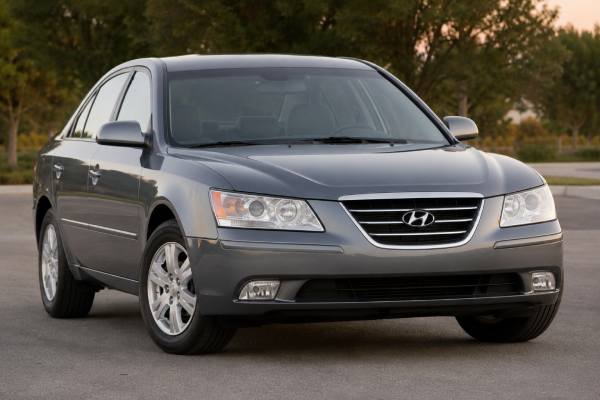
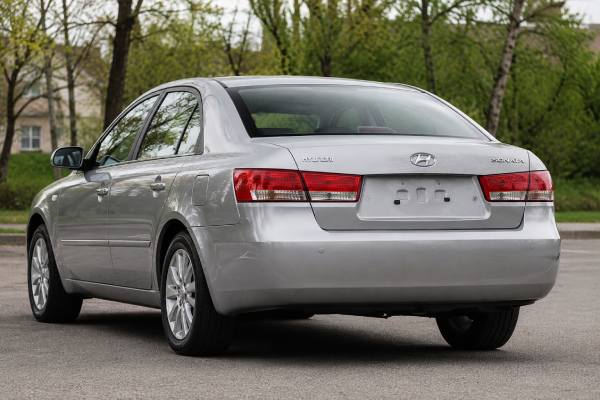
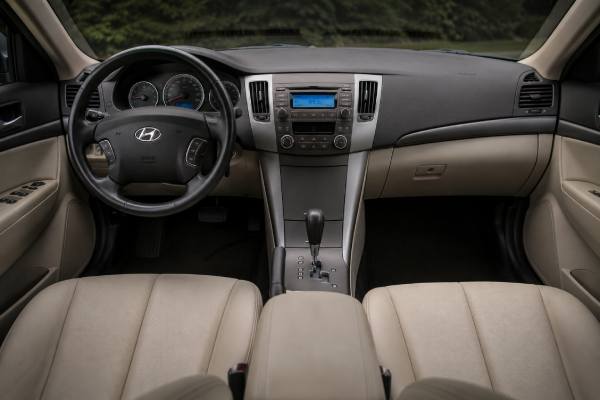
The facelift Hyundai Sonata NF with the Lambda 3.3 V6 is one of the more interesting versions of Hyundai’s late-2000s family sedan. It keeps the roomy, practical, front-wheel-drive sedan layout of the regular Sonata, but adds a naturally aspirated aluminum V6, a five-speed automatic transmission, stronger passing power, and higher-trim equipment.
For buyers, the appeal is simple: it is comfortable, spacious, inexpensive to buy, and much quicker than the four-cylinder Sonata of the same generation. The trade-off is that it is now an older car, so condition matters more than trim badges. Rust, neglected transmission fluid, worn suspension parts, oil leaks, and incomplete recall work can turn a cheap V6 Sonata into a poor buy.
This guide covers the 2009–2010 facelift Sonata NF 3.3 V6 with the 249 hp Lambda engine, focusing mainly on North American specification because that is where this exact 249 hp rating and trim structure are best documented.
Quick Overview
- The 3.3L Lambda V6 gives the Sonata NF strong highway passing power and a smoother character than the four-cylinder models.
- Standard ESC, ABS, six airbags, and a large cabin make it a practical used family sedan.
- The biggest ownership caveat is age-related condition: salt-belt rear crossmember corrosion, old ATF, suspension wear, and oil leaks need careful checking.
- Normal engine oil and filter service is every 7,500 miles / 12,000 km or 6 months; severe use can require 3,000 miles / 4,800 km or 3 months.
- EPA fuel economy for the V6 automatic is 19 mpg city, 29 mpg highway, and 22 mpg combined.
Table of Contents
- Hyundai Sonata NF V6 Profile
- Hyundai Sonata NF Lambda V6 Specs
- Hyundai Sonata NF Trims and Safety
- Reliability Issues and Service Actions
- Maintenance and Used Buying Advice
- Driving Character, Performance and Economy
- How Sonata NF Compares to Rivals
Hyundai Sonata NF V6 Profile
The Hyundai Sonata NF was the fifth-generation Sonata, sold during the mid-to-late 2000s. The facelifted 2009–2010 version brought cleaner exterior detailing, an improved cabin, better feature availability, and a more polished feel than early NF models. In V6 form, the car used Hyundai’s Lambda 3.3-liter V6, an all-aluminum, naturally aspirated engine paired with a five-speed SHIFTRONIC automatic transmission.
The 3.3 V6 version was not meant to be a sport sedan in the rear-drive sense. It was a comfort-biased family sedan with useful extra power. The V6 made the Sonata feel relaxed at highway speeds, less strained with passengers aboard, and more confident during merging or passing. Compared with the four-cylinder car, it also felt smoother and more refined, especially under moderate acceleration.
The NF’s strengths are still easy to understand today. The cabin is spacious, the trunk is large, the controls are simple, and the ride is generally comfortable. Hyundai also equipped the Sonata well for its time. Stability control, side-curtain airbags, ABS, Brake Assist, Electronic Brake-force Distribution, and active front head restraints were important safety features in the late-2000s midsize segment.
The V6 version is best viewed as a low-cost, high-comfort used sedan rather than a collectible or enthusiast model. Its value depends heavily on service history and body condition. A well-kept V6 Sonata can still be a pleasant daily driver, but a neglected example may need several repairs at once: tires, brakes, struts, control arms, leaking gaskets, transmission service, engine mounts, and corrosion work.
For 2010 in the U.S. lineup, the V6 was mainly tied to the SE and Limited trims. That matters because many V6 cars also came with 17-inch wheels, better interior equipment, and more convenience features. The SE leaned sportier with a firmer suspension setup, while the Limited aimed for comfort and luxury features such as leather seating and upgraded audio.
The facelift Sonata NF 3.3 V6 is most appealing for someone who wants a roomy, simple, conventional sedan and is willing to inspect carefully before buying. It is not the most fuel-efficient Sonata, and it is not as dynamically sharp as a Mazda6 or as resale-proof as a Camry. But when maintained well, it offers a lot of car for modest money.
Hyundai Sonata NF Lambda V6 Specs
The exact numbers below are for the 2009–2010 Sonata NF 3.3 V6 automatic in common North American specification. Some markets used different trim names, equipment, tire packages, fuel-tank figures, towing limits, or speed-limit calibrations, so VIN-specific documentation should always be checked before ordering parts or planning service.
Powertrain and efficiency
| Item | Hyundai Sonata NF 3.3 V6 |
|---|---|
| Engine family / code | Lambda 3.3 V6, commonly identified as G6DB in parts and service data |
| Engine layout | 60-degree V6, 6 cylinders, DOHC, 24 valves, 4 valves per cylinder |
| Bore x stroke | 92.0 x 83.8 mm (3.62 x 3.29 in) |
| Displacement | 3.3 L (3,342 cc) |
| Induction | Naturally aspirated |
| Fuel system | Multi-point fuel injection; regular unleaded gasoline |
| Compression ratio | Approximately 10.4:1 |
| Maximum power | 249 hp (186 kW) at 6,000 rpm |
| Maximum torque | 310 Nm (229 lb-ft) at 4,500 rpm |
| Timing drive | Timing chain |
| EPA fuel economy | 12.4 / 8.1 / 10.7 L/100 km city/highway/combined (19 / 29 / 22 mpg US; 22.8 / 34.8 / 26.4 mpg UK) |
| Real-world highway at 120 km/h / 75 mph | Typically about 8.5–9.5 L/100 km (25–28 mpg US; 30–33 mpg UK) when healthy and lightly loaded |
| Transmission | Five-speed SHIFTRONIC automatic, commonly listed as A5HF1 for V6 applications |
| Drive type | Front-wheel drive |
| Differential | Open front differential integrated with the transaxle |
Chassis, dimensions, and capacities
| Item | Specification |
|---|---|
| Front suspension | Independent double-wishbone layout with coil springs and stabilizer bar |
| Rear suspension | Independent multi-link layout with coil springs and stabilizer bar |
| Steering | Power-assisted rack and pinion; approximately 16.9:1 ratio |
| Brakes | Four-wheel disc brakes; front ventilated, rear solid |
| Brake disc diameter | Common V6 catalog sizing is about 300 mm front and 284 mm rear (11.8 in / 11.2 in); verify by VIN before parts purchase |
| Most common V6 tire size | 215/55 R17 on 17-inch wheels for SE and Limited V6 trims |
| Ground clearance | About 160 mm (6.3 in) |
| Length / width / height | 4,800 / 1,830 / 1,475 mm (189.0 / 72.0 / 58.1 in) |
| Wheelbase | 2,730 mm (107.5 in) |
| Turning circle | 10.9 m (35.8 ft), kerb-to-kerb |
| Curb weight | About 1,585 kg (3,494 lb), depending on trim and equipment |
| GVWR | About 2,051 kg (4,522 lb) |
| Estimated payload | About 466 kg (1,028 lb), calculated from GVWR minus typical curb weight |
| Fuel tank | 67 L (17.7 US gal / 14.7 UK gal); some market literature lists 70 L |
| Cargo volume | 462 L (16.3 ft³), trunk volume; SAE-style published figure |
| Towing capacity | Up to about 907 kg (2,000 lb) braked where rated; unbraked limits vary by market |
Performance and service capacities
| Item | Specification or guidance |
|---|---|
| 0–100 km/h / 0–62 mph | About 7.8 seconds in published Canadian-style data; condition and tires affect results |
| Top speed | Market and limiter dependent; some North American listings quote about 195 km/h (121 mph) |
| 100–0 km/h braking distance | About 43 m (141 ft) in published test-style data, dependent on tires and brake condition |
| Engine oil | API SJ/SL or above, ILSAC GF-3 or above; SAE 5W-20 or 5W-30 preferred; 5.2 L (5.49 US qt) with filter |
| Coolant | Ethylene-glycol coolant for aluminum engines, typically 50/50 mix; 10.9 L (11.52 US qt) |
| Automatic transmission fluid | Hyundai Genuine ATF SP-III or approved SP-III equivalent; total capacity about 8.2 L (8.66 US qt) |
| Brake fluid | DOT 3 or DOT 4 |
| Power steering fluid | PSF-4 type fluid; about 0.9 L (1.0 US qt) |
| A/C refrigerant | R134a, commonly listed around 550 g (19.4 oz); verify the under-hood label |
| A/C compressor oil | PAG 46 / FD46XG type, commonly around 150 mL (5.1 fl oz); verify by compressor and label |
| Engine oil drain plug torque | 34–44 Nm (25.3–32.5 lb-ft) |
| Spin-on oil filter torque | 12–16 Nm (8.7–11.6 lb-ft), where applicable |
| Wheel nut torque | 88–108 Nm (65–80 lb-ft) |
Safety and driver assistance
| Area | Result or availability |
|---|---|
| Euro NCAP | No directly comparable public Euro NCAP rating is commonly available for this North American 3.3 V6 specification |
| IIHS moderate overlap front | Good, rating applies to 2006–2010 Sonata models |
| IIHS side impact | Acceptable, original side test |
| IIHS roof strength | Marginal |
| IIHS head restraints and seats | Good |
| IIHS headlight rating | Not part of the rating program for this model year |
| NHTSA-era rating summary | Hyundai reported five-star front and side impact results under the older NHTSA system |
| ADAS | No modern AEB, ACC, lane keeping, traffic sign assist, blind-spot monitoring, or rear cross-traffic alert |
| Core safety systems | Six airbags, ESC, ABS, Brake Assist, EBD, TPMS, active front head restraints, and rear LATCH anchors |
Hyundai Sonata NF Trims and Safety
The facelift Sonata NF was sold with different trim structures by market, but the U.S. 2010 lineup is the clearest guide for the 249 hp V6. In that lineup, the GLS became four-cylinder only, while the SE and Limited remained available with the 3.3L V6. For 2009, V6 availability was broader in some listings, so buyers should verify the engine from the VIN, emissions label, and under-hood layout rather than relying only on a badge.
SE and Limited differences
The SE is the version to look for if you want the most responsive V6 Sonata. It came with a sport-tuned suspension, 17-inch alloy wheels, performance-oriented 215/55R17 tires, fog lights, a rear spoiler, leather-wrapped controls, and trim-specific seat materials. The SE V6 also used dual chrome exhaust tips, which are a quick visual clue.
The Limited is the comfort-oriented version. It typically added leather seating, heated front seats, automatic climate control, a power sunroof, upgraded Infinity audio, an auto-dimming mirror with HomeLink and compass, and more polished interior trim. For many used buyers, the Limited is the better daily-driver choice because it gives the V6 powertrain with a more relaxed equipment package.
Useful quick identifiers include:
- V6 engine cover and under-hood emissions label showing 3.3L displacement.
- SE dual chrome exhaust tips and sportier 17-inch wheel package.
- Limited leather seating, heated front seats, automatic climate control, and premium audio.
- SHIFTRONIC automatic selector on V6 cars.
- VIN decoding and service records to confirm engine, trim, production date, and recall eligibility.
Safety equipment and crash structure
The Sonata NF was competitive for its time because Hyundai made key active and passive safety features widely available. Standard ESC was a strong point in this generation, especially when some rivals still treated stability control as optional or trim-dependent during the mid-2000s. ABS, Brake Assist, EBD, TPMS, and four-wheel disc brakes gave the car a solid safety foundation.
Passive safety equipment included dual front airbags, front seat-mounted side-impact airbags, front and rear side-curtain airbags, front seatbelt pretensioners and load limiters, active front head restraints, and rear LATCH anchors. The structure performed well in IIHS moderate overlap testing, but the roof-strength rating was Marginal and the original side-impact rating was Acceptable rather than Good.
There are no modern driver-assistance systems to calibrate after windshield or bumper work. That makes repairs simpler than on newer sedans, but it also means the driver does not get automatic emergency braking, adaptive cruise control, lane centering, or blind-spot monitoring. On a used example, good tires, functioning ABS/ESC, properly aimed headlights, healthy brakes, and no airbag warning lights matter more than any trim badge.
Reliability Issues and Service Actions
The Lambda 3.3 V6 is generally a durable engine when serviced, and it avoids the reputation problems associated with some later Hyundai/Kia four-cylinder engines. Even so, these cars are now old enough that age, heat cycles, corrosion, and deferred maintenance are the main reliability risks.
| Issue area | Prevalence | Severity / cost | Typical symptoms | Recommended remedy |
|---|---|---|---|---|
| Rear crossmember corrosion | Common in salt-belt history cars | High if structural | Heavy rear subframe rust, alignment issues, clunks, unsafe control-arm mounting points | Verify Recall Campaign 113 completion, inspect crossmember thickness and mounting areas, replace if badly corroded |
| Valve cover or timing cover oil seepage | Occasional to common with age | Low to medium | Burning oil smell, oil on engine sides, smoke from hot exhaust areas | Replace leaking gaskets and clean residue; inspect PCV system |
| Ignition coils, plugs, or intake-related misfires | Occasional | Low to medium | Check-engine light, rough idle, hesitation under load | Scan codes, replace worn iridium plugs, diagnose coils, inspect intake leaks |
| Automatic transmission shift harshness | Occasional, worse with neglected ATF | Medium to high | Delayed engagement, flare, harsh 2–3 or 3–4 shift, shudder | Check fluid condition and level, use SP-III fluid, scan TCM data, address solenoids or mounts if needed |
| Suspension bushings, struts, and links | Common by mileage | Low to medium | Clunks, wandering, uneven tire wear, loose steering feel | Inspect front lower arms, ball joints, sway links, rear links, struts, and alignment |
| Cooling system aging | Occasional | Medium | Coolant smell, overheating, crust near radiator or hoses, weak heat | Pressure-test, replace aged hoses, radiator, thermostat, cap, and coolant as needed |
| Stop lamp switch failure | Known recall area | Medium safety risk | Brake lights fail or stay on, ESC light, cruise-control issues, shift-interlock problems | Verify stop lamp switch recall completion and correct switch adjustment |
Engine and timing chain considerations
The 3.3L Lambda uses a timing chain, not a routine timing belt. That is good for ownership cost, but it does not mean the timing system should be ignored forever. Listen for chain rattle at cold start, check for cam/crank correlation faults, and investigate oil-pressure or sludge concerns quickly. Chain, guide, or tensioner work is not a normal short-interval service item, but it becomes relevant if noise, timing faults, or poor maintenance history appear.
Because this engine has solid-style valve actuation rather than traditional hydraulic lifters, valve clearance condition can matter at high mileage. A light ticking sound is not always serious, but persistent valve-train noise, misfires, or uneven compression should be diagnosed properly.
Oil leaks are more common than catastrophic internal failures. Valve-cover gaskets, front cover areas, cam/crank seals, oil cooler or filter housing areas, and PCV-related seepage should be inspected. A small seep is not unusual on an older car, but oil dripping onto hot exhaust parts or soaking rubber components should be repaired.
Recalls, campaigns, and records
Two service-action areas matter most for a used 2009–2010 Sonata NF:
- Rear crossmember corrosion campaign: certain 2006–2010 Sonata vehicles in salt-belt states were included because road salt and water could corrode the rear crossmember. The remedy involved inspection, corrosion treatment, or replacement depending on condition.
- Stop lamp switch campaign: affected vehicles could experience brake-light, ESC, cruise-control, and shift-interlock issues. Replacement and correct adjustment of the switch are important.
A buyer should ask for proof of completed recall work, not just a seller’s statement. Check the VIN through an official recall lookup and ask a Hyundai dealer to print the warranty/recall history. For any car that lived in the Midwest, Northeast, Canada, or other salted-road regions, also inspect the front and rear subframes, rear control-arm pockets, brake lines, fuel lines, rocker seams, wheel arches, and lower door seams.
Maintenance and Used Buying Advice
A good Sonata NF V6 is not difficult to maintain, but it needs the basics done on time. The most expensive used examples are often the cheap ones that need every neglected item at once.
| Item | Normal interval | Severe-use guidance | Notes |
|---|---|---|---|
| Engine oil and filter | 7,500 miles / 12,000 km or 6 months | 3,000 miles / 4,800 km or 3 months | Use correct API/ILSAC oil; 5W-20 or 5W-30 preferred |
| Engine air filter | Inspect regularly; replace when dirty | Replace more often in dust | A restricted filter hurts economy and throttle response |
| Cabin air filter | About every 12 months / 10,000 miles / 15,000 km | More often in dusty or humid areas | Helps HVAC airflow and odor control |
| Spark plugs | Iridium plugs typically around 100,000 miles / 160,000 km | Inspect earlier if misfires occur | Use correct heat range and torque |
| Coolant | First at 60,000 miles / 96,000 km or 60 months; then every 25,000 miles / 40,000 km or 24 months | Follow same or shorter interval in harsh conditions | Use aluminum-safe ethylene-glycol coolant |
| Automatic transmission fluid | Inspect per schedule | Replace every 30,000 miles / 48,000 km in severe use | Use Hyundai SP-III specification fluid only |
| Brake fluid | Inspect at scheduled services; many owners replace every 2–3 years | Shorter if moisture or corrosion is present | DOT 3 or DOT 4 |
| Brake pads and rotors | Inspect at least every 7,500–15,000 miles / 12,000–24,000 km | More often in city or salted-road use | Check caliper slide pins and parking brake hardware |
| Timing chain system | No routine belt-style replacement interval | Inspect if noise, codes, or poor oil history | Replace chain/guides/tensioners only when out of spec or symptomatic |
| Drive belts and hoses | Inspect every service | Replace sooner if cracked, swollen, noisy, or oil-soaked | Old rubber is a common roadside-failure cause |
| Tires and alignment | Rotate every 7,500 miles / 12,000 km; check alignment if wear appears | More often if roads are rough | Uneven wear often points to worn bushings or struts |
| 12V battery | Test annually after 3 years | Replace sooner in extreme heat or cold | Weak voltage can trigger odd electrical symptoms |
Buyer inspection checklist
Before buying, start with the body and underside. Rust is the first deal-breaker. Look closely at the rear crossmember, rear control-arm mounts, front subframe, brake and fuel lines, rocker panels, lower door edges, rear wheel arches, and spare-tire well. Surface rust is normal on old hardware; flaking structural rust is not.
Next, check the powertrain cold. The V6 should start quickly, idle smoothly, and settle without heavy chain rattle. Look for oil smoke, coolant smell, or a flashing check-engine light. After a full warm-up, inspect for leaks around the valve covers, timing cover, oil filter area, radiator, thermostat housing, and transmission cooler lines.
The automatic transmission should engage Drive and Reverse promptly without a heavy bang. During the road test, check light-throttle shifts, kickdown, highway cruising, and stop-and-go behavior. A single slightly firm shift on an old car may not be alarming, but flares, shudder, delayed engagement, or burnt-smelling fluid should lower the price sharply.
Suspension condition matters because the Sonata’s comfort depends on tight bushings, good struts, and proper alignment. Listen for clunks over small bumps, vibration at 60–75 mph, brake pulsation, and steering pull. Budget for tires, brakes, struts, control arms, sway links, and alignment if records are thin.
Best buys are clean SE or Limited V6 cars with documented oil changes, coolant service, ATF service, recall completion, rust-free structure, and matching quality tires. Avoid cars with active airbag lights, severe underside corrosion, overheating history, unknown transmission behavior, or evidence of long-term oil neglect.
Driving Character, Performance and Economy
The Sonata NF 3.3 V6 feels strongest in normal road driving, not on a racetrack. The engine has enough low- and mid-range torque to move the car without constant downshifts, and it becomes noticeably stronger as revs build. It is smoother than the four-cylinder Sonata and better suited to highway passing, loaded family trips, and hilly routes.
Throttle response is conventional and predictable. There is no turbo lag, no hybrid transition, and no complex drive-mode strategy. The five-speed automatic is simple by modern standards, but it suits the V6 well when healthy. It may not shift as quickly as newer six-, eight-, or dual-clutch gearboxes, yet it gives the car a relaxed character. SHIFTRONIC manual control is useful for holding a gear on hills or during passing, but most drivers will leave it in Drive.
Ride quality depends on trim. Limited models are generally more comfort-focused, while SE models feel firmer because of the sport-tuned suspension and 17-inch tire package. The SE is more tied down in corners, but it can also feel busier over rough pavement. Steering is light to moderate in weight, with enough response for normal driving but not much road texture. The car’s front-wheel-drive layout means hard acceleration can produce some torque steer or inside-wheel spin on poor tires.
Cabin noise is reasonable for its age when the car is in good condition. Worn tires, tired engine mounts, dry suspension bushings, or old door seals can make a used car feel much older than a clean example. At highway speeds, the V6 usually feels calm, and the engine turns in a relaxed manner compared with smaller engines working harder.
Real-world fuel economy is the main cost of choosing the V6. In city driving, expect roughly 12.5–14.5 L/100 km (16–19 mpg US; 19–23 mpg UK), depending on traffic and trip length. Mixed driving often lands around 10.5–12.0 L/100 km (20–22 mpg US; 24–26 mpg UK). Highway driving at 100–120 km/h can return about 8.1–9.5 L/100 km (25–29 mpg US; 30–35 mpg UK), assuming good tires, correct alignment, no dragging brakes, and a healthy oxygen-sensor and fuel-trim situation.
Cold weather, short trips, winter tires, roof racks, and old ATF can make economy worse. A V6 Sonata that struggles to beat 20 mpg US on steady highway use needs inspection for dragging brakes, low tire pressure, bad thermostat, lazy oxygen sensors, fuel-trim faults, or transmission lockup problems.
How Sonata NF Compares to Rivals
The Sonata NF 3.3 V6 sits in the same broad used-sedan group as the Toyota Camry V6, Honda Accord V6, Nissan Altima V6, Ford Fusion V6, Chevrolet Malibu V6, Mazda6 V6, and Kia Optima/Magentis V6. Its main advantage is value. It often costs less than an equivalent Camry or Accord while offering a large cabin, strong V6 power, good equipment, and simple mechanicals.
Against the Toyota Camry V6, the Sonata is usually cheaper to buy but does not match the Camry’s resale strength or long-standing reputation. A clean Sonata can be a smarter value, but a neglected one will not have the same market forgiveness. The Camry V6 is also more powerful in some years, while the Sonata counters with lower purchase cost.
Against the Honda Accord V6, the Sonata feels less sporty and less polished, but often rides comfortably and costs less. The Accord has a stronger enthusiast following, better steering feel, and broader parts familiarity. The Sonata is better for buyers who value price, space, and equipment more than sharp handling.
Against the Nissan Altima V6, the Sonata is more conventional. The Altima is quicker and more energetic, but many buyers are cautious about older Nissan CVT ownership. The Sonata’s five-speed automatic is not modern, yet it is more traditional and easier for many independent shops to understand.
Against the Ford Fusion V6 and Chevrolet Malibu V6, the Sonata competes well on cabin space, standard safety equipment, and value. The Fusion has a more composed chassis, while the Malibu can feel solid and quiet. The Sonata’s advantage is usually purchase price and a strong feature set in Limited trim.
Against the Mazda6 V6, the Sonata is less engaging but more comfort-oriented. The Mazda is the better driver’s car; the Sonata is the better low-cost cruiser.
The best reason to choose the Sonata NF 3.3 V6 is not that it is the best midsize sedan in every category. It is that a clean, documented, rust-free example can deliver V6 smoothness, large-car space, and good equipment for very little money. The worst reason to buy one is price alone. Condition should decide the purchase.
References
- 2010 SONATA: HYUNDAI’S TOP SELLING, FUEL-EFFICIENT, MID-SIZE SEDAN EXPANDS I-4 AVAILABILITY 2009 (Manufacturer Publication)
- OWNER’S MANUAL Operation Maintenance Specifications 2009 (Owner’s Manual)
- Gas Mileage of 2010 Hyundai Sonata 2010 (Fuel Economy)
- 2009 Hyundai Sonata 2009 (Safety Rating)
- Check for Recalls: Vehicle, Car Seat, Tire, Equipment 2026 (Recall Database)
Disclaimer
This article is for informational purposes only and is not a substitute for professional diagnosis, repair advice, or official service procedures. Specifications, torque values, service intervals, capacities, recalls, and parts can vary by VIN, market, production date, trim, and equipment. Always verify critical information against official service documentation, the under-hood labels, and a qualified Hyundai technician before servicing or buying a vehicle.
If this guide helped you, please consider sharing it on Facebook, X/Twitter, or your preferred platform to support our work.