
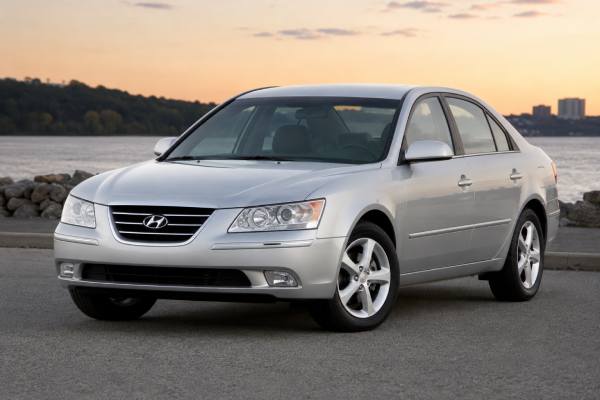
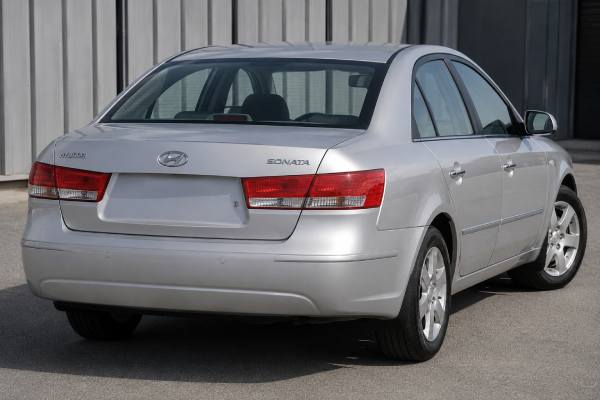
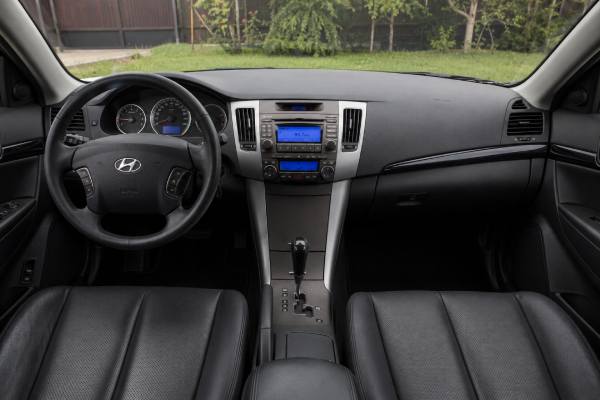
The facelifted Hyundai Sonata NF with the Lambda 3.3-liter V6 is one of the stronger versions of Hyundai’s fifth-generation sedan. It combines a naturally aspirated V6, front-wheel drive, a five-speed automatic transmission, a large cabin, and a comfort-biased chassis that was updated for the late NF years.
For buyers, the appeal is simple: the Sonata NF V6 offers near-large-car space, decent straight-line performance, standard safety equipment for its era, and usually lower used prices than equivalent Honda Accord, Toyota Camry, or Nissan Altima V6 models. The main things to judge carefully are service history, suspension corrosion, automatic transmission behavior, oil leaks, and whether recall work has been completed.
Fast Facts
- The 3.3L Lambda V6 is smooth, chain-driven, naturally aspirated, and rated around 249–250 hp depending on market.
- The facelift brought a more refined cabin, improved steering feel, updated suspension tuning, and available navigation in some markets.
- Standard stability control, ABS, side airbags, curtain airbags, and active front head restraints were strong safety features for the period.
- Check rear subframe/crossmember corrosion carefully, especially on cars from salt-belt climates.
- Normal-service engine oil interval is about 7,500 miles / 12,000 km or 6 months; severe use calls for shorter intervals.
Table of Contents
- Sonata NF V6 Model Brief
- Sonata NF V6 Technical Specs
- Sonata NF V6 Trims and Safety
- Reliability Issues and Recalls
- Maintenance and Buying Advice
- Driving Performance and Economy
- Sonata NF V6 Rival Comparison
Sonata NF V6 Model Brief
The Hyundai Sonata NF was the fifth-generation Sonata, sold in many markets from the mid-2000s into 2010. The facelifted version covered the late production years and is especially relevant for 2008–2010 cars, depending on market timing. In the United States, the major facelift was most clearly associated with the 2009 model year, while other regions used slightly different model-year labels.
The 3.3-liter Lambda V6 sits at the top of the normal petrol range. It is an aluminum, DOHC, 24-valve V6 with multi-point fuel injection and continuously variable valve timing. In facelift form, it is usually quoted at 249 hp SAE in North American specifications or approximately 250 PS / 184 kW in some international references. Torque is about 310 Nm / 229 lb-ft, delivered high enough in the rev range to give the car a smooth, progressive feel rather than a low-rpm shove.
This version is front-wheel drive only. All V6 versions use a five-speed automatic transmission with Hyundai’s SHIFTRONIC manual-selection mode. There is no factory manual gearbox for the V6 in the main North American specification. The drivetrain layout is conventional: transverse engine, open front differential, hydraulic power steering, and independent suspension at both ends.
The facelift matters because Hyundai did more than change the lights and grille. The cabin received a more modern center stack, improved materials, standard USB/iPod auxiliary inputs in many trims, and better overall presentation. The chassis tuning was revised as well, with sharper steering response and different suspension tuning. SE/Sport-style versions received firmer springs, larger stabilizer bars, and 17-inch wheels, giving the V6 version a more controlled feel than earlier comfort-focused Sonata models.
As a used car, the Sonata NF V6 is best understood as a value-focused midsize sedan with a large-car feel. It is not a sports sedan, even in SE trim, but the V6 gives it easy highway passing power and relaxed cruising ability. It suits drivers who want a simple naturally aspirated engine, good cabin space, a conventional automatic, and lower purchase costs than the best-known Japanese rivals.
The trade-off is that condition matters more than badge reputation. A well-maintained V6 Sonata can be a durable, comfortable car, but neglected examples can need suspension, brake, cooling system, transmission fluid, tire, and corrosion-related work that quickly exceeds the car’s market value. The strongest candidates are cars with clear oil-change history, clean ATF, working air conditioning, no dashboard warning lights, solid rear suspension mounting areas, and proof that recall campaigns have been completed.
Sonata NF V6 Technical Specs
Specifications vary slightly by country, trim, and model year. The figures below focus on the facelifted Hyundai Sonata NF 3.3 V6 automatic, using the common North American 2009 specification as the main baseline and noting market-dependent items where needed.
Powertrain and Efficiency
| Item | Hyundai Sonata NF 3.3 V6 facelift |
|---|---|
| Engine code | G6DB, Lambda-family V6 |
| Layout | Front transverse V6, 6 cylinders |
| Valvetrain | DOHC, 4 valves per cylinder, 24 valves total |
| Bore × stroke | 92.0 × 83.8 mm / 3.62 × 3.30 in |
| Displacement | 3.3 L / 3,342 cc |
| Induction | Naturally aspirated |
| Fuel system | Multi-point fuel injection |
| Compression ratio | About 10.4:1 |
| Max power | 249 hp SAE / about 186 kW at 6,000 rpm; often rounded to 250 hp / 184 kW by market |
| Max torque | 310 Nm / 229 lb-ft at 4,500 rpm |
| Timing drive | Chain |
| Rated fuel economy | 10.7 L/100 km combined; 19 mpg city / 29 mpg highway / 22 mpg combined US; about 22.8 / 34.8 / 26.4 mpg UK |
| Real-world highway at 120 km/h / 75 mph | Typically about 8.0–9.5 L/100 km / 25–29 mpg US, depending on tires, load, terrain, and condition |
Transmission, Chassis and Dimensions
| Item | Specification |
|---|---|
| Transmission | 5-speed automatic with SHIFTRONIC manual mode |
| Transmission family | Hyundai 5-speed automatic; verify exact code by VIN/build plate |
| Drive type | Front-wheel drive |
| Differential | Open front differential |
| Front suspension | Independent double-wishbone, coil springs, stabilizer bar |
| Rear suspension | Independent multi-link, coil springs, stabilizer bar |
| Steering | Hydraulic rack and pinion; about 16.9:1 overall ratio where listed |
| Brakes | Front ventilated discs, rear solid discs, ABS/EBD/Brake Assist |
| Common brake rotor sizes | Common V6/17-inch listings: about 300 mm front and 284 mm rear; verify before ordering |
| Popular tire size | P215/55R17 on SE/Limited V6; P215/60R16 on some trims |
| Ground clearance | About 160–165 mm / 6.3–6.5 in, market-dependent |
| Length / width / height | 4,800 / 1,830 / 1,475 mm; 189.0 / 72.0 / 58.0 in |
| Wheelbase | 2,730 mm / 107.5 in |
| Turning circle | About 10.9 m / 35.8 ft curb-to-curb |
| Curb weight | About 1,560–1,685 kg / 3,440–3,715 lb, depending on market and trim |
| GVWR | Approx. 2,030 kg / 4,475 lb on many market listings; verify VIN label |
| Fuel tank | 67 L / 17.7 US gal / 14.7 UK gal; some markets list 70 L / 18.5 US gal |
| Cargo volume | About 462 L / 16.3 ft³ SAE in North America; some VDA-style listings quote about 523 L / 18.5 ft³ |
Performance and Capability
| Item | Typical figure |
|---|---|
| 0–100 km/h / 0–62 mph | About 7.7–8.0 seconds; some 0–60 mph tests are quicker |
| Top speed | About 220–230 km/h / 137–143 mph, market-dependent |
| 100–0 km/h braking | Commonly around 40–43 m / 131–141 ft when tires and brakes are fresh |
| Towing capacity | Often listed around 900 kg / 2,000 lb in North America; some markets quote higher braked limits |
| Payload | Market-dependent; use the door-jamb payload label for the exact vehicle |
Fluids, Capacities and Key Torque Values
| Item | Specification |
|---|---|
| Engine oil spec | API SJ/SL or above, ILSAC GF-3 or above; 5W-20 or 5W-30 commonly preferred |
| Engine oil capacity | 5.2 L / 5.49 US qt with filter |
| Coolant | Ethylene-glycol coolant for aluminum engines; use correct premix or 50/50 mix unless local guidance differs |
| Coolant capacity | About 8.2 L / 8.66 US qt for automatic 3.3L models |
| Automatic transmission fluid | Hyundai Genuine ATF SP-III or approved equivalent |
| Automatic transmission capacity | About 10.9 L / 11.52 US qt total capacity |
| Brake fluid | DOT 3 or DOT 4 equivalent |
| Power steering fluid | PSF-4 type fluid |
| Wheel nut torque | 88–108 Nm / 65–80 lb-ft |
| Engine oil drain plug torque | About 34–44 Nm / 25.3–32.5 lb-ft |
| Oil filter torque | About 12–16 Nm / 8.7–11.6 lb-ft |
Safety and Driver Assistance
| Item | Availability / rating |
|---|---|
| Airbags | Dual front, front seat-mounted side-impact airbags, and front/rear side curtain airbags |
| Stability control | ESC standard on late NF Sonata models in many markets |
| Braking aids | ABS, EBD, Brake Assist |
| Child-seat provisions | Rear LATCH/ISOFIX-type anchors depending on market |
| IIHS ratings | Moderate overlap front: Good; side: Acceptable; roof strength: Marginal; head restraints/seats: Good for 2009 rating set |
| NHTSA period ratings | Commonly listed as five-star front and side ratings under the older rating system |
| Headlight rating | No modern IIHS headlight rating for this generation |
| ADAS | No factory AEB, ACC, lane keeping, blind-spot monitoring, rear cross-traffic alert, or traffic-sign assist in the normal NF V6 |
Sonata NF V6 Trims and Safety
In North America, the facelifted V6 Sonata was most commonly found as GLS V6, SE V6, and Limited V6, though trim names vary by country. International markets often used names such as Premium, Elite, SLX, or similar. The core mechanical package stayed familiar: 3.3L V6, five-speed automatic, front-wheel drive, four-wheel independent suspension, and four-wheel disc brakes.
The trim that best matches the V6’s character is usually the SE or equivalent sport-oriented grade. It brings 17-inch wheels, 215/55R17 tires, firmer suspension tuning, a rear spoiler on many cars, fog lights, leather-trimmed controls, and a more controlled body feel. The Limited is more comfort-oriented, typically adding leather seating, heated front seats, automatic climate control, sunroof availability, upgraded audio, and additional convenience features. The GLS V6, where sold, is simpler but can be a good buy when the condition is better than a higher-trim car.
Quick trim identifiers include the rear badge, wheel size, seat material, steering-wheel audio buttons, dual-zone climate controls, sunroof, navigation screen, and audio head unit. SE models usually have the clearest visual tells: 17-inch alloys, sportier seats, and a firmer stance. Limited models tend to show leather, woodgrain-style trim, heated seats, and more convenience equipment.
Year-to-year changes are important. The facelift brought a redesigned dashboard and center console, updated exterior lamps, revised bumpers, improved audio connectivity, available factory navigation in some markets, and sharper steering/suspension tuning. For the V6, the late-facelift engine calibration and variable intake updates helped output and response compared with earlier NF V6 cars.
Safety equipment was one of the Sonata’s stronger selling points. Standard or widely fitted features included:
- Six airbags: front, front side, and side curtain coverage.
- Electronic Stability Control.
- Anti-lock brakes with Electronic Brake-force Distribution.
- Brake Assist.
- Active front head restraints.
- Tire Pressure Monitoring System in North American cars.
- Three-point belts for all seating positions.
- Rear child-seat anchors.
The safety ratings need context because testing standards changed over time. The Sonata NF performed well in the older U.S. NHTSA star system, where front and side results were commonly quoted at five stars. IIHS results were more mixed but still respectable for the era: Good in the original moderate overlap front test, Acceptable in the original side test, Good for head restraints/seats, and Marginal for roof strength. Modern small-overlap, pedestrian AEB, headlight, and advanced crash-avoidance tests did not apply to this generation.
There is no modern driver-assistance suite. Buyers should not expect automatic emergency braking, adaptive cruise control, lane centering, blind-spot monitoring, rear cross-traffic alert, or camera-based traffic-sign recognition. Backup cameras and parking sensors may appear on some cars as dealer or aftermarket equipment, but they are not equivalent to a modern integrated ADAS package. After collision repairs, still confirm that airbags, seat-belt pretensioners, OCS passenger-seat sensing, ABS, ESC, and steering-angle sensor calibrations have been checked correctly.
Reliability Issues and Recalls
The 3.3L Lambda V6 is generally a sound engine when serviced properly. It is not part of the later Hyundai/Kia Theta II direct-injection engine issue profile that affected many four-cylinder models. It uses port fuel injection, so intake-valve carbon buildup is usually much less of a concern than on many direct-injection engines. It also uses a timing chain rather than a belt, so there is no routine timing-belt replacement interval.
That does not make the car maintenance-free. Age is now the main enemy. Even a low-mileage Sonata NF is an older vehicle, so rubber, seals, cooling parts, suspension bushings, electronics, and corrosion protection matter as much as mileage.
| Issue | Prevalence | Severity / cost | Symptoms | Likely remedy |
|---|---|---|---|---|
| Rear crossmember/subframe corrosion | Common in salt climates | High | Rear alignment changes, clunks, visible rust near rear suspension mounts | VIN recall check, inspection, repair or crossmember replacement |
| Stop lamp switch failure | Common enough for recall | Low | Brake lights fail or stay on, cruise issues, shifter interlock issues | Replace switch under recall/updated part |
| Valve cover or front-cover oil seepage | Occasional | Low–medium | Burning oil smell, drips, oil on accessories | Replace gaskets/seals; clean and recheck |
| Alternator contamination from oil leaks | Occasional | Medium | Battery light, charging faults, weak electrical system | Fix leak first, then test/replace alternator |
| Automatic transmission harsh shift or flare | Occasional | Medium–high | Delayed engagement, hard 2–3 shift, flare when hot | Check ATF condition/level, scan codes, service fluid, diagnose solenoids/valve body |
| Suspension bushing and ball-joint wear | Common with age | Medium | Clunks, wandering, uneven tire wear | Replace worn control arms, links, bushings, align |
| Wheel bearing noise | Occasional | Medium | Humming that rises with speed | Replace bearing/hub assembly |
| Cooling system aging | Common with age | Medium | Coolant smell, overheating, brittle hoses | Pressure test, replace hoses, thermostat, radiator as needed |
| Air conditioning weakness | Occasional | Medium | Warm air, compressor cycling, refrigerant leak | Leak test, repair, recharge to exact spec |
Recalls and Service Actions
The most important recall area for late NF Sonatas is rear crossmember corrosion. Affected 2006–2010 Sonata models in salt-belt areas may allow road salt and water into portions of the rear crossmember, leading to corrosion and possible rear control-arm detachment. On a used example, do not rely only on the seller’s statement. Check the VIN through the official recall system and inspect the rear suspension structure on a lift.
The stop lamp switch recall is also important. A failed switch may cause brake lamps not to illuminate, brake lamps to stay illuminated, cruise control not to cancel correctly, or the shifter interlock to behave incorrectly. The repair is straightforward, but completion should still be confirmed.
Some 2008 cars may also have an occupant-classification-system airbag recall depending on production date and market. This involved the passenger-seat sensing system and correct classification of occupants. Again, the right answer is a VIN check, not a guess based only on model year.
Software updates on this generation are modest by modern standards. There is no battery-management system or ADAS camera network to maintain. Relevant updates are more likely to involve powertrain control, transmission shift quality, occupant classification, or audio/navigation behavior. If a car has persistent shifting complaints, warning lights, or airbag/OCS messages, ask a dealer or Hyundai specialist to check whether any applicable campaign or calibration is still open.
Pre-Purchase Checks
Before buying, request the following:
- Complete service history, including oil changes and ATF service.
- Proof of recall completion by VIN.
- Inspection of the rear crossmember, rear control-arm mounts, brake lines, rocker seams, and subframe areas.
- Cold start test for timing-chain rattle, misfire, exhaust smoke, and accessory noise.
- Hot test drive to check shift quality, cooling fan operation, braking vibration, and steering pull.
- Scan of engine, transmission, ABS, ESC, and airbag modules.
- Tire inspection for uneven wear, which may reveal suspension or alignment problems.
A clean, rust-free, well-maintained V6 is usually a better purchase than a higher-trim car with poor records and visible corrosion.
Maintenance and Buying Advice
Maintenance should be based on the official schedule for the exact VIN and market, but the following is a practical used-car schedule for a facelifted Sonata NF 3.3 V6 automatic.
| Item | Practical interval |
|---|---|
| Engine oil and filter | 7,500 miles / 12,000 km or 6 months in normal use; 3,000–5,000 miles / 4,800–8,000 km in severe use |
| Engine air filter | Inspect every 15,000 miles / 24,000 km; replace about every 30,000 miles / 48,000 km or sooner if dusty |
| Cabin air filter | Inspect yearly; replace about every 12,000–15,000 miles / 20,000–24,000 km |
| Coolant | First major replacement around 60,000 miles / 96,000 km or 60 months; then about every 25,000 miles / 40,000 km or 24 months |
| Spark plugs | Iridium plugs commonly serviced around 100,000–105,000 miles / 160,000–168,000 km |
| Automatic transmission fluid | Normal schedule may be long, but used-car preventive service every 30,000–60,000 miles / 48,000–96,000 km is wise |
| Brake fluid | Every 2–3 years |
| Brake pads and rotors | Inspect every service; replace based on thickness, corrosion, vibration, and pad life |
| Serpentine/accessory belt | Inspect at oil services; replace for cracks, glazing, noise, or tensioner issues |
| Timing chain | No routine replacement; inspect if rattle, timing-correlation codes, poor running, or guide/tensioner symptoms appear |
| Valve clearance | Inspect/adjust if excessive valve noise or vibration is present |
| 12V battery | Test yearly after 3 years; typical replacement window is 4–6 years |
| Tires | Rotate every 5,000–7,500 miles / 8,000–12,000 km; align if wear is uneven or after suspension work |
For fluids, do not improvise. The V6 takes about 5.2 L / 5.49 US qt of engine oil with filter, and Hyundai listed 5W-20 or 5W-30 oil meeting the required API/ILSAC standards as common choices. The automatic transmission requires SP-III specification ATF or an approved equivalent. Using a universal fluid that does not meet the correct spec can create shift issues.
Used Buyer Checklist
Inspect these areas carefully:
- Rear structure: Rear crossmember, control-arm mounts, trailing arm points, subframe seams, and brake-line routing.
- Engine bay: Oil leaks around valve covers, timing cover areas, oil filter housing, and front accessories.
- Cooling system: Radiator end tanks, hoses, thermostat behavior, coolant color, and fan operation.
- Transmission: Smooth engagement from Park to Drive/Reverse, clean red ATF, no hot shift flare.
- Suspension: Front lower arms, rear links, sway-bar links, struts, mounts, and ball joints.
- Brakes: Rotor rust, pulsation, sticky calipers, soft pedal, and ABS/ESC warning lights.
- Electronics: Airbag light, passenger airbag indicator, TPMS, window regulators, audio, climate control, and alternator output.
- Interior: Seat wear, water leaks, sunroof drains, dashboard illumination, and HVAC blend-door operation.
The best years to seek are usually the later facelift cars with complete records and no corrosion. A 2009 or 2010 V6 with documented maintenance and clean underbody condition is often preferable to an early 2008 car unless the 2008 is clearly better preserved. For trim choice, SE gives the best balance of V6 performance character and equipment, while Limited is the comfort pick. Avoid cars with severe underbody rust, unresolved airbag/ESC lights, harsh transmission shifts, coolant loss, or evidence of neglected oil leaks.
Long-term durability is generally respectable. The engine itself can last well when oil changes are regular and leaks are fixed early. The automatic transmission is more sensitive to fluid condition and heat. The body and rear suspension structure are the deciding factors in salty regions. A rust-free car with fresh fluids is worth paying more for than a cheaper example that needs structural, brake, and suspension work.
Driving Performance and Economy
The Sonata NF V6 feels strongest in normal road driving rather than aggressive cornering. The Lambda V6 is smooth, quiet when cruising, and willing to rev when asked. It does not have turbocharged low-end torque, but it responds cleanly and gives the car confident passing ability. The five-speed automatic is simple by modern standards, yet it suits the engine’s relaxed character.
Throttle response is progressive. Around town, the V6 moves the Sonata easily without needing high revs. On the highway, kickdown is decisive enough for passing, although the transmission may downshift more noticeably than a newer six- or eight-speed automatic. SHIFTRONIC manual mode is useful for holding a gear on hills or during a pass, but it does not make the car feel sporty in the modern sense.
Ride quality is one of the car’s strengths. GLS and Limited versions are comfortable and absorb rough pavement well, though worn struts or bushings can make the body feel floaty. SE models feel tighter, with less roll and better steering response, but they are still more comfort sedan than sharp sports sedan. Steering is hydraulic and reasonably natural, but feedback is modest.
Braking feel is adequate when the system is fresh. Old brake fluid, rusted rear rotors, sticky calipers, and cheap tires can make a big difference, so a poor test-drive braking feel should not be dismissed as “normal old car behavior.” A properly maintained V6 Sonata should stop straight, resist vibration, and maintain pedal consistency in normal road use.
Cabin noise is moderate. At city speeds, the V6 is subdued. At highway speeds, tire roar and wind noise become more noticeable than in newer sedans, but the car remains a comfortable long-distance cruiser. Tire choice has a large effect: touring tires suit the Sonata’s character better than cheap hard-compound tires.
Real-world fuel economy depends heavily on driving style:
| Use case | Typical economy |
|---|---|
| City driving | About 12–15 L/100 km / 16–20 mpg US / 19–24 mpg UK |
| Mixed driving | About 10–12 L/100 km / 20–24 mpg US / 24–29 mpg UK |
| Highway 100–110 km/h | About 7.5–8.5 L/100 km / 28–31 mpg US / 34–37 mpg UK |
| Highway 120 km/h / 75 mph | About 8.0–9.5 L/100 km / 25–29 mpg US / 30–35 mpg UK |
| Cold winter short trips | Often 10–20% worse than mild-weather figures |
Performance is still respectable for an older midsize sedan. Expect 0–100 km/h in the high-7-second range for a healthy car, with some 0–60 mph tests around the high-6 to low-7-second range depending on measurement method. The important part is not the number; it is how easy the V6 makes merging and passing compared with the four-cylinder Sonata.
For towing or heavy loads, follow the market-specific rating. North American references often list around 2,000 lb / 900 kg maximum towing, while some other markets list higher braked trailer limits. Regardless of the published number, this is a front-wheel-drive sedan with an older automatic transmission, so heavy towing, steep grades, and hot weather should be treated conservatively. Use correct trailer equipment, keep speeds modest, service the ATF, and monitor engine temperature.
Sonata NF V6 Rival Comparison
The Sonata NF V6 competed against the Toyota Camry V6, Honda Accord V6, Nissan Altima V6, Ford Fusion V6, Mazda6 V6, Chevrolet Malibu V6, and Kia Optima/Magentis V6. On paper, it offered a strong mix of power, space, warranty coverage when new, and standard safety equipment. On the used market, its main advantage is value.
| Rival | Strengths versus Sonata NF V6 | Sonata advantage |
|---|---|---|
| Toyota Camry V6 | Stronger resale, more power in many years, excellent refinement | Usually cheaper to buy, spacious, good standard safety |
| Honda Accord V6 | Sharper handling, stronger brand reputation, high-revving V6 | Lower purchase price, softer ride, simpler value proposition |
| Nissan Altima V6 | Strong acceleration, sportier character | More conventional automatic feel; often less CVT concern |
| Ford Fusion V6 | Available AWD in some versions, solid chassis | Larger-feeling cabin and often better value |
| Mazda6 V6 | More engaging steering and handling | More relaxed ride and roomier sedan feel |
| Chevrolet Malibu V6 | Comfortable and quiet | Stronger V6 output and often better equipment value |
| Kia Optima/Magentis V6 | Closely related value alternative | Sonata often has broader availability and stronger parts familiarity |
Against a Camry or Accord V6, the Sonata is less prestigious and may not hold value as well, but that lower resale value is exactly why it can make sense as a used buy. You often get V6 power, leather or sport trim, and safety equipment for less money. The key is not to buy the cheapest one; buy the one with the least corrosion and the best maintenance history.
Against an Altima V6, the Sonata feels less athletic but also avoids the common buyer concern around Nissan CVTs from the period. The Sonata’s five-speed automatic is older technology, but many shoppers prefer its conventional feel. Against the Mazda6, the Sonata is less fun but more relaxed. Against the Fusion, the Hyundai lacks available AWD but feels spacious and simple.
The Sonata NF V6 is best for someone who values comfort, equipment, and purchase-price efficiency more than brand image or sharp handling. It is not the top choice for maximum fuel economy, modern safety technology, or enthusiast driving. It is a good choice when the individual car is clean, documented, rust-free, and priced realistically.
A strong buying decision comes down to condition. A slightly more expensive Sonata with complete records, clean underbody, smooth transmission, fresh brakes, and good tires is usually the smart purchase. A neglected V6 with corrosion, warning lights, overdue fluids, and cheap repairs is not a bargain.
References
- 2009 SONATA 2008 (Manufacturer Publication)
- OWNER’S MANUAL Operation Maintenance Specifications 2008 (Owner’s Manual)
- Gas Mileage of 2009 Hyundai Sonata 2026 (Fuel Economy Database) ([fueleconomy.gov][1])
- 2009 Hyundai Sonata 2026 (Safety Rating) ([IIHS][2])
- Part 573 Safety Recall Report 13V-354 2014 (Recall Database)
Disclaimer
This article is for informational purposes only and is not a substitute for professional diagnosis, inspection, repair, or official service guidance. Specifications, torque values, fluid capacities, maintenance intervals, recall applicability, and repair procedures can vary by VIN, market, production date, trim, and equipment. Always verify details against the official service documentation for the exact vehicle and consult a qualified technician when needed.
If this guide helped you, please consider sharing it on Facebook, X/Twitter, or your preferred automotive community to support our work.