
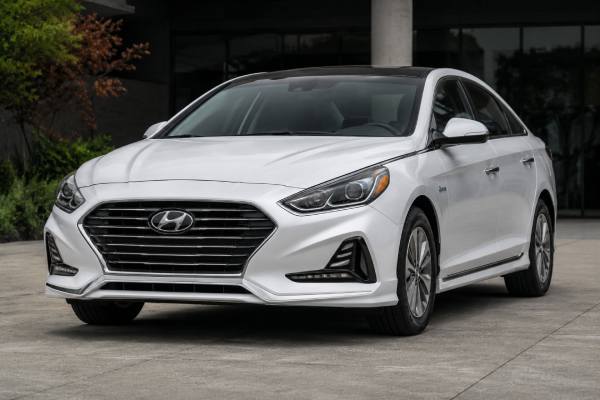
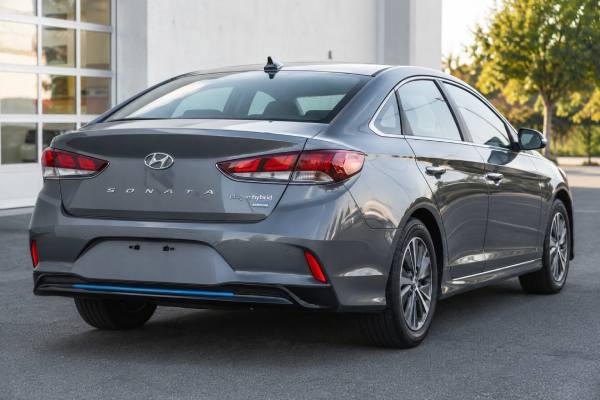
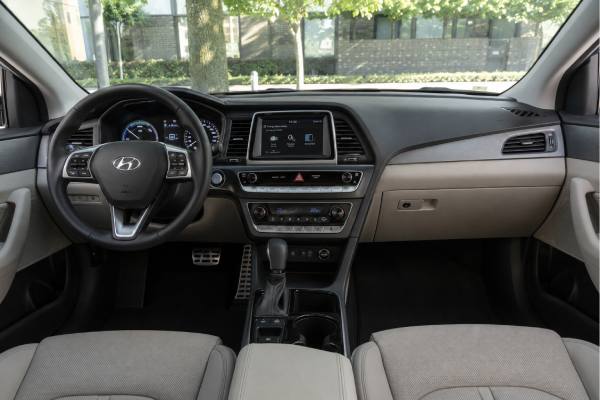
The 2018–2019 Hyundai Sonata Plug-in Hybrid is a midsize sedan for drivers who want real electric commuting range without giving up gasoline range, a conventional driving feel, or a roomy cabin. This facelifted LF-generation Sonata PHEV pairs Hyundai’s Nu 2.0-liter GDI gasoline engine with a stronger electric motor, a 9.8 kWh lithium-ion polymer battery, front-wheel drive, and a 6-speed automatic transmission rather than the eCVT used in many rivals.
Its main appeal is simple: it can cover many daily trips on electricity, then behave like a normal hybrid sedan when the battery is depleted. The main questions for buyers are battery health, recall completion, charging behavior, service history, and whether the reduced trunk space is acceptable.
Final Verdict
The 2018–2019 Hyundai Sonata Plug-in Hybrid is a good used choice for commuters who can charge at home or work and want a spacious, quiet sedan with a more traditional automatic-transmission feel than many hybrids. Its strongest appeal is the blend of usable EV range, long gasoline backup range, and midsize comfort. The biggest tradeoff is ownership complexity: the high-voltage battery, onboard charger, BMS, and hybrid-specific parts make inspection history more important than on a normal Sonata. Buy only after confirming recall/campaign completion, stable charging, clean hybrid diagnostics, and a battery that still delivers useful EV range.
| Pros | Cons |
|---|---|
| Useful EV range for many daily commutes | Small 9.9 cu ft trunk limits luggage flexibility |
| Roomy midsize cabin with comfortable rear seating | Rare model, so hybrid-specific parts can be slower |
| 6-speed automatic feels more conventional than eCVTs | Battery and charger checks are essential before purchase |
| Strong safety record with available advanced driver aids | Best efficiency requires regular charging discipline |
| 202 hp system output gives adequate everyday performance | No AWD, no DC fast charging, no towing focus |
Table of Contents
- LF Sonata PHEV Detailed Overview
- Specifications and Technical Data
- Trims, Options, Safety and Driver Assistance
- Reliability, Common Issues and Service Actions
- Maintenance and Buyer’s Guide
- Driving and Performance
- How the Sonata PHEV Compares to Rivals
LF Sonata PHEV Detailed Overview
The facelifted 2018–2019 Sonata Plug-in Hybrid is best understood as a comfortable midsize sedan with a short-range EV mode, not as a performance hybrid or a full electric car. It suits owners who drive predictable daily distances, can recharge often, and still need a gasoline engine for long trips.
The LF Sonata was already a roomy, conservative family sedan, and the plug-in version adds a larger battery and more electric power without changing the basic personality. The 2018 facelift brought updated exterior styling, revised lighting, a refreshed interior layout, infotainment improvements, retuned suspension details, and broader availability of driver-assistance technology. For shoppers comparing it with the regular Sonata Hybrid, the plug-in version’s biggest advantage is the ability to drive many local trips without starting the engine. Its biggest sacrifice is cargo space, because the larger battery reduces trunk volume.
Mechanically, the Sonata PHEV uses a 2.0-liter naturally aspirated direct-injected gasoline engine and an electric motor integrated with a 6-speed automatic transmission. This Transmission-Mounted Electrical Device layout gives it a more familiar stepped-gear feel than Toyota-style planetary hybrids or many eCVT-equipped hybrids. The result is less “rubber band” sensation under acceleration, though the Sonata still prioritizes smoothness and economy over sharp response.
The car is front-wheel drive only. There is no AWD version, no performance trim, and no serious towing role. That makes the ownership case more focused: this is a daily commuter and highway sedan for people who value quiet operation, comfort, fuel savings, and sedan space.
For used buyers, the PHEV-specific parts matter more than the headline mileage. A well-kept car that charges normally, still shows a healthy electric range, has completed recalls and campaigns, and has clean service records is much more attractive than a cheaper example with unresolved hybrid warnings. Because this model was sold in relatively small numbers, a pre-purchase inspection should be done by a Hyundai dealer or an independent hybrid specialist with scan-tool access to the battery-management system.
The 2019 model year is often the cleaner choice because it benefits from the final-year specification and is generally newer. A 2018 can still be a good buy, but it deserves extra attention to recall completion, trunk latch work, hybrid battery/BMS records, and charging behavior. Either year can be worthwhile when the price reflects condition and when the buyer’s use pattern includes frequent charging.
Specifications and Technical Data
The Sonata Plug-in Hybrid uses Hyundai’s Nu 2.0 GDI four-cylinder engine, a 50 kW electric motor, a 9.8 kWh lithium-ion polymer battery, and a 6-speed automatic transmission driving the front wheels. The important technical point is that it behaves like an electric car for short trips, then like a conventional hybrid sedan after the plug-in battery range is used.
| Item | Hyundai Sonata Plug-in Hybrid LF facelift |
|---|---|
| Model years covered | 2018–2019 facelift LF Sonata Plug-in Hybrid |
| Engine | Nu 2.0L GDI DOHC 16-valve inline-4 |
| Displacement | 1,999 cc / 2.0 liters |
| Bore × stroke | 81 mm × 97 mm |
| Compression ratio | 13.5:1 |
| Gasoline engine output | 154 hp at 6,000 rpm; 140 lb-ft at 5,000 rpm |
| Electric motor output | 50 kW / 67 hp; 151 lb-ft |
| Combined system output | 202 hp at 6,000 rpm |
| Battery | 9.8 kWh lithium-ion polymer, 360V maximum |
| Fuel type | Regular unleaded gasoline plus external charging |
| Item | Specification |
|---|---|
| Transmission | 6-speed electronic automatic with SHIFTRONIC manual mode |
| Hybrid layout | Transmission-mounted electric motor with clutch-based hybrid operation |
| Drive type | Front-wheel drive |
| Final drive ratio | 3.510 |
| Onboard AC charger | 3.3 kW |
| Level 1 charging time | About 8.7 hours on 110/120V |
| Level 2 charging time | About 2.7 hours on 220/240V |
| DC fast charging | Not supported |
| Item | Value |
|---|---|
| Body style | 4-door midsize sedan, 5 seats |
| Length | 4,854 mm (191.1 in) |
| Width | 1,864 mm (73.4 in), excluding mirrors |
| Height | 1,471 mm (57.9 in) |
| Wheelbase | 2,804 mm (110.4 in) |
| Passenger volume | 106.1 cu ft |
| Cargo volume | 9.9 cu ft (about 280 L) |
| Fuel tank | 55 L (14.53 US gal) |
| Turning diameter | 10.9 m (35.6 ft), curb to curb |
| Item | Specification or rating |
|---|---|
| Front suspension | MacPherson strut with high-performance dampers |
| Rear suspension | Independent multi-link with high-performance dampers |
| Front brakes | 12.0 in ventilated discs |
| Rear brakes | 11.2 in ventilated discs |
| Common tire size | 215/55R17 on Plug-in Hybrid models |
| EPA electric range | Up to 28 miles, depending on model year/listing |
| EPA electric efficiency | 99 MPGe combined; 34 kWh/100 miles |
| EPA gasoline economy | 37 city / 42 highway / 39 combined mpg US |
| Gasoline economy, metric | 6.4 / 5.6 / 6.0 L/100 km city/highway/combined |
| Item | Useful service value |
|---|---|
| Engine oil | SAE 5W-20 preferred in many markets; 5W-30 commonly allowed |
| Engine oil capacity | About 4.1 L (4.3 US qt) with filter |
| Brake fluid | DOT 3 or DOT 4, as specified by service documentation |
| Automatic transmission fluid | Hyundai/Kia ATF SP-IV specification or approved equivalent |
| Wheel nut torque | 107–127 Nm (79–94 lb-ft) |
| Timing drive | Timing chain; inspect for noise, stretch or correlation faults |
Trims, Options, Safety and Driver Assistance
The Sonata Plug-in Hybrid was sold in a narrow trim range compared with the gasoline Sonata, so equipment and condition usually matter more than trim complexity. The key buying distinction is whether the car has the safety, lighting, navigation, audio, and comfort features you want, because mechanical differences are limited.
Trims and equipment
In North America, the Sonata Plug-in Hybrid was commonly offered as a base Plug-in Hybrid and Plug-in Hybrid Limited. Both use the same 2.0 GDI PHEV system, 6-speed automatic transmission, front-wheel drive layout, 9.8 kWh battery, and 17-inch wheel/tire package. There is no AWD option, no sport suspension package that changes the basic chassis, and no different engine tune by trim.
The Limited is the more desirable used-car target for many buyers because it typically brings more comfort and technology equipment. Depending on market and exact build, desirable features may include leather seating, heated and ventilated front seats, heated steering wheel, larger infotainment/navigation system, premium audio, wireless charging, parking assistance features, LED lighting, smart cruise control, and lane-support technology.
Quick identifiers include Plug-in Hybrid exterior badging, a charging door, a hybrid-specific instrument display, EV/HEV energy-flow screens, and the smaller trunk with the raised battery packaging. On a test drive, the car should allow EV operation when sufficiently charged and should show normal charging status at the charge port and instrument cluster.
Safety ratings and structure
The LF Sonata family performed strongly in U.S. crash testing for this generation. The 2018 Sonata earned high IIHS crashworthiness results, including Good ratings in the major crashworthiness categories, while the Top Safety Pick+ award depended on optional front crash prevention and specific headlights on vehicles built after the relevant production date. That distinction matters: a Sonata with the right optional safety system and better headlights is not the same safety package as a lower-spec car with basic lighting.
NHTSA ratings for the Sonata/Sonata Hybrid family were also strong, commonly listed as 5-star overall for this generation. Buyers should still check the exact VIN and trim because ratings, equipment, and recall status can vary by body style, production date, market, and installed safety systems.
Driver assistance and calibration considerations
Standard safety equipment includes stability control, traction control, ABS, electronic brake-force distribution, a rearview camera, tire-pressure monitoring, and seven airbags, including a driver’s knee airbag. Blind-spot detection, rear cross-traffic alert, and lane-change assist were important available or standard features depending on year and trim.
More advanced systems may include automatic emergency braking, adaptive cruise control, lane departure warning, lane keeping assist, automatic high beams, and rear parking sensors. When shopping, verify these systems from the actual buttons, cluster menus, windshield camera area, radar sensor area, and build sheet rather than relying only on the listing.
After windshield replacement, front-end collision repair, bumper removal, alignment work, or radar/camera replacement, ADAS calibration may be needed. A used Sonata with unexplained warning lights, disabled lane support, or a nonfunctioning smart cruise system should be treated as a diagnostic job, not a simple switch setting.
Reliability, Common Issues and Service Actions
The Sonata PHEV can be durable, but it is less forgiving of poor diagnostics and incomplete campaign history than a normal gasoline sedan. The most important checks are high-voltage battery behavior, charging reliability, 12V battery health, recall completion, and evidence of regular oil and fluid maintenance.
| Issue area | Prevalence | Severity/cost | Typical signs |
|---|---|---|---|
| 12V battery weakness | Common with age/low use | Low to medium | No-ready condition, random warnings, slow boot-up |
| Brake rotor corrosion | Common in wet/salt climates | Low to medium | Pulsation, scraping, rusty rear rotors |
| Charging or OBC complaints | Occasional | Medium to high | Refuses charge, red charge light, charging interruptions |
| Hybrid battery/BMS faults | Occasional to rare | High | Check Hybrid System, reduced EV range, no EV drive |
| GDI misfire/carbon symptoms | Occasional with mileage | Medium | Rough cold start, misfire codes, hesitation |
| Engine knock/oil neglect | Rare but serious | High | Knocking, low oil, metal debris, bearing noise |
Hybrid system and charging issues
Early Sonata PHEV service actions are especially important. Certain 2016–2018 Sonata Plug-in Hybrid vehicles were affected by a Voltage Protection Device recall. The concern was that the VPD could activate during EV operation and cause loss of motive power. The remedy involved replacing the relevant BMS components and wiring with an updated overvoltage protection design. Some OBC-related campaigns also addressed onboard-charger software and charging-lamp control logic.
For a 2018–2019 facelift buyer, the practical lesson is clear: do not guess based on model year alone. Check the VIN through Hyundai and NHTSA, ask for dealer campaign records, and scan the BMS/OBC for stored or pending codes. During inspection, plug the car into Level 1 and Level 2 power if possible. It should start charging normally, show predictable charge status, and complete a charge without warning lights.
Battery degradation should be judged by real behavior, not only by dashboard range. A healthy car should still deliver useful EV miles in mild weather. Short winter trips, heater use, high speeds, old tires, and poor alignment can reduce displayed range, but a dramatic drop, repeated hybrid warnings, or a car that avoids EV mode deserves specialist diagnosis.
Gasoline engine and transmission
The Nu 2.0 GDI engine is efficient and generally smooth, but it still needs clean oil and correct service. Direct injection can lead to intake-valve deposits over time, especially with short trips and low-load operation. Symptoms include rough cold starts, misfires, hesitation, or reduced smoothness when the engine starts after EV operation. Ignition coils, spark plugs, fuel injectors, and carbon buildup should be considered before assuming a major hybrid fault.
The engine uses a timing chain, not a routine timing belt. There is no normal mileage-based chain replacement, but rattling on startup, cam/crank correlation codes, or persistent timing-related faults should be investigated.
The 6-speed automatic is a strength because it feels familiar and tends to shift smoothly. Harsh engagement, delayed reverse, flare between gears, shudder, or fluid leaks are warning signs. Because hybrid torque flows through the transmission, poor shifting should be checked with a scan tool before purchase.
Chassis, brakes, body and recalls
Regenerative braking reduces friction-brake use, which is good for pad life but can allow rotors to rust. This is most noticeable on rear rotors in rainy, coastal, or salted-road climates. Periodic firm braking in a safe place and regular brake inspections help keep the system clean.
Suspension wear is typical midsize-sedan wear: sway-bar links, control-arm bushings, struts, wheel bearings, and alignment issues become more likely with mileage. Check for uneven tire wear, clunks over small bumps, steering pull, and vibration at highway speed.
Corrosion inspection should focus on rear suspension mounting areas, subframe edges, brake lines, underbody seams, exhaust hangers, and the trunk/spare-well area. A clean southern car is usually more attractive than a cheaper salt-belt car with rusty fasteners and brake hardware.
Recall and service-action verification should include the VPD/BMS campaign where applicable, trunk latch campaign where applicable, and any market-specific software or customer satisfaction programs. Ask for proof, not verbal assurance.
Maintenance and Buyer’s Guide
The best Sonata PHEV to buy is the one with boring paperwork: regular oil changes, completed campaigns, clean charging behavior, good tires, no hybrid warnings, and no unexplained electrical history. A cheap car with a questionable battery or unresolved “Check Hybrid System” message can become expensive quickly.
| Interval | Maintenance items |
|---|---|
| Monthly | Check tire pressure, oil level, coolant level, brake fluid, lights, charge port and charging cable |
| Every 6–12 months / 6,000–7,500 miles | Replace engine oil and filter; rotate tires; inspect brakes, suspension, steering, hoses and leaks |
| Every 15,000 miles | Replace cabin air filter; inspect brake fluid, fuel system, parking brake and vapor hoses |
| Every 30,000 miles | Replace engine air filter; inspect fuel lines, belts, cooling system and hybrid cooling ducts |
| Every 45,000–60,000 miles | Service brake fluid by age; consider ATF service in severe use; inspect mounts, axles and wheel bearings |
| Around 95,000–105,000 miles | Replace spark plugs; inspect coils, PCV system, serpentine belt and timing-chain behavior |
| 120,000 miles / 10 years | Replace engine/hybrid cooling fluids as specified; then follow shorter repeat coolant intervals |
| Every 3–5 years | Test or replace 12V battery; inspect terminals and hybrid-system readiness behavior |
Use severe-service intervals if the car sees short trips, very hot or cold weather, mountain driving, heavy stop-and-go use, salted roads, long storage periods, or rideshare/delivery duty. Plug-in hybrids often accumulate engine hours differently from gasoline cars, but the engine still needs time-based oil changes because moisture, fuel dilution, and age affect oil even when gasoline mileage is low.
Fluid and service priorities
Use the oil viscosity and specification listed for the VIN and market. In many North American references, SAE 5W-20 is preferred for economy, with 5W-30 commonly accepted depending on climate and documentation. Avoid extended oil-change experiments; the GDI engine benefits from clean oil.
The automatic transmission should use the correct Hyundai/Kia SP-IV fluid specification or approved equivalent. Universal ATF is not worth the risk. Even when the official schedule is inspection-based, a careful drain-and-fill around 60,000–80,000 miles can be sensible for long-term ownership, especially if the car is used in heat or heavy traffic.
Brake fluid should be changed by age and moisture content, not just mileage. Brake rotors and calipers need regular inspection because regenerative braking can hide wear or corrosion until vibration appears.
The high-voltage system is not a DIY area. Do not open battery covers, orange-cable connections, inverter components, or onboard-charger assemblies without proper training and insulated equipment.
Buyer inspection checklist
Before buying, request:
- Hyundai dealer printout showing completed recalls, service campaigns and warranty repairs.
- Battery-management scan showing no active or stored major battery/OBC/DC–DC faults.
- A full charge test and a test drive from EV mode into hybrid mode.
- Evidence of regular oil changes and correct fluids.
- Inspection for brake corrosion, uneven tire wear and suspension clunks.
- Confirmation that all ADAS features work without warning lights.
- Check of charging cable, charge-port door, port pins and charge indicator lights.
- Cold start after the gasoline engine has sat overnight.
- Underbody inspection for rust, leaks and crash repair.
Best buys are usually late-build 2018 or 2019 Limited models with clean records, working Level 2 charging, strong EV range, and no hybrid warnings. Avoid cars with repeated unresolved check-engine or hybrid-system lights, missing campaign records, salvage history, water intrusion, poor body repairs, or a seller who cannot demonstrate charging.
Long-term durability is good when the car is maintained and kept in its intended use case. The key risk is not ordinary service cost; it is an out-of-warranty hybrid fault on a low-volume model. Price the car with that reality in mind.
Driving and Performance
The Sonata Plug-in Hybrid drives like a quiet, comfort-biased midsize sedan with added electric smoothness. It is quick enough for daily traffic, but its real strength is calm commuting rather than sporty response.
In EV mode, the car is smooth and relaxed at low speeds. The electric motor gives immediate step-off torque, so city driving feels easier than the horsepower number suggests. When the gasoline engine starts, the transition is usually smooth, though a cold engine can be more noticeable on winter mornings or after many short EV-only trips.
The 6-speed automatic gives the car a more conventional feel than many hybrid rivals. Under moderate throttle, it shifts naturally and avoids the constant high-rpm drone associated with some eCVTs. Under hard acceleration, the engine becomes more audible and the car feels tuned for steady progress rather than urgency. Independent testing and real-world reports generally place 0–60 mph around the high-7-second to low-8-second range, depending on battery charge, tires, conditions and test method.
Ride quality is one of the Sonata’s better traits. The suspension is tuned for comfort, with stable highway manners and good isolation from small bumps. The heavier PHEV battery gives the car a planted feel, but it is not playful. Steering is light and predictable rather than communicative. Braking can feel slightly grabby or inconsistent at low speeds because the car blends regenerative and friction braking.
Real-world efficiency depends heavily on charging. In mild weather, many owners can see roughly 22–28 electric miles in mixed use, with city driving often doing better than fast highway use. Cold weather, cabin heat, snow tires, high speeds, and battery age can reduce EV range into the high teens or low 20s. Once the plug-in battery range is depleted, expect charge-sustaining economy close to the official 39 mpg combined rating when driven gently, with highway-heavy use often near 5.6–6.5 L/100 km and mixed use often around 6.0–7.0 L/100 km.
Charging is simple. A normal household outlet can refill the battery overnight, while a Level 2 station can do it in under three hours. Because the battery is small by EV standards, the lack of DC fast charging is not a major problem. The best ownership pattern is to charge at home every night and again at work if available. Owners who rarely plug in would usually be better served by a regular Sonata Hybrid.
The Sonata PHEV is not rated or suited as a towing vehicle in the way an SUV or truck is. Load it like a normal family sedan, not a utility vehicle. Extra passengers and luggage are handled well from a comfort standpoint, but the small trunk is the packaging limit.
How the Sonata PHEV Compares to Rivals
The Sonata Plug-in Hybrid makes the most sense against rivals when cabin space, sedan comfort and value matter more than maximum EV range. It is not the most efficient PHEV, but it is one of the more comfortable midsize plug-in sedans of its era.
| Model | Main advantage | Main tradeoff |
|---|---|---|
| Hyundai Sonata Plug-in Hybrid | Roomy cabin, conventional feel, good value | Small trunk and low-volume parts concern |
| Kia Optima Plug-in Hybrid | Similar mechanical package with different styling | Same basic PHEV parts and cargo compromises |
| Ford Fusion Energi | Common used-market choice, comfortable ride | Very limited trunk space and modest efficiency |
| Toyota Prius Prime | Excellent hybrid efficiency and Toyota reputation | Less midsize-sedan comfort and different driving feel |
| Chevrolet Volt | Much longer EV range and strong electric driving | Tighter rear seat and discontinued support concerns |
| Honda Clarity Plug-in Hybrid | Long EV range and spacious cabin | Unusual styling and model-specific parts availability |
Against the Toyota Prius Prime, the Sonata feels more like a traditional midsize sedan. It has a roomier rear seat and calmer highway character, but the Prius Prime is usually the better choice for maximum gasoline efficiency after the battery is depleted.
Against the Chevrolet Volt, the Sonata wins on rear-seat comfort and conventional sedan feel. The Volt’s advantage is much stronger EV-first capability, with a longer electric range that can cover more commutes without gasoline. Buyers choosing between them should decide whether they want an EV-like plug-in or a comfortable hybrid sedan with EV assistance.
Against the Ford Fusion Energi, the Sonata is similar in concept but often feels more efficient and more spacious for passengers. Both have compromised trunks, so cargo needs should be checked in person.
The Kia Optima Plug-in Hybrid is the closest relative. It shares much of the same basic hybrid logic, so the decision often comes down to price, equipment, styling, local availability and service history.
The best reason to choose the Sonata PHEV is that it balances comfort, EV commuting ability, gasoline backup range, and used value. The best reason to skip it is if you need a large trunk, AWD, very long electric range, or the lowest possible risk of rare hybrid-specific parts delays.
References
- Hyundai Reveals 2018 Sonata Hybrid and Plug-in Hybrid Models at Chicago Auto Show 2018 (Manufacturer News Release)
- 2018 Sonata Hybrid/Plug-In Hybrid Specifications 2018 (Manufacturer Specification Sheet)
- Compare Cars Side-by-Side 2018 (EPA Fuel Economy)
- 2018 Hyundai Sonata 2018 (Safety Rating)
- Part 573 Safety Recall Report 18V-166 2018 (Recall Report)
Disclaimer
This article is for informational purposes only and is not a substitute for professional diagnosis, repair advice, or official service documentation. Specifications, torque values, service intervals, procedures, campaign eligibility, and equipment can vary by VIN, market, production date, trim and installed options. Always verify details against the official owner’s manual, service manual, Hyundai dealer records, and VIN-specific recall/campaign checks before buying, servicing, or repairing a vehicle.
If this guide helped you, please consider sharing it on Facebook, X/Twitter, or your preferred automotive community to support our work.