
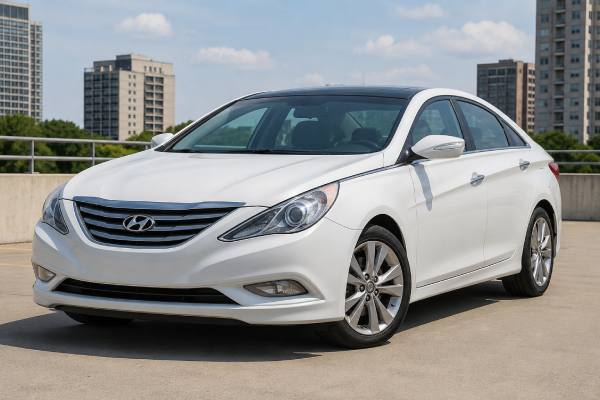
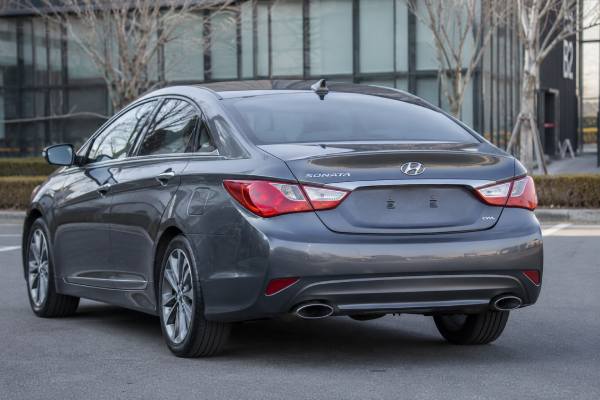
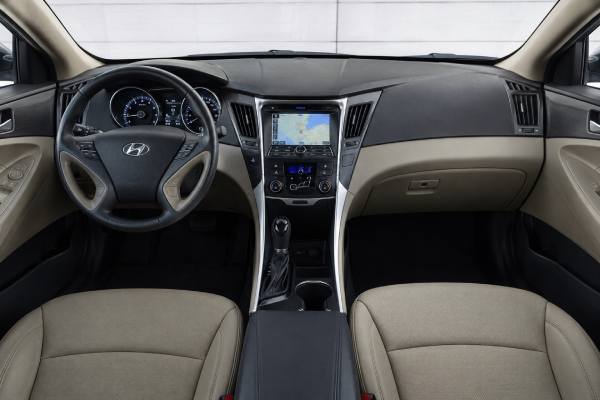
The 2014 Hyundai Sonata YF 2.0T is the high-output version of the facelifted sixth-generation Sonata, pairing a 2.0-liter Theta II turbocharged direct-injection four-cylinder with a six-speed automatic and front-wheel drive. In North American specification, it replaced the traditional V6 option with 274 hp, strong mid-range torque, and better fuel use than many six-cylinder rivals of the same era.
This guide focuses on the 2014 facelift Sonata YF with the 2.0 T-GDi / 2.0T engine. It covers the specifications, dimensions, trim differences, safety equipment, reliability issues, maintenance needs, driving feel, and buying checks that matter most when evaluating one today.
Owner Snapshot
- Strong 274 hp output and broad 269 lb-ft torque make the Sonata 2.0T quick for a front-drive midsize sedan.
- Spacious cabin and 464 L / 16.4 ft³ trunk give it practical family-car usability.
- SE 2.0T is the sportier setup; Limited 2.0T is the comfort and equipment-focused version.
- Theta II bearing, fuel-hose, and turbo actuator checks are essential before buying.
- For hard city use, short trips, or hot-climate driving, use the severe-service oil interval: about 6 months or 3,750 miles / 6,000 km.
Table of Contents
- Sonata YF 2014 2.0T Profile
- Sonata YF 2.0T Technical Data
- Sonata YF Trims and Safety
- Reliability Issues and Service Actions
- Maintenance Plan and Buying Advice
- Driving Performance and Real-World Economy
- How Sonata YF Compares to Rivals
Sonata YF 2014 2.0T Profile
The 2014 Hyundai Sonata YF 2.0T sits at an interesting point in the midsize sedan market. It is still a conventional gasoline sedan, but its powertrain strategy was ahead of many rivals: instead of offering a V6, Hyundai used a turbocharged four-cylinder with gasoline direct injection, a twin-scroll turbocharger, and a broad torque band. The result is a sedan that feels much stronger than the standard 2.4 GDI Sonata while keeping reasonable running costs.
The facelifted 2014 YF brought styling and equipment updates rather than a full platform redesign. The body shape remained the same Fluidic Sculpture sedan, but the car received revised exterior details, upgraded cabin materials, better sound insulation, new audio and navigation options, revised wheels, and additional driver-assistance availability. Hyundai also worked on noise, vibration, and harshness with added insulation and damping, which matters because earlier YF Sonatas could feel a little road-noisy compared with the quieter Toyota Camry and Honda Accord.
The 2.0T version was aimed at buyers who wanted near-V6 acceleration without moving into a larger or more expensive sedan. With 274 hp and 269 lb-ft, it had more headline power than several direct competitors, including the Ford Fusion 2.0 EcoBoost and many naturally aspirated four-cylinder midsize sedans. It is front-wheel drive only, so traction off the line depends heavily on tire quality and road conditions. In wet weather, aggressive throttle use can make the front tires work hard.
In the used market, the Sonata 2.0T’s appeal is clear: it offers strong performance, a large cabin, a big trunk, good feature content, and usually lower purchase prices than a comparable Accord V6 or Camry V6. The trade-off is that the Theta II family needs careful inspection. A well-maintained, recall-completed example can be a good value, but a neglected one can become expensive quickly.
Best use cases include commuting, highway driving, family use, and buyers who want a comfortable sedan with strong passing power. It is less ideal for buyers who want sports-sedan steering feel, all-wheel drive, maximum long-term simplicity, or a car they can buy without a deep service-history check.
Sonata YF 2.0T Technical Data
The figures below focus on the U.S.-market 2014 Sonata YF 2.0T SE and Limited. Some dimensions, fluids, towing guidance, and equipment details vary by market, trim, build date, and under-hood label.
| Item | 2014 Hyundai Sonata YF 2.0T |
|---|---|
| Engine code | Theta II G4KH family, 2.0 T-GDi / 2.0T GDI |
| Engine layout | Inline-4, aluminum block/head, DOHC, 4 valves per cylinder |
| Bore × stroke | 86.0 × 86.0 mm / 3.39 × 3.39 in |
| Displacement | 2.0 L / 1,998 cc |
| Induction | Twin-scroll turbocharger, intercooler |
| Fuel system | Gasoline direct injection |
| Compression ratio | 9.5:1 |
| Maximum power | 274 hp / 204 kW @ 6,000 rpm |
| Maximum torque | 365 Nm / 269 lb-ft @ 1,650–4,500 rpm |
| Timing drive | Chain |
| Rated efficiency | EPA listing: 9.8 L/100 km combined, 21 mpg US city, 31 mpg US highway / about 28.8 mpg UK combined |
| Real-world highway at 120 km/h / 75 mph | Typically about 7.5–8.7 L/100 km / 27–31 mpg US / 32–37 mpg UK when healthy and lightly loaded |
| Item | Specification |
|---|---|
| Transmission | 6-speed automatic with SHIFTRONIC manual mode; A6LF-series Hyundai transaxle family |
| Drive type | Front-wheel drive |
| Differential | Open front differential integrated with transaxle |
| Item | Specification |
|---|---|
| Front suspension | MacPherson strut, coil springs, stabilizer bar |
| Rear suspension | Independent multi-link, coil springs, stabilizer bar |
| Steering | Motor-driven electric power steering; driver-selectable Comfort, Normal, Sport assist modes |
| Brakes | Front vented discs about 320 mm / 12.6 in; rear discs about 285 mm / 11.2 in |
| Popular tire size | 225/45 R18 on SE 2.0T; some Limited packages use different wheel/tire combinations |
| Ground clearance | About 135 mm / 5.3 in |
| Length / width / height | 4,821 / 1,834 / 1,471 mm — 189.8 / 72.2 / 57.9 in |
| Wheelbase | 2,794 mm / 110.0 in |
| Turning circle | About 10.9 m / 35.8 ft curb-to-curb |
| Curb weight | About 1,566–1,600 kg / 3,452–3,527 lb, depending on trim and equipment |
| GVWR | About 1,980–2,040 kg / 4,365–4,497 lb, market and trim dependent |
| Fuel tank | 70 L / 18.5 US gal / 15.4 UK gal |
| Cargo volume | 464 L / 16.4 ft³ trunk volume; seats-down sedan cargo figure not standardized |
| Metric | Figure |
|---|---|
| 0–100 km/h / 0–62 mph | About 6.8–7.2 seconds, depending on test method, tires, and launch |
| 0–60 mph | Commonly tested around 6.5–6.7 seconds |
| Top speed | Not officially published for the U.S.-market 2014 2.0T; market data varies |
| 100–0 km/h braking | About 40 m / 131 ft in contemporary tests, tire dependent |
| Towing capacity | Not rated or not recommended in many U.S. manuals; follow the market-specific owner’s manual |
| Payload | Roughly 390–470 kg / 860–1,035 lb, depending on trim and GVWR label |
| System | Specification / capacity |
|---|---|
| Engine oil | API SL/SM or better as specified by manual; commonly 5W-30 or 5W-40 for 2.0T; about 4.6 L / 4.9 US qt with filter |
| Coolant | Ethylene-glycol coolant for aluminum engines/radiators, typically 50/50 premix; about 6.7–7.0 L / 7.1–7.4 US qt |
| Automatic transmission fluid | Hyundai/Kia ATF SP-IV; total fill about 7.1 L / 7.5 US qt, drain-and-fill amount is lower |
| Differential / transfer case | No separate rear differential or transfer case; front final drive is part of the transaxle |
| A/C refrigerant | R-134a; many YF charts show 550 ±20 g / 19.4 ±0.7 oz, while some 2014 data shows higher charge. Verify under-hood label. |
| A/C compressor oil | PAG46 / FD46XG type; about 150 mL / 5.1 fl oz in many service charts, label and compressor data take priority |
| Wheel lug nuts | 88–107 Nm / 65–79 lb-ft |
| Engine oil drain plug | About 39–44 Nm / 29–33 lb-ft; use a new washer |
| Item | 2014 Sonata YF 2.0T |
|---|---|
| NHTSA | 5-star overall rating commonly listed for the 2014 Sonata sedan; frontal 4 stars, side 5 stars, rollover 5 stars in many summaries |
| IIHS | Good in moderate-overlap front, side, roof strength, and head restraints; Marginal in driver-side small-overlap front |
| Euro NCAP | No directly applicable Euro NCAP rating for this U.S.-market YF 2.0T specification |
| IIHS headlight rating | Not applicable; IIHS headlight ratings were introduced later |
| ADAS | No AEB, ACC, lane keeping, or traffic-sign assist. Blind-spot detection available depending on trim/package. |
Sonata YF Trims and Safety
For the 2014 U.S.-market Sonata 2.0T, the main trims are SE 2.0T and Limited 2.0T. Both use the same 274 hp turbocharged engine, six-speed automatic, and front-wheel-drive layout, but they feel slightly different because of suspension, wheel, tire, and equipment choices.
The SE 2.0T is the sportier version. It typically brings 18-inch wheels, sport-tuned suspension, paddle shifters, dual exhaust finishers, more aggressive trim details, and firmer body control. It is the better choice for buyers who want sharper turn-in and a less floaty feel, but the ride can be busier on rough city roads.
The Limited 2.0T focuses more on comfort and upscale equipment. It commonly includes leather seating, heated seats, upgraded interior trim, automatic climate control, and more available technology. Limited models can be identified by richer interior materials, comfort features, and available premium audio/navigation equipment. For many used buyers, a Limited with complete service records is the easiest Sonata 2.0T to live with daily.
For 2014, important equipment updates included a 4.3-inch color audio display with rearview camera availability, an optional eight-inch navigation system, improved cabin insulation, upgraded audio choices, new display features, tire-specific TPMS, and added blind-spot detection availability. The facelift did not turn the Sonata into an advanced driver-assistance sedan by modern standards, but it did make the car more usable and better equipped.
Safety equipment includes six airbags, electronic stability control, anti-lock brakes, brake assist, electronic brake-force distribution, active front head restraints, three-point belts for all seating positions, front pretensioners, tire-pressure monitoring, and LATCH anchors for the rear outboard seats. A rearview camera is common on SE and Limited models, and blind-spot detection is standard on some Limited versions and available on SE through package content.
The main safety limitation is not structural strength in standard crash tests; it is age and technology. The YF Sonata predates common fitment of automatic emergency braking, adaptive cruise control, lane keeping, and modern pedestrian/cyclist detection. IIHS small-overlap performance was also weaker than its moderate-overlap and side-impact results. For family use, tire condition, brake condition, headlight clarity, and functioning stability-control systems are especially important.
After windshield replacement, front-end repair, suspension work, or bumper repair, there are fewer ADAS calibration concerns than on newer cars because the 2014 YF does not rely on a full suite of forward cameras and radar. However, blind-spot detection sensors, rear camera wiring, ABS wheel-speed sensors, steering-angle calibration, and TPMS should still be checked after collision repairs or electrical work.
Reliability Issues and Service Actions
The 2014 Sonata 2.0T can be durable when maintained carefully, but it is not a used car to buy casually. The Theta II GDI and turbo systems require proof of maintenance, recall completion, and a careful inspection for noise, oil use, fuel leaks, boost faults, and cooling-system problems.
| Issue | Prevalence | Severity / cost | Typical signs | Best response |
|---|---|---|---|---|
| Connecting-rod bearing wear / engine seizure risk | Known campaign issue | High | Knocking noise, oil-pressure warning, P1326, limp mode, no-start | Verify recall/KSDS completion; dealer diagnosis; engine inspection or replacement where covered |
| Turbo electronic wastegate actuator faults | Occasional | Medium | P2562/P2563/P2565, low boost, high boost, reduced power, turbo noise | Follow actuator inspection/adjustment procedure; replace actuator when out of spec |
| Fuel feed hose cracking/leak | Recall-related | High | Fuel smell, visible leak near high-pressure pump area, fire risk | Verify recall 20V-121 / 22V-312 remedy by VIN; replace hose where required |
| Direct-injection carbon buildup | Occasional with age | Medium | Rough idle, misfires, hesitation, reduced economy | Diagnose first; walnut blasting or intake-valve cleaning if confirmed |
| Automatic transmission shift concerns | Occasional | Medium | Delayed engagement, flare, harsh shifts, old ATF | Check fluid history, scan for codes, update/adapt if needed, service ATF carefully |
| Shift cable detachment recall | Recall-related | High safety risk | Gear indicator mismatch, vehicle may not park as expected | Verify campaign completion by VIN and dealer records |
| Suspension and steering wear | Common with age | Low to medium | Clunks, tire wear, wandering, vibration | Inspect control-arm bushings, links, struts, wheel bearings, alignment |
The most important reliability subject is the Theta II bearing campaign. Affected 2013–2014 Sonata models with 2.4 GDI and 2.0T GDI engines were included in service actions related to machining debris, bearing wear, abnormal engine noise, P1326 knock-sensor detection, and potential no-crank/no-start conditions. On a used Sonata 2.0T, ask for written proof of campaign completion, not just a seller’s verbal assurance.
The fuel-hose recalls are also important because fuel leakage in the engine bay can become a fire risk. Look and smell carefully around the low-pressure fuel feed line and high-pressure pump area after a test drive. A car that smells of fuel, has fresh stains, or has unclear recall status should not be treated as ready to buy.
Turbo-related issues are usually less catastrophic than bearing failure, but they can still be expensive. The electronic wastegate actuator can cause boost-control codes and drivability problems. The official repair approach is diagnosis and actuator service/replacement when indicated, not automatically replacing the entire turbocharger.
Other age-related checks include oil seepage, coolant leaks, cracked hoses, weak ignition coils, worn spark plugs, carbon buildup, tired engine mounts, noisy wheel bearings, sticking brake calipers, and corrosion around subframes, suspension mounting points, brake lines, exhaust hardware, lower door seams, and underbody seams in salt-belt climates.
Before purchase, request the full service history, recall printout, oil-change records, ATF service record, coolant service record, and any engine replacement documentation. A replacement engine is not automatically bad; it can be a positive if installed by a Hyundai dealer with paperwork. What matters is whether the current engine is quiet, clean, properly updated, and maintained.
Maintenance Plan and Buying Advice
A Sonata 2.0T should be maintained more like a turbocharged GDI engine than a simple commuter four-cylinder. The engine works hard, uses direct injection, and has known bearing-related history, so clean oil, correct fluids, and early diagnosis matter.
| Service item | Suggested interval | Notes |
|---|---|---|
| Engine oil and filter | Normal: about 7,500 miles / 12,000 km or 12 months. Severe: about 3,750 miles / 6,000 km or 6 months. | Use severe interval for short trips, hot weather, turbo use, city driving, dusty roads, or unknown history. |
| Engine air filter | Inspect every 15,000 miles / 24,000 km; replace as needed | Replace sooner in dusty areas. |
| Cabin air filter | Every 12–15 months or 15,000 miles / 24,000 km | Cheap and improves HVAC performance. |
| Spark plugs | About 105,000 miles / 168,000 km or 7 years in normal service; earlier if misfires or tuned use | Use correct heat range and gap; turbo engines dislike incorrect plugs. |
| Timing chain | No routine replacement interval | Inspect if cold-start rattle, correlation codes, metal debris, or chain/tensioner noise appears. |
| Serpentine belt and hoses | Inspect every 30,000 miles / 48,000 km; expect replacement with age | Heat from the turbo engine bay ages rubber parts. |
| Coolant | Initial long interval may be up to 10 years / 120,000 miles; older used cars should be serviced if history is unknown | Use compatible coolant for aluminum engines and correct mix. |
| Automatic transmission fluid | Inspect regularly; replace around 60,000 miles / 96,000 km under severe use | Use SP-IV specification fluid only. |
| Brake fluid | Every 2–3 years | Important for ABS/ESC reliability and pedal consistency. |
| Brake pads, rotors, calipers | Inspect every service | Check rear caliper slide pins and uneven wear. |
| Tire rotation | Every 5,000–7,500 miles / 8,000–12,000 km | Front tires wear quickly on the 2.0T if driven hard. |
| Alignment | Annually or after tire/suspension work | Uneven tire wear can mimic steering or suspension faults. |
| 12 V battery | Test yearly after 3 years; replace often around 4–6 years | Weak voltage can trigger confusing electronic symptoms. |
For buying, start with the VIN. Check open recalls through an official VIN tool, then ask the seller or dealer for the service printout. The ideal car has frequent oil changes, Hyundai campaign completion, no unexplained engine replacement gaps, no fuel odor, no warning lights, no boost-control faults, and no transmission flare.
During inspection, listen to the engine cold and fully warm. A brief injector tick is normal for GDI, but heavy knocking, low-end rumble, or a flashing check-engine light is not. Scan the car even if no warning lamp is on. Look for pending codes, P1326 history, misfire counts, boost-control faults, catalyst efficiency codes, and transmission codes.
On the test drive, check full-throttle acceleration only after the engine is warm and traffic conditions are safe. The car should build boost smoothly, shift cleanly, and track straight under braking. Any hesitation, limp mode, slipping, or heavy smoke should stop the purchase until properly diagnosed.
The SE 2.0T is best for a buyer who wants sharper chassis response and does not mind a firmer ride. The Limited 2.0T is better for comfort, daily commuting, and equipment value. Avoid cars with missing service history, unresolved recalls, fuel smells, engine knock, overheating evidence, mismatched tires, cheap aftermarket engine modifications, or unclear salvage repairs.
Long-term durability depends heavily on maintenance and whether the engine has been handled correctly under the recall and warranty-extension programs. A clean, documented Sonata 2.0T can be a lot of sedan for the money. A neglected one is usually not worth the discount.
Driving Performance and Real-World Economy
The Sonata 2.0T’s strongest dynamic quality is straight-line power. The engine produces useful torque from low rpm and holds it through the mid-range, so highway passing is easy. Compared with the standard 2.4 GDI, the 2.0T feels much more relaxed when merging, climbing grades, or carrying passengers.
Throttle response is generally strong once the turbo is awake. There can be a slight delay from low rpm, especially if the transmission is in a higher gear, but the broad torque band keeps the car from feeling peaky. The six-speed automatic is smooth in normal use and willing enough to downshift, although it is not as crisp as modern eight-speed automatics or dual-clutch units. Paddle shifters help on SE models, but the transmission still prioritizes smoothness over aggressive manual control.
Ride and handling depend on trim. The SE 2.0T has a sportier suspension and lower-profile tires, giving better body control and more direct responses. It also transmits more road texture. The Limited is calmer and more comfort-oriented, making it better for long commutes and rough pavement. Neither version feels like a true sport sedan, but both are stable at highway speeds and predictable in corners.
Steering feel is mixed. The driver-selectable steering modes change effort, with Comfort useful for parking and Sport adding weight at speed. However, added weight does not equal rich road feedback. The car is easy to place, but enthusiasts may find it artificial compared with a Mazda6 or older hydraulic-steering sedans.
Braking is adequate when the system is healthy, but used examples vary widely. Fresh fluid, quality tires, smooth rotors, free-moving caliper pins, and good pads make a big difference. A long pedal, vibration, or pulling under braking should be addressed before judging the car.
Real-world fuel use depends heavily on boost use. In mixed commuting, expect roughly 9.5–11.5 L/100 km / 20–25 mpg US / 24–30 mpg UK. Gentle highway driving can land near 7.5–8.7 L/100 km / 27–31 mpg US / 32–37 mpg UK. Dense city driving, cold weather, short trips, and frequent turbo use can push consumption above 12 L/100 km / below 20 mpg US.
The 2.0T is not a towing-focused sedan, and many U.S. references do not rate it for trailer towing. With passengers and luggage, it remains stable, but heat management, brakes, and tire load should be respected. For long mountain drives, use quality oil, keep the cooling system healthy, and avoid repeated heavy boost on a poorly maintained car.
How Sonata YF Compares to Rivals
The 2014 Sonata 2.0T competes most directly with the Toyota Camry V6, Honda Accord V6, Nissan Altima V6, Ford Fusion 2.0 EcoBoost, Chevrolet Malibu Turbo, Volkswagen Passat V6, and Mazda6 2.5. Its position is simple: it offers strong power, good equipment, and a large cabin at an attractive used price, but it asks more from the buyer during inspection.
| Rival | Main advantage over Sonata 2.0T | Where Sonata 2.0T responds well |
|---|---|---|
| Toyota Camry V6 | Smoother V6, excellent reliability reputation, relaxed ownership | Sonata often costs less and has strong turbo torque |
| Honda Accord V6 | Sharper overall polish, strong engine, high resale value | Sonata offers similar everyday acceleration at lower purchase prices |
| Ford Fusion 2.0 EcoBoost | Available AWD, more modern chassis feel | Sonata has higher 2014 headline horsepower and a roomier trunk |
| Nissan Altima V6 | Quick acceleration and light driving feel | Sonata avoids the Altima CVT driving character |
| Mazda6 2.5 | Better steering feel and handling balance | Sonata 2.0T is much stronger in straight-line performance |
| Volkswagen Passat V6 | Refined powertrain and mature highway feel | Sonata is simpler to source parts for in many regions and uses regular gasoline |
Choose the Sonata 2.0T if you want power, space, equipment, and value, and you are willing to inspect carefully. Choose the Camry or Accord if you want the safest long-term reliability bet and can accept higher purchase prices. Choose the Fusion if AWD matters. Choose the Mazda6 if steering and chassis feel matter more than acceleration.
The Sonata’s biggest advantage is value. Its biggest weakness is risk management. A properly documented example can feel like a bargain because it delivers near-V6 performance and a comfortable, roomy cabin. But the cheapest example on the market is rarely the best one. Service history, recall status, and current engine health should matter more than mileage alone.
References
- MAJOR UPDATE FOR 2014 HYUNDAI SONATA DELIVERS NEW LEVELS OF REFINEMENT, SAFETY AND TECHNOLOGY 2013 (Manufacturer Publication) ([Hyundai News][1])
- Gas Mileage of 2014 Hyundai Sonata 2026 (Official Fuel Economy Data) ([Fuel Economy][2])
- 2014 Hyundai Sonata 2026 (Safety Rating) ([IIHS Crash Testing][3])
- Service Campaign T3G & Warranty Extensions TXXC/TXXI – ENGINE BEARING INSPECTION / ENGINE REPLACEMENT – Dealer Best Practice 2022 (TSB / Warranty Extension)
- Vehicle Detail Search – 2014 HYUNDAI SONATA 4 DR page_view_event | NHTSA 2026 (Recall Database) ([NHTSA][4])
Disclaimer
This article is for informational purposes only and is not a substitute for professional diagnosis, repair, inspection, or official service documentation. Specifications, torque values, service intervals, fluids, recall eligibility, and repair procedures can vary by VIN, market, production date, trim, and installed equipment. Always verify critical information against the official owner’s manual, service manual, under-hood labels, VIN-based recall records, and qualified Hyundai service guidance.
If this guide helped you, please consider sharing it on Facebook, X/Twitter, or your preferred platform to support our work.