
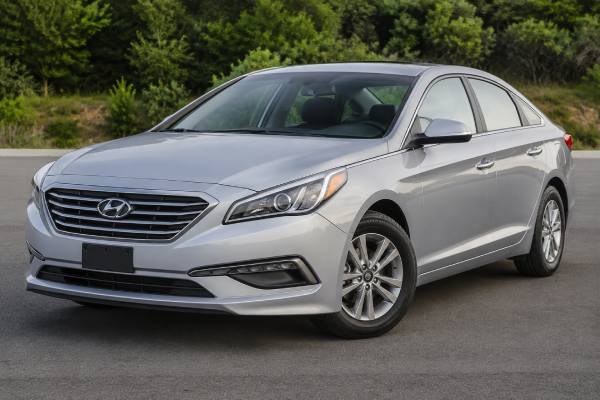
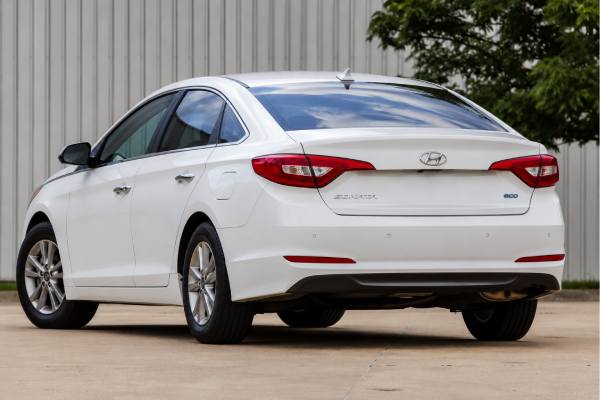
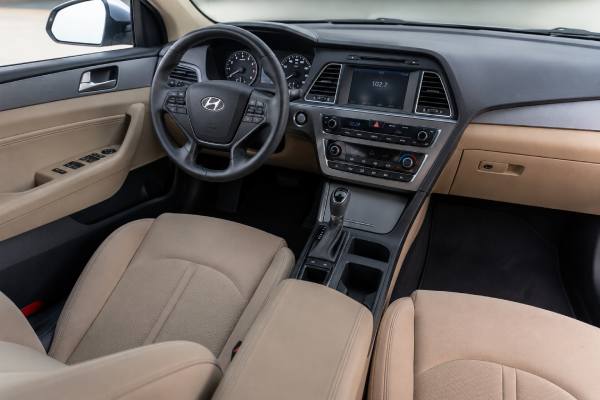
The 2015–2017 Hyundai Sonata LF with the naturally aspirated Theta II 2.4 GDi engine is one of the most common versions of Hyundai’s midsize sedan from this generation. It combines a roomy cabin, large trunk, comfortable ride, straightforward front-wheel-drive layout, and a 185 hp gasoline direct-injection engine paired with a 6-speed automatic transmission.
For used-car buyers, the appeal is easy to understand: the Sonata LF often costs less than comparable Toyota Camry and Honda Accord models while offering generous equipment and strong crash-test performance. The main caution is also clear: the Theta II family has a known history of bearing-wear, knock-sensor, and engine-protection campaigns, so service records and VIN-specific campaign checks matter more than usual.
Owner Snapshot
- Spacious cabin and 462 L / 16.3 ft³ trunk make it practical for commuting and family use.
- The 2.4 GDi engine delivers smooth everyday power with good highway economy for a non-hybrid sedan.
- Safety ratings are strong, but advanced driver-assistance features were mostly package-dependent.
- Engine bearing-wear campaigns, oil consumption, and complete service history should be checked before purchase.
- Typical normal-use oil service is about every 7,500 miles / 12,000 km or 12 months; severe use should be shorter.
Table of Contents
- Sonata LF 2.4 GDi At a Glance
- Sonata LF Specs and Data
- Sonata LF Trims and Safety
- Reliability Issues and Campaigns
- Maintenance and Used Buying
- Driving Performance and Economy
- Sonata LF Versus Rivals
Sonata LF 2.4 GDi At a Glance
The LF-generation Hyundai Sonata arrived for the 2015 model year with a more conservative design than the previous YF Sonata, but it was a more mature car underneath. It used a front-engine, front-wheel-drive layout, a large sedan body that the EPA classified as a large car in the U.S. market, and a cabin designed around comfort, rear-seat space, and everyday usability.
This article focuses on the standard gasoline 2.4 GDi version sold mainly in North America from 2015 through 2017. It does not cover the 1.6 turbo Eco, 2.0 turbo Sport/Limited, hybrid, or plug-in hybrid versions except where they help explain trim or equipment differences.
The 2.4-liter Theta II GDi engine is an inline-four with direct injection, dual overhead cams, 16 valves, chain-driven camshafts, and natural aspiration. Output is 185 hp at 6,000 rpm and 178 lb-ft / 241 Nm at 4,000 rpm. In real use, that makes the Sonata 2.4 more of a relaxed family sedan than a sporty one. It has enough power for commuting, highway merging, and long-distance travel, but it does not have the low-rpm punch of the 2.0T or the fuel savings of the hybrid.
The strongest reasons to consider one are:
- Large interior for the price
- Comfortable ride quality
- Simple FWD layout
- Good trunk space
- Strong crash-test structure
- Good feature availability on Limited and package-equipped cars
- Lower used prices than many Japanese-brand rivals
The main ownership question is engine condition. A clean Sonata LF 2.4 with proof of oil changes, campaign completion, no bearing-noise symptoms, no abnormal oil consumption, and no stored P1326 history can be a good-value sedan. A neglected one with missing records, low oil history, warning lights, or knock symptoms is a much higher-risk purchase.
The 2015 model year introduced the LF platform. For 2016 and 2017, safety structure and equipment availability improved in some areas, and certain driver-assistance features became more desirable because of IIHS crash-prevention testing. Buyers should not assume all Sonatas have the same safety equipment. Blind-spot monitoring, rear cross-traffic alert, lane-departure warning, adaptive cruise control, and automatic emergency braking depended on trim and package.
For most used buyers, the best balance is a well-maintained SE, Sport, or Limited 2.4 with verified campaign completion. Limited models are more comfortable and often better equipped, but the more complex options, panoramic sunroof, HID lighting, navigation, and electronic parking brake can add inspection points. The Sport trim looks more aggressive and may have larger wheels, which improve appearance but can slightly reduce ride comfort and tire affordability.
Sonata LF Specs and Data
The figures below describe the 2015–2017 Hyundai Sonata LF 2.4 GDi gasoline model with front-wheel drive and a 6-speed automatic transmission. Exact equipment, tire size, emissions classification, and service data can vary by VIN, trim, market, and production date.
Powertrain and efficiency
| Item | Hyundai Sonata LF 2.4 GDi |
|---|---|
| Engine code / family | Theta II GDi, commonly G4KJ family |
| Layout | Inline-4, aluminum block/head, DOHC, 4 valves per cylinder |
| Bore × stroke | 88 × 97 mm / 3.46 × 3.82 in |
| Displacement | 2.4 L / 2,359 cc / 144 cu in |
| Induction | Naturally aspirated |
| Fuel system | Gasoline direct injection |
| Compression ratio | 11.3:1 |
| Maximum power | 185 hp / 138 kW at 6,000 rpm |
| Maximum torque | 241 Nm / 178 lb-ft at 4,000 rpm |
| Timing drive | Timing chain |
| Rated fuel economy, 2017 base 2.4 | 8.1 L/100 km combined / 29 mpg US / 34.8 mpg UK; 9.4 city / 6.5 highway L/100 km |
| Rated fuel economy, 2015 base 2.4 | 8.4 L/100 km combined / 28 mpg US / 33.6 mpg UK; 9.8 city / 6.5 highway L/100 km |
| Real-world highway at 120 km/h / 75 mph | Usually about 7.3–8.2 L/100 km / 29–32 mpg US / 35–39 mpg UK, depending on tires, load, wind, and maintenance |
Transmission and driveline
| Item | Specification |
|---|---|
| Transmission | 6-speed automatic with SHIFTRONIC manual mode; A6MF2 family commonly associated with 2.4L models |
| Drive type | Front-wheel drive |
| Final drive | 2.89:1 on common 2.4L automatic specifications |
| Differential | Open front differential integrated with transaxle |
Chassis, dimensions, and capacity
| Item | Specification |
|---|---|
| Front suspension | MacPherson strut |
| Rear suspension | Independent multi-link |
| Steering | Electric power-assisted rack-and-pinion |
| Brakes | Front ventilated discs about 305 mm / 12.0 in; rear discs about 284–285 mm / 11.2 in |
| Common tire sizes | 205/65 R16, 215/55 R17, or 235/45 R18 depending on trim/package |
| Ground clearance | About 135 mm / 5.3 in |
| Length / width / height | 4,854 mm / 1,864 mm / 1,476 mm; 191.1 in / 73.4 in / 58.1 in |
| Wheelbase | 2,805 mm / 110.4 in |
| Turning circle, curb-to-curb | About 10.9 m / 35.8 ft |
| Curb weight | About 1,474–1,522 kg / 3,250–3,356 lb depending on trim and equipment |
| GVWR | About 2,040 kg / 4,497 lb for 2.4 GDi specifications |
| Fuel tank | 70 L / 18.5 US gal / 15.4 UK gal |
| Cargo volume | 462 L / 16.3 ft³ trunk volume |
Performance and capability
| Metric | Typical result |
|---|---|
| 0–100 km/h / 0–62 mph | About 8.1–8.5 seconds; independent 0–60 mph testing commonly falls around 7.9 seconds |
| Top speed | About 212 km/h / 132 mph in independent testing conditions |
| 100–0 km/h braking | About 40 m / 131 ft equivalent estimate from 70–0 mph test data; tires and surface matter greatly |
| Trailer towing | Not a primary tow vehicle in North American guidance; if market-rated elsewhere, verify VIN-specific limits |
| Payload | Varies by curb weight and certification label; use door-jamb label rather than a generic figure |
Fluids and service capacities
| System | Specification / capacity |
|---|---|
| Engine oil | API SM / ILSAC GF-4 or better; commonly 5W-20 for fuel economy, with 5W-30 or 10W-30 allowed by temperature chart; 4.8 L / 5.07 US qt drain-and-refill |
| Coolant | Ethylene-glycol coolant for aluminum radiator, mixed with water; 7.2 L / 7.60 US qt |
| Automatic transmission fluid | Hyundai/Kia ATF SP-IV equivalent; about 7.1 L / 7.50 US qt total system capacity |
| Brake fluid | FMVSS116 DOT 3 or DOT 4; about 0.7–0.8 L / 0.7–0.8 US qt |
| A/C refrigerant | R-134a; 575 ± 20 g / 20.2 ± 0.7 oz for 2.4 GDi |
| A/C compressor oil | PAG ND-OIL8; 80 ± 10 mL / 2.82 ± 0.35 fl oz |
| Wheel lug nut torque | Typically about 108–127 Nm / 80–94 lb-ft; verify with wheel and market documentation |
| Engine oil drain plug torque | Common service value about 39 Nm / 29 lb-ft; replace crush washer and verify by VIN |
Safety and driver assistance
| Area | Result / availability |
|---|---|
| IIHS crashworthiness | Good ratings across major 2017 crashworthiness categories; 2016+ structure changes improved small-overlap performance |
| IIHS headlights | Poor in tested 2016–2017 headlight configurations |
| IIHS front crash prevention | Superior with optional Automatic Emergency Braking where equipped |
| NHTSA | 5-star overall safety rating reported for the model generation in U.S. testing |
| ADAS availability | Blind-spot monitoring, rear cross-traffic alert, lane-departure warning, adaptive cruise control, automatic high beams, and AEB were trim/package dependent |
Sonata LF Trims and Safety
In the U.S. market, the 2015–2017 Sonata 2.4 GDi was sold in several familiar grades. Exact names and content changed by model year, but the main 2.4L lineup usually centered on base/SE, Sport, and Limited trims. Canadian and other markets used different grade names, so equipment should always be checked from the window sticker, build sheet, or VIN report.
The SE or base 2.4 models are the simplest. They commonly include cloth seating, 16-inch wheels, standard stability control, ABS, basic infotainment, Bluetooth, and the core safety structure. These cars are usually the best low-cost ownership choice because there is less optional equipment to repair. The downside is that many desirable safety and comfort features may be absent.
Sport 2.4 models add visual and functional upgrades such as more aggressive exterior trim, larger wheels, sportier cabin details, and sometimes paddle shifters or dual exhaust-style exterior treatment depending on market and year. The mechanical change is not dramatic; the 2.4 Sport remains a comfort-biased sedan, not a dedicated performance model. Larger wheels can sharpen initial steering response but may make the ride firmer and replacement tires more expensive.
Limited 2.4 models are the comfort-oriented choice. They are more likely to have leather seating, power front seats, upgraded audio, dual-zone climate control, keyless entry/start, available navigation, heated or ventilated seats, memory settings, HID lighting, panoramic sunroof, and more driver-assistance features. A Limited with Tech and Ultimate-style packages can be much nicer to live with, but it also requires more careful inspection.
Useful quick identifiers include:
- 16-inch wheels and simpler cloth cabin: often base or SE.
- 17-inch or 18-inch wheels, sport trim pieces, and sportier seats: often Sport.
- Leather, power seating, upgraded infotainment, or panoramic roof: often Limited or package-equipped.
- Camera and blind-spot indicators in mirrors: higher equipment level or package.
- Adaptive cruise buttons and AEB-related warning messages: package-equipped cars only.
Safety performance is a major strength of the LF Sonata. The structure performed well in IIHS testing, especially in later LF years after structural and restraint-system improvements. Still, not every model year and build date should be treated identically. Early 2015 cars did not have every later improvement, and IIHS notes are specific about 2016 model changes and post-October 2015 structural reinforcement for small-overlap protection.
Standard safety equipment generally includes front airbags, front seat-mounted side airbags, full-length curtain airbags, a driver knee airbag, ABS, electronic stability control, traction control, tire-pressure monitoring, and LATCH child-seat anchors. LATCH usability was not perfect in IIHS evaluation, so family buyers should physically test child-seat installation rather than relying only on rating summaries.
ADAS availability is the important trim difference. Blind-spot detection and rear cross-traffic alert are among the most useful options for daily driving because the Sonata is long and has broad rear pillars. Automatic Emergency Braking and adaptive cruise control are more valuable still, but they were not standard across the 2.4 range. After front-end collision repair, windshield replacement, suspension work, or radar/camera-related repairs, ADAS calibration should be verified. A car with warning lights, unavailable cruise, or persistent lane/forward-safety messages should be diagnosed before purchase.
Reliability Issues and Campaigns
The Sonata LF 2.4 GDi can be a durable sedan when serviced properly, but it is not a car to buy casually without records. The engine family has enough history that the pre-purchase inspection should focus on oil level, noise, campaign completion, stored diagnostic codes, and service proof.
| Issue | Prevalence | Severity / cost | Typical signs | Best response |
|---|---|---|---|---|
| Connecting-rod bearing wear / P1326 | Occasional but important | High | Knock that rises with rpm, blinking MIL, limp mode, DTC P1326 | Verify KSDS/campaign history, dealer diagnosis, warranty eligibility, and engine replacement records |
| Oil consumption | Common with age/mileage | Medium to high | Low oil between changes, blue smoke, fouled plugs, catalyst stress | Perform oil-consumption test, inspect PCV system, avoid cars with unclear history |
| GDI intake deposits | Occasional | Medium | Rough idle, hesitation, misfires, poor cold running | Diagnose ignition/fuel first, then consider intake valve cleaning when confirmed |
| Automatic transmission shift harshness | Occasional | Low to medium | Delayed engagement, bump shifts, flare, dirty ATF | Check for software updates, inspect mounts, service with correct SP-IV fluid |
| Panoramic sunroof issues | Option-dependent | Medium | Rattles, wind noise, slow movement, campaign history | Inspect tracks, seals, glass operation, and recall completion |
| Suspension and steering wear | Common with mileage | Low to medium | Clunks, uneven tire wear, wandering, vibration | Inspect struts, control arms, tie rods, alignment, tires, and wheel bearings |
The most important campaign-related topic is Hyundai’s knock-sensor and engine-protection strategy. Many Theta II GDi vehicles received software updates intended to detect early bearing-wear signatures. If the system detects a qualifying knock pattern, the malfunction indicator lamp may blink, a P1326 code may store, and the car may enter reduced-power operation. That is not a normal drivability quirk; it is a warning that the engine needs proper dealer-level diagnosis.
For buying, ask for:
- Proof of completed Hyundai campaigns and recalls by VIN.
- Records showing oil changes at reasonable intervals.
- Any engine replacement documentation, including mileage and part details.
- Diagnostic scan history, especially any P1326 events.
- Oil-consumption test results if the owner reports topping up.
- Dealer records, not just verbal claims.
Known recall and service-action areas for 2015–2017 Sonata models can include engine-related campaigns, Smart Junction Box turn-signal software, panoramic sunroof wind-deflector bonding on equipped cars, parking-brake warning switch issues on some vehicles, and ABS-light/noncompliance campaigns on certain early production 2015–2016 cars. Recall applicability is VIN-specific, so a generic model-year list is not enough.
Engine inspection should be done cold and hot. A light tick from direct injection is normal; a deeper metallic knock that follows rpm is not. Check oil level before starting, look for oil-change stickers, inspect for sludge under the oil cap, and listen after a fully warm restart. During the road test, verify smooth acceleration, no flashing check-engine light, no limp mode, and no hesitation under load.
Corrosion is not usually the Sonata LF’s defining issue, but it still matters in salted regions. Inspect rear suspension fasteners, brake lines, subframe edges, lower door seams, trunk seams, exhaust hangers, and wheel arches. Also check for poor accident repair because ADAS-equipped cars can be expensive to recalibrate after structural or front-end work.
Maintenance and Used Buying
A Sonata LF 2.4 GDi responds well to simple, regular maintenance. The engine’s direct injection, known bearing-wear history, and oil-consumption potential make oil quality and level checks especially important. Treat the oil dipstick as a routine ownership tool, not an emergency-only item.
| Interval | Service items |
|---|---|
| Every fuel fill or monthly | Check engine oil level, coolant level, tire condition, lights, and visible leaks |
| Every 7,500 miles / 12,000 km or 12 months | Replace engine oil and filter under normal use; rotate tires; inspect brakes, steering, suspension, belts, hoses, and fluid levels |
| Severe use: 3,750–5,000 miles / 6,000–8,000 km | Use shorter oil intervals for short trips, extreme heat/cold, dusty roads, heavy traffic, rideshare use, or frequent high-speed driving |
| Every 15,000 miles / 24,000 km | Inspect or replace cabin air filter and engine air filter as needed; inspect brake fluid, fuel system lines, parking brake, and vapor hoses |
| Every 30,000 miles / 48,000 km | Replace engine air filter if not already done; inspect fuel lines, suspension, alignment, brake pads/rotors, and battery condition |
| Every 45,000–60,000 miles / 72,000–96,000 km | Consider ATF drain-and-fill with correct SP-IV fluid, especially for long-term ownership; flush brake fluid if time/mileage warrants |
| Around 95,000–105,000 miles / 153,000–169,000 km | Replace spark plugs with correct heat range and type; inspect ignition coils and valve-cover seepage |
| Around 120,000 miles / 192,000 km or 10 years | Replace coolant if not already serviced; inspect radiator, hoses, thermostat behavior, water pump area, and cooling fans |
| Timing chain | No routine belt replacement; inspect for chain rattle, timing-correlation codes, guide/tensioner wear, or abnormal start-up noise |
| 12 V battery | Test from year 3 onward; many batteries need replacement around 4–6 years depending on climate |
For engine oil, the factory capacity is about 4.8 L / 5.07 US qt for drain and refill. Use oil that meets or exceeds the specified API/ILSAC requirements. In warm climates or high-mileage use, many owners prefer quality 5W-30 within allowed guidance, but the correct choice should follow the owner’s manual viscosity chart for climate and market.
For the automatic transmission, Hyundai often described these units as low-maintenance under normal use, but long-term owners benefit from fresh ATF. Use only correct SP-IV-type fluid. Avoid universal ATF unless it specifically meets the Hyundai/Kia requirement. A drain-and-fill is usually safer than an aggressive high-pressure flush on an unknown, high-mileage unit.
A strong buyer’s inspection should include:
- Cold start after sitting overnight.
- Scan for stored, pending, and permanent codes.
- Check for P1326, misfires, catalyst codes, and timing-correlation codes.
- Confirm all recall/campaign completions by VIN.
- Inspect oil level and ask how often it needs topping up.
- Listen for warm idle knock and acceleration knock.
- Verify smooth 1–2 and 2–3 shifts.
- Test A/C, heat, infotainment, backup camera, steering-wheel controls, and all windows.
- Inspect sunroof operation if equipped.
- Check tire wear for alignment or suspension clues.
- Inspect brake pulsation and parking-brake warning function.
- Confirm two working keys and immobilizer/security operation where applicable.
Best buys are usually late-2016 or 2017 cars with full service records, no engine-warning history, clean body structure, and completed campaigns. A documented engine replacement by Hyundai can be positive if the paperwork is complete and the repair was done correctly. Cars to avoid include neglected examples with low oil, loud knocking, unexplained limp mode, missing campaign history, salvage titles, severe oil consumption, or electrical warning lights.
Driving Performance and Economy
The Sonata LF 2.4 is tuned more for calm daily use than excitement. The body is quiet for the class, the seats are comfortable on longer drives, and the suspension absorbs broken pavement well on 16- and 17-inch wheels. With 18-inch tires, the car looks sharper and feels a little more responsive, but impacts are more noticeable and tire costs rise.
Steering is light and easy in town. It is accurate enough for highway driving, but feedback is muted compared with a Mazda6 or some Accord trims. The chassis has safe, predictable front-wheel-drive balance: it resists sudden oversteer, leans moderately in corners, and gives the driver clear signs when the front tires are approaching their grip limit.
The 2.4 GDi engine feels best in gentle and moderate driving. Throttle response is smooth, and the 6-speed automatic generally shifts without drama. Because peak torque arrives at 4,000 rpm, the engine needs revs for quick passing. The transmission will kick down when asked, but it is not as quick or decisive as newer 8-speed automatics or dual-clutch units. In heavy city traffic, a well-maintained car should shift cleanly without harsh bumps or flares.
Noise, vibration, and harshness are generally well controlled. At idle, the GDI injectors can make a light ticking sound. On the highway, wind and tire noise depend heavily on tire brand and wheel size. A loud droning, growling wheel bearing, exhaust leak, or rough idle should not be dismissed as normal.
Real-world fuel economy is respectable. Expect roughly:
- City driving: 9.5–11.5 L/100 km / 20–25 mpg US / 24–30 mpg UK
- Mixed driving: 8.0–9.5 L/100 km / 25–29 mpg US / 30–35 mpg UK
- Highway at 100–110 km/h / 62–68 mph: 6.5–7.5 L/100 km / 31–36 mpg US / 37–43 mpg UK
- Highway at 120 km/h / 75 mph: 7.3–8.2 L/100 km / 29–32 mpg US / 35–39 mpg UK
Cold weather, short trips, winter tires, roof racks, low tire pressure, and old spark plugs can push those figures noticeably worse. The large 70 L fuel tank gives the Sonata good highway range, often more than 700 km / 435 miles between fill-ups in steady cruising.
Braking feel is easy to modulate, though not especially sporty. Brake pulsation is common on used sedans if rotors are worn or pad deposits have formed. During a test drive, check for straight braking from highway speed and listen for rear brake scraping, especially on cars that sat unused.
The Sonata is not a towing-focused vehicle in North American use. It is better treated as a passenger sedan for people, luggage, and normal commuting loads. With a full cabin and trunk, acceleration becomes more relaxed, but the car remains stable if tires, brakes, and suspension are in good condition.
Sonata LF Versus Rivals
The Sonata LF 2.4 competes most directly with the Toyota Camry 2.5, Honda Accord 2.4, Nissan Altima 2.5, Mazda6 2.5, Ford Fusion 2.5/1.5T, Kia Optima 2.4, and Chevrolet Malibu. Its position in the group is clear: it is a value-focused midsize sedan with big space, strong safety structure, and good equipment for the money, but it needs a more careful engine-history check than some rivals.
| Rival | Compared with Sonata LF 2.4 |
|---|---|
| Toyota Camry 2.5 | Usually more expensive and more conservative, but has a stronger reputation for long-term durability and resale value. |
| Honda Accord 2.4 | Sharper to drive and very efficient, but often priced higher; CVT condition and service history still matter. |
| Nissan Altima 2.5 | Often efficient and affordable, but CVT durability concerns can outweigh the Sonata’s conventional automatic advantage. |
| Mazda6 2.5 | More engaging steering and handling, but less rear-seat/trunk comfort emphasis and sometimes firmer ride quality. |
| Ford Fusion | Solid road manners and available AWD on some versions, but powertrain choice greatly affects reliability and cost. |
| Kia Optima 2.4 | Mechanically very similar in many areas, so engine campaign and service-history checks are just as important. |
Choose the Sonata if you want comfort, space, features, and a lower purchase price. Choose the Camry if maximum low-drama ownership is worth paying more. Choose the Accord or Mazda6 if steering feel and driver engagement matter. Choose the Altima only after carefully evaluating CVT condition. Compare the Kia Optima like a sibling rather than a separate mechanical category.
The Sonata LF 2.4’s best used-car case is not that it is the most exciting sedan or the most bulletproof sedan. Its best case is that a documented, well-kept example can deliver a lot of car for the money. The cabin is large, the trunk is useful, the ride is comfortable, the fuel economy is reasonable, and the safety foundation is strong. The buying decision should come down to evidence: records, VIN checks, engine behavior, oil use, and inspection results.
References
- LF CAN-e 8.qxp 2017 (Owner’s Manual specifications)
- Gas Mileage of 2017 Hyundai Sonata 2017 (Fuel Economy)
- 2017 Hyundai Sonata 2017 (Safety Rating)
- Vehicle Detail Search – 2017 HYUNDAI SONATA 4 DR FWD | NHTSA 2017 (Safety / Recall Database)
- Service Campaign T3G Dealer Best Practice 2020 (TSB / Service Campaign)
Disclaimer
This article is for informational purposes only and is not a substitute for professional diagnosis, repair advice, or official service documentation. Specifications, torque values, service intervals, campaign eligibility, fluids, procedures, and equipment can vary by VIN, production date, market, trim, and installed options. Always verify critical information against the official owner’s manual, service manual, dealer records, and VIN-specific recall/campaign databases before servicing or buying a vehicle.
If this guide helped you, please consider sharing it on Facebook, X/Twitter, or another platform to support our work.