
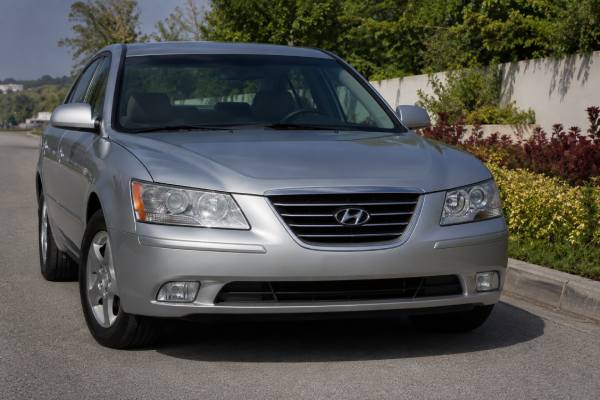

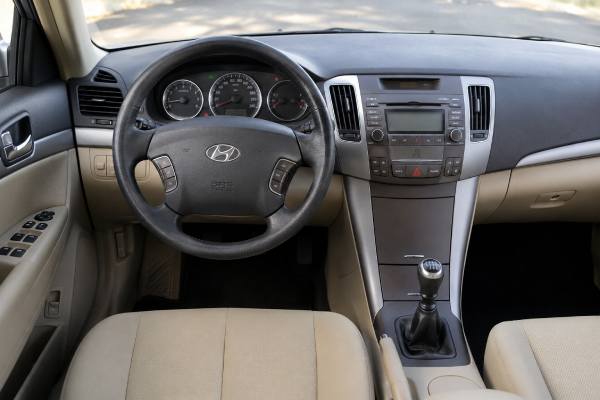
The 2006–2008 Hyundai Sonata NF 2.4 is a roomy front-wheel-drive midsize sedan built around a naturally aspirated 2.4-liter Hyundai Theta-family four-cylinder engine. In 162 hp form, it was aimed at buyers who wanted more space and equipment than many compact sedans offered, without the running costs of the 3.3-liter V6.
For today’s used-car buyer, the Sonata NF 2.4 is attractive because it is simple by modern standards: no turbocharger, no direct injection, no hybrid system, and no complex driver-assistance suite. The important questions are whether the engine and transmission have been serviced correctly, whether safety recalls have been completed, and whether rust-prone underbody areas are clean—especially in salt-belt climates.
Quick Overview
- Spacious cabin and large trunk make it practical for commuting, family use, and long-distance driving.
- The 2.4-liter four-cylinder is simpler and cheaper to run than the V6, with timing-chain construction and regular-gasoline operation.
- Standard safety equipment was strong for its era, including ABS, stability control, traction control, front side airbags, and curtain airbags on many U.S.-market cars.
- Check carefully for rear crossmember corrosion, airbag occupant-classification recall completion, oil leaks, suspension wear, and transmission-fluid history.
- Normal-service oil and filter interval is commonly 7,500 miles / 12,000 km or 6 months; severe use shortens this to about 3,000 miles / 4,800 km or 3 months.
Table of Contents
- Sonata NF 2006–2008 Profile
- Sonata NF 2.4 Specs
- Sonata NF Trims and Safety
- Reliability, Issues and Recalls
- Maintenance and Used Buying
- Driving Feel and Economy
- Comparison With Midsize Rivals
Sonata NF 2006–2008 Profile
The NF-generation Hyundai Sonata marked a major step forward for Hyundai in the midsize sedan class. Compared with earlier Sonatas, the NF was larger, better equipped, structurally more mature, and much closer in size and purpose to mainstream rivals such as the Toyota Camry, Honda Accord, Nissan Altima, Ford Fusion, Chevrolet Malibu, and Kia Optima.
The 2.4-liter version is the sensible choice in the range. It gives up the extra smoothness and passing power of the 3.3-liter V6, but it reduces fuel use, usually lowers repair costs, and avoids some V6-specific packaging and service expense. It is best understood as a comfortable daily driver rather than a sporty sedan.
A key detail for buyers is engine identification. The 162 hp 2.4 used in 2006–2008 NF Sonatas is widely listed as the G4KC 2.4-liter Theta-family MPI engine. Some databases and market references group it under broader Theta or Theta II naming, but it is not the later high-output direct-injection 2.4 GDI engine found in newer Sonatas. That matters because later Theta II GDI engine-recall discussions do not automatically apply to this 2006–2008 162 hp MPI car. Always verify by VIN, emissions label, and engine code rather than relying only on a listing title.
In practical use, the Sonata NF 2.4’s main strengths are space, comfort, simple controls, and good value. The cabin has generous front and rear room, the trunk is large for the class, and the ride is tuned more for smoothness than sharp handling. Many cars were well equipped for the money, especially GLS, SE, and Limited trims depending on market and year.
Its main weaknesses are age-related rather than design-shocking. These cars are now old enough that neglected cooling systems, worn suspension bushings, weak batteries, faded headlights, tired motor mounts, rusty subframes, and overdue fluids matter more than brochure specifications. A clean, serviced Sonata NF 2.4 can still be a useful low-cost sedan, but a cheap example with deferred maintenance can quickly exceed its purchase price in repairs.
For buyers, the best cars are usually later 2007–2008 examples with complete service records, no open recalls, smooth automatic shifting, dry engine seams, quiet timing-chain operation, clean underbody metal, and working air conditioning. Avoid cars with airbag warning lights, severe rear suspension rust, harsh transmission engagement, overheating history, or obvious oil neglect.
Sonata NF 2.4 Specs
Specifications vary by market, trim, transmission, tire package, and production date. The figures below focus on the 2006–2008 NF sedan with the 162 hp 2.4-liter gasoline engine. Where public sources differ, values are shown as practical ranges or noted as market-dependent.
Powertrain and efficiency
| Item | Hyundai Sonata NF 2.4, 162 hp |
|---|---|
| Engine code | Commonly listed as G4KC, Theta-family MPI 2.4 |
| Layout | Front transverse inline-4 gasoline |
| Valvetrain | DOHC, 16 valves, 4 valves per cylinder, CVVT |
| Bore × stroke | 88.0 × 97.0 mm / 3.46 × 3.81 in |
| Displacement | 2.4 L / 2,359 cc |
| Induction | Naturally aspirated |
| Fuel system | Multi-point fuel injection |
| Compression ratio | Approximately 10.5:1 |
| Max power | 162 hp / 119 kW @ 5,800 rpm |
| Max torque | About 219–222 Nm / 162–164 lb-ft @ 4,250 rpm |
| Timing drive | Timing chain |
| Fuel | Regular unleaded gasoline |
| EPA fuel economy, automatic | 21 mpg city / 30 mpg highway / 24 mpg combined US; about 11.2 / 7.8 / 9.8 L/100 km |
| EPA fuel economy, manual | 21 mpg city / 31 mpg highway / 25 mpg combined US; about 11.2 / 7.6 / 9.4 L/100 km |
| Real-world highway at 120 km/h / 75 mph | Commonly about 8.4–9.4 L/100 km / 25–28 mpg US if healthy; more with hills, cold weather, or old tires |
Transmission and driveline
| Item | Detail |
|---|---|
| Manual transmission | 5-speed manual, market/trim dependent |
| Automatic transmission | 4-speed automatic on 2.4-liter 2006–2008 U.S.-market cars |
| Drive type | Front-wheel drive |
| Differential | Open front differential |
| AWD / 4×4 | Not fitted to this variant |
Chassis, dimensions and capacities
| Item | Detail |
|---|---|
| Front suspension | MacPherson strut with coil spring and stabilizer bar |
| Rear suspension | Independent multi-link with coil springs and stabilizer bar |
| Steering | Hydraulic-assist rack-and-pinion; published steering ratio varies by source |
| Brakes | Front ventilated discs, rear discs, ABS |
| Common brake rotor sizes | Often 280 mm front and 262–284 mm rear depending on build/market; verify by VIN before ordering parts |
| Common tire sizes | P215/60R16; some trims use P215/55R17 |
| Ground clearance | About 160 mm / 6.3 in |
| Length | 4,800 mm / 188.9 in |
| Width | 1,830–1,832 mm / about 72.1 in |
| Height | 1,474–1,475 mm / about 58.0 in |
| Wheelbase | 2,730 mm / 107.4–107.5 in |
| Turning circle | About 10.9 m kerb-to-kerb / 35.8 ft; up to about 12.0 m wall-to-wall |
| Curb weight | About 1,440–1,480 kg / 3,170–3,260 lb depending on transmission and trim |
| GVWR | About 2,030 kg / 4,475 lb |
| Fuel tank | 67–70 L / 17.7–18.5 US gal, market dependent |
| Trunk volume | About 462–523 L / 16.3–18.5 ft³ depending on SAE/VDA measuring method |
| Payload estimate | Roughly 500–590 kg / 1,100–1,300 lb depending on curb weight and equipment |
Performance and capability
| Item | Detail |
|---|---|
| 0–100 km/h / 0–62 mph | About 8.9 seconds manual; about 10.4 seconds automatic |
| 0–60 mph | Typically high-8-second to high-9-second range depending on transmission and test method |
| Top speed | About 202–212 km/h / 126–132 mph depending on transmission and market |
| 100–0 km/h braking | Usually low-40 m range with good tires and healthy brakes; condition matters greatly on used cars |
| Towing capacity | Up to about 907 kg / 2,000 lb where rated; lower or not recommended in some markets |
| Unbraked trailer rating | Often around 750 kg / 1,650 lb in some non-U.S. data, but verify local documentation |
Fluids and service capacities
| Item | Specification / capacity |
|---|---|
| Engine oil | API SJ/SL or above, ILSAC GF-3 or above; 5W-20 preferred in many manuals, 5W-30 acceptable by climate |
| Engine oil capacity | About 4.3 L / 4.54 US qt with filter |
| Coolant | Ethylene-glycol coolant compatible with aluminum engines; typically 50/50 mix |
| Coolant capacity | About 6.5 L / 6.87 US qt for 2.4 manual; about 6.3 L / 6.66 US qt for 2.4 automatic |
| Manual transaxle oil | Hyundai Genuine MTF 75W/85 API GL-4 or equivalent; about 1.75 L / 1.8 US qt |
| Automatic transmission fluid | Hyundai Genuine ATF SP-III or approved SP-III equivalent; about 7.8 L / 8.24 US qt total capacity |
| Brake fluid | DOT 3 or DOT 4 |
| Power steering fluid | Check market-specific manual; capacity about 0.9 L / 0.95 US qt |
| A/C refrigerant | R-134a; charge amount varies by market label and equipment |
| Engine oil drain plug torque | 34–44 Nm / 25.3–32.5 lb-ft |
| Oil filter torque | About 12–16 Nm / 8.7–11.6 lb-ft |
| Wheel lug nut torque | Commonly about 88–108 Nm / 65–80 lb-ft; verify by wheel type and manual |
Safety and assistance
| Item | Detail |
|---|---|
| IIHS moderate overlap front | Good, rating applies to 2006–2010 models |
| IIHS side original test | Acceptable |
| IIHS roof strength | Marginal, based on later testing applying to 2006–2010 models |
| IIHS head restraints and seats | Good |
| NHTSA-era rating | Five-star front and side ratings were reported for 2006 Sonata under the older NHTSA test protocol |
| Euro NCAP / related data | Older European/ANCAP-era data is not directly comparable with modern Euro NCAP percentage scoring |
| Airbags | Dual front, front-seat side airbags, and side-curtain airbags on many U.S.-market cars |
| ADAS | No modern AEB, ACC, lane keeping, blind-spot monitoring, or traffic-sign assist on this generation |
| Stability systems | ABS, traction control, and electronic stability control were major strengths for the era |
Sonata NF Trims and Safety
Trim names changed by market, but U.S.-market 2006–2008 cars are usually seen as GL, GLS, SE, and Limited, with some year-to-year reshuffling. The 2.4-liter four-cylinder was common in base and mid-level trims and became available across more of the range as Hyundai adjusted the lineup.
Trims and option differences
The GL was the simplest version and is most likely to have the 5-speed manual transmission. It can be a good low-cost choice if the car is clean, but many used buyers prefer GLS or higher trims because they add comfort features without much penalty in running cost.
GLS models typically bring the best balance of equipment and value. Depending on year, they may include automatic transmission, upgraded interior trim, cruise control, keyless entry, better audio, alloy wheels, and additional convenience features.
SE trim moved the Sonata toward a slightly sportier look. On 2008 cars, SE equipment can include firmer appearance details, larger wheels or performance-oriented tires depending on package, a spoiler, and extra interior features. Do not expect a genuinely sporty chassis; the Sonata remains comfort-biased.
Limited is the luxury-oriented trim, usually with leather seating, more convenience equipment, upgraded audio, power seat features, and more exterior brightwork. A four-cylinder Limited can be appealing because it combines comfort equipment with the simpler 2.4 engine. The tradeoff is that more equipment means more items to test before buying: seat motors, sunroof drains, climate-control operation, audio functions, heated seats where fitted, and power accessories.
Quick identifiers include trunk badges, wheel design, seat material, steering-wheel controls, sunroof, climate-control panel, and audio branding. For mechanical parts, do not rely on badges alone. Use the VIN, emissions label, transmission type, build date, and brake rotor measurements before ordering service parts.
Safety equipment and ratings
For its era, the Sonata NF was well equipped. U.S.-market cars commonly included ABS, electronic brake-force distribution, traction control, electronic stability control, active front head restraints, front airbags, front side airbags, and side-curtain airbags. This was a genuine advantage in the mid-2000s, when some rivals still made stability control optional or trim-dependent.
IIHS results are a mixed but generally respectable picture for an older design. The Sonata earned a Good rating in the original moderate overlap frontal test and Good for head restraints and seats. The original side test was Acceptable, and roof strength was later rated Marginal under IIHS’s roof-strength protocol. That means the car had strong basic crash protection for its age, but it should not be judged by modern small-overlap, updated side-impact, or headlight standards.
The early 2006 seat-recliner issue is important because it affected crash-test performance before Hyundai changed the lever and recalled early cars. A pre-purchase inspection should verify recall completion, especially for vehicles built early in the 2006 model year.
Driver assistance and child-seat provisions
This Sonata does not have modern active safety technology such as automatic emergency braking, adaptive cruise control, lane centering, lane departure prevention, rear cross-traffic alert, traffic-sign recognition, or camera-based pedestrian detection. A buyer coming from a newer car should treat it as a traditional sedan with stability control, airbags, and good visibility rather than semi-automated assistance.
Rear child-seat provisions include LATCH/ISOFIX-style anchors depending on market, three-point rear belts, and head restraints. Because these vehicles are old, inspect rear belt retractors, buckles, anchor covers, seatback latches, and any signs of water intrusion before using child seats.
After any collision repair, steering, suspension, airbag, or seat work, warning lights must be checked properly. The occupant classification system in the passenger seat is especially important; do not ignore an airbag light or a passenger-airbag status lamp that behaves abnormally with an adult seated correctly.
Reliability, Issues and Recalls
A well-maintained Sonata NF 2.4 can be durable, but age and maintenance history dominate the ownership experience. Most expensive failures on today’s cars are linked to neglected fluids, overheating, corrosion, ignored warning lights, or cheap previous repairs.
Common and occasional problems
| Issue | Prevalence | Severity / cost | Symptoms | Best response |
|---|---|---|---|---|
| Rear crossmember corrosion | Common in salt-belt cars, rare in dry climates | High | Rear alignment change, clunks, visible rust, unsafe suspension mounting | VIN recall check, lift inspection, repair or replace crossmember |
| Passenger-seat OCS airbag issue | Known recall area | Medium to high safety importance | Passenger airbag light incorrect, airbag warning lamp | Verify recall completion; dealer diagnosis |
| Suspension wear | Common with age | Low to medium | Clunks, wandering, uneven tire wear | Inspect struts, control arms, ball joints, links, bushings |
| Valve cover / gasket seepage | Occasional | Low to medium | Oil smell, wet engine edges, smoke on exhaust | Replace gasket, clean and recheck |
| Motor mounts | Common with mileage | Medium | Vibration at idle, thump on gear engagement | Inspect and replace worn mounts |
| Automatic transmission harshness | Occasional | Medium to high | Delayed engagement, flare, harsh shifts, dark ATF | Check fluid, scan TCM/PCM, service with correct SP-III fluid |
| Cooling-system neglect | Occasional | Medium to high | Overheating, low coolant, heater issues | Pressure test, replace hoses/radiator/thermostat as needed |
| A/C weakness | Common with age | Medium | Warm air, cycling, noisy compressor | Leak test, confirm correct refrigerant charge |
| Headlight haze and bulb issues | Common | Low | Poor night visibility | Restore or replace lamps, check aim |
| Brake-light switch / exterior lighting recalls | Known campaign area | Low to medium | Brake lights stuck, no shift from Park, warning lights | Check recall status and switch operation |
Engine and timing-chain considerations
The 2.4-liter MPI engine uses a timing chain rather than a scheduled timing belt. That reduces routine service cost, but it does not make the chain lifetime-proof. Listen for rattling on cold start, rough idle, timing-correlation fault codes, or persistent cam/crank sensor codes. Chain, guide, or tensioner work is not a casual maintenance item; it should be done when there are symptoms, verified wear, or diagnostic evidence.
Oil condition is critical. A Theta-family four-cylinder with regular oil changes is far less risky than one with varnish under the oil cap, noisy startup, or sludge visible through the filler. Check for oil leaks at the valve cover, front cover, oil pan, and filter area. A brief mechanical tick on startup can be normal in older engines, but persistent chain rattle or knocking under load is a warning sign.
This engine is not the later 2.4 GDI setup with direct-injection carbon buildup concerns. It uses port-style multi-point injection, so intake-valve carbon is generally less of a defining ownership issue than on later GDI engines.
Transmission and driveline concerns
The 4-speed automatic is not modern, but it is usually serviceable if the fluid has not been neglected. On a test drive, it should engage Drive and Reverse promptly, shift without a heavy flare, and kick down predictably. Old ATF, wrong fluid, overheating, or ignored shift complaints can shorten its life. Hyundai SP-III specification matters; generic fluid choices can create shift-quality problems.
Manual-transmission cars are simpler, but check clutch take-up, synchronizer feel, release bearing noise, and gear-oil leaks. Axle boots and CV joints should be inspected on both automatic and manual cars.
Recalls, service actions and verification
Important recall areas for this generation include the early 2006 front seat recliner lever, occupant classification system for the passenger airbag, rear crossmember corrosion in salt-belt states, brake-light switch issues, certain lighting-related campaigns, sun visor airbag warning labels, and ABS-module fire-risk campaigns affecting some older Hyundai vehicles.
The practical rule is simple: check the VIN, not just the model year. A recall can depend on build date, market, production plant, equipment, registration region, and whether the car was previously repaired. Ask for dealer service records and run the VIN through Hyundai and NHTSA recall tools. On the lift, confirm that recall repairs were actually performed cleanly and that corrosion or wiring problems have not returned.
Maintenance and Used Buying
The Sonata NF 2.4 is easiest to own when serviced on time with the correct fluids. It is not a difficult car, but it is unforgiving of years of neglect because low market values often encourage owners to postpone repairs.
Practical maintenance schedule
| Service item | Normal interval | Severe-use interval / note |
|---|---|---|
| Engine oil and filter | 7,500 miles / 12,000 km or 6 months | 3,000 miles / 4,800 km or 3 months for short trips, heat, dust, salt, heavy traffic, towing |
| Tire rotation | About 7,500 miles / 12,000 km | Check alignment if wear is uneven |
| Engine air filter | Inspect regularly; replace around 30,000 miles / 48,000 km as needed | More often in dusty use |
| Cabin air filter | Inspect every 12 months | Replace more often in dusty or humid areas |
| Spark plugs | Iridium plugs commonly around 60,000 miles / 96,000 km | Replace earlier if misfire or poor starting appears |
| Coolant | First change about 60,000 miles / 96,000 km or 60 months | Then about every 25,000 miles / 40,000 km or 24 months |
| Automatic transmission fluid | Inspect regularly; service around 60,000 miles / 96,000 km in normal use | About 30,000 miles / 48,000 km in severe use |
| Manual transaxle oil | Inspect per schedule | Replace around 60,000 miles / 96,000 km under severe use |
| Brake fluid | Every 2–3 years is prudent | Sooner if moisture contamination is found |
| Brake pads, rotors, hoses | Inspect every service | Replace based on wear, corrosion, pulsation, hose cracking |
| Drive belts and hoses | Inspect every service | Replace if cracked, glazed, swollen, or noisy |
| Timing chain | No fixed replacement interval | Inspect if noisy, stretched, or timing faults appear |
| Battery | Test annually after 3 years | Typical replacement window 4–6 years |
| Alignment | Check after suspension work or tire wear | Essential after crossmember or control-arm repair |
Inspection checklist before buying
Start with the body and underside. The rear crossmember, rear control-arm mounting points, subframes, brake lines, fuel lines, rocker seams, wheel arches, and jacking points deserve careful inspection. Surface rust is normal on older cars; flaking structural rust, perforation, or misaligned rear suspension is not.
Then move to the powertrain. The engine should start quickly cold, idle smoothly, and pull without misfire. Look for oil seepage, coolant crust, overheating evidence, mixed fluids, smoke, and poor previous repairs. Remove the oil cap and check for heavy sludge. Inspect the radiator, overflow bottle, hoses, thermostat area, and fans.
On automatic cars, test from cold and fully warm. Gear engagement should not slam. Shifts should be deliberate but not violent. A small amount of old-car firmness is acceptable; slipping, flaring, or burnt-smelling ATF is not.
Inside, check every electrical item. Test the air conditioning, heater modes, blower speeds, power windows, locks, mirrors, gauges, warning lights, stereo, sunroof drains, trunk release, and remote keys. Warning lights should illuminate at key-on and go out after start. A missing bulb or dead warning lamp can hide a problem.
Best years and trims to seek
A clean 2007 or 2008 GLS, SE, or four-cylinder Limited is often the sweet spot. These cars usually have better equipment than the base model, while still using the simpler 2.4-liter engine. A base GL manual can be a good budget choice if it is rust-free and well maintained, but it may be harder to resell.
Avoid examples with structural rust, open safety recalls, overheating history, no maintenance records, harsh transmission behavior, active airbag faults, or cheap mismatched tires. At this age, condition matters more than trim.
Long-term durability is reasonable when the car is serviced properly. The best examples are basic, comfortable, inexpensive transportation. The worst examples are false economy: cheap to buy, but expensive to make safe.
Driving Feel and Economy
The Sonata NF 2.4 drives like a comfort-focused midsize sedan from the mid-2000s. It is not sharp, but it is easy to live with. The steering is light, the cabin is spacious, and the suspension is tuned to absorb daily-road roughness rather than encourage aggressive driving.
Ride, handling and refinement
At city speeds, the Sonata feels relaxed. The ride is generally soft enough for broken pavement, expansion joints, and suburban roads, although worn struts and old bushings can make the car feel floaty or clunky. A fresh suspension alignment and good tires make a major difference.
On the highway, straight-line stability is good for the class. The long wheelbase helps it feel settled, and the cabin is quieter than older Hyundai models. Road and wind noise rise with age, especially if door seals are tired, tires are cheap, or wheel bearings are beginning to hum.
Cornering balance is safe and predictable. The front-wheel-drive layout produces mild understeer when pushed. Steering feedback is limited, but that is normal for the car’s mission. The brakes feel adequate when the system is fresh, but old fluid, rusty rotors, seized slide pins, or low-quality pads can make the pedal feel weak. A brake inspection is essential on any used example.
Powertrain character
The 2.4-liter engine is smooth enough for daily use and has adequate low- and mid-range torque. It will not feel fast with the automatic, especially with passengers or luggage, but it is capable for commuting and highway cruising. The manual transmission makes better use of the engine and improves acceleration, but manual cars are less common.
The 4-speed automatic is the main reason the car feels older. It has wider gear spacing than modern 6-, 8-, or CVT-style transmissions, so passing sometimes requires a noticeable kickdown. In gentle use, it is simple and predictable. In hilly areas, it may hunt between gears more than newer automatics.
Real-world fuel economy
Official EPA ratings put the automatic at about 21 mpg city, 30 mpg highway, and 24 mpg combined US. In metric terms, that is about 11.2 L/100 km city, 7.8 L/100 km highway, and 9.8 L/100 km combined. The manual is slightly better on the highway and combined cycle.
Real-world figures depend strongly on condition and use. A healthy 2.4 automatic may return around 10–12 L/100 km in city use, 8.4–9.4 L/100 km at 120 km/h, and roughly 9–10.5 L/100 km mixed. Cold weather, short trips, underinflated tires, old oxygen sensors, dragging brakes, and neglected spark plugs can push consumption much higher.
For towing or full-load use, the Sonata is adequate only within its rating and with a conservative driving style. It is not a tow-focused car. Expect longer braking distances, more transmission heat, and a clear fuel-economy penalty when carrying heavy loads or climbing grades.
Comparison With Midsize Rivals
Against period rivals, the Sonata NF 2.4’s strongest argument is value. It usually costs less than a similar Toyota Camry or Honda Accord, yet it offers a roomy cabin, strong standard safety equipment for the era, and straightforward mechanicals.
The Toyota Camry is typically smoother and has a stronger reputation for long-term durability, especially when comparing average used examples. It also tends to hold value better. The Sonata counters with lower purchase cost and often more equipment for the money.
The Honda Accord is more engaging to drive and has a stronger enthusiast following. Its steering, chassis feel, and resale value are generally better. The Sonata is quieter in personality, more comfort-oriented, and often cheaper to buy in equivalent condition.
The Nissan Altima feels more powerful and more expressive, especially in V6 form, but used Altimas can vary widely in condition. The Sonata’s 2.4 engine and conventional automatic may appeal to buyers who prefer simplicity over performance.
The Ford Fusion and Mercury Milan from the same era are solid alternatives, with good chassis tuning and available V6/AWD combinations. The Sonata usually wins on rear-seat space and value, while the Fusion may feel more composed on a winding road.
The Kia Optima shares some family engineering with the Sonata and can be a close alternative. The Hyundai generally has broader name recognition in the used market, but either car should be judged by condition, rust, service records, and recall status.
For a buyer who wants the most reliable midsize sedan regardless of price, the Camry and Accord remain safer default choices. For a buyer who wants maximum space and equipment per dollar, and who is willing to inspect carefully, the Sonata NF 2.4 can make sense. The best purchase is not the cheapest listing—it is the cleanest, least-rusty, best-documented car with a smooth drivetrain and completed safety campaigns.
References
- Manuals & Warranties | Hyundai Resources | MyHyundai 2026 (Owner’s Manual Resource)
- Gas Mileage of 2006 Hyundai Sonata 2026 (Fuel Economy)
- Gas Mileage of 2008 Hyundai Sonata 2026 (Fuel Economy)
- 2006 Hyundai Sonata 2026 (Safety Rating)
- Check for Recalls: Vehicle, Car Seat, Tire, Equipment 2026 (Recall Database)
Disclaimer
This article is for informational purposes only and is not a substitute for professional diagnosis, repair advice, or official service documentation. Specifications, torque values, service intervals, fluids, safety equipment, and procedures can vary by VIN, market, production date, trim, transmission, and installed equipment. Always verify details against the official owner’s manual, service manual, under-hood labels, parts catalog, and dealer or manufacturer records for the exact vehicle.
If this guide was useful, please consider sharing it on Facebook, X/Twitter, or your preferred automotive community to support our work.