
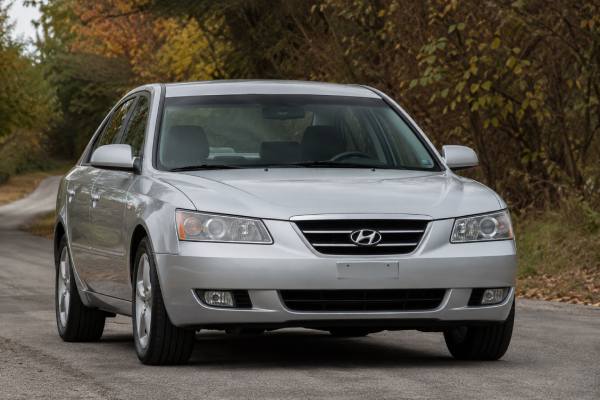
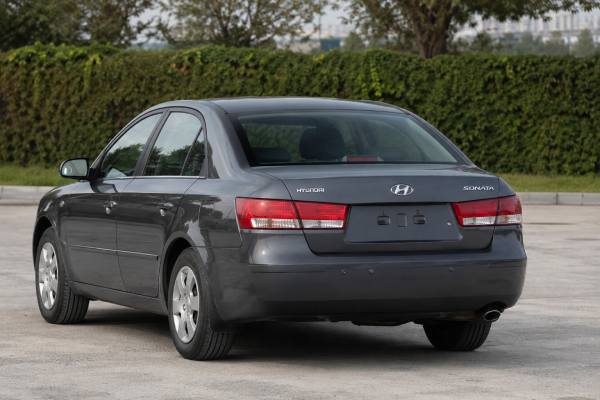
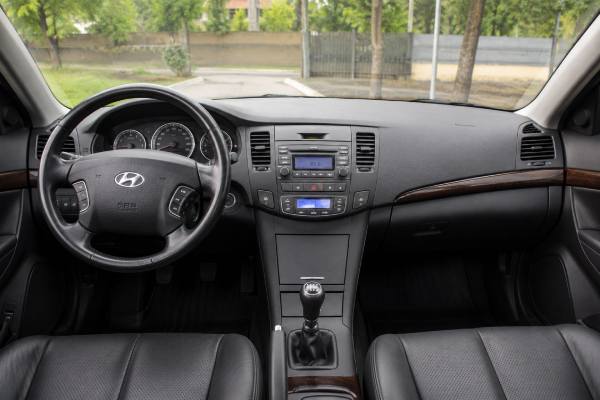
The 2005–2007 Hyundai Sonata NF with the Theta 2.4-liter engine is a practical midsize sedan from the period when Hyundai was moving from budget-car status toward serious Accord and Camry competition. In 2.4-liter form, it offers a roomy cabin, a large trunk, simple front-wheel-drive mechanicals, and a naturally aspirated multi-point-injection engine that is generally easier to live with than many later direct-injection designs.
This guide focuses on the 2.4-liter Theta-powered Sonata NF rated around 165 hp in many markets. Some North American documents list the same 2.4-liter engine at 162 hp under SAE rating methods, so output can vary slightly by market and certification method. For buyers, owners, and mechanics, the important questions are not just horsepower figures. They are whether the car is safe, what it costs to maintain, which failures to watch for, and how it compares with the Toyota Camry, Honda Accord, Nissan Altima, and other used midsize sedans from the same era.
Owner Snapshot
- Spacious cabin, large trunk, comfortable ride, and strong standard safety equipment for its age.
- The 2.4-liter Theta MPI engine uses a timing chain and avoids the carbon buildup concerns of later direct-injection engines.
- Salt-belt rear crossmember corrosion and brake-light switch recalls are important VIN checks before purchase.
- Normal engine oil service is typically every 7,500 miles or 12 months; severe use is closer to 3,750 miles or 6 months.
- A clean service history, correct ATF SP-III fluid, and rust-free underbody matter more than mileage alone.
Table of Contents
- Hyundai Sonata NF Model Background
- Hyundai Sonata NF 2.4 Specifications
- Hyundai Sonata NF Trims and Safety
- Reliability Issues and Service Actions
- Maintenance Schedule and Buying Checks
- Driving Feel and Real-World Performance
- How Sonata NF Compares to Rivals
Hyundai Sonata NF Model Background
The Hyundai Sonata NF arrived as a major step forward from the previous EF-generation Sonata. It was larger, more rigid, better equipped, and more safety-focused than earlier Hyundais. In many markets, the NF Sonata was sold from 2005 onward, with the 2006 model year marking its full arrival in North America. The 2005–2007 period is especially relevant because it covers the early version of the NF before later styling and equipment updates.
The Theta 2.4-liter four-cylinder was the sensible engine choice. It was not the fastest Sonata engine of the period — the 3.3-liter V6 was clearly stronger — but the 2.4 offered lower running costs, simpler servicing, better fuel economy, and enough performance for daily commuting. It is a naturally aspirated inline-four with dual overhead camshafts, four valves per cylinder, continuously variable valve timing, multi-point fuel injection, and a timing chain.
For a used-car buyer today, the Sonata NF 2.4 makes the most sense as an affordable, roomy, comfortable sedan rather than an enthusiast car. Its biggest strengths are practical: generous interior space, a large trunk, good highway manners, simple controls, and strong standard safety equipment for the mid-2000s. In the U.S. market, Hyundai made electronic stability control, traction control, ABS, brake assist, electronic brake-force distribution, front side airbags, side-curtain airbags, and active front head restraints standard when many competitors still reserved some safety features for higher trims.
The car’s age now matters more than its original showroom appeal. A well-kept Sonata NF can still be useful, but neglected examples can need suspension work, transmission servicing, cooling-system repairs, engine mounts, oil-leak repairs, and rust remediation. In cold-weather regions where road salt is used, underbody corrosion is one of the most important inspection points, especially around the rear crossmember and control-arm mounting points.
The 165 hp rating also needs a small note. Hyundai’s global and market-specific ratings were not always presented in the same way. Many references describe the Theta 2.4 around 165 hp, while U.S. Hyundai material for 2006–2007 often lists 162 hp and 164 lb-ft. This does not usually indicate a meaningfully different driving experience. It is more often a difference in rating standard, market tuning, or published specification.
The best examples to buy are not necessarily the lowest-mileage cars. A 120,000-mile Sonata with complete oil-change records, clean coolant, fresh suspension parts, correct transmission fluid, working safety systems, and minimal corrosion is usually a better bet than a 70,000-mile car that sat outside, missed recalls, and has original fluids. Because these cars are now old enough for age-related failures, condition and documentation are more important than trim badges.
Hyundai Sonata NF 2.4 Specifications
Specifications vary by country, trim, transmission, emissions certification, and production date. The figures below describe the 2005–2007 Hyundai Sonata NF 2.4 Theta as commonly sold in North America and comparable export markets. Always verify final specifications against the VIN, under-hood labels, and official service information for the exact vehicle.
| Item | Hyundai Sonata NF Theta 2.4 |
|---|---|
| Engine code | G4KC / Theta 2.4 MPI, market-dependent naming |
| Engine layout | Inline-4, 4 cylinders, DOHC, 4 valves per cylinder |
| Bore × stroke | 88.0 × 97.0 mm (3.46 × 3.82 in) |
| Displacement | 2.4 L (2,359 cc) |
| Induction | Naturally aspirated |
| Fuel system | Multi-point fuel injection |
| Compression ratio | About 10.5:1, depending on market calibration |
| Maximum power | 165 hp (123 kW) at about 5,800 rpm; U.S. literature often lists 162 hp (121 kW) |
| Maximum torque | About 219–227 Nm (162–167 lb-ft) at about 4,250 rpm; U.S. literature lists 164 lb-ft |
| Timing drive | Timing chain |
| Rated efficiency | About 9.4–9.8 L/100 km combined (24–25 mpg US / 29–30 mpg UK), depending on transmission and test method |
| Real-world highway at 120 km/h (75 mph) | Typically about 7.8–9.0 L/100 km (26–30 mpg US / 31–36 mpg UK) when healthy, lightly loaded, and on suitable tyres |
| Item | Specification |
|---|---|
| Manual transmission | 5-speed manual, available mainly on lower 2.4 trims |
| Automatic transmission | 4-speed automatic with Shiftronic manual selection; transmission code varies by market and build |
| Drive type | Front-wheel drive |
| Differential | Open front differential integrated with transaxle |
| Item | Specification |
|---|---|
| Front suspension | Double wishbone with coil springs, gas dampers, and stabilizer bar |
| Rear suspension | Multi-link independent rear suspension with stabilizer bar |
| Steering | Hydraulic power rack-and-pinion; ratio approximately 16.9:1 depending on rack and tyre package |
| Brakes | Four-wheel discs; front vented discs and rear solid discs, with ABS/EBD/Brake Assist on many markets |
| Common tyre size | 215/60 R16 on many GLS-style trims; 225/50 R17 on sport or higher trims in some markets |
| Ground clearance | About 160 mm (6.3 in), market-dependent |
| Length / width / height | About 4,800 / 1,832 / 1,475 mm (189.0 / 72.1 / 58.1 in) |
| Wheelbase | 2,730 mm (107.5 in) |
| Turning circle | About 10.9 m (35.8 ft) kerb-to-kerb |
| Kerb / curb weight | About 1,460–1,490 kg (3,220–3,285 lb), depending on transmission and trim |
| GVWR | About 2,030 kg (4,475 lb), market-dependent |
| Fuel tank | About 67–70 L (17.7–18.5 US gal / 14.7–15.4 UK gal), depending on market specification |
| Cargo volume | About 462 L (16.3 ft³) by U.S. trunk measurement; some global sources list about 523 L (18.5 ft³) by different methods |
| Metric | Typical figure |
|---|---|
| 0–100 km/h (0–62 mph) | About 8.9–10.5 seconds, depending on transmission and test conditions |
| Top speed | About 202–212 km/h (125–132 mph), depending on transmission and market |
| 100–0 km/h braking distance | Typically mid-40 m range when fitted with quality tyres and healthy brakes; test results vary widely |
| Towing capacity | North America commonly up to about 907 kg (2,000 lb); some markets list up to 1,700 kg braked and 700–750 kg unbraked |
| Payload | About 540–570 kg (1,190–1,255 lb), depending on curb weight and certification plate |
| System | Specification or capacity |
|---|---|
| Engine oil | API SL or newer; 5W-20 often preferred in U.S. use, with 5W-30 or 10W-30 acceptable in some climates; about 4.0–4.3 L (4.2–4.5 US qt) with filter |
| Coolant | Ethylene-glycol coolant safe for aluminum engines, mixed around 50/50 with distilled or deionized water; about 6.5 L (6.9 US qt) |
| Automatic transmission fluid | Hyundai Genuine ATF SP-III or approved SP-III equivalent; total capacity about 7.8 L (8.2 US qt), with less removed during a drain-and-fill |
| Manual transmission oil | API GL-4 75W-85; about 1.9–2.2 L (2.0–2.3 US qt), depending on transaxle version |
| Brake fluid | DOT 3 or DOT 4 as marked on reservoir cap and service information |
| Power steering fluid | Hyundai PSF-3 or specified equivalent; service amount depends on flushing method |
| A/C refrigerant | R-134a; commonly around 550–600 g (19–21 oz), but confirm under-hood label |
| A/C compressor oil | PAG oil type specified by compressor label; total system quantity is commonly around 120 mL (4.1 fl oz), with component-replacement amounts varying |
| Wheel lug nuts | Typically about 88–108 Nm (65–80 lb-ft); verify wheel and stud specification |
| Engine oil drain plug | Typically about 35–45 Nm (26–33 lb-ft), depending on service document |
| System or rating | Sonata NF 2.4 notes |
|---|---|
| NHTSA crash testing | Old-protocol five-star front and side impact ratings were reported for the NF Sonata |
| IIHS testing | Good moderate-overlap front, Acceptable side, Marginal roof strength, and Good head restraints for the tested 2006 generation |
| Euro NCAP / ANCAP-style older testing | Older four-star adult-occupant result and two-star pedestrian result are commonly associated with tested European-market models; modern percentage categories do not apply |
| Headlight rating | Modern IIHS headlight ratings were not part of the period test program |
| ADAS | No modern AEB, ACC, lane keeping, blind-spot monitoring, rear cross-traffic alert, or traffic-sign assist |
Hyundai Sonata NF Trims and Safety
The trim structure depends heavily on market. In North America, the early NF Sonata was commonly arranged around GL, GLS, LX, SE, and Limited names as the years evolved. By 2007, U.S. Hyundai material described a simpler GLS, SE, and Limited lineup. Other markets used names such as GL, GLS, Premium, Elite, Executive, or Luxury, sometimes with different wheel sizes, seat materials, and audio systems.
For the 2.4-liter model, the most important trim differences are not usually mechanical. The engine, front-wheel-drive layout, suspension architecture, and brake concept remain broadly similar. The meaningful changes are equipment, wheel and tyre packages, seating material, audio, climate control, sunroof availability, and interior trim.
Trims and option identifiers
Entry-level 2.4 Sonatas usually have cloth seats, 16-inch wheels, simpler audio, manual or basic automatic climate controls, and fewer luxury touches. Mid-level cars often add alloy wheels, cruise control, better trim, steering-wheel audio controls, and sometimes a power driver’s seat. Higher 2.4 trims may add leather upholstery, automatic climate control, a sunroof, premium audio, heated seats in colder markets, fog lights, and 17-inch alloy wheels.
Quick identifiers include:
- 16-inch steel wheels or simpler alloys on many lower trims.
- 17-inch alloys and lower-profile tyres on sport or higher trims.
- Leather seats, automatic climate control, and chrome exterior details on upper trims.
- Sunroof, upgraded audio, and power driver’s seat as common option tells.
- VIN, build plate, and original window sticker as the best way to confirm exact trim and factory equipment.
The 2007 model year brought naming and equipment changes in some regions. In the U.S., the SE became a V6-focused sport/value trim, while the 2.4 GLS remained the main four-cylinder value model. A GLS Premium-Sport type package allowed some 2.4 buyers to get 17-inch wheels and a more upscale feature mix without moving to the V6. Because used listings often mislabel these cars, the tyre size, seat material, engine label, and transmission are more reliable than the seller’s trim description alone.
Safety ratings and structure
Safety was one of the Sonata NF’s strongest selling points when new. The body structure was stiffer than the previous Sonata, and Hyundai equipped the car with a more complete safety package than many base midsize sedans of the period. Standard equipment in many major markets included six airbags: dual front airbags, front seat-mounted side-impact airbags, and full-length side-curtain airbags. Active front head restraints, three-point seatbelts, front pretensioners, and rear child-seat anchors were also part of the package.
In U.S. testing, the Sonata NF earned strong old-protocol government crash-test results for front and side impacts. IIHS results were more mixed but still respectable for the period: the moderate-overlap front result was Good, the side-impact result was Acceptable, head restraints were Good, and roof strength was Marginal under the roof-strength evaluation used by IIHS. That mix means the Sonata NF was safety-competitive in its day, but it should not be judged as equal to a modern midsize sedan with current small-overlap engineering, stronger roof standards, and modern crash-avoidance technology.
European and Australasian test data for related models used older scoring systems. Some records show a four-star adult-occupant result and a two-star pedestrian result. Modern Euro NCAP categories such as adult percentage, child percentage, vulnerable-road-user percentage, and safety-assist percentage were not used in the same way for these older tests, so direct comparison with current five-star cars is misleading.
Driver assistance and service implications
The Sonata NF does not have modern driver-assistance systems such as automatic emergency braking, adaptive cruise control, lane-keeping assist, traffic-sign recognition, blind-spot monitoring, or rear cross-traffic alert. That simplifies ownership because there are no radar sensors, camera calibrations, or ADAS modules to manage after bumper or windshield replacement.
The systems that do matter are ABS, ESC, traction control, airbag control, seatbelt pretensioners, occupant classification, brake-light switch input, and wheel-speed sensors. A used Sonata should start with the ABS, ESC, and airbag warning lights illuminating briefly during bulb check and then turning off. Warning lights that stay on should not be dismissed as “just a sensor,” because they may disable important safety functions.
After suspension work, wheel bearing replacement, steering work, or crash repair, the car should be checked for wheel-speed sensor faults, steering alignment, and proper ESC operation. After seat removal or interior water damage, the occupant classification and airbag wiring should be checked carefully.
Reliability Issues and Service Actions
The Sonata NF 2.4 is not a fragile car, but age, salt exposure, poor fluid maintenance, and low-value ownership can make neglected examples expensive. The 2.4 Theta MPI engine is generally simpler than later Theta II direct-injection engines. It avoids intake-valve carbon buildup caused by direct injection and does not use a timing belt. Still, it is not maintenance-free.
| Issue | Prevalence | Severity / cost | Typical signs | Recommended action |
|---|---|---|---|---|
| Rear crossmember corrosion | Common in salt-belt cars; rare in dry climates | High | Rust flakes, rear alignment issues, clunks, weak control-arm mounts | Check VIN campaign status; inspect rear subframe/crossmember thoroughly |
| Stop lamp switch failure | Common enough for recalls | Low to medium | Brake lights not working or staying on, shift interlock trouble, ESC light, cruise-control problems | Verify recall completion and replace switch if symptoms remain |
| Valve cover or timing-cover oil seepage | Occasional to common with age | Low to medium | Burning-oil smell, wet gasket edges, oil on engine side | Replace gaskets and clean PCV system; monitor oil level |
| CVVT oil-control faults | Occasional, more likely with poor oil history | Medium | Rough idle, hesitation, P0011/P0014/P0016-type timing codes | Use correct oil, inspect oil-control valve, verify timing-chain condition |
| Timing-chain rattle | Occasional at higher mileage | Medium to high | Cold-start rattle, timing correlation faults, poor running | Inspect chain, guides, tensioner, and CVVT phaser; replace if out of spec |
| Automatic shift flare or harsh engagement | Occasional | Medium | Delayed Drive engagement, 2–3 flare, harsh downshifts | Confirm correct ATF SP-III, check level and condition, diagnose solenoids and mounts |
| Suspension wear | Common with age | Low to medium | Clunks, wandering, uneven tyre wear, loose steering feel | Inspect control-arm bushings, ball joints, struts, sway links, and alignment |
| Occupant classification concerns | Occasional | Medium | Passenger airbag light behaves incorrectly | Check seat sensors, wiring, calibration, and applicable service actions |
Engine and timing-chain concerns
The 2.4 Theta engine uses a timing chain, so there is no scheduled timing-belt replacement. That is a real ownership advantage, but it does not mean the timing system can be ignored. Poor oil maintenance can accelerate wear in the chain, guides, tensioner, and CVVT components. A brief noise on a very cold start may be less serious than a constant rattle, but any repeated chain noise, timing correlation code, or unstable idle deserves proper diagnosis.
Oil consumption should be checked, especially on cars with unclear oil-change history. The 2.4 MPI engine is not as strongly associated with the later Theta II GDI reputation, but any 15- to 20-year-old engine can consume oil if rings are worn, the PCV system is restricted, or the car has been run low. A buyer should check the dipstick before and after a long test drive, inspect the oil cap for sludge, and look for blue smoke after extended idling.
Cooling-system age is another common issue. Radiators, hoses, thermostats, radiator caps, and coolant reservoirs can all weaken with time. Overheating is much more damaging than normal mileage, so a car that has a history of temperature spikes should be approached carefully.
Transmission and driveline
The 4-speed automatic is not sophisticated by modern standards, but it can last well when serviced with the correct fluid. The critical point is fluid specification. These transmissions were designed around Hyundai-approved ATF SP-III. Generic multi-vehicle fluid can create shift-quality problems if it does not truly meet the required friction behavior.
A healthy automatic should engage Drive and Reverse without a long delay, shift smoothly once warm, and kick down predictably. Harsh shifts can be caused by old fluid, mount wear, solenoid issues, throttle or sensor inputs, or internal transmission wear. A fluid change may help a neglected but still healthy unit, but it will not repair burned clutches or severe internal damage.
Manual-transmission cars are simpler and can feel livelier, but clutch condition, release-bearing noise, gear synchros, and shifter wear need checking. If the clutch bites at the top of the pedal travel, slips under load, or chatters when pulling away, budget for clutch work.
Recalls, campaigns, and records
Several service actions matter on this generation. The rear crossmember corrosion recall is the most serious for cars registered or used in salt-heavy regions. Road salt and water could enter sections of the rear crossmember, causing thinning or perforation. In severe cases, an inboard control-arm mounting point could separate, affecting handling. Dealer remedies involved inspection, rust-proofing treatment, or crossmember replacement depending on condition.
Brake-light switch recalls are also important. A failed switch can affect brake lamps, shift interlock operation, ESC warnings, and cruise-control cancellation. Early sun visor airbag-warning-label recalls and occupant classification system updates may also apply to some vehicles.
A proper pre-purchase file should include:
- VIN-based recall check results.
- Dealer proof that open recalls were completed.
- Oil-change records with date and mileage.
- ATF service records showing correct SP-III fluid.
- Coolant, brake-fluid, spark-plug, and filter history.
- Rust inspection notes or photos from underneath the car.
- Receipts for suspension, wheel bearings, engine mounts, and brake repairs.
Do not rely only on a clean dashboard. Some warning lights can be cleared temporarily before sale. Scan all modules if possible, including engine, transmission, ABS/ESC, and airbag systems.
Maintenance Schedule and Buying Checks
The Sonata NF 2.4 rewards basic maintenance. The best approach is not aggressive over-servicing, but steady attention to oil, coolant, transmission fluid, brake fluid, suspension, tyres, and corrosion protection. Because these cars are now old, time-based service is just as important as mileage-based service.
| Item | Typical interval | Notes |
|---|---|---|
| Engine oil and filter | Every 7,500 miles / 12 months normal; about 3,750 miles / 6 months severe use | Use correct viscosity and API rating; short trips, heat, dust, and stop-start city use count as severe |
| Engine air filter | Inspect yearly; replace about every 15,000–30,000 miles | Replace sooner in dusty regions |
| Cabin air filter | Every 12 months or 12,000–15,000 miles | Helps HVAC airflow and reduces blower strain |
| Coolant | About 60,000 miles / 5 years initially, then about 30,000 miles / 2 years unless service document says otherwise | Use aluminum-safe coolant and correct water mix |
| Spark plugs | Usually 60,000–100,000 miles depending on plug type and market schedule | Replace earlier if misfires, poor fuel economy, or worn electrodes are found |
| Timing chain | No routine replacement interval | Inspect for rattle, stretch, guide wear, tensioner issues, and timing correlation faults |
| Serpentine belt and hoses | Inspect every service; often replaced around 60,000–90,000 miles or with visible wear | Check cracking, glazing, swelling, leaks, and soft hose sections |
| Automatic transmission fluid | Preventive drain-and-fill about every 30,000–60,000 miles depending on use | Use Hyundai-approved SP-III fluid; avoid unverified universal ATF |
| Manual transaxle oil | About every 60,000 miles, sooner under severe use | Use GL-4 75W-85 or specified equivalent |
| Brake fluid | Every 2 years | Moisture-contaminated fluid can corrode components and reduce boiling margin |
| Brake pads and rotors | Inspect every 6–12 months | Check slide pins, parking brake function, rotor rust, and pad taper |
| Tyre rotation and alignment | Rotate every 6,000–7,500 miles; check alignment yearly or after suspension work | Uneven tyre wear often points to worn bushings or poor alignment |
| Valve clearance | Inspect only if noisy, misfiring, or compression concerns appear unless market schedule requires otherwise | Not a casual service item; use official procedure |
| 12 V battery | Test yearly after 3 years; replacement commonly needed around 4–6 years | Weak voltage can create misleading electrical symptoms |
Buyer inspection checklist
Start under the car. Rust is one of the biggest deal-breakers. Check the rear crossmember, rear suspension mounting points, brake lines, fuel lines, rocker panels, front subframe, lower control arms, and jacking points. Surface rust is expected on an older car in many climates, but swelling seams, perforation, flaking structural metal, or patched suspension mounts are warning signs.
Then check the engine cold. It should start promptly without extended rattling, heavy smoke, or unstable idle. Listen near the timing cover for chain noise. Look around the valve cover, timing cover, oil pan, and crank seals for leaks. Inspect the coolant tank for oily residue or heavy rust-colored deposits. A pressure test is worthwhile before buying any example with coolant smell, low coolant, or temperature instability.
During the test drive, check:
- Smooth automatic engagement from Park to Reverse and Drive.
- No harsh 2–3 flare, slipping, or delayed kickdown.
- Straight tracking on level road.
- No steering clunks over small bumps.
- Stable braking without vibration or pull.
- ESC, ABS, and airbag lights turning off after startup.
- Air conditioning cooling at idle and while driving.
- No overheating during traffic or hill climbing.
For reconditioning, budget realistically. Even a cheap Sonata can need tyres, brake pads and rotors, struts, control-arm bushings, engine mounts, fluids, filters, spark plugs, battery, and air-conditioning work. If a car needs several of these at once, the repair bill can exceed the price difference between a neglected car and a cleaner example.
The best versions to seek are rust-free 2.4-liter cars with documented oil changes, correct ATF service, working safety systems, and no major accident history. Higher trims are pleasant, but condition should outrank leather seats or sunroof availability. A simpler GLS-style car with cloth seats, 16-inch tyres, and full maintenance history may be the smartest long-term choice.
Driving Feel and Real-World Performance
The Sonata NF 2.4 drives like a comfort-biased midsize sedan. Its long wheelbase and independent suspension give it a composed ride over most roads, and the cabin feels spacious in a way that made the car competitive when new. It is not sporty in the same sense as a Mazda6 or a well-kept Honda Accord, but it is stable, predictable, and easy to drive.
Steering is hydraulic, with more natural weight than many later electric systems, though feedback is modest. The car turns in cleanly enough for daily use, then settles into mild understeer if pushed. Body roll is present but not excessive, and the rear suspension helps the car feel more settled than older torsion-beam sedans. Tyres make a big difference. A Sonata on good 215/60 R16 touring tyres usually rides better and tracks more quietly than one on old, hard, mismatched 17-inch tyres.
The 2.4-liter engine is adequate rather than exciting. It has enough low- and mid-range torque for normal city driving, but it needs revs for quick merging or passing. Above about 4,000 rpm it becomes louder and less refined, though it is not unusually harsh for a large four-cylinder of its period. The manual transmission makes the car feel more responsive, while the 4-speed automatic is smoother and more common but less eager.
The automatic’s main weakness is its limited number of gears. At highway speed, it can feel relaxed once settled, but passing may require a downshift that arrives with a pause compared with modern 6-, 8-, or 10-speed automatics. On hills, the transmission may hold lower gears longer and raise engine noise. This is normal if shifts are clean and predictable; slipping, flaring, or banging into gear is not normal.
Real-world economy depends strongly on traffic, temperature, tyre condition, and transmission. A healthy 2.4 manual can return about 8.5–9.5 L/100 km in mixed use (25–28 mpg US / 30–34 mpg UK). An automatic often lands closer to 9.0–10.5 L/100 km (22–26 mpg US / 27–31 mpg UK). In dense city driving, 10.5–12.5 L/100 km (19–22 mpg US / 23–27 mpg UK) is realistic. On steady 100–120 km/h highway runs, 7.5–9.0 L/100 km (26–31 mpg US / 31–37 mpg UK) is achievable when the car is healthy and not heavily loaded.
Cold weather can reduce economy noticeably, especially on short trips where the engine and automatic transmission do not fully warm up. Expect winter fuel use to worsen by 10–20 percent in very cold, short-trip driving. Dragging brakes, low tyre pressure, old spark plugs, oxygen-sensor faults, thermostat problems, or a dirty air filter can make economy worse.
Braking feel is straightforward. With fresh fluid, good pads, smooth rotors, and working ABS, the Sonata stops confidently for normal use. The car is not light, so cheap pads and neglected fluid are easy to notice on repeated stops. Brake pulsation is usually rotor runout or uneven deposits, while rear brake noise can come from corrosion, sticky slide pins, or parking-brake hardware.
For towing, the Sonata should be treated as a light-duty sedan. Some markets publish much higher braked trailer limits than North America, but that does not make the car a natural tow vehicle. Short local towing with a properly rated hitch, light load, and good brakes is different from long grades in hot weather. With a moderate trailer or full passenger load, expect longer stopping distances, more transmission heat, and a fuel-consumption penalty that can easily reach 15–30 percent.
How Sonata NF Compares to Rivals
The Sonata NF 2.4 competes most directly with the Toyota Camry 2.4, Honda Accord 2.4, Nissan Altima 2.5, Ford Fusion 2.3, Mazda6 2.3, Chevrolet Malibu, and Kia Optima/Magentis. Its strongest argument is value: it often costs less than equivalent Toyota and Honda models while offering a large cabin, big trunk, and strong safety equipment.
| Model | Main strengths | Main cautions | Best fit |
|---|---|---|---|
| Hyundai Sonata NF 2.4 | Roomy, comfortable, strong standard safety for age, affordable pricing, simple MPI engine | Rust in salt climates, old-car suspension wear, correct ATF service matters | Value-focused buyers wanting space and comfort |
| Toyota Camry 2.4 | Strong reputation, good parts support, comfortable ride, high resale | Often more expensive; oil consumption and age-related leaks possible on some engines | Buyers prioritizing resale and predictable ownership |
| Honda Accord 2.4 | Sharper handling, strong engine, durable interior, good manual option | Usually pricier; more road noise; automatic condition still needs checking | Drivers wanting a more engaging midsize sedan |
| Nissan Altima 2.5 | Quick feel, roomy cabin, comfortable highway manners | QR25 engine issues on some years, catalyst/oil-consumption concerns, condition varies widely | Buyers who value performance but inspect carefully |
| Ford Fusion / Mazda6 four-cylinder | Better steering feel, composed chassis, practical size | Rust can be a concern; cabin and rear-seat space may trail Sonata | Drivers who want handling over maximum cabin room |
| Kia Optima / Magentis | Similar platform and engines, often cheaper than Sonata | Equipment and resale vary; same age-related inspection needs | Budget buyers open to a closely related alternative |
Against the Camry, the Sonata usually wins on purchase price and original standard safety equipment. The Camry counters with stronger resale value, easier buyer confidence, and a larger independent repair knowledge base. A clean Sonata can be the better deal, but a neglected Sonata is not automatically a bargain.
Against the Accord, the Sonata is softer and roomier-feeling, while the Honda feels more precise and responsive. The Accord’s 2.4-liter engine is one of the better four-cylinders of the period, but good examples often cost more. Buyers who care about handling may prefer the Honda; buyers who care about comfort and value may prefer the Hyundai.
Against the Altima, the Sonata feels less lively but more conservative. The Nissan can feel quicker and sportier, yet some early 2.5-liter Altimas require more careful engine-history checks. Against the Fusion and Mazda6, the Sonata offers more cabin space and comfort, while the Ford/Mazda pair usually feel tighter and more driver-focused.
The practical verdict is simple: buy the Sonata NF 2.4 only if the individual car is clean, documented, rust-free, and mechanically sound. It is not rare enough to justify buying a bad one. When maintained properly, it can be an inexpensive, comfortable, and safe used sedan. When neglected, its low purchase price can quickly disappear into suspension, corrosion, transmission, and cooling-system repairs.
References
<a href="https://www.hyundainews.com/assets/documents/original/15600-SONATARAISESTHEBARONMIDSIZESEDANVALUEFOR2007.pdf">SONATA RAISES THE BAR ON MIDSIZE SEDAN VALUE FOR 2007</a>2006 (Manufacturer Publication)<a href="https://www.manualslib.com/manual/231865/Hyundai-2006-Sonata.html">HYUNDAI 2006 SONATA AUTOMOBILE OWNER'S MANUAL | ManualsLib</a>2006 (Owner’s Manual)<a href="https://www.fueleconomy.gov/feg/bymodel/2006_Hyundai_Sonata.shtml">Gas Mileage of 2006 Hyundai Sonata</a>2006 (Fuel Economy Data)<a href="https://www.iihs.org/ratings/vehicle/hyundai/sonata-4-door-sedan/2006">2006 Hyundai Sonata</a>2006 (Safety Rating)<a href="https://static.nhtsa.gov/odi/rcl/2013/RCONL-13V354-0123.pdf">IMPORTANT SAFETY RECALL</a>2013 (Recall Notice)
Disclaimer
This article is for informational purposes only and is not a substitute for professional diagnosis, repair, inspection, or official service documentation. Specifications, torque values, service intervals, procedures, fluids, safety equipment, and recall applicability can vary by VIN, market, production date, trim, and installed equipment. Always verify critical information against the vehicle’s official owner’s manual, workshop manual, under-hood labels, certification plate, and manufacturer or dealer records.
If this guide helped you, please consider sharing it on Facebook, X/Twitter, or your preferred automotive community to support our work.