
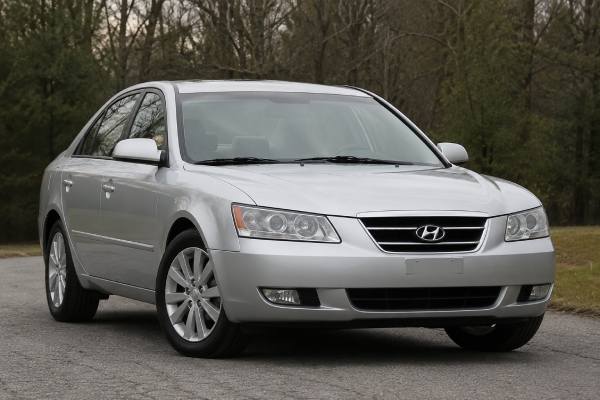
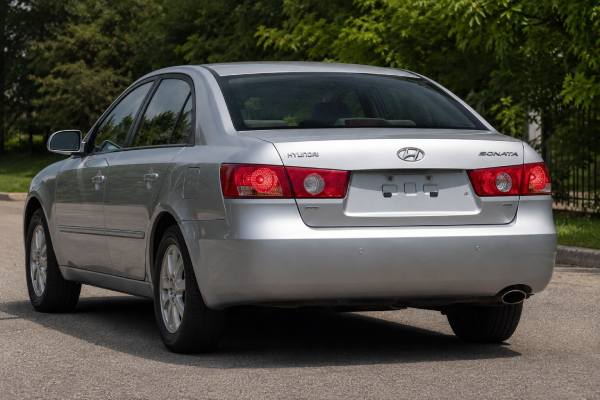
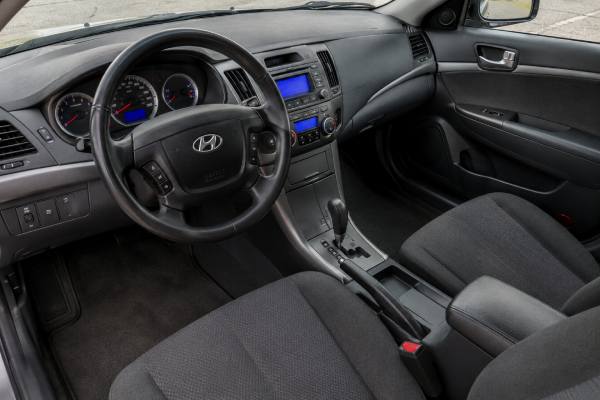
The Hyundai Sonata NF with the Lambda 3.3 V6 is one of the more interesting versions of Hyundai’s fifth-generation Sonata. It paired a roomy, conservative sedan body with a smooth all-aluminum V6, front-wheel drive, a 5-speed automatic, and an unusually strong safety-equipment package for its time. For buyers today, the appeal is simple: it can be a comfortable, inexpensive, and mechanically straightforward used sedan if the right maintenance and recall work have been done.
The main things to understand are the market differences and the age-related issues. The 3.3 V6 was quoted around 233 hp in many international references, while North American material commonly listed 235 hp for 2006 and 234 hp for 2007. The car itself is broadly the same idea: a naturally aspirated Lambda V6 Sonata NF with good space, relaxed highway manners, and maintenance needs that now matter more than the original spec sheet.
Owner Snapshot
- Smooth Lambda 3.3 V6 gives strong passing power and relaxed highway cruising.
- Spacious cabin and large trunk make it more practical than many same-era midsize sedans.
- Standard or widely available ESC, ABS, side airbags, and curtain airbags were strong safety points for the period.
- Rust, rear crossmember condition, ABS-module recall status, and transmission fluid history are key buying checks.
- Engine oil service is typically every 7,500 miles / 12,000 km under normal use, or sooner in severe service.
Table of Contents
- Sonata NF 3.3 V6 Overview
- Sonata NF 3.3 V6 Specs
- Sonata NF Trims and Safety
- Reliability Issues and Recalls
- Maintenance and Buying Advice
- Driving Feel and Performance
- Sonata NF Versus Rivals
Sonata NF 3.3 V6 Overview
The NF-generation Hyundai Sonata was a major step forward from the previous EF Sonata. It was larger, more rigid, better equipped, and more competitive with the Toyota Camry, Honda Accord, Nissan Altima, Mazda6, and Ford Fusion. In many markets, the 3.3 V6 sat above the 2.4-liter four-cylinder and gave the Sonata a much stronger personality: quieter, quicker, and better suited to long-distance driving.
The engine is the Lambda G6DB 3.3-liter V6. It is an all-aluminum, naturally aspirated, DOHC, 24-valve unit with multi-point fuel injection and continuously variable valve timing. It uses a timing chain rather than a scheduled timing belt, which is a useful ownership advantage. There is no turbocharger, no direct injection system, no hybrid hardware, and no dual-clutch transmission. That makes the powertrain relatively simple by modern standards.
The 3.3 V6 was paired with a 5-speed automatic transmission with manual shift control in most markets. Drive is to the front wheels through an open differential. This is not a sporty layout, but it suits the Sonata’s role well. The V6 has enough torque to move the car easily without frequent high-rpm driving, and the automatic is generally smooth when serviced correctly.
Dimensionally, the NF Sonata is a large midsize sedan. It is about 4,800 mm long, with a 2,730 mm wheelbase and a wide cabin. Hyundai highlighted the car’s large interior volume in period material, and that remains one of its strongest used-car advantages. The rear seat is adult-friendly, the trunk is usefully large, and the seating position is straightforward.
The car’s value today depends heavily on condition. A clean, rust-free, well-maintained Sonata NF 3.3 V6 can be a comfortable bargain. A neglected one can quickly become uneconomical because age-related repairs can exceed the car’s market value. The best examples are not necessarily the lowest-mileage cars; they are the ones with proof of fluid services, completed recalls, good tires, clean underbody structure, and no warning lights.
The 2005–2007 year range also needs market awareness. In the United States, the redesigned Sonata arrived as a 2006 model. In other markets, the NF body appeared around 2005. Trim names changed by country: GLS V6 and LX were used in North America for 2006, while 2007 brought names such as SE and Limited. Other regions used names such as Elite, SLX, or CDX depending on local distributor practice.
Sonata NF 3.3 V6 Specs
The figures below focus on the 2005–2007 Sonata NF 3.3 V6 with the Lambda naturally aspirated petrol engine and 5-speed automatic. Some values vary slightly by market, model year, wheel package, emissions calibration, and measurement standard.
Powertrain and efficiency
| Item | Specification |
|---|---|
| Engine code | G6DB Lambda 3.3 V6 |
| Engine layout | Transverse V6, 6 cylinders, DOHC, 4 valves per cylinder, 24 valves total |
| Bore × stroke | About 92.0–92.7 × 83.8 mm depending on data source and market listing |
| Displacement | 3.3 L / 3,342 cc |
| Induction | Naturally aspirated |
| Fuel system | Multi-point fuel injection |
| Compression ratio | 10.4:1 |
| Maximum power | 233 hp class / about 171–174 kW at 6,000 rpm; North American listings quote 234–235 hp |
| Maximum torque | About 304–308 Nm / 224–227 lb-ft at 3,500 rpm |
| Timing drive | Timing chain |
| Rated efficiency | US EPA 2006–2007 V6 automatic: 18 mpg city / 27 mpg highway / 21 mpg combined; about 13.1 / 8.7 / 11.2 L/100 km |
| Real-world highway at 120 km/h / 75 mph | Typically about 8.8–10.0 L/100 km, or 24–27 mpg US / 29–32 mpg UK, when healthy and lightly loaded |
Transmission, chassis, and dimensions
| Item | Specification |
|---|---|
| Transmission | 5-speed automatic with manual shift mode; commonly associated with Hyundai A5HF1 family |
| Drive type | Front-wheel drive |
| Differential | Open front transaxle differential |
| Front suspension | Independent double wishbone / double A-arm type, coil springs, anti-roll bar |
| Rear suspension | Independent multi-link, coil springs, anti-roll bar |
| Steering | Hydraulic power-assisted rack and pinion; about 16.9:1 overall ratio |
| Brakes | Four-wheel discs with ABS and EBD; front vented discs about 280 mm / 11.0 in, rear discs about 262 mm / 10.3 in |
| Popular tire sizes | 215/60 R16 or 225/50 R17 depending on trim and package |
| Ground clearance | About 160 mm / 6.3 in |
| Length / width / height | About 4,800 / 1,832 / 1,473–1,480 mm; 188.9 / 72.1 / 58.0–58.3 in |
| Wheelbase | 2,730 mm / 107.4–107.5 in |
| Turning circle | About 10.9 m / 35.8 ft kerb-to-kerb |
| Kerb / curb weight | About 1,569–1,571 kg / 3,458–3,463 lb for V6 automatic versions |
| GVWR | About 2,130 kg / 4,696 lb in several North American listings |
| Fuel tank | About 65–67 L / 17.2–17.7 US gal / 14.3–14.7 UK gal |
| Cargo volume | About 462 L / 16.3 ft³ by SAE-style trunk measurement; some markets list larger VDA-style boot figures |
Performance and service capacities
| Item | Specification |
|---|---|
| 0–100 km/h / 0–62 mph | About 7.7–7.9 seconds depending on market and test conditions |
| Top speed | About 228–230 km/h / 142–143 mph where unrestricted |
| 100–0 km/h braking | Typically mid-40 m range / about 140–150 ft in independent testing; varies heavily with tire and brake condition |
| Towing capacity | Market dependent; some North American listings show up to 907 kg / 2,000 lb, while many markets advise conservative or no regular towing |
| Payload | About 550–560 kg / 1,200–1,235 lb depending on VIN plate and market |
| Engine oil | SAE 5W-20 preferred in North American owner material; 5W-30 acceptable in many conditions. Capacity about 5.2 L / 5.5 US qt with filter |
| Coolant | Ethylene glycol-based aluminum-compatible coolant, normally 50:50 premix; capacity about 8.2–8.9 L / 8.7–9.4 US qt depending on source |
| Automatic transmission fluid | Hyundai-approved ATF SP-III; total fill about 10.9 L / 11.5 US qt for many 5-speed listings, drain-and-fill volume is lower |
| Brake fluid | DOT 3 or DOT 4 |
| Power steering fluid | Hyundai PSF specification; verify by reservoir cap and service documentation |
| A/C refrigerant | R134a; charge varies by market and compressor specification, so verify under-hood label |
| Key torque values | Engine oil drain plug about 39 Nm / 29 lb-ft; wheel lug nuts typically about 88–107 Nm / 65–79 lb-ft, verify by service manual |
Sonata NF Trims and Safety
The 3.3 V6 was not usually the base Sonata NF. It appeared in higher trims or V6-specific grades, which means many cars have better equipment than the four-cylinder versions.
In the United States, the 2006 V6 models were commonly GLS V6 and LX. The GLS V6 gave the buyer the larger engine and 5-speed automatic, while LX added luxury equipment such as leather upholstery, heated front seats, automatic climate control, upgraded interior trim, and 17-inch wheels. For 2007, the lineup shifted toward GLS, SE, and Limited naming. The SE and Limited were the V6-focused trims in many North American materials, with Limited taking the comfort and luxury role.
Other markets used different names. Australian and New Zealand cars may appear as V6, Elite, or SLX versions depending on year and market. European references may identify the car simply as Sonata 3.3 V6 automatic. Because trim names vary, the best way to identify a specific car is to check the VIN, engine bay label, original registration data, tire placard, and equipment.
Quick identifiers include:
- V6 badge or 3.3 engine bay layout: the Lambda V6 fills the bay more completely than the 2.4 four-cylinder.
- Automatic only in most V6 markets: the 3.3 was normally paired with the 5-speed Shiftronic automatic.
- Wheel package: 16-inch wheels were common on lower V6 trims, while 17-inch wheels with 225/50 R17 tires often indicate a higher trim or package.
- Interior equipment: leather, heated seats, automatic climate control, power driver seat, and upgraded audio point toward LX, Limited, or equivalent higher trims.
- Build origin: North American cars may be Alabama-built; some early or certain recall-affected cars may be Korea-built, so VIN origin matters.
Safety equipment was a major selling point for the NF Sonata. Typical equipment included front airbags, front seat-mounted side airbags, side curtain airbags, ABS, electronic brake-force distribution, traction control, electronic stability control, active front head restraints, three-point belts for all seating positions, front pretensioners, and rear LATCH/ISOFIX-style child-seat anchors depending on market terminology.
Crash-test results should be read by test body and test version. In U.S. testing, the Sonata performed strongly for its era, with five-star NHTSA front and side crash-test results widely reported in period Hyundai material. IIHS ratings were more mixed but still respectable: the 2006–2010 Sonata earned Good in the original moderate-overlap front test, Acceptable in the original side test, Good for head restraints and seats, and Marginal in the later roof-strength assessment that applied across the generation.
There were no modern ADAS systems such as autonomous emergency braking, adaptive cruise control, lane-keeping assist, blind-spot monitoring, rear cross-traffic alert, or traffic-sign assist. Parking sensors, if present, are market or accessory dependent. After windshield, steering, suspension, or airbag repairs, there are no camera/radar calibrations like on modern cars, but ABS/ESC faults and airbag warning lights still need scan-tool diagnosis rather than guesswork.
Reliability Issues and Recalls
The Sonata NF 3.3 V6 is not a fragile car, but every example is now old enough for age, corrosion, rubber parts, neglected fluids, and incomplete recall work to matter more than original build quality. A clean V6 with records can be durable; a cheap neglected car can become expensive quickly.
| Issue area | Prevalence | Severity / cost | Typical symptoms | Recommended action |
|---|---|---|---|---|
| Rear crossmember corrosion | Common in salt-belt or coastal climates | High if advanced | Rear alignment changes, clunks, visible rust, failed inspection | Check recall status, inspect on lift, replace or treat as required |
| ABS module moisture/fire recall | VIN-dependent | High safety priority | May be no symptom before failure; ABS warning possible | Verify campaign completion and dealer remedy |
| Automatic transmission fluid neglect | Occasional to common | Medium to high | Harsh shifts, delayed engagement, flare, dark/burnt ATF | Service with correct SP-III fluid if appropriate; diagnose before flushing a failing unit |
| Valve cover or front cover seepage | Occasional | Low to medium | Oil smell, wet engine sides, oil on exhaust area | Replace gaskets and inspect PCV system |
| Cooling system aging | Common with age | Medium | Coolant smell, overheating, brittle hoses, radiator seepage | Pressure test, replace weak hoses/radiator/thermostat as needed |
| Suspension bushings and links | Common at higher mileage | Low to medium | Knocks, vague steering, uneven tire wear | Inspect control arms, sway links, struts, rear links, then align |
| OCS passenger-airbag recognition | Recall/campaign related | Medium safety priority | Passenger airbag-off lamp with adult occupant | Verify OCS recall or reprogramming history |
The Lambda V6 uses a timing chain, so there is no routine timing-belt replacement. However, chain systems are not maintenance-free if oil services are neglected. Listen for cold-start rattles, cam/crank correlation fault codes, and persistent upper-engine noise. These symptoms can indicate chain, guide, or tensioner wear, but diagnosis should confirm the cause before major work.
Oil consumption is not usually the headline weakness of this engine, but older high-mileage examples can use oil through wear, stuck rings, PCV faults, or leaks. Check the dipstick before and after a test drive. A dry engine bay is a better sign than a freshly pressure-washed one.
The 5-speed automatic is generally acceptable when serviced, but old fluid and heat shorten its life. A healthy unit should engage Drive and Reverse promptly, shift cleanly when warm, and downshift without banging. A small amount of adaptive shift feel is normal in older Hyundai automatics, but repeated flare, slipping, or hard 2–3 and 3–4 shifts deserve caution.
Important recalls and service actions to verify include:
- ESC oversensitivity recall: certain early 3.3-liter cars with ESC needed HECU software reprogramming because the system could apply braking too aggressively in some banked-curve conditions.
- Front seat recliner recall: early 2006 cars could have front seat belt interference with the manual seatback recliner knob.
- Sun visor airbag-label recall: affected cars needed inspection or replacement of warning labels or visor assemblies.
- Passenger occupant classification recall: some 2006–2008 Sonata cars could misclassify smaller adults and keep the passenger airbag disabled.
- Rear crossmember corrosion recall: 2006–2010 Sonata cars in salt-belt areas were subject to inspection, rustproofing, repair, or replacement depending on corrosion level.
- ABS module electrical recall: certain Korea-built 2006 Sonata NF vehicles were included in a campaign related to moisture entering the ABS electrical system and possible engine-compartment fire risk.
Before purchase, request service history, recall-completion proof, transmission-fluid records, coolant-service records, and underbody photos if buying remotely. A professional inspection should include a scan of all modules, not just engine codes.
Maintenance and Buying Advice
A Sonata NF 3.3 V6 is at the stage of life where preventive maintenance matters more than mileage alone. A 200,000 km car with regular fluids and a clean underbody may be a better buy than a 110,000 km car with stale ATF, old coolant, rusty suspension mounts, and warning lights.
| Item | Typical interval | Notes |
|---|---|---|
| Engine oil and filter | 7,500 miles / 12,000 km or 12 months normal use; 3,000–5,000 miles / 5,000–8,000 km severe use | Use correct viscosity and quality; shorter intervals help timing-chain life |
| Engine air filter | Inspect every service; replace about 30,000 miles / 48,000 km or sooner in dust | A dirty filter affects throttle response and fuel use |
| Cabin air filter | 12–24 months | Replace sooner if airflow is weak or odor appears |
| Coolant | Initial long interval may be up to 120,000 miles / 10 years in some schedules; used cars benefit from 3–5 year refreshes | Use aluminum-compatible coolant and correct mix |
| Spark plugs | About 60,000–100,000 miles depending on plug type and market schedule | Use correct heat range; rear bank labor is higher |
| Automatic transmission fluid | Inspect regularly; replace about 30,000–60,000 miles / 48,000–96,000 km depending on use | Use Hyundai-approved SP-III fluid; avoid universal fluid unless explicitly approved |
| Brake fluid | Every 2–3 years | Important for ABS/ESC hydraulic reliability |
| Brake pads, rotors, hoses | Inspect at every service or tire rotation | Check rear caliper sliders and parking brake function |
| Drive belts and hoses | Inspect every 12 months; replace cracked, swollen, noisy, or oil-soaked parts | Age matters as much as mileage |
| Timing chain | No routine belt-style replacement | Inspect if rattling, timing codes, poor oil history, or cam-correlation faults appear |
| Tire rotation and alignment | Rotate every 5,000–7,500 miles / 8,000–12,000 km; align when wear or suspension work requires | Uneven rear wear can point to rear link or crossmember issues |
| 12 V battery | Test yearly after 3 years; replace commonly at 4–6 years | Weak batteries can trigger false electrical symptoms |
A good buyer inspection should start underneath. Look at the rear crossmember, rear control-arm mounting points, fuel and brake lines, subframe seams, rocker panels, wheel arches, and jacking points. Surface rust is normal in many regions; perforation, swelling seams, or weakened suspension mounting areas are not.
Then inspect the powertrain. The V6 should start quickly, idle smoothly, and pull cleanly without misfire. Check for oil leaks around the valve covers, front timing cover area, oil pan, and oil cooler area if equipped. Look for coolant crust near hose ends, radiator tanks, thermostat housing, and expansion tank.
During the road test, the automatic should shift smoothly both cold and hot. Test gentle acceleration, kickdown, steady cruising, and stop-and-go driving. Any hard engagement, slipping, delayed Reverse, or repeated flare should reduce the price or end the inspection.
Choose the cleanest body and best service history over the most loaded trim. Higher trims are nicer, but leather, sunroofs, power seats, and premium audio add failure points. Seek a car with completed recalls, no airbag/ABS/ESC lights, matching quality tires, stable temperature, and evidence of regular oil and ATF service. Avoid cars with structural rust, overheating history, unexplained coolant loss, transmission slip, or missing paperwork.
Long-term durability outlook is fair to good. The engine architecture is fundamentally sound, the car is not mechanically exotic, and parts support remains reasonable in many markets. The limiting factors are rust, neglected automatic transmission fluid, aging electrical components, and whether repair costs still make sense relative to the car’s low market value.
Driving Feel and Performance
The Sonata NF 3.3 V6 drives like a comfort-biased family sedan with a strong engine rather than a sports sedan. Its best qualities are smoothness, space, and easy acceleration. It is happiest on open roads, suburban commutes, and long highway trips where the V6 can settle into a quiet rhythm.
The Lambda V6 is the highlight. It has enough torque at low and mid rpm to make the Sonata feel relaxed in normal traffic. Throttle response is progressive rather than sharp, which suits the automatic transmission. When pressed, the engine revs cleanly toward 6,000 rpm and gives the car better passing power than four-cylinder versions. The sound is subdued rather than dramatic.
The 5-speed automatic is smooth when healthy. It is not as quick or intelligent as modern automatics, but it avoids the droning feel of many CVTs and works well with the V6’s torque. Kickdown can feel a little deliberate by modern standards, and older units may hunt on grades if the fluid is tired or adaptive behavior is off. Manual shift mode is useful for holding a lower gear on descents or during overtakes, but it does not turn the car into a performance sedan.
Ride comfort is generally good. The long wheelbase, independent rear suspension, and soft-edged damping help the car absorb rough urban roads and highway expansion joints. On 17-inch wheels, impact harshness is slightly more noticeable than on 16-inch tires, but the car still leans toward comfort.
Handling is safe and predictable. The steering is light to moderate in weight and not especially communicative. The front-wheel-drive layout means understeer appears if the car is pushed hard, especially on old or budget tires. ESC was a major benefit for the time, but tire quality remains the biggest real-world handling upgrade.
Cabin noise is acceptable for the class and era. Wind and road noise are present by modern standards, but the V6 version is calmer than the four-cylinder under acceleration. Worn engine mounts, cupped tires, tired struts, or loose suspension links can make a bad example feel much older than a well-kept one.
Real-world economy depends heavily on traffic. Expect roughly 12–15 L/100 km in urban driving, or about 16–20 mpg US / 19–24 mpg UK. Mixed use commonly lands near 10–12 L/100 km, or 20–24 mpg US / 24–29 mpg UK. Steady highway driving can drop below 10 L/100 km, but high speeds, cold weather, short trips, old oxygen sensors, dragging brakes, and low tire pressure all hurt efficiency.
Towing should be approached conservatively. Even where a 2,000 lb / 907 kg rating appears, this is a front-wheel-drive sedan with a transaxle and passenger-car cooling margins, not a tow vehicle. Light utility-trailer use may be acceptable when the car is healthy, correctly equipped, and legally rated, but frequent towing, steep grades, and heavy loads accelerate brake, tire, cooling, and transmission wear.
Sonata NF Versus Rivals
The Sonata NF 3.3 V6 competed in a crowded and very strong midsize-sedan field. Its rivals were not weak: the Toyota Camry V6 was known for refinement and resale value, the Honda Accord V6 for sharper road manners and engine quality, the Nissan Altima V6 for stronger performance, the Mazda6 V6 for handling, and the Ford Fusion V6 for value and available all-wheel drive in later versions.
| Model | Main advantage | Main drawback versus Sonata | Best buyer fit |
|---|---|---|---|
| Hyundai Sonata NF 3.3 V6 | Value, space, strong safety equipment, smooth V6 | Lower resale, aging trim quality, rust concerns | Budget buyer wanting comfort and power |
| Toyota Camry V6 | Refinement, reliability reputation, resale value | Usually costs more for similar condition | Buyer prioritizing low drama and resale |
| Honda Accord V6 | Sharper handling, strong V6, better driver feel | Some years have automatic-transmission concerns; prices can be higher | Driver who wants a more responsive sedan |
| Nissan Altima V6 | Quick acceleration and lively engine | Rougher refinement and more variable used condition | Buyer who values speed over polish |
| Mazda6 V6 | Handling and steering feel | Less rear-seat space and often more road noise | Buyer wanting a sportier chassis |
| Ford Fusion V6 | Good value, solid road manners, later AWD availability | Less powerful than some V6 rivals in early form | Practical buyer considering domestic alternatives |
The Sonata’s strongest case is value. It often costs less than a Camry or Accord in similar condition, yet gives a large cabin, good trunk space, a smooth V6, and strong safety equipment for the era. That makes it attractive when the car has been cared for.
Its weakest case is long-term desirability. It does not have the same resale strength or enthusiast following as some rivals, and a neglected example is not worth saving unless it is extremely cheap and structurally sound. Interior materials can age, suspension rubber wears, and corrosion can decide the car’s future.
Against the Camry, the Hyundai usually wins on purchase price and equipment per dollar. Against the Accord, it wins on comfort and value but loses on steering feel and driver engagement. Against the Altima, it feels calmer and more mature but not as energetic. Against the Mazda6, it is roomier and softer but less agile.
The best reason to buy a Sonata NF 3.3 V6 is not that it is the best sedan in the class. It is that a well-maintained one can be a lot of car for modest money. Buy on condition, recall history, rust status, and service records, not badge loyalty or advertised mileage alone.
References
- THE ALL-NEW 2006 SONATA: A HYUNDAI LIKE YOU’VE NEVER SEEN BEFORE 2005 (Manufacturer Publication)
- Hyundai 2006 Sonata Owner’s Manual 2006 (Owner’s Manual)
- Gas Mileage of 2006 Hyundai Sonata 2006 (Fuel Economy)
- 2006 Hyundai Sonata 2006 (Safety Rating)
- Part 573 Safety Recall Report 13V-354 2013 (Recall Database)
Disclaimer
This article is for informational purposes only and is not a substitute for professional diagnosis, inspection, or repair. Specifications, torque values, service intervals, fluids, recall applicability, and procedures can vary by VIN, market, build date, and installed equipment. Always verify critical information against the official owner’s manual, factory service documentation, VIN plate, under-hood labels, and an authorized Hyundai dealer or qualified technician.
If this guide helped you, please consider sharing it on Facebook, X/Twitter, or your favorite automotive community to support our work.