
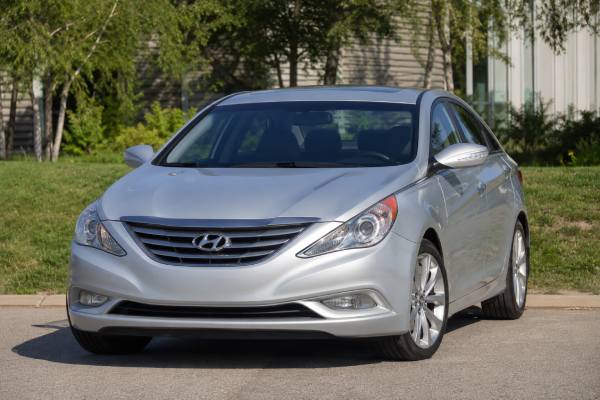
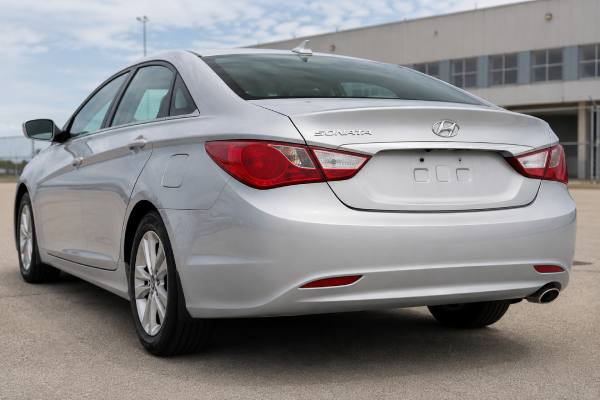
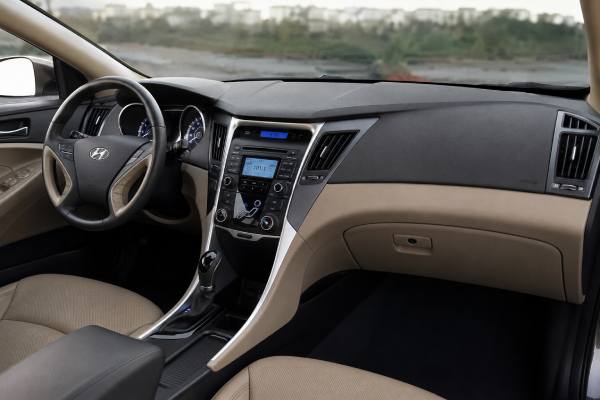
The 2011–2013 Hyundai Sonata YF 2.0T is the turbocharged version of Hyundai’s sixth-generation midsize sedan. Instead of offering a V6, Hyundai used a 2.0-liter Theta II direct-injection turbo engine rated at 274 hp, giving the Sonata strong straight-line performance while keeping a four-cylinder layout, front-wheel drive, and a conventional 6-speed automatic transmission.
For used-car shoppers, this Sonata is attractive because it combines roomy family-sedan practicality with quick acceleration and good equipment. The important caveat is ownership due diligence: the Theta II GDI family is known for serious engine-related recalls, service campaigns, and extended coverage programs. A good car with verified recall completion and strong maintenance records can be appealing; a neglected one can become expensive quickly.
Owner Snapshot
- Strong 274 hp output and 365 Nm of torque give the Sonata 2.0T V6-like pace without a V6 engine.
- The cabin is spacious for a midsize sedan, with a large 464 L / 16.4 ft³ trunk and generous front-seat room.
- SE and Limited 2.0T trims typically include 18-inch wheels, dual exhaust, paddle shifters, and upgraded equipment.
- The main ownership concern is Theta II connecting-rod bearing risk; recall, KSDS software, and service-history proof matter.
- Use 5W-30 or 5W-40 oil meeting the correct specification, and service it at about 7,500 miles / 12 months in normal use, or sooner in severe use.
Table of Contents
- Sonata YF 2.0T Model Profile
- Sonata YF 2.0T Specs
- Sonata YF 2.0T Equipment and Safety
- Reliability, Issues, and Recalls
- Maintenance and Buying Advice
- Driving, Performance, and Economy
- Sonata 2.0T Versus Rivals
Sonata YF 2.0T Model Profile
The Hyundai Sonata YF was a major turning point for Hyundai in North America. It moved the Sonata away from conservative styling and into a sleeker, more expressive shape with a long wheelbase, a high beltline, and a coupe-like roofline. The 2.0T version added the engine Hyundai used to replace a traditional V6 option: a 2.0-liter Theta II turbocharged gasoline direct-injection four-cylinder.
The result was unusual for the early 2010s midsize-sedan class. Many rivals still used naturally aspirated V6 engines for their performance trims, while Hyundai chose a smaller turbocharged engine with direct injection and a twin-scroll turbocharger. On paper, the Sonata 2.0T delivered 274 hp at 6,000 rpm and 269 lb-ft / 365 Nm from 1,750 to 4,500 rpm. That broad torque curve is central to the way the car feels: it does not need to be revved hard to move quickly in normal driving.
The covered 2011–2013 model years are the core early YF turbo years. In the U.S. market, the 2.0T was generally offered in SE 2.0T and Limited 2.0T forms, both paired with a 6-speed automatic transmission and front-wheel drive. There was no factory manual 2.0T Sonata in this period, and there was no all-wheel-drive version. The car was designed as a roadgoing sedan rather than a sport sedan in the rear-drive sense.
Its appeal is practical as much as performance-based. The Sonata has five seats, a large trunk, easy highway manners, and good standard safety equipment for its time. The 2.0T gives it stronger passing power than the base 2.4 GDI without sacrificing the basic ownership experience of a normal family sedan. It uses regular gasoline, though many owners prefer high-quality fuel and shorter oil-change intervals because of the turbocharged, direct-injected engine.
The buying decision, however, is more complicated than the spec sheet suggests. The Theta II GDI engine family has a documented history of connecting-rod bearing issues, engine inspections, recalls, and software campaigns. That does not mean every Sonata 2.0T is bad, but it changes what “good condition” means. Mileage alone is not enough. A buyer should care about recall completion, knock-sensor detection software status, oil-change history, engine noise at cold start and hot idle, and whether any engine replacement was done by Hyundai.
The best examples are usually cars with clear dealer records, no active recalls, clean cold-start behavior, smooth idle, no oil-pressure warnings, and evidence of regular oil service with the correct viscosity and specification. The riskiest examples are cars with vague history, persistent ticking or knocking, flashing check-engine lights, P1326 history, oil consumption complaints, or recent auction/dealer resale with little paperwork.
In short, the Sonata YF 2.0T is quick, spacious, and well equipped, but it is not a used car to buy casually. It rewards careful inspection and documentation.
Sonata YF 2.0T Specs
The following figures are for the 2011–2013 Hyundai Sonata YF 2.0T gasoline model, with the 2.0-liter Theta II T-GDi engine, 6-speed automatic transmission, and front-wheel drive. Some values vary by trim, production date, market, tyres, and VIN, so service-data confirmation is essential before repair work.
| Item | 2011–2013 Hyundai Sonata YF 2.0T |
|---|---|
| Engine code | Theta II G4KH 2.0 T-GDi |
| Layout | Inline-4, 4 cylinders, DOHC, 4 valves per cylinder, Dual CVVT |
| Bore × stroke | 86.0 × 86.0 mm / 3.39 × 3.39 in |
| Displacement | 2.0 L / 1,998 cc |
| Induction | Twin-scroll turbocharger with intercooler |
| Fuel system | Gasoline direct injection |
| Compression ratio | 9.5:1 |
| Maximum power | 274 hp / 204 kW at 6,000 rpm |
| Maximum torque | 365 Nm / 269 lb-ft at 1,750–4,500 rpm |
| Timing drive | Chain |
| Rated efficiency | About 9.0 L/100 km combined / 26 mpg US / 31.2 mpg UK; current EPA listing shows 22 mpg city and 33 mpg highway |
| Real-world highway at 120 km/h / 75 mph | Typically about 8.3–9.5 L/100 km / 25–28 mpg US / 30–34 mpg UK, depending on tyres, load, terrain, wind, and maintenance |
| Item | Specification |
|---|---|
| Transmission | 6-speed SHIFTRONIC automatic, A6LF2 family; confirm exact code by VIN |
| Drive type | Front-wheel drive |
| Differential | Open front differential integrated with transaxle |
| Front suspension | MacPherson strut with stabilizer bar |
| Rear suspension | Independent multi-link with stabilizer bar |
| Steering | Electric power-assisted rack and pinion; approx. 14.5:1 ratio; about 2.9 turns lock-to-lock |
| Brakes | Front vented discs about 300 mm / 11.8 in; rear solid discs about 284 mm / 11.2 in |
| Most common 2.0T tyre size | 225/45 R18 on 18-inch wheels |
| Ground clearance | About 140 mm / 5.5 in |
| Length / width / height | 4,821 / 1,834 / 1,471 mm; 189.8 / 72.2 / 57.9 in |
| Wheelbase | 2,794 mm / 110.0 in |
| Turning circle | About 10.9 m / 35.8 ft kerb-to-kerb |
| Curb weight | About 1,514–1,566 kg / 3,338–3,452 lb, depending on trim and equipment |
| GVWR | About 2,030 kg / 4,475 lb; verify door placard |
| Fuel tank | 70 L / 18.5 US gal / 15.4 UK gal |
| Cargo volume | 464 L / 16.4 ft³ trunk volume, SAE-style published figure |
| Metric | Typical figure |
|---|---|
| 0–100 km/h / 0–62 mph | About 6.8–7.2 seconds, depending on test conditions |
| 0–60 mph | About 6.4–6.8 seconds in typical independent testing |
| Top speed | About 210 km/h / 130 mph |
| 100–0 km/h braking | About 38–41 m / 125–135 ft with good tyres and brakes |
| Towing capacity | Not commonly tow-rated in U.S. owner material; do not assume a braked or unbraked tow rating without market-specific documentation |
| Payload | About 516 kg / 1,137 lb, depending on door-placard configuration |
| System | Specification or capacity |
|---|---|
| Engine oil | 5W-30 or 5W-40 meeting API SM / ILSAC GF-4 or better where specified; approx. 4.6 L / 4.9 US qt with filter |
| Coolant | Ethylene-glycol coolant for aluminum engines, typically 50/50 with distilled water; approx. 6.5–6.7 L / 6.9–7.1 US qt |
| Automatic transmission fluid | Hyundai/Kia ATF SP-IV; total dry capacity about 7.1 L / 7.5 US qt, with a smaller drain-and-fill volume |
| Differential / transfer case | No separate rear differential or transfer case on FWD models |
| A/C refrigerant | R-134a; commonly about 500 g / 17.6 oz, but use under-hood label as primary source |
| A/C compressor oil | PAG 46; total system amount commonly around 100–125 mL / 3.4–4.2 fl oz, depending on compressor and service condition |
| Oil drain plug torque | About 39 Nm / 29 lb-ft; use a new washer |
| Wheel lug nut torque | About 88–107 Nm / 65–79 lb-ft |
| Spark plug torque | Typically about 18–25 Nm / 13–18 lb-ft; confirm plug type and service manual procedure |
Sonata YF 2.0T Equipment and Safety
The 2.0T was not just an engine option; it usually brought a more upscale or sport-oriented trim level. The two main U.S.-market versions to know are SE 2.0T and Limited 2.0T.
The SE 2.0T is the sportier-looking version. It normally has 18-inch alloy wheels, a firmer suspension tune than lower trims, paddle shifters, dual exhaust outlets, fog lights, sportier seat trim, and visual details that separate it from the GLS. It is the better fit for buyers who want the turbo engine but prefer a slightly simpler equipment set.
The Limited 2.0T is the more comfort-oriented choice. It typically adds leather seating surfaces, heated front seats, dual-zone automatic climate control, proximity key with push-button start on many examples, upgraded interior trim, and access to higher audio/navigation packages. Some cars have a panoramic sunroof and a rearview camera when equipped with navigation or package content, but equipment varies enough that every used car should be checked individually.
Quick identifiers include:
- “2.0T” badging on the trunk or trim listing.
- Dual exhaust outlets.
- 18-inch wheel fitment on most 2.0T examples.
- Paddle shifters behind the steering wheel.
- VIN/build records showing the 2.0L turbo GDI engine rather than the 2.4 GDI.
Year-to-year changes were mainly equipment and packaging rather than fundamental mechanical changes. The engine output remained the same for the 2011–2013 cars covered here. Blue Link telematics and infotainment availability became more prominent during the period, and some convenience features moved between packages or became easier to find on later cars.
| Category | 2011–2013 Sonata YF 2.0T notes |
|---|---|
| IIHS crash ratings | Rating applies broadly to 2011–2014 Sonata sedan. Good results in moderate overlap front, original side, roof strength, and head restraints; small-overlap driver rating was weaker than the main crash tests. |
| NHTSA | 2013 Sonata received a 5-Star Overall Safety Rating in U.S. government testing; check exact year and body listing when comparing cars. |
| Euro NCAP | Not the main rating body for this U.S.-market Sonata YF 2.0T; IIHS and NHTSA are the relevant references for North American cars. |
| Headlights | No modern IIHS headlight rating for this generation in the way newer vehicles are scored. |
| Airbags | Six-airbag system: dual front, front seat-mounted side, and front/rear side curtain airbags. |
| Child-seat provisions | LATCH lower anchors for rear outboard seats and top tether anchors for rear seating positions. |
| Stability and braking aids | ABS, electronic brake-force distribution, brake assist, traction control, electronic stability control, and tyre-pressure monitoring. |
| ADAS availability | No modern AEB, adaptive cruise control, lane centering, cyclist detection, or traffic-sign recognition. Rearview camera availability depends on trim/package. |
From a service perspective, this is a simpler car than newer Sonatas with camera/radar ADAS suites. Windshield replacement, bumper repair, and wheel alignment generally do not involve the same calibration burden as a modern vehicle with lane cameras and radar cruise. That said, steering-angle sensor calibration, ABS/ESC diagnostics, TPMS service, and airbag-system repairs still need correct scan-tool procedures.
For family use, the Sonata’s safety package was competitive in its era. The bigger limitation is not crash structure so much as the absence of modern crash-avoidance aids. A buyer coming from a newer vehicle may miss automatic emergency braking, blind-spot monitoring, and adaptive cruise control.
Reliability, Issues, and Recalls
Reliability is the most important section for this car. The Sonata 2.0T’s strongest advantage is its engine output, but the same Theta II GDI family is also the reason buyers need to be careful. The goal is not to avoid every Sonata 2.0T, but to separate documented, well-serviced cars from risky ones.
| Issue | Prevalence | Severity / cost tier | Typical signs | Recommended action |
|---|---|---|---|---|
| Connecting-rod bearing wear | Known high-priority concern | High | Metallic knock, oil-pressure warning, flashing MIL, P1326, limp mode, stall | Do not continue normal driving; verify recalls, KSDS update, dealer bearing test, and extended coverage eligibility |
| Oil consumption | Occasional to common on higher-mileage examples | Medium to high | Low oil between changes, smoke, fouled plugs, catalyst damage risk | Perform documented consumption test; inspect PCV, leaks, turbo, and engine condition |
| GDI carbon buildup | Occasional | Medium | Rough idle, hesitation, misfires, loss of response | Inspect intake valves if symptoms persist; clean as needed |
| Turbo or boost-control faults | Occasional | Medium to high | Underboost/overboost codes, oil in intake, whistle, poor acceleration | Check hoses, intercooler piping, wastegate control, oil supply, and turbo shaft play |
| 6-speed automatic shift quality | Occasional | Medium | Harsh shifts, flare, delayed engagement, shudder | Check ATF condition, software updates, mounts, and adaptive values before condemning transmission |
| Steering coupler / column clunk | Common on many Hyundai/Kia EPS vehicles of this era | Low to medium | Clunk over small bumps or when rocking steering wheel | Inspect flexible coupler and steering column components |
| Salt-belt suspension corrosion | Climate-dependent | Medium | Rusty springs, subframe corrosion, seized fasteners, brake-line corrosion | Lift inspection before purchase, especially in northern states and Canada |
The major recall history involves connecting-rod bearing damage linked to metallic debris from engine manufacturing on affected vehicles. For 2011–2012 Sonata models equipped with 2.0L and 2.4L GDI engines, the issue led to inspections, possible engine replacement, and extended short-block coverage. A later recall campaign covered certain 2013–2014 Sonata YF vehicles with 2.4L and 2.0T GDI engines produced at HMMA, again focused on inspecting for excessive connecting-rod bearing wear.
Hyundai also introduced a Knock Sensor Detection System software update, often referred to as a product improvement campaign. This software is designed to detect vibration patterns associated with bearing wear. When triggered, the vehicle may set P1326, illuminate or flash the malfunction indicator, and enter a reduced-power protection mode. That code should not be casually cleared on a used-car inspection; it is evidence that the vehicle needs proper dealer diagnosis.
Other recalls and service actions that may affect a 2011–2013 Sonata include fuel pipe inspection after some engine replacement work, front seat-belt anchor/pretensioner linkage repairs, brake pedal stopper pad recalls on some 2011–2012 cars, steering-related recalls on some early 2011 production vehicles, and corrosion-related front coil spring recalls in salt-belt regions. Not every VIN is affected by every campaign, so the only safe answer is a VIN check and dealer service-history printout.
Pre-purchase checks should include:
- Official VIN recall check showing no open campaigns.
- Proof of KSDS software update where applicable.
- Dealer records for any engine inspection or replacement.
- Oil-change records showing correct viscosity and reasonable intervals.
- Cold start after sitting overnight, with windows open and radio off.
- Hot idle check after a proper road test.
- Scan for stored, pending, and permanent codes.
- Inspection for oil leaks, coolant leaks, turbo oil seepage, and fuel smell.
- Road test for shift flare, harsh 2–3 or 3–4 changes, and torque-converter shudder.
- Lift inspection for subframe, brake lines, springs, control arms, and exhaust corrosion.
A Sonata 2.0T with verified campaign completion and clean engine behavior can be a lot of car for the money. A car with missing records, warning lights, engine knock, or unexplained recent code clearing should be treated as high risk.
Maintenance and Buying Advice
Maintenance for the Sonata 2.0T should be more conservative than the bare minimum. Turbocharging, direct injection, and the Theta II bearing history make clean oil, correct viscosity, and regular inspections especially important.
| Interval | Recommended service |
|---|---|
| Every fuel fill or monthly | Check engine oil level, coolant level, tyre pressure, lights, and visible leaks. Low oil is especially important on this engine family. |
| 5,000–7,500 miles / 8,000–12,000 km or 6–12 months | Change engine oil and filter. Use the correct 5W-30 or 5W-40 specification. Shorten the interval for short trips, cold weather, heavy traffic, or aggressive driving. |
| 7,500 miles / 12,000 km | Rotate tyres, inspect brake pads/rotors, check steering and suspension, inspect CV boots, and check for uneven tyre wear. |
| 15,000–30,000 miles / 24,000–48,000 km | Replace cabin air filter and engine air filter as condition requires; inspect fuel lines, vapor hoses, brake lines, parking brake, belts, and hoses. |
| 30,000 miles / 48,000 km or 2 years | Replace brake fluid if moisture content is elevated or if service history is unknown; inspect caliper slide pins and parking brake operation. |
| 45,000–60,000 miles / 72,000–96,000 km | Consider spark plug inspection or replacement depending on plug type, tune, symptoms, and service data. Turbo engines are less forgiving of worn plugs. |
| 60,000 miles / 96,000 km | Service ATF under severe-use conditions or if history is unknown; inspect drive belt, coolant hoses, mounts, suspension bushings, and wheel bearings. |
| 96,000–105,000 miles / 154,000–169,000 km | Replace spark plugs if not already done; inspect valve cover leaks, ignition coils, PCV valve, and intake carbon symptoms. |
| 120,000 miles / 193,000 km or 10 years | Replace coolant if not already serviced; after that, use shorter follow-up coolant intervals based on official guidance and coolant condition. |
| Any mileage | Timing chain has no routine belt-style replacement interval, but inspect for chain noise, correlation faults, guide wear, tensioner issues, and oil-pressure-related symptoms. |
A good buyer’s inspection should begin before the test drive. Look under the oil cap for sludge, check the dipstick level, and see whether the oil looks extremely old. A fresh oil change is not automatically reassuring; it may have been done to hide consumption or metal. Ask for records, not promises.
During the road test, the engine should build boost smoothly without surging, stumbling, or smoking. A light tick from direct-injection hardware is normal, but a deeper metallic knock that rises with rpm is not. The transmission should engage Drive and Reverse without a long delay, shift cleanly under light throttle, and downshift without a heavy bang.
On a lift, focus on the front subframe, lower control arms, rear suspension arms, brake lines, fuel lines, exhaust flanges, and front coil springs in salt-belt cars. Check for engine oil at the turbo oil feed/return area, valve cover, front timing cover, oil pan, and rear main area. Inspect coolant residue near hose connections and the radiator.
For trim choice, the SE 2.0T is often simpler and sportier, while the Limited 2.0T is better equipped but may have more age-related features to inspect, such as sunroof drains, navigation/audio components, backup camera, power seat functions, and leather wear. A lower-trim car with complete records is usually a better buy than a fully loaded car with uncertain engine history.
The long-term durability outlook is mixed but manageable. The body and cabin can hold up well, parts availability is generally good, and the automatic transmission is not unusually troublesome when serviced. The engine is the deciding factor. Prioritize documentation, oil discipline, and recall status over mileage, paint shine, or wheel design.
Driving, Performance, and Economy
The Sonata 2.0T feels quick for a front-drive midsize sedan of its era. The engine’s wide torque band makes the car responsive in normal traffic, especially from 30–70 mph / 50–110 km/h. It does not need a high-rpm launch to feel strong; the useful part of the power curve arrives early and stays available through typical passing speeds.
Throttle response is generally smooth rather than sharp. There can be a short delay while the automatic selects the right gear and the turbo builds full boost, but the twin-scroll turbo setup keeps lag reasonable. Once moving, the car pulls harder than most naturally aspirated four-cylinder sedans from the same period.
The 6-speed automatic is tuned more for smoothness and economy than for aggressive sport driving. In normal use, that works well. It shifts without drama and keeps engine speed low on the highway. Under sudden throttle, it can take a moment to kick down, and older cars with worn fluid or unaddressed adaptation issues may feel harsher than they should. Paddle shifters give manual control, but they do not turn the Sonata into a true sport sedan.
Ride quality depends on wheel and tyre choice. The 18-inch 225/45 R18 setup gives the 2.0T a firmer, more planted feel than smaller-wheel trims, but it also transmits sharper impacts. On good roads, the car feels stable and composed. On broken pavement, it can feel busy compared with a Camry or Accord on taller-sidewall tyres.
Handling is predictable, with safe front-drive understeer at the limit. Steering effort is light to medium and easy in city driving, but road feel is limited. This is not a chassis that invites constant back-road driving in the way a Mazda6 might. It is better understood as a quick family sedan with good highway manners.
Braking performance is adequate when the system is fresh. Pedal feel is straightforward, but old fluid, cheap pads, warped rotors, or seized slide pins can make the car feel much worse than factory condition. Because the 2.0T has real speed, brake maintenance should not be treated casually.
Real-world economy varies widely. In city driving, expect roughly 10.5–12.5 L/100 km / 19–22 mpg US / 23–26 mpg UK. On steady highways at 60–70 mph / 100–113 km/h, a healthy car can return about 7.3–8.4 L/100 km / 28–32 mpg US / 34–38 mpg UK. At 75 mph / 120 km/h, 8.3–9.5 L/100 km / 25–28 mpg US / 30–34 mpg UK is more realistic. Mixed driving often lands around 9.0–10.0 L/100 km / 24–26 mpg US / 29–31 mpg UK.
Cold weather can reduce economy, especially on short trips. Turbocharged direct-injection engines warm up, enrich, and manage emissions in ways that can make winter short-trip consumption noticeably worse. Low tyre pressure, dragging brakes, old spark plugs, dirty air filters, and poor alignment also matter.
The Sonata 2.0T is not a tow car in the North American sense. Without a clear market-specific tow rating, it should be treated as a passenger sedan. Full-load driving is fine when the cooling system, tyres, and brakes are in good condition, but towing or repeated mountain-grade abuse adds heat and stress that this model was not primarily designed around.
Sonata 2.0T Versus Rivals
The Sonata 2.0T competed in a crowded midsize-sedan field. Its closest alternatives include the Honda Accord V6, Toyota Camry V6, Nissan Altima V6, Ford Fusion Sport V6, Volkswagen Passat 2.0T, and Kia Optima SX 2.0T. The Kia is mechanically related in many areas, while the V6 competitors take a more traditional route to power.
| Model | Main strength | Main drawback versus Sonata 2.0T | Best fit |
|---|---|---|---|
| Hyundai Sonata YF 2.0T | Strong torque, roomy cabin, high feature value, good highway economy for the power | Theta II recall history makes documentation essential | Buyer wanting speed and value with careful inspection |
| Honda Accord V6 | Smooth V6, strong resale, excellent long-term reputation | Timing belt service and higher purchase prices | Buyer prioritizing refinement and durability |
| Toyota Camry V6 | Very strong reliability reputation and relaxed power delivery | Less engaging handling and often higher used prices | Buyer wanting low-drama ownership |
| Nissan Altima V6 | Quick acceleration and lighter feel | CVT concerns can dominate ownership decisions | Buyer comfortable with careful CVT inspection |
| Ford Fusion Sport V6 | Available AWD on some versions and secure road feel | Heavier, thirstier, and often less efficient | Buyer needing all-weather traction |
| Kia Optima SX 2.0T | Similar turbo performance with distinctive styling | Shares many Theta II inspection concerns | Buyer cross-shopping Hyundai/Kia equipment and styling |
Against V6 rivals, the Sonata’s main advantage is torque-rich performance with better four-cylinder fuel economy potential. It also tends to offer a lot of equipment for the money. A well-kept Limited 2.0T can feel surprisingly upscale for its age, especially with leather, heated seats, premium audio, and navigation.
The Accord V6 and Camry V6 generally feel smoother and more mechanically relaxed. Their engines do not have the same turbo heat and direct-injection carbon concerns, and their reputations are stronger among long-term used-car buyers. However, they often cost more, and the Accord V6 requires timing-belt service at the proper interval.
The Nissan Altima V6 is quick, but its CVT is a major inspection point. Some drivers like its lighter, more immediate feel; others prefer the Sonata’s conventional automatic. The Ford Fusion Sport is attractive where AWD matters, but it is heavier and typically less efficient.
The related Kia Optima SX 2.0T is the closest mechanical rival. It offers similar power and often sportier styling, but the same broad engine-family concerns apply. The decision between Sonata 2.0T and Optima SX often comes down to condition, records, price, and personal preference.
The best verdict is practical: buy the individual car, not the badge. Among all these choices, a documented, recall-complete Sonata 2.0T can be a strong value. But if two cars are similar in price and condition, the one with clearer service history, better inspection results, and fewer open questions is the smarter choice.
References
- All-New 2011 Sonata Adds a Second, Even More Powerful Engine Delivering Best-in-Class Horsepower and Fuel Economy 2010 (Manufacturer Publication)
- Gas Mileage of 2013 Hyundai Sonata 2013 (Fuel Economy Rating)
- 2013 Hyundai Sonata 2013 (Safety Rating)
- Part 573 Safety Recall Report 15V-568 2015 (Recall Database)
- Product Improvement Campaign 2019 (Service Campaign)
Disclaimer
This article is for informational purposes only and is not a substitute for professional diagnosis, repair, or official service information. Specifications, torque values, service intervals, recall applicability, procedures, and fluid requirements can vary by VIN, market, production date, trim, and equipment. Always verify details against official Hyundai service documentation, the owner’s manual, the under-hood labels, the door placard, and dealer VIN records before buying parts or performing repairs.
If this guide helped you, please consider sharing it on Facebook, X/Twitter, or your preferred automotive community to support our work.