

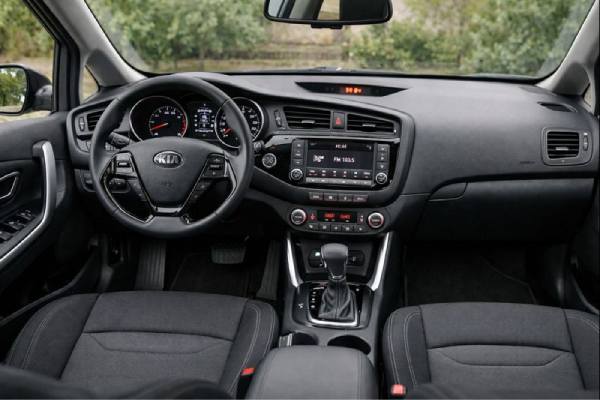

The facelift Kia Cee’d SW (JD) with the 1.0 T-GDi is an interesting “small engine, big job” wagon. You get a light, compact turbo three-cylinder that relies on a broad torque band rather than high revs, paired with a practical long-roof body that can genuinely replace a small SUV for many owners. The engineering story is efficiency through downsizing: direct injection, turbocharging, and careful gearing to keep the engine in its sweet spot on the road.
Ownership is usually straightforward if you respect turbo-petrol basics: frequent oil changes, good warm-up habits, and avoiding endless short trips where condensation and deposits build. The reward is a roomy, easy-to-park estate with predictable handling, sensible running costs, and enough real-world shove for everyday loads.
Owner Snapshot
- Strong mid-range pull for a 1.0-litre, especially from ~1,500 rpm, making it relaxed in traffic.
- One of the most usable boots in the class, with a wagon layout that stays practical even with bulky items.
- Stable, confidence-building chassis that feels “European-tuned” at motorway speeds.
- Caveat: direct-injection turbo engines dislike repeated cold short trips; plan occasional longer drives.
- Typical service rhythm: engine oil and filter every 15,000 km (10,000 miles) or 12 months (whichever comes first).
Section overview
- Kia Ceed SW JD facelift in practice
- Kia Ceed SW 1.0 T-GDi 118 specs
- Kia Ceed SW equipment and safety
- Reliability hotspots and service actions
- Maintenance schedule and buying checklist
- Driving character and real economy
- Ceed SW JD versus key rivals
Kia Ceed SW JD facelift in practice
Think of the Cee’d SW as a “do-it-all” estate that stays honest about what it is: front-wheel drive, compact outside, and genuinely spacious where it counts. In facelift form (2015–2018), the car benefits from small but meaningful refinements—quietness, better infotainment depending on trim, and extra driver-assist availability—while keeping the underlying JD platform’s solid, predictable feel.
The 1.0 T-GDi changes the ownership character compared with the older non-turbo petrols. It doesn’t need to be thrashed to feel responsive, because the turbo and direct injection are designed to deliver usable torque early. In daily driving, that means fewer downshifts and less “wide open throttle” work than you might expect from a 1.0-litre wagon. The tradeoff is that this engine responds best to correct oil quality, sensible warm-up, and consistent maintenance—more like a modern turbo car than an old-school small-displacement petrol.
As a wagon, the SW’s value is its shape. The load floor and tall tailgate make it good at real tasks: prams, flat-pack furniture, bikes with the seats down, and travel luggage without playing Tetris. With passengers aboard, the rear legroom and roofline are still family-friendly, and the car’s lower centre of gravity (vs many crossovers) helps it feel stable when loaded.
If you’re shopping this model, it helps to be clear about your priorities:
- Best use case: mixed commuting plus weekend trips, where the engine regularly reaches full temperature.
- Least ideal use case: repeated 3–5 km cold runs with long idle periods, especially in winter.
- What the facelift brings: better feature availability (often camera-based speed-limit info, blind-spot monitoring, and parking aids on higher trims), plus incremental NVH improvements depending on market.
Overall, this variant is a sensible choice if you want wagon practicality and a modern turbo petrol, and you’re willing to treat it like the modern, emissions-optimized engine it is—rewarding when maintained, unforgiving when neglected.
Kia Ceed SW 1.0 T-GDi 118 specs
Specifications can vary by market, wheel size, and emissions calibration, so the numbers below are presented as typical ranges for the facelift Cee’d SW with the higher-output 1.0 T-GDi (commonly listed as 120 PS / 118 hp). Use them as a practical reference, then verify by VIN and local documentation.
Powertrain and efficiency (typical)
| Item | Specification |
|---|---|
| Engine family / code | Kappa II T-GDi (commonly G3LC in many applications) |
| Layout | Inline-3, turbocharged, DOHC, 4 valves/cyl (12 valves total) |
| Displacement | 1.0 L (998 cc) |
| Bore × stroke | ~71.8 × 84.0 mm (2.83 × 3.31 in) |
| Fuel system | Gasoline direct injection (GDI) |
| Induction | Single turbocharger + intercooler |
| Compression ratio | ~10.0:1 |
| Max power | 118 hp (88 kW) @ ~6,000 rpm |
| Max torque | ~171–172 Nm (126–127 lb-ft) from ~1,500–4,000 rpm (market dependent) |
| Timing drive | Chain (typical for this engine family) |
| Rated efficiency | ~4.9–5.6 L/100 km (48–58 mpg US / 50–65 mpg UK), depending on test cycle and wheels |
| Real-world highway @ 120 km/h | ~6.3–6.8 L/100 km (35–37 mpg US / 41–45 mpg UK) in steady conditions |
Transmission and driveline
| Item | Specification |
|---|---|
| Transmission (most common) | 6-speed manual |
| Drive type | FWD |
| Differential | Open (traction control manages slip) |
Chassis and dimensions (wagon)
| Item | Typical value |
|---|---|
| Suspension (front / rear) | MacPherson strut / multi-link (common JD SW layout) |
| Steering | Electric power steering |
| Brakes | 4-wheel discs (front often ventilated); sizes vary by trim (commonly ~280–300 mm front) |
| Most popular tyre size | 205/55 R16 (also common: 225/45 R17) |
| Ground clearance | ~150 mm (5.91 in), market dependent |
| Length / width / height | ~4505 / 1780 / 1485 mm (177.36 / 70.08 / 58.46 in) |
| Wheelbase | ~2650 mm (104.33 in) |
| Turning circle | ~10.6 m (34.8 ft) |
| Kerb (curb) weight | ~1285–1370 kg (2833–3020 lb), equipment dependent |
| GVWR | ~1820–1900 kg (4012–4189 lb), market dependent |
| Fuel tank | ~53 L (14.00 US gal / 11.66 UK gal) |
| Cargo volume (VDA) | ~528 L (18.65 ft³) seats up / ~1642 L (57.99 ft³) seats down |
Performance and capability (typical)
| Metric | Typical value |
|---|---|
| 0–100 km/h (0–62 mph) | ~11.0–12.0 s (wheel/weight dependent) |
| Top speed | ~188–195 km/h (117–121 mph) |
| Braking distance 100–0 km/h | ~37–39 m (tire condition and trim matter) |
| Towing capacity | Often around ~1200 kg (2646 lb) braked / ~600 kg (1323 lb) unbraked (verify locally) |
| Payload | Often ~450–550 kg (992–1213 lb), trim dependent |
Fluids and service capacities (decision-useful typicals)
| Item | Typical spec |
|---|---|
| Engine oil | Full-synthetic meeting the required ACEA/API spec; common viscosity: 5W-30 (many markets), sometimes 0W-30/0W-20 by later spec updates; capacity ~3.6 L (3.80 US qt / 3.17 UK qt) |
| Coolant | Long-life ethylene glycol OAT-type coolant; typical system capacity ~5.3 L (5.60 US qt / 4.66 UK qt) |
| Manual transmission fluid | API GL-4 (check exact grade); capacity varies by gearbox version |
| A/C refrigerant | Many late JD applications use R1234yf; charge amount varies by equipment (verify under-hood label) |
Safety and driver assistance (availability depends on trim)
| Item | Notes |
|---|---|
| Crash ratings | Euro NCAP rating exists for the Cee’d generation; test version and applicability depend on year/trim |
| Core safety | ESC stability control, multiple airbags, ISOFIX/LATCH |
| Optional ADAS (market/trim dependent) | Blind-spot monitoring, rear cross-traffic alert, speed-limit sign recognition, parking aids |
Kia Ceed SW equipment and safety
Trim strategy on the facelift Cee’d SW is market-specific, but the pattern is consistent: the wagon body is widely available, the 1.0 T-GDi often sits in the “value-to-mid” part of the range, and higher trims add comfort and driver assistance rather than major mechanical changes. That’s good news for buyers, because it means you can prioritize condition and history without worrying that you’re missing a critical suspension or driveline feature that only exists on one grade.
Trims and options that change daily life
Common equipment differences you’ll see across markets:
- Wheels and ride feel: 16-inch setups (often 205/55 R16) usually ride more quietly and tolerate rough roads better; 17-inch packages sharpen steering response but can increase road noise and tire cost.
- Lighting: Halogen headlights are common on lower trims; projector or LED elements may appear higher up. Better headlights matter more than most people expect on an estate that does long trips.
- Infotainment: look for factory navigation, Bluetooth stability, USB functionality, and (if present) reversing camera clarity. On older units, slow boot-up or intermittent connectivity can be a clue to a tired head unit or wiring issues.
- Comfort packs: dual-zone climate, heated seats, and parking sensors are the features that tend to make the car feel “newer” even years later.
Quick identifiers when viewing cars:
- Wheel design + seat material often signals trim level more reliably than badges (which can be removed).
- Button presence is a giveaway: heated seat switches, parking sensor toggles, and steering wheel controls usually correlate with higher grades.
- Factory towbar wiring (when present) should look tidy and integrated; messy aftermarket wiring can cause lighting faults.
Safety ratings and what they mean today
The Cee’d family has an established Euro NCAP result for this generation. What matters for a 2015–2018 facelift buyer is not only the star rating, but what equipment the tested car had and how your specific car is configured. For example, stability control is a baseline expectation, but certain driver-assistance features (like blind-spot monitoring or camera-based speed-limit info) may be optional and not present on every car.
Safety systems and ADAS notes
Expect the fundamentals:
- Airbags: front, side, and curtain airbags are typical; verify the airbag warning light behavior on start-up (it should illuminate briefly, then go out).
- Child-seat provisions: ISOFIX points in the rear seats are common; check for damaged plastic guides or missing covers if child seats were frequently used.
- Braking and stability: ABS and ESC are standard expectations; a good test drive includes a few firm brake applications to check for vibration, pulling, or a long pedal.
If the car has optional ADAS (blind-spot or rear cross-traffic alert), be aware that bumper repairs and sensor alignment matter. After a rear-end bump or a poorly repaired quarter panel, sensor-based features may behave erratically or throw intermittent warnings—often “fixed” only by proper calibration and correct mounting geometry.
Reliability hotspots and service actions
Reliability for the facelift Cee’d SW 1.0 T-GDi is usually good when maintenance is consistent, but it’s not a “set and forget” engine in the way an older naturally aspirated unit could be. Below is a practical way to think about issues by prevalence and cost tier, plus what to look for.
Common (watch closely)
- GDI intake deposits (medium cost, long-term):
Symptoms: rough idle, hesitation, reduced efficiency, occasional misfires—often after lots of short trips.
Likely cause: direct injection doesn’t wash the intake valves with fuel, allowing oily vapor deposits to accumulate.
Remedy: driving pattern improvements (regular hot runs), correct oil spec, and intake cleaning when needed. - Ignition wear (low to medium cost):
Symptoms: misfire under load, stuttering at low rpm, flashing MIL in severe cases.
Likely cause: tired spark plugs or a weak coil. Turbo engines are tougher on ignition parts.
Remedy: replace plugs at sensible intervals (often earlier than non-turbo), address coils if misfires persist. - Turbo-related noises (medium cost if ignored):
Symptoms: wastegate rattle, whistle changes, reduced boost feel.
Likely cause: actuator wear, boost leaks, or vacuum/solenoid issues.
Remedy: smoke test for leaks; repair hoses/actuator issues early before the turbo is stressed.
Occasional (depends on use and environment)
- Cooling system seepage (medium cost):
Symptoms: slow coolant loss, sweet smell, dampness around hoses/radiator area.
Root cause: aging hose clamps, radiator end tanks, or water pump seep.
Remedy: pressure test, fix small leaks before overheating risk. - Electric power steering “clunk” (low to medium cost):
Symptoms: knock felt through the wheel on small bumps at low speed.
Root cause: steering column coupler wear in some electric steering systems.
Remedy: coupler replacement or column service, depending on design and market. - Rear suspension bushings (medium cost):
Symptoms: rear-end thump, uneven tire wear, vague stability when loaded.
Root cause: bushing wear accelerated by bad roads and heavy loads.
Remedy: bushing replacement and alignment afterward.
Rare but higher consequence
- Timing chain concerns (high cost if severe, but uncommon):
Symptoms: persistent rattling on cold start that doesn’t fade quickly, timing correlation faults.
Root cause: tensioner wear or chain stretch (usually at high mileage or poor oil history).
Remedy: diagnosis before parts replacement; oil history is a major predictor.
Recalls, TSBs, and software actions
Because recalls and service campaigns vary by country and VIN, treat them as a required admin step, not a nice-to-have:
- Run a VIN recall check and confirm completion with dealer records.
- Ask for proof of any ECU/infotainment updates if the owner reports past drivability or connectivity issues.
- Check warning lights and scan for stored codes even if the dash is clear.
Pre-purchase checks worth paying for
- Cold start from fully cold (listen for abnormal rattle and observe idle quality).
- Full-temperature drive (check boost delivery, misfires, coolant stability).
- Underbody inspection (exhaust, rear suspension bushings, brake lines, and corrosion at seams/subframes).
- Evidence of correct oil changes (receipts matter more than verbal assurances).
Maintenance schedule and buying checklist
A simple maintenance plan is the difference between a “cheap-to-run turbo wagon” and a car that slowly develops drivability annoyances. Use the schedule below as a practical baseline, then align it with your local service book and VIN-specific guidance.
Practical maintenance schedule (distance/time)
- Engine oil and filter: every 15,000 km (10,000 miles) or 12 months. If the car does mostly city short trips, consider 10,000 km intervals for extra protection.
- Engine air filter: inspect every service; replace typically 30,000–45,000 km (more often in dusty areas).
- Cabin filter: 15,000–30,000 km (or yearly if you have allergies or city pollution).
- Spark plugs: commonly 60,000 km for turbo petrol (some markets may specify longer with iridium, but earlier replacement keeps coils and cat happier).
- Coolant: often long-life; commonly 5 years/100,000 km first change, then every 3–5 years (verify exact spec for your market).
- Brake fluid: every 2 years regardless of mileage.
- Brake pads and discs: inspect at each service; replace by wear, not mileage.
- Manual gearbox oil: often “lifetime” in some books, but a change around 100,000–120,000 km can improve shift quality and longevity.
- Tires: rotate every 10,000–12,000 km, align if you see uneven wear or after suspension work.
- 12 V battery: test annually after year 5; many last 5–7 years depending on climate and usage.
Fluids: what to ask for (and why)
For turbo GDI engines, oil quality is not negotiable. Ask the shop to document:
- The exact viscosity and ACEA/API spec used.
- The oil capacity filled (helps catch underfill/overfill errors).
- Any note on fuel dilution smell in drained oil (short-trip cars can show more dilution).
Essential torque values (verify by manual, but useful for planning)
- Wheel nuts: typically 88–108 Nm (65–80 lb-ft) depending on wheel type.
- Spark plugs: commonly 18–25 Nm (13–18 lb-ft) depending on plug design.
- Oil drain plug: often 25–35 Nm (18–26 lb-ft) depending on sump design.
Buyer’s guide: inspection checklist
Service history and paperwork
- Proof of annual oil services (not “whenever the light came on”).
- Receipts for plugs, filters, and brake fluid at sensible intervals.
- Evidence of recall/campaign completion by VIN.
Mechanical and body
- Check for oil seepage around the turbo area and front of engine.
- Look for coolant crusting near hose joints and radiator edges.
- Inspect rear suspension bushes and tire wear patterns—wagons often carry loads.
Electronics and comfort
- Confirm all steering wheel controls, Bluetooth, USB, camera/sensors (if equipped).
- Test A/C performance at idle and while driving; weak cooling can indicate low charge or condenser issues.
Long-term durability outlook
With consistent oil changes and a driving pattern that regularly warms the engine fully, the 1.0 T-GDi Cee’d SW can age well. The biggest “longevity lever” is avoiding neglected oil and ignoring early misfire/boost-leak symptoms. Treat it like a modern turbo engine, and it typically behaves like one: efficient, capable, and dependable.
Driving character and real economy
The 1.0 T-GDi Cee’d SW is not fast in a hot-hatch sense, but it’s pleasantly responsive in everyday use. The key is torque delivery: instead of building power with revs, it gives you usable pull low down, which suits a family wagon. In traffic, it feels lighter than its cargo-friendly shape suggests, and on the motorway it’s stable and reassuring—one of the advantages of a lower, wagon-like stance compared with taller crossovers.
Ride, handling, and NVH
- Ride comfort: on 16-inch wheels, the car generally deals well with broken surfaces and expansion joints. On 17s, it feels tighter but can thump more over sharp edges.
- Steering feel: light in town, more settled at speed. It’s not “talkative,” but it tracks straight and doesn’t feel nervous.
- Braking: predictable pedal feel when the system is healthy; pay attention to vibration under braking (often a sign of disc issues) and rear caliper slide pin condition.
Cabin noise is typically dominated by tire choice and road surface. A good set of touring tires can make the car feel notably more refined.
Powertrain character and gearing
This engine is happiest when you drive it like a turbo: keep it in the midrange, short-shift when you can, and avoid lugging it at very low rpm in a high gear. Expect:
- Low-rpm torque: strong enough that it doesn’t feel strained in normal commuting.
- Turbo response: generally quick; a small turbo spools early, but full shove still comes after a moment if you request sudden acceleration from very low rpm.
- Manual gearbox behavior: a healthy clutch bites cleanly and the gearbox should feel precise; reluctance into gear can hint at worn mounts, old fluid, or clutch wear.
Real-world fuel economy
Official figures often look excellent, but real consumption depends heavily on speed and trip length.
Typical real-world ranges owners can expect:
- City: ~6.8–8.2 L/100 km (29–35 mpg US / 34–42 mpg UK), higher in winter or with short trips.
- Highway (100–120 km/h): ~6.0–7.0 L/100 km (34–39 mpg US / 40–47 mpg UK).
- Mixed driving: ~6.3–7.5 L/100 km (31–37 mpg US / 38–45 mpg UK).
Cold weather often adds 10–20% consumption due to longer warm-up time and cabin heating demand, and short trips amplify that effect.
Load carrying and towing feel
With a full boot or passengers, the car remains stable, but you’ll notice the difference during overtakes—plan passing maneuvers rather than relying on “instant power.” If towing is relevant, ensure the car’s cooling system, clutch condition, and service history are strong. Turbo petrols can tow, but they dislike overheating and oil neglect more than many older engines.
Ceed SW JD versus key rivals
In the compact wagon segment, the facelift Cee’d SW 1.0 T-GDi competes more on balanced ownership than on headline acceleration. Here’s how it typically stacks up against common alternatives.
Versus Ford Focus Estate 1.0 EcoBoost
- Focus strengths: sharper steering feel and handling “edge,” often more engaging on a twisty road.
- Cee’d strengths: tends to feel simpler to live with over time if serviced consistently, and often offers strong value equipment-for-money in used markets.
- Decision point: choose the Focus if you prioritize dynamics; choose the Kia if you prioritize a steady, practical ownership profile.
Versus Hyundai i30 Wagon (similar era)
- i30 strengths: very similar platform philosophy; parts and service familiarity overlap in many regions.
- Cee’d strengths: trim packaging can be more appealing depending on market, and the wagon’s practicality is consistently strong.
- Decision point: compare condition and history first—these cars are close enough that the best-maintained example often wins.
Versus VW Group wagons (Leon ST / Octavia Combi 1.0 TSI)
- TSI strengths: efficient engines with strong aftermarket knowledge; Octavia often offers a larger cabin/boot “one class up” feel.
- Cee’d strengths: often simpler option structure, and can be a better value buy with comparable practicality.
- Decision point: if you want maximum space and a more premium-feeling cabin, the Octavia may pull ahead; if you want value and straightforward ergonomics, the Kia remains compelling.
Versus Peugeot 308 SW 1.2 PureTech
- 308 strengths: very efficient packaging, often excellent ride comfort, and a modern cabin feel.
- Cee’d strengths: a more conventional control layout that some drivers prefer, and a reputation for solid “daily driver” durability when maintained.
- Decision point: evaluate engine-specific risk tolerance and verify service documentation carefully on either choice.
Where the Cee’d SW shines
- You want wagon practicality without SUV size.
- You value stable highway manners and predictable control.
- You plan to maintain it properly and can give it regular full-temperature drives.
Where a rival may fit better
- You want class-leading rear space (Octavia Combi often wins).
- You want sportier steering and chassis feel (Focus can lead).
- You want newer-generation ADAS as standard (newer rivals may offer more).
If you buy the Cee’d SW for what it is—a sensible, efficient, well-sized estate—and you keep up with maintenance, it remains one of the more rational used-wagon choices in its bracket.
References
- Distinctive looks, new engines and more dynamic performance for upgraded Kia cee’d 2015 (Manufacturer Press Release)
- 7.2 Kia Service Intervals.xlsx 2025 (Service Intervals)
- Engine Oil Grades and Capacities 2023 (Service and Maintenance)
- Kia Recalls | Kia Europe 2026 (Recall Database)
- Kia C’eed – Crash Test 2012 2012 (Safety Rating)
Disclaimer
This article is for informational purposes only and is not a substitute for professional inspection, diagnosis, or repair. Specifications, torque values, service intervals, and procedures can vary by VIN, market, model year, and equipment; always verify details using your official owner’s manual and service documentation for the specific vehicle.
If you found this guide useful, please consider sharing it on Facebook, X (Twitter), or your favorite forum—it helps support our work and keeps more detailed guides coming.