
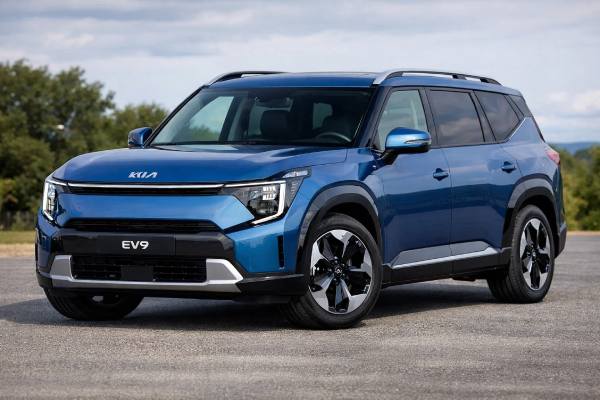
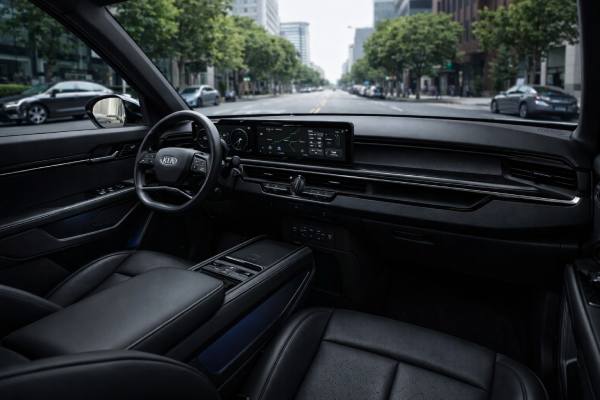
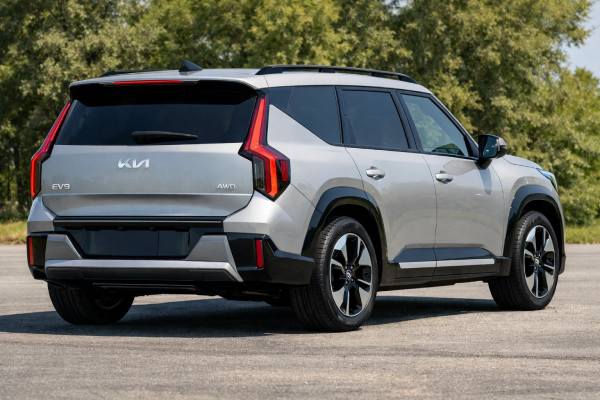
The Kia EV9 (MV) with the 99.8 kWh battery and 201 hp single-motor rear-wheel-drive setup is the “long-range value” version of Kia’s three-row EV. It trades outright punch for calmer power delivery, strong highway legs, and the benefits of a simpler driveline. Underneath, it shares the group’s modern EV architecture with fast DC charging capability, a large, flat battery pack that lowers the center of gravity, and a chassis tuned for family comfort rather than sharp-edged sportiness.
For owners, the appeal is straightforward: useful real-world range, a roomy cabin with genuine third-row usability, and fewer moving parts than dual-motor variants. The details that matter most are charging behavior (including how quickly it tapers), tire and brake upkeep on a heavy EV, and staying current on software updates that can affect charging, driver assistance, and infotainment stability.
Owner Snapshot
- Strong EPA-rated range for a three-row SUV, with RWD efficiency benefits on long trips.
- Fast DC charging capability for quicker road-trip stops when the battery is warm and the charger can deliver.
- Spacious interior packaging and flexible seating layouts without needing an AWD upgrade.
- Plan for tire wear on a heavy vehicle and keep camera/radar areas clean for consistent ADAS performance.
- Rotate tires about every 12,000 km (8,000 mi) or 12 months, whichever comes first.
Quick navigation
- Kia EV9 MV long-range story
- Kia EV9 MV 99.8 kWh specs
- Kia EV9 MV trims and ADAS
- Reliability signals and fixes
- Maintenance plan and buying
- Real driving and range
- How it stacks up
Kia EV9 MV long-range story
This EV9 variant is best understood as a deliberately “right-sized” configuration. The 99.8 kWh battery gives the vehicle enough energy reserve to make a three-row family SUV feel relaxed on longer days, while the 201 hp rear motor keeps the driving character smooth and predictable. In everyday terms: it’s not trying to wow you off the line the way a dual-motor EV can. Instead, it focuses on consistency—steady acceleration, stable highway behavior, and range that remains practical even when you drive like a normal human rather than an efficiency contest judge.
From an engineering standpoint, the biggest advantage of the single-motor layout is simplicity. With one drive unit instead of two, there are fewer parts to manage, fewer seals and shafts to worry about, and typically less complexity in torque distribution logic. You also avoid the efficiency penalty that can come with carrying an extra motor and associated hardware. For buyers who don’t need AWD traction, that’s a sensible trade.
The EV9’s packaging is also a key part of the story. A large underfloor battery helps create a flat cabin floor and allows Kia to push the wheelbase long for better second- and third-row space. The result is an EV that feels purpose-built as a people mover, not a two-row SUV stretched at the last minute. You get a genuinely usable third row and cargo volume that stays competitive when seats are up.
The ownership picture is shaped by three realities of modern EVs: charging, software, and weight. Charging is quick when conditions are right, but it is still sensitive to battery temperature, starting state of charge, and charger capability. Software matters because charging behavior, range estimation, and ADAS confidence can change with updates. Weight matters because tires, brakes, and suspension components work harder than they would on a lighter crossover. If you accept those constraints and maintain it like the heavy, powerful EV it is, this EV9 configuration can be one of the most rational ways to own a large electric SUV.
Kia EV9 MV 99.8 kWh specs
Powertrain and battery
| Spec | Value |
|---|---|
| Motor type | Permanent Magnet Synchronous Motor (PMSM) |
| Motor count and axle | Single motor, rear axle |
| Rear horsepower | 201 hp (150 kW) @ 4,200–8,200 rpm |
| Rear torque | 258 lb-ft (350 Nm) @ 0–4,000 rpm |
| Total horsepower | 201 hp (150 kW) |
| Total torque | 258 lb-ft (350 Nm) |
| Battery type | Lithium Ion Battery |
| Battery chemistry | NMC |
| Battery energy, gross | 99.8 kWh |
| Battery energy, usable | 96.0 kWh |
| Battery nominal voltage | 552 V |
| 12 V battery capacity | 60 Ah |
| Efficiency / test standard | EPA |
| Rated efficiency (combined) | 23.6 kWh/100 km (380 Wh/mi) |
| Rated range (EPA) | 489 km (304 mi) |
Driveline and charging
| Spec | Value |
|---|---|
| Transmission / drive unit | Single-speed reduction gear |
| Drive type | RWD |
| Final gear ratio (constant) | 13.16:1 |
| Charging connector (AC) | SAE J1772 |
| Charging connector (DC) | CCS1 |
| Charging port location | Rear right |
| Onboard charger (AC), max power | 10.9 kW |
| DC fast-charge peak power | 210 kW |
| DC fast charge (50 kW EVSE) | 83 min |
| DC fast charge (350 kW EVSE) | 24 min |
| AC normal charge (11 kW EVSE, 240 V / 48 A) | 8 h 45 m |
| AC normal charge with ICCB (120 V / 12 A) | 84 h 20 m |
| Low-voltage DC–DC converter, max power | 2.4 kW |
Performance and capability
| Spec | Value |
|---|---|
| 0–60 mph (0–97 km/h) | 8.8 s |
| 19–44 mph (31–71 km/h) | 3.2 s |
| 37–62 mph (60–100 km/h) | 5.2 s |
| 50–75 mph (80–121 km/h) | 7.1 s |
| Top speed | 185 km/h (115 mph) |
| Braking distance (62–0 mph) | 39.0 m (128 ft) |
| Towing capacity, without brakes | 454 kg (1,000 lb) |
Chassis and dimensions
| Spec | Value |
|---|---|
| Front suspension | MacPherson Strut + Dual Lower Arm Type |
| Rear suspension | Multi-link |
| Steering type | Rack and Pinion – Rack Mounted Motor-Driven Power Steering (R-MDPS) |
| Steering ratio | 16.02:1 |
| Turns, lock-to-lock | 2.93 |
| Turning circle radius, curb-to-curb | 6.19 m (20.3 ft) |
| Brakes, type (front/rear) | Ventilated Disc / Ventilated Disc |
| Brake disc diameter (front/rear) | 361 mm / 345 mm (14.2 in. / 13.6 in.) |
| Parking brake type | Electric Parking Brake (EPB) |
| Wheel size | 19-inch wheels |
| Wheelbase | 3,099 mm (122.0 in.) |
| Length | 5,009 mm (197.2 in.) |
| Width | 1,979 mm (77.9 in.) |
| Height, without roof rails | 1,750 mm (68.9 in.) |
| Ground clearance, min | 178 mm (7.0 in.) |
| Approach angle | 20.0° |
| Departure angle | 22.8° |
| Curb weight, min/max | 2,410–2,415 kg (5,313–5,324 lb) |
| GVWR | 2,940 kg (6,482 lb) |
| Luggage capacity, behind 1st row (SAE) | 2,313 L (81.7 ft³) |
| Luggage capacity, behind 2nd row (SAE) | 1,232 L (43.5 ft³) |
| Luggage capacity, behind 3rd row (SAE) | 572 L (20.2 ft³) |
| Frunk capacity | 91 L (3.2 ft³) |
| Frunk payload | 40 kg (88 lb) |
Safety and driver assistance
| Spec | Value |
|---|---|
| Euro NCAP rating | 5 stars |
| Euro NCAP Adult Occupant | 84% |
| Euro NCAP Child Occupant | 88% |
| Euro NCAP Vulnerable Road Users | 76% |
| Euro NCAP Safety Assist | 83% |
| IIHS award | Top Safety Pick (2024–2025; vehicles built after Jan 2024) |
| IIHS headlight rating | Good (Land/GT-Line; vehicles built after Jan 2024) |
Kia EV9 MV trims and ADAS
Although this article centers on the 99.8 kWh, 201 hp RWD configuration, it helps to understand how it sits within the broader EV9 lineup—because most used listings and dealer inventory comparisons are really “battery + motor count + seating layout” decisions.
Where the 201 hp long-range RWD fits
In markets where Kia offers multiple EV9 powertrains, the key dividing lines are:
- Battery size: standard pack versus 99.8 kWh long-range pack
- Driveline: single-motor RWD versus dual-motor AWD
- Seating: 7-passenger bench setups versus 6-passenger captain’s-chair layouts (often tied to higher trims)
This 201 hp RWD long-range version is typically positioned as the range-focused step above the smaller-battery entry model and below AWD trims that prioritize acceleration and traction. For many buyers, it is the sweet spot: you gain road-trip range without paying for a second motor you may not need.
Trim identifiers that help in the real world
When you’re trying to confirm you’re looking at the correct variant, the fastest practical checks are:
- Window sticker / build sheet: look for the 99.8 kWh battery and RWD drivetrain wording.
- Output clue: listings that show 201 hp (or around 150 kW) generally point to the single-motor long-range setup.
- Charging claims: long-range models are often marketed with the higher headline range figure and fast-charge timing.
- Seating layout: many long-range RWD examples are configured as 6-passenger (captain’s chairs), but this is market- and trim-dependent.
Safety ratings and what they really mean
For European-style testing, Euro NCAP’s five-star result indicates strong crash protection and a solid set of driver assistance functions. It’s worth remembering that NCAP protocols evolve; a “five-star” is meaningful, but the percentages are the better detail because they show strengths across adult, child, vulnerable road user protection, and assistance performance.
For the U.S. market, IIHS recognition matters because it’s sensitive to headlight performance and crash-test outcomes under strict criteria. The EV9’s Top Safety Pick status applies under specific build conditions (notably after a headlight aim-related improvement). If you’re shopping used, the build date can matter—not because the vehicle is unsafe without it, but because awards are tied to very specific equipment performance and test criteria.
ADAS features: what’s typically included and what changes over time
Most EV9s are equipped with a modern ADAS package that usually includes:
- Forward collision avoidance (vehicle, pedestrian, cyclist detection)
- Adaptive cruise control with stop-and-go
- Lane keeping and lane following support
- Blind-spot monitoring and rear cross-traffic alert
- Parking sensors and camera-based surround view on higher trims
- Highway assist functions that can reduce fatigue on long drives
Two ownership realities to keep in mind: first, cameras and radar sensors need clean surfaces and correct alignment after body repairs. Second, software updates can change calibration feel—some updates improve false alerts or refine lane centering, while others may introduce new warnings until sensors are recalibrated.
Reliability signals and fixes
The EV9 is still early in its lifecycle, so “reliability” is less about decade-long failure patterns and more about identifying what tends to appear in the first few years: campaign work, software stabilization, and the normal teething of a highly networked EV. The good news is that many early issues are addressed through service actions rather than expensive mechanical repairs.
Common vs occasional vs rare: what owners should watch
Common (low to medium cost):
- 12V battery sensitivity: Heavy accessory load, short trips, or software behaviors can cause low-voltage warnings. Symptoms include random error messages, slow wake-up, or infotainment resets. Remedy is usually battery testing, software updates, and ensuring the DC–DC system behavior is up to date.
- Infotainment and connectivity glitches: Bluetooth dropouts, profile issues, or app pairing quirks. Remedy is typically software updates, head-unit resets, and ensuring the vehicle’s OTA process completes cleanly.
- Brake noise or surface corrosion: Strong regenerative braking reduces friction brake use, which can allow surface rust to build. Symptoms are scraping sounds after rain or washing. Remedy is periodic firm friction-brake stops and regular caliper/slider inspections.
Occasional (medium cost):
- Charging session instability: Charge interruptions at AC stations or handshake issues at DC fast chargers. Symptoms include repeated charge start failures, unexpected stops, or reduced power. Root causes range from charger-side faults to vehicle charge-port latch issues or software. Remedy is software updates, charge-port inspection, and verifying the latest charging logic and preconditioning behavior.
- ADAS sensor complaints: Camera obstruction warnings or inconsistent lane-centering behavior in heavy rain/snow. Remedy is cleaning sensor areas, checking windshield camera mounting after glass replacement, and recalibration when required.
Rare (high cost, but important):
- High-voltage isolation or moisture-related faults: These can present as “stop safely” warnings or limp-home behavior. They are uncommon but can be serious. Remedy requires professional diagnosis, insulation testing, and inspection of connectors, seals, and junction points.
Service actions, recalls, and why they matter
Early-life campaigns are not unusual on new models, and EV9 has seen safety and service actions that can involve items like fastener verification or component inspection. The practical takeaway is simple:
- Ask for proof of completion (dealer service record or official VIN lookup result).
- Treat unresolved recalls as a negotiating point and schedule completion immediately after purchase.
Software and calibration: the hidden reliability lever
EVs often improve materially through software. Updates can affect:
- Battery management system logic (charging curve behavior, range estimation)
- Thermal management (battery heating/cooling strategy)
- Driver assistance tuning (lane centering and warning thresholds)
- Infotainment stability and navigation routing (including charging stop planning)
If a vehicle has a history of “phantom warnings,” inconsistent charging power, or recurring infotainment bugs, the first question should be whether it is fully up to date. The second question is whether any hardware work (windshield replacement, bumper repair) occurred without proper sensor recalibration.
Pre-purchase checks to request
Bring structure to your inspection:
- Battery health snapshot: verify that full-charge indicated range is plausible for season and wheel size, and check for abnormal fast-charge tapering.
- Charging hardware check: inspect the port door, latch feel, and any signs of water intrusion.
- Road test for noises: listen for clunks over speed bumps (bushings) and whines that change with speed (drive unit or bearings).
- Recall status: confirm all campaigns are completed for the VIN.
- OTA and connectivity: confirm profiles, phone key (if equipped), and app services function normally.
Maintenance plan and buying
A large EV like the EV9 rewards routine, simple maintenance. The powertrain itself is low-maintenance compared with an internal combustion SUV, but the vehicle’s weight, tire loads, and reliance on software make a disciplined schedule worthwhile.
Practical maintenance schedule
Use this as a real-world baseline unless your local Kia documentation specifies otherwise:
- Tire rotation: every 12,000 km (8,000 mi) or 12 months. Check tread depth across the axle; uneven wear is a fast clue that alignment is off.
- Wheel alignment check: every 24,000 km (15,000 mi) or 24 months, and immediately after pothole impacts or curb strikes.
- Cabin air filter: every 24,000 km (15,000 mi) or 12 months (more often in dusty cities or heavy HVAC use).
- Brake inspection (pads, rotors, caliper slides): every 24,000 km (15,000 mi) or 12 months. Even with regen, hardware needs lubrication and corrosion control.
- Brake fluid change: about every 48,000 km (30,000 mi) or 24 months in humid climates, or per the official schedule in your region.
- Cooling system inspection: annually; coolant replacement interval depends on the exact coolant spec and market guidance, so verify by VIN documentation.
- 12V battery test: annually after year 2; expect replacement around 4–6 years depending on climate and parking patterns.
Severe-use adjustments apply if you do frequent DC fast charging, tow regularly, or drive in extreme heat/cold. In those cases, shorten inspection intervals and pay special attention to tires, brakes, and cooling performance.
Consumables that matter most on this EV9
- Tires: The EV9 can wear tires faster than lighter SUVs. Budget for replacement sooner if you drive aggressively or run underinflated tires. Choose EV-rated tires when possible for load capacity and noise control.
- Brakes: Periodic “friction brake exercise” helps keep rotors clean. A simple habit—one or two firm stops from highway speed in a safe area every couple of weeks—can reduce corrosion noise.
- Wipers and washer fluid: It sounds basic, but ADAS performance depends on clean glass and functional wipers.
Buyer’s guide: how to shop used with confidence
Battery and range checks
- Look for consistent, predictable range behavior rather than chasing a perfect number. Cold weather and high speeds reduce range sharply on any EV.
- During a test drive, verify that regen works smoothly and that the energy display behaves consistently.
Charging behavior
- Try an AC session if possible and confirm it starts and holds steady.
- If you can DC fast charge, watch for strong power early in the session and a reasonable taper rather than immediate throttling.
Thermal management
- Confirm cabin heat and A/C performance. If equipped with a heat pump in your market/trim, verify it provides strong heat without unusual noise.
Chassis and body
- Inspect the underbody for damage, especially around aerodynamic panels and battery-area protection.
- Check for abnormal tire wear patterns that suggest alignment issues.
Electronics and updates
- Confirm cameras are clear and that parking and lane features work without persistent warnings.
- Ask for the vehicle’s software update history and any service invoices for module reflashes.
Which versions to seek or avoid
For most families who don’t need AWD, the long-range RWD concept is the one to seek: it keeps the big-battery advantage and avoids the complexity and efficiency penalty of dual motors. If you live in snow-belt regions or regularly tow, an AWD trim may still be the better tool—but treat tires as the first traction upgrade either way.
Long-term durability outlook: expect battery capacity to decline slowly with age and use, with faster decline if the vehicle lives on frequent high-power DC charging and high heat. The higher-cost “unknowns” over time are more likely to be electronics (sensors, cameras, modules) than the motor itself—another reason to keep software current and avoid poorly repaired collision damage.
Real driving and range
On the road, the long-range RWD EV9 feels like a calm, heavy-duty cruiser. The initial throttle response is smooth rather than jumpy, which is exactly what many families want in a three-row vehicle. Around town, the EV’s instant torque makes it easy to merge and slip into gaps, even if it doesn’t have the “snap” of the dual-motor trims.
Ride, handling, and NVH
The EV9’s battery mass sits low in the chassis, which helps body control. You still feel the vehicle’s size—especially in quick lane changes—but the platform’s stability is a strength. Steering is light to moderate in effort, tuned for easy parking and relaxed highway tracking. Expect the quietness to be impressive at city speeds, while highway noise depends heavily on tire choice and wheel size. Larger wheels can sharpen response but often add impact harshness and road roar.
Braking feel and regen handoff
One-pedal driving or strong regen modes can reduce brake pedal use, but the EV9 still needs a predictable transition between regenerative and friction braking. In normal driving, the handoff is generally smooth; you may notice more “blending” feel in low-speed stops or when traction is limited by wet or icy roads. A useful habit is to occasionally brake firmly enough to engage the friction brakes—this keeps rotors clean and confirms pedal consistency.
Real-world efficiency and what changes it
For this 99.8 kWh RWD setup, real-world consumption commonly falls into these patterns:
- City: often the most efficient scenario thanks to regen and lower aerodynamic drag at speed.
- Highway (100–120 km/h / 60–75 mph): efficiency drops as speed rises; aero drag becomes the dominant load.
- Cold weather: range can fall noticeably due to battery chemistry limits and cabin heat demand, especially on short trips where the pack never fully warms.
The most important range lever is speed. If you’re trying to maximize distance between chargers, dropping from fast-lane cruising to steady-flow speeds can produce a meaningful gain without changing anything else.
Charging performance in daily life
At home, the EV9’s AC charging capability is strong enough that overnight charging covers most driving patterns. A Level 2 setup is the best ownership upgrade you can make.
On the road, DC charging speed depends on three things: battery temperature, charger capability, and starting state of charge. A warm battery at a capable charger allows a strong initial charge rate, followed by tapering as the battery fills. In practice, you plan trips around the 10–80% window because it is typically the fastest part of the curve. If you start charging at a high state of charge (for example, 60–70%), you should expect lower power and a slower session.
Load, passengers, and towing reality
With multiple passengers and luggage, consumption increases. Add winter temperatures, roof boxes, or sustained high speed, and the range penalty grows quickly. If you tow (where approved), plan conservatively—range reductions can be substantial on any EV with a trailer, especially at highway speeds. The smart approach is to treat the EV9 as a vehicle that can road trip well, but only when you respect the physics: speed, weight, temperature, and drag always win.
How it stacks up
The EV9 long-range RWD lives in a competitive space: three-row EVs and near-three-row “family” EVs that promise road-trip usability. The right comparison depends on what you value most.
Against dual-motor EV9 variants
Compared with AWD EV9 trims, this RWD long-range model typically offers:
- Better efficiency and potentially better range in mild conditions
- Less complexity (one motor, fewer driveline components)
- Slower acceleration and less all-weather traction without AWD
If you don’t need AWD for snow, steep driveways, or towing confidence, the RWD long-range case is strong.
Against Rivian R1S
The R1S usually targets buyers who want higher performance, off-road capability, and premium pricing to match. The EV9’s advantage is value and comfort-first family packaging, often at a lower entry point. If your priority is a refined people carrier rather than a performance adventure SUV, the EV9 configuration makes practical sense.
Against Tesla Model X and large two-row EVs
Some two-row EVs deliver strong range and performance, but they don’t match the EV9’s third-row practicality. If you genuinely use three rows, the EV9 competes on space and day-to-day usability rather than raw speed.
Against Hyundai’s related platform cousins
Platform relatives often share charging behavior and core EV architecture. The decision then becomes design, cabin packaging, pricing, and dealer/service experience. The EV9’s standout is that it was designed from the start as a three-row EV, not adapted from a smaller template.
Bottom line
If your goal is a family-sized EV that can road trip without constant charging anxiety, the 99.8 kWh, 201 hp RWD EV9 is a rational and often underrated choice. It won’t satisfy buyers who want the quickest acceleration or AWD traction as standard. But for many owners, it is the configuration that best matches the real job: moving people comfortably, charging quickly enough on trips, and doing it with fewer compromises than most large electric SUVs.
References
- 2024 Kia EV9 Specifications 2024
- All-new 2024 EV9 rated at an EPA-estimated 304 miles of all electric driving range in Light Long Range RWD 2023
- Gas Mileage of 2024 Kia EV9 2024
- Kia EV9 2023 (Safety Rating)
- 2024 Kia EV9 qualifies for IIHS award 2024 (Safety Rating)
Disclaimer
This article is for informational purposes only and is not a substitute for professional diagnosis, repair, or safety inspection. Specifications, torque values, service intervals, software behavior, and procedures can vary by VIN, market, production date, and equipment. Always verify details using the official owner’s manual, service documentation, and dealer guidance for the exact vehicle you own or plan to purchase.
If you found this guide useful, please consider sharing it on Facebook, X (Twitter), or your favorite forum to help others discover it.