
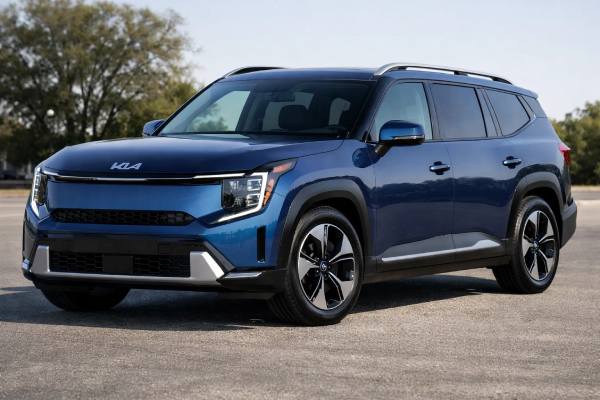
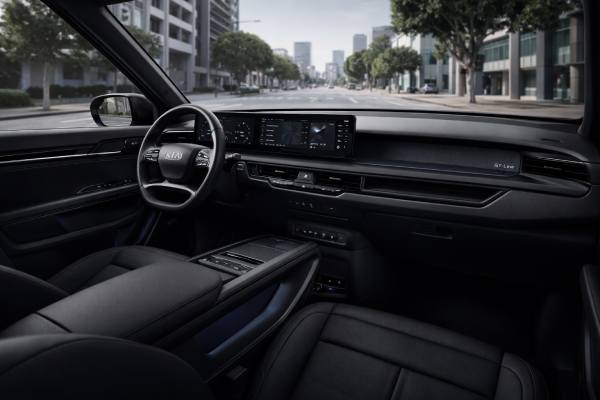

The Kia EV9 (MV) with the 76.1 kWh battery and 215 hp single-motor layout is the “efficiency-first” take on Kia’s three-row electric SUV. You get the same big-body practicality and modern E-GMP electrical architecture as the higher trims, but with fewer drivetrain parts and a lighter curb weight than the dual-motor versions—both of which help everyday range and long-term simplicity. The trade-off is straightforward: passing power and towing headroom are more modest, and you’ll feel the EV9’s size more when you ask it to sprint.
Where this variant shines is ownership steadiness. The rear-drive, single-motor setup reduces complexity, the charging hardware is designed for fast road trips when conditions are right, and the cabin packaging (flat floor, tall roofline) makes the EV9 genuinely usable as a family hauler. Below is a practical, buyer-focused guide covering real range, performance feel, reliability signals, safety results, and the maintenance habits that keep an EV9 healthy for the long run.
Owner Snapshot
- Strong daily usability: spacious three-row packaging with a flat floor and genuinely usable cargo behind the third row
- Simple drivetrain: single rear motor means fewer AWD-specific components to maintain or troubleshoot
- Fast-trip potential: capable DC charging when the battery is warm and the charger can deliver high power
- Watch cold-weather range: HVAC load and a cold battery can noticeably reduce winter highway range
- Rotate tires every 12,000 km (8,000 mi) and check alignment if you see shoulder wear or steering pull
Navigate this guide
- Kia EV9 (MV) ownership overview
- Kia EV9 (MV) key specifications
- Kia EV9 (MV) trims and safety tech
- Reliability and common EV9 fixes
- Maintenance plan and buying tips
- Road feel, range, and charging
- EV9 Light RWD vs rivals
Kia EV9 (MV) ownership overview
Think of the 76.1 kWh / 215 hp EV9 as the “cleanest” way into the platform. It keeps the EV9’s core engineering—an 800-volt-class electrical system, a long wheelbase for stable ride, and a high seating position—while avoiding the added mass and extra wear points of a second motor, front half-shafts, and AWD torque management. In daily driving, that simplicity shows up as smooth, predictable throttle response and fewer drivetrain modes to fuss with.
From an ownership standpoint, three traits matter most:
- Energy use at speed: The EV9 is a large, tall SUV. Aerodynamics and mass dominate on the highway. This variant’s smaller pack means you’ll plan stops a bit more carefully on fast road trips than long-range or larger-battery competitors, even if charging speeds are strong.
- Thermal behavior: Like most EVs, it is happiest when the battery is warm enough to accept high charge power. In winter, preconditioning (warming the pack before arriving at a fast charger) is the difference between “quick coffee stop” and “longer wait.”
- Tire-driven comfort: Wheel and tire choice can change the EV9’s personality more than many buyers expect. The 19-inch package generally rides quieter and more comfortably than larger wheel options, and it tends to be more forgiving on broken pavement.
The EV9’s practical advantages are obvious: easy third-row access for the class, a flat load floor with seats folded, and family-friendly storage. The less obvious advantage is how the EV layout reduces routine service compared with a combustion three-row SUV—no engine oil, no spark plugs, no exhaust system, and far fewer heat-related under-hood parts.
The biggest “reality check” for this specific configuration is expectations management: it is not the quick EV9, and it is not the longest-range EV9. If your driving is mostly city/suburban with occasional highway legs, it’s an efficient and easier-to-own spec. If you regularly do long, high-speed highway days (or tow), the larger-battery or AWD variants will feel less constrained.
Kia EV9 (MV) key specifications
Powertrain, battery, and electrical
| Spec | Value |
|---|---|
| Vehicle | Kia EV9 (MV) single-motor RWD |
| Motor count and axle | 1 motor, rear axle |
| Motor type | Permanent Magnet Synchronous (PMSM) |
| Max power | 215 hp (160 kW) |
| Max torque | 350 Nm (258 lb-ft) |
| Drive battery type | Lithium-ion |
| Battery capacity (gross) | 76.1 kWh |
| System voltage | 632 V |
| Drivetrain | Rear-wheel drive (RWD) |
| Transmission / drive unit | Single-speed reduction gear |
| Final drive ratio | 13.16 |
Charging and efficiency
| Spec | Value |
|---|---|
| DC fast charging time (10–80%) at 350 kW | 20 min |
| DC fast charging time (10–80%) at 50 kW | 63 min |
| DC fast charging time (10–80%) via NACS | 27 min |
| AC charging (Level 2, 240 V) acceptance | 10.9 kW |
| AC charging time (10–100%) at 11 kW | 6 h 45 min |
| AC charging time (10–100%) via 240 V portable | 11 h 15 min |
| Efficiency / test standard | EPA |
| Rated range (EPA) | 370 km (230 mi) |
| Real-world highway @ 120 km/h (75 mph), typical | 28–32 kWh/100 km (450–515 Wh/mi) |
| Real-world highway @ 120 km/h (75 mph), typical range | 240–270 km (150–170 mi) |
Performance and capability
| Spec | Value |
|---|---|
| 0–60 mph (0–97 km/h) | 7.7 s |
| 0–62 mph (0–100 km/h), approx. | ~8.0 s |
| Towing capacity (with trailer brakes) | 907 kg (2,000 lb) |
| Towing capacity (without trailer brakes) | 454 kg (1,000 lb) |
Chassis, dimensions, and weights
| Spec | Value |
|---|---|
| Front suspension | MacPherson strut |
| Rear suspension | Multi-link |
| Brakes (front / rear) | Ventilated discs / ventilated discs |
| Brake rotor diameter (front / rear) | 361 mm (14.2 in) / 345 mm (13.6 in) |
| Tire size | 255/60R19 |
| Length | 5,009 mm (197.2 in) |
| Width | 1,979 mm (77.9 in) |
| Height | 1,750 mm (68.9 in) |
| Wheelbase | 3,099 mm (122.0 in) |
| Ground clearance | 178 mm (7.0 in) |
| Approach / departure | 20.0° / 22.8° |
| Turning circle radius | 6.2 m (20.3 ft) |
| Curb weight (RWD) | 2,316 kg (5,106 lb) |
| GVWR (RWD) | 2,910 kg (6,415 lb) |
| Cargo volume (behind 3rd / 2nd / 1st) | 572 / 1,232 / 2,313 L (20.2 / 43.5 / 81.7 ft³) |
| Frunk volume | 91 L (3.2 ft³) |
Safety ratings and service basics
| Spec | Value |
|---|---|
| Euro NCAP (publication) | Dec 2023 |
| Euro NCAP adult occupant | 84% |
| Euro NCAP child occupant | 88% |
| Euro NCAP vulnerable road users | 76% |
| Euro NCAP safety assist | 83% |
| IIHS | Top Safety Pick (built after Jan 2024) |
Kia EV9 (MV) trims and safety tech
Even though this article focuses on the 76.1 kWh / 215 hp configuration, it helps to understand how Kia typically “builds up” the EV9 lineup—because used listings often mix wheel packages, seating layouts, and driver-assistance tiers. The single-motor, smaller-battery version is commonly positioned as the value-oriented entry point, and the options you choose can change daily satisfaction more than the headline horsepower suggests.
Trims and options that matter most
If you’re shopping this powertrain, prioritize options that improve comfort and charging consistency rather than pure performance:
- Wheel size and tire type: 19-inch wheels generally bring the quietest ride and best efficiency. Moving to wider, larger tires can add road noise and shave range at highway speeds.
- Seating configuration: Bench vs captain’s chairs is more about family logistics than luxury. Captain’s chairs can make third-row access easier and reduce daily friction.
- Thermal package / heat pump (where offered): In cold climates, a heat pump can reduce the energy penalty of cabin heating compared with resistive heating alone. It won’t “fix” winter range, but it can make it less harsh.
- Hitch/tow prep: If you plan to tow even light loads, make sure the vehicle is equipped correctly. Towing capability is not just a number; it’s cooling logic, wiring, and sometimes software coding.
Quick identifiers for buyers
Because online listings can be messy, use simple checks:
- Battery size confirmation: Look for 76.1 kWh in the vehicle’s spec sheet or window sticker equivalent. Some sellers list “EV9” generically.
- Drive layout: Single rear motor = RWD. In a test drive, it should feel clean and linear without the “front pull” sensation some dual-motor systems can show under hard acceleration.
- Tire size: 255/60R19 is a common tell for the more efficiency-focused setup.
Safety ratings and what they mean in practice
The EV9’s safety story is strong on paper, but always interpret ratings in context:
- Euro NCAP: The EV9’s December 2023 publication includes high category scores across adult and child protection, plus strong Safety Assist. That usually reflects a solid structural base and well-integrated standard driver assistance.
- IIHS: “Top Safety Pick” for vehicles built after January 2024 is meaningful because IIHS criteria can be build-date sensitive. If you’re buying used, confirm build month/year on the door-jamb label.
Driver assistance systems (ADAS): what you’ll actually live with
In day-to-day use, the EV9’s ADAS experience comes down to three things:
- Lane support calibration: A well-tuned lane centering system reduces fatigue. A poorly calibrated one nags or oscillates. During a test drive, try a straight, well-marked road and see if it tracks confidently without ping-ponging.
- Adaptive cruise behavior: Look for smooth speed matching in traffic and predictable braking. Overly aggressive braking feels tiring on commutes.
- Parking aids: With a large body and upright corners, good camera resolution and consistent ultrasonic/radar behavior are more than convenience—they reduce scrapes and wheel damage.
If you service the windshield (glass replacement) or do alignment work, insist on proper ADAS calibration afterward. Small errors in camera/radar alignment can create false warnings or degraded lane support—problems that feel “electrical” but are actually setup-related.
Reliability and common EV9 fixes
The EV9 is still early in its lifecycle, so “reliability” is best assessed as patterns: early recalls and campaigns, repeated complaint themes, and which systems are most sensitive to environment and charging habits. For this single-motor variant, the mechanical layout is simpler than AWD trims, but it still shares the same high-voltage architecture, charging hardware, and software stack.
Common / occasional / rare: what to watch
Common (low to medium cost):
- 12 V battery sensitivity: Many modern EVs put real load on the 12 V system (telemetry, security, modules that stay awake). Symptoms include random warning lights, failure to “ready,” or intermittent infotainment glitches. Remedy is often battery testing, software updates that reduce parasitic drain, and replacing the 12 V battery if it fails a load test.
- Infotainment and app connectivity quirks: Usually solved via updates, resets, or module reprogramming.
Occasional (medium cost):
- Charge-port latch or communication faults: Symptoms include the connector not locking/unlocking properly or charging sessions that stop unexpectedly. Root causes range from latch mechanism wear to moisture intrusion at seals. Remedies can be adjustment, latch replacement, or connector/module replacement.
- AC charging handshake issues: If home Level 2 charging is inconsistent, the onboard charger (OBC) and the EVSE compatibility handshake are prime suspects. The best diagnostic is to test on a second known-good Level 2 source.
Rare (high cost):
- High-voltage component replacement: This can include the OBC, DC–DC converter, or battery-related contactors. These are uncommon, but when they happen the cost and downtime can be significant.
Software and calibration: the “hidden” reliability layer
With EVs, software is not just infotainment—it controls charging behavior, battery thermal management, and driver assistance. A real-world example is DC fast charging: a vehicle can be mechanically fine but charge slowly if preconditioning logic isn’t triggering or if the battery temperature window is missed. When evaluating a used EV9:
- Ask for evidence of campaign completion and current software status.
- During a drive, navigate to a fast charger (even if you won’t plug in) and confirm the car offers or initiates preconditioning behavior when appropriate.
Driveline and chassis wear points
Even a “simple” EV still has heavy loads:
- Tires and alignment: The EV9’s weight and instant torque can eat tires if alignment is off even slightly. Inner-edge wear is a common sign.
- Brake hardware corrosion: Strong regenerative braking means the friction brakes may not get used hard often. In wet climates, that can lead to surface rust, squeal, or uneven pad deposits. A periodic firm braking routine helps keep rotors clean.
- Suspension bushings and links: Listen for low-speed clunks over bumps (links/bushings) and feel for steering shimmy (wheel balance, tire issues).
Recalls, TSBs, and how to verify work
At minimum, check official recall databases by VIN and ask the seller for dealer documentation showing completion. One documented safety recall involves rear gear drive unit fasteners, where the remedy is inspection and replacement/retightening of specific hardware. If the seller can’t show proof, budget the time to have a dealer confirm status—because recall completion is about safety, not preference.
Pre-purchase checks worth paying for
If you only do three paid checks, do these:
- Battery health snapshot: Ask for a state-of-health style report (or equivalent diagnostic reading) and confirm there are no stored high-voltage isolation faults.
- Charging behavior: Test AC charging and—if possible—observe DC fast charging for the first 5–10 minutes to ensure it ramps properly.
- ADAS sanity check: Confirm cameras and sensors behave normally: no persistent fault messages, no erratic lane-keeping, and consistent parking sensor behavior.
Maintenance plan and buying tips
EV maintenance is lighter than combustion maintenance, but it is not “nothing.” The EV9’s long-term comfort and reliability depend on tires, brakes, cooling systems, and software hygiene. Here’s a practical schedule that keeps costs predictable and avoids the most common ownership traps.
A practical maintenance schedule (normal use)
Use distance or time—whichever comes first:
- Every 12,000 km (8,000 mi) or 12 months
- Tire rotation; inspect tread depth across the tire face
- Brake inspection (pads/rotors/calipers) and a firm-braking road test to confirm smooth handoff from regen to friction
- Suspension/steering inspection (links, bushings, ball joints) and check for uneven tire wear
- Cabin air filter inspection (replace if airflow drops or odors appear)
- Every 24,000 km (15,000 mi) or 24 months
- Replace cabin air filter if not already done
- Check alignment (especially if you’ve hit potholes or curbs)
- 12 V battery test (voltage, reserve capacity, load test)
- Every 48,000–64,000 km (30,000–40,000 mi) or 48 months
- Brake fluid condition check and replace if moisture content is high (many owners choose a 2–3 year cadence for peace of mind)
- Thorough underbody inspection (fasteners, shields, impact marks, corrosion hotspots)
- Around 4–6 years (climate dependent)
- Plan for a 12 V battery replacement window if you live in heat or see repeated low-voltage warnings. Preventive replacement is often cheaper than a “no start” day.
Severe-use adjustments (do these if you match the pattern)
If you frequently DC fast charge, drive sustained high speeds, tow, or live in very hot/cold climates:
- Shorten tire rotation to every 8,000–10,000 km (5,000–6,000 mi).
- Inspect brakes more often for corrosion and slider lubrication.
- Pay extra attention to cooling performance: fans should run smoothly, no unusual smells, and no recurring thermal warnings.
Fluids, torque values, and decision-making essentials
Even if you don’t DIY, these details help you judge service quality:
- Wheel fastener torque: Confirm the shop torques to spec (overtightened lugs can warp brake rotors over time).
- Coolant systems: EVs rely on coolant loops for battery and power electronics. If a shop services coolant, ensure they use the correct type and bleeding procedure—air pockets can cause performance limits or heating/cooling faults.
Buyer’s guide: how to choose the right used EV9
Battery health and range reality
- Ask the seller what typical highway range looks like at 110–120 km/h (68–75 mph). Compare the answer to your commute needs.
- Check for signs of DC fast-charge throttling: if the car never seems to charge quickly even when warm, something may be wrong (or the owner never preconditions).
Charging hardware
- Inspect the charge port area for cracked plastics, bent pins, or a loose door/latch feel.
- Confirm the car includes any cables/adapters you expect, and test on both AC and (if possible) DC.
Thermal management
- Run HVAC in both heating and cooling modes. Weak cooling or inconsistent heat can signal a refrigerant issue or a heat-pump related fault (where equipped).
- Listen for noisy fans and check that the vehicle doesn’t throw repeated thermal warnings.
Chassis and body
- Look under the vehicle for damaged underbody panels and missing fasteners. On EVs, aero shields matter for efficiency and protecting wiring.
- Check for curb rash and uneven tire wear—these are quick clues to alignment history.
Best-fit trims/options for most owners
- If you drive in mixed climates and do frequent winter trips, seek a configuration with the best available thermal efficiency features (heat pump, where offered).
- If you routinely carry seven people and cargo, prioritize seating layout and comfort options over bigger wheels.
Long-term outlook: with sane charging habits (not living at 100% state of charge, and preconditioning when fast charging in winter), this configuration should age well. The most likely “big-ticket” items over a long life are tires, suspension wear items, and—rarely—high-voltage auxiliary components like the OBC or DC–DC converter.
Road feel, range, and charging
Ride, handling, and cabin quiet
The EV9’s long wheelbase gives it a stable, grown-up ride, especially on the 19-inch tire package. You’ll notice less head toss than in some shorter electric SUVs, and the body control is generally confident for a tall vehicle. The trade-off is that the EV9 still feels big in tight city corners—more like a traditional three-row SUV than a sporty crossover.
Noise, vibration, and harshness (NVH) tends to be dominated by:
- Tire pattern and width: wider tires can add a steady highway “roar.”
- Road surface: coarse asphalt will raise cabin noise more than you might expect because there’s no engine noise to mask it.
- Wind noise: the EV9’s boxier silhouette is practical, but wind is a factor above ~110 km/h (68 mph).
Powertrain character: what 215 hp feels like
This single-motor EV9 is tuned for smoothness rather than drama. Around town it feels immediate and easy to meter in traffic. On the highway, the limitation is not “slow,” but you will plan passes more deliberately than you would in a dual-motor EV9. If you routinely merge onto short on-ramps with a full cabin, this is where you feel the difference.
Real-world efficiency and range
Real-world energy use depends heavily on speed and temperature:
- City/suburban: regen and low speeds favor efficiency; this is where the EV9 can feel surprisingly reasonable for its size.
- Highway at 110–120 km/h: air drag dominates. Expect consumption to rise sharply compared with city driving, and range to fall accordingly.
- Cold weather: heating load plus a colder battery increases consumption and can reduce fast-charge speed until the pack warms.
A practical planning mindset for this variant: treat the EPA range as a best-case mixed number, then build your own “personal rating” based on your typical speed. If you drive fast highways daily, assume a materially lower range buffer and plan charging stops earlier, especially in winter.
Charging performance: how to get the best result
This is where EV9 engineering can pay off, but only if you set it up correctly:
- Home charging (AC): A ~11 kW Level 2 setup is the sweet spot for overnight replenishment. If you rely on a portable 240 V cable, you’ll still charge meaningfully, just more slowly.
- DC fast charging (road trips): Fast chargers deliver the best experience when:
- you arrive with a low-to-mid state of charge (SOC),
- the battery is warm (or preconditioned),
- and the station is delivering stable high power.
Watch the charge curve behavior: a healthy session ramps quickly early, then tapers as SOC rises. If you see weak ramp-up repeatedly in moderate temperatures, it’s worth checking software status and whether preconditioning is functioning.
Braking feel: regen-to-friction handoff
In everyday use, the EV9 encourages one-pedal style driving. The key is consistency: you want a predictable transition when you ask for more stopping power. During a test drive, do a few medium stops from 60–80 km/h and confirm:
- no pulsing through the pedal,
- no sudden “grabby” behavior,
- and no squeal that persists after a few firm stops (which could indicate glazed pads or corrosion).
Load and towing reality
The EV9 can tow modest loads in this configuration, but towing is a range multiplier in the wrong direction. If you tow regularly, plan for a large range penalty and more frequent stops. Also consider heat: long grades with a trailer can stress thermal systems more than flat cruising.
EV9 Light RWD vs rivals
The EV9’s closest rivals depend on what you value most: three-row packaging, long-range cruising, or premium refinement. Here’s how the 76.1 kWh / 215 hp EV9 tends to stack up in real shopping decisions.
Versus other three-row EVs
Strength: space efficiency and usability
The EV9’s cabin packaging is a standout. If you regularly use the third row, the EV9’s upright design and long wheelbase generally make it easier to live with than many “two-and-a-half row” crossovers. For families, that matters more than a 0–60 number.
Trade-off: smaller-battery road-trip buffer
Many three-row EV alternatives lean toward larger battery options to mask highway drag. With 76.1 kWh, the EV9 can road trip, but you plan more actively at high speed, and cold-weather highway days require more charging discipline.
Versus two-row long-range electric SUVs
If you compare against popular two-row EVs with bigger packs, you’ll often see:
- Better highway range per stop from larger-battery competitors,
- but less seating flexibility and sometimes tighter cargo ergonomics.
If you only need two rows 95% of the time, a two-row EV may deliver simpler road-trip math. If you truly need three-row function, the EV9’s design earns its keep.
Versus plug-in hybrids (PHEVs) as a “safe” alternative
A three-row PHEV can be compelling for drivers who can’t charge reliably. The EV9 wins decisively if:
- you can charge at home,
- you value quietness and smoothness,
- and you want to avoid fuel-system maintenance.
But PHEVs can be easier for long rural trips with sparse charging. Your local infrastructure matters as much as the vehicle choice.
Best-fit buyer profiles
This EV9 configuration is the right pick if you are:
- a family that needs real third-row space a few times a week,
- a mostly local driver with overnight home charging,
- someone who prefers simpler mechanical layouts and predictable ownership.
You may want a different EV9 variant (or a different model) if you are:
- a frequent high-speed highway traveler doing long legs without stops,
- a regular tower,
- or someone who wants strong passing power with a full cabin.
Bottom line
The 76.1 kWh / 215 hp EV9 is not the “headline” EV9, but it can be the smartest EV9. If your daily life is family logistics, school runs, commuting, and weekend errands—with occasional road trips—it offers a balanced combination of space, modern charging capability, and reduced drivetrain complexity that can pay dividends over years of ownership.
References
- Compare Specs of the 2026 Kia EV9 | Model Chart: Light RWD, Light Long Range RWD, Wind AWD, Land AWD, G-T Line AWD, GT AWD 2026
- Kia EV9 2023 (Safety Rating)
- 2024 Kia EV9 4-door SUV 2024 (Safety Rating)
- IMPORTANT SAFETY RECALL 2024 (Recall Database)
- KIA AMERICA TO OFFER NORTH AMERICAN CHARGING STANDARD (NACS) IN EARLY 2025 2024
Disclaimer
This article is for informational purposes only and is not a substitute for professional diagnosis, inspection, or repair. Specifications, torque values, charging behavior, and service intervals can vary by VIN, market, software version, and equipment; always verify details using official manufacturer service information for your exact vehicle.
If you found this guide useful, please consider sharing it on Facebook, X/Twitter, or your favorite forum to support our work.