
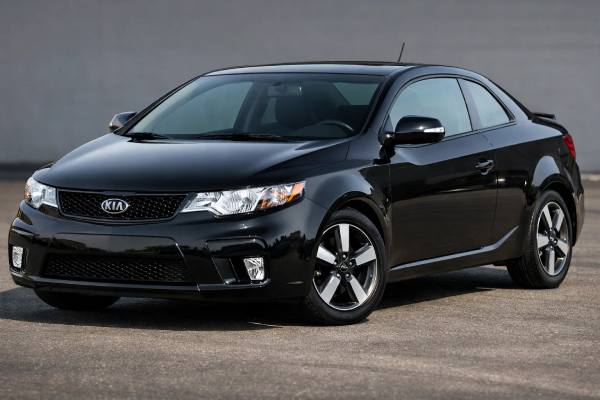
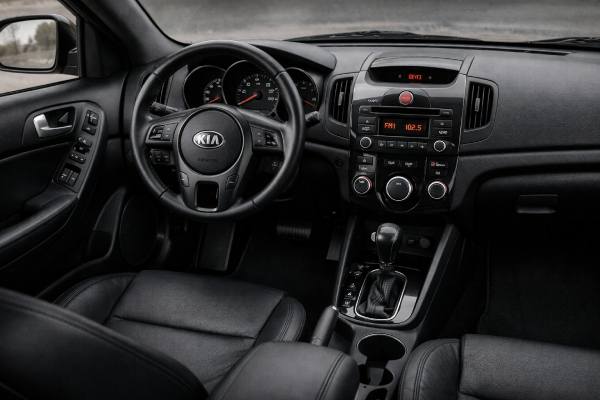
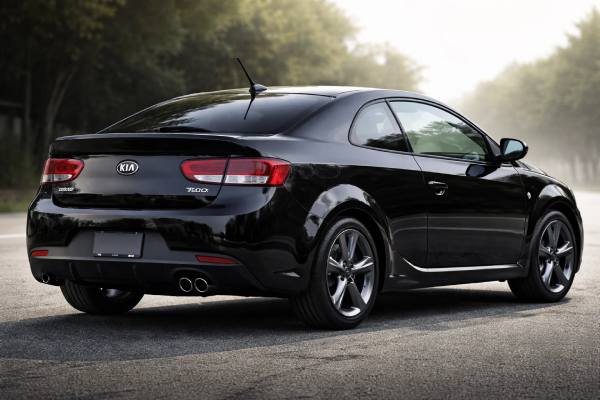
The 2010–2011 Kia Forte Koup (TD) with the 2.0-liter Theta II and 156 hp is a practical coupe wearing a sporty shape. Under the styling, it shares the same core engineering as the Forte sedan: a stiff compact chassis, front-wheel drive, and a naturally aspirated four-cylinder aimed at predictable ownership rather than fragile performance. What makes the Koup stand out is how much day-to-day usability it packs into a two-door body—real rear seats for short trips, a trunk that works for weekend bags, and straightforward controls that are easy to live with.
For buyers today, the “good deal” version is the one with clean maintenance history and completed recall work. If you focus on oil change discipline, cooling system health, and brake/ESC function, this powertrain can be a steady long-term commuter with lower running costs than many turbo rivals.
Owner Snapshot
- A roomy-for-a-coupe cabin and useful trunk make it easier to live with than most two-doors.
- Strong standard safety hardware for its era, including ESC and full-length side curtains on many trims.
- Simple, naturally aspirated 2.0 l character: reliable when maintained, not fast when overloaded.
- Prioritize recall completion and ABS/ESC warning-light checks before purchase.
- Plan engine oil and filter service about every 8,000–10,000 km (5,000–6,000 mi) or 6–12 months, depending on use.
What’s inside
- Kia Forte Koup TD coupe character
- Kia Forte Koup TD specs and capacities
- Kia Forte Koup TD equipment and crash results
- Known faults and recall checks
- Service plan and buying tips
- Road manners and fuel use
- Two-door rivals and value
Kia Forte Koup TD coupe character
The Forte Koup is best understood as a compact daily driver with coupe proportions, not a high-strung sport coupe. The TD platform uses a front-wheel-drive unibody with a simple, durable suspension layout—MacPherson struts up front and a torsion-beam rear. That rear design is less complex than a multi-link setup, but it tends to be cost-effective to maintain and consistent on imperfect roads. In normal driving, the Koup feels stable and predictable, with steering and braking tuned for confidence rather than razor-sharp feedback.
The 2.0-liter Theta II (156 hp) fits the car’s mission: it’s smooth, straightforward, and happiest when you treat it like a commuter engine. Peak power sits higher in the rev range, so the car feels more responsive if you keep it in the mid-range rather than lugging it in a tall gear. On steep grades or with passengers, it can feel busy—especially with an automatic—because it needs revs to make pace. For owners, this is actually a plus: naturally aspirated engines typically reward consistent oil service and clean intake air with fewer expensive surprises than early direct-injection turbos.
Where the Koup differs from the sedan is the ownership experience around the body style. The doors are long and heavy, so check hinge alignment and listen for wind noise that suggests worn seals or a door that is slightly out of adjustment. The rear seating is usable, but access depends on front seat hardware that should slide and latch smoothly—any stiffness or “won’t return” behavior often traces to worn seat tracks or a tired release mechanism.
A key 2011-era theme is comfort and tech catching up to the sporty look. Many cars were available with higher-grade audio, convenience features like push-button start, and navigation on certain trims and packages. The result is a coupe that can feel more “modern” inside than its age suggests, provided the electronics have not been abused by poor battery maintenance or water intrusion from clogged cowl drains.
Kia Forte Koup TD specs and capacities
This section focuses on the 2010–2011 Forte Koup with the 2.0-liter, 156 hp engine. Specs can vary by market, build date, and transmission, so treat the figures below as a configuration guide and verify against your VIN label and owner documentation.
Powertrain and efficiency
| Item | Specification |
|---|---|
| Engine family | Theta II 2.0 l inline-4 (commonly labeled G4KD in many markets) |
| Layout and valvetrain | I-4, DOHC, 4 valves/cyl (16-valve total) |
| Bore × stroke | 86 × 86 mm (3.39 × 3.39 in) (typical for this family) |
| Displacement | 2.0 l (1998 cc) |
| Induction | Naturally aspirated |
| Fuel system | Multi-point fuel injection (MPFI) |
| Compression ratio | ~10.5:1 (varies by market calibration) |
| Max power | 156 hp (116 kW) |
| Max torque | 195 Nm (144 lb-ft) |
| Timing drive | Chain |
| Rated efficiency (common 2.0 setup) | 25/34 mpg US city/highway (30.0/40.8 mpg UK) ≈ 9.4/6.9 L/100 km |
| Real-world highway @ 120 km/h | Often ~7.0–8.0 L/100 km (29–34 mpg US), depending on tyres, wind, and load |
Transmission and driveline
Because 2010–2011 offerings can differ by region and production timing, confirm the exact gearbox by VIN/build sheet.
| Item | Specification |
|---|---|
| Drive type | Front-wheel drive (FWD) |
| Differential | Open |
| Manual option | 5-speed manual in many 2.0 configurations |
| Automatic option | 4-speed automatic in many 2.0 configurations; some markets/listings also show later 6-speed automatics within the Forte range |
Chassis and dimensions
| Item | Specification |
|---|---|
| Suspension (front/rear) | MacPherson strut / torsion beam |
| Steering | Power-assisted rack-and-pinion (speed-sensitive assist on many versions) |
| Brakes | Four-wheel disc with ABS; ESC traction and stability functions on many trims |
| Common wheel and tyre sizes | 205/55 R16 (EX-style fitment); 215/45 R17 (sportier trims) |
| Wheelbase | 2649 mm (104.3 in) |
| Length | 4481 mm (176.4 in) |
| Width | 1765 mm (69.5 in) |
| Height | 1400 mm (55.1 in) |
| Turning circle (curb-to-curb) | ~10.33 m (33.9 ft); some wheel packages list ~10.79 m (35.4 ft) |
| Passenger volume | ~2568 L (90.7 ft³) |
| Trunk volume | ~357 L (12.6 ft³) |
Performance and capability
Published acceleration and braking numbers depend heavily on transmission, tyres, and test conditions. For real-world expectations:
- 0–100 km/h (0–62 mph): commonly ~9–11 s for the 2.0 l version
- Passing (80–120 km/h): typically ~9–11 s with a downshift
- Towing: often not rated for meaningful towing in many markets; treat it as a non-tow car unless your local documentation explicitly states otherwise
Fluids and service capacity guidance
Exact capacities and torque values vary by VIN and transmission, but these are practical planning ranges commonly used for parts ordering and service discussions:
| System | Specification and typical planning range |
|---|---|
| Engine oil | API-grade gasoline oil; commonly 5W-20 or 5W-30 depending on climate; ~4.0–4.3 L (4.2–4.5 US qt) with filter (verify for your VIN) |
| Coolant | Ethylene glycol long-life coolant, typically 50/50 mix; capacity often ~6–7 L (6.3–7.4 US qt) (verify) |
| Automatic ATF | Hyundai/Kia-spec ATF (spec depends on transmission generation); drain-and-fill is usually far less than total capacity |
| Manual trans oil | Often GL-4 75W-85/75W-90 depending on market; capacity varies |
| Wheel lug torque | Commonly ~90–110 Nm (66–81 lb-ft) (confirm for wheel size and market) |
Kia Forte Koup TD equipment and crash results
The fastest way to avoid buying the wrong Forte Koup is to separate trim identity from engine identity. On many 2010–2011 cars, the sporty-looking “SX” badge is frequently tied to the larger 2.4-liter engine, while the 156 hp 2.0 l car often appears as EX or similarly positioned trims. That means you should confirm the engine on the under-hood emissions label and the VIN decode, not by wheels or body kit alone.
Trims and options that matter
Common equipment themes you’ll see across this generation:
- EX-style comfort baseline: practical wheels and tyres, cloth upholstery, and a conventional key start on many cars.
- Sport appearance upgrades: larger wheels, firmer suspension tuning on sportier versions, and interior touches like metal-look pedals or contrast stitching on some packages.
- Tech convenience packages: navigation (not universal), upgraded audio, push-button start, and sunroof availability depending on trim and market.
Practical identifiers when walking a used car lot:
- Tyre size check: 205/55 R16 often points to comfort-oriented setups; 215/45 R17 often points to sportier trim packaging.
- Steering wheel and shifter details: paddle shifters and sport trim cues can indicate a higher equipment line, but still verify the engine.
- Cluster type: a trip computer and enhanced display often appear on upper trims and can hint at package level.
Safety systems and what “modern” means here
For its era, the Forte Koup often came with a strong list of standard safety hardware, especially on better-equipped trims:
- Dual front airbags plus side and full-length curtain airbags on many configurations
- Active front headrests
- Side impact door beams and defined crumple zones
- ABS with electronic brake-force distribution and brake assist
- Electronic stability control (ESC), traction control (TCS), and tyre pressure monitoring (TPMS) on many trims
What you generally won’t get in 2010–2011 is modern camera- and radar-based driver assistance such as automatic emergency braking, adaptive cruise control, or lane-centering. If a seller claims those features, treat it as a misunderstanding unless the car has clearly been retrofitted (which introduces its own risks).
Crash ratings: how to interpret them for the Koup
Crash-test data can be body-style specific. In many public databases, results are easiest to find for the Forte sedan rather than the two-door Koup. When a coupe variant is not directly tested, the most honest interpretation is:
- Use official results that match the tested body style when available.
- If only sedan data exists, treat it as a structural reference, not a guaranteed “same rating” for the coupe.
- Prioritize real safety condition: correct airbag lights, intact seatbelts, and complete recall work.
For a used-car decision, the Koup’s practical safety advantage often comes down to having ESC functioning properly, quality tyres, and brakes in good condition—things you can verify on a test drive.
Known faults and recall checks
A well-kept Forte Koup 2.0 can be dependable, but age and neglected maintenance can turn small issues into expensive ones. Below is a field-focused map of what tends to matter most, organized by prevalence and cost impact. Mileage bands are approximate; condition and service history dominate.
Common and usually low-to-medium cost
- Ignition coils and spark plugs (common, low/medium):
Symptoms: stumble under load, flashing check-engine light, fuel smell.
Likely cause: tired coils, worn plugs, or moisture in coil boots.
Remedy: replace plugs on schedule, replace coils as needed, and confirm no oil in plug wells. - Valve cover gasket seep (common, low):
Symptoms: burnt-oil smell, light smoke near the exhaust side, oily residue on the engine.
Likely cause: hardened gasket with age.
Remedy: gasket replacement and PCV (positive crankcase ventilation) check. - Front suspension wear (common, medium):
Symptoms: clunks over sharp bumps, vague steering feel, uneven tyre wear.
Likely cause: worn stabilizer links, strut mounts, or control-arm bushings.
Remedy: targeted bushing/link replacement plus alignment.
Occasional but can become costly
- Oil consumption or oil-level neglect (occasional, high if ignored):
Symptoms: low oil on dipstick between services, noisy top end on cold start, lifter-like ticking.
Likely cause: age-related ring wear, extended oil intervals, or PCV issues.
Remedy: shorten oil intervals, confirm correct viscosity, address PCV, and monitor level every fuel fill until stable. - Cooling system aging (occasional, medium/high):
Symptoms: creeping temperature in traffic, coolant smell, wet radiator corners, heater performance changes.
Likely cause: radiator end-tank fatigue, thermostat sticking, old coolant reducing corrosion protection.
Remedy: pressure test, replace weak parts proactively, and restore correct coolant mix. - Automatic shift quality decline (occasional, medium):
Symptoms: delayed engagement, flare on upshifts, harsh 2–3 behavior on cold starts.
Likely cause: aged ATF, adaptation drift, solenoid wear on high-mileage units.
Remedy: correct-spec fluid service (often drain-and-fill cycles), scan for codes, and check for software updates where supported.
Recalls and service actions to treat as mandatory
Two recall categories deserve special attention on many Hyundai/Kia products of this era:
- ABS/HECU-related fire-risk campaigns (high severity):
These campaigns focus on the hydraulic electronic control unit (HECU) area and related electrical protection.
What you do: confirm recall completion, inspect for evidence of heat damage near the ABS module, and take any brake/ABS warning light seriously. - Airbag-related recalls (high severity):
Certain vehicles across the industry have had airbag inflator campaigns that can be VIN-specific.
What you do: verify by VIN, confirm the warning light behavior at key-on, and avoid cars with intermittent airbag lights.
Pre-purchase checks to request
- A scan report for engine and ABS/ESC modules (even if the dash is “clean”)
- Proof of recall completion from dealer records
- Evidence of consistent oil service (receipts or stamped history)
- A cold start observation: listen for extended rattles, ticking, or misfire
- Brake test at low speed: ABS should self-check without unexpected pulsation or warning lamps
Service plan and buying tips
A good maintenance plan for the Forte Koup 2.0 is not complicated, but it should be consistent. The biggest ownership mistakes tend to be stretched oil intervals and ignoring “small” warning lights. Use the schedule below as a practical baseline, then adapt it to your climate and driving pattern.
Practical maintenance schedule
| Item | Normal use | Severe use (short trips, heavy city, extreme heat/cold) |
|---|---|---|
| Engine oil and filter | 10,000–12,000 km or 12 months | 8,000–10,000 km or 6–9 months |
| Tyre rotation | 10,000–12,000 km | 8,000–10,000 km |
| Engine air filter | 30,000 km (inspect sooner in dust) | 20,000–25,000 km |
| Cabin air filter | 15,000–20,000 km | 10,000–15,000 km |
| Brake fluid | Every 2 years | Every 2 years |
| Coolant (long-life) | 5–10 years depending on type | 4–8 years depending on type |
| Spark plugs | 100,000–160,000 km depending on plug type | Inspect earlier if misfire or hard starts |
| Manual gearbox oil | 80,000–120,000 km (if serviceable) | 60,000–100,000 km |
| Automatic ATF | 60,000–90,000 km (drain-and-fill strategy) | 50,000–80,000 km |
| Drive belts and hoses | Inspect every service; replace by condition | Inspect every service; replace by condition |
| Battery test | Annually after year 3 | Annually after year 3 |
Fluids and parts: what to choose
- Oil viscosity: many owners do well with 5W-20 or 5W-30 depending on climate. If you see consumption, a move to the manufacturer-approved heavier grade for your market can reduce burn-off—only if it remains within approved specs.
- Coolant discipline: use the correct long-life coolant type and a proper 50/50 mix. Mixing random coolants is a common cause of premature radiator and heater-core trouble.
- Brake service quality: this platform responds well to clean slider pins, correct pad hardware, and periodic brake fluid replacement. Spongy pedal feel is often old fluid, not a failing master cylinder.
Buyer’s guide: what to inspect in person
Body and structure
- Check the lower door edges and rocker seams for rust bubbles.
- Look for uneven panel gaps around long coupe doors (hinge wear or prior repair).
- Inspect the trunk floor under the carpet for moisture—often a tail lamp seal issue.
Powertrain
- Check oil level and condition before the test drive, then again after.
- Look for coolant staining around radiator corners and hose connections.
- Confirm the engine reaches temperature smoothly and holds it in traffic.
Chassis and brakes
- On a smooth road, the car should track straight without steering correction.
- Under firm braking, it should feel stable with no grinding or steering shake.
- Any ABS/ESC warning light should be treated as a “do not buy until proven fixed.”
Electronics
- Verify window regulators (especially long coupe glass), door locks, and blower speeds.
- Confirm all keys/fobs exist; replacing smart keys can be expensive.
Long-term durability outlook
If maintained with reasonable intervals and kept ahead of recalls, a Forte Koup 2.0 can be a solid high-mileage car. The durability limit is rarely the basic chassis; it’s usually maintenance discipline—oil level, cooling system health, and timely repairs of small leaks before they snowball.
Road manners and fuel use
The Forte Koup’s driving personality is “stable and easy” with a hint of sportiness. The wheelbase and chassis tuning give it decent straight-line confidence on the highway, and the steering is light enough for daily use without feeling vague when the front tyres are in good shape. The torsion-beam rear does mean you’ll feel sharp bumps more than in a multi-link competitor, but it also keeps the car consistent and predictable on uneven pavement.
Ride, handling, and NVH
- Ride: firm enough to feel controlled, but it can get busy over broken city roads on low-profile tyres. If comfort matters, the 16-inch tyre package often rides better than the 17-inch setup.
- Handling balance: safe, mild understeer at the limit—exactly what you want in a front-drive daily coupe.
- Braking feel: generally straightforward. Pedal softness is often old brake fluid or cheap pads rather than a deep hydraulic fault.
- Cabin noise: wind noise can increase with door seal aging; tyre roar depends heavily on tyre brand and alignment.
Powertrain character and transmission behavior
With 156 hp, the 2.0 l engine is adequate rather than quick. It responds best to smooth throttle inputs and timely downshifts.
- Manual: feels more lively because you can keep the engine in its stronger mid-range. Clutch take-up should be smooth; any chatter or high engagement point suggests wear.
- Automatic: prioritizes comfort. If it hesitates or flares, fluid condition and proper service history matter more than mileage alone.
A useful test-drive check is a moderate hill climb: the car should downshift cleanly and pull without misfire. Any hesitation paired with a flashing engine light is a walk-away sign until diagnosed.
Real-world efficiency
For many 2.0 configurations, official figures around 25 mpg city / 34 mpg highway translate to roughly 9.4 / 6.9 L/100 km. In real use:
- City-heavy commuting: often ~8.5–10.0 L/100 km depending on traffic and warm-up time
- Highway cruising (100–120 km/h): often ~7.0–8.0 L/100 km in calm weather
- Cold weather penalty: expect an increase of ~0.5–1.0 L/100 km when trips are short and the engine stays cold
If your numbers are far worse, the usual culprits are under-inflated tyres, alignment drift, dragging brakes, or a tired upstream oxygen sensor affecting fueling.
Load and practicality limits
The Koup can handle passengers, but performance drops noticeably with a full cabin and luggage. If you routinely drive with four adults, the sedan or a larger hatchback tends to feel less strained. Also, treat this generation as a “no-tow” vehicle unless your local documentation explicitly provides towing ratings and equipment requirements.
Two-door rivals and value
Shopping a 2010–2011 Forte Koup 2.0 usually means cross-shopping other compact two-doors and a few sporty coupes. The Koup’s core advantage is value: it often costs less than the most famous badges while offering a generous equipment list and a surprisingly usable interior.
Where the Forte Koup tends to win
- Everyday usability: the rear seat and trunk are more practical than many coupes, and the cabin volume is strong for the class.
- Feature value: when equipped with convenience packages, you can get navigation, upgraded audio, and comfort features that were pricey on some rivals.
- Straightforward mechanicals: a naturally aspirated 2.0 l can be easier to maintain than early small-displacement turbos, provided oil service is consistent.
Where rivals may be stronger
- Fuel economy leaders: some competitors in this era can beat it in mixed driving by a small margin, especially with newer transmission designs.
- Steering feel and chassis polish: certain sport-focused coupes deliver more feedback, especially on a back road.
- Resale strength: the Koup can depreciate harder, which is great for buyers but less great for sellers.
Smart comparison approach
Instead of comparing only published horsepower, compare the ownership fundamentals:
- Service history quality: consistent oil service and coolant care matter more than brand.
- Recall completion: treat ABS/airbag-related work as non-negotiable.
- Tyre and brake condition: these cars feel dramatically different depending on maintenance.
- Transmission choice: the manual often feels more responsive; the automatic is easier in traffic—pick based on your real use.
Bottom line for buyers
Choose the Forte Koup 2.0 if you want an affordable coupe that behaves like a sensible compact car. It’s not a performance icon, but as a commuter and weekend runabout, it can be a strong value—especially when you buy the cleanest example you can find and maintain it on time.
References
- 2011 KIA FORTE KOUP 2010 (Press Release PDF)
- Gas Mileage of 2011 Kia Forte 2011 (Fuel Economy Data)
- 2011 Kia Forte 4-door sedan 2011 (Safety Rating)
- Part 573 Safety Recall Report 23V-652 2023 (Recall Database)
- Check for Recalls: Vehicle, Car Seat, Tire, Equipment 2026 (Recall Database)
Disclaimer
This article is for informational purposes only and is not a substitute for professional inspection, diagnosis, or repair. Specifications, torque values, fluid types, capacities, and service intervals vary by VIN, market, and equipment. Always verify details using official owner and service documentation for your exact vehicle and consult a qualified technician when needed.
If this guide helped, please consider sharing it on Facebook, X (Twitter), or your favorite forum to support our work.