
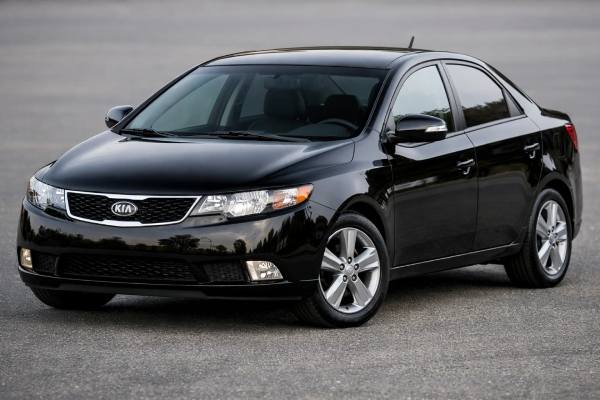
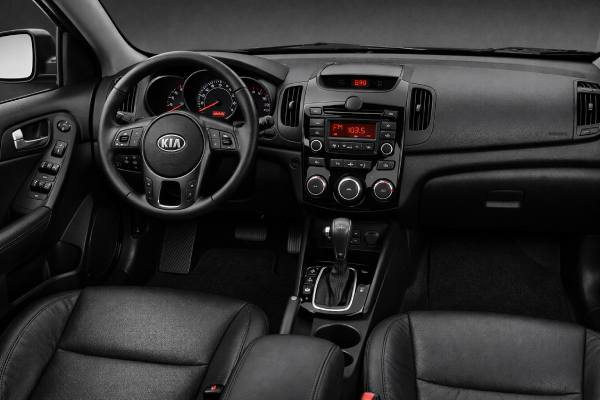
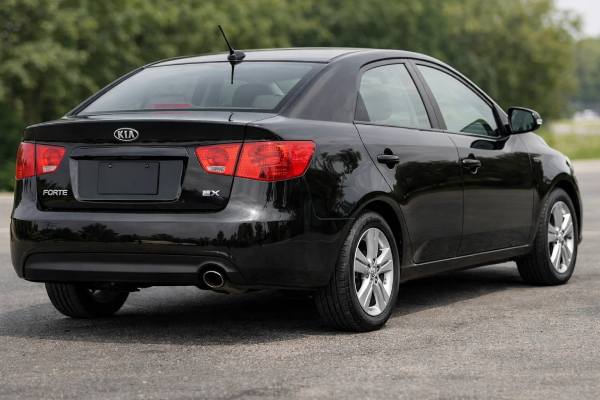
The 2010–2011 Kia Forte (TD) sedan with the 2.4-liter Theta II is the “big-engine” version of an otherwise sensible compact. It keeps the same straightforward chassis (front struts, rear torsion beam, front-wheel drive) but adds a noticeably stronger midrange that makes highway merges and two-lane passing easier than the base 2.0. In everyday ownership, this trim tends to be about two things: powertrain condition and proof of updates. The 2.4 MPI (multi-port injected) setup is mechanically simpler than later direct-injection variants, yet the broader Theta II family has known failure modes that reward careful maintenance and documentation. If you shop or maintain one today, the best approach is to treat it like a “clean-history” car: verify campaign completion, keep oil service disciplined, and inspect cooling and steering components like you would on any 15-year-old daily driver.
Owner Snapshot
- Stronger 2.4-liter pull makes the Forte feel less strained on grades and at highway speeds.
- Multi-port injection is generally simpler to keep clean than early direct-injection systems.
- SX-style wheel and tire packages improve grip but can ride firmer on rough pavement.
- Confirm the 2.4-liter engine software campaign has been completed and keep records.
- Change engine oil every 6,000–12,000 km (3,750–7,500 mi) or 6–12 months, depending on driving severity.
Quick navigation
- Kia Forte TD 2.4L model profile
- Kia Forte TD 2.4L numbers and dimensions
- Kia Forte TD 2.4L options and safety kit
- Problem patterns and recall work
- Ownership schedule and inspection tips
- Road test impressions and economy
- How the 2.4 Forte stacks up
Kia Forte TD 2.4L model profile
This guide focuses on the Forte (TD) sedan sold for 2010–2011 with the 2.4-liter Theta II rated at 173 hp—most commonly associated with the higher trim mix (often “SX” in North America). It matters because the 2.4 changes the car’s personality without changing its underlying mission: it’s still a compact built for commuting and low running costs, but with a more relaxed power reserve.
What the 2.4 changes in daily use
The key advantage is usable torque at normal rpm. You don’t need to wind it out to keep pace with modern traffic, and it tends to hold speed on long highway grades with fewer downshifts. In practical terms, that means:
- Less “busy” throttle on hills and when merging.
- Better passing confidence with two adults and luggage.
- A calmer feel at higher speeds, especially with the later 6-speed automatic (2011).
The tradeoff is that the 2.4-liter cars are usually paired with larger wheels and wider tires and sometimes firmer suspension tuning, which can sharpen turn-in but also make potholes and expansion joints more noticeable.
Engineering basics you should know
The 2.4 Theta II in this period is typically a chain-driven, DOHC 16-valve inline-four with variable valve timing. The “MPI” (multi-port injection) version uses conventional injectors at the intake ports, which often means fewer carbon-deposit concerns than early direct-injection layouts. You still want to treat it as an older engine, though:
- Oil quality and oil level matter more with age.
- Cooling system health (thermostat, radiator, hoses) becomes a reliability multiplier.
- Rubber components—mounts, bushings, belts—age out regardless of mileage.
Ownership sweet spot
A good 2.4 Forte is a strong value when it has:
- Consistent oil service history.
- No chronic overheating history.
- Proof that engine and safety campaigns were completed.
- A quiet timing chain area at cold start (no persistent rattle).
- A stable idle with no misfire under load.
If you’re shopping, favor cars with documentation over mileage bragging rights. A higher-mile car with records and completed campaigns can be a safer bet than a low-mile example with gaps.
Kia Forte TD 2.4L numbers and dimensions
Below are practical, ownership-relevant specifications for the 2010–2011 Forte sedan with the 2.4-liter Theta II. Treat them as market- and VIN-dependent: small differences show up by emissions spec, transmission, wheel package, and build date.
Powertrain and efficiency
| Item | Specification |
|---|---|
| Code | Theta II 2.4 MPI (market naming varies) |
| Engine layout and cylinders | I-4, DOHC, 4 cylinders, 4 valves/cyl |
| Bore × stroke | 88.0 × 97.0 mm (3.46 × 3.82 in) |
| Displacement | 2.4 L (2359 cc) |
| Induction | Naturally aspirated |
| Fuel system | MPI (port injection) |
| Compression ratio | ~10.5:1 (varies by calibration) |
| Max power | 173 hp (129 kW) @ ~6000 rpm |
| Max torque | ~225–230 Nm (166–170 lb-ft) @ ~3800–4000 rpm (market dependent) |
| Timing drive | Chain |
| Rated efficiency (typical) | 9.0–9.5 L/100 km combined (26 mpg US) depending on transmission |
| Real-world highway @ 120 km/h (75 mph) | ~7.5–8.5 L/100 km (28–31 mpg US), terrain and tires dependent |
Transmission and driveline
| Item | 2010 | 2011 |
|---|---|---|
| Drive type | FWD | FWD |
| Manual | 6-speed manual (where offered) | 6-speed manual |
| Automatic | Commonly 5-speed automatic | Commonly 6-speed automatic |
| Differential | Open | Open |
Chassis, brakes, and key dimensions
| Item | Specification |
|---|---|
| Suspension (front/rear) | MacPherson strut / torsion beam |
| Steering | Electric power steering (EPS), rack-and-pinion |
| Brakes | 4-wheel disc on higher trims (sizes vary by market) |
| Wheels and tyres (common performance package) | P215/45 R17 (17 in rim) |
| Length / width / height | ~4530 / 1775 / 1460 mm (178.3 / 69.9 / 57.5 in) |
| Wheelbase | ~2650 mm (104.3 in) |
| Ground clearance | ~140–150 mm (5.5–5.9 in) depending on tires and load |
| Turning circle (kerb-to-kerb) | ~10.6–11.0 m (34.8–36.1 ft) |
| Curb weight | ~1270–1350 kg (2800–2980 lb), transmission dependent |
| Fuel tank | ~50–53 L (13.2–14.0 US gal / 11.0–11.7 UK gal) |
| Cargo volume | ~416 L (14.7 ft³) seats up (sedan trunk; method varies) |
Performance and capability
| Metric | Typical real-world range |
|---|---|
| 0–100 km/h (0–62 mph) | ~7.8–8.6 s (transmission and traction dependent) |
| Top speed | ~195–205 km/h (121–127 mph), market limited |
| Braking 100–0 km/h | ~38–41 m (125–135 ft), tires and pad condition dependent |
| Towing capacity | Not commonly rated for towing in many markets; treat as “light accessory only” unless your manual states otherwise |
| Payload | Varies by certification; check door-jamb label |
Fluids and service capacities
| Item | Specification (typical) |
|---|---|
| Engine oil | API SM/SN class; commonly 5W-20 (climate dependent); ~4.1–4.5 L (4.3–4.8 US qt) with filter |
| Coolant | Ethylene glycol long-life coolant; mix typically 50/50; ~5.5–6.5 L (5.8–6.9 US qt) total system |
| Automatic transmission | Kia-spec ATF (varies by transmission generation); drain/fill often ~3–4 L; dry fill higher |
| Manual transmission | MTF per Kia spec; ~1.8–2.1 L (1.9–2.2 US qt) |
| A/C refrigerant | R-134a; charge varies by market (often ~450–550 g / 16–19 oz) |
Key torque specs
| Fastener | Typical spec range |
|---|---|
| Wheel lug nuts | ~88–108 Nm (65–80 lb-ft) |
| Spark plugs | ~18–25 Nm (13–18 lb-ft) |
| Engine oil drain plug | ~30–45 Nm (22–33 lb-ft) |
Use these torque figures as decision aids only—verify against the correct service documentation for your VIN.
Kia Forte TD 2.4L options and safety kit
The 2.4-liter Forte sedan is typically packaged as the more “fully equipped” version, so the feature mix matters as much as the engine. Most cars you’ll find today will have a blend of comfort and sport cues: larger wheels, a more aggressive exterior look, and more cabin equipment than base models.
Trims, identifiers, and what to look for
While exact trim names vary by market, 2.4 sedans commonly align with the upper grade. Quick ways to confirm you’re looking at the right variant:
- Engine badge and paperwork: verify the 2.4 in registration/inspection documents, not just seller claims.
- Wheel and tire size: many are on 17-inch wheels with wider tires.
- Brake setup: higher trims often use rear disc brakes (base trims may use rear drums in some markets).
- Interior cues: upgraded seat material, steering-wheel controls, and higher audio tiers are common.
Options that change the driving experience
A few option choices meaningfully affect comfort and cost:
- Wheel package: 17-inch tires help grip but can be pricier and more sensitive to alignment. If roads are rough where you live, a smaller wheel setup (if fitted) can ride better and protect against bent rims.
- Infotainment and audio tiers: older head units can develop button wear or screen dimming. Confirm everything works, including Bluetooth pairing if equipped.
- Sunroof and lighting: check drains (sunroof) and confirm headlamp clarity; fogging and UV haze are common at this age.
Safety ratings: what they mean here
This generation of Forte was evaluated under the test methods of its era. The important buyer takeaway is less about chasing a single “star” and more about verifying:
- The car has electronic stability control (ESC) (often standard on many trims, but confirm).
- The airbag and seatbelt systems have not been modified and show no warning lights.
- Any safety-related service campaigns were completed for your production window.
Airbags, child-seat provisions, and braking systems
Expect front airbags and side/curtain coverage on most trims, plus:
- LATCH/ISOFIX anchor points for outboard rear seats (confirm the anchor covers and tether points are present and undamaged).
- ABS and ESC on many vehicles; confirm ABS self-test behavior and that the ABS lamp illuminates at key-on and then goes out.
At this age, safety is also about maintenance: worn shocks, mismatched tires, or cheap brake parts can erase the advantage of a decent original crash structure. When you test drive, do at least one firm stop from 60–80 km/h to check for steering pull, vibration, or early ABS cycling.
Problem patterns and recall work
A 2010–2011 2.4 Forte can be dependable, but it rewards owners who treat it like a system. Below is a practical “what fails” map by prevalence and cost impact, followed by the service actions that matter most.
Common, lower-cost issues
- Steering clunk/click (EPS coupling wear):
Symptoms: light knocking through the wheel over small bumps, especially at low speed.
Likely cause: wear in the EPS coupling/bushing.
Remedy: coupling replacement and inspection of intermediate shaft joints. - Front suspension wear:
Symptoms: rattles over sharp bumps; vague steering.
Likely cause: sway bar links, control arm bushings, or strut mounts aging.
Remedy: replace worn links/bushings; align afterward. - Brake vibration and uneven wear:
Symptoms: steering shake under braking.
Likely cause: rotor thickness variation from heat, sticking caliper slides, or cheap pads.
Remedy: service slide pins, replace pads/rotors as a matched set.
Occasional, medium-cost issues
- Cooling system aging:
Symptoms: slow coolant loss, heater performance changes, higher temp on climbs.
Likely cause: thermostat drift, radiator end-tank seepage, water pump wear.
Remedy: pressure test, renew weak components proactively if evidence appears. - Automatic transmission shift quality:
Symptoms: flare on upshift, harsh engagement, delayed kickdown.
Likely cause: aged fluid or adaptation issues.
Remedy: correct-spec fluid service and inspection for leaks; avoid “universal ATF.”
Rare but high-severity: Theta II bearing wear
The most important ownership topic for this specific 2.4 MPI application is the connecting rod bearing wear risk associated with Theta II engines in certain build populations. A key official action is a software update that installs a knock-based early warning strategy and may add extended coverage after completion.
What to watch for:
- Metallic knocking under load.
- Oil pressure warning behavior.
- Sudden power reduction with a blinking check-engine light (limp mode).
What to do:
- Confirm the engine software update campaign was completed by an authorized dealer.
- Keep oil changes documented; this matters for warranty decisions and diagnostics.
- If the car enters reduced-power mode, stop treating it as “drive it until it breaks.” Get it inspected promptly.
How to verify recall and campaign completion
Use the official VIN-based recall lookup and request dealer service history. For a used purchase, ask for printed proof of campaign completion, not just verbal confirmation. If records are missing, factor that into price and risk.
Ownership schedule and inspection tips
This section blends a maintenance schedule you can actually follow with a buyer’s checklist that targets known age points on the 2.4 Forte.
Practical maintenance schedule
Use distance or time—whichever comes first. If you do short trips, cold starts, heavy city driving, or long idling, follow the “severe” line.
| Item | Normal use | Severe use |
|---|---|---|
| Engine oil and filter | 12,000 km / 12 months (7,500 mi) | 6,000 km / 6 months (3,750 mi) |
| Tire rotation | 10,000–12,000 km (6,000–7,500 mi) | 8,000–10,000 km (5,000–6,000 mi) |
| Engine air filter | Inspect every 15,000 km | Inspect every 10,000–15,000 km |
| Cabin air filter | 15,000 km / 12 months | 10,000–15,000 km |
| Brake fluid | Every 2 years | Every 2 years (more often if humid/mountain use) |
| Coolant | 5–10 years (coolant type dependent) | Same, but inspect yearly |
| Spark plugs | 150,000–160,000 km (90,000–100,000 mi) typical for iridium | Earlier if misfire or poor fuel quality |
| Automatic transmission fluid | 60,000–100,000 km (40,000–60,000 mi) as preventative care | 40,000–60,000 km (25,000–37,000 mi) |
| Serpentine belt and hoses | Inspect every oil service | Inspect every oil service |
| Timing chain | No fixed interval; inspect for noise/correlation faults | Same |
Fluid specs: what matters most
- Engine oil: use a reputable brand meeting the required API standard; 5W-20 is common, but climate may call for 5W-30. The bigger point is consistent oil quality and correct oil level.
- ATF: use the correct Kia-specified fluid for the transmission generation; mixing “universal” fluids can create shift issues.
- Coolant: stick with the correct long-life formulation; mixing types can shorten corrosion protection.
Buyer’s guide: inspection checklist
Focus on evidence, not optimism:
- Campaign proof: confirm the 2.4 engine software campaign completion in writing.
- Cold start behavior: listen for persistent chain-area rattle, knocking, or rough idle beyond a brief start-up phase.
- Oil condition: check level, smell (fuel dilution), and look for metal glitter on the dipstick or in the filter area.
- Cooling system: inspect for dried coolant residue at hose ends and radiator seams; confirm stable temperature on a long drive.
- Transmission: verify smooth engagement from Park to Drive, clean shifts, and no slipping under throttle.
- Steering and suspension: check for EPS clunk, torn control-arm bushings, and uneven tire wear.
- Rust hotspots: look at subframe seams, rear beam mounts, and brake line routing areas, especially in salted climates.
Durability outlook
With verified campaigns, steady oil service, and a healthy cooling system, the 2.4 Forte can be a durable commuter. Without those fundamentals, it can become a “cheap car that gets expensive.” Price it accordingly.
Road test impressions and economy
The 2.4-liter Forte’s personality is best described as “compact car, grown-up power.” It doesn’t turn the Forte into a sport sedan, but it does remove the strained feeling many base compacts develop at highway speed.
Ride, handling, and NVH
- Ride: On 17-inch tires, sharp edges are more noticeable, but the body stays controlled. If your roads are broken, tire choice and correct pressures make a bigger difference than most owners expect.
- Handling: The chassis is predictable. Turn-in is quick enough for daily driving, with safe understeer near the limit.
- Steering: EPS is light and easy in parking lots. Feedback is limited compared with hydraulic systems, but it’s accurate when aligned properly.
- Cabin noise: Wind and tire noise dominate at speed—especially with aggressive tires. Worn door seals and old tires can make the car feel louder than it should.
Powertrain character
The 2.4’s main advantage is midrange shove. It pulls cleanly from moderate rpm without demanding constant downshifts. Transmission behavior is where 2010 vs 2011 can feel different:
- The 2010-era automatic can feel more “stepped” and may downshift more abruptly under kickdown.
- The 2011-era 6-speed automatic (when fitted) generally keeps the engine in a calmer zone and helps highway efficiency.
Manual cars feel more direct and are often the most satisfying version if the clutch and shifter are in good condition.
Real-world fuel economy
Official ratings cluster around 26 mpg combined (US) for the 2.4, with city and highway figures depending on transmission. In owner terms:
- City: ~10.0–11.5 L/100 km (20–23 mpg US), higher in winter or short-trip use.
- Highway (100–120 km/h): ~7.5–8.5 L/100 km (28–31 mpg US).
- Mixed commuting: ~8.5–10.0 L/100 km (23–28 mpg US).
The biggest real-world swing factors are tire choice, alignment, and how often the car is driven cold. A well-maintained 2.4 can be reasonably efficient, but it won’t match the best 1.8–2.0 liter rivals in stop-and-go traffic.
Key performance metrics that matter
What changes the ownership verdict is not top speed; it’s passing ability. Expect a healthier 80–120 km/h pull than base engines of the era, especially when the transmission is not hunting between gears.
How the 2.4 Forte stacks up
To understand the 2.4 Forte’s place, compare it with mainstream compacts from the same era: Honda Civic, Toyota Corolla, Mazda Mazda3, and Hyundai Elantra.
Where it wins
- Power-per-dollar (when bought used): The 2.4 offers a stronger torque feel than many 1.8–2.0 rivals without requiring premium fuel.
- Everyday usability: A roomy rear seat and strong trunk for the class make it practical.
- Simple engine hardware (MPI): Port injection is generally easier to live with long-term than early DI setups, especially for short-trip drivers.
Where rivals can be stronger
- Resale and long-term perception: Civic and Corolla often hold value better, even when the Forte is equally serviceable.
- Steering feel and refinement: Mazda3 typically feels more connected; Corolla often feels smoother at the edges, depending on trim.
- Risk profile: The Forte’s biggest downside is not comfort—it’s the need to verify specific engine-related campaigns and keep strict maintenance records.
Best match by buyer type
- Best for: drivers who want compact-car running costs but dislike “slow car stress,” and buyers willing to verify campaign completion and maintain the engine carefully.
- Not ideal for: anyone who wants a “buy it and ignore it” car with minimal paperwork, or drivers in very rough-road areas who will be unhappy with low-profile tires.
Value verdict
A well-documented 2.4 Forte can be one of the smarter used buys in its class: it feels more capable than the average economy compact, and parts availability is typically straightforward. The condition filter is strict, though—documentation and inspection quality matter more here than on some rivals.
References
- ALL-NEW 2010 KIA FORTE COMPACT SEDAN ARRIVES WITH STYLING, PERFORMANCE AND ECONOMY 2009 (Manufacturer Press Release)
- 2011 Forte – Overview 2010 (Manufacturer Press Release)
- Gas Mileage of 2011 Kia Forte 2026 (Official Fuel Economy Data)
- 2010 Kia Forte 4-door sedan 2010 (Safety Rating)
- Microsoft Word – PI2102 FLT#401 – Owner Renotification Letter 2025 (Service Campaign Notice)
Disclaimer
This article is for informational purposes only and is not a substitute for professional diagnosis, inspection, or repair. Specifications, torque values, service intervals, fluids, and procedures vary by VIN, market, build date, and equipment. Always verify details using your vehicle’s official service information and the correct documentation for your exact model.
If this guide helped, please consider sharing it on Facebook, X (Twitter), or your favorite forum/community so others can benefit as well.