


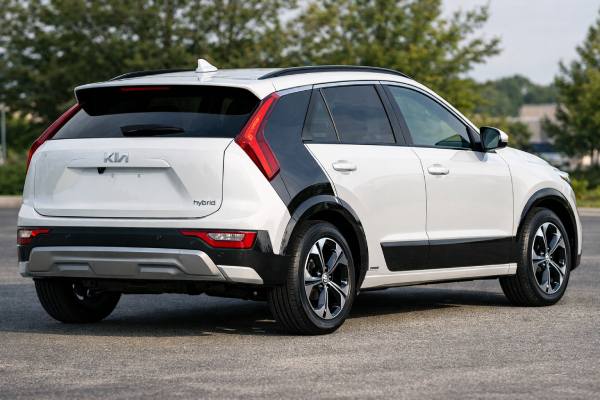
The second-generation Kia Niro Hybrid (SG2) is built for people who want real-world efficiency without giving up everyday comfort. Its Smartstream 1.6-liter hybrid system pairs an Atkinson-cycle gasoline engine with an electric motor and a small high-voltage battery, managed by software that tries to keep the engine in its best efficiency zone. The result is a crossover that feels calmer and more refined than many economy hybrids, especially in stop-and-go driving where the electric motor can smooth out low-speed transitions.
Ownership tends to be straightforward: routine service looks like a modern gasoline car, but with fewer brake-wear events thanks to regenerative braking. The trade-off is that hybrids add complexity—coolant loops, power electronics, and a dual-clutch transmission in many markets—so condition and service history matter more than on a simple non-hybrid compact.
Top Highlights
- Strong city efficiency and easy daily drivability, with smooth low-speed assistance from the electric motor
- Practical cabin packaging for a compact crossover, with usable cargo space and good rear-seat comfort
- Generally low brake wear thanks to regenerative braking, especially in commuter use
- Caveat: software updates and recall completion matter—verify by VIN before buying used
- Typical interval: rotate tires every 10,000–12,000 km (or 6–8 months) to keep wear even
Navigate this guide
- Kia Niro Hybrid SG2 basics
- Kia Niro Hybrid SG2 specifications
- Kia Niro Hybrid SG2 trims and safety
- Reliability issues and service actions
- Maintenance and used buying strategy
- Driving feel and real economy
- Rivals and best alternatives
Kia Niro Hybrid SG2 basics
Think of the SG2 Niro Hybrid as a “hybrid-first” crossover, not a gasoline car with a battery added later. The packaging, calibration, and driving modes are designed around keeping the hybrid system in its efficient sweet spots. In practice, that means it rewards gentle throttle inputs and steady speeds, but it can still handle highway duty without feeling strained.
Powertrain layout and what it means
- The 1.6-liter engine is tuned for efficiency (Atkinson-cycle behavior), so it does not chase high torque at low rpm the way a small turbo might.
- The electric motor fills the gaps: it helps with launch, smooths gear changes (where a DCT is used), and reduces engine load during small speed changes.
- The high-voltage battery is sized for frequent short boosts and regen capture—not long electric-only driving. That’s normal for a conventional hybrid (HEV).
Why owners tend to like this generation
- Predictable operating costs: Even though it is a hybrid, most routine service is familiar—oil, filters, tires, brakes, and coolant.
- Brake hardware lasts longer: Regenerative braking handles a meaningful share of deceleration, so pads and rotors can last noticeably longer in mixed driving.
- Comfort-oriented tuning: The Niro’s mission is efficient transport, so it typically prioritizes ride comfort and quiet cruising over sporty responses.
What matters most when shopping
- Trim and wheel size: Larger wheels can reduce comfort and often cost a few points of fuel economy.
- Service history: Hybrids are tolerant, but neglected fluids, weak 12 V batteries, and overdue inspections can create nuisance faults.
- Software and recalls: This is a modern, networked car. A “perfect” mechanical inspection still isn’t enough if key campaigns were ignored.
If you want a crossover shape without the fuel appetite of a small turbo SUV, the SG2 Niro Hybrid’s engineering focus—efficiency first, comfort second, and performance “enough”—is exactly the point.
Kia Niro Hybrid SG2 specifications
Powertrain and efficiency
| Spec | Value |
|---|---|
| Powertrain type | Hybrid (HEV) |
| Engine family | Smartstream G1.6 Hybrid |
| Displacement | 1.6 L (approx. 1580 cc) |
| Engine layout | Inline-4 |
| Induction | Naturally aspirated |
| Fuel system | Gasoline direct injection (GDI) |
| System max power | 139 hp (104 kW) |
| Hybrid battery type | Lithium-ion |
| Hybrid battery capacity | ~1.3 kWh |
Transmission and driveline
| Spec | Value |
|---|---|
| Drive type | FWD |
| Transmission type | 6-speed dual-clutch automatic (DCT) |
Chassis and dimensions
| Spec | Value |
|---|---|
| Vehicle class | Compact crossover (C-SUV) |
| Suspension (front) | MacPherson strut |
| Suspension (rear) | Multi-link |
| Length | ~4420 mm |
| Width | ~1825 mm |
| Height | ~1545 mm |
| Wheelbase | ~2720 mm |
| Turning circle (kerb-to-kerb) | ~10.6 m |
Performance
| Spec | Value |
|---|---|
| 0–100 km/h (0–62 mph) | ~10–11 s |
| Top speed | ~160 km/h |
Safety and driver assistance
| Spec | Value |
|---|---|
| Core active safety | ABS, ESC, traction control |
| Common ADAS availability | AEB, ACC, lane assist, blind-spot monitoring (trim-dependent) |
Kia Niro Hybrid SG2 trims and safety
Trim naming and equipment vary by market, but the SG2 Niro Hybrid usually follows a familiar ladder: an entry trim with the essential safety suite, mid-level trims that add comfort and convenience, and upper trims that layer on premium audio, larger displays, and more driver assistance.
Trims and options that change daily ownership
- Wheel and tire packages: Smaller wheels generally ride better and help economy. Larger wheels can sharpen steering response, but they often raise road noise and reduce real-world efficiency, especially at highway speeds.
- Infotainment tier: Many buyers focus on screen size, but the bigger ownership difference is often connectivity (wireless phone integration, navigation-based routing features, and update support).
- Comfort packages: Heated seats/steering wheel, upgraded climate features, and better seat materials matter more on a hybrid than people expect, because the engine may run less at low speeds—cabin heat strategy and comfort features can influence how “settled” the car feels in winter.
Quick identifiers when inspecting a used car
- Driver-assistance buttons and steering-wheel icons: Higher ADAS trims usually have clearer control layouts for adaptive cruise and lane-centering features.
- Mirror and bumper hardware: Some trim levels add radar sensors and more camera coverage; check for mismatched bumper paint or sensor alignment issues after repairs.
- Instrument cluster style: Many markets reserve larger clusters or higher-resolution displays for higher trims, which can be a quick tell.
Safety ratings and what they really mean
A challenge with global models is that rating bodies and test versions differ. NHTSA and IIHS apply to U.S.-market cars, while European markets look to Euro NCAP. Even when the star count is the same, test protocols can emphasize different crash scenarios and driver-assistance performance.
When you evaluate safety, focus on:
- Standard vs optional ADAS: A trim that can be equipped with adaptive cruise and lane centering is not the same as one that has it.
- Headlight performance (where rated): Lighting is a daily safety feature. Two “identical” cars can differ a lot depending on headlamp type and calibration.
- Post-repair calibration: If the car has had windshield replacement, front-end repairs, or suspension work, ask whether cameras and radar were recalibrated. AEB and lane functions can be sensitive to alignment.
Driver assistance and service implications
Modern Niro Hybrid ADAS is generally dependable, but it is not “set and forget.” The most common ownership friction is not a broken sensor—it’s a sensor that’s dirty, blocked, misaligned, or operating with outdated software. When buying used, test every ADAS feature you plan to rely on, and verify that warning lights do not appear after a short drive and restart.
Reliability issues and service actions
The SG2 Niro Hybrid tends to be a solid long-term bet when maintained correctly, but its reliability profile is hybrid-typical: fewer problems tied to a conventional starter and alternator, and more that involve software, sensors, wiring integrity, and cooling management. Below is a practical map of what to watch for.
Common (watch closely)
- 12 V battery weakness (low cost / high annoyance)
Symptoms: intermittent warning lights, “no start” behavior, infotainment resets, random fault messages after sitting.
Likely cause: aging 12 V battery, frequent short trips, or parasitic draw from accessories.
Remedy: load test the battery, check charging behavior, replace proactively if marginal. - Brake feel changes due to regen blending (low to medium cost)
Symptoms: inconsistent pedal feel at low speed, light grinding after rain, or surface rust noise.
Likely cause: regen doing most work, friction brakes not used enough, or pad/rotor glazing.
Remedy: periodic firm stops (when safe), brake inspection, pad/rotor service if corrosion is advanced. - Dual-clutch behavior in traffic (medium cost if ignored)
Symptoms: shudder when creeping, hesitation on hot days, or rough low-speed engagement.
Likely cause: heat and wear in the clutch pack or calibration that needs updating.
Remedy: confirm software is current, ensure correct transmission fluid service where applicable, and avoid excessive “creep” habits.
Occasional (depends on climate and use)
- Cooling-system sensitivity (medium cost)
Symptoms: overheating warnings, fan running often, reduced performance on hot days.
Likely cause: clogged radiator fins, coolant level issues, or electric pump/valve problems.
Remedy: inspect cooling stack, verify correct coolant and bleed procedure, check pump operation. - Hybrid system warnings (medium to high cost)
Symptoms: “Check hybrid system,” reduced power, or intermittent limp behavior.
Likely cause: sensor faults, HV wiring issues, or control-module logic that needs updating.
Remedy: proper scan with hybrid-capable diagnostics, verify bulletin updates, and confirm recall completion.
Rare (but expensive when it happens)
- High-voltage component faults (high cost)
Symptoms: persistent hybrid warnings, isolation faults, or refusal to enter READY mode.
Likely cause: moisture ingress, damaged connectors, or internal component failure in inverter/DC–DC area.
Remedy: dealer-level diagnostic and insulation testing; repairs must follow HV safety procedures.
Recalls, TSBs, and verification strategy
This generation has had at least one high-profile campaign affecting wiring integrity under the front passenger seat in certain builds. The best ownership practice is simple:
- Run a VIN check on official databases.
- Ask for dealer paperwork showing completion.
- Inspect the repair area for correct routing and protective coverings.
A used hybrid can be mechanically healthy and still be a poor buy if campaigns were skipped. Put recall completion on the same level as service history.
Maintenance and used buying strategy
A good hybrid maintenance plan is less about “more service” and more about the right service at the right intervals, plus checks that prevent nuisance faults. Use this as a practical, owner-friendly schedule, then match it to your market’s official book for your exact VIN.
Practical maintenance schedule (normal use)
- Every 10,000–12,000 km or 6–12 months
- Engine oil and filter (use the specified low-viscosity oil grade for this engine family)
- Tire rotation; check alignment if wear is uneven
- Brake inspection (pads, rotors, slide pins); confirm regen and friction braking feel is consistent
- Suspension and steering inspection (bushings, ball joints, tie-rod play)
- Visual cooling-system check (levels, leaks, radiator condition)
- Every 20,000–30,000 km or 12–24 months
- Cabin air filter replacement
- Air intake filter replacement (more often in dusty areas)
- Full scan for stored codes (especially if buying used)
- Every 40,000–60,000 km or 3–4 years
- Brake fluid service (time matters as much as distance)
- Detailed underbody inspection for corrosion and damaged covers
- Every 60,000–100,000 km or 4–6 years (use-market dependent)
- Engine coolant service (verify correct coolant type; hybrids can be sensitive to improper mixing)
- Transmission service if specified for your exact transmission and usage profile
Severe-use adjustments (do this if it fits your life)
If you do short trips in winter, heavy city traffic, frequent steep grades, or regularly carry a full load:
- Shorten oil-change intervals toward the lower end
- Inspect brakes more often for corrosion (regen reduces brake “self-cleaning”)
- Pay extra attention to cooling stack cleanliness (road grime matters)
Used-buyer checklist (hybrid-specific)
Traction battery health
- Ask for a battery health or hybrid-system report from a dealer or hybrid-capable shop.
- During a test drive, watch for rapid state-of-charge swings and repeated engine starts at low loads, which can hint at weak battery performance.
Charging and 12 V system
- Even HEVs rely heavily on a stable 12 V system for electronics stability.
- Check for slow booting screens, repeated error pop-ups, or a history of “battery drain” complaints.
Transmission and driveline
- In stop-and-go traffic, confirm smooth engagement without shudder.
- Listen for drivetrain clunks on takeoff, which can indicate mounts or driveline slack.
Cooling and HVAC
- Confirm strong A/C performance and stable engine temperatures.
- Check for fan noise that seems excessive at mild temperatures (can suggest blocked airflow or control issues).
Best years and trims to seek
- Seek cars with complete records and verified campaigns, even if the trim is lower.
- Choose wheel/tire packages that match your roads: smaller wheels often make the Niro quieter and cheaper to run.
Long-term, the SG2 Niro Hybrid rewards owners who treat it like a modern software-managed vehicle: keep fluids current, keep recalls closed, and don’t ignore “minor” warning behavior.
Driving feel and real economy
On the road, the Niro Hybrid’s goal is to feel “normal,” not like a science project. Most of the time it succeeds. The electric motor helps the car pull away smoothly, and the engine tends to settle into a steady rhythm once you’re cruising. Where some hybrids feel rubbery or droning, the Niro’s calibration usually aims for a more conventional response—especially as speeds rise.
Ride, handling, and noise (NVH)
- Ride quality: The battery weight is low in the chassis, which helps body control over bumps. With smaller wheels, the Niro can feel notably more composed on broken pavement.
- Steering: Steering is typically light and predictable rather than chatty. It’s tuned for easy placement in traffic, not feedback.
- Cabin noise: Expect moderate road noise on coarse asphalt and improved quiet on smoother highways. Larger wheels and certain tire brands can swing this a lot.
Powertrain character
In a conventional hybrid, the most important “performance” trait is how smoothly it transitions between electric assist and engine power.
- In gentle driving, transitions should be subtle.
- In aggressive merges, you may feel the system coordinate engine rpm and gear engagement; that’s normal, but it shouldn’t shudder or hesitate repeatedly.
Real-world efficiency expectations
Your consumption will vary by speed and temperature more than by terrain.
- City driving: Usually the strongest scenario because regen captures energy and the engine can avoid inefficient low-load operation.
- Highway at 110–120 km/h: Expect a noticeable drop compared with city numbers, because aerodynamic drag rises quickly and the hybrid battery has less opportunity to help.
- Cold weather: Any hybrid can lose efficiency in winter because the engine runs to provide heat and because batteries accept and deliver power less efficiently when cold.
Practical rule: if your weekly driving is mostly urban and suburban, the Niro Hybrid’s economy advantage is large and obvious. If you live at 120–130 km/h on the motorway, the advantage shrinks, but it usually remains better than a comparable non-hybrid crossover.
Everyday braking feel
The system blends regenerative and friction braking. A well-sorted car feels consistent, but some drivers notice a “step” right before a stop. If you’re evaluating a used example, do repeated gentle stops from 30–10 km/h and confirm the pedal stays predictable.
Rivals and best alternatives
The SG2 Niro Hybrid sits in a busy space: efficient compact crossovers and hatchback-like hybrids with higher seating. The best competitor for you depends on whether you value maximum mpg, driving feel, interior space, or warranty coverage.
If you want the highest efficiency
- Toyota Prius: Often the mpg benchmark, especially in certain trims. It may feel more “purpose-built” for efficiency than the Niro, but it isn’t a crossover in the same way for cargo height and rear headroom.
If you want a similar shape with a different ownership flavor
- Toyota Corolla Cross Hybrid: More traditional SUV vibe, generally straightforward to own. It can be a strong alternative if you value conservative tuning and broad dealer familiarity.
If you prioritize comfort and features per dollar
- Look for rivals that package driver assistance and comfort features into mid trims rather than forcing top trims. In many markets, the Niro’s value depends heavily on how its option packages are structured.
Where the Niro Hybrid tends to win
- Balanced crossover usability: It usually offers a practical cabin without feeling oversized.
- Everyday smoothness: Electric assist can make it feel calmer in traffic than small turbo crossovers.
- Warranty and ownership support (market-dependent): In some regions, coverage is a genuine advantage.
Where it can lose
- High-speed economy vs the best hybrids: The fastest motorway commutes can narrow the advantage.
- Complexity vs non-hybrid crossovers: If you keep cars for 12–15 years, hybrid component aging becomes more relevant, even if failures are uncommon.
Bottom line: the SG2 Niro Hybrid is a smart buy when you want crossover practicality, strong commuter efficiency, and a calm daily driving experience—especially if you can confirm service history, software updates, and recall completion.
References
- RCLRPT-25V004-1235.PDF 2025 (Recall Database) ([NHTSA][1])
- RCLA-25V004-9274.pdf 2025 (Recall Notice) ([NHTSA][2])
- Edmunds Compares: 2023 Toyota Prius vs. 2023 Kia Niro 2023 ([AP News][3])
- KIA recalls more than 80,000 electric, hybrid vehicles over due to wiring that could impact airbags 2025 ([Houston Chronicle][4])
Disclaimer
This article is for informational purposes only and is not a substitute for professional diagnosis, inspection, or repair. Specifications, torque values, service intervals, and procedures can vary by VIN, market, model year, and installed equipment. Always verify details against official owner and service documentation for your exact vehicle.
If you found this guide useful, consider sharing it on Facebook, X (Twitter), or your favorite forum to support our work.