
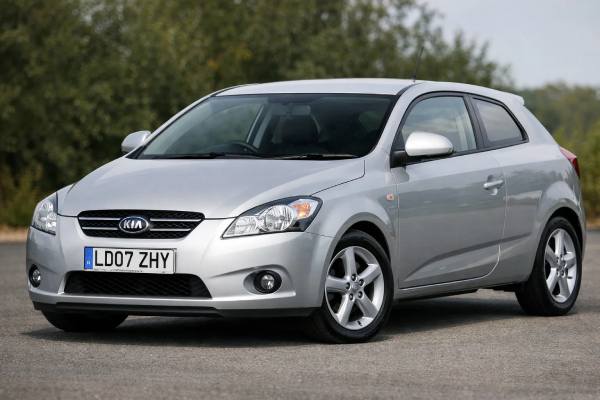
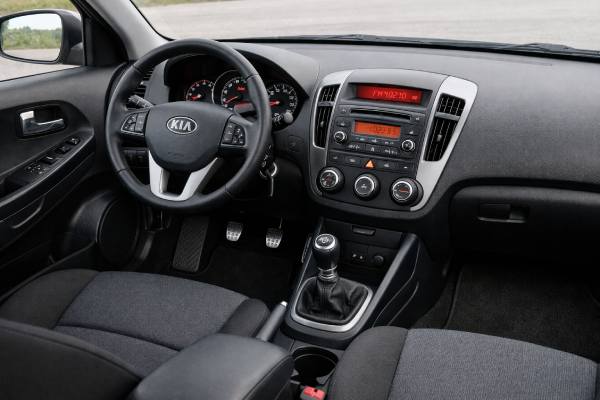
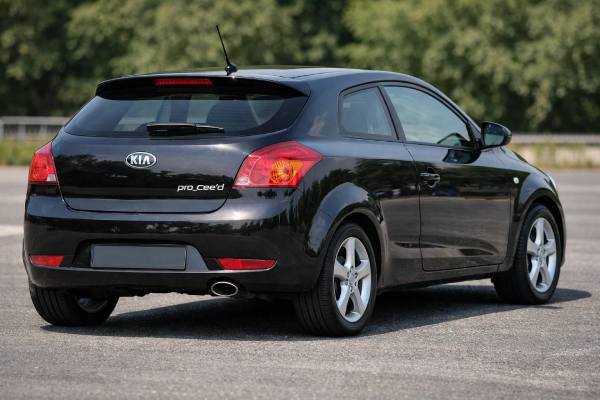
The 2007–2009 Kia Pro Cee’d (ED) with the 1.4 G4FA is a straightforward, European-focused three-door hatch that majors on sensible engineering rather than drama. The naturally aspirated 1.4-liter “Gamma” engine uses port fuel injection and a timing chain, which keeps routine ownership simple and makes it tolerant of everyday driving conditions. The chassis is a bigger part of the story than many expect: a stable wheelbase and a multi-link rear suspension give the car a planted feel and consistent tire contact over broken pavement, which helps both ride quality and predictable handling.
As an ownership proposition, this Pro Cee’d is about low complexity, reasonable parts costs, and solid safety fundamentals for its era—provided you buy one with evidence of regular fluid service and address small age-related issues early. It is not quick, but it is honest: a car that rewards preventive maintenance more than modifications, and one that can stay dependable well past its teens with the right care.
Quick Specs and Notes
- Simple, chain-driven 1.4 MPI engine with easy servicing and few “must-have” upgrades.
- Multi-link rear suspension helps stability and ride comfort versus many torsion-beam rivals.
- Best value examples have complete service history and clean underbody with no structural rust.
- Plan engine oil and filter service every 15,000 km (10,000 mi) or 12 months, sooner in severe use.
- Coolant replacement is easy to neglect—treat it as a scheduled item, not a “top-up only” fluid.
Navigate this guide
- Kia Pro Cee’d ED model character
- Kia Pro Cee’d ED specs and measurements
- Kia Pro Cee’d ED trims, safety, and ADAS
- Reliability patterns and common fixes
- Maintenance schedule and buying tips
- Driving feel and real economy
- How Kia Pro Cee’d ED compares
Kia Pro Cee’d ED model character
The Pro Cee’d is the three-door, slightly sportier-looking sibling in the first-generation Cee’d (ED) family. In practice, it drives like a well-sorted compact hatch: stable at speed, tidy in corners, and easy to place in traffic. The “sporty” part is mostly in the proportions and seating position rather than raw pace—especially with the 1.4, which prefers revs and smooth driving over punchy low-rpm torque.
Where this model tends to win owners is in its balance of simplicity and day-to-day usability:
- Engine philosophy: The 1.4 G4FA is naturally aspirated, port-injected (MPI), and not highly stressed. That combination generally means fewer heat-management surprises than early small turbos, and fewer fuel-system sensitivities than direct injection.
- Chassis tuning: A multi-link rear suspension (unusual at the price when new) helps it stay composed over mid-corner bumps and reduces the “skip” some torsion-beam hatches can show on rough roads.
- Practical hatch packaging: Even as a three-door, it is easy to live with if you accept the longer front doors and occasional rear-seat access inconvenience. Cargo volume is competitive for the class, and the hatch opening is usefully square.
The tradeoffs are equally clear. The Pro Cee’d’s doors are heavier and longer than a five-door’s; that matters in tight parking. The 1.4 engine is happiest when maintained and driven smoothly, but it will feel strained if you routinely load the car heavily or demand quick overtakes without downshifting. And because these cars are now well into “age and mileage” territory, condition matters more than the badge: the best ones are the cars that were serviced on time, protected from corrosion, and fixed properly when small faults first appeared.
If you want a compact that feels “grown up” on the highway, is easy to service, and has honest mechanicals, the 2007–2009 Pro Cee’d 1.4 is still a sensible used buy—just not a performance bargain.
Kia Pro Cee’d ED specs and measurements
Below are the key technical figures for the 2007–2009 Pro Cee’d (ED) with the 1.4 G4FA, focused on what matters for ownership, servicing, and real-world use.
Powertrain and efficiency
| Item | Specification |
|---|---|
| Code | G4FA |
| Engine layout and cylinders | Inline-4, DOHC, 16-valve (4 valves/cyl) |
| Bore × stroke | 77.0 × 74.99 mm (3.03 × 2.95 in) |
| Displacement | 1.4 L (1,396 cc) |
| Induction | Naturally aspirated |
| Fuel system | MPI (port injection) |
| Compression ratio | 10.5:1 |
| Max power | 109 PS (80.2 kW) @ 6,200 rpm |
| Max torque | 137 Nm (101 lb-ft) @ 5,000 rpm |
| Timing drive | Chain |
| Rated efficiency (combined) | 6.1 L/100 km (38.6 mpg US / 46.3 mpg UK) |
| Real-world highway @ 120 km/h (75 mph) | ~6.8–7.6 L/100 km (31–35 mpg US), weather and tires dependent |
Transmission and driveline
| Item | Specification |
|---|---|
| Transmission | 5-speed manual |
| Drive type | FWD |
| Differential | Open |
| Notable gearing trait | Needs downshifts on grades; keep the engine in the mid-range for best response |
Chassis and dimensions
| Item | Specification |
|---|---|
| Suspension (front/rear) | MacPherson strut / multi-link |
| Steering | Rack-and-pinion assist; ratio ~13.2:1 |
| Brakes (front/rear) | Ventilated discs 280 mm (11.0 in) / solid discs 262 mm (10.3 in) |
| Common tire sizes | 195/65 R15, 205/55 R16, 225/45 R17 |
| Ground clearance | 150 mm (5.9 in) |
| Length / width / height (3-door) | 4,250 / 1,790 / 1,450 mm (167.3 / 70.5 / 57.1 in) |
| Wheelbase | 2,650 mm (104.3 in) |
| Turning circle (kerb-to-kerb) | ~10.34 m (33.9 ft) |
| Fuel tank | 53 L (14.0 US gal / 11.7 UK gal) |
| Cargo volume (VDA) | 340 L (12.0 ft³) seats up / ~1,300 L (45.9 ft³) max |
Performance and capability
| Item | Specification |
|---|---|
| 0–100 km/h (0–62 mph) | ~11.6 s |
| Top speed | ~187 km/h (116 mph) |
| Braking 100–0 km/h | ~39.5 m (129.6 ft) (test-dependent) |
| Towing capacity | 1,200 kg (2,646 lb) braked / 550 kg (1,213 lb) unbraked |
| Towball limit | ~55 kg (121 lb) |
Fluids and service capacities (owner-focused)
| System | Spec | Capacity |
|---|---|---|
| Engine oil | SAE 5W-20 or 5W-30; API SJ/SL-class and higher | 3.3 L (3.49 US qt) with filter |
| Manual gearbox oil | API GL-4; SAE 75W-85 | 1.9 L (2.01 US qt) |
| Coolant | Ethylene glycol-based (aluminum radiator) | 5.8–5.9 L (6.18 US qt) |
| Brake and clutch fluid | DOT-3 or DOT-4 | 0.7–0.8 L (0.79 US qt typical) |
| A/C refrigerant | Typically R134a | Verify charge on under-hood label (varies by equipment) |
| Key torque spec | Wheel nuts | 88–107 Nm (65–79 lb-ft) |
These figures can vary slightly by market, wheel package, and build date, but they capture the baseline hardware and the numbers that most influence maintenance planning and day-to-day behavior. ([kia-bg.com][1])
Kia Pro Cee’d ED trims, safety, and ADAS
Trim naming on ED-era Cee’d models varies by country, but the pattern is consistent: a base trim with the essentials, one or two comfort-oriented trims, and a sport-styled trim that mainly adds wheels, cosmetic cues, and a few convenience upgrades. For the 2007–2009 Pro Cee’d 1.4, the most meaningful differences usually come down to wheels/tires, stability control availability, and cabin equipment rather than major mechanical changes.
Trims and options that change ownership
Look for these features because they influence cost, comfort, or resale:
- Wheels and tires: 15-inch packages ride softest and are cheapest to keep in tires. 16s and 17s sharpen steering response but can increase road noise and susceptibility to pothole damage.
- Climate control: Manual A/C is simple and generally cheaper to troubleshoot; automatic climate adds comfort but can add sensor/blend-door complexity as the car ages.
- Audio and connectivity: Some cars have factory AUX/USB; others are basic CD/radio. Check function of every button—small interior electronics repairs can be time-consuming.
- Heated seats and mirrors: In cold climates, these are valuable “quality of life” options and often indicate a higher equipment tier.
Quick identifiers when you are standing by the car:
- Fog lights, larger wheels, and sport seats often point to higher trims.
- A stability control button (or ESC indicator on the cluster during key-on) hints the car is equipped—important in winter climates.
- ISOFIX/LATCH markings should be visible at the rear outboard seats; verify the anchors are intact and the plastic guides are not broken.
Safety ratings and what they mean today
The ED Cee’d achieved a top-tier result for adult occupant protection in its era. Keep in mind the methodology was points-based in 2007, so it does not map cleanly to modern percentage scoring. Still, it indicates strong basic structure, effective restraint systems, and respectable crash performance compared with same-generation rivals. Euro NCAP awarded the Cee’d 5 stars for adult occupant protection (34 points), with strong side-impact performance noted in the report. ([Euro NCAP][2])
Safety systems and ADAS reality check
“Driver assistance” on this model is mostly foundational safety tech, not modern ADAS:
- Expected safety equipment: front airbags plus side and curtain airbags on many trims; ABS with electronic brake-force distribution; seatbelt pretensioners and load limiters.
- Stability and traction control: often fitted, but not always standard in every early-market configuration—confirm on the specific car.
- Child-seat provisions: ISOFIX/LATCH rear outboard, with top-tether provisions depending on market; verify labels and anchor condition.
What you generally will not get on a 2007–2009 Pro Cee’d: automatic emergency braking, adaptive cruise control, lane centering, or modern blind-spot monitoring. That is normal for the era—so the buyer’s job is to prioritize good tires, healthy brakes, and functional stability control over chasing features the platform simply did not offer.
Reliability patterns and common fixes
At this age, reliability is less about any single “fatal flaw” and more about how well the car has been maintained—and whether previous repairs were done carefully. The 1.4 G4FA itself is typically durable when it gets clean oil, correct coolant, and timely ignition service. Most problems are manageable, but they cluster in predictable places.
Common issues (high prevalence, low to medium cost)
- Ignition coils and plugs
Symptoms: misfire under load, flashing MIL, rough idle.
Likely cause: aging coil packs or worn plugs.
Remedy: replace plugs at the scheduled interval; replace coils as needed (often best done as a matched set if multiple are weak). - Vacuum leaks and idle fluctuations
Symptoms: inconsistent idle, lean codes, hesitation.
Likely cause: hardened PCV/vacuum hoses or intake leaks with age.
Remedy: smoke test, renew brittle hoses, clean throttle body as needed. - Suspension consumables (links, bushings)
Symptoms: knocks over bumps, vague steering on-center.
Likely cause: worn anti-roll bar links, control arm bushings, or rear multi-link bushings.
Remedy: replace worn components in pairs; align afterward.
Occasional issues (medium cost, can strand you)
- Cooling system seepage
Symptoms: coolant smell, low level, damp radiator end tanks, weak cabin heat.
Likely cause: aged hoses, clamps, radiator tanks, or thermostat housing seals.
Remedy: pressure test; fix leaks early to avoid overheating and head gasket risk. - Manual gearbox and clutch wear
Symptoms: clutch slip, high bite point, difficulty selecting gears, bearing noise.
Likely cause: normal wear, city driving, or poor previous clutch work.
Remedy: clutch kit when slipping; address mounts and linkage if shift feel is poor.
Rare but expensive (low prevalence, high severity)
- Timing chain noise or correlation faults
Symptoms: rattling on cold start, cam/crank correlation codes, poor running.
Likely cause: tensioner wear or chain stretch (often accelerated by long oil intervals).
Remedy: verify with diagnostic data and mechanical inspection; replace chain components if out of spec.
Recalls, service actions, and how to verify
Because recall campaigns differ by market and VIN range, the practical approach is to verify the specific car: check the official recall database where available and confirm completion with dealer history. For UK-registered cars, the government recall checker is the fastest first step. GOV.UK ([GOV.UK][3])
Pre-purchase, ask for: documented oil services, evidence of coolant replacement, brake fluid history, and proof that any recall actions were completed—not just “checked.”
Maintenance schedule and buying tips
A well-kept Pro Cee’d 1.4 is usually a “small maintenance, small problems” car. The goal is to prevent age-related wear from turning into downtime. Use the schedule below as a practical baseline, then match it to your local handbook for your VIN.
Practical maintenance schedule (distance or time, whichever comes first)
- Engine oil and filter: every 15,000 km (10,000 mi) or 12 months; for severe use (short trips, heavy traffic, dust, very cold), consider 7,500 km or 6 months.
- Engine air filter: inspect regularly; replace when dirty (more often in dusty areas).
- Cabin filter (if fitted): replace about every 15,000–30,000 km or annually if you drive in traffic/pollution.
- Spark plugs: replace on schedule; if you see misfires, do not “stretch” the interval.
- Coolant: first major replacement is commonly around 90,000 km or ~5 years, then more frequently thereafter; treat coolant as a real service item, not a lifetime fluid.
- Brake fluid: every 2 years is a sensible rule of thumb for moisture control, especially in humid climates.
- Manual gearbox oil: many cars survive on “fill for life,” but changing it around 90,000–120,000 km can improve shift quality; severe-use schedules often shorten this.
- Accessory belts and hoses: inspect annually for cracking, glazing, and seepage.
- Tires: rotate every 8,000–10,000 km; check alignment if the steering is off-center or wear is uneven.
- Battery (12 V): expect replacement roughly every 4–6 years depending on climate and usage.
The above intervals align with the published service schedules and oil guidance for the ED-era gasoline models. ([Kia][4])
Fluid specs and capacities (quick decision sheet)
- Oil: SAE 5W-20 or 5W-30; capacity 3.3 L (3.49 US qt) with filter.
- Manual trans oil: GL-4 75W-85; capacity 1.9 L (2.01 US qt).
- Coolant: ethylene glycol-based for aluminum radiator; 5.8–5.9 L total system fill.
- Wheel nuts torque: 88–107 Nm (65–79 lb-ft).
Buyer’s guide: what to inspect first
- Rust and water ingress: check sills, rear arches, subframe areas, and hatch seals; inspect the spare wheel well for moisture.
- Cooling system health: stable temperature, clean coolant, no crusty residue at hose joints.
- Cold start behavior: listen for brief chain rattle; steady idle after a short warmup.
- Clutch and gearbox: no slip in higher gears, no crunch into second, no whining on overrun.
- Suspension knocks: especially over sharp bumps; budget for links/bushings if noisy.
- Brakes: consistent pedal feel, no pulsing, and even pad wear.
Best-used-buy pattern: choose the cleanest body you can find, prioritize documented fluid history over low mileage, and favor trims with stability control if you drive year-round in poor weather.
Driving feel and real economy
In motion, the Pro Cee’d 1.4 feels more “European hatch” than its price point might suggest. The front end is predictable and the rear multi-link helps the car stay settled when the road surface is uneven—especially mid-corner. Steering assistance is typically light at parking speeds and more consistent on the move than many older electric setups, though it is not a feedback-rich system by modern enthusiast standards.
Powertrain character
The 1.4 G4FA is smooth and cooperative, but it rewards the right driving style:
- Throttle response: clean and linear, with best response once you are above low rpm.
- Torque behavior: modest torque means you will downshift on hills and for quick overtakes; it is a momentum engine.
- Manual gearbox: generally easy to use; shift feel depends heavily on bushings, mounts, and the condition of the gearbox oil.
If you drive it like a relaxed commuter, it feels calm. If you demand quick acceleration without downshifting, it feels busy. That is normal for a naturally aspirated 1.4 of this era.
Ride, handling, and NVH
- Ride: compliant on typical urban roads; sharper impacts are mostly dictated by wheel size and tire sidewall.
- Highway stability: good straight-line behavior for a compact hatch, helped by the wheelbase and suspension layout.
- Cabin noise: tire noise rises on coarse pavement; wind noise depends on door seal condition (important on a three-door with longer doors).
Real-world efficiency
The rated combined figure is in the low 6 L/100 km range, but real-life results depend on speed and temperature. Expect:
- City-heavy driving: often mid-7s to low-8s L/100 km if traffic is dense.
- Steady highway (100–120 km/h): typically high-6s to mid-7s L/100 km depending on wind, tires, and load.
- Cold weather: higher consumption until the engine is fully warm; short trips are the worst case.
The key to good economy is not “babying” it—it is keeping tires properly inflated, maintaining clean oil, and using the gearbox to keep the engine in its efficient mid-range.
How Kia Pro Cee’d ED compares
This Pro Cee’d sits in the same used-car space as many mid-2000s to late-2000s compacts: practical, affordable, and now defined by condition. Here is how it typically stacks up.
Against mainstream hatch rivals
- Volkswagen Golf (Mk5 era): often feels more solid inside and can have stronger resale, but parts and repair costs can be higher. The Pro Cee’d’s multi-link rear gives it a composed ride that keeps it competitive dynamically.
- Ford Motor Company Focus (Mk2 era): usually sharper steering feel and handling balance; the Kia tends to be simpler in powertrain spec (especially the 1.4 MPI) and can be cheaper to keep if you find a clean example.
- Honda Civic (8th gen): often more efficient feeling at speed and can have excellent drivetrain longevity, but may command higher prices; Kia’s value advantage is strongest when you buy on condition and history.
Where the Pro Cee’d 1.4 wins
- Low complexity drivetrain: no turbo hardware, no direct-injection carbon-management routine, and a generally service-friendly layout.
- Chassis maturity for the class: stable, predictable, and not “cheap feeling” on uneven roads.
- Used value: often priced attractively compared with some badge-heavy alternatives.
Where it loses
- Performance headroom: the 1.4 is adequate, not lively, especially with passengers or on fast roads.
- Age-related wear is now the main story: suspension bushings, cooling hoses, and sealing issues matter more than brand reputation.
- Modern safety tech: you are buying structural safety and basic electronic stability systems, not contemporary ADAS.
If your priority is a clean, honest compact hatch with manageable running costs, the Pro Cee’d 1.4 remains a smart shortlist car—provided you verify maintenance history and buy the best body you can find.
References
- cee’d product Guide 2007 (Product Guide)
- Engine Oil Grades and Capacities 2023 (Service Guide)
- ED Swedish 9.qxp 2009 (Owner’s Manual)
- Adult occupant protection Child restraints Pedestrian protection Safety equipment Car details Comments 2007 (Safety Rating)
- Check if a vehicle, part or accessory has been recalled – GOV.UK 2025 (Recall Database)
Disclaimer
This article is for informational purposes only and is not a substitute for professional inspection, diagnosis, or repair. Specifications, torque values, service intervals, and procedures can vary by VIN, market, model year, and installed equipment, so always verify details against the official owner’s manual and service documentation for your specific vehicle.
If this guide helped, please consider sharing it on Facebook, X (Twitter), or your favorite forum to support our work.