

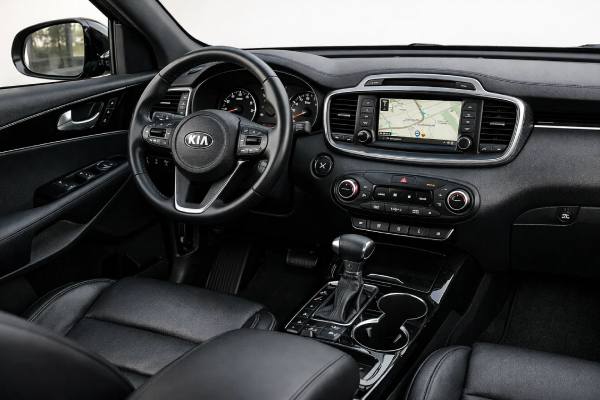
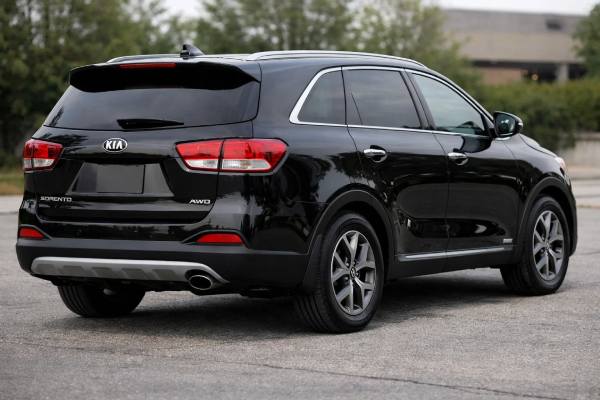
The 2015–2017 Kia Sorento FWD (UM) with the 2.4-liter G4KJ is the “quietly sensible” choice in this generation: a naturally aspirated, direct-injected four-cylinder paired with a conventional 6-speed automatic and a practical two-row-or-three-row cabin layout (depending on trim). It is not the fast Sorento, and it is not the tow-focused Sorento. What it does well is everyday comfort—stable highway manners, predictable controls, and family-friendly packaging—while keeping complexity lower than the turbo and V6 variants.
Ownership success with this model is mostly about disciplined basics: frequent oil changes (especially under short-trip use), staying ahead of fluids, and confirming recall and software actions were completed. If you buy carefully, it can be a dependable midsize crossover with reasonable running costs.
Owner Snapshot
- Comfortable, stable ride and a quiet cabin for the class, especially on the highway.
- Simple, familiar drivetrain (NA 2.4 + 6AT) that avoids turbo-specific heat and plumbing.
- Strong interior practicality with usable cargo volume and easy daily ergonomics.
- Biggest caveat: verify engine-related service actions and watch oil level between changes.
- Typical interval: change engine oil and filter every 10,000–12,000 km (6,000–7,500 mi) or 6 months (sooner for severe use).
Explore the sections
- Sorento UM FWD model profile
- Sorento UM 2.4 specs tables
- Sorento UM trims and safety
- Reliability issues and recalls
- Maintenance plan and buying
- On-road performance feel
- Rivals and value check
Sorento UM FWD model profile
Think of the 2015–2017 Sorento UM FWD 2.4 as the “core” version of the third-generation Sorento: front-wheel drive, a naturally aspirated four-cylinder, and a conventional torque-converter automatic. That combination matters because it shapes what the car is best at—efficient, low-stress family driving—while also defining its limits.
What owners usually like
- Comfort-first tuning. The Sorento UM rides with a mature, slightly soft edge that smooths rough pavement without feeling floaty at normal speeds. It’s a good match for long commutes and road trips.
- User-friendly packaging. You get a higher seating position than a wagon, wide-opening doors, and practical storage throughout the cabin. Many trims offer a small third row; even if you rarely use it, it can be valuable for occasional kid carpools.
- Predictable drivetrain behavior. With no turbo boost to wait for, throttle response is consistent. The 6-speed automatic is familiar and generally smooth in everyday conditions.
Where expectations should be realistic
- It’s adequate, not quick. With 185 hp moving a midsize body, acceleration is “plan it” rather than “pounce.” Passing on a two-lane road often needs a downshift and a bit of runway.
- Not the towing hero. The 2.4 FWD is typically set up for light-duty towing and hauling. It’s better to treat towing as an occasional task, not a weekly routine—especially in hot weather or mountainous terrain.
- Direct injection means maintenance discipline matters. The G4KJ is a GDI engine, and GDI engines tend to be more sensitive to oil quality, short-trip dilution, and intake-valve deposits over time.
Who this variant fits best
- Drivers who want a midsize crossover primarily for commuting, school runs, and highway travel.
- Buyers who value a simpler powertrain over maximum performance.
- Owners willing to keep up with oil level checks and scheduled fluid services.
If you want a Sorento that feels effortless when loaded with people and gear, you’d usually step up to a stronger engine. If you want the most straightforward Sorento to live with, this FWD 2.4 is often the one.
Sorento UM 2.4 specs tables
Below are core specifications for the 2015–2017 Sorento UM FWD equipped with the G4KJ 2.4L and 6-speed automatic. Values can vary slightly by market, trim, wheel size, and whether a third-row seat is fitted, so treat these as the right baseline to verify against your VIN.
Powertrain and efficiency
| Item | Spec |
|---|---|
| Code | G4KJ |
| Engine layout and cylinders | Inline-4, transverse; DOHC; 4 valves/cyl; dual CVVT |
| Bore × stroke | 88.0 × 97.0 mm (3.46 × 3.82 in) |
| Displacement | 2.4 L (2,359 cc) |
| Induction | Naturally aspirated |
| Fuel system | Gasoline direct injection (GDI) |
| Compression ratio | 11.3:1 |
| Max power | 185 hp (138 kW) @ 6,000 rpm |
| Max torque | 241 Nm (178 lb-ft) @ 4,000 rpm |
| Timing drive | Chain |
| Rated efficiency (typical, US) | 11.2 / 8.1 / 9.8 L/100 km (21 / 29 / 24 mpg US city/hwy/comb) |
| Real-world highway @ 120 km/h (75 mph) | ~8.5–10.0 L/100 km (24–28 mpg US), wind/tires/load dependent |
Transmission and driveline
| Item | Spec |
|---|---|
| Transmission | 6-speed automatic (Sportmatic-style manual mode on many trims) |
| Drive type | FWD |
| Differential | Open (traction managed by brake-based stability/traction control) |
Chassis and dimensions
| Item | Spec |
|---|---|
| Suspension (front/rear) | MacPherson strut / multi-link (trim-dependent details) |
| Steering | Electric power assist (rack-and-pinion) |
| Brakes | 4-wheel discs (trim/wheel dependent sizes) |
| Wheels/tyres (common) | 235/65 R17 (common base fitment; larger wheels optional) |
| Ground clearance | 185 mm (7.3 in) |
| Approach / departure | 16.9° / 21.0° |
| Length / width / height | 4,760 / 1,890 / 1,690 mm (187.4 / 74.4 / 66.5 in, with rails) |
| Wheelbase | 2,780 mm (109.4 in) |
| Fuel tank | 71.2 L (18.8 US gal / 15.6 UK gal) |
| Cargo volume | ~1,098 L (38.8 ft³) behind 2nd row; ~2,081 L (73.5 ft³) max (SAE-style figures) |
Performance and capability (typical)
| Item | Spec |
|---|---|
| Acceleration | 0–100 km/h (0–62 mph): ~9.5–10.5 s (test conditions vary) |
| Braking (dry, typical test) | ~60–0 mph in ~40 m (130 ft), tire/trim dependent |
| Towing capacity | Often ~907 kg (2,000 lb) braked (confirm by VIN/label) |
| Payload | Trim- and equipment-dependent; check door-jamb label |
Fluids and service capacities (decision-useful)
| Item | Spec (verify by VIN/label) |
|---|---|
| Engine oil | SAE 5W-20 or 5W-30 (market/climate dependent); ~4.8 L (5.1 US qt) with filter |
| Coolant | Phosphate OAT-style coolant (HOAT/POAT family depending on market); capacity varies with heater/rear HVAC |
| Transmission/ATF | Kia ATF SP-IV; fill capacity ~7.5 US qt (service fill can be lower than total) |
| A/C refrigerant | Many UM models use R-1234yf; charge varies with rear A/C (check underhood label) |
| Key torque specs (critical) | Wheel lug nuts commonly ~88–108 Nm (65–80 lb-ft); drain plug torque varies by pan/washer type |
Why the tables matter: for this Sorento, the “big three” ownership levers are oil quality/interval, cooling system health, and correct ATF spec and level. Getting those right does more for longevity than almost any bolt-on upgrade.
Sorento UM trims and safety
Equipment varies widely across 2015–2017 Sorento UM trims, and that variation affects both day-to-day satisfaction and the safety-tech you actually get. For the FWD 2.4, trims commonly start with value-oriented models and step upward into comfort and tech packages; some markets also offer a third-row seat even with the four-cylinder.
Trims and options that change ownership
Easy identifiers to look for
- Wheel size and brake feel. Base trims often run 17-inch wheels (more sidewall comfort). Larger wheels look sharper but can ride firmer and cost more to replace.
- Third-row presence. A third row is usually obvious from the rear seatbelt anchors and floor structure. If you need it, confirm it’s factory-fitted; retrofits are rarely worth it.
- Cooling and comfort features. Dual-zone climate and rear vents help family use. If rear HVAC is fitted, it changes A/C service details (charge amount and leak points).
Functional differences that matter
- Driver-assistance availability. Advanced systems may be optional or bundled. Don’t assume features like forward collision warning or lane support are standard just because the car looks “loaded.”
- Headlights. Lighting performance can vary dramatically by trim and headlight type. If you drive rural roads or do a lot of night highway, prioritize the best headlight setup available for your market—this is a real safety upgrade.
Safety ratings: how to interpret them
You’ll see different results depending on the testing body and the test year/version. The key is to treat ratings as structure + restraint performance, not as a promise that every trim has the same safety tech.
- In European testing, the Sorento earned a top-tier overall result with strong adult and child occupant protection scores for its class and era, with pedestrian protection and assist-system scores reflecting 2014–2015 technology expectations.
- In U.S.-style evaluations, the Sorento’s core crash structure performs well in the major crashworthiness categories, while headlight performance and front crash prevention availability (standard vs optional) can shift the overall “recommended” picture.
Safety systems and ADAS: what you should confirm
Even on trims without advanced driver assistance, the Sorento UM typically includes the fundamentals: multi-stage airbags, stability control, traction control, ABS, and strong child-seat anchoring provisions (ISOFIX/LATCH equivalents).
If equipped, common ADAS features may include:
- Forward collision warning / AEB (varies by year/market/trim)
- Blind-spot monitoring and rear cross-traffic alert
- Lane departure warning or lane-keeping support (later years, option-dependent)
- Adaptive cruise control on higher trims (market-dependent)
Service implication: any windshield replacement, front-end repair, or alignment work on an ADAS-equipped vehicle may require camera/radar calibration. When shopping used, ask for evidence of proper calibration after major glass or collision work—poorly calibrated systems can behave unpredictably.
Reliability issues and recalls
Reliability on the 2015–2017 Sorento UM 2.4 is best understood as a mix of “normal used-car wear” and a few known powertrain concerns that you must screen for. Below is a practical map by prevalence and cost tier, followed by what to check before purchase.
Common to occasional issues (and what they feel like)
Common / low-to-medium cost
- Oil consumption or oil level drop between services
Symptoms: low oil on dipstick, ticking on cold start, oil light flickers under braking/turning.
Likely causes: long oil intervals, short-trip dilution, PCV system issues, ring wear patterns on some GDI engines.
Remedy: shorten oil interval, confirm correct oil grade, inspect PCV, check for leaks, document consumption rate. - Intake valve deposits (GDI characteristic)
Symptoms: rough idle, hesitation, reduced fuel economy over time.
Likely cause: fuel doesn’t wash the valves in GDI engines.
Remedy: periodic intake cleaning (walnut blasting or approved method), consistent high-quality fuel, ensure PCV system health.
Occasional / medium cost
- Ignition coils and plugs
Symptoms: misfires under load, flashing MIL, rough running.
Remedy: replace plugs at the correct interval; address coils in sets if recurring. - Cooling-system aging items (hoses, thermostat, radiator seepage)
Symptoms: slow coolant loss, temperature creep in traffic.
Remedy: pressure test, replace worn components early—overheating is expensive on modern aluminum engines.
Rare but high-severity
- Bottom-end bearing wear patterns on some Theta-family engines
Symptoms: knock, metallic noise, loss of power, warning lights, or catastrophic failure.
Remedy: verification of any engine monitoring software updates, recall/service action completion, and strong maintenance history.
Recalls, service campaigns, and software actions
This is the single most important admin step for this model: verify recall and service action completion by VIN using official records and dealership history. Campaigns can include items such as seatbelt/airbag-related components and engine monitoring software updates. The right outcome is documented completion—not “the seller thinks it was done.”
Pre-purchase checks to request (worth paying for)
- Cold-start listen test (engine noise, timing chain rattle, abnormal knocking).
- Oil condition and level (not just “fresh oil,” but correct level after sitting).
- Scan for codes and readiness monitors (misfire history, catalyst efficiency, cam/crank correlation).
- Cooling system pressure test and inspect for dried coolant residue.
- Transmission shift quality under light throttle and moderate kickdown; confirm no delayed engagement.
- Proof of recall/TSB completion (printed dealer record or official database confirmation).
A Sorento UM 2.4 with clean documentation, stable oil consumption, and completed service actions can be a very reasonable long-term vehicle. A vague-history example is where costs can appear quickly.
Maintenance plan and buying
A simple maintenance plan is what makes the Sorento UM 2.4 feel “easy” instead of “temperamental.” Below is a practical schedule you can follow even if the factory plan in your market is less strict—because real-world driving often counts as severe service.
Practical maintenance schedule (time or distance, whichever comes first)
Engine oil and filter
- Normal use: 10,000–12,000 km (6,000–7,500 mi) or 6 months
- Severe use (short trips, cold climate, heavy traffic): 5,000–8,000 km (3,000–5,000 mi)
Check the oil level monthly; top-ups are cheaper than engines.
Air filters
- Engine air filter: inspect every 15,000 km, replace as needed (often 30,000 km typical).
- Cabin air filter: 15,000–20,000 km depending on dust/pollen.
Spark plugs
- Many trims use long-life plugs; typical replacement is ~160,000 km (100,000 mi), but inspect earlier if you see misfires or rough idle.
Coolant
- Common modern interval: 10 years/160,000 km first change, then every 2–3 years / 50,000 km thereafter (verify for your coolant type).
Never mix coolant chemistries unless the service manual allows it.
Automatic transmission fluid
- Use the correct ATF spec and level procedures. For longevity, consider a drain-and-fill around 60,000–80,000 km (40,000–50,000 mi), sooner if the vehicle has seen heat, hills, or towing.
Brake fluid
- Every 2–3 years regardless of mileage (moisture absorption is time-based).
Brake pads/rotors
- Inspect at every tire rotation; replace based on thickness, not squeal alone.
Tires and alignment
- Rotate every 8,000–10,000 km (5,000–6,000 mi).
If you see inside-edge wear, get an alignment early—crossover tires are expensive.
Battery
- Test yearly after year 3; typical replacement window is 4–6 years depending on climate and usage.
Buyer’s guide: what to seek, what to avoid
Seek
- Full service records with consistent oil intervals.
- Evidence of recall/service action completion.
- Smooth cold start, stable idle, and clean scan results.
- Tires in good shape (suggests the owner didn’t ignore basics).
Be cautious with
- Cars with unknown oil change history or long gaps between services.
- Any example that arrives “already warmed up” when you come to view it.
- Warning lights recently cleared, or a seller unwilling to allow a pre-purchase inspection.
Durability outlook
With consistent maintenance, the Sorento UM 2.4 can deliver long, practical service. The key is to treat oil changes and cooling health as non-negotiable, and to buy one with confirmed campaign completion.
On-road performance feel
On the road, the Sorento UM 2.4 feels engineered for calm, predictable driving rather than excitement. That’s a compliment if you spend hours on highways or carry passengers who value smoothness.
Ride, handling, and noise
Ride quality is one of the Sorento’s best traits in this era. The suspension is tuned to round off broken pavement, and the body stays composed over long undulations. It’s not a sporty setup, but it avoids the bouncy, underdamped feel some crossovers get when loaded.
Handling balance is safe and neutral. In fast corners you’ll feel the weight and the tall stance; the chassis prefers a steady, clean line rather than abrupt direction changes. Steering is light-to-medium with modest road feedback—good for parking and commuting, not for “feel.”
Cabin noise (NVH) is typically well managed at city speeds, and highway wind noise is controlled for the class. Tire choice matters: aggressive tread patterns can add a noticeable hum. If you’re optimizing comfort, prioritize touring tires and keep pressures correct.
Powertrain character
The naturally aspirated 2.4 provides smooth, linear pull, but peak torque arrives higher in the rev range than many drivers expect. The 6-speed automatic generally shifts unobtrusively; under hard acceleration it will drop multiple gears, which can feel busy, but that’s normal for a midsize crossover with modest power.
Practical tips:
- Use steady throttle for best efficiency; frequent wide-open kickdowns cost fuel quickly.
- When merging or passing, commit early—this powertrain rewards planning more than last-second bursts.
- If your model has selectable drive modes, “Normal” often delivers the best shift logic; sportier modes may hold gears longer without making the engine meaningfully stronger.
Real-world efficiency
If you maintain the engine well and drive smoothly, highway fuel economy can be quite respectable for a midsize crossover, but cold weather and short trips will raise consumption quickly. Expect the biggest drops in:
- Winter driving with frequent warm-up cycles
- Heavy stop-and-go traffic
- Roof boxes or loaded cargo areas (aerodynamics matter)
Load and towing reality
The 2.4 FWD can handle light towing, but sustained grades, high ambient temperatures, and full passenger loads stack heat into the drivetrain. If towing is part of your routine, prioritize:
- Fresh ATF and correct level
- Cooling system in excellent condition
- Conservative speed and gear selection on long climbs
Driven within its design envelope, the Sorento UM 2.4 is a pleasant, confidence-inspiring daily vehicle—just not the version you buy for effortless thrust.
Rivals and value check
Cross-shopping is where you’ll see the Sorento UM 2.4’s personality clearly: it’s a comfort-and-value midsize crossover, not the performance pick. Here’s how it tends to stack up against common alternatives.
Where the Sorento UM 2.4 wins
Value for equipment. In many markets, you can find Sorentos with features that cost more in rivals—especially comfort and infotainment upgrades. If you want “a lot of car for the money,” it often scores well.
Ride comfort and daily usability. Compared with some firmer-handling competitors, the Sorento’s calmer tuning is easier to live with, particularly on rough roads.
Lower complexity than turbo rivals. If you’re choosing between a small turbo engine and this naturally aspirated 2.4, the Sorento can feel like the simpler long-term bet—fewer boosted parts, less heat density, and generally more straightforward service access.
Where rivals can be better
Power and effortless passing. Many competitors offer stronger base engines or more torque at lower rpm, which feels relaxed when the vehicle is loaded. If you routinely carry adults in all seats, stronger engines reduce stress.
Third-row usability. Some rivals provide a roomier, more genuinely useful third row. On the Sorento, the third row (when fitted) is often best described as “occasional.”
Safety tech standardization. Competitors that made AEB and other ADAS features standard earlier can be easier to shop for—you spend less time decoding option packages. With the Sorento, you may need to be more careful about which trims actually include the tech.
Quick shopping guidance
- If you prioritize comfort and value, the Sorento UM 2.4 is a strong candidate—provided the maintenance history is excellent.
- If you prioritize performance and full-load driving, consider stronger engines in this class.
- If you prioritize night driving and maximum visibility, make headlight performance a deciding factor, not an afterthought.
Bottom line: a well-documented Sorento UM 2.4 FWD can be one of the smarter used buys in the midsize crossover space—comfortable, practical, and straightforward—so long as you verify campaigns, keep oil intervals conservative, and choose the trim that matches your safety-tech expectations.
References
- 2016 Kia Sorento Specifications 2016 (Specifications)
- 2016 Kia Sorento 2016 (Safety Rating)
- Kia Sorento – 2014 2014 (Safety Rating)
- Kia Global Information System – TSB 2022 (TSB)
- RCLRPT-18V907-4204.PDF 2018 (Recall Database)
Disclaimer
This article is for informational purposes only and is not a substitute for professional diagnosis, inspection, or repair. Specifications, torque values, service intervals, fluid types, and procedures can vary by VIN, market, model year, and equipment. Always verify details using the official owner’s manual and service documentation for your specific vehicle.
If you found this guide useful, please consider sharing it on Facebook, X (Twitter), or your favorite forum to help support our work.