


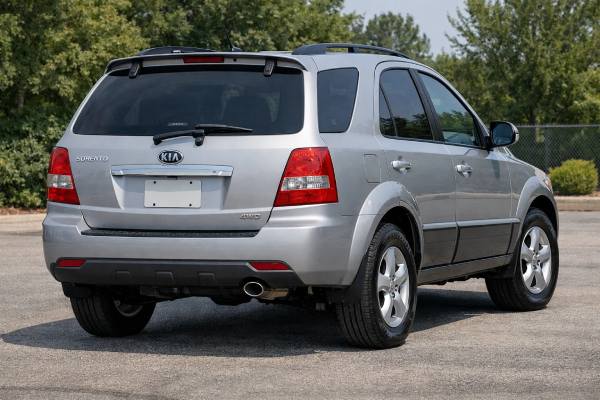
The facelift 2007–2009 Sorento BL with the 3.3-liter G6DB V6 is one of the more “honest” mid-size SUVs of its era: a body-on-frame chassis, a conventional rear-wheel-drive layout, and a naturally aspirated V6 tuned for smooth torque rather than high-strung power. In RWD form, it’s also the simplest Sorento drivetrain—fewer rotating parts than 4WD/AWD versions, fewer fluid services, and generally less driveline wear if the vehicle has lived an easy life.
Where this Sorento earns respect is durability under real use: rough roads, heavy loads, and frequent short trips. Where you need clear eyes is running costs. Fuel economy is average at best, and age-related items (cooling system, suspension bushings, rust protection, and electrical sensors) often matter more than the engine itself. If you buy the right example and maintain it consistently, it can be a long-term workhorse.
What to Know
- Strong low-to-mid range pull from the 3.3 V6, with a relaxed feel at highway speeds.
- RWD layout keeps the drivetrain simpler than 4WD versions, with fewer fluids and fewer failure points.
- Watch for frame and underbody corrosion, especially around suspension mounting points and brake lines.
- Plan on refreshing suspension wear parts and brakes on older examples—even if mileage is modest.
- For mixed driving, change engine oil every 10,000 km (6,000 mi) or 12 months (sooner under severe use).
Quick navigation
- Kia Sorento BL RWD facelift in depth
- Kia Sorento BL 3.3 V6 specs and dimensions
- Kia Sorento BL trims safety and equipment
- Reliability problems and service bulletins
- Maintenance plan and buying checklist
- On-road feel and real-world economy
- Rivals and realistic alternatives
Kia Sorento BL RWD facelift in depth
This facelift-era Sorento BL sits at an interesting crossroads between older truck-based SUVs and the newer wave of unibody crossovers. Underneath, the architecture is traditional: a separate frame, higher ride height than many car-based rivals, and suspension tuned for durability and load control. In daily use that translates to a planted, slightly “heavy” feel and a willingness to tolerate bad pavement without sounding fragile.
The 3.3-liter G6DB V6 is the key differentiator. It’s a DOHC, 24-valve V6 designed for smoothness and broad torque delivery. In this Sorento, it’s less about sprinting and more about steady effort—merging, passing, or carrying five people and luggage without feeling strained. Because it’s naturally aspirated, throttle response is predictable and linear, with none of the lag or heat-management concerns you get from turbo engines.
RWD matters for ownership. Compared with 4WD/AWD variants, there are fewer driveline components to maintain (no transfer case service, fewer CV joints, and fewer seals). That can reduce long-term costs and the number of noises you’ll chase as the vehicle ages. The trade-off is traction: in rain, snow, or on steep loose surfaces, you’re relying more on tires and stability control than on driven front wheels.
The 2007–2009 facelift brought meaningful ownership improvements depending on market: updated exterior lighting and bumpers, interior revisions, and—more importantly—progress on safety equipment. Many vehicles in this era gained additional airbags or improved restraint calibrations. Still, it remains a product of its time: you should not expect modern driver-assistance features, and crash-test results can vary significantly by test type.
Who is it for today? It suits buyers who want a sturdy SUV feel, simpler mechanicals, and a V6 that doesn’t need special treatment. It’s less ideal for drivers prioritizing fuel economy, modern crash performance, or the quiet ride of newer unibody crossovers. The best examples are the ones with clear service history, rust prevention, and evidence that the cooling system and transmission have been cared for—those details usually matter more than a slightly lower odometer reading.
Kia Sorento BL 3.3 V6 specs and dimensions
Below are practical specifications for the facelift Sorento BL with the G6DB 3.3 V6 and rear-wheel drive. Exact values can vary by market, wheel package, emissions calibration, and tow equipment, so treat the numbers as a high-confidence baseline and verify against the vehicle’s VIN-specific documentation.
Powertrain and efficiency
| Item | Specification |
|---|---|
| Engine code | G6DB |
| Layout | V6, DOHC, 24-valve (4 valves/cyl) |
| Displacement | 3.3 L (3342 cc) |
| Bore × stroke | 92.0 × 83.8 mm (3.62 × 3.30 in) |
| Induction | Naturally aspirated |
| Fuel system | Multi-point injection (MPFI) |
| Compression ratio | ~10.4:1 |
| Max power | 242 hp (180 kW) @ ~6000 rpm |
| Max torque | 309 Nm (228 lb-ft) @ ~4500 rpm |
| Timing drive | Chain |
| Rated efficiency (typical) | 10.7–14.7 L/100 km highway/city (22/16 mpg US) |
| Real-world highway @ 120 km/h | ~11.0–12.5 L/100 km (19–21 mpg US), tire- and load-dependent |
Transmission and driveline
| Item | Specification |
|---|---|
| Transmission | 5-speed automatic (market-dependent coding) |
| Drive type | RWD (2WD) |
| Differential | Open rear diff common; LSD optional/market-dependent |
Chassis, brakes, wheels, and dimensions
| Item | Specification |
|---|---|
| Platform type | Body-on-frame SUV |
| Suspension (front) | Independent double wishbone, coil springs |
| Suspension (rear) | Multi-link with coil springs (live-axle style layout on many markets) |
| Steering | Power-assisted rack and pinion (typical for this generation) |
| Brakes | 4-wheel disc; ABS standard on most trims |
| Common tire size | 245/70 R16 (popular base fitment); some trims 245/65 R17 |
| Ground clearance | ~200 mm (~7.9 in), market and tire-dependent |
| Length | ~4565 mm (~179.7 in) |
| Width | ~1885 mm (~74.2 in) |
| Height | ~1730 mm (~68.1 in) |
| Wheelbase | ~2710 mm (~106.7 in) |
| Turning circle | ~11.0 m (~36 ft) |
| Curb weight | ~1870–2000 kg (4120–4410 lb), trim-dependent |
| Fuel tank | ~80 L (21.1 US gal / 17.6 UK gal) |
Performance and capability
| Item | Typical figure |
|---|---|
| 0–100 km/h (0–62 mph) | ~9.0–10.0 s (tires, load, altitude affect this) |
| Top speed | ~185–195 km/h (115–121 mph), market-dependent |
| Braking 100–0 km/h | ~40–43 m (131–141 ft), tire-dependent |
| Towing capacity | Up to ~1588 kg (3500 lb) when properly equipped (market limits vary) |
| Payload | ~500–650 kg (1100–1430 lb), trim and GVWR-dependent |
Fluids and service capacities (ownership-focused)
These values are commonly reported for this engine family and vehicle class, but always confirm by VIN and market. The “right” fluid spec matters more than being perfect to the last 0.2 L.
| System | Spec (typical) |
|---|---|
| Engine oil | API SJ/SL class oil; 5W-30 or 10W-30 depending climate; ~5.0–5.5 qt (4.7–5.2 L) with filter |
| Coolant | Ethylene-glycol OAT/HOAT type for aluminum radiators; typically 50/50 mix |
| Automatic transmission | ATF SP-III type commonly specified for this era; capacity varies by service method |
| Rear differential | GL-5 gear oil (commonly 75W-90 or 80W-90 depending market) |
| Brake fluid | DOT 4 |
| A/C refrigerant | R-134a (charge varies by market equipment) |
| Wheel lug torque (typical range) | ~90–110 Nm (66–81 lb-ft), confirm for wheel type |
Safety and driver assistance (period-correct)
| Item | Notes |
|---|---|
| Crash ratings | Vary by test and market; this generation is known for mixed results depending on the impact type |
| Airbags | Front airbags common; side/curtain availability varies by trim and market; check labels and build sheet |
| Stability control | Often standard or optional depending on year/trim; verify via dash indicators and VIN equipment list |
| ADAS | Modern systems (AEB, ACC, lane assist) generally not present on this generation |
Kia Sorento BL trims safety and equipment
Trims and equipment on the 2007–2009 Sorento BL vary widely by market, so the most useful approach is to think in “equipment bands” rather than assuming a trim badge always means the same thing. Most examples fall into a practical base grade, a comfort-oriented mid grade, and a top grade with leather, premium audio, and convenience features. In some regions you’ll see names such as LX/EX (or equivalent), but the badge is less important than the actual build content.
Trims and options that change ownership
- Wheel and tire packages: Base 16-inch wheels generally ride softer and are cheaper to replace; 17-inch packages can sharpen steering slightly but raise tire cost.
- Tow prep and cooling: Some vehicles include a hitch, wiring, and upgraded cooling. If you plan to tow, prioritize a factory-style setup and confirm transmission cooling health.
- Limited-slip differential (LSD): Where available, LSD can noticeably improve low-speed traction in rain or light snow for a RWD SUV. It also adds a fluid requirement (use LSD-compatible gear oil when specified).
- Interior and electrical load: Heated seats, sunroof, and premium audio add comfort, but they also increase the number of age-related electrical faults you might encounter (switches, seat wiring, window regulators, and alternator load).
Quick identifiers to verify what you’re actually buying
- Dashboard lights at key-on: Look for ABS and stability-control indicators that illuminate briefly then go out. Missing indicator behavior can hint at bulb removal or coding issues.
- Airbag labels: Side and curtain airbags are usually labeled on seats, pillars, or headliner tags. Don’t assume; check.
- Underbody inspection: RWD versus 4WD layouts are easy to spot. A RWD truck will generally lack a transfer case and front driveshaft.
- Tire placard and axle tags: These can help confirm factory tire size, pressure, and in some cases axle ratio or equipment.
Safety ratings and what they mean in practice
This generation typically shows uneven crash performance depending on the test type. In ownership terms, that means you should treat safety as a combination of structure, restraint equipment, and your particular trim’s airbags. If your shortlist includes multiple vehicles, prioritize the one with more complete airbag coverage and a clean history over one that merely has a higher trim badge.
Safety systems and “driver assistance” expectations
For 2007–2009, you should think in terms of classic safety features rather than modern ADAS:
- ABS (anti-lock braking) is common and should be considered essential.
- ESC (electronic stability control) is a major value-add for a RWD SUV; confirm it works and that there are no persistent wheel-speed sensor faults.
- Traction control may be integrated with stability control; behavior can feel conservative but it helps keep rear-wheel slip manageable.
- Child-seat provisions (LATCH/ISOFIX) are usually present, but check anchor accessibility and seat condition.
If a vehicle has been in a collision, pay attention to airbag modules, seat-belt pretensioners, and steering angle sensor calibration. On older SUVs, “it drives straight” is not the same as “all safety systems are correct.” A proper scan for stored codes and a careful visual inspection can prevent expensive surprises later.
Reliability problems and service bulletins
At this age, reliability is less about a single weak component and more about accumulated wear, corrosion, and whether the vehicle received consistent fluid services. The G6DB 3.3 V6 is generally capable of high mileage when maintained, but the Sorento BL platform has predictable trouble spots worth sorting by prevalence and cost.
Common, lower-cost issues (annoying but manageable)
- Ignition coils and plugs: Misfires under load, rough idle, or a flashing MIL often trace to a coil beginning to fail or plugs overdue. Remedy is straightforward: replace the affected coil(s), renew plugs with the correct heat range, and verify no oil contamination in the plug wells.
- Valve cover gasket seepage: Oil smell after driving, light smoke near the rear of the engine, or oil in plug wells points to gasket aging. Fix early to avoid coil damage.
- Sensor and EVAP faults: Oxygen sensors, purge valves, and vacuum leaks can trigger persistent codes. The right fix is diagnosis, not parts swapping—especially when wiring has aged.
Occasional, medium-cost issues (plan for them)
- Cooling system aging: Radiators, plastic tanks, hoses, and thermostats can become the real “lifespan” items. Symptoms include slow coolant loss, sweet smell, heater performance changes, and rising temps in traffic. Prevention is simple: keep coolant fresh and replace weak hoses before they burst.
- Automatic transmission behavior: Harsh shifts, delayed engagement when cold, or flare on upshifts can come from fluid condition, solenoids, or wear. A careful service strategy (correct ATF type, measured drain-and-fill cycles) is safer than aggressive flushing on a neglected unit.
- Suspension wear: Clunks over bumps, wandering on the highway, or uneven tire wear typically mean bushings, ball joints, stabilizer links, and shocks are tired. The Sorento’s “truck” feel hides wear until it becomes obvious.
Rare but higher-cost risks (don’t ignore the early hints)
- Timing chain noise or correlation faults: The G6DB uses a chain, not a belt. Chains usually last a long time, but low oil quality or extended intervals can accelerate guide and tensioner wear. Rattle on cold start or timing-correlation codes deserve prompt attention.
- Differential leaks or bearing noise: Whine that changes with speed, seepage at seals, or metallic fluid suggests overdue service or wear. Catching it early can mean seals and fluid; ignoring it can mean bearings and gears.
Corrosion and structural checks (high importance on an older BL)
Corrosion is the issue that can turn a “good price” into a bad ownership story. Prioritize:
- Frame and crossmember condition
- Rear suspension mounting points
- Brake lines and fuel lines
- Body seams, sills, and underbody coating quality
Rust isn’t only cosmetic. If mounting points are compromised, repairs get complex and inspection failure becomes likely.
Recalls, TSBs, and how to confirm completion
For this age group, assume there may be recalls or service actions related to braking hydraulics, wiring, or fire-risk precautions (exact campaigns vary by market). The right process is consistent:
- Run a VIN recall check through an official portal.
- Ask the seller for paperwork showing completion.
- If uncertain, call a dealer service desk with the VIN to confirm campaign status.
When a recall involves a control module or hydraulic unit, treat warning lights, stored ABS codes, or unusual brake feel as “stop and verify” items. Safety-related repairs should be confirmed, not guessed.
Maintenance plan and buying checklist
A well-planned maintenance routine is what makes a 2007–2009 Sorento BL feel dependable rather than “old.” The goal is not to replace everything—it’s to service fluids on time, prevent heat and corrosion damage, and refresh wear parts before they stress more expensive systems.
Practical maintenance schedule (distance or time)
Use whichever comes first (km/mi or months):
- Engine oil and filter: every 10,000 km (6,000 mi) / 12 months; 7,500 km (4,500 mi) / 6 months for short trips, heavy city use, or frequent towing.
- Engine air filter: inspect every 15,000 km (9,000 mi); replace ~30,000 km (18,000 mi) or sooner in dusty use.
- Cabin filter: every 15,000–20,000 km (9,000–12,000 mi) or annually.
- Coolant: every 5 years or ~100,000 km (60,000 mi) unless your market specifies different.
- Spark plugs: typically 100,000 km (60,000 mi) if iridium; sooner if conventional plugs are fitted.
- Automatic transmission fluid: every 60,000–80,000 km (37,000–50,000 mi) depending on heat load; shorten the interval if towing or mountain driving.
- Rear differential fluid (RWD): every 60,000–80,000 km (37,000–50,000 mi); more often if water exposure or heavy towing.
- Brake fluid: every 2 years, regardless of mileage.
- Brake pads/rotors: inspect every 15,000 km (9,000 mi); replace as wear dictates.
- Serpentine belt and hoses: inspect annually; replace belt around 100,000–120,000 km (60,000–75,000 mi) or at first cracking.
- Alignment and tire rotation: rotate every 10,000 km (6,000 mi); align yearly or after suspension work.
- 12 V battery: test annually after year 3; typical replacement window is 4–6 years.
Fluid specifications (ownership-level guidance)
- Engine oil: quality API-rated oil suited to climate (commonly 5W-30; 10W-30 in warmer climates), and keep the level near the full mark. Low oil level is what turns “chain engine” into “chain problem.”
- ATF: use the correct spec for your market (often SP-III for this era). If you don’t know what’s in it, do measured drain-and-fills rather than an aggressive flush.
- Differential: GL-5 gear oil; if equipped with LSD, ensure the fluid matches LSD requirements.
- Coolant: correct antifreeze type and mix ratio matter. Don’t mix unknown coolants; flush properly when changing type.
- Brake fluid: DOT 4, bled until clean and bubble-free.
Essential torque values (decision-making level)
Exact figures vary by wheel and engine variant, but these typical ranges help you evaluate whether a shop is working responsibly:
- Wheel lug nuts: ~90–110 Nm (66–81 lb-ft)
- Engine oil drain plug: commonly ~30–40 Nm (22–30 lb-ft)
- Spark plugs: typically ~18–25 Nm (13–18 lb-ft) on aluminum heads (do not overtighten)
Buyer’s checklist (what to inspect before money changes hands)
Rust and structure
- Frame rails, crossmembers, rear suspension mounts, and brake/fuel lines
- Signs of patchwork undercoating hiding corrosion (fresh black spray with no documentation is a warning)
Powertrain
- Smooth cold start, no chain rattle, stable idle
- No coolant smell, no oil in coolant, and no milky residue under oil cap
- Transmission engages promptly from Park to Drive/Reverse; no flare on moderate throttle
Chassis
- Clunks over bumps, steering wander, vibration at 80–120 km/h (50–75 mph)
- Uneven tire wear suggesting alignment or worn bushings
- Brake feel: firm pedal, no pulsing, no ABS warning lights
Electrics
- All windows, locks, HVAC blower speeds, and charging voltage
- Scan for stored codes even if no lights are on
What to seek
- Clean underbody, documented fluid services, functioning stability control, and a calm transmission.
What to avoid
- Significant structural rust, persistent ABS/ESC lights, overheating history, or “shift issues” that the seller can’t explain with service records.
On-road feel and real-world economy
Driving the Sorento BL RWD is a reminder of how SUVs used to feel: solid, slightly truck-like, and confident over broken pavement. The steering typically isn’t razor sharp, but it tends to be stable on the highway when the suspension is healthy. If you experience float, excessive body roll, or vague straight-line tracking, assume shocks and bushings are tired rather than blaming “the model.”
Ride, handling, and NVH (noise, vibration, and harshness)
- Ride quality: With the common 16-inch tire package, the Sorento can absorb potholes and rough patches better than many unibody crossovers of its era. Larger wheels can add impact harshness.
- Handling balance: RWD gives a slightly different cornering feel than FWD-based SUVs—more neutral when lightly loaded, but also more sensitive to throttle and traction in wet conditions.
- Cabin noise: Expect noticeable tire and wind noise at highway speeds compared with newer SUVs. A “howl” that changes with speed can indicate aggressive tires, wheel bearings, or differential wear.
Powertrain character and transmission behavior
The 3.3 V6 is generally smooth and predictable. It builds power steadily rather than delivering a sudden surge. In real use, it feels strongest in mid-range passing rather than off-the-line snap. The 5-speed automatic is typically tuned for comfort. Healthy units shift cleanly without slipping; neglected units may hesitate, flare, or thump on downshifts.
A few real-world tips:
- If shifts are harsh only when cold, fluid condition and level deserve attention first.
- If it hunts between gears on gentle hills, check tire size consistency, throttle calibration, and consider whether the transmission has been over-serviced or under-serviced.
Efficiency: what owners actually see
Official ratings for the 3.3 2WD are typically around 16 mpg city / 22 mpg highway (US), which is roughly 14.7 / 10.7 L/100 km. In practice:
- City: ~14–16 L/100 km (15–17 mpg US) if trips are short or traffic-heavy
- Highway (100–120 km/h): ~11–12.5 L/100 km (19–21 mpg US) depending on tires, wind, and load
- Mixed: ~12–14 L/100 km (17–20 mpg US)
Cold weather and winter tires can raise consumption noticeably. So can roof racks, heavy cargo, and underinflated tires.
Traction, tires, and control systems
Because this is RWD, tires matter more than usual. If you live in a snowy climate, a dedicated winter tire set is not optional—it’s the difference between “manageable” and “frustrating.” Stability control (when equipped and functioning) can keep the rear end tidy, but it can’t create grip where tires don’t have it.
Towing and load behavior
With the right hitch and cooling health, the Sorento can tow moderate loads confidently. The limiting factors are heat management and braking margin, not raw engine power. If you tow:
- Keep ATF fresh and consider adding or verifying a transmission cooler where appropriate.
- Expect a meaningful fuel economy penalty; +20–35% consumption under moderate tow is common for this class.
Rivals and realistic alternatives
Shopping a 2007–2009 Sorento BL RWD usually means you’re comparing it with a mixed group: some true body-on-frame SUVs and many unibody crossovers that prioritize comfort. The “best” choice depends on what you value most—ruggedness, safety performance, fuel economy, or day-to-day refinement.
Where the Sorento BL RWD stands out
- Truck-like durability feel: The body-on-frame layout tends to tolerate rough roads and heavy use without feeling delicate.
- Simple drivetrain: RWD avoids transfer case complexity and reduces driveline maintenance compared with 4WD variants.
- V6 smoothness: The 3.3 is generally pleasant for highway driving and steady towing duty.
Where rivals can be stronger
Many unibody crossovers from the same era—think mid-size family-focused models—often deliver:
- Better fuel economy (especially with smaller engines or FWD layouts)
- Quieter cabins and more car-like steering
- More consistent crash-test outcomes, depending on model and test type
Common alternative profiles (how to think about them)
- Unibody family crossovers (comfort-first): If your priority is quiet cruising, easier parking, and less “truck feel,” a unibody crossover may make daily life simpler. The downside is often lower towing confidence and a more delicate feel on broken roads.
- Body-on-frame competitors (work-first): If you want similar toughness and towing stability, other truck-based SUVs can match the Sorento’s intent—but they may bring the same age-related rust risks and sometimes even worse fuel economy.
- Same era, different engine: Within the Sorento range, larger engines can feel stronger but may cost more to run. Smaller engines can be cheaper to fuel but may feel strained under load.
A realistic verdict
Choose the Sorento BL RWD if you want a sturdy, straightforward SUV with a smooth V6 and you’re willing to maintain it like an older truck: fluids on time, rust prevention, and suspension refreshes as needed. Skip it if your priorities are modern crash protection, advanced driver assistance, or consistently low fuel consumption. In that case, a newer unibody crossover—even with higher mileage—can be the better ownership experience.
If you’re deciding between two Sorentos, buy the one with the cleaner underbody, better documentation, and fewer warning lights—not the one with the shiniest paint. On a vehicle of this age, condition is the real trim level.
References
- Manuals 2026 (Owner’s Manual Portal)
- Vehicle Detail Search – 2008 KIA SORENTO | NHTSA 2026 (Recall Database)
- Gas Mileage of 2008 Kia Sorento 2026 (Official Fuel Economy)
- 2008 Kia Sorento 4-door SUV 2026 (Safety Rating)
Disclaimer
This article is for informational purposes only and is not a substitute for professional diagnosis, inspection, or repair. Specifications, torque values, fluid types, service intervals, and procedures can vary by VIN, market, production date, and installed equipment. Always verify details using official service documentation for the specific vehicle you are working on.
If you found this guide helpful, please consider sharing it on Facebook, X (Twitter), or your favorite forum to support our work.