

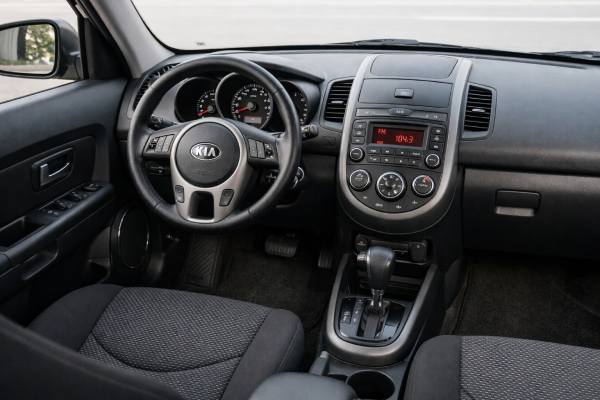

The facelifted Kia Soul AM sits in a useful middle ground between a small hatchback and a compact crossover. In 2011–2013 form, the 1.6-litre petrol version remains appealing because the core recipe is simple and practical: upright seating, good visibility, a roomy square body, and a naturally aspirated engine that is easier to live with than many later downsized turbo units. It also has the kind of honest engineering that ages well when owners keep up with basic service. Equipment and engine descriptions can vary by market, so VIN-based checking matters when you are buying parts or comparing seller ads. Even so, the car’s character is consistent. It is a front-wheel-drive compact with useful interior packaging, modest running costs, and straightforward maintenance needs. The best examples still feel durable, practical, and easy to use every day, which is why the facelift Soul continues to make sense as a used buy.
Owner Snapshot
- Easy to see out of, easy to park, and easier to load than many small hatchbacks.
- Strong space efficiency with 340 L cargo up and 1,336 L with the rear seat folded.
- The 1.6 petrol is mechanically simple by modern standards and suits mixed city use well.
- Older cars need close checks for steering-coupling noise, recall completion, and cooling-system age.
- Rotate tyres every 12,000 km and keep oil service on time, even on lightly used cars.
Navigate this guide
- Kia Soul AM facelift explained
- Kia Soul AM specs and data
- Kia Soul AM trims and safety
- Reliability, faults and recalls
- Maintenance and buying advice
- Road manners and efficiency
- Kia Soul AM versus rivals
Kia Soul AM facelift explained
The 2011–2013 facelift did not change the Soul’s basic mission. It remained a tall, boxy compact with hatchback running costs and mini-MPV usefulness, but the update sharpened the look, improved cabin presentation in many markets, and helped the model stay competitive without adding much complexity. For buyers today, that matters more than styling. The facelift Soul AM is still easy to get in and out of, easy to judge in traffic, and roomy enough to work as a single-car household for many owners.
The 1.6-litre petrol version is usually the best fit for owners who want the Soul’s shape without diesel-specific maintenance. In day-to-day use, the petrol Soul suits drivers who value dependable cold starts, smooth low-speed response, and simpler long-term ownership over outright pace. It is not a fast car, and it was never intended to be. Its appeal comes from being easy to drive, easy to live with, and generally manageable to maintain.
One important caveat is naming. Listings often blur together G4FC, Gamma 1.6 MPI, and other 1.6 petrol descriptions. Some markets published figures closer to the mid-120 hp range, while others and many classifieds describe the engine as a 130 hp unit. The safest way to understand the facelift car is by hardware family first and headline output second: a 1.6-litre Gamma-family petrol engine, front-wheel drive, compact upright body, and market-dependent trim and equipment. For service data, parts, and emissions paperwork, the VIN matters more than a seller’s summary.
That VIN-first approach is especially useful because the facelift Soul can differ more by region than buyers expect. Gearbox choices, wheel sizes, trim names, and some engine details changed across markets, but the practical fundamentals remained the same: a compact body, usable rear seat, square cargo opening, and sensible service capacities. Those traits are the reason the Soul still feels relevant on the used market.
Its strongest engineering trait is packaging efficiency. You sit high, the roofline helps rear headroom, and the near-vertical tailgate makes the boot easier to use than the numbers alone suggest. That combination gives the Soul a lasting advantage over many style-led rivals. It does not pretend to be a sporty crossover. Instead, it focuses on visibility, access, practicality, and straightforward ownership, and that is exactly why a good facelift AM can still be a smart purchase.
Kia Soul AM specs and data
For this facelift AM version, the safest approach is to focus on the hardware that is consistent across the 1.6-litre petrol range and clearly note where market variation exists. Equipment, gearbox availability, and even published output figures can differ by country, so buyers should always confirm with the VIN before ordering parts or comparing official numbers.
Powertrain and efficiency
| Item | Data |
|---|---|
| Code | G4FC / Gamma-family 1.6 petrol |
| Engine layout and cylinders | Inline-4, DOHC, 4 cylinders, 4 valves per cylinder |
| Bore × stroke | 77.0 × 85.44 mm (3.03 × 3.36 in) |
| Displacement | 1.6 L (1,591 cc) |
| Induction | Naturally aspirated |
| Fuel system | Usually MPI for G4FC-labelled cars; some facelift markets also carried 1.6 GDI variants |
| Compression ratio | Market-dependent; verify by VIN or local homologation sheet |
| Max power | Commonly advertised around 124–130 hp (91–97 kW); verify by VIN-market data |
| Max torque | Commonly around 152–160.8 Nm (112–119 lb-ft); verify by VIN-market data |
| Timing drive | Chain |
| Rated efficiency | Varies by market, gearbox, and homologation cycle |
| Real-world highway at 120 km/h | Usually lands in the high-6s to high-7s L/100 km when healthy |
Transmission and driveline
| Item | Data |
|---|---|
| Transmission | Manual or automatic, depending on market and trim |
| Drive type | FWD |
| Differential | Open |
Chassis and dimensions
| Item | Data |
|---|---|
| Steering | Electric power steering |
| Wheels and tyres | 195/65 R15, 205/55 R16, or 225/45 R18; 205/55 R16 is a common fitment |
| Length / Width / Height | 4,120 / 1,785 / 1,610 mm (162.2 / 70.3 / 63.4 in) |
| Height with roof rails | 1,660 mm (65.4 in) |
| Wheelbase | 2,550 mm (100.4 in) |
| Turning circle | Around 10.5 m (34.4 ft), market-dependent |
| Kerb weight | Varies by trim and gearbox |
| GVWR | 1,690 kg manual / 1,710 kg automatic (3,726 / 3,770 lb) |
| Fuel tank | 48 L |
| Cargo volume | 340 L seats up / 1,336 L seats folded |
Fluids and service capacities
| Item | Data |
|---|---|
| Engine oil | 3.3 L (3.49 US qt) with filter |
| Oil grade | ACEA A3 or A5, typically 5W-30 or 5W-40 |
| Coolant | 6.5 L (6.87 US qt), ethylene-glycol type for aluminium engine and radiator |
| Manual transmission fluid | 1.8–1.9 L, API GL-4 SAE 75W/85 |
| Automatic transmission fluid | 7.3 L, SP-IV specification |
| Brake and clutch fluid | 0.7–0.8 L, DOT-3 or DOT-4 |
| Wheel-nut torque | 88–107 Nm (65–79 lb-ft) |
Safety and assistance
| Item | Data |
|---|---|
| Euro NCAP | 5 stars; Adult 87%, Child 86%, Pedestrian 39%, Safety Assist 86% |
| ESC | Standard in the tested European specification |
| ADAS suite | No modern AEB, ACC, lane centring, or blind-spot monitoring suite in this generation |
The key message from the data is simple. The Soul’s 1.6 petrol setup is mechanically conventional, the service capacities are modest, and the body dimensions make very efficient use of its footprint. That is part of the model’s appeal. It gives owners useful packaging and simple running gear without unusual service demands.
Kia Soul AM trims and safety
The best way to shop a facelift Soul is by equipment, not by trim name. Trim labels changed across countries, while the actual differences that matter to owners were usually wheel size, gearbox, interior trim, audio system, parking aids, climate control, and other convenience features. As a result, two 2012 or 2013 Souls can feel quite different to drive and live with even when they share the same 1.6 petrol engine.
Lower-spec cars often came with 15-inch wheels, simpler stereos, cloth trim, and fewer cosmetic details. Higher trims usually moved to 16-inch or 18-inch wheels, upgraded cabin materials, extra speakers, parking sensors, camera systems in some markets, automatic climate control, and more visual trim. From a used-buyer perspective, the most important differences are practical rather than cosmetic. Larger wheels affect ride comfort and tyre cost. Automatic climate control and parking aids improve daily usability. Upgraded stereos can make the cabin feel a class above the base versions.
Mechanically, most facelift Souls remained straightforward. You are usually choosing between wheel and comfort packages, not between radically different chassis hardware. That is good news. It means condition matters more than trim hierarchy. A well-kept middle trim on 16-inch wheels is often the sweet spot because it offers a good blend of comfort, equipment, and sensible tyre cost.
Safety is stronger than the Soul’s style-led image might suggest. The model achieved a 5-star Euro NCAP result, with strong adult and child occupant scores for its class and era. Stability control, anti-lock braking, and seatbelt reminders formed part of a solid safety baseline. In real terms, that means the Soul started from a competent passive-safety platform, even if it now feels old-fashioned next to newer small crossovers.
What it does not offer is a modern driver-assistance package. Buyers should not expect automatic emergency braking, adaptive cruise control, lane centring, or current blind-spot systems. This is a pre-ADAS vehicle in the modern sense. The upside is simplicity. Conventional safety systems are usually cheaper to maintain than later camera-and-radar-based systems, and basic body repairs are often less complicated because there are fewer sensors to recalibrate.
For family buyers, the Soul still makes sense. It has a high seating position, accessible rear doors, useful child-seat accommodation, and a body shape that is easy to judge in traffic. It lacks the newest active safety technology, but it offers a sturdy, practical safety package for its age. The best way to read the trims is simple: seek the equipment you will actually use, but prioritize condition, service records, and wheel size over badge name.
Reliability, faults and recalls
The facelift Soul 1.6 petrol is generally a sensible used-car bet, but its age now matters as much as its design. The biggest gap between a good example and an expensive one is usually not the engine family itself. It is service history, cooling-system condition, steering condition, recall completion, and whether previous owners fixed small faults before they became larger ones.
Here is the practical reliability map:
- Common, low to medium cost: steering-column flexible coupling wear in the motor-driven power steering system.
Symptoms: clicking, knocking, or a clunk while turning the wheel at parking speed or when stationary.
Likely root cause: worn flexible coupling in the electric steering assembly.
Recommended remedy: replace the coupling and confirm steering feel afterward. - Common, low cost: ignition-service neglect.
Symptoms: rough idle, hesitant cold start, misfire under load, and higher fuel use.
Likely root cause: old spark plugs, weak coils, or long oil intervals that allow deposits to build up.
Recommended remedy: baseline service with the correct plugs, a charging-system check, and a scan for stored faults. - Occasional, medium cost: cooling-system seepage.
Symptoms: sweet smell, gradual coolant loss, dried residue, or weaker cabin heat.
Likely root cause: aging hoses, clamps, radiator end tanks, or plastic housing parts.
Recommended remedy: pressure-test the system, repair the leak properly, and refill with the correct coolant. - Occasional, high cost on affected 1.6 GDI cars in some markets: catalytic-converter overheating and related engine damage.
Symptoms: warning light, knocking, misfire, or loss of power.
Likely root cause: catalytic-converter failure leading to abnormal combustion and, in severe cases, piston damage.
Recommended remedy: verify the exact engine type and VIN campaign status before purchase. - Rare, high severity on affected vehicles: HECU short-circuit fire risk.
Symptoms: ABS warning light, burning smell, or smoke from the engine bay.
Likely root cause: internal short in the hydraulic electronic control unit circuitry.
Recommended remedy: confirm recall completion immediately.
Outside those headline items, inspect for the usual age-related wear points: tired dampers, noisy wheel bearings, weak engine mounts, rusty exhaust hardware, sticky door locks, and corrosion beginning around rear arches, tailgate seams, and underside suspension mounts. None of these issues makes the Soul a poor design. They simply reflect where a 2011–2013 vehicle now sits in its life cycle.
Transmission condition also matters. Manuals are usually durable if the clutch engages cleanly and the gearbox shifts quietly. Automatics deserve a careful road test. Look for delayed engagement, harsh shifting, flare between gears, or evidence that the fluid has never been serviced on a hard-used car.
Before buying, ask for a complete service history, proof of recall work, recent ignition service, and signs that the cooling system has been maintained properly. On cars from markets with active recall databases, always run the VIN through an official recall check. A good Soul tends to be an easy car to own. A neglected one can quickly lose that advantage.
Maintenance and buying advice
A facelift Soul 1.6 petrol rewards steady, ordinary maintenance. That is one of its biggest strengths. It does not need an exotic ownership strategy. It simply needs timely service, correct fluids, and sensible preventive checks. Skip those basics, and small faults begin to stack up.
Practical maintenance schedule
| Item | Practical interval | Notes |
|---|---|---|
| Engine oil and filter | 10,000 miles / 12 months official; shorter on short-trip cars | 3.3 L with filter; 5W-30 or 5W-40 depending on climate and market spec |
| Engine air filter | Inspect every service; replace around 15,000–30,000 km as needed | Sooner in dusty or urban use |
| Cabin air filter | About every 15,000–20,000 km or yearly | Cheap and worth doing |
| Spark plugs | Replace per service plan; immediately if history is unknown | Match exact plug type to VIN |
| Coolant | Replace by time or condition; baseline change is sensible if history is unclear | System capacity 6.5 L |
| Manual gearbox oil | Inspect per service plan; renew if shift quality is poor or history is unknown | 1.8–1.9 L, API GL-4 SAE 75W/85 |
| Automatic transmission fluid | Severe-use service is important on older cars | Use SP-IV only |
| Brake fluid | Inspect yearly and replace by time or moisture level | DOT-3 or DOT-4 |
| Tyre rotation | Every 12,000 km | Helps front-tyre wear and steering consistency |
| Brakes | Inspect pads, discs, and hoses every service | Urban cars often suffer corrosion before wear-out |
| Belts and hoses | Inspect every service | Age matters more than mileage |
| Valve clearance | Check if noisy or if running quality changes | Not usually a frequent routine job |
| 12 V battery | Test yearly after year 4 | Weak batteries can trigger misleading faults |
Useful service data
| Item | Specification |
|---|---|
| Engine oil capacity | 3.3 L (3.49 US qt) |
| Coolant capacity | 6.5 L (6.87 US qt) |
| Manual transmission oil | 1.8–1.9 L |
| Automatic transmission fluid | 7.3 L |
| Brake fluid | DOT-3 or DOT-4 |
| Wheel-nut torque | 88–107 Nm (65–79 lb-ft) |
Buyer’s checklist
- Look underneath for rust on the rear axle area, subframes, heat shields, and exhaust joints.
- Turn the wheel lock to lock at parking speed and listen for steering-coupling noise.
- Start the engine from cold and watch for unstable idle, warning lights, or belt noise.
- Check that the coolant is clean and at the correct level, with no dried residue around hoses.
- On automatics, watch for harsh engagement or delayed response when selecting drive.
- Verify that windows, locks, climate controls, audio, parking sensors, and camera systems all work.
- Ask for recall proof and a full service file.
- Prefer a well-kept mid-trim car over a higher-spec example with patchy history.
The best buy is usually a mid-spec car on 16-inch wheels with complete records and no warning lights. The one to avoid is the neglected example with steering noise, overdue service, cooling-system seepage, and vague answers about recall work. Long term, a cared-for Soul AM 1.6 can still be a durable daily car, but condition matters far more than trim level.
Road manners and efficiency
The facelift Soul does not try to hide what it is. It is tall, upright, and tuned for ease before excitement. Happily, that honesty works in its favor. Around town, the Soul feels compact from behind the wheel, the high roof improves visibility at junctions, and the upright seating position reduces fatigue on short daily trips. The steering is light at low speed, which suits parking and urban driving well, even if it does not offer much feedback once the road opens up.
Ride quality is better than the shape suggests. On 15-inch or 16-inch wheels, the car generally absorbs everyday bumps well enough and feels settled on ordinary roads. On 18-inch wheels, it tends to look better than it rides. You pay more for tyres and usually lose some compliance over rough surfaces. Broken mid-corner pavement can unsettle the rear more than it would in a lower, longer hatchback, so the Soul is happiest when driven smoothly rather than aggressively.
The 1.6 petrol suits the car best when you accept that it is a moderate-output naturally aspirated engine rather than a torque-heavy one. Throttle response is usually clean, and low-speed drivability is pleasant, but fast overtakes need planning. The manual gearbox often makes the best use of the engine because it lets the driver keep the revs where the car responds best. The automatic is the more relaxed choice, but it sacrifices some urgency.
Cabin noise is acceptable for the class and age. In town, the Soul is calm enough. At motorway speeds, wind and tyre noise become more obvious than they are in lower traditional hatchbacks. The engine itself is usually smooth when healthy, but it is not especially quiet when worked hard.
Typical real-world fuel use
| Use case | Typical real-world figure |
|---|---|
| City | 8.0–9.5 L/100 km |
| Mixed | 7.0–8.2 L/100 km |
| Steady 100 km/h | 6.2–6.8 L/100 km |
| Steady 120 km/h | 7.2–8.0 L/100 km |
These are realistic ownership-style figures rather than one universal factory number, because the Soul’s published economy varies by market, gearbox, test cycle, and wheel size. In practice, it is efficient enough if driven within its brief. It is not a long-distance express, but it is a predictable, low-stress daily car with good urban manners and a strong practicality-to-size ratio.
Kia Soul AM versus rivals
The facelift Soul’s used-market strengths become clearer when you compare it with the cars buyers usually cross-shop.
Against a Nissan Juke 1.6, the Soul is usually the more practical tool. The Juke looks more dramatic and can feel more playful, but the Kia is easier to see out of, easier to load, and usually more comfortable in ordinary family use. The rear seat also feels less compromised.
Against a Skoda Yeti or a small turbo crossover from the same era, the Soul gives away some motorway maturity and some cabin polish, but it often wins on straightforward naturally aspirated ownership. That matters if your priority is lower long-term risk rather than the nicest dashboard or the strongest mid-range shove.
Against a Suzuki SX4, the answer depends on what you need. The SX4 can be the stronger rough-weather choice if AWD matters, but the Soul feels more modern inside, offers a friendlier cargo opening, and usually presents as a more cheerful everyday car. If winter traction is not your main concern, the Kia often feels like the more user-friendly package.
Against mini-MPV alternatives such as the Hyundai ix20 or Kia Venga, the Soul is the character choice. Those models may package rear passengers even more efficiently, but the Soul combines much of that practicality with a less utilitarian look and a more crossover-like seating position.
So where does the facelift Soul AM really land?
- Choose it over rivals if you want visibility, easy access, useful cargo space, and a simple petrol drivetrain.
- Skip it if you want strong motorway pace, low wind noise, or modern active safety technology.
- Seek the best-kept mid-spec car, not the flashiest wheel package.
- Treat verified recalls and maintenance history as more important than trim badge or color.
That is the Soul’s real advantage today. It still offers a very usable shape and generally manageable ownership costs, provided you buy carefully and keep up with the basics. For a buyer who values practicality over fashion, it remains one of the more honest small used crossovers of its period.
References
- AM (FL) swd-foreword.qxp 2011 (Owner’s Manual)
- KIA Soul – Euro NCAP Results 2009 2009 (Safety Rating)
- Engine Oil Grades and Capacities – Kia 2023 (Service Guide)
- Part 573 Safety Recall Report 19V-120 2019 (Recall Database)
- Part 573 Safety Recall Report 23V-652 2023 (Recall Database)
Disclaimer
This article is for informational purposes only and is not a substitute for professional diagnosis, repair, or VIN-specific service advice. Specifications, torque values, service intervals, procedures, and equipment can vary by VIN, market, transmission, and trim, so always verify critical data against official service documentation for the exact vehicle.
If this guide helped, please share it on Facebook, X, or another social platform to support our work.