

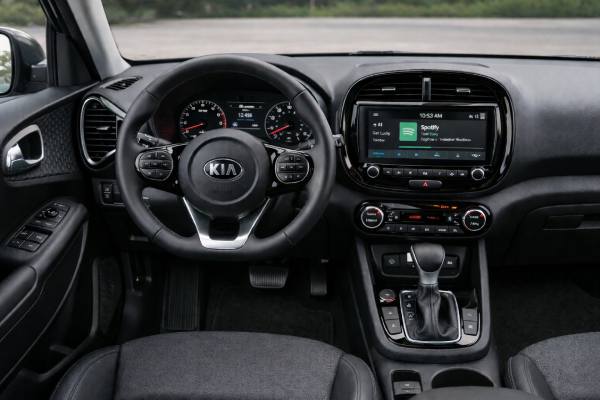

The Kia Soul SK3 Turbo is the performance version that gives the boxy Soul shape real pace. With the G4FJ 1.6-liter turbocharged direct-injection engine, 201 hp, and a 7-speed dual-clutch transmission, it turns a practical urban hatchback into something much quicker and more entertaining than its shape suggests. That mix is the reason enthusiasts still seek it out. At the same time, one market caveat matters: in many current facelift-era markets, including Kia’s recent U.S. Soul lineup, the 1.6T is no longer the standard current powertrain offering. So this guide is most useful for readers searching specifically for the SK3 Turbo hardware, comparing it with the facelifted/current Soul range, or shopping markets and dealer stock where the turbo specification still matters. Treated that way, the Soul Turbo stands out for its strong mid-range punch, roomy cabin, and relatively simple front-drive packaging, while asking buyers to be more careful about DCT behavior, direct-injection upkeep, and service history than the basic 2.0-liter car.
Quick Specs and Notes
- The 1.6 turbo engine gives the Soul real straight-line pace without losing its upright packaging and easy visibility.
- The larger brakes, quicker steering ratio, and stronger standard equipment make it more than just a trim package.
- Cabin space and cargo flexibility remain excellent for a compact hatchback, even in the performance version.
- The main ownership caveat is drivetrain condition: low-speed DCT behavior, fluid history, and prior software updates matter.
- A practical oil-service target is every 10,000 km or 12 months, with shorter intervals for heavy city use or hot-climate driving.
Contents and shortcuts
- Kia Soul SK3 turbo profile
- Kia Soul SK3 hard numbers
- Kia Soul SK3 trims and safety
- Common faults and service actions
- Maintenance plan and buying tips
- Real-world performance and economy
- Soul Turbo compared with rivals
Kia Soul SK3 turbo profile
The SK3-generation Soul Turbo is the version that makes the Soul more than a style-first compact. In its 201 hp form, it takes the same tall-roof, front-drive platform used by the ordinary Soul and gives it enough engine, brake, and trim substance to feel genuinely quick. That is why this version has a stronger following than its boxy shape might suggest.
The engineering formula is simple and effective. The G4FJ 1.6-liter turbocharged four-cylinder brings a healthy torque curve, the 7-speed dual-clutch transmission keeps it in the useful part of the powerband, and the chassis gets enough supporting work to make the extra performance feel intentional. The turbo car is not a full hot hatch in the classic manual-gearbox sense, but it is much more than a cosmetic GT-Line. It has stronger brakes, wider tires, more decisive acceleration, and a more serious front-end feel than the non-turbo Soul.
That is the upside. The downside is that the Soul Turbo makes most sense only when you understand what it is and what it is not. It is quick in a straight line, practical, and unusually spacious for its size. It is not rear-drive, not all-wheel drive, and not as finely damped as a more expensive performance hatch. It still rides on a tall body with a torsion-beam rear axle. That means the experience is strong and useful rather than deeply polished.
The bigger complication is market availability. The current facelift-era Soul in the U.S. moved to a simplified 2.0-liter lineup, and the turbo disappeared from the official range. So if you are specifically shopping the G4FJ 201 hp Soul, you are effectively dealing with the SK3 Turbo spec as a performance reference point, a used-buy target, or a market-specific trim story rather than a universally current showroom configuration. That matters because buyers often search “2023-present Soul Turbo” expecting a direct current equivalent that no longer exists in some regions.
Viewed honestly, though, the appeal is still strong. The Soul Turbo gives you the compact footprint and upright access of an everyday hatchback, but with enough power to avoid the underpowered feel that can affect the base Soul on highway merges or loaded climbs. It is especially appealing for drivers who want one practical car that can still feel lively, and who care more about packaging and visibility than about the lower seating position of a conventional sport hatch.
Kia Soul SK3 hard numbers
The table set below focuses on the 201 hp G4FJ-based SK3 Turbo specification that most buyers mean when they search for the performance Soul. Current facelifted Soul dimensions and safety structure remain closely related, but recent official lineup documents in some markets no longer pair that body with the 1.6T engine.
| Powertrain and efficiency | Kia Soul SK3 Turbo 1.6T |
|---|---|
| Engine code | G4FJ |
| Engine layout and cylinders | Inline-4, DOHC, 4 cylinders, 4 valves per cylinder |
| Bore × stroke | 77.0 × 85.4 mm (3.03 × 3.36 in) |
| Displacement | 1.6 l (1,591 cc) |
| Induction | Turbocharged |
| Fuel system | Gasoline direct injection |
| Compression ratio | 10.0:1 |
| Max power | 201 hp (150 kW) @ 6,000 rpm |
| Max torque | 264 Nm (195 lb-ft) |
| Timing drive | Chain |
| Rated efficiency | 8.7 / 7.4 / 8.1 l/100 km city / highway / combined (27 / 32 / 29 mpg US) |
| Real-world highway @ 120 km/h (75 mph) | Usually about 8.0–9.0 l/100 km (26–29 mpg US) |
| Transmission and driveline | Kia Soul SK3 Turbo 1.6T |
|---|---|
| Transmission | 7-speed dual-clutch transmission |
| Drive type | FWD |
| Differential | Open |
| Final drive ratio | 4.786:1 (1/2/4/5) and 3.526:1 (3/6/7/R) |
| Clutch type | Dry-type double plate |
| Chassis and dimensions | Kia Soul SK3 Turbo 1.6T |
|---|---|
| Front suspension | MacPherson strut |
| Rear suspension | Coupled torsion beam axle |
| Steering | Motor-driven power steering; 12.7:1 |
| Brakes | 305 mm (12.0 in) front vented discs / 284 mm (11.2 in) rear solid discs |
| Wheels and tyres | 235/45 R18 |
| Ground clearance | 170 mm (6.7 in) |
| Length | 4,196 mm (165.2 in) |
| Width | 1,801 mm (70.9 in) |
| Height | 1,600 mm (63.0 in) |
| Wheelbase | 2,601 mm (102.4 in) |
| Turning circle, kerb-to-kerb | 10.6 m (34.8 ft) |
| Kerb weight | 1,377 kg (3,036 lb) |
| GVWR | 1,860 kg (4,101 lb) |
| Fuel tank | 54 l (14.2 US gal / 11.9 UK gal) |
| Cargo volume | 530 l / 662 l / 1,759 l depending on floor position and seat configuration (18.7 / 23.4 / 62.1 ft³) |
| Performance and capability | Kia Soul SK3 Turbo 1.6T |
|---|---|
| 0–60 mph | About 6.4–6.5 s |
| 0–100 km/h (0–62 mph) | About 6.7–6.9 s |
| Top speed | About 206 km/h (128 mph) |
| 62–0 mph braking distance | About 34.7 m (114 ft) |
| Payload | About 483 kg (1,065 lb) |
| Towing capacity | Not generally promoted as a towing variant |
| Fluids and service capacities | Kia Soul SK3 Turbo 1.6T |
|---|---|
| Engine oil | Full synthetic; 0W-20 or 5W-30 depending on market and climate |
| Brake fluid | DOT 3 or DOT 4 |
| A/C refrigerant | R-1234yf or R-134a depending on market specification |
| Key torque specs | Wheel nuts: 107–127 Nm (79–94 lb-ft) |
| Safety and driver assistance | Kia Soul SK3 body |
|---|---|
| IIHS crash ratings | Good in key crash categories for 2020–25 body structure |
| Headlight rating | Trim-dependent; stronger with upgraded LED package |
| Standard baseline assists on current facelifted lineup | AEB, lane keep assist, lane following assist, driver attention warning, high beam assist |
| Higher-trim or package assists | Blind-spot collision avoidance, rear cross-traffic collision avoidance, navigation-based smart cruise control, cyclist detection, junction turning |
The numbers explain the car’s appeal. This is not just a faster trim badge. The turbo Soul gets the hardware that lets its extra power show up in real driving: more tire, more brake, quicker steering, and a transmission tuned around the stronger engine rather than a fuel-first base motor.
Kia Soul SK3 trims and safety
Trim structure is where the Soul story gets complicated, because the SK3-generation body and the G4FJ turbo powertrain do not line up neatly in every market after the facelift phase. In the earlier SK3 performance setup, the turbo model sat at the top of the range and was often identified as the GT-Line Turbo or simply Turbo, depending on year. It was the version with the 1.6T engine, 7-speed DCT, larger brakes, LED lighting, bigger wheels, upgraded seats, and the most complete factory safety-tech set.
That made it easy to identify when new. The turbo car usually wore 18-inch wheels, a center-exit exhaust treatment, sportier front and rear bumpers, red or gloss-black trim details, and a stronger interior package with premium audio, upgraded seats, and a more serious infotainment setup. It was not a separate chassis engineering program, but it was clearly the premium-performance Soul.
The current facelifted Soul range in some markets, however, is different. In the U.S. especially, Kia simplified the lineup for 2023 and dropped both the X-Line and Turbo. That left the LX, S, EX, and GT-Line trims powered by a single 2.0-liter engine. In other words, the current GT-Line is mainly a design and equipment trim, not the old 201 hp performance version. This is one of the easiest places for buyers to get confused. A late GT-Line badge does not automatically mean a turbo Soul.
Safety equipment remains one of the Soul’s better traits. The redesigned SK3 body earned strong IIHS results that apply across the 2020–25 structure, including Good scores in major crash tests. That gives the Soul a firmer passive-safety foundation than many earlier boxy small cars. The body structure is not the weak point here.
Driver assistance evolved meaningfully after the facelift. On recent Souls, automatic emergency braking with pedestrian detection, lane keep assist, lane following assist, driver attention warning, and high beam assist are widely available and often standard. Higher trims or packages add blind-spot collision avoidance, rear cross-traffic collision avoidance, cyclist detection, junction-turning support, and navigation-based smart cruise control. That means the current non-turbo Soul can actually be stronger in standard active safety than some earlier turbo cars, even if it is much slower.
For buyers, the trim lesson is simple. If you want the actual 201 hp G4FJ turbo Soul, you must verify the engine and transmission, not just the exterior trim. If you are comfortable with the current facelifted body but do not need the turbo, the newer GT-Line and packaged trims offer a better standard safety story and lower complexity. The right choice depends on whether performance or easy long-term ownership matters more.
Common faults and service actions
The Soul Turbo’s reliability picture is neither disastrous nor effortless. Most of the real risk comes from a few predictable systems rather than from random catastrophic failure. If you understand those systems before buying, the car becomes much easier to judge.
The issue map looks like this:
- Common, low to medium cost: spark plugs, coil packs, dirty intake tracts, worn front tyres, brake hardware wear, and ordinary suspension consumables.
- Occasional, medium cost: carbon build-up on intake valves, DCT shudder or clutch calibration complaints, wastegate or boost-control issues, and worn engine mounts.
- Less common, higher cost: neglected turbocharger lubrication, persistent DCT clutch wear, and poor prior repair history around software updates or gearbox work.
The engine itself is the easier half of the story. The G4FJ is a known direct-injection turbo four, so the usual GDI realities apply. Carbon build-up on the intake valves is not guaranteed, but on short-trip cars it becomes more likely as mileage climbs. Symptoms include rough cold idle, light hesitation, uneven throttle response, or a gradual loss of crispness rather than a dramatic breakdown. The remedy is familiar: plugs, coils, injector and intake diagnosis, and valve cleaning when deposits are severe enough to justify it.
Oil quality matters more than on the base 2.0-liter car. This engine rewards frequent oil changes and punishes lazy service. Leave dirty oil in a turbocharged direct-injection four for too long and you increase risk across the timing system, turbo bearing life, and long-term consumption. A healthy turbo Soul usually feels sharp and smooth. A neglected one often feels coarse before it becomes obviously faulty.
The more controversial part is the 7-speed dual-clutch transmission. In good condition it shifts quickly and helps the car feel faster than its shape suggests. In bad condition it can feel hesitant, jerky at parking speeds, or inconsistent when hot in stop-start traffic. Some of that is normal dry-clutch character. Some of it points to clutch wear, actuator calibration drift, or software history that needs checking. Buyers who have only driven torque-converter automatics often mistake normal DCT behavior for failure, while sellers sometimes dismiss real judder as “just how they all are.” The truth sits in the middle.
Software history matters here. Earlier SK3 1.6T cars saw ECU logic improvement activity, and the broader 7-DCT family has had clutch-judder inspection and replacement guidance. That does not mean every turbo Soul is suspect. It means documented dealer history is valuable.
One more important distinction: the current 2025 NHTSA piston-ring recall on certain 2021–2023 Souls applies to specific 2.0-liter Nu MPI cars, not to the G4FJ turbo setup. Current-body buyers still need to run the VIN, but that particular campaign is not the headline risk for the 201 hp turbo car.
Pre-purchase checks should include a cold start, a full warm drive, slow-speed maneuvering for DCT smoothness, fault-code scanning, and proof of software and recall completion. On this car, paperwork really does change the risk level.
Maintenance plan and buying tips
The best way to own a Soul Turbo is to service it more like a small performance car than like a disposable commuter. That does not mean it is expensive to maintain. It means discipline matters more than on the 2.0-liter Soul.
A sensible real-world service plan looks like this:
- Engine oil and filter: every 8,000 to 10,000 km or 12 months. In hot climates, short-trip use, or enthusiastic driving, lean toward the shorter interval.
- Engine air filter: inspect at each oil service and replace around 30,000 km if the car sees normal road use.
- Cabin air filter: every 15,000 to 20,000 km or 12 months.
- Spark plugs: inspect and replace on schedule; turbo DI engines do not reward delaying ignition maintenance.
- Brake fluid: every 2 years.
- DCT fluid and clutch behavior check: inspect for software history, leaks, and shift quality; do not wait for severe judder before acting.
- Coolant and hose inspection: yearly, especially on warmer-climate cars.
- Tyre rotation and alignment: every 10,000 to 12,000 km, sooner if front tyre wear becomes uneven.
- Brake inspection: every service, because the turbo car’s stronger pace makes brake condition more important.
- 12 V battery check: yearly after year four.
The timing chain does not create a fixed replacement interval the way a belt would, but that does not mean it should be forgotten. This engine relies on good oil history. Start-up rattle, correlation faults, or obvious neglect deserve investigation rather than optimism.
The buying checklist should be strict:
- Verify it is truly the 1.6T turbo car by engine, gearbox, and trim content.
- Ask for proof of regular oil changes, not just generic “dealer serviced” claims.
- Test the DCT both cold and fully warm, especially in crawling traffic and parking-lot maneuvers.
- Check for boost leaks, non-standard intake parts, or poor-quality tuning.
- Inspect the front brakes and tyre brand choice; cheap tyres often signal cheap upkeep.
- Run the VIN for recall completion and check for past TSB or campaign work.
- Scan for stored or pending codes, not just active warning lights.
The strongest buys are clean, unmodified cars with full dealer or specialist records. Mild cosmetic changes are not a deal-breaker. Questionable tuning, hard launches, and missing software history are. This is also a car where an excellent base Soul GT-Line from the facelift era may be a smarter buy than a neglected old turbo, depending on your priorities.
Long-term durability is good when the car is serviced properly. The expensive examples are almost always the ones that were driven like quick cars but maintained like cheap hatchbacks.
Real-world performance and economy
The Soul Turbo succeeds because it is faster than it looks. From the driver’s seat, the strongest impression is not dramatic top-end speed but useful mid-range thrust. The engine comes on with enough torque to make merges and passing feel easy, and the 7-speed DCT helps the car stay alert once you are moving.
Around town, the Soul Turbo feels more responsive than the base car immediately. Throttle response is stronger, gaps in traffic are easier to use, and the extra torque makes the upright Soul body feel lighter on its feet than it really is. At the same time, low-speed transmission behavior is still the defining compromise. A conventional automatic would feel smoother in creeping traffic. The DCT feels quicker and more direct once you are moving, but less polished when inching along.
Ride quality is better than many buyers expect. Even on 18-inch wheels, the Soul Turbo is not punishing. The body still moves around more than a lower hot hatch, but the damping and steering are good enough that it never feels unruly. The quicker steering ratio and larger tires give the front end more confidence than the ordinary Soul, and the larger brakes make repeated moderate-speed use feel more controlled.
In instrumented testing, the turbo Soul has run from 0–60 mph in about 6.4 to 6.5 seconds and stopped from 60 mph in roughly 114 feet. Those are real performance numbers, not just “quick for a boxy car” excuses. The car is legitimately brisk. It also retains the Soul’s practical strengths: good sightlines, generous headroom, and very usable cargo space.
Real-world fuel economy is fair for the pace on offer. Expect roughly 9.5 to 11.0 l/100 km in dense city use, around 7.2 to 8.2 l/100 km on a calm highway run, and roughly 8.0 to 9.0 l/100 km in mixed driving. Push hard, add heavy passengers, or spend lots of time in boost, and it moves upward quickly. The engine itself is happier than many rivals on regular fuel, but it still rewards good-quality gasoline and clean service history.
NVH is mixed. Road and wind noise are more noticeable than in sleeker hatches, while the engine sounds purposeful rather than refined when worked hard. That said, the car’s combination of visibility, punch, and practicality makes it very easy to enjoy in the real world. It is not the most sophisticated compact performance car. It is one of the most usable.
Soul Turbo compared with rivals
The Soul Turbo does not really compete on the same terms as a traditional hot hatch. Its closest rivals are the quick, high-roofed compact crossovers and sporty hatchbacks that blend pace with packaging rather than pure handling focus.
Against a Mazda CX-30 Turbo, the Soul gives up all-wheel drive, polish, and interior richness, but wins on visibility, cargo flexibility, and simplicity. Against a Volkswagen Taos, it feels quicker and more characterful in turbo form, though the Taos offers a more crossover-like driving position and, in some markets, AWD. Against the Hyundai Kona turbo variants, the Soul often feels roomier and easier to live with, while the Kona is the more conventional dynamic choice.
Within Kia’s own family, the current Seltos 1.6T is the most natural comparison because it effectively inherits the role of the fast small Kia crossover in today’s lineup. The Seltos brings AWD availability, newer packaging logic, and better current-market support. The Soul Turbo counters with lower mass, stronger boxy practicality, and a more distinct personality.
That is really the Soul Turbo’s niche. It is for the buyer who wants a quick compact car but dislikes cramped rear access, low rooflines, and overstyled cabins. It is also for the buyer who wants one vehicle to do daily-duty family chores and still feel entertaining on an empty road.
Where it loses is obvious. It is not the quietest, not the most refined, not the most sophisticated, and not the easiest transmission to love in crawling traffic. Its current-market support is also weaker because the recent facelifted Soul lineup no longer treats the turbo as the default premium-performance option in some regions.
So the verdict is straightforward. If you specifically want the 201 hp Soul, the G4FJ turbo remains the version to chase. If you mainly want the Soul shape with lower complexity and stronger current safety packaging, the facelifted 2.0-liter GT-Line or EX may be the wiser answer. The advantage of the turbo car is that it still offers something unusual: real pace in a compact, upright, practical body without pretending to be something it is not.
References
- 2021 KIA SOUL OVERVIEW 2020 (Manufacturer Overview)
- 2021 Kia Soul Specifications 2020 (Specifications)
- 2023 Kia Soul Overview 2022 (Manufacturer Overview)
- 2025 Kia Soul 2025 (Safety Rating)
- Part 573 Safety Recall Report 25V-099 2025 (Recall Report)
Disclaimer
This article is for informational purposes only and is not a substitute for professional diagnosis, repair, or VIN-specific service guidance. Specifications, torque values, intervals, procedures, recalls, software campaigns, and equipment can vary by VIN, market, trim, and production date, so always confirm details against official service documentation for the exact vehicle.
If this guide helped you, please consider sharing it on Facebook, X, or another platform to support our work.