

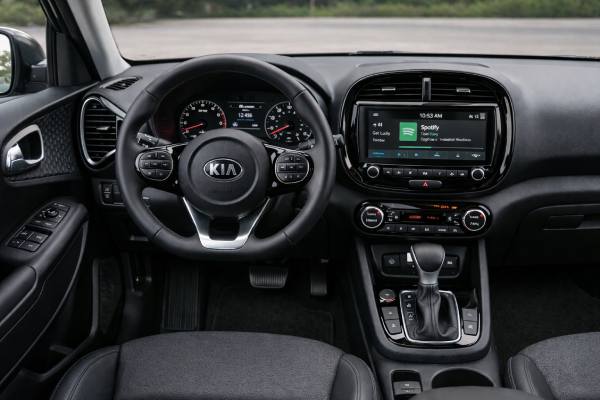
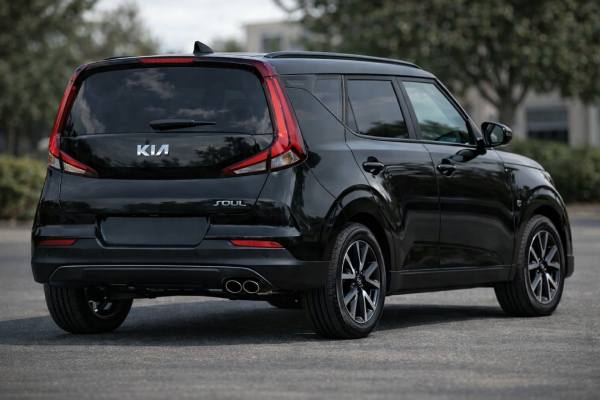
The facelifted Kia Soul SK3 is best understood as the final, cleaned-up version of Kia’s boxy small crossover formula. For 2023, Kia simplified the lineup, made the 2.0-liter naturally aspirated MPI engine standard across the range, and paired it with the Intelligent Variable Transmission. That gave the Soul a clearer identity: roomy, easy to drive, efficient enough, and mechanically simpler than many turbocharged rivals. In practical terms, the final facelift run centers on the 2023, 2024, and 2025 model years. That matters because these later cars blend mature safety technology, a very usable cabin, and one of the easiest ownership experiences in the class.
The Soul’s appeal is not speed or rugged off-road ability. It is packaging. The tall roof, wide doors, and square cargo area make daily life easier than many sleeker subcompact SUVs. For buyers who want a practical used crossover without turbocharger complexity or all-wheel-drive maintenance, the 2.0-liter SK3 remains one of the most rational choices in the segment.
What to Know
- The boxy body gives the Soul one of the most useful cabins and cargo areas in the small-crossover class.
- The 2.0 MPI engine avoids turbocharger complexity and stays simpler than many downsized rivals.
- Standard lane-keeping, forward-collision warning, and pedestrian detection make the facelift car feel much more modern than older Souls.
- Early 2023 cars need especially careful recall and engine-campaign checks before purchase.
- A sensible oil-service rhythm is every 5,000–7,500 miles (8,000–12,000 km) or 6–12 months, depending on use.
Contents and shortcuts
- Kia Soul SK3 Final Run
- Kia Soul SK3 Hard Data
- Kia Soul SK3 Equipment and Safety
- Defects, Recalls, and Wear Trends
- Service Strategy and Used-Buy Tips
- Real-World Pace and Economy
- Soul SK3 Against Alternatives
Kia Soul SK3 Final Run
The facelifted SK3 Soul is the version that removed most of the confusion from the earlier third-generation lineup. Before 2023, buyers had to choose between several visual themes and, in some markets, more varied powertrains. For 2023, Kia simplified the lineup to LX, S, EX, and GT-Line trims, dropped the turbo and X-Line variants, and made one powertrain standard: the 2.0-liter inline-four with 147 hp and the i-VT. That decision changed the car’s character. The Soul stopped trying to be several different things and became one thing done well: a practical, urban-friendly, tall-roofed hatch-crossover with a low learning curve for owners.
That simplicity is the Soul’s main engineering advantage. The naturally aspirated MPI engine is not exotic, but it is also not burdened by turbo heat, direct-injection intake carbon build-up, or complex all-wheel-drive hardware. The gearbox is an IVT, which still benefits from sensible long-term service, but it is matched to a modest, non-turbo engine and a front-wheel-drive layout. In daily use, that gives the Soul a calmer, more predictable feel than many subcompact SUVs that chase sportier numbers on paper.
The facelift also made the Soul more convincing from a safety and convenience standpoint. Kia made several driver-assistance features standard from 2023 onward, including forward collision avoidance with pedestrian detection, lane keeping, lane departure warning, driver attention warning, high beam assist, and rear occupant alert. Later packaging on higher trims added blind-spot avoidance, rear cross-traffic collision avoidance, navigation-based smart cruise control, and Highway Drive Assist. That does not make the Soul a class leader in high-end driver assistance, but it does make it feel modern enough for today’s used market.
Another important ownership point is timing. Although the prompt says “2023–present,” the final public run is best thought of as 2023–2025. For used buyers in 2026, that is actually helpful. Late-run cars usually benefit from the most settled trim logic, the best safety content, and fewer confusing specification overlaps. In practical terms, the facelift SK3 Soul is the final mature version of the model, and that is exactly why it deserves attention in the used market.
Kia Soul SK3 Hard Data
The table below focuses on the final public U.S.-market facelift specification, which is the clearest official reference point for the 2023–2025 Soul 2.0 MPI. Public Kia sheets do not publish every workshop-only figure, so a few service items remain VIN-specific.
| Powertrain and efficiency | Data |
|---|---|
| Code | Commonly catalogued as G4NH in parts listings; Kia public spec sheets identify it as a 2.0L MPI I-4 |
| Engine layout and cylinders | Inline-4, DOHC, 16 valves |
| Bore × stroke | 81.0 × 97.0 mm (3.19 × 3.82 in) |
| Displacement | 2.0 L (1,999 cc) |
| Induction | Naturally aspirated |
| Fuel system | MPI |
| Compression ratio | 12.5:1 |
| Max power | 147 hp (110 kW) @ 6,200 rpm |
| Max torque | 179 Nm (132 lb-ft) @ 4,500 rpm |
| Timing drive | Chain |
| Rated efficiency | 27/33/30 mpg US for LX, S, GT-Line; 29/35/31 mpg US for EX |
| Rated efficiency in L/100 km | About 8.7 / 7.1 / 7.8 for LX, S, GT-Line; about 8.1 / 6.7 / 7.6 for EX |
| Real-world highway @ 120 km/h (75 mph) | Around 7.8–8.3 L/100 km (28–30 mpg US / 34–36 mpg UK) |
| Transmission and driveline | Data |
|---|---|
| Transmission | Intelligent Variable Transmission (i-VT / IVT) |
| Drive type | FWD |
| Differential | Open |
| Transmission fluid capacity | 6.7 L (7.1 US qt) |
| Chassis and dimensions | Data |
|---|---|
| Suspension (front/rear) | MacPherson strut / coupled torsion beam axle |
| Steering | MDPS; 12.8:1 ratio |
| Brakes | Vented front disc / solid rear disc, 279 / 262 mm (11.0 / 10.3 in) |
| Wheels and tyres (most common) | 205/60 R16, 215/55 R17, 235/45 R18 |
| Ground clearance | 170 mm (6.7 in) |
| Length / width / height | 4,196 / 1,801 / 1,600 mm (165.2 / 70.9 / 63.0 in) |
| Wheelbase | 2,601 mm (102.4 in) |
| Turning circle (kerb-to-kerb) | 10.6 m (34.8 ft) |
| Kerb weight | 1,310 kg LX/S; 1,355 kg EX; 1,360 kg GT-Line |
| GVWR | 1,825 kg (4,023 lb) |
| Fuel tank | 54.1 L (14.3 US gal / 11.9 UK gal) |
| Cargo volume | 685 L (24.2 ft³) seats up on mat; 662 L with board low; 529 L with board high; 1,758 L (62.1 ft³) seats folded |
| Performance and capability | Data |
|---|---|
| 0–100 km/h (0–62 mph) | About 8.7–9.3 s based on independent 0–60 mph testing |
| Top speed | About 193 km/h (120 mph), governor-limited in testing |
| Braking distance | Independent testing reported 161 ft from 70–0 mph |
| Towing capacity | No mainstream U.S. tow rating published in Kia’s public spec sheet |
| Payload | VIN-and-trim dependent; check tire label and door sticker |
| Fluids and service capacities | Data |
|---|---|
| Engine oil | 4.0 L (4.2 US qt) with filter |
| Fuel requirement | Regular unleaded, 87 octane or higher |
| Coolant | Public Kia media sheets do not publish fill volume; verify by VIN in service literature |
| Transmission fluid | 6.7 L total fill in public spec sheet; exact service-fill method is VIN-specific |
| Brake fluid | Verify by service literature; DOT-class brake fluid used |
| A/C refrigerant and compressor oil | Workshop-manual item; verify by VIN |
| Key torque spec | Wheel nuts 88–107 Nm (65–79 lb-ft) |
| Safety and driver assistance | Data |
|---|---|
| Crash ratings | IIHS results for the 2020–2025 generation are strong in core crash tests |
| Headlight rating | Equipment-dependent |
| ADAS suite | Forward collision avoidance, lane keeping, lane departure warning, driver attention warning, high beam assist standard; blind-spot, rear cross-traffic, smart cruise, and Highway Drive Assist available by trim |
The Soul’s spec sheet tells a clear story. It is compact outside, easy to live with inside, and built around a straightforward front-drive layout rather than headline numbers.
Kia Soul SK3 Equipment and Safety
The 2023 facelift did more than refresh the nose and tail. It reset the trim logic. Kia simplified the range to LX, S, EX, and GT-Line, then built a cleaner step-up structure. LX is the budget entry point, but it is not stripped in the old economy-car sense. S is the value trim, because it adds more convenience and still keeps running costs under control. EX is usually the comfort sweet spot, with better efficiency, useful equipment, and sensible tyre size. GT-Line is the style-and-options trim, and with the Technology Package it becomes the most feature-rich version of the run.
The most important mechanical differences by trim are wheel size and ride character. LX and S use 16-inch wheels. EX moves to 17s, which is a very good balance for ride quality, tyre replacement cost, and road noise. GT-Line uses 18-inch wheels and feels a little firmer, more for appearance than for genuine performance gain. For daily ownership, the EX remains the most balanced version because it combines better highway economy with strong feature content and still avoids the harsher tyre package of the GT-Line.
Year-to-year changes were modest but useful. The 2023 facelift introduced the updated styling, simplified lineup, and broader standard safety content. For 2024, Kia added an EX Designer Package with 18-inch wheels, mixed upholstery, and a different interior look, and also added a smart-key sleep mode on equipped cars to help reduce key-frequency duplication risk. For 2025, Kia added the Soulmate Special Edition package with exclusive wheels, trim detailing, two-tone styling, upgraded audio, and visual changes that gave the Soul a final special-run identity.
The safety story is solid for the class. The SK3 Soul benefits from a strong basic structure, and the later trim packaging makes the car feel much more current than older Souls. Core crash performance is good, and the availability of lane-keeping support, automatic emergency braking, blind-spot monitoring, and rear cross-traffic systems makes the final-run model much easier to recommend to modern buyers. It is still important to verify exact trim and package content, because not every Soul on the used market will have the same headlamps, radar-based features, or rear safety aids.
In practical terms, the Soul’s safety and equipment story is one of thoughtful improvement rather than dramatic reinvention. That suits the car. It was always at its best as a usable, honest daily driver, and the facelift versions simply make that brief easier to recommend.
Defects, Recalls, and Wear Trends
Because the final-run SK3 Soul is still relatively new, its reliability picture is shaped more by recalls and early-production issues than by a long list of old-age failures. That is a positive overall. The basic 2.0 MPI and FWD layout is simpler than many small crossovers with turbo engines, dual-clutch gearboxes, or AWD hardware. But buyers still need to separate early 2023 cars from later production examples.
The most important current issue is the piston-oil-ring recall that affects certain 2021–2023 Souls with the 2.0-liter Nu MPI engine. The defect can lead to cylinder-wall damage, increased oil consumption, abnormal engine noise, oil-pressure warning illumination, engine damage, seizure, loss of drive power, and fire risk. In practical terms, early 2023 cars are the ones to check most closely. Any sign of rising oil use, metallic knock, low-oil-pressure warnings, or rough running deserves serious attention and should not be dismissed as “normal.”
The second major 2023 issue is the ISG electric oil pump recall on certain IVT-equipped Souls. A damaged capacitor in the transmission oil-pump controller can short and increase fire risk. This is exactly the kind of issue that might never show up in a casual test drive, which is why recall completion matters more than how the car feels over ten minutes.
There was also a side-curtain-airbag recall affecting certain 2023 Souls. The concern was that airbags could deploy unexpectedly due to a manufacturing error. Again, this is not something a buyer can detect just by driving the car around the block. Dealer-record confirmation and VIN checks matter far more than a clean dashboard at the time of sale.
Outside those major campaigns, wear trends are more ordinary. Rear brake corrosion can show up on lightly used cars, especially if they spend most of their lives on short trips. Tyres on 18-inch GT-Line cars are more prone to shoulder wear and impact damage. As these Souls age, expect typical compact-car wear items such as drop links, bushes, and batteries rather than a dramatic list of deep mechanical failures.
There is also a smaller warranty extension for horn-sound malfunction on certain 2020–2025 Souls. That is not a serious reliability red flag, but it is the sort of small manufacturer action that is still worth checking when buying a used example. The broad picture remains good: most final-run Souls are reliable if recall work has been completed and maintenance has been consistent.
Service Strategy and Used-Buy Tips
The Soul’s maintenance strategy should match the way these cars are usually used. Most live in towns and suburbs, doing short trips, school runs, shopping miles, and moderate commuting. That means the best owner habit is not heroic mechanical work. It is disciplined routine service. The 2.0 MPI engine is simpler than a turbo or direct-injection-only rival, but it still depends on clean oil, healthy cooling, and sensible transmission care.
A practical long-term schedule looks like this:
| Interval | What to do |
|---|---|
| Every 5,000–7,500 miles / 8,000–12,000 km or 6–12 months | Engine oil and filter, tyre inspection, brake inspection, fluid-level check, scan for stored faults |
| Every 10,000–15,000 miles / 16,000–24,000 km | Cabin air filter, tyre rotation, battery test, alignment check if wear suggests it |
| Every 15,000–30,000 miles / 24,000–48,000 km | Engine air filter, inspect auxiliary belt, inspect suspension bushes and links |
| Every 30,000–45,000 miles / 48,000–72,000 km | Spark plug inspection or replacement by condition, brake service if the car lives in salt or short-trip use |
| Every 2–3 years | Brake-fluid replacement |
| Around 50,000–70,000 miles / 80,000–112,000 km | Sensible IVT fluid service for long-term ownership, especially in heat or heavy stop-start use |
| By condition after 5–7 years | 12 V battery replacement window, coolant condition check, hose inspection |
For fluids, the most decision-useful public figures are 4.0 L of engine oil with filter, 6.7 L total transmission fluid capacity, and wheel-nut torque of 88–107 Nm. Public media sheets do not publish every workshop-only fill volume, so coolant capacity, refrigerant charge, and some torque values still need VIN-correct service data before parts are ordered or repairs are started.
The used-buyer checklist is short and important:
- Run a VIN recall check before viewing the car.
- Confirm engine-recall status on any 2023 car, especially early production.
- Confirm IVT oil-pump recall status on 2023 cars.
- Check cold start, hot restart, and oil level.
- Listen for unusual engine noise after full warm-up.
- Inspect rear brakes for corrosion on lightly used cars.
- On GT-Line cars, inspect 18-inch tyres closely for shoulder wear and impact damage.
- Test every ADAS function, camera, and infotainment feature.
The best used buys are usually 2024–2025 EX cars or well-kept S trims. GT-Line is attractive if you want the look and equipment, but it carries the normal trade-offs of larger wheels and costlier tyres. The version to approach most carefully is an early 2023 car with incomplete recall paperwork or vague engine history.
Real-World Pace and Economy
The Soul does not hide what it is from the first mile. The seating position is upright, visibility is excellent, and the short nose makes city placement easy. That alone explains much of the model’s appeal. Unlike lower hatchbacks that feel slightly more agile but less convenient, the Soul is built around easy entry, clear sightlines, and a cabin that works well in real traffic.
On the move, the 147-hp engine is adequate rather than eager. Around town, the Soul feels lighter than its square shape suggests because the low-speed throttle response is clean and the IVT does a reasonable job of keeping the engine in its useful band. At higher speeds, the car remains competent but not especially quick. Independent testing suggests 0–100 km/h comes in around the high-eight-second to low-nine-second range, which is fine for the class but not a selling point in itself.
Ride quality depends strongly on trim. LX and S models on 16-inch wheels are the easiest to live with over patched urban pavement. EX on 17s is the best all-round version, because it stays composed without getting busy and still returns the strongest highway economy in the range. GT-Line cars on 18s look sharper and can feel slightly firmer in body control, but they also let more sharp-edge impact into the cabin. This is the usual small-crossover tyre trade-off rather than a design flaw.
Fuel economy is one of the Soul’s better real-world traits. Official ratings land at 27/33/30 mpg for LX, S, and GT-Line, and 29/35/31 mpg for EX. In plain terms, that means a healthy EX can be a very efficient highway commuter for a box-shaped vehicle, while lower trims still do well enough if tyre pressures and alignment are kept in check. Expect roughly 7.1–7.8 L/100 km on a steady highway run and around 8.5–9.5 L/100 km in mixed urban-suburban use, depending on trim, temperature, and traffic.
The Soul never disguises its tall body. It leans sooner than a lower hatchback, and steering feel is light rather than rich. But that is acceptable because the car’s real strength is ease. It is simple to drive, simple to park, and less tiring in dense traffic than many rivals.
Soul SK3 Against Alternatives
The Soul’s closest natural alternative is the Hyundai Venue. The Venue is cheaper and simpler, but it also gives up meaningful power. Its smaller 1.6-liter engine makes it feel more budget-minded in real driving, especially on hills or with passengers on board. The Soul counters with stronger performance, a more substantial road feel, and a cabin that feels larger than the class suggests. The Venue makes sense if the goal is the lowest entry price and easy city dimensions. The Soul is the better buy if you want a genuinely more useful vehicle without moving much higher in cost.
The Nissan Kicks is the more modern “mainstream crossover” rival. In newer form, it offers available AWD, which is something the Soul never did. That makes the Nissan the better answer for buyers in snowy regions who care about traction more than packaging. The Soul still answers with its boxier roofline, easier entry, and a cargo area that feels more honest and less style-constrained. If you need AWD, the Soul is not the right tool. If you value visibility, accessibility, and cabin usefulness over fashion, it still holds its ground.
The Subaru Crosstrek sits one rung up in capability. Standard AWD and a more outdoors-oriented image make the Subaru the better rough-weather and gravel-road choice. The trade-off is cost, a more SUV-like mission, and less of the Soul’s urban simplicity. The Crosstrek is the better tool for mixed-surface use. The Soul is the better city package.
Even within Kia’s own recent history, the Soul makes a case against the older turbocharged trims. The late 2.0 MPI facelift cars are not as quick as the old turbo variants, but they are easier to understand mechanically and avoid the extra drivetrain complexity that can make long-term ownership less predictable.
That is the real verdict on the final SK3 Soul. It is not the fastest, the cheapest, or the most rugged choice. It is the one that most consistently turns its unusual shape into real owner benefit. For buyers who want a small crossover that is easy to enter, easy to park, reasonably efficient, and not overcomplicated, the final 2023–2025 Soul remains one of the strongest used options in its niche.
References
- 2025 Kia Soul Specifications 2025 (Technical Specifications)
- 2025 Kia Soul Features & Options 2025 (Features and Options)
- 2024 Kia Soul 2024 (Safety Rating)
- Part 573 Safety Recall Report 25V-099 2025 (Recall Database)
- A NEW WAY TO ROLL: KICKING OFF A CELEBRATION OF THE KIA SOUL 2025 (Press Release)
Disclaimer
This article is for informational purposes only and is not a substitute for professional diagnosis, repair, or VIN-specific technical guidance. Specifications, torque values, service intervals, campaign scope, and procedures vary by VIN, market, trim, build date, and equipment, so always verify against official service documentation before ordering parts or carrying out repairs.
If this guide helped you, please share it on Facebook, X/Twitter, or your preferred forum. That support helps us continue publishing detailed, owner-focused vehicle guides.