
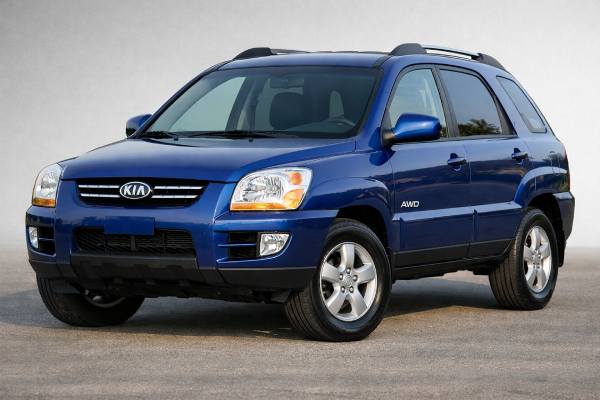
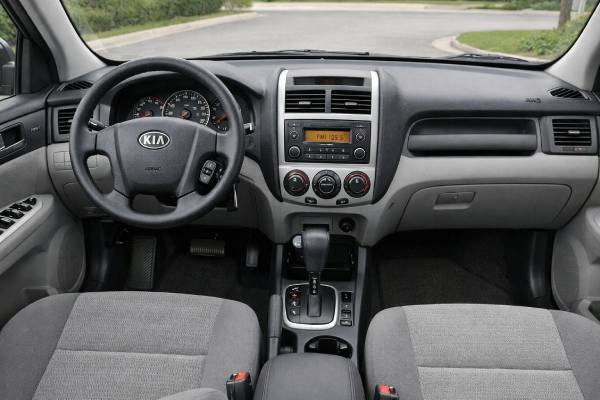
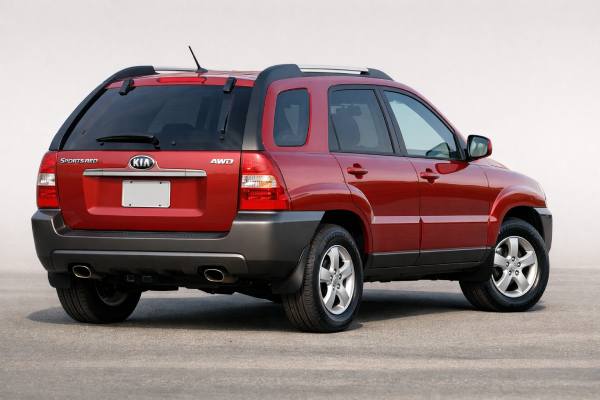
The 2004–2007 Kia Sportage AWD with the 2.7-liter G6BA V6 sits in an interesting place in Kia history. It is newer and safer than the old body-on-frame Sportage, but still simple enough to feel mechanical, repairable, and honest. In KM form, the Sportage moved to a car-based unibody layout shared with the Hyundai Tucson, yet kept enough ground clearance, an on-demand AWD system, and a lock mode to remain useful on snow, loose gravel, and rough tracks. The V6 version is the smoothest and strongest petrol option of the range, giving this compact SUV a more relaxed character than the smaller four-cylinder models. It is not especially quick by modern standards, and it is not the most fuel-efficient choice, but it is often the most pleasant KM Sportage to drive. For buyers who want a compact AWD SUV with simple controls, proven hardware, and reasonable parts support, this version still has a clear appeal.
What to Know
- The 2.7-liter V6 is smoother and quieter than the four-cylinder engines and suits the automatic gearbox well.
- AWD lock mode and decent ground clearance make it more capable on poor surfaces than many soft-road rivals.
- Cabin space and cargo flexibility are strong for the class, especially with the rear seats folded.
- Timing-belt history matters more than mileage alone, and rust-belt cars need careful underbody checks.
- Kia’s published petrol service interval for 2005–2010 Sportage models is 10,000 miles or 12 months.
Guide contents
- Sportage KM V6 Character
- Sportage KM Numbers and Hardware
- Sportage KM Grades and Protection
- Weak Points and Factory Actions
- Care Schedule and Shopper Checks
- Road Manners and Real Pace
- Where It Beats Rivals
Sportage KM V6 Character
The KM-generation Sportage is the model that turned the nameplate into something closer to the compact SUVs we recognize today. It traded the earlier truck-like layout for a unibody platform, independent suspension, better crash structure, and more everyday comfort. That shift changed the ownership experience in a useful way. The Sportage became easier to live with on normal roads without losing the basic AWD practicality that made buyers look at it in the first place.
In 2.7-liter AWD form, this is the most effortless petrol KM Sportage of the 2004–2007 period. The G6BA V6 is a naturally aspirated 24-valve unit from Hyundai-Kia’s Delta engine family. It is not a high-tech engine by current standards, but it is smooth, predictable, and strong enough to make the compact Sportage feel properly usable with passengers, luggage, or winter tyres. This matters because the four-cylinder petrol versions can feel strained once the vehicle is loaded or driven on faster roads. The V6 is simply the more relaxed match for the chassis.
There is one detail worth explaining clearly because it confuses buyers. Some markets describe this engine at 175 hp, while many North American listings show 173 hp. That difference usually comes down to regional rating standards rather than a major hardware change. In practical terms, you are dealing with the same 2.7-liter V6 and roughly the same real-world performance.
The AWD system also shapes the KM Sportage’s identity. It is not a low-range off-roader and it does not pretend to be one. Under normal driving it behaves like an on-demand system, which helps road manners and fuel use. When surfaces turn slick, the lock function can hold a fixed front-to-rear split at low speed, giving the car more traction in snow, mud, sand, or steep loose climbs. That makes it more useful than many older compact SUVs that were mostly styled for adventure rather than engineered for it.
As an ownership proposition, the V6 AWD Sportage makes sense for buyers who want a compact, straightforward SUV with decent visibility, simple ergonomics, and enough traction for bad weather. Its weak points are equally clear. Fuel economy is average at best, the automatic transmission is older in feel than later six-speed units, and condition matters far more than badge or trim. A well-kept example still feels honest and usable. A neglected one can quickly become a timing-belt job, a suspension job, and a corrosion project at the same time.
Sportage KM Numbers and Hardware
Published specifications for the 2004–2007 V6 AWD Sportage vary slightly by market, measurement standard, and trim. The table below focuses on the common KM-era 2.7 AWD configuration and flags the areas where North American and export data differ. For everyday ownership, the key constants are the G6BA 2.7-liter V6, the 4-speed automatic, the AWD system with lock mode, and the 2,630 mm wheelbase.
| Powertrain and efficiency | Figure |
|---|---|
| Code | G6BA |
| Engine layout and cylinders | V6, 6 cylinders, DOHC, 4 valves per cylinder |
| Bore × stroke | 86.7 × 75.0 mm (3.41 × 2.95 in) |
| Displacement | 2.7 L (2,656 cc) |
| Induction | Naturally aspirated |
| Fuel system | MPFI |
| Compression ratio | 10.0:1 to 10.1:1, market-source dependent |
| Max power | 175 hp (129 kW) @ 6,000 rpm |
| Max torque | 241 Nm (178 lb-ft) @ 4,000 rpm |
| Timing drive | Belt |
| Rated efficiency | About 10.0 L/100 km (23.5 mpg US / 28.2 mpg UK) in common export data; North American AWD figures are usually worse |
| Real-world highway @ 120 km/h (75 mph) | About 10.5–11.5 L/100 km (20.5–22.4 mpg US / 24.6–26.9 mpg UK) |
| Transmission and driveline | Figure |
|---|---|
| Transmission | 4-speed automatic |
| Drive type | AWD / 4×4, on-demand with lock mode |
| Differential | Open axle differentials; electronically controlled torque transfer |
| Chassis and dimensions | Figure |
|---|---|
| Suspension front | Independent MacPherson strut |
| Suspension rear | Independent multi-link |
| Steering | Rack-and-pinion power steering; open public sources do not give a dependable ratio for every market |
| Brakes | Ventilated front disc / rear disc |
| Common brake sizes | About 280 mm front and 262 mm rear, trim-source dependent |
| Wheels and tyres | 235/60 R16 is the most common V6 AWD fitment |
| Ground clearance | About 195 mm (7.7 in) |
| Angles | Approach angle commonly listed at about 29.5°; other angles vary by market literature |
| Length | 4,350 mm (171.3 in) |
| Width | 1,800–1,840 mm (70.9–72.4 in), market-source dependent |
| Height | 1,695–1,730 mm (66.7–68.1 in), depending on rails and market |
| Wheelbase | 2,630 mm (103.5 in) |
| Turning circle | About 10.8–10.9 m (35.4–35.8 ft) |
| Kerb weight | About 1,595–1,600 kg (3,516–3,527 lb) in common North American data; some export databases list higher figures |
| GVWR | About 2,100–2,170 kg (4,630–4,784 lb), market dependent |
| Fuel tank | About 65 L (17.2 US gal / 14.3 UK gal) on many AWD V6 listings |
| Cargo volume | About 668 L (23.6 ft³) seats up and about 1,886 L (66.6 ft³) seats down, SAE-style North American figures |
| Performance and capability | Figure |
|---|---|
| 0–100 km/h (0–62 mph) | About 10.5 s |
| Top speed | About 180 km/h (112 mph) |
| Braking distance | No dependable factory 100–0 km/h figure found in open official material |
| Towing capacity | Up to about 907 kg (2,000 lb) in common North American listings; always verify local rating |
| Payload | Roughly 450–500 kg (992–1,102 lb), market dependent |
| Fluids and service capacities | Figure |
|---|---|
| Engine oil | API SL/SJ, commonly 10W-30; Kia later recommends 5W-30 product equivalents; capacity 4.5 L (4.8 US qt) |
| Coolant | Ethylene-glycol mix, usually 50:50; exact capacity varies by radiator and market, so verify by VIN-specific data |
| Transmission / ATF | Hyundai-Kia SP-III type ATF; exact dry and service-fill quantities vary by procedure |
| Differential / transfer case | GL-5 gear oil; capacities vary by housing and published source, so confirm before filling |
| A/C refrigerant | R134a; charge amount varies by market and climate system |
| A/C compressor oil | PAG type; charge amount should be taken from the under-hood label or workshop data |
| Key torque specs | Wheel nuts are typically about 88–107 Nm (65–79 lb-ft); suspension, belt-system, and driveline fasteners should be checked against VIN-specific service data |
| Safety and driver assistance | Figure |
|---|---|
| Crash ratings | IIHS: Acceptable moderate overlap front and Acceptable side for 2005–2010 models |
| Roof strength | IIHS Poor |
| Head restraints and seats | IIHS Poor for seats built before April 2008 |
| Headlight rating | No IIHS headlight rating for this generation |
| ADAS suite | None |
| Core safety equipment | Front airbags, front side airbags, side-curtain airbags, ABS, and in some markets ESC and traction functions depending on trim |
The most useful ownership takeaway from the table is not the raw performance number. It is the hardware mix. The G6BA V6 is robust when serviced, the AWD system is helpful rather than decorative, and the chassis is practical. The tradeoff is simple: you get smoother power and better traction than the smaller engines, but you also accept higher fuel use and a timing belt that must not be ignored.
Sportage KM Grades and Protection
Trim names on the KM Sportage vary by region, but the V6 AWD usually sat near the top of the range. In North America, the most common trim names were LX and EX, with the 2.7-liter engine tied to automatic transmission and available AWD. In other markets, names and package groupings changed, but the main hardware story stayed familiar: the V6 brought stronger standard equipment, more comfort features, and wider tyre fitment than the base four-cylinder models.
For used buyers, the trim name matters less than the actual equipment on the car. The first thing to confirm is that it really is the V6 AWD version. Quick identifiers include the 2.7-liter engine layout, automatic transmission, AWD lock button, and typically 16-inch wheel packages. Higher-spec examples often add climate control, upgraded audio, alloy wheels, leather or part-leather trim, a sunroof, and more convenience equipment. On a 20-year-old SUV, though, mixed wheels, swapped interior parts, and missing trim pieces are common, so visual inspection is more useful than sales labels.
Mechanical differences between grades were usually modest, but they still matter. Four-cylinder Sportages could be lighter and cheaper to run, yet they do not feel as relaxed on the road. The V6 AWD model gives you the strongest petrol output in this period and the best match for towing light loads, climbing grades, or carrying a full cabin. Suspension hardware is broadly shared across the range, though tyre choice changes the driving feel noticeably. A healthy V6 AWD on good 235-section tyres feels more planted and composed than a neglected example on mixed-budget rubber.
Safety equipment also improved the value case for the KM generation compared with the earlier Sportage. The IIHS results for the 2007 Sportage show Acceptable ratings in the moderate overlap front and side tests, which is respectable for a compact SUV from the mid-2000s. The weak areas are just as important: roof strength is rated Poor, and head restraints and seats are also rated Poor for vehicles built before April 2008. In practical terms, the KM Sportage was a clear step forward over the first-generation model in frontal and side protection, but it still falls short of later standards in rollover and rear-impact whiplash protection.
There is no modern driver assistance here. No automatic emergency braking, no lane-keeping support, no adaptive cruise control, and no blind-spot monitoring. Stability control was not universal in all markets and trims, so buyers should verify actual equipment rather than assume it from the model year. The safer used example is usually one with verified ABS operation, correct tyre sizes, healthy suspension joints, and complete airbag and recall history. Child-seat anchors are commonly present, but you should still check the actual ISOFIX or LATCH hardware on the vehicle. On an SUV of this age, safety is as much about condition and maintenance as it is about the original specification sheet.
Weak Points and Factory Actions
The KM Sportage with the 2.7 V6 does not suffer from one single fatal flaw, which is part of its appeal. Instead, it has a group of age-sensitive weak points that range from minor annoyances to expensive neglect. The engine itself is fundamentally durable, but it is not tolerant of missed timing-belt service. The rest of the vehicle is similar: generally sound, but very dependent on maintenance history and climate.
The most important issue is the timing belt. This is a belt-driven V6, not a chain-driven one, and overdue service is the fastest way to turn a decent Sportage into a major repair. In practical ownership terms, you should treat missing belt records as an immediate service need. When the front of the engine is opened, water pump, tensioners, idlers, and the accessory belt path should be assessed at the same time. That service is the dividing line between a low-stress V6 Sportage and a gamble.
Oil leaks are common but usually manageable. Valve-cover gasket seepage, front-engine oil leaks, and age-hardened seals show up often enough that they should be expected rather than treated as a surprise. The symptoms are straightforward: burnt-oil smell, oily rear bank, damp timing covers, or a dirty alternator area. The root causes are usually aging gaskets, crankshaft seals, or cam seals. The remedy is conventional mechanical work, not anything exotic, but access around the rear bank can make labor add up.
Cooling-system aging is another common theme. Radiators, thermostat housings, hoses, and plastic end tanks do not age gracefully forever. A buyer should watch for temperature instability, pink or green crusting, sweet smell after shutdown, or weak cabin heat. This is especially important on the V6 because repeated overheating can turn a routine cooling repair into a head-gasket or head-warping problem.
The driveline is usually robust, but neglected fluids and tyre mismatch can create problems. Expect occasional complaints about clunks, propshaft vibration, transfer-unit seal dampness, or rear coupling complaints on high-mile cars. Symptoms such as shudder on tight turns, driveline thump when taking up drive, or noise under load deserve attention. Many of these issues are worsened by uneven tyre diameters or very old fluids rather than by dramatic component failure.
On the chassis side, front suspension wear is common and rarely subtle once it advances. Worn lower arms, bushings, ball joints, drop links, and dampers give the Sportage the loose, thumping feel that many buyers mistake for “just an old SUV.” Steering should feel calm and direct enough for the class, not vague and busy. Rear suspension bushings and wheel bearings also deserve attention on older examples.
Factory actions matter here. Official U.S. records show recall activity around stop lamp switch problems on some 2007 vehicles, and Kia later launched a product improvement campaign for fuel tank straps on certain 2005–2007 Sportage vehicles used in heavy road-salt regions. That campaign is not the same thing as a dramatic defect recall, but it tells you exactly where Kia saw long-term corrosion risk. A careful buyer should check VIN-based recall status, ask for dealer printouts where possible, and inspect the underside rather than trusting a clean dashboard and shiny paint. On this generation, the underbody often tells the truth faster than the rest of the car.
Care Schedule and Shopper Checks
The official Kia service guide for 2005–2010 petrol Sportage models gives a straightforward interval of 10,000 miles or 12 months. That is a useful baseline, but older V6 AWD examples benefit from a more cautious real-world plan. Time matters as much as mileage on these vehicles. A low-mileage Sportage that sat outside for years can need more recommissioning than a higher-mileage one with consistent servicing.
A practical maintenance schedule looks like this:
- Engine oil and filter: every 10,000 miles or 12 months at the latest. On short-trip or severe use, I would shorten that interval.
- Timing belt service: every 60,000 miles or about 6 years is the safe planning point for the G6BA. Replace belt, tensioners, idlers, and usually the water pump together.
- Engine air filter: inspect at every service and replace roughly every 20,000–30,000 miles depending on dust and climate.
- Cabin air filter: every 12 months or about 15,000–20,000 miles.
- Spark plugs: around 60,000 miles is a sensible interval on this engine unless records show a recent replacement.
- Coolant: replace on age and condition, commonly every 3–5 years in practical use.
- ATF: drain and refill every 40,000–60,000 miles if you want the 4-speed automatic to live an easy life.
- AWD and axle oils: every 30,000–40,000 miles is a good preventive interval on older vehicles.
- Brake fluid: every 2 years.
- Tyre rotation and alignment check: every 5,000–8,000 miles, especially on AWD models.
- Serpentine belt and hoses: inspect every service, replace by age, cracks, noise, or belt-service timing.
- 12 V battery: test before winter; many last about 4–6 years.
- Valve clearance: no routine manual adjustment is usually expected on this engine, but persistent warm-engine ticking should still be investigated.
For fluid choices, the clearest official data point is Kia’s oil chart: the 2005–2007 Sportage KM 2.7 Delta petrol is listed at 4.5 liters with API SL/SJ 10W-30, with Kia’s later recommended product reference pointing to 5W-30 equivalents. For the automatic transmission, use the correct Hyundai-Kia SP-III type fluid rather than a generic substitute. For the differentials and AWD hardware, stick to the correct GL-5 gear-oil grade and verify quantities before filling because published capacities vary across markets and repair sources.
As a buyer, inspect the Sportage in this order:
- Check timing-belt history first.
- Then inspect the underbody, fuel tank straps, subframes, brake lines, and rear floor edges.
- Then look for cooling-system leaks, oil leaks, and rough idle or misfire.
- Then test the transmission for flare, harsh engagement, or delayed drive.
- Then confirm ABS, airbag, and AWD-related warning lights all cycle and go out correctly.
The best examples are usually 2006–2007 V6 AWD cars with clear service records, clean underside condition, and intact factory equipment. I would be more cautious with early rust-belt cars that have patchy history, unknown belt service, or fresh underseal hiding old corrosion. Long-term durability is fair to good if the belt service, fluids, and underbody are kept under control. If those three areas are ignored, the vehicle gets expensive quickly.
Road Manners and Real Pace
The V6 AWD Sportage is not a fast SUV, but it is a much more relaxed one than the smaller-engined versions. The naturally aspirated 2.7 does not deliver a big low-rpm shove the way a modern turbo engine does, yet it responds cleanly, sounds smooth, and suits the older 4-speed automatic better than a smaller petrol engine would. Around town, it feels easygoing rather than eager. On the open road, it settles into a calm cruise without the strained, busy feel that many compact SUVs of this era can develop.
Ride quality is one of its better traits. The KM chassis has enough suspension travel and tyre sidewall to absorb broken surfaces without the brittle edge you find in some later crossovers. It does not handle like a sport SUV, but it stays composed enough in medium-speed bends and tracks straight on poor roads. Steering is light by modern standards and not rich in feedback, yet it is easy to place. That suits the vehicle’s mission. This is an SUV meant to be predictable, not playful.
Body control is acceptable rather than sharp. You notice roll if you push it, and fast direction changes reveal its age, height, and tyre choice. Good dampers and fresh bushings make a large difference here. Many used examples feel worse than they should because they are rolling on tired shocks, old tyres, or worn front arms. A sorted Sportage is calmer and less clumsy than its reputation suggests.
Noise levels are also fairly reasonable for the era. The V6 is quieter than the diesels and more refined than the four-cylinder petrol when climbing or overtaking. Wind noise rises noticeably at motorway speeds, and the 4-speed automatic keeps revs higher than a later six-speed would, but nothing feels harsh or crude if the car is in good condition.
In real fuel use, you should plan conservatively. Around town, expect something in the 12–14 L/100 km range in typical traffic. On a steady highway run, about 10.5–11.5 L/100 km is realistic at true 120 km/h speeds. Mixed driving usually lands around 11–12 L/100 km. Cold weather, short trips, roof loads, and old tyres can push those figures higher.
The AWD system works best as a confidence tool. On wet roads, gravel, and snow, it helps the Sportage put power down neatly. In deep snow or loose surfaces, lock mode gives the car a stronger, more secure feel at low speed. It still lacks low range, serious articulation, and the tyre clearance of a true off-roader, so it is better thought of as a capable compact AWD SUV than as a trail specialist. For winter roads, rural tracks, and muddy access lanes, that is enough.
Where It Beats Rivals
The KM Sportage V6 AWD competes best when you judge it as a whole package, not as a single standout in one category. Against a Honda CR-V of the same era, the Kia offers a more rugged feel, stronger V6 smoothness, and a more useful AWD lock function on loose surfaces. Against a Toyota RAV4, it usually loses on brand perception and resale, but it often wins on purchase price and can feel more straightforward to buy cheaply in the used market.
Compared with the Hyundai Tucson, the difference is small because the two vehicles are closely related underneath. In many markets, the decision comes down to price, condition, and equipment rather than any major engineering split. Against the first-generation Nissan Qashqai, the Sportage feels less modern and less refined, but also more traditional in the way it drives and the way it approaches AWD utility. Against something like the Land Rover Freelander, the Kia generally gives up some off-road image and cabin character but can be the easier long-term ownership proposition.
Its biggest advantage is balance. It gives you a smooth petrol V6, real AWD usefulness, compact exterior size, decent cargo flexibility, and simple mechanical systems without asking you to step into premium-brand running costs. That is a solid formula for buyers in rural areas, snowy climates, or mixed-use households.
Its weaknesses are just as clear. The 4-speed automatic feels old, fuel economy is middling, and the safety picture is only average by mid-2000s standards. Roof-strength and whiplash-related results are not strong points. If you mainly want a city crossover with low running costs, a smaller-engine rival makes more sense. If you want a modern family car with advanced safety systems, this Kia is too old.
But if your shortlist is made up of honest, used AWD SUVs that can handle winter, bad roads, and light outdoor duty without being overly complex, the 2004–2007 Sportage 2.7 AWD deserves a serious look. It is not the class icon. It is the sensible outsider that often becomes appealing once you compare real condition, real repair costs, and real-world utility.
References
- Service Intervals 2026 (Service Guide)
- Engine Oil Grades and Capacities – Kia 2023 (Service Guide)
- 2007 Kia Sportage 2026 (Safety Rating)
- Vehicle Detail Search – 2007 KIA SPORTAGE 2026 (Recall Database)
- fuel tank strap replacement (pi1801) 2018 (Product Improvement)
Disclaimer
This article is for informational purposes only and is not a substitute for professional diagnosis, inspection, or repair. Specifications, torque values, service intervals, fluid capacities, procedures, and fitted equipment can vary by VIN, market, production date, and trim, so always verify details against the official service documentation for the exact vehicle.
If this guide was useful, please consider sharing it on Facebook, X, or another platform to support our work.