
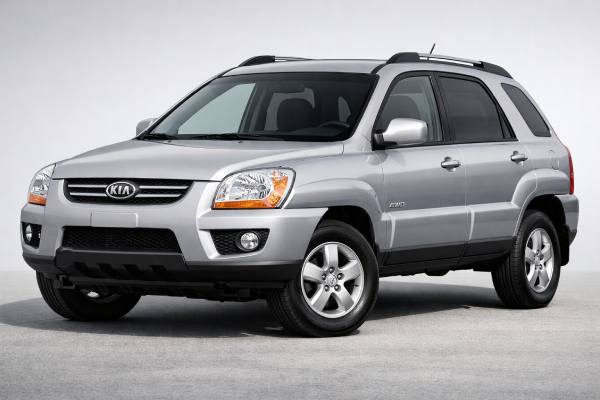
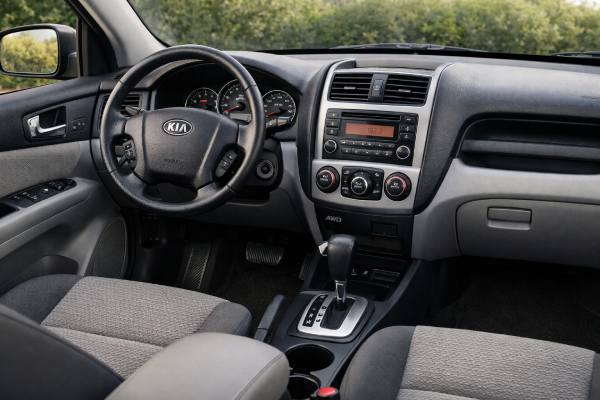
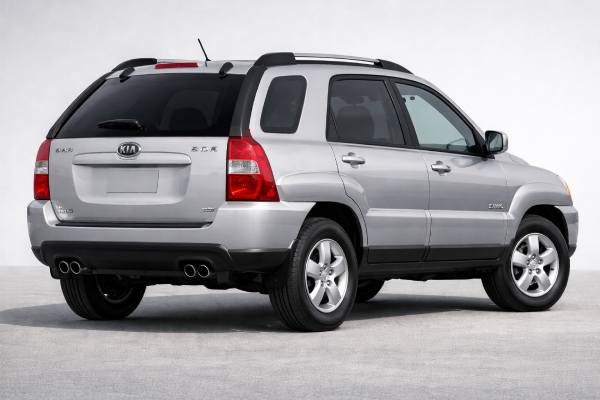
The 2006–2007 Kia Sportage AWD with the 140 hp D4EA diesel is one of those mid-2000s compact SUVs that makes sense when you look past the badge and focus on the hardware. It combines a torquey common-rail turbo-diesel, a compact unibody body shell, and an on-demand all-wheel-drive system with lock mode, so it feels more modern than the old body-on-frame Sportage but still honest and mechanical by current standards. It also sits in an important part of the KM timeline: Kia introduced the stronger Euro 4 VGT diesel in early 2006, and the second-generation Sportage received a light facelift in October 2007.
That mix gives this version a clear identity today. It is practical, good on long runs, and usually cheaper than a comparable Honda CR-V or Toyota RAV4 diesel. The trade-offs are just as clear: cabin refinement is average, safety is dated by modern standards, and neglected diesel or AWD servicing can turn a cheap used SUV into an expensive one.
Essential Insights
- Strong low-rpm torque and AWD traction make it more useful than the petrol 2.0 for towing, winter roads, and loaded driving.
- The D4EA diesel is efficient on long motorway trips and generally suits the Sportage better than the thirstier V6.
- The cabin, ride, and safety tech now feel firmly mid-2000s, so condition matters more than trim level.
- Injector, EGR, turbo-hose, clutch, and AWD-fluid neglect are the main ownership risks.
- Kia’s published UK service interval for 2005–2007 diesel Sportage models is 10,000 miles / 12 months.
Navigate this guide
- Kia Sportage KM Diesel Profile
- Kia Sportage KM Numbers and Hardware
- Kia Sportage KM Grades and Protection
- Known Weak Spots and Campaigns
- Service Plan and Used-Buy Tips
- On-Road Character and Economy
- Standing Against Mid-2000s Rivals
Kia Sportage KM Diesel Profile
The second-generation Sportage changed the model’s identity. Instead of the older, tougher-looking body-on-frame formula, the KM moved to a car-based platform shared closely with the Hyundai Tucson. That matters because the 2006–2007 AWD diesel does not drive like an old-school off-roader. It drives like a compact crossover with useful ground clearance, a flexible cabin, and enough mechanical traction to handle bad weather, rough lanes, and light towing without pretending to be a low-range 4×4.
For this specific version, the engine is the main reason to care. The D4EA 2.0-liter common-rail diesel in 140 hp form is the stronger update over the earlier 113 hp unit. It brings a healthier torque curve, better motorway pace, and a more convincing match to the Sportage’s weight. In daily use, that means fewer downshifts, easier hill climbing, and more relaxed cruising with passengers or luggage on board. It also suits the AWD system well, because the low-end shove helps the car feel more secure when pulling away on wet or loose surfaces.
The AWD layout itself is best understood as on-demand rather than heavy-duty. In normal driving the Sportage behaves mostly like a front-drive crossover, with the system shuffling torque rearward when slip is detected. Lock mode helps on snow, mud, and steep loose surfaces by preloading the system, but it does not turn the Sportage into a true off-road machine. There is no low range, and the chassis, approach angles, and underbody protection were designed for mixed road use first.
That focus explains why the KM still has a quiet used-market appeal. It offers a useful seating position, a practical square body, and a decent luggage area in a package that is often cheaper than the big-name Japanese alternatives. It is also old enough now that buyers can choose condition over status. A clean, rust-light, properly serviced diesel AWD Sportage can still be a very sensible family workhorse or winter commuter.
The weak side is age. Materials are durable rather than premium. Noise levels are acceptable, not polished. Safety equipment belongs to its era, not today’s. And because the diesel and AWD systems add complexity, poor maintenance hits harder here than on a basic petrol front-drive version. That is why this Sportage is best treated as a condition-led purchase. The right example feels sturdy and honest. The wrong one feels cheap for about a week, then expensive.
Kia Sportage KM Numbers and Hardware
Published spec data for the 2006–2007 Sportage AWD 2.0 CRDi is broadly consistent across market catalogs, with minor variation in weight, trim equipment, and some height figures depending on wheel and roof-rail fitment. The table below reflects the common 140 hp European-spec manual AWD version and highlights the figures that matter most to owners and buyers.
| Category | Specification |
|---|---|
| Engine code | D4EA |
| Engine layout and cylinders | Inline-4, 4 cylinders, OHC/DOHC family diesel, 4 valves per cylinder |
| Bore × stroke | 83 × 92 mm (3.27 × 3.62 in) |
| Displacement | 2.0 l (1,991 cc) |
| Induction | Turbocharged, intercooler |
| Fuel system | Common-rail direct injection |
| Compression ratio | 17.3:1 |
| Max power | 140 hp (103 kW) @ 4,000 rpm |
| Max torque | 305 Nm (225 lb-ft) @ 1,800 rpm |
| Timing drive | Belt |
| Rated efficiency | 7.1–7.2 l/100 km combined (33 mpg US / 39–40 mpg UK) |
| Real-world highway @ 120 km/h | Typically about 7.0–8.0 l/100 km depending on tyres, load, temperature, and DPF fitment |
| Transmission and driveline | Specification |
|---|---|
| Transmission | 6-speed manual on the common AWD 140 hp version |
| Drive type | AWD / 4×4, electronically controlled on-demand system |
| Differential | Open differentials with electronic control logic; no mainstream evidence of a factory LSD on this trim |
| AWD lock mode | Yes, for low-speed loose-surface use |
| Chassis and dimensions | Specification |
|---|---|
| Suspension front | Independent MacPherson strut, coil springs, anti-roll bar |
| Suspension rear | Independent multi-link / strut-type rear setup with coil springs and anti-roll bar |
| Brakes | Front ventilated discs 300 mm (11.81 in), rear discs 284 mm (11.18 in) |
| Wheels and tyres | Common size 215/65 R16; some markets also used 235/60 R16 or 17-inch packages |
| Ground clearance | About 195 mm (7.7 in), market-dependent |
| Length | 4,350 mm (171.3 in) |
| Width | 1,800–1,840 mm (70.9–72.4 in), source method varies |
| Height | About 1,695–1,730 mm (66.7–68.1 in) |
| Wheelbase | 2,630 mm (103.5 in) |
| Turning circle | About 10.9 m (35.8 ft), commonly listed |
| Kerb weight | About 1,660 kg (3,660 lb) in common manual AWD trim |
| GVWR | About 2,260 kg (4,982 lb) |
| Fuel tank | 58 l (15.3 US gal / 12.8 UK gal) |
| Cargo volume | Roughly 667–1,886 l by some catalogs; about 392 l minimum in stricter boot-volume listings |
| Performance and service data | Specification |
|---|---|
| 0–100 km/h | About 11.1–12.0 sec depending on market data source |
| Top speed | 177 km/h (110 mph) |
| Towing capacity | Commonly 1,550–1,600 kg braked, 750 kg unbraked |
| Payload | Roughly 600 kg in a typical manual AWD trim |
| Engine oil | 5.9 l (6.23 US qt); Kia later lists 10W-30 API CF-4 for 2005–2007 KM diesel in one service sheet, so VIN-based confirmation matters |
| Coolant | About 8.7 l (9.2 US qt) in common service data |
| A/C refrigerant | Market and supplier dependent; verify on the under-bonnet label before service |
| Key torque specs | Wheel fastener figures commonly fall near 98–108 Nm in market guides; always verify by VIN and wheel type before tightening |
Two cautions are worth stating clearly. First, early Kia service publications are not perfectly consistent across regions on diesel lubricant standards, so you should always check the exact VIN or market manual before choosing oil. Second, the 2007 facelift was light. Mechanical identity matters more than visual trim, so buy on specification and history, not on bumper details alone.
Kia Sportage KM Grades and Protection
Trim naming for the 2006–2007 Sportage varies more than many buyers expect. Depending on market, you may see badges such as XE, XS, EX, Active, Titan, or simple regional trim codes. That can make internet shopping confusing, because the same diesel AWD mechanical package may sit inside two vehicles with different upholstery, wheel size, or convenience features. The smarter way to read one is by hardware first and trim second.
For this diesel AWD version, the main things to identify are the 140 hp D4EA engine, the 6-speed manual, and the electronically controlled AWD system with lock function. On many cars, the AWD lock button and the six-speed pattern tell you more than the boot badge. Better-equipped trims usually add climate control, alloy wheels, roof rails, upgraded audio, leather or part-leather trim, heated front seats, rear parking sensors, and more exterior brightwork. Simpler trims may keep cloth upholstery and smaller wheel packages, which is not a bad thing on an older SUV because smaller wheels usually help ride comfort and reduce tire costs.
Mechanically, trim differences are not dramatic in the way they might be on a performance SUV. You are not choosing between several suspension tunes or limited-slip differentials. The real variation is between front-wheel drive and AWD, diesel and petrol, manual and automatic. For long-term ownership, the diesel manual AWD is the most complete version for mixed use, but it is not automatically the cheapest to keep. A front-drive petrol may be less troublesome in light-duty urban service.
Safety equipment also depends on region and trim. By 2006–2007, buyers could often expect ABS, front airbags, and stronger passive-safety structure than the old first-generation Sportage. Side and curtain airbags, ESC, downhill brake control, and hill-start assist were more likely on better-equipped or later-market cars, but not every country standardized the same package at the same time. That is why a physical inspection matters. Count airbags, check the switchgear, and confirm warning lights behave correctly at startup.
For crash ratings, the most accessible public record today is IIHS for the U.S.-market 2007 Sportage, which is relevant to the same generation body shell even though it is not this exact European diesel trim. IIHS rated the 2007 Sportage Acceptable in moderate overlap front and side crash tests, but Poor for roof strength and head restraints and seats. That is a useful reminder that this is a mid-2000s crossover with basic passive protection, not a modern safety benchmark.
There is effectively no modern ADAS story here. No autonomous emergency braking, adaptive cruise control, lane centering, blind-spot monitoring, rear cross-traffic alert, or traffic-sign recognition. Calibration concerns after service are therefore simpler than on newer SUVs, but so is the safety net. Buyers with regular family or motorway use should weigh that carefully. In used form, the safest Sportage KM is simply the one with intact airbags, working ABS and stability systems, correct tyres, clean crash history, and no warning lights.
Known Weak Spots and Campaigns
The 2006–2007 diesel AWD Sportage is not a fragile vehicle, but it does have predictable age-related and diesel-specific problem areas. The good news is that most of them are understandable. The bad news is that several are expensive when ignored.
The most common low-to-medium severity issues sit around the diesel intake and boost system. Symptoms usually include flat acceleration, limp-home behavior, smoking under load, or poor cold response. Likely causes are split intercooler hoses, sticky EGR hardware, soot build-up in the intake path, tired vacuum lines, or a dirty air-metering sensor. None of those faults is unusual for a mid-2000s common-rail diesel, but together they can make a healthy engine feel weak and rough.
A second group of problems is costlier. Injector wear or poor spray pattern, hard starting when warm, noisy combustion, and excessive smoke can point to injector condition or fuel-system contamination. Turbocharger trouble on the D4EA usually shows up as whistle changes, weak boost, overboost faults, or inconsistent mid-range pull. Often the root cause is not a destroyed turbo but sticky vanes, actuator issues, or old oil and poor shutdown habits. Clutch and dual-mass flywheel wear also deserve attention on higher-mileage manual AWD cars. Rattle at idle, shudder on take-off, and vibration under load are the classic warning signs.
AWD hardware adds a few more watch points. Neglected rear differential and coupling oils can lead to noise or roughness. Propshaft support components and worn driveline mounts can add vibration or clunks that owners sometimes mistake for gearbox trouble. Suspension wear is also common by now: anti-roll-bar links, front arm bushes, ball joints, rear bushes, and wheel bearings are routine reconditioning items rather than rare failures. Rust matters just as much as mechanical wear. Pay particular attention to the rear subframe area, sill seams, wheel arches, brake lines, and the lower edge of the tailgate.
On service actions, the clearest public recall thread still visible for this generation is the stop-lamp-switch campaign affecting certain 2007–2010 Sportage vehicles in some markets. The fault could cause intermittent brake-light operation and other related symptoms. The exact population is market-dependent, so the right approach is not to guess but to verify by VIN with Kia or a national recall database. Kia’s own recall guidance pages state that dealers can confirm outstanding work using the VIN or registration and record whether repairs were completed.
For pre-purchase checks, ask for five things before you discuss price: full service history, timing-belt evidence, diesel-fuel-system work records, AWD-fluid history, and recall proof. Then inspect the car cold. Listen for DMF rattle, look for smoke on startup, test the clutch under load, scan for old glow-plug or boost codes, and inspect the underside for corrosion and damp seals. The KM Sportage is at its best when it has been serviced steadily, not when it has been rescued cheaply.
Service Plan and Used-Buy Tips
This Sportage rewards regular maintenance more than heroic repairs. If you keep the fluids fresh, stay ahead of the timing belt, and treat the diesel intake and AWD system as service items rather than lifetime parts, it can age well. If you skip those basics, the car becomes a chain of medium-size bills.
A practical ownership plan looks like this:
- Engine oil and filter: every 10,000 miles / 16,000 km or 12 months by Kia’s UK schedule for 2005–2007 diesel Sportage models. On older examples used for short trips, towing, or cold starts, a shorter 8,000–10,000 km interval is sensible.
- Timing belt: replace on schedule for the D4EA, and never assume it was done unless there is dated proof. If history is incomplete, budget for the belt, tensioners, and water pump immediately.
- Fuel filter: replace routinely on schedule and sooner if fuel quality is uncertain. Dirty diesel is expensive.
- Air filter and cabin filter: inspect at each service and replace regularly, especially in dusty driving.
- Coolant: refresh at sensible intervals, and inspect hoses, thermostat operation, radiator condition, and expansion tank health. Old coolant and half-failing thermostats are common root causes of bigger trouble.
- Manual gearbox, rear differential, and AWD coupling oils: change them proactively on age and mileage, especially if the vehicle tows, sees mountain use, or has no fluid history.
- Brake fluid: every two years is the safe default on an older AWD diesel.
- Brake inspection: check disc corrosion, rear-brake drag, hose condition, and parking-brake operation at every service.
- Tyres, alignment, and suspension checks: every year, because worn bushes and cheap tyres change the way this car drives more than owners expect.
- Battery and glow-plug system: test before winter. Weak voltage often turns small diesel problems into hard-start complaints.
Useful fluid information for buyer decision-making includes the following common service figures:
- Engine oil: 5.9 l, with Kia’s UK service sheet showing 10W-30 API CF-4 for 2005–2007 KM diesel.
- Coolant: about 8.7 l in common data.
- Fuel tank: 58 l.
- Rear differential: common aftermarket service data points to roughly 0.75 l of GL-5 gear oil, but confirm by VIN.
- Manual transmission and AWD case fluids: verify by gearbox and market before purchase of fluids, because service literature varies.
As a used buy, the best version is usually the manual AWD diesel with simple trim, complete records, and no rust. Seek smaller wheels, good-brand tyres, working climate control, and evidence of recent belt and fluid work. Be careful with cars that have glossy paint but missing paperwork, oversize wheels, cheap tyres, or a warm engine when you arrive to inspect. Common reconditioning items include front links and bushes, rear bushes, brake discs, clutch components, boost hoses, engine mounts, and battery or glow-plug work.
The long-term durability outlook is decent, not exceptional. The structure and basic drivetrain are sturdy enough, but the Sportage only stays cheap if you keep it maintained before faults stack up. That is the difference between a well-bought KM and a false bargain.
On-Road Character and Economy
This diesel AWD Sportage drives with more confidence than charm, and for many owners that is exactly right. The steering is not especially talkative, the cabin is not especially quiet, and the chassis does not invite hard cornering. But it feels planted, predictable, and easy to place, which is often more useful in a compact family SUV than any claim of sportiness.
On the motorway, the D4EA engine is the star. Its 305 Nm arrive early, so the car settles into long-distance work without feeling strained. With the 6-speed manual, sixth gear gives the Sportage a calmer cruising character than many older compact SUVs. Overtakes still need planning, but you are working with real low-rpm torque instead of waiting for a naturally aspirated petrol engine to wake up. In town, the diesel is less graceful. It can feel gruff when cold, and clutch quality matters because a worn dual-mass flywheel or tired clutch makes the car feel far older than it is.
Ride quality is decent over ordinary roads, with enough suspension travel to cope with poor surfaces, broken tarmac, and winter damage. The body does lean when pushed, but grip is secure enough on good tyres. Straight-line stability is one of the Sportage’s better traits, especially in bad weather. The AWD system is not for serious off-roading, but on wet roads, snow, gravel lanes, or muddy access tracks it gives the car a useful sense of security. The lock mode is best seen as a recovery aid for low-speed traction, not something to leave engaged as a lifestyle choice.
Real-world efficiency remains a strong point. Official period figures cluster around 7.1–7.2 l/100 km combined, 8.9 city, and 6.2 highway for the manual AWD version. In practice, most healthy cars land around 7.0–8.5 l/100 km in mixed use, with motorway cruising around 120 km/h often ending up in the low-7s to high-7s depending on wind, load, tyre choice, and temperature. Short winter trips can push that into the 9s.
Noise, vibration, and harshness are average for the class and age. Wind and road noise become noticeable at speed, and the diesel adds a coarse edge under hard acceleration. Braking is stable rather than sharp, and pedal feel depends heavily on maintenance. A well-kept Sportage stops straight and predictably. A neglected one can feel soft, rusty, or inconsistent.
Under load, the verdict stays positive as long as expectations stay realistic. With passengers, luggage, or a moderate trailer, the diesel torque helps the Sportage feel more capable than its power figure suggests. Consumption rises, of course, and the cooling system must be healthy. But when properly serviced, this is one of the better KM combinations for real-world utility, because it combines enough torque, enough traction, and enough comfort without becoming overly complex.
Standing Against Mid-2000s Rivals
The Sportage AWD diesel sits in one of the busiest used-SUV classes of its era, so comparison matters. Its key rivals include the Hyundai Tucson 2.0 CRDi, Honda CR-V 2.2 i-CTDi, Toyota RAV4 D-4D, Nissan X-Trail dCi, and Suzuki Grand Vitara diesel. Each one beats the Kia somewhere. The trick is deciding where the Kia still makes the strongest case.
Against the Hyundai Tucson, the Sportage is really a style and equipment choice more than a mechanical one. The two share much of their core engineering, so buyers usually end up choosing based on condition, trim, and price. The Kia often feels a touch more polished inside and can be better value in markets where Tucson prices stay strong. The Honda CR-V is the cleaner on-road choice. It is usually more refined, often more precise to drive, and feels more mature on long trips. The Toyota RAV4 tends to win on reputation and resale. It is hard to call the Kia the safer financial bet against a good Toyota.
Where the Sportage answers back is value and usefulness. It often costs less to buy than the Honda or Toyota, and its diesel AWD combination is a genuinely strong everyday setup. It also has a simpler charm than some rivals. Controls are straightforward, packaging is sensible, and servicing is not intimidating if the previous owner has not let things slide too far. For buyers who need winter traction, reasonable towing ability, and affordable parts access more than premium feel, that matters.
Compared with the Nissan X-Trail, the Sportage feels slightly less airy and less boxy, but often easier to buy well. Compared with the Suzuki Grand Vitara, it is less off-road focused but more comfortable and efficient for normal road use. That defines the Kia’s market position. It is not the off-road specialist and not the class leader for refinement. It is the balanced budget choice.
That makes it easiest to recommend to three kinds of buyer:
- the owner who wants a low-cost diesel family SUV for mixed town and motorway use;
- the buyer in a cold or rural region who values AWD but does not need a heavy 4×4;
- the practical used-car shopper who cares more about service history than badge prestige.
The less suitable buyer is someone chasing modern safety, quietness, and low-touch ownership. The Sportage can be dependable, but it is not hands-off. It needs careful buying and consistent servicing. When that happens, it compares well because it gives you a lot of usable vehicle for the money. When it has been neglected, the Japanese rivals justify their stronger reputations very quickly. The KM Sportage’s place in the class is simple: not the best at everything, but one of the smarter buys when value, torque, and winter usability are higher priorities than image.
References
- Engine Oil Grades and Capacities – Kia 2023 (Service Data)
- 7.2 Kia Service Intervals.xlsx 2023 (Service Data)
- 2007 Kia Sportage 2026 (Safety Rating)
- Car Safety Recalls | What They Are & What To Do | Kia UK 2025 (Recall Database)
- HYUNDAI MOTOR GROUP R&D DIVISION 2016 (Technical Guide)
Disclaimer
This article is for informational purposes only and is not a substitute for professional diagnosis, repair, inspection, or workshop procedures. Specifications, torque values, fluid requirements, service intervals, and repair methods can vary by VIN, market, transmission, emissions equipment, and trim, so always verify critical details against official service documentation for the exact vehicle.
If this guide helped you, please consider sharing it on Facebook, X, or another platform to support our work.