
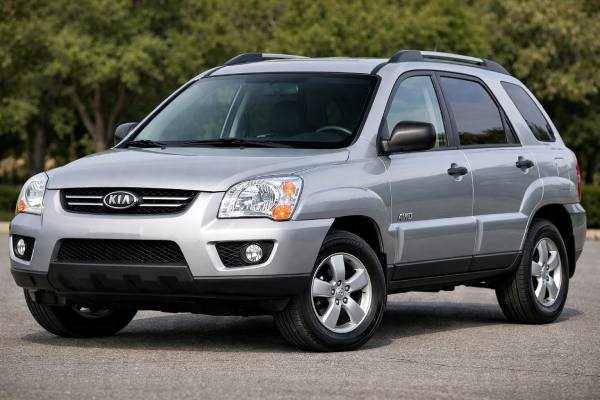
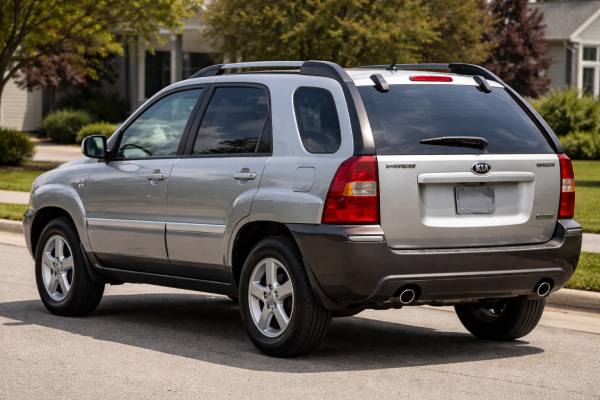
The 2005–2007 Kia Sportage FWD with the 2.0-liter D4EA diesel is one of those crossovers that makes more sense the longer you look at it. It was part of the second-generation KM range, the point where Sportage moved away from the old body-on-frame formula and became a front-drive-based family SUV. That change gave it better cabin space, easier road manners, and lower everyday running effort than the first-generation model.
For owners today, the appeal is straightforward. The 113 hp diesel offers useful low-end torque, simple mechanical packaging compared with later emissions-heavy diesels, and a roomy body that still feels compact in town. The weak points are equally clear: age-related corrosion underneath, diesel fuel-system wear, timing-belt discipline, and trim-dependent safety equipment. Buy a good one and it is still a practical, honest used SUV. Buy a neglected one and small deferred jobs quickly stack into an expensive catch-up list.
Essential Insights
- Strong low-rpm diesel torque makes it easier to drive than the modest power figure suggests.
- Front-wheel drive keeps weight, complexity, and service costs lower than comparable AWD versions.
- The cabin and cargo area are genuinely useful for a compact SUV of this era.
- Check fuel-system condition, rust around the rear underside, and timing-belt history before anything else.
- Kia’s later service-interval guide lists 10,000 miles or 12 months for 2005–2007 diesel Sportage models.
Navigate this guide
- Kia Sportage KM diesel profile
- Kia Sportage KM technical figures
- Kia Sportage KM grades and protection
- Known faults and campaign history
- Upkeep plan and used-buy tips
- On-road manners and economy
- Rival check and value
Kia Sportage KM diesel profile
The KM-generation Sportage marked a big reset for the model. Instead of chasing the old compact off-roader formula, Kia aimed at the expanding family-crossover market. That matters because the 2005–2007 front-wheel-drive diesel behaves much more like a practical road SUV than a rugged trail truck. It shares its general platform logic with the Hyundai Tucson of the same period, which means a transverse powertrain, car-like driving position, and better packaging efficiency than the first-generation Sportage ever offered.
In D4EA 2.0 CRDi form, the early diesel sat in the sensible middle of the range. The headline figure of 113 hp does not sound impressive, but the engine’s real value is torque. In normal use, the diesel pulls willingly from low revs and suits the Sportage’s relaxed mission better than the entry petrol. For buyers who spend time on rural roads, commute longer distances, or carry passengers and luggage often, the diesel is the more natural fit.
The FWD version has a specific used-market advantage: simplicity. Compared with AWD models, there is no transfer case, no rear differential to service, and less driveline mass. That reduces both mechanical drag and the number of age-related faults lurking underneath. It also means the front-drive car is the better choice for owners who mainly drive on paved roads and want the lowest ownership risk in an older Sportage.
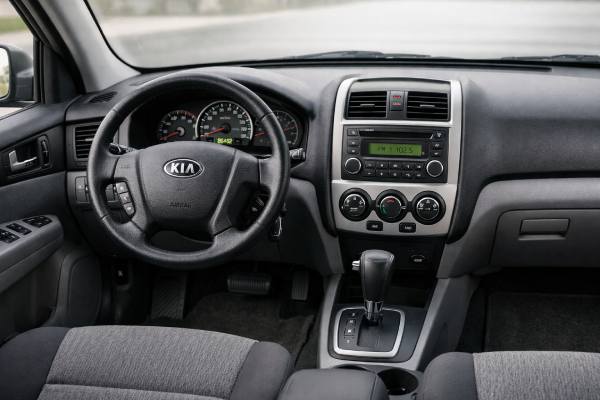
Another reason the KM still deserves attention is packaging. It is compact enough to park easily, yet it offers a useful upright cabin, a wide rear opening, and a square cargo area. Measured by modern standards, the dashboard is plain, but visibility is good and the controls are easy to understand. For many owners, that matters more than styling drama.
The trade-off is that this is still an early-2000s Kia. Material quality is decent rather than rich, road noise is more noticeable than in newer rivals, and safety equipment varies a lot by market and trim. The best way to think about this Sportage is as a value-focused diesel family SUV with honest strengths: space, mechanical simplicity, and low-speed flexibility. Its long-term appeal depends less on the badge and more on whether the previous owners kept up with timing-belt service, fluid changes, and underbody care.
Kia Sportage KM technical figures
The table below focuses on the 2005–2007 FWD diesel model with the D4EA 2.0-liter engine. Some figures vary slightly by market, emissions calibration, wheel size, and transmission, so the safest rule is to verify final details by VIN before ordering parts or quoting workshop values.
Powertrain and efficiency
| Item | Typical data for 2005–2007 Sportage FWD diesel |
|---|---|
| Code | D4EA |
| Engine layout and cylinders | Front transverse inline-4, 4 cylinders |
| Valvetrain | SOHC, 4 valves per cylinder |
| Bore × stroke | 83.0 × 92.0 mm (3.27 × 3.62 in) |
| Displacement | 2.0 L (1,991 cc) |
| Induction | Turbocharged diesel |
| Fuel system | Common-rail direct injection |
| Compression ratio | About 17.7:1 |
| Max power | 113 hp (83 kW) @ about 4,000 rpm |
| Max torque | About 245 Nm (181 lb-ft) @ about 1,800–2,000 rpm |
| Timing drive | Belt |
| Rated efficiency | Commonly around 6.7–7.1 L/100 km (35.1–33.1 mpg US / 42.1–39.8 mpg UK), depending on test cycle |
| Real-world highway @ 120 km/h | Roughly 6.7–7.4 L/100 km in healthy condition |
Transmission and driveline
| Item | Typical data |
|---|---|
| Transmission | 5-speed manual most common |
| Automatic option | 4-speed automatic in some markets |
| Drive type | FWD |
| Differential | Open |
Chassis and dimensions
| Item | Typical data |
|---|---|
| Front suspension | Independent MacPherson strut |
| Rear suspension | Independent multi-link |
| Steering | Hydraulic power steering |
| Brakes | Front vented discs, rear discs on many European diesel trims |
| Most popular tyre sizes | 215/65 R16 or 235/60 R16 |
| Ground clearance | Market dependent, commonly around 188–195 mm (7.4–7.7 in) |
| Length / width / height | 4,350 / 1,800 to 1,840 / 1,695 to 1,730 mm (171.3 / 70.9 to 72.4 / 66.7 to 68.1 in) |
| Wheelbase | 2,630 mm (103.5 in) |
| Turning circle | About 10.9 m (35.8 ft) |
| Kerb weight | Commonly about 1,560–1,620 kg (3,439–3,572 lb) |
| Fuel tank | 58 L (15.3 US gal / 12.8 UK gal) |
| Cargo volume | Commonly listed around 667 to 1,886 L (23.6 to 66.6 ft³), method varies by market |
Performance and capacities
| Item | Typical data |
|---|---|
| 0–100 km/h (0–62 mph) | About 12.5–13.5 s |
| Top speed | About 170–176 km/h (106–109 mph) |
| Braking distance | Not consistently published for this exact trim |
| Towing capacity | 1,400 kg (3,086 lb) braked / 500 kg (1,102 lb) unbraked for 2WD diesel in the manual |
| Payload | Usually around 550–650 kg depending on trim and equipment |
Fluids and service capacities
| Item | Typical data |
|---|---|
| Engine oil | ACEA B4 for early wastegate version or ACEA C3 for VGT listing; 5.9 L (6.2 US qt) with filter |
| Coolant | Ethylene-glycol based for aluminium radiator; 8.7 L (9.2 US qt) diesel |
| Manual transmission oil | API GL-4 SAE 75W-85; 2.1 L on 5-speed manual |
| Automatic transmission fluid | Diamond ATF SP-III / SK ATF SP-III; 7.8 L |
| Differential / transfer case | Not applicable on FWD model |
| Brake / clutch fluid | FMVSS 116 DOT-3 or DOT-4; 0.7–0.8 L |
| Wheel nut torque | 88–107 Nm (65–79 lb-ft) |
On paper, the Sportage KM diesel is not exciting. In practice, the combination of useful torque, decent space, and manageable service data is exactly what makes it appealing as an older daily-use SUV.
Kia Sportage KM grades and protection
Trim structure on the 2005–2007 Sportage varied a lot by country, so it is more helpful to think in equipment bands than in a single universal trim ladder. In Europe and the UK, the 113 hp front-drive diesel usually appeared in lower-to-mid trim levels, with equipment names such as XE, XS, LX, EX, or their local equivalents. The core differences were less about powertrain and more about convenience, wheel size, and safety features.
Entry versions often paired the diesel with steel wheels or basic alloys, cloth trim, manual air conditioning, and a simple audio unit. Mid-level cars typically added 16-inch alloys, better seat trim, rear privacy glass in some markets, cruise control, roof rails, and sometimes automatic climate control. Higher-spec diesel trims could include heated front seats, leather or part-leather trim, a sunroof, automatic lights, and extra exterior detailing.
Quick visual identifiers help when advertisements are vague:
- 215/65 R16 tyres usually point to the more common 16-inch setup.
- 235/60 R16 tyres often indicate a higher visual specification or different market package.
- Roof rails, climate-control panels, and steering-wheel audio buttons usually signal a better-equipped car.
- ESC, side airbags, and curtain airbags were not always universal, so the presence of warning lights and trim labels matters.
Safety is where age and market variation become important. Front airbags were standard, and many better trims added front side airbags and curtain airbags. ISOFIX child-seat anchors were part of the vehicle’s family-SUV brief, and ABS was common on diesel models. Electronic stability control, however, was not guaranteed across all markets in the early years. That means two apparently similar 2006 diesel Sportages can differ in real safety equipment.
For crash-test context, the safest precise public reference for the pre-facelift family is the IIHS 2006 Sportage 4-door rating set. It recorded acceptable scores for moderate-overlap frontal impact and side impact, but poor ratings for roof strength and head restraints. That is respectable for the period, but clearly behind today’s standards. Buyers should also be careful not to apply later facelift five-star Euro NCAP figures directly to this 2005–2007 113 hp FWD version, because equipment, structure details, and test protocol timing do matter.
ADAS does not enter the picture here. There is no autonomous emergency braking, adaptive cruise control, lane-centering, blind-spot monitoring, rear cross-traffic alert, or traffic-sign recognition. That actually simplifies ownership: there are no radar sensors to calibrate after bumper work and no camera-based lane systems to misalign after windshield replacement. But it also means the driver does all the work. For an older used SUV, that trade-off is normal. The key is to judge this Sportage against its era, not against a 2020s crossover.
Known faults and campaign history
The 2005–2007 Sportage KM diesel is generally durable when serviced on time, but it has a few predictable aging patterns. The useful way to read them is by prevalence and severity.
Common and usually medium cost
The D4EA diesel often develops intake and EGR contamination if it spends most of its life on short trips. The signs are familiar: flat throttle response, uneven idle, smoky acceleration, or a tendency to feel strangled above mid-range revs. The root cause is soot and oil residue building up through the intake tract. The fix is cleaning the EGR path and intake system, then checking boost hoses and vacuum control hardware.
Fuel-system wear is another regular issue as mileage climbs. Hard starting, rough cold idle, excessive clatter, or uneven running under load can point to injector leak-off problems, tired glow plugs, or air entering the fuel line. On neglected cars, a blocked fuel filter only makes diagnosis harder. The cure is proper leak-off testing, fresh filtration, and injector work only where test results justify it.
Common and more serious
Timing-belt neglect is the biggest mechanical risk. This engine can tolerate years of service, but it does not tolerate unknown belt history. If there is no dated proof of belt replacement, tensioner work, and ideally water-pump service, assume the job is due now. That one missing document changes the real value of the vehicle.
Clutch and dual-mass flywheel wear can also show up on manual cars. Symptoms include idle rattle, vibration on take-up, judder when moving off, or slip under full torque in higher gears. It is not a reason to reject the car automatically, but it is a strong bargaining point because the job is labour-heavy.
Occasional but worth checking
Front suspension bushes, anti-roll-bar links, wheel bearings, and ABS wheel-speed sensors are routine weak points on heavier diesel front-drive crossovers of this age. A Sportage that feels vague or noisy on rough roads usually needs straightforward chassis work rather than anything exotic.
Underbody corrosion matters too. The shell is better than the first-generation Sportage, but rust still appears around rear underbody fittings, brake lines, subframe areas, and fuel-tank hardware. Kia later issued a product-improvement campaign on certain 2005–2007 Sportage models to replace fuel-tank straps with improved parts, which tells you exactly where the factory saw long-term durability risk.
Recall history is not huge, but there is one especially relevant campaign: the stop-lamp-switch recall covering 2006–2007 Sportage vehicles in the U.S. market. A failed switch could affect brake-light operation, ESC warning behavior, cruise-control cancellation, and even shifter release. On an older car, that history is still relevant because a bad stop switch can create several symptoms that owners wrongly blame on bigger electrical faults.
Before purchase, ask for four things: full service history, proof of timing-belt work, evidence that campaign work was checked by VIN, and recent fluid-service records. Those documents matter more than polish, wheels, or a clean engine bay.
Upkeep plan and used-buy tips
A sensible maintenance plan is what separates a dependable Sportage KM diesel from a troublesome cheap SUV. Kia’s later interval guide lists 10,000 miles or 12 months for 2005–2007 diesel models, but on a vehicle of this age, shorter fluid cycles make more sense if you want to protect the turbocharger, injection system, and belt-driven engine.
| Item | Practical interval | Notes |
|---|---|---|
| Engine oil and filter | 6,000–8,000 miles or 12 months | Shorter intervals suit older diesels |
| Engine air filter | Inspect every service, replace 15,000–20,000 miles | Sooner in dusty use |
| Cabin filter | 12 months or as needed | Easy to ignore, easy to fix |
| Fuel filter | About every 30,000 km or 24 months | Sooner if fuel quality is poor |
| Timing belt, tensioners, and idlers | By 150,000 km or 120 months | Treat missing proof as immediately due |
| Coolant | First at 90,000 km or 60 months, then every 45,000 km or 24 months | Water pump should be checked during belt work |
| Auxiliary belts | Inspect at every service | Replace at first crack, glazing, or noise |
| Brake fluid | Every 2 years | Moisture matters on cars that sit |
| Manual gearbox oil | 40,000–60,000 miles | Often overlooked on used examples |
| Automatic ATF | 40,000–50,000 miles | Helps shift quality and longevity |
| Brake pads and rotors | Inspect every service | Rear hardware can corrode before it wears out |
| Tyre rotation and alignment | 6,000–8,000 miles | Good way to spot suspension wear |
| Battery test | Annually after year 4 | Weak batteries create false diesel starting complaints |
Useful fluid data for workshop decisions is strong on this generation. The diesel takes 5.9 liters of oil with filter. Coolant capacity is 8.7 liters. The 5-speed manual gearbox takes 2.1 liters of API GL-4 SAE 75W-85. Brake and clutch fluid spec is DOT-3 or DOT-4. Wheel nuts tighten to 88–107 Nm. Those are the numbers owners most often need when checking whether a service invoice looks sensible.
As a buyer, inspect in this order:
- Timing-belt proof and service receipts.
- Cold start behavior and diesel smoke.
- Underbody rust, especially fuel-tank area and brake lines.
- Clutch take-up and flywheel noise.
- Front suspension play and tyre wear pattern.
- Air conditioning, heater fan, window switches, and central locking.
- Evidence of water leaks into the cabin or luggage area.
The best buy is usually a front-drive manual diesel with modest wheel size, full history, and no cosmetic tuning. The version to avoid is the shiny but undocumented example with a noisy clutch, damp underside, and no belt record. Long term, a well-kept FWD Sportage can age better than expected because its design is simple and its space remains genuinely useful.
On-road manners and economy
The 113 hp Sportage diesel is better than its numbers suggest, as long as you expect calm usefulness rather than speed. The first thing you notice on the move is the easy driving position. Visibility is good, the seat base is high enough to feel SUV-like without being truck-like, and the controls are simple. For everyday urban and suburban driving, it still feels unintimidating.
Ride quality is one of the KM’s stronger points. It is firmer than a large family hatchback, but not harsh, and the suspension handles broken roads more calmly than many smaller crossovers of the same era. Straight-line stability is decent, especially on standard-size tyres. The downside is steering feel. It is light and predictable, but not especially communicative. Push harder into bends and the car leans early, reminding you that its priorities are comfort and security, not sharp handling.
The diesel engine suits the chassis well. There is some lag below the main torque band, but once the turbo is working, the Sportage moves with enough confidence for normal overtakes and loaded family use. The 5-speed manual is the gearbox to have because it lets you hold the engine in its strong mid-range and generally feels better matched to the 113 hp tune than the slower automatic. The automatic is usable, but it makes the car feel more relaxed than responsive.
Noise, vibration, and harshness are typical for an early common-rail diesel SUV. Around town, you hear the engine at idle and under load, though it settles once warm. At highway speeds, wind and tyre noise become more noticeable than engine noise. It is not refined by modern standards, but it is not wearing when the car is healthy.
Real-world economy is a core part of the verdict:
- City: about 8.0–9.5 L/100 km, or 29.4–24.8 mpg US and 35.3–29.7 mpg UK.
- Highway: about 6.1–6.9 L/100 km, or 38.6–34.1 mpg US and 46.3–40.9 mpg UK.
- Mixed use: about 6.8–7.8 L/100 km, or 34.6–30.2 mpg US and 41.5–36.2 mpg UK.
- Cold weather penalty: often around 0.5–1.0 L/100 km in short-trip winter driving.
Towing is modest but useful. The owner’s manual gives the FWD diesel a 1,400 kg braked limit and 500 kg unbraked. That is enough for a light trailer or small leisure load, but not a reason to buy the car if you tow often in hilly terrain. Under moderate load, expect fuel use to rise by roughly 20–30 percent.
In short, the Sportage diesel drives like a competent practical tool. It does not surprise you, but it usually does what owners need without drama.
Rival check and value
The Sportage FWD diesel makes the most sense when compared with mid-2000s compact SUV rivals rather than with modern cars. In that company, it lands as the value-focused choice with a good mix of space and torque, but not the strongest badge image or the most polished dynamics.
| Rival | Main advantage over Sportage | Sportage’s answer |
|---|---|---|
| Hyundai Tucson 2.0 CRDi | Similar engineering with slightly stronger market familiarity in some places | Often cheaper to buy for nearly the same hardware |
| Honda CR-V 2.2 i-CTDi | More refined cabin and stronger long-distance feel | Usually lower purchase price and simpler used-market entry |
| Toyota RAV4 D-4D | Strong reliability image and better resale | Better value per dollar or euro spent |
| Nissan X-Trail dCi | Boxier utility and stronger rough-road image | More car-like cabin feel and easier urban size |
Its closest rival is really the Hyundai Tucson, because the two share so much underneath. If both cars are in equal condition, the choice often comes down to price, service history, and trim level rather than any major engineering difference. That is good news for Sportage buyers because it means you can usually find parts knowledge and mechanical overlap without paying a premium.
Against a Honda CR-V diesel, the Kia feels less sophisticated, especially in steering response and cabin finish. Against a Toyota RAV4 diesel, it loses on reputation and, in many markets, on resale confidence. But the Sportage usually wins the value argument. You often get comparable space, useful diesel torque, and a simpler ownership path for less money upfront.
That value equation only works if the car is healthy. A cheap example that needs belt work, front suspension, injector diagnosis, and underbody rust repair is not a bargain. A documented, rust-checked, front-drive manual diesel can be. That is the central comparison point with rivals: the Sportage does not need to beat them on every metric. It only needs to offer enough practicality and low-speed usability to justify its lower price.
For many buyers today, that is exactly where it succeeds. It is not the most desirable compact SUV of its time, but it is one of the more understandable ones. For owners who want a straightforward diesel family crossover without the added complexity of AWD, the 2005–2007 Kia Sportage FWD still makes a credible case.
References
- Kia Sportage instruktionsböcker | Kia Sweden 2022 (Owner’s Manual)
- Service Intervals V25.1 2025 (Service data)
- 2006 Kia Sportage 2006 (Safety Rating)
- April 23, 2009 ROBERT BABCOCK NVS-215dgl SENIOR MANAGER, REGULATIONS 09V-130 2009 (Recall Database)
- Kia Global Information System – TSB 2018 (TSB)
Disclaimer
This article is for informational purposes only and is not a substitute for professional diagnosis, inspection, or repair. Specifications, torque values, service intervals, procedures, and fitted equipment can vary by VIN, market, emissions version, transmission, and trim, so always verify critical details against official service documentation for the exact vehicle.
If this guide was useful, please consider sharing it on Facebook, X, or other social platforms to support our work.