
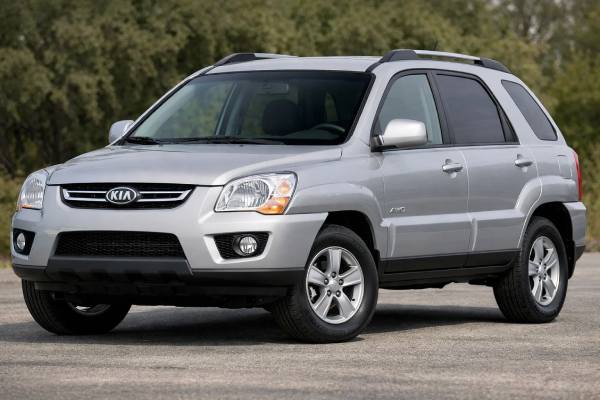
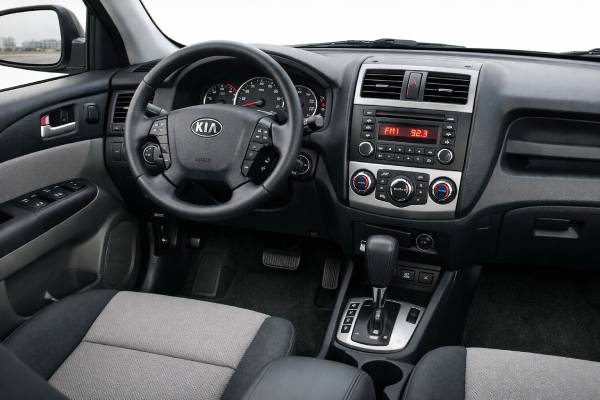
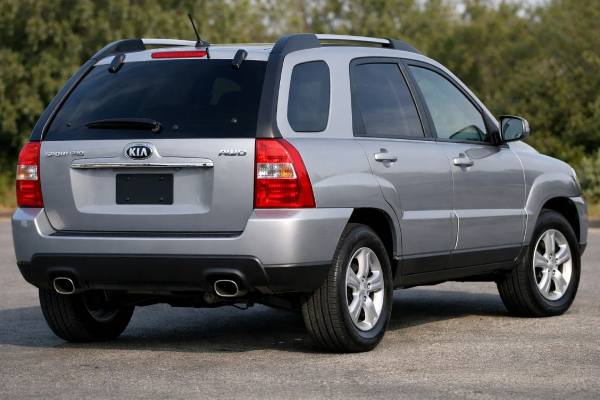
The facelifted 2008–2010 Kia Sportage KM with the G6BA 2.7-litre V6 is the version people often overlook when they focus only on the cheaper 2.0 petrol or diesel models. That is a mistake. This V6 AWD Sportage is not modern by current crossover standards, but it offers a useful blend of smooth six-cylinder power, compact exterior size, a simple hydraulic-steering feel, and a straightforward on-demand four-wheel-drive system with a lock mode for low-grip conditions. It is also one of the more honest used SUVs of its era: no turbocharger, no direct injection, no dual-clutch gearbox, and no complicated hybrid hardware. The trade-off is clear. Fuel use is higher, the 4-speed automatic feels old, and neglected cars become expensive through many small faults rather than one dramatic failure. Buy a clean, rust-controlled, well-documented example, though, and the facelift KM V6 still makes sense as an affordable all-weather family SUV.
Fast Facts
- The 2.7-litre V6 gives the facelift KM stronger low-speed pull and smoother cruising than the 2.0 petrol.
- Standard V6 automatic and AWD make it a useful winter and towing companion for buyers who do not need serious off-road hardware.
- Kia’s compact body and simple cabin layout still make the vehicle easy to live with in town.
- Rust, overdue timing-belt service, and old automatic-transmission fluid matter more than mileage alone.
- Factory maintenance guidance points to oil service every 15,000 km or 12 months and timing-belt replacement every 150,000 km or 120 months, with shorter intervals under hard use.
Navigate this guide
- Kia Sportage KM V6 character
- Kia Sportage KM data tables
- Kia Sportage KM grades and safety
- Known faults and campaigns
- Maintenance plan and buyer checks
- On-road feel and fuel use
- Rivals and best alternatives
Kia Sportage KM V6 character
The facelift KM Sportage sits at an interesting point in compact-SUV development. It has the basic shape and seating position buyers wanted in the late 2000s, yet it still drives with many traits from an earlier mechanical era. You get a steel unibody shell, fully independent suspension, hydraulic power steering, and a conventional naturally aspirated V6 linked to an old-school torque-converter automatic. That combination matters because it explains why the 2.7 AWD model feels different from many rivals. It is smoother and quieter at low load than a four-cylinder version, but it is also thirstier and less efficient than newer engines.
The G6BA engine is part of Kia and Hyundai’s Delta V6 family. In this Sportage application it gives the car the kind of easy, linear response that suits normal road driving. There is no turbo lag, no need to chase revs just to keep up with traffic, and no complicated electrified system filling in the gaps. Around town, that makes the V6 Sportage easier and calmer than the 2.0 petrol. On a light throttle, it feels more relaxed than the paper figures alone suggest. That is one reason this version still appeals to used buyers who value drivability over fuel economy.
The other key part of the character is the AWD system. This is not a low-range, body-on-frame off-roader. It is an on-demand crossover system designed to help on wet roads, loose surfaces, snow, and steep driveways. The driver-selectable lock mode gives the car more predictable traction at low speed, which is useful in winter or on muddy tracks, but it is not meant for prolonged dry-road use or for replacing a true locking transfer case. In practical terms, the Sportage V6 AWD is best understood as a compact family SUV with extra grip, not a trail rig.
The facelift itself mainly sharpened the presentation rather than changing the whole engineering package. That matters for buyers today, because the 2008–2010 cars still feel closely related to the earlier KM but can be easier to live with in day-to-day use if they were better equipped. In some export markets, the 2.7 V6 appeared only in upper trims, often paired with leather, a sunroof, and more convenience equipment.
Ownership today depends far more on history than spec. A clean, rust-free V6 AWD with a recent timing-belt service, healthy cooling system, and fresh driveline fluids can feel durable and solid. A neglected one can feel like a chain of medium-cost jobs waiting to happen. That is the real identity of this model: fundamentally simple, genuinely usable, but very sensitive to how carefully previous owners treated it.
Kia Sportage KM data tables
The table below focuses on the facelift 2008–2010 Kia Sportage KM AWD with the G6BA 2.7-litre petrol V6. Some figures varied slightly by market, trim, wheel package, and local homologation, so rows that were not consistently published in open factory material are marked accordingly instead of guessed.
| Powertrain and efficiency | Data |
|---|---|
| Code | G6BA |
| Engine layout and cylinders | 60-degree V6, 6 cylinders, DOHC, 4 valves per cylinder |
| Bore × stroke | 86.7 × 75.0 mm (3.41 × 2.95 in) |
| Displacement | 2.7 L (2,656 cc) |
| Induction | Naturally aspirated |
| Fuel system | Multi-port fuel injection |
| Compression ratio | 10.4:1 |
| Max power | 175 hp (129 kW) @ 6,000 rpm |
| Max torque | 241 Nm (178 lb-ft) @ 4,000 rpm |
| Timing drive | Belt |
| Transmission | 4-speed automatic |
| Drive type | On-demand AWD with driver-selectable lock mode |
| Differential | Open front and rear, electronically controlled center coupling |
| Rated efficiency | EPA-style 4WD figure: 18/23 mpg US city/highway; about 11.8 L/100 km combined (20 mpg US / 24 mpg UK) |
| Real-world highway @ 120 km/h | Usually about 10.5–11.5 L/100 km (22.4–20.5 mpg US / 26.9–24.6 mpg UK) |
| Chassis and dimensions | Data |
|---|---|
| Suspension, front / rear | MacPherson strut / dual-link independent |
| Steering | Hydraulic power-assisted rack-and-pinion |
| Steering ratio | Not consistently published in open factory sources |
| Brakes | Four-wheel discs; exact diameters vary by market literature |
| Wheels and tyres | Most common size 235/60 R16 on 6.5J×16 wheels |
| Ground clearance | About 195 mm (7.7 in), market dependent |
| Length / width / height | 4,350 / 1,800 / 1,695 mm (171.3 / 70.9 / 66.7 in) |
| Height with roof rails | 1,730 mm (68.1 in) |
| Wheelbase | 2,630 mm (103.5 in) |
| Front / rear track | 1,540 / 1,540 mm, or 1,550 / 1,550 mm with wider tyre package |
| Turning circle | Not consistently published in open factory sources |
| Kerb weight | Usually around the mid-1,600 kg range, depending on market and equipment |
| GVWR | Market dependent |
| Fuel tank | 65 L (17.2 US gal / 14.3 UK gal) |
| Cargo volume | Roughly compact-SUV class average; published methods vary by market |
| Performance and capability | Data |
|---|---|
| 0–100 km/h (0–62 mph) | About 10.5–11.0 s |
| Top speed | About 180 km/h (112 mph) |
| Braking distance | No open factory stopping-distance figure consistently published |
| Towing capacity | 750 kg (1,653 lb) unbraked / 1,600 kg (3,527 lb) braked |
| Maximum tow-ball load | 75 kg (165 lb) |
| Payload | Usually about 500–550 kg, market dependent |
| Fluids and service capacities | Data |
|---|---|
| Engine oil | API SJ/SL or higher, ILSAC GF-3 or higher; typically 10W-30; 4.5 L (4.8 US qt) with filter |
| Coolant | Ethylene-glycol based coolant for aluminum radiator; 7.0 L (7.4 US qt) |
| Automatic transmission fluid | DIAMOND ATF SP-III or SK ATF SP-III; 7.8 L (8.2 US qt) |
| Transfer case oil | API GL-5 or higher; 0.8 L (0.85 US qt) |
| Rear differential oil | SAE 80W-90; 0.75 L (0.79 US qt) |
| Power steering fluid | PSF-III; 0.9 L (0.95 US qt) |
| Brake and clutch fluid | FMVSS 116 DOT 3 or DOT 4; 0.7–0.8 L |
| Wheel nut torque | 88–107 Nm (65–79 lb-ft) |
| Safety and driver assistance | Data |
|---|---|
| IIHS crash ratings, 2005–2010 generation | Moderate overlap front: Acceptable; side: Acceptable; roof strength: Poor; head restraints and seats: Good |
| Euro NCAP | No clearly separable public facelift-KM result confirmed for this exact V6 AWD configuration |
| Headlight rating | Not part of IIHS assessment for this generation |
| ADAS suite | No AEB, ACC, lane-centering, blind-spot warning, rear cross-traffic alert, or traffic-sign recognition |
| Stability and braking aids | ABS standard; ESC and traction-related features varied by trim and market |
The important takeaway from the numbers is simple. This is a compact SUV with a genuinely useful V6 and respectable towing ability for its size, but it pays for that with fuel consumption and an old 4-speed automatic. Buyers who want the smoothest KM Sportage will prefer it. Buyers who want the cheapest fuel bills will not.
Kia Sportage KM grades and safety
Trim structure for the facelift V6 AWD depended heavily on region, and that matters more than many buyers realize. In North America, the 2.7-litre engine often appeared in higher automatic trims because the V6 was positioned as the premium drivetrain. In some European and export markets, Kia historical pricing and equipment lists show the 2.7 as an upper-grade automatic model, often described in terms similar to EX or EX Full Auto. That usually meant the V6 came bundled with more comfort and convenience equipment, not just more engine.
The practical effect is that most 2.7 AWD facelift cars are better equipped than a typical 2.0 model. Common upgrades included alloy wheels, automatic transmission, upgraded seat trim, climate-control improvements, cruise control, a sunroof in some markets, and a more complete audio setup. Just as important, some markets bundled safety features into those better trims. So, when shopping, the V6 often brings both more equipment and more weight. That helps comfort, but it can also make suspension wear and fuel use slightly worse than on a lighter four-cylinder car.
Mechanical differences between trims were more important than cosmetic ones. The V6 AWD model was usually automatic only, and the tyre size most commonly associated with it was 235/60 R16. The AWD hardware remained crossover-oriented rather than heavy-duty. You still had the lock mode for low-grip surfaces, but not low range, not a locking rear differential, and not the sort of underbody protection expected from a dedicated off-roader. That makes wheel and tyre condition especially important. A V6 AWD Sportage on a matched set of decent all-season or winter tyres feels secure. The same vehicle on mixed worn tyres feels far less convincing.
Safety equipment was good for the time, even if it is dated now. The key hardware in most markets included front airbags, front side airbags, full-length curtain airbags, ABS, and child-seat anchorage points. ESC was available and often included on better-equipped examples, but standard fit was not universal in every market. That means buyers should verify by VIN or by the actual dashboard switch and warning-lamp layout, rather than by assuming all V6 cars were identical.
The IIHS results give useful context. For the 2005–2010 Sportage generation, the vehicle earned Acceptable ratings in the original moderate-overlap front and side-impact tests, Good for head restraints and seats, and Poor for roof strength. That mix sounds uneven today because it is. By late-2000s standards the structure and restraint package were reasonable, but this is still an older compact SUV from before the era of strong small-overlap performance and routine crash-avoidance technology. There is no factory autonomous emergency braking, no adaptive cruise control, and no lane-keeping assist to help a distracted driver.
That is why condition matters as much as equipment. On this generation, safety is closely tied to maintenance. Strong tyres, healthy dampers, even brake wear, functioning ABS sensors, and an intact airbag system do more for real security than the trim badge on the tailgate. In used form, the best-equipped Sportage is only the best choice if those fundamentals still work properly.
Known faults and campaigns
The facelift KM V6 is best understood as a vehicle with medium mechanical complexity but high age-related risk. In other words, the design itself is not especially exotic, but the newest examples are now old enough that small faults can accumulate into a tiring ownership experience. The good news is that most problem areas are known. The bad news is that many examples have had just enough maintenance to stay mobile, not enough to stay truly sorted.
Common and medium-cost issues start with timing-belt neglect. The G6BA is a belt-driven V6, and an overdue belt service on a twenty-year-old SUV is a major warning sign. A seller who says the belt was “probably done” is not giving enough information. Alongside the belt, the water pump and tensioning hardware deserve the same attention. Cooling-system aging is the next major concern. Radiators, thermostat housings, hoses, clamps, and coolant neglect do not look dramatic until the car overheats, and V6 engine bays do not make leak tracing as easy as on a simple inline-four.
Oil seepage is also normal by now. Typical sources include rocker-cover gaskets, front seals, and tired PCV-related breathing issues that encourage dampness around the top of the engine. Most of these are low-to-medium severity rather than catastrophic, but they matter because they can drip onto other parts, soften rubber, or hide bigger problems. Oxygen sensors and ageing catalytic converters are another occasional V6 expense, especially if the engine has spent years running rich because of sensor faults or neglected ignition parts.
The automatic transmission is usually durable when the fluid has been renewed on schedule, but old ATF changes the story. The symptoms are familiar: delayed engagement into Drive or Reverse, flared upshifts, harsh cold shifts, or lazy kickdown. These boxes rarely benefit from denial. If the fluid is dark, smells burnt, or has never been changed, assume the transmission has had a harder life than the odometer suggests.
On the driveline and chassis side, pay close attention to the rear differential, transfer case, driveshaft joints, wheel bearings, front lower arm bushes, drop links, and rear suspension links. A clonk on take-up, humming at speed, or vibration under load usually points to wear that is manageable early but costly if ignored. Rust makes everything worse. Brake pipes, fuel lines, rear underbody seams, tank straps, mounting points, and subframe areas deserve careful inspection, especially in salt-use regions.
Campaign history is essential. Certain 2008–2009 Sportages were recalled for Hydraulic Electronic Control Unit issues that could create fire risk, and Kia later expanded recall action for previously repaired vehicles. There is also a later 2010-specific HECU fuse campaign in some markets. These are not small paperwork items. A buyer should verify completion through an official VIN check and dealer records, not a seller’s memory.
Before purchase, ask for six things: documented timing-belt service, coolant and ATF history, recall completion records, proof of recent AWD fluid work, close underbody photos, and a scan for stored fault codes. The facelift V6 Sportage can be dependable, but only when it has been maintained like a V6 AWD vehicle rather than treated like a cheap disposable runabout.
Maintenance plan and buyer checks
The maintenance plan for the V6 AWD Sportage is straightforward on paper and demanding in real life. Straightforward, because the vehicle uses conventional fluids and service items. Demanding, because age now matters as much as distance. Even a low-mileage example may need time-based work on belts, hoses, seals, brakes, tyres, and suspension rubber. That is why the best strategy is to reset the baseline as soon as you buy one unless the records are unusually strong.
A practical schedule for ownership today looks like this:
| Item | Normal-use interval | Hard-use guidance |
|---|---|---|
| Engine oil and filter | Every 15,000 km or 12 months | Every 7,500 km or 6 months |
| Engine air filter | Inspect regularly; replace by condition | Sooner in dust or salt-heavy use |
| Cabin air filter | Replace regularly; often yearly | More often in dusty climates |
| Timing belt | Inspect at 90,000 km or 48 months; replace by 150,000 km or 120 months | Replace every 60,000 km or 48 months in severe service |
| Spark plugs | Follow plug type; iridium lasts longest | Inspect early if idle is rough |
| Coolant | First change at 90,000 km or 60 months; then every 45,000 km or 24 months | Do not extend if history is unclear |
| Automatic transmission fluid | Inspect routinely; refresh well before wear symptoms | Around every 45,000 km in severe use |
| Transfer case oil | Inspect routinely | Every 40,000 km in severe use |
| Rear differential oil | Inspect routinely | Every 80,000 km in severe use |
| Brake fluid | Every 24 months is sensible | Same |
| Brake pads and rotors | Inspect every service | Same |
| Battery | Test yearly after year four | Same |
| Auxiliary belts and hoses | Inspect at every service | Replace by condition, not optimism |
| Wheel alignment and tyre rotation | Rotate and inspect at regular service visits | Same |
The buyer’s checklist should be just as structured:
- Confirm the timing belt with invoices, not verbal claims.
- Check for coolant staining, crusted joints, and radiator ageing.
- Inspect ATF condition and ask whether the gearbox has ever been serviced.
- Verify transfer case and rear differential fluids on AWD models.
- Look underneath for rust around brake lines, tank mounts, rear floor seams, and suspension points.
- Test every electrical function, especially ABS, ESC, brake lights, central locking, and HVAC controls.
- Drive the car long enough to assess cold shift quality, hot idle stability, and steering feel.
For reconditioning, the usual first-year items are tyres, brakes, battery, fluids, drop links, bushes, and sometimes wheel bearings. That is normal. What should make you walk away is structural rust, no belt history, unresolved warning lights, or obvious overheating signs.
The years to target are the facelift cars with confirmed campaign completion and a recent belt service. The years to avoid are not defined by calendar alone. A clean 2008 beats a neglected 2010 every time. Long-term durability is decent if you stay ahead of fluids and cooling-system care. The Sportage does not reward deferred maintenance, but it does respond well to disciplined ownership.
On-road feel and fuel use
The V6 facelift Sportage is pleasant in a way many modern budget SUVs are not. It does not feel especially fast on paper, but it feels settled and easy to use. The engine starts cleanly, pulls with less fuss than the 2.0 petrol, and makes the vehicle feel less strained when merging, climbing, or carrying passengers. In everyday traffic, that matters more than outright acceleration. You do not have to work the drivetrain hard to get ordinary performance.
The 4-speed automatic is the main reminder of the Sportage’s age. It is smooth when healthy, but it is not quick or clever. It will often hold a lower gear longer than a modern 6- or 8-speed, and on steep roads it can shuffle between gears if the fluid is tired or the throttle input is inconsistent. The benefit is simplicity. The drawback is that motorway refinement and fuel economy suffer compared with newer rivals. A well-serviced transmission behaves predictably. A neglected one makes the whole vehicle feel older than it really is.
Ride quality is solid rather than plush. The independent rear suspension helps the Sportage feel more stable and less agricultural than older body-on-frame SUVs, yet sharp bumps still come through. On broken city streets, the car can feel busy. On faster roads, it settles down and tracks honestly. Hydraulic steering gives more natural weighting than many later electric systems, although true feedback is still limited by the tall body and comfort-oriented chassis tuning.
Noise levels are typical for the class and era. The V6 itself is smooth and unobtrusive at moderate throttle, which is one of the strongest reasons to choose it. Wind and tyre noise become more noticeable at motorway speeds, especially on older door seals or coarse tyres. That makes tyre choice important not only for grip but also for refinement. Cheap, hard tyres can make the cabin seem much noisier than the chassis deserves.
Real-world fuel use is the clear trade-off. Expect roughly 13–15 L/100 km in heavy city use, about 10.5–11.5 L/100 km at a true 120 km/h cruise, and around 11.5–13.5 L/100 km in mixed driving. In US terms, that is roughly 18–16 mpg city, 22–20 mpg highway, and 20–18 mpg combined. Winter use, roof loads, short trips, and aggressive tyres can push those numbers higher quite quickly. Moderate towing can add another 20 to 30 percent.
AWD behavior is reassuring in poor conditions. On rain, slush, gravel, or light snow, the system gives the car a secure, planted feel. The lock mode helps on slippery starts and low-speed loose surfaces, but this is still a compact crossover setup. On dry tarmac, the best Sportage is the one on good tyres with a healthy suspension, not the one with the most aggressive marketing language on its tailgate. Treated within its limits, the V6 AWD Sportage remains a competent and easy companion.
Rivals and best alternatives
The closest rival is the first-generation Hyundai Tucson with the 2.7 V6 and AWD. Mechanically, the two are so close that used buyers should treat them as twin choices rather than separate engineering philosophies. The Hyundai often feels slightly more conservative inside, while the Kia can look a little bolder, especially in facelift form. In practice, buy on condition, underbody health, and paperwork. There is no rational reason to choose a rusty Sportage over a clean Tucson, or the other way around.
The Toyota RAV4 V6 is the obvious performance benchmark of the era. It is faster, stronger at higher speed, and generally more polished as a drivetrain package. It also tends to command stronger prices and, in many markets, has a reputation premium that survives even on older cars. If outright pace, resale, and drivetrain polish are your priorities, the Toyota is the stronger vehicle. If purchase value matters most and you are happy with a simpler, less expensive proposition, the Kia remains attractive.
The Honda CR-V is a different comparison because it stayed with four-cylinder power in this period. It usually wins on interior packaging, easy ownership image, and broad market appeal. The Sportage V6 counters with smoother power delivery, stronger towing usefulness, and a more relaxed feel under load. For a family using the rear seats heavily, the Honda often makes more sense. For a buyer who wants compact size with a smoother six-cylinder engine, the Kia has a clearer identity.
The Suzuki Grand Vitara is the choice for buyers who want more genuine off-road flavor. Some versions offered more serious four-wheel-drive hardware and a more rugged feel, but they were often less roomy and less refined on normal roads. The Sportage is the better all-rounder for mixed daily use. The Suzuki is better for buyers who really care about trails, ruts, and low-speed terrain work.
So who should buy the facelift KM V6 AWD Sportage? The right owner wants a compact, affordable used SUV with a smooth engine, usable AWD, and relatively understandable mechanicals. This car makes the most sense for snowy climates, rural mixed-road use, and buyers who value comfort over outright thrift. It makes the least sense for heavy urban drivers chasing low fuel bills or buyers who expect modern active safety. Viewed honestly, it is neither a hidden sports SUV nor a serious off-roader. It is an old-fashioned, competent compact AWD wagon with a good V6, and that is exactly why the right example still deserves attention.
References
- KM Swedish 3.qxd 2008 (Owner’s Manual)
- Kia Service Intervals 2023 (Service Information)
- 2009 Kia Sportage 2009 (Safety Rating)
- 2008-2009MY Sportage 2022 (Recall Report)
- safety recall campaign – hecu fuse replacement (sc284km) 2023 (Recall Bulletin)
Disclaimer
This article is for informational purposes only and is not a substitute for professional diagnosis, repair, or inspection. Specifications, torque values, service intervals, procedures, and equipment can vary by VIN, market, model year, and trim, so always confirm details against the correct official service documentation for the exact vehicle.
If this guide was useful, please consider sharing it on Facebook, X, or another platform to support our work.