
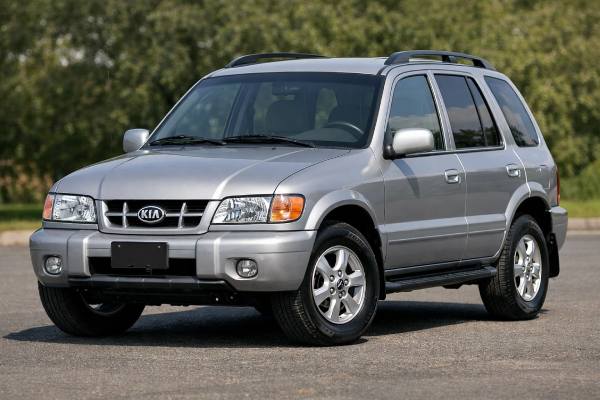
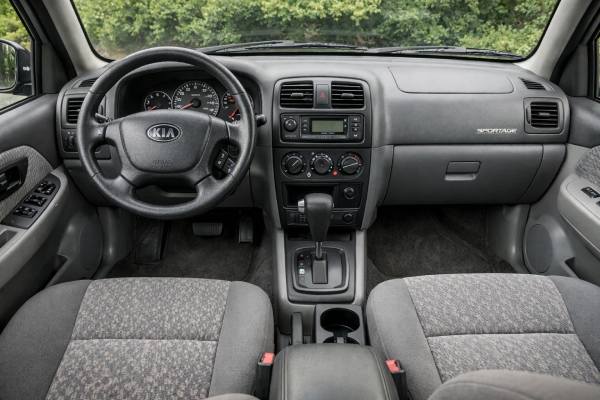
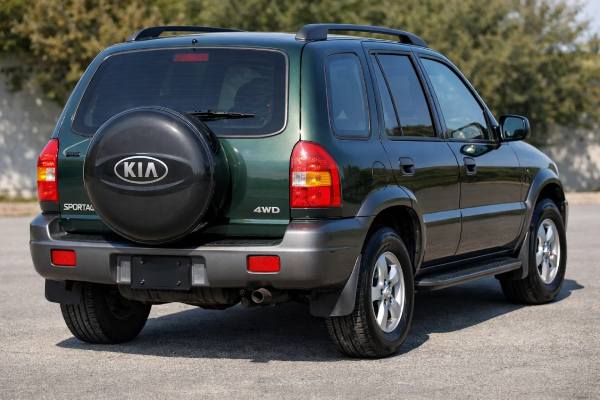
The facelifted first-generation Kia Sportage is one of those SUVs that makes more sense the more honestly you judge it. It is not fast, quiet, or especially modern, but it is simple, sturdy in concept, and built around hardware that still appeals to owners who want a compact diesel 4×4 with real low-speed utility. The first-generation NB-7 Sportage received its facelift late in the model’s life, and the 2000–2002 RF diesel AWD version kept the formula straightforward: a Mazda-sourced 2.0-liter turbo-diesel, a manual gearbox, part-time four-wheel drive, and a tough, old-school chassis rather than a soft crossover setup. That means modest motorway pace, but also decent durability when serviced properly and better rough-surface confidence than many period compact SUV rivals. For the right buyer, that still matters. This is a vehicle best understood as a practical tool: slower than most modern traffic, but refreshingly honest when maintained well.
Quick Specs and Notes
- Best suited to rough roads, snow, tracks, and light utility work rather than fast highway driving.
- The RF turbo-diesel is simple and durable when belt service and cooling upkeep are not neglected.
- Part-time 4×4 hardware gives it more genuine off-road ability than many car-based rivals of its era.
- Rust, fuel-tank condition, and front-suspension wear matter more than odometer reading alone.
- Plan routine servicing every 9,000 miles or 12 months, and treat timing-belt service as a major priority around 60,000 km.
Start here
- Sportage NB-7 Essentials
- Sportage NB-7 Specs and Data
- Sportage NB-7 Trims and Safety
- Reliability, Faults and Recalls
- Maintenance and Buying Advice
- Driving and Diesel Character
- Rivals and Best Fit
Sportage NB-7 Essentials
For the right buyer, this Sportage still has a clear identity. It is a compact SUV from the era before most vehicles in this class became road-biased crossovers. The core appeal is not badge prestige or outright performance. It is the mix of a simple 2.0-liter turbo-diesel, a five-speed manual, a part-time 4×4 system, and a chassis layout that still feels more utility-focused than lifestyle-driven. The facelifted first-generation model carried on with the same basic character through the final production years, which suits the 2000–2002 diesel facelift cars covered here.
The engine is the Mazda-family RF turbo-diesel, a 1,998 cc inline-four with an old-school indirect-injection design, two valves per cylinder, and a timing belt. Output is only about 82 hp, but peak torque of 195 Nm arrives low enough to suit crawling, muddy lanes, and relaxed town use. The published performance figures make the point clearly: 0–100 km/h takes about 20.5 seconds and top speed is about 145 km/h. In other words, it feels usable at low and medium speeds, but never brisk.
The chassis story is just as important. Period specifications describe independent double-wishbone front suspension, a de Dion rear setup with coil springs, and disc-front/drum-rear brakes. That combination gives the Sportage a distinct feel. It is more rugged and mechanical than later Sportages, and more truck-like in the way it reacts to bumps, steering inputs, and heavy braking. At the same time, it stays compact and easy enough to place on narrow roads. Turning circle is about 11.2 m, which is acceptable rather than tight.
This generation also needs to be judged with age in mind. Most surviving examples are now well into classic-daily territory. Reliability is less about whether the design was flawless and more about whether previous owners kept up with belt changes, rust prevention, fuel-system care, and underbody repairs. A well-kept RF diesel Sportage can still be a useful, honest machine. A neglected one can become a slow project with corrosion, suspension wear, and recall-history questions. That gap between good and bad examples is now the main ownership story.
Sportage NB-7 Specs and Data
Open public data for this older diesel AWD Sportage is patchy, and some figures vary by market, body configuration, and measurement method. The tables below reflect the most common 5-door facelift RF diesel data, with range notes where open sources disagree. Wheelbase, engine output, torque, and fuel consumption are quite consistent across sources. Weight, cargo volume, and overall length are less consistent, so those are shown more carefully.
| Powertrain and efficiency | Figure |
|---|---|
| Code | RF / RF-TCI |
| Engine layout and cylinders | Longitudinal inline-4, SOHC, 2 valves per cylinder |
| Bore × stroke | 86.0 × 86.0 mm (3.39 × 3.39 in) |
| Displacement | 2.0 L (1,998 cc) |
| Induction | Turbocharged |
| Fuel system | Indirect diesel injection / prechamber |
| Compression ratio | 21.1:1 |
| Max power | 82 hp (61 kW) @ 4,000 rpm |
| Max torque | 195 Nm (144 lb-ft) @ 2,000 rpm |
| Timing drive | Belt |
| Rated efficiency | 9.1 L/100 km (25.8 mpg US / 31 mpg UK) combined |
| Extra-urban figure | 7.7 L/100 km (30.5 mpg US / 36.7 mpg UK) |
| Transmission and driveline | Figure |
|---|---|
| Transmission | 5-speed manual |
| Published gear ratios | 3.72 / 2.02 / 1.36 / 1.00 / 0.80 |
| Final drive | 4.44:1 |
| Drive type | AWD / 4×4, part-time |
| Differential | Market-dependent; verify axle hardware by VIN and tags |
| Chassis and dimensions | Figure |
|---|---|
| Front suspension | Independent double wishbone, coil springs, anti-roll bar |
| Rear suspension | De Dion axle, coil springs |
| Steering | Power steering; open public sources do not give a reliable ratio |
| Brakes | Front disc about 270 mm; rear drum about 250 mm |
| Common tyre size | 205/70 R15 |
| Length | About 4,120 mm (162.2 in) for common facelift 5-door data |
| Width | 1,764 mm (69.4 in) |
| Height | 1,650 mm (65.0 in) |
| Wheelbase | 2,650 mm (104.3 in) |
| Turning circle | 11.2 m (36.7 ft) |
| Kerb weight | About 1,438–1,468 kg (3,170–3,236 lb) |
| GVWR | About 1,928–1,930 kg (4,251–4,255 lb) |
| Fuel tank | 60 L (15.9 US gal / 13.2 UK gal) |
| Cargo volume | About 373–475 L (13.2–16.8 ft³) seats up, source-dependent |
| Performance and capability | Figure |
|---|---|
| 0–100 km/h (0–62 mph) | 20.5 s |
| Top speed | 145 km/h (90 mph) |
| Payload | About 465–490 kg (1,025–1,080 lb) |
| Braking distance | No dependable period figure found in open sources |
| Towing | Market-dependent; confirm with the VIN plate and manual |
| Fluids and service capacities | Practical note |
|---|---|
| Engine oil | 5W-30 or 10W-30 depending on climate and manual; RF-family open sources often show about 5.5 L with filter, but confirm by dipstick and VIN-specific documentation |
| Coolant | 50:50 ethylene-glycol mix; exact capacity not consistently published in open factory documents |
| Manual gearbox oil | 75W-90 gear oil; exact fill quantity not consistently published in open factory documents |
| Differential and transfer case | Gear oil spec varies by housing and market; confirm before service |
| A/C refrigerant | R134a on most period builds, but charge amount should be confirmed from under-hood labels or service data |
| Key torque specs | Use VIN-specific workshop data; open public sources are too inconsistent to publish as a safe reference |
| Safety and driver assistance | Figure |
|---|---|
| Crash rating | IIHS moderate overlap front: Marginal overall for 1998–2002 4-door models |
| Euro NCAP | No verified period public result found for this exact model in open sources |
| Headlights | No IIHS headlight rating for this generation |
| ADAS | None |
| Core safety equipment | Driver and passenger frontal airbags on later models; ABS often optional, depending on market |
The one specification area worth extra caution is dimensions and cargo space. Public sources disagree more than usual here, likely because they mix short-body, long-body, and market-specific registrations. For buyers and parts planning, the safe constants are the 2,650 mm wheelbase, 205/70 R15 tyre size, 60 L tank, and 61 kW / 195 Nm powertrain figures.
Sportage NB-7 Trims and Safety
Trim strategy on the facelift Sportage was more regional than global. That matters because two seemingly identical 2001 or 2002 RF diesel AWD cars can differ in ABS fitment, wheel style, upholstery, air-conditioning, roof rails, side steps, and even airbag count. On this generation, it is better to buy by actual equipment than by trim name alone. That is especially important now that many surviving examples have mixed wheels, replacement interiors, aftermarket hub parts, or retrofitted accessories.
Mechanically, the diesel AWD versions were usually closer to each other than their badges suggested. The main hardware that shapes the ownership experience stays the same: RF turbo-diesel engine, manual gearbox, part-time 4×4 system, and the same basic suspension and brake architecture. Differences are more often functional than exciting. Common variations include steel versus alloy wheels, air conditioning versus no air conditioning, ABS versus no ABS, and basic cloth interiors versus more comfort-focused upholstery packages. If you are shopping today, the most useful identifiers are practical ones: 205/70 R15 fitment, the presence or absence of ABS hardware, the condition of the transfer-case linkage, and whether the vehicle still carries factory underbody protection pieces.
Safety is a mixed story, and it reflects the era. The key official crash reference that is easy to verify today is IIHS. Its moderate-overlap front test for the 1998 Kia Sportage 4-door 4WD applies to 1998–2002 models and returns a Marginal overall rating, with Marginal structure and safety-cage performance. Driver and passenger frontal airbags became standard beginning with the 1998 model year in that market. That is acceptable context for a late-1990s small SUV, but it is far behind modern expectations. A public Euro NCAP result for this exact first-generation diesel facelift is much harder to verify, so it is safer not to overclaim.
Driver assistance is essentially absent. There is no automatic emergency braking, no lane support, no blind-spot warning, and no modern stability software. Even ABS was not universal in every market. That means tyres, brakes, suspension bushings, and steering condition matter more here than on a newer vehicle with electronics masking weakness. For family use, you also should not assume modern child-seat anchorage standards. Check the actual rear-seat hardware on the vehicle instead of trusting a sales description. In ownership terms, the Sportage’s safety comes down to basic passive protection, predictable handling at sane speeds, and keeping the underbody and suspension in sound shape.
Reliability, Faults and Recalls
The good news is that the RF diesel itself is not a complicated engine by modern standards. It is a cast-iron block, aluminum head, SOHC eight-valve unit with a belt-driven cam and indirect injection. That simplicity is part of the Sportage’s appeal. The bad news is that nearly every problem you will see now is amplified by age. Rubber hardens, cooling systems silt up, vacuum hoses crack, chassis hardware corrodes, and many examples have spent years with overdue belts or cheap patch repairs.
The most common mechanical issues are predictable. First, timing-belt neglect is a real risk. RF engine-family sources point to a 60,000 km belt interval, and a snapped belt can bend valves. Second, oil leaks and sweating around the head-gasket area are common age-related complaints. Third, after very high mileage, cracks around the prechambers and declining cold-start quality can show up. None of that makes the engine fragile, but it does mean a “runs fine” seller description is not enough. You want proof of belt history, even idle quality when cold, and a cooling system that holds temperature properly.
On the vehicle side, rust is often more decisive than the engine. The Sportage has known age-related trouble around the fuel tank, tank straps, protective shielding, underbody seams, and the sending-unit area. In plain language, that means underbody inspection matters. If the tank, straps, shield, or floor edges look crude, scaly, or recently undersealed without preparation, treat that as a major warning. Suspension wear is another concern, especially at the front end. Upper ball-joint and arm condition deserve careful inspection, because a vehicle can feel merely “old” on a test drive while hiding serious wear underneath.
Two official safety campaign areas deserve special attention. One is the seat-belt buckle issue affecting late Sportage production, where false-latch or no-latch conditions were investigated. The other is the 2002 cooling-fan-blade recall, which covered vehicles built during part of the final production period because fan blades could crack and separate as the plastic aged through heat cycles. On a used car, you want evidence that recall work was completed, not just a seller’s promise. The cleanest path is a VIN-based recall check plus dealer-history confirmation where possible.
Pre-purchase, ask for service records, recall proof, underbody photos, cold-start video, and confirmation of recent fluid service for the gearbox, transfer case, and axles. A healthy example should feel slow but steady. A bad one will often reveal itself through rough starting, driveline clunks, rusty seams, vague steering, brake pull, or damp fuel-tank areas.
Maintenance and Buying Advice
A practical service baseline for this generation is every 9,000 miles or 12 months, whichever comes first. For a 2000–2002 RF diesel, that should be treated as a ceiling rather than an excuse to delay maintenance. These vehicles are old, many are used infrequently, and short-trip driving is hard on older diesels. Fresh fluids and careful inspection matter more than stretching intervals.
A practical ownership plan looks like this:
- Engine oil and filter: every 9,000 miles or 12 months at the latest; sooner for short trips, dusty use, or long storage.
- Timing belt: replace on time and assume it is due immediately if there is no paperwork; a safe planning interval is about 60,000 km.
- Valve-clearance check: around every 100,000 km, because the RF engine does not use hydraulic lifters.
- Coolant: refresh on age, not just mileage, and inspect radiator, hoses, thermostat behavior, and fan operation.
- Air and fuel filters: replace regularly; poor diesel filter maintenance shows up quickly in starting and drivability.
- Gearbox, transfer case, and axle oils: change preventively on old examples with unknown history.
- Brake fluid and brake inspection: every two years, plus frequent checks of rear drums, front discs, hoses, and handbrake function.
- Tyre rotation and alignment: important because worn suspension parts can mask tyre wear until it becomes expensive.
- Battery and charging system: test the 12 V battery before winter and inspect grounds on any vehicle with slow cranking.
- Rust inspection: treat as routine maintenance, not a one-time buying check.
For fluids, publicly available factory charts are incomplete for this exact RF diesel in many markets. Independent RF-engine data commonly points to a roughly 5.5 L oil fill with filter and 5W-30 or 10W-30 viscosities depending on climate and manual guidance, but it is still wise to confirm fill by dipstick and local service data rather than by memory alone. That same caution applies to gearbox, transfer-case, axle, coolant, and A/C capacities. This is one of those vehicles where VIN-specific workshop data is worth the effort.
As a buyer, focus on condition over mileage. The best version is usually a structurally clean, mostly stock diesel AWD with documented belt service, intact underbody protection, tidy fuel-tank area, and no recall ambiguity. Avoid vehicles with fresh black underseal over rust, mixed tyres, sloppy shifter feel, unexplained cooling work, or a missing service trail for the last major belt job. Long term, the durability outlook is fair to good if the chassis stays rust-free. Once corrosion gets ahead of you, the value equation changes quickly.
Driving and Diesel Character
Behind the wheel, the RF diesel Sportage feels exactly like an early compact 4×4 should. It sits upright, the controls feel mechanical, and the engine works best when you lean on torque rather than revs. With only 82 hp, acceleration is slow on paper and slow in reality. Still, the 195 Nm torque peak at about 2,000 rpm gives it enough low-speed usefulness that it does not feel helpless in town, on tracks, or on slippery surfaces. It feels more willing below 60 km/h than its 0–100 km/h figure suggests.
Ride and handling are old-school. The front double-wishbone and rear de Dion layout help it feel sturdier than many soft compact SUVs of the same era, but not especially polished. Expect more body movement, more steering slack around center, and more brake dive than in a later crossover. Cabin noise is also part of the package. At motorway speed the diesel, gearing, wind noise, and the bluff shape all remind you that this is a late-1990s design. It is happiest at patient cruising speeds, not fast autobahn work.
Traction is the area where the Sportage still makes a case for itself. The part-time 4×4 setup matters. On mud, snow, loose gravel, and rough access roads, it gives the Kia a more serious feel than many old compact SUVs that were tuned mainly for road use. The tradeoff is the usual one: part-time systems are for low-grip conditions, not for dry-pavement use in four-wheel drive. A healthy transfer case, hubs, and matching tyres make a noticeable difference to how confident the vehicle feels.
For fuel economy, the combined official figure is around 9.1 L/100 km, with a 7.7 L/100 km extra-urban number. In real ownership, those are sensible planning numbers rather than targets to beat. A tidy vehicle driven gently may do well on slower secondary roads, but at a true 120 km/h highway pace a practical estimate is more like about 9 to 10 L/100 km, especially with winter diesel, headwinds, roof accessories, or older tyres. That is the sort of result most owners should expect from the Sportage’s age, gearing, and aerodynamics.
Rivals and Best Fit
The easiest way to understand this Sportage is to compare its priorities, not just its badge. Period compact SUVs such as the Toyota RAV4 and Honda CR-V made more sense for buyers who wanted better road manners, easier everyday driving, and a more car-like feel. The Kia answers a different question. It is the choice for someone who values simple diesel hardware, compact size, and genuine rough-surface usefulness more than speed, refinement, or prestige.
Against a Land Rover Freelander or some Suzuki and small 4×4 alternatives of the same era, the Sportage’s appeal is usually cost and simplicity. It is not the class leader for polish, but it can be the easier long-term ownership proposition when you find a rust-free example with good service history. Parts sourcing, repair logic, and mechanical access are often more straightforward than on more ambitious rivals. That matters because, at this age, repairability is part of the value. A vehicle that is slightly crude but easy to keep going can be a better bet than a nicer vehicle with deeper failure costs.
So who should actually buy one? Someone who needs a cheap, compact, mechanically honest diesel 4×4 for mixed road and light off-road use, and who is willing to inspect it carefully. Who should skip it? Anyone expecting modern safety, quiet cruising, brisk overtaking, or carefree corrosion resistance. As a second vehicle, rural runabout, winter tool, or hobby 4×4, the facelift RF Sportage still makes sense. As an only family car for long fast journeys, it is well past its natural brief.
References
- Service Intervals 2023 (Service Guide)
- Engine Oil Grades and Capacities 2023 (Service Guide)
- 2002 Kia Sportage 2025 (Safety Rating)
- Vehicle Detail Search – 2002 KIA SPORTAGE 2025 (Recall Database)
- Safety Belt Buckles Malfunction 2003 (Recall Investigation)
Disclaimer
This article is for informational purposes only and is not a substitute for professional diagnosis, inspection, or repair. Specifications, torque values, service intervals, fluid capacities, procedures, and fitted equipment can vary by VIN, market, production date, and trim, so always verify details against official service documentation for the exact vehicle.
If this guide helped you, please consider sharing it on Facebook, X, or another social platform.