
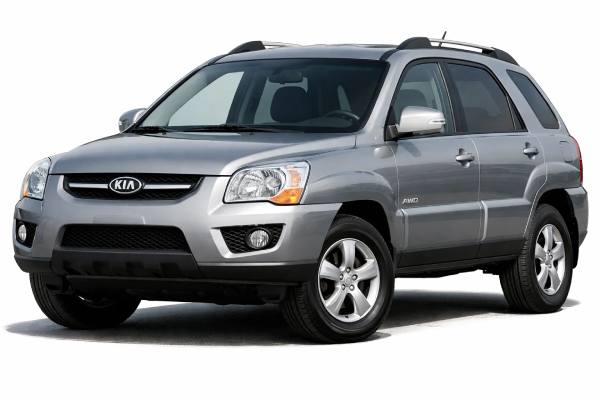
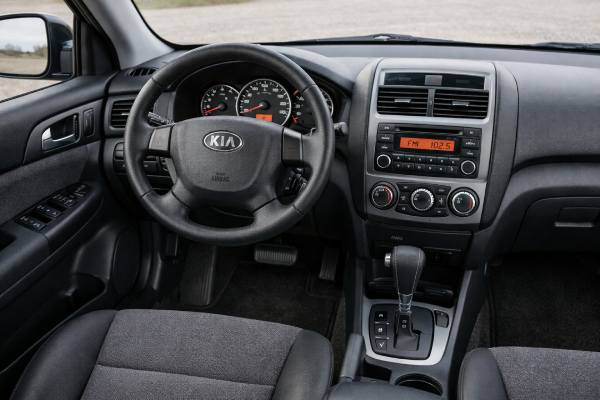
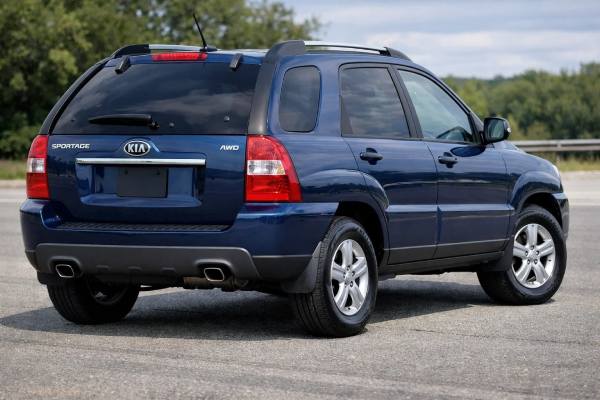
The facelifted 2008–2010 Kia Sportage KM with the 2.0-liter D4EA diesel and front-wheel drive is one of the more sensible versions of this generation. It gives up the extra weight and mechanical drag of AWD, but keeps the compact footprint, upright seating position, useful cargo area, and straightforward engineering that made the KM Sportage easy to live with. In 113 hp form, the D4EA is not the quickest diesel in the range, yet it is often the calmer ownership choice because it is simpler in tune and less demanding on the gearbox, tyres, and driveline than the stronger variants. The facelift also helped the KM age better visually, with cleaner exterior details and a more modern feel. For buyers who want an affordable diesel SUV that is roomy, honest, and reasonably easy to service, this Sportage still makes a strong case. The key is buying condition, not just specification.
Owner Snapshot
- The 113 hp D4EA diesel is not fast, but it is durable when belt service and clean oil changes are taken seriously.
- FWD layout lowers running costs slightly and gives this Sportage a lighter, simpler everyday feel than the AWD versions.
- Cabin space, visibility, and cargo flexibility remain strong points for family and utility use.
- Timing-belt history, injector condition, and underbody corrosion matter more than mileage alone.
- Kia’s published service interval for 2008–2010 diesel Sportage models is 12,500 miles or 12 months.
Explore the sections
- Sportage KM Diesel Profile
- Sportage KM Specs and Data
- Sportage KM Facelift Equipment
- Trouble Spots and Service Actions
- Upkeep Plan and Buying Tips
- Daily Driving and Economy
- Rival Matchups and Best Fit
Sportage KM Diesel Profile
The KM-generation Sportage was the model that pushed the nameplate fully into compact crossover territory. It moved away from the older, more truck-like formula and adopted a unibody platform, independent suspension, better packaging, and more polished road manners. That change matters even today, because it defines what this 2008–2010 facelift Sportage does well. It is not an off-road tool in the old sense. It is a compact diesel SUV designed to handle daily commuting, family travel, wet roads, poor surfaces, and occasional rough tracks with less effort than the first-generation model.
In facelifted FWD diesel form, the character becomes even clearer. This version keeps the practical body, the useful seating position, and the respectable ground clearance, but trims away the added weight, complexity, and servicing cost of the AWD system. That makes it one of the better choices for buyers who mostly drive on-road and want a straightforward used SUV rather than a lifestyle badge. The front-wheel-drive layout also gives the car a slightly lighter feel in the nose and tends to improve fuel economy by a modest but noticeable margin.
The engine is the 2.0-liter D4EA common-rail diesel. In this 113 hp specification, it is the lower-output tune rather than the later, stronger 140 hp or 150 hp variants. That sounds like a disadvantage, and in outright pace it is. Yet there is a practical upside. The 113 hp version asks less of the clutch, gearbox, tyres, and front axle, and it suits drivers who care more about steady torque and predictable running costs than about quick overtakes. It is a sensible engine rather than an exciting one.
This is also a useful model to understand in the used market because sellers often mix specifications. Some facelifted KM Sportages carry the stronger diesel tune, different wheel packages, or market-specific trim combinations. Others are registered late and described as newer than the engineering actually suggests. That means buyers should not rely only on year or badge. Confirm the engine output, transmission type, emissions hardware, and trim equipment before treating one car as equal to another.
As an ownership proposition, the 2008–2010 Sportage 2.0 diesel FWD sits in a sweet spot for practical buyers. It is roomy without being large, simple without feeling crude, and old enough to avoid a lot of later electronic complexity. The weaknesses are predictable too: the diesel needs regular maintenance, the safety picture is only average by modern standards, and neglected examples quickly become expensive. A good one still makes sense. A rough one will consume time and money faster than its modest badge suggests.
Sportage KM Specs and Data
This facelift diesel Sportage exists in several market-specific forms, and that is why some published figures do not line up perfectly. The 113 hp D4EA engine remained available in some regions even while other markets moved to stronger 140 hp and 150 hp versions. The tables below focus on the 2008–2010 facelift KM with front-wheel drive and the 113 hp diesel tune, while noting where open public data varies by trim, tyres, or local homologation.
| Powertrain and efficiency | Figure |
|---|---|
| Code | D4EA |
| Engine layout and cylinders | Inline-4, transverse, DOHC, 4 valves per cylinder |
| Bore × stroke | 83.0 × 92.0 mm (3.27 × 3.62 in) |
| Displacement | 2.0 L (1,991 cc) |
| Induction | Turbocharged, intercooled |
| Fuel system | Common-rail direct injection |
| Compression ratio | About 17.7:1 |
| Max power | 113 hp (83 kW) @ 4,000 rpm |
| Max torque | About 245 Nm (181 lb-ft) @ 1,800–2,500 rpm |
| Timing drive | Belt |
| Rated efficiency | About 6.8–7.1 L/100 km (33–35 mpg US / 40–42 mpg UK) combined, market dependent |
| Real-world highway @ 120 km/h (75 mph) | About 7.3–8.0 L/100 km (29–32 mpg US / 35–39 mpg UK) |
| Transmission and driveline | Figure |
|---|---|
| Transmission | Manual transmission; 5-speed on many 113 hp listings, with some market overlap in late registrations, so verify by VIN |
| Drive type | FWD |
| Differential | Open front differential |
| Chassis and dimensions | Figure |
|---|---|
| Suspension front | Independent MacPherson strut |
| Suspension rear | Independent multi-link |
| Steering | Rack-and-pinion power steering |
| Steering ratio | Open public sources do not consistently publish a reliable ratio for this exact variant |
| Brakes | Ventilated front discs / rear discs |
| Common brake sizes | About 280 mm front and 262 mm rear, trim dependent |
| Most common tyre size | 215/65 R16 |
| Ground clearance | About 195 mm (7.7 in) |
| Length | 4,350 mm (171.3 in) |
| Width | 1,840 mm (72.4 in) |
| Height | About 1,695–1,730 mm (66.7–68.1 in), depending on rails and market |
| Wheelbase | 2,630 mm (103.5 in) |
| Turning circle | About 10.8–10.9 m (35.4–35.8 ft) |
| Kerb weight | About 1,540–1,600 kg (3,395–3,527 lb), market dependent |
| GVWR | About 2,140–2,270 kg (4,718–5,004 lb), market dependent |
| Fuel tank | 58 L (15.3 US gal / 12.8 UK gal) |
| Cargo volume | About 667 L (23.6 ft³) seats up / about 1,886 L (66.6 ft³) seats down |
| Performance and capability | Figure |
|---|---|
| 0–100 km/h (0–62 mph) | About 13.5–14.0 s |
| Top speed | About 167–170 km/h (104–106 mph) |
| Braking distance | No dependable factory 100–0 km/h figure found in open official material |
| Towing capacity | Market dependent; often around 1,400 kg (3,086 lb) braked and 750 kg (1,653 lb) unbraked, but verify the VIN plate |
| Payload | Roughly 500–600 kg (1,102–1,323 lb), market dependent |
| Fluids and service capacities | Figure |
|---|---|
| Engine oil | ACEA C3 5W-30; capacity 5.9 L (6.2 US qt) |
| Coolant | Ethylene-glycol mix, usually 50:50; exact capacity varies by radiator and market |
| Transmission oil | Correct manual-gearbox oil varies by gearbox code and market; verify before filling |
| Differential / transfer case | Not applicable for FWD |
| A/C refrigerant | R134a |
| A/C compressor oil | PAG type; check label or workshop data for exact amount |
| Key torque specs | Wheel nuts are typically in the 88–107 Nm (65–79 lb-ft) range; other values should be confirmed from VIN-specific service data |
| Safety and driver assistance | Figure |
|---|---|
| Crash ratings | IIHS: Acceptable moderate overlap front, Acceptable side, Poor roof strength, Good head restraints and seats |
| Euro NCAP | No public test result was verified for this exact facelift KM diesel FWD configuration |
| Headlight rating | No IIHS headlight rating for this generation |
| ADAS suite | None |
| Core safety equipment | Front airbags, front side airbags, side curtain airbags, ABS, and stability control on some markets and trims |
The most useful way to read these figures is this: the Sportage is not quick, but it is practical; not especially light, but still compact; and not especially advanced, but clear in its engineering. That balance explains why a clean facelift diesel can still feel useful today.
Sportage KM Facelift Equipment
The 2008–2010 facelift did not reinvent the KM Sportage, but it improved the details that owners notice every day. Styling became cleaner, trim choices looked fresher, and equipment packages in many markets were reorganized to make the line-up easier to understand. That sounds minor, yet it matters in the used market because the facelift cars tend to look newer than they really are, and buyers often assume all late KM Sportages are heavily updated when in reality the mechanical changes were modest.
On the 113 hp front-wheel-drive diesel, the trim story varies by market more than by engineering. In some regions this engine sat as a value-oriented fleet or family specification, which usually meant cloth upholstery, manual climate control or simple air conditioning, 16-inch wheels, basic audio, and fewer cosmetic extras. In other markets, the same engine could be paired with better convenience equipment, roof rails, upgraded seat trim, or parking sensors. That is why trim names alone are not enough. A late-registered 2010 car may still be a fairly basic specification, while a 2008 car can be better equipped.
Mechanically, the differences between trims are usually smaller than the differences between engines. The 113 hp diesel does not turn the Sportage into a performance model, and front-wheel drive keeps the character road-focused. Wheel and tyre packages do affect the feel, though. Base 16-inch wheels usually give the best ride quality and cheaper replacement costs. Higher-spec wheels can sharpen the appearance, but they do not transform the chassis and often make an older car feel harsher over broken roads.
Safety equipment is respectable for the period, but very modest by modern standards. The strongest verified safety data point for this generation comes from IIHS. For the 2005–2010 structure, the Sportage receives Acceptable ratings in moderate overlap front and side impact, a Poor rating for roof strength, and a Good rating for head restraints and seats in the 2010 listing. That means the KM-generation Sportage was a clear improvement over many older compact SUVs in basic frontal and side protection, but it is still weak in rollover-related structure compared with newer vehicles.
There is no modern driver-assistance technology here. No automatic emergency braking, no lane support, no blind-spot warning, no rear cross-traffic alert, and no adaptive cruise control. Even stability control was not universal across all regions and trims, so it is important to confirm actual equipment on the individual car. The safer used buy is not always the fanciest-looking one. It is the one with verified airbags, working ABS, healthy brakes, correct tyre sizes, and no signs of previous crash repair. For family buyers, ISOFIX or child-seat hardware should also be confirmed directly rather than assumed from brochure language. On a vehicle of this age, safety is as much about maintenance and structural condition as it is about original specification.
Trouble Spots and Service Actions
The D4EA diesel is generally a solid engine when maintained properly, but it is not a diesel that forgives neglect. Most of its major problems follow a familiar pattern: missed belt work, contaminated oil, soot-heavy short-trip use, weak injectors, or cooling systems that were allowed to age too far. The basic design is durable. The expensive failures usually come from service shortcuts rather than from a fundamentally bad engine.
The first high-priority issue is timing-belt history. This is not a chain-driven engine, and that fact should shape every buying decision. If there is no belt invoice, assume it needs one. The proper job is more than just a belt. Tensioners, idlers, water pump, and accessory-belt hardware should be inspected or replaced at the same time. Symptoms of overdue timing service are often no symptoms at all until the failure happens, which is exactly why paperwork matters so much.
The second common issue area is fuel and air metering. Older D4EA engines can develop hard starting, uneven idle, smoke, or reduced pulling power from tired glow plugs, injector leak-off, dirty EGR passages, weak boost control, or split intercooler hoses. The pattern is usually simple: the engine still runs, but it no longer feels clean or strong. Owners sometimes chase sensors first, but many drivability problems on this engine start with basic mechanical and intake-side faults rather than a dramatic electronic failure.
Third, watch for oil leaks and contamination. Valve-cover seepage, front-engine oil misting, and tired turbo oil lines are not rare on older examples. The serious risk is not a small damp patch. It is the car that has been run low on oil, serviced with the wrong viscosity, or left with long intervals while doing mostly short trips. On a diesel of this age, poor oil discipline shows up everywhere: turbo wear, smoky running, noisy top end, and sticky EGR behavior.
Cooling-system age also matters. Radiators, thermostat housings, hose joints, and plastic tanks do not last forever. A diesel Sportage that warms slowly, runs too cool, or drifts warm in traffic should not be dismissed as normal. That kind of behavior often points to a cooling system that needs proper attention. A healthy diesel should reach temperature cleanly and stay there.
The rest of the car has its own predictable weak points. Front suspension wear is common, especially lower arms, ball joints, drop links, and dampers. Wheel bearings can get noisy. Rear bushings age quietly until the car starts to feel loose or thumpy. Clutch and dual-mass flywheel wear can appear on high-mileage manual cars, especially if they spent years in city traffic or towing. Corrosion is the other major filter. Brake lines, subframe mounts, rear floor edges, and underbody seams deserve careful inspection.
There was also an official regional recall campaign on certain 2008–2009 KM Sportage vehicles for HECU connector cover and HECU inspection or replacement, tied to corrosion and possible electrical shorting in road-salt conditions. That is not proof that every facelift diesel has the issue, but it is an important reminder that VIN checks matter. Ask for recall proof, inspect the underhood electrical area for prior work, and do not rely on a clean dashboard alone. On an older Sportage, structural and electrical condition matter just as much as engine smoothness.
Upkeep Plan and Buying Tips
Kia’s published interval for 2008–2010 diesel Sportage models is 12,500 miles or 12 months, whichever comes first. That is a useful starting point, but a 15-year-old diesel SUV deserves a stricter real-world approach. Age changes the rules. Cars that sit a lot, do short urban trips, or carry incomplete service history should be maintained more conservatively than the original brochure schedule suggests.
A practical maintenance plan for the D4EA FWD looks like this:
- Engine oil and filter: every 10,000–12,500 miles or 12 months. On short-trip use, I would shorten that interval.
- Timing belt kit: replace at the manufacturer’s interval for the exact VIN, and treat missing history as immediate work. In real ownership, many careful buyers use about 90,000 km or 60,000 miles as the planning point.
- Water pump: inspect or replace with timing-belt service.
- Engine air filter: inspect at every service and replace roughly every 20,000–30,000 km depending on dust and use.
- Cabin filter: yearly or about every 15,000–20,000 km.
- Fuel filter: about every 20,000–30,000 km, especially where fuel quality varies.
- Coolant: every 4–5 years in practical ownership, sooner if condition is uncertain.
- Manual gearbox oil: about every 60,000–80,000 km as preventive maintenance.
- Brake fluid: every 2 years.
- Brake pads, discs, and hoses: inspect at every service.
- Tyre rotation and alignment: every 8,000–10,000 km, especially because worn front suspension can hide geometry problems.
- Auxiliary belt and hoses: inspect every service and replace on age, cracks, or noise.
- Battery and charging system: test before winter; older diesels depend heavily on strong starting voltage.
- Glow plugs and intake cleanliness: inspect when cold starts, smoke, or rough idling begin to appear.
For fluid choices, the strongest open official data point is Kia’s oil-capacity sheet. It lists the 2008–2010 KM 2.0 diesel at 5.9 liters with ACEA C3 5W-30. That is useful because many older examples have been filled with whatever was on hand. On a common-rail diesel with possible DPF fitment depending on market, correct oil spec matters. Coolant, A/C charge, and gearbox fill quantities are less consistently published in open factory documents for this exact variant, so it is wise to verify those through VIN-specific workshop information before ordering parts or filling fluids.
As a buyer, inspect the car in this order:
- Confirm engine code, output, and gearbox first.
- Check timing-belt paperwork second.
- Inspect the underbody third, especially brake lines, seams, mounts, and any heavy underseal.
- Then check for injector noise, smoke, hard starting, and boost leaks.
- Then drive it long enough to test clutch take-up, steering straightness, braking, and cooling stability.
The best facelift 113 hp FWD Sportages are usually simple, honest cars with modest trim, clear service history, and clean underbodies. I would rather buy a lower-spec example with a fresh belt kit and tidy structure than a prettier one with mystery history and cheap cosmetic reconditioning. Long-term durability is fair to good if the engine is serviced on time and rust stays controlled. Once both service history and corrosion become uncertain, the value equation deteriorates quickly.
Daily Driving and Economy
On the road, this Sportage feels exactly like a mid-2000s compact diesel SUV should: steady, upright, calm, and a little slower than its chunky looks suggest. The 113 hp D4EA does not make the car feel lively, but it does make it feel honest. There is enough low-end pull to move away cleanly, climb moderate grades without fuss, and sit comfortably in daily traffic. The gap between this engine and the later 140 hp or 150 hp versions is noticeable on fast roads, but less important in ordinary town and suburban driving.
The front-wheel-drive layout changes the experience more than many buyers expect. With no rear driveline to drag along, the car feels a bit lighter and slightly cleaner in its responses than the AWD version. Steering is still light and not especially rich in feedback, yet the front end feels less burdened and the overall character is more straightforward. That suits the 113 hp tune well. It is a car that prefers smooth inputs and steady momentum rather than sharp demands.
Ride quality is one of the KM Sportage’s better traits. The suspension is compliant enough to deal with rough urban pavement, patched country roads, and everyday potholes without becoming harsh. Body roll is present, and quick direction changes remind you that this is a tall compact SUV with comfort-biased tuning. Even so, a well-kept Sportage feels more settled than many neglected examples suggest. Fresh dampers, healthy bushings, and correct tyres make a large difference.
Noise, vibration, and harshness are typical for the class and era. At idle, the diesel is clearly audible. Under acceleration, it sounds workmanlike rather than refined. Once settled at a cruise, though, it is not an especially tiring car if tyre noise and wind seals are in good condition. In fact, one of the strengths of the FWD diesel is that it becomes a quiet enough companion when driven within its natural pace.
Real-world fuel economy is respectable rather than outstanding. In mixed driving, around 6.8–7.6 L/100 km is realistic for a healthy FWD car driven normally. City-heavy use can push that into the 7.8–8.8 L/100 km range. On open-road runs, especially at 90–110 km/h, the car can do notably better. At a true 120 km/h motorway pace, plan for roughly 7.3–8.0 L/100 km. Winter fuel, clogged filters, old tyres, short trips, or roof accessories will push those figures upward.
This is not a sports crossover, and it does not need to be. The real appeal is that it feels stable, easy to place, and mechanically understandable. For commuting, school runs, light travel, and mixed urban-rural use, it still fits its job well.
Rival Matchups and Best Fit
The facelift KM Sportage 2.0 diesel FWD makes the most sense when compared with the compact SUVs buyers actually cross-shop in the used market. Against the Hyundai Tucson of the same era, the difference is small because the vehicles are closely related underneath. In practice, condition, equipment, and history matter more than the badge. Against a Honda CR-V diesel or Toyota RAV4 diesel, the Kia usually loses on brand reputation and sometimes on resale, but it often wins on entry price and can be cheaper to buy into at the same age.
Against the first Nissan Qashqai, the Sportage feels less polished and less modern inside, but also more SUV-like in its seating position and load-carrying feel. Against the early Ford Kuga, it tends to feel slower and less sharp to drive, yet often simpler in trim and easier to understand mechanically. That balance is the Kia’s whole case: it is rarely the class star, but it is frequently the practical outsider.
The biggest advantage of this exact 113 hp FWD version is that it avoids some of the extra complication that buyers do not always need. It skips the AWD hardware, keeps fuel use reasonable, and offers the same roomy body as more expensive or more heavily equipped Sportages. It also avoids the temptation to treat the vehicle like a performance diesel, which often helps long-term wear.
Its weaknesses are equally clear. It is slower than the stronger diesel rivals, safety is only average by today’s standards, and the used-market spread between a good example and a bad one is enormous. If you want a compact SUV mainly for snow, towing, or steep unpaved work, the AWD version or a more capable rival makes more sense. If you want a quiet modern crossover with advanced assistance systems, this Kia is from the wrong era.
But for buyers who want a compact diesel SUV with useful space, simple controls, reasonable parts support, and no unnecessary complication, the 2008–2010 Sportage 2.0 diesel FWD is still easy to recommend. It is not the most glamorous KM Sportage. It may be one of the smartest.
References
- 7.2 Kia Service Intervals.xlsx 2026 (Service Guide)
- Engine Oil Grades and Capacities – Kia 2023 (Service Guide)
- 2010 Kia Sportage 2026 (Safety Rating)
- Vehicle Detail Search – 2010 KIA SPORTAGE 4 DR FWD/AWD | NHTSA 2026 (Recall Database)
Disclaimer
This article is for informational purposes only and is not a substitute for professional diagnosis, inspection, or repair. Specifications, torque values, service intervals, fluid capacities, procedures, and equipment can vary by VIN, market, build date, and trim, so always verify details against the official service documentation for the exact vehicle.
If this guide was useful, please consider sharing it on Facebook, X, or another platform to support our work.