
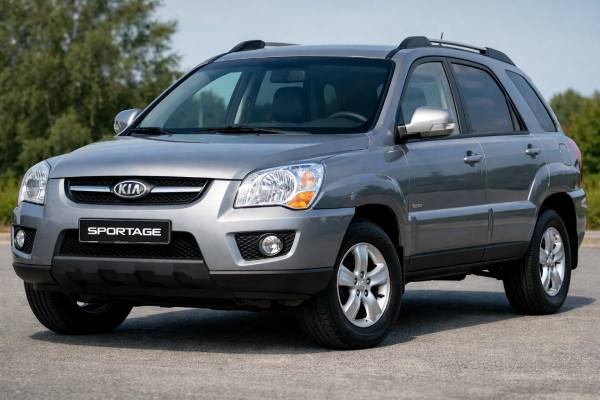
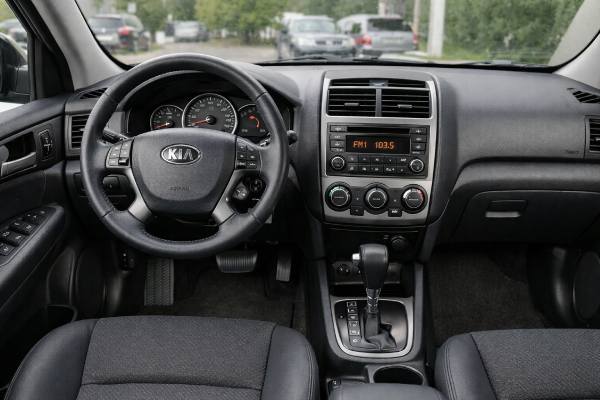
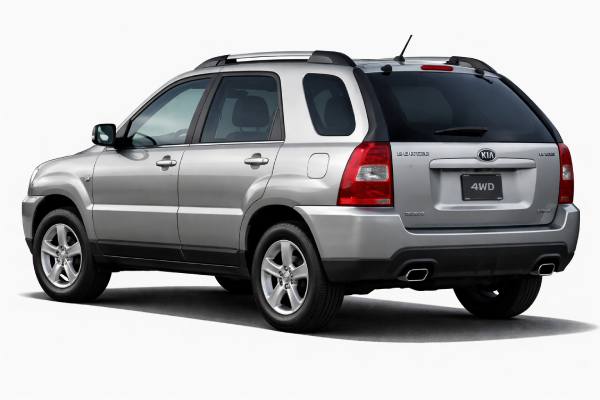
The facelift-era Kia Sportage KM is the version that makes the strongest case for this generation today. It kept the simple G4GC 2.0-liter petrol engine and front-wheel-drive layout, but paired them with fresher styling, improved cabin tech, and, in facelift form, better seat and head-restraint performance than many earlier examples. It is still an old-school compact crossover in the best sense: naturally aspirated, multi-port injected, easy to understand, and not overloaded with electronics.
That simplicity is the main reason it still has value in 2026. A clean, documented Sportage FWD 2.0 can be a practical daily SUV with honest running costs, decent ride comfort, and strong interior flexibility. But this is also a model where body condition, recall history, and timing-belt proof matter more than trim badges or low asking prices. The facelift cars are the ones to target, but only if the underbody, cooling system, and service file support the story.
Fast Facts
- The facelift brought cleaner styling, better cabin features, and stronger seat and head-restraint results on later builds.
- The 2.0 petrol stays appealing because it uses simple multi-port injection and avoids direct-injection carbon issues.
- Ride comfort is better than expected thanks to fully independent suspension at both ends.
- Rust, overdue timing-belt work, and incomplete recall history are the biggest ownership risks.
- Plan around 15,000 km or 12 months for routine servicing, whichever comes first.
Navigate this guide
- Kia Sportage KM facelift basics
- Kia Sportage KM hard numbers
- Kia Sportage KM trims and protection
- Common faults and Kia campaigns
- Ownership schedule and buyer checks
- Road manners and real economy
- Facelift Sportage versus peers
Kia Sportage KM facelift basics
The 2008–2010 facelift version of the KM Sportage is less about major mechanical change and more about targeted improvement. Kia kept the same core platform, which means a steel unibody, transverse engine layout, fully independent suspension, and the same practical compact-SUV footprint. What changed was the presentation and some of the ownership experience. Facelift cars gained a cleaner front-end design, revised lamps and bumpers, updated wheel designs, and, in key markets, improved audio and navigation options. In North America, the meaningful facelift arrived for the 2009 model year, though some markets group the late-2008 cars into the same updated family.
For this specific version, the important mechanical story is stability. The G4GC 2.0-liter four-cylinder remained a naturally aspirated, multi-port-injected unit rated at 140 hp and 184 Nm. That matters because the facelift did not turn the Sportage into something more complex or more fragile. It stayed a simple, belt-driven petrol engine with widely available parts and predictable service needs. In front-wheel-drive form, it is also the lightest and least complicated way to own a KM Sportage. You avoid the extra weight and additional driveline parts of the AWD versions, and you keep fuel use and repair exposure in check.
The facelift cars also benefit from a subtle but worthwhile safety improvement that many buyers miss. IIHS data for the 2010 Sportage, which applies to 2005–2010 models, shows the same acceptable moderate-overlap and side results as before, and the same poor roof-strength result, but facelift-era seats built after March 2008 earned a good score for head restraints and seats. That makes the facelift the better choice if you are selecting between an early KM and a later one with otherwise similar condition. It is not a modern crash structure, but it is the more mature version of this body.
Ownership appeal comes from balance rather than excellence in one area. The Sportage is roomy enough for five, flexible in the rear thanks to the flat-folding seat, and still easy to place in town. The driving position feels SUV-like without the bulk of a larger vehicle. The 2.0 engine will not make it feel fast, but it is well matched to buyers who want a durable family runabout rather than a performance crossover. That is why the facelift version remains the smart pick: it is the same useful KM formula, just in its most complete and least compromised form.
Kia Sportage KM hard numbers
The facelift FWD 2.0 stayed close to the pre-facelift car mechanically, so the key numbers are familiar. What matters is choosing values that match the front-wheel-drive four-cylinder layout rather than mixing in V6 or AWD data. The table below reflects the facelift-era 2.0 petrol in baseline North American and closely related export-market form, with notes where market differences matter.
Powertrain and efficiency
| Item | Kia Sportage FWD (KM) Facelift 2.0 |
|---|---|
| Code | G4GC |
| Engine layout and cylinders | Inline-4, DOHC, 4 valves/cyl |
| Bore × stroke | 82.0 × 93.5 mm (3.23 × 3.68 in) |
| Displacement | 2.0 L (1,975 cc) |
| Induction | Naturally aspirated |
| Fuel system | Multi-port fuel injection |
| Compression ratio | 10.0:1 |
| Max power | 140 hp (104 kW) @ 6,000 rpm |
| Max torque | 184 Nm (136 lb-ft) @ 4,500 rpm |
| Timing drive | Belt |
| Rated efficiency | About 10.7 / 8.7 L/100 km city/highway (22 / 27 mpg US; 26.4 / 32.4 mpg UK) |
| Real-world highway @ 120 km/h (75 mph) | Usually 8.0–9.0 L/100 km (26–29 mpg US; 31–35 mpg UK) in healthy trim |
Transmission, chassis, and dimensions
| Item | Kia Sportage FWD (KM) Facelift 2.0 |
|---|---|
| Transmission | 5-speed manual or 4-speed automatic |
| Drive type | FWD |
| Differential | Open |
| Suspension (front/rear) | MacPherson strut / dual-link independent |
| Steering | Power rack-and-pinion; about 3.06 turns lock-to-lock |
| Brakes | 279 mm (11.0 in) front vented discs; 262 mm (10.3 in) rear discs |
| Wheels and tyres | Most common size: 215/65 R16 |
| Ground clearance | 195 mm (7.7 in) |
| Approach / departure angle | 29.5° / 28.7° |
| Length / width / height | 4,350 / 1,800 / 1,695 mm (171.3 / 70.9 / 66.7 in) |
| Wheelbase | 2,630 mm (103.5 in) |
| Turning circle | 10.8 m (35.4 ft) |
| Kerb weight | About 1,465–1,476 kg (3,230–3,254 lb) |
| GVWR | About 2,050 kg (4,519 lb), market dependent |
| Fuel tank | 57.9 L (15.3 US gal / 12.7 UK gal) |
| Cargo volume | 668 / 1,886 L (23.6 / 66.6 ft³), SAE-style measurement |
Performance, fluids, and safety
| Item | Kia Sportage FWD (KM) Facelift 2.0 |
|---|---|
| 0–100 km/h (0–62 mph) | About 11.1 s, gearbox and market dependent |
| Top speed | About 175–179 km/h (109–111 mph) |
| Towing capacity | About 680 kg (1,500 lb) braked; 454 kg (1,000 lb) unbraked in U.S. data |
| Payload | Roughly 530–540 kg (1,168–1,190 lb), market dependent |
| Engine oil | 4.0 L (4.2 US qt); 10W-30 in Kia’s published chart, with equivalent approved grades by climate |
| Coolant | About 6.9 L (7.3 US qt); correct Kia-approved coolant mix, typically 50:50 |
| Automatic transmission fluid | Kia ATF SP-III; about 7.8 L (8.3 US qt) fill |
| Key torque specs | Public owner documents are limited; verify wheel, suspension, and timing-component torque values against workshop data |
| Crash ratings | IIHS: moderate overlap front Acceptable, side Acceptable, roof strength Poor, head restraints and seats Good |
| Headlight rating | Not tested by IIHS for this generation |
| ADAS suite | None; no AEB, ACC, lane keeping, or blind-spot assist |
The spec sheet tells a simple story. This is not a power-heavy or feature-heavy facelift. Its value lies in conventional engineering, reasonable dimensions, and predictable servicing. For many buyers, that is exactly the appeal.
Kia Sportage KM trims and protection
Trim strategy matters more on the facelift Sportage than it first appears, because the 2.0 FWD engine and gearbox combination was not spread evenly across every grade in every market. In North America, the facelift-era G4GC petrol is usually linked to the LX, especially in front-wheel-drive form with either the five-speed manual or four-speed automatic. The EX typically moved upward with the V6, added more comfort equipment, and was aimed at buyers who wanted a richer look and feel. In export markets, though, Kia often offered higher-trim 2.0 versions, so badges alone do not tell the full story.
That means the best quick identifiers are physical rather than brochure-based. A facelift 2.0 FWD often wears 16-inch wheels with 215/65 R16 tyres, simpler exterior trim, and a less busy interior specification than a V6 or late high-spec export model. The facelift itself is easy to spot: revised grille, updated front and rear bumper details, fresher lamp graphics, and newer wheel designs. Inside, many facelift cars gained USB and auxiliary inputs, updated audio integration, and, in some markets, optional navigation. If you are shopping, the presence of USB/AUX in the center stack and the newer front-end styling are better clues than trusting a seller’s trim description.
The safety equipment list was strong for the period. In U.S.-market facelift form, Kia advertised six airbags as standard: dual front airbags, front seat-mounted side airbags, and full-length side-curtain airbags. ABS with electronic brakeforce distribution was standard, and the facelift-era press material also listed traction control and electronic stability control. That is important because many older budget SUVs of the same era did not make ESC as widespread. Child-seat provisions were there too, with LATCH anchor points in the rear. Structurally, though, the Sportage still belongs to an older crash-safety generation. It has solid feature content, but its body shell does not deliver the same rollover or small-overlap protection standards found in newer rivals.
The facelift’s most useful safety distinction is in seat design. Earlier KM Sportage models were weak in IIHS head-restraint testing, but facelift-era front seats built after March 2008 achieved a good result. That does not solve the poor roof-strength rating, and it does not turn the Sportage into a 2010 Top Safety Pick, but it is a real ownership advantage over earlier cars. For family use, that makes the facelift easier to recommend.
Year-to-year changes were modest once the updated front end arrived. The 2009 model year introduced the visible refresh and new cabin tech in North America, while 2010 was largely a carryover year before the all-new next-generation Sportage arrived. For a used buyer, that means condition, crash history, and service proof are more important than choosing between a 2009 and a 2010 badge.
Common faults and Kia campaigns
The facelift FWD 2.0 is not a vehicle with one dominant powertrain defect. Its reliability pattern is more typical of a simple compact SUV that has aged into a condition-led purchase. The problems that matter most are corrosion, overdue timing-belt service, and ordinary suspension and cooling-system wear. In other words, most expensive Sportage ownership problems are not surprises. They are the result of age, climate, and deferred maintenance.
The issue to rank as common and high-risk is underbody corrosion in salt-belt use. Kia’s SC104 voluntary service campaign covered 2005–2010 Sportage vehicles and added anti-corrosion material to the underbody of affected cars in road-salt states. That campaign tells you a lot. On a facelift Sportage, you should inspect the rear subframe, suspension pickup points, fuel and brake lines, floor seams, and the general condition of the underbody coating before you care about paint shine or interior trim. Surface rust is manageable. Structural scaling, softened seams, or heavily crusted lines are not.
The second big issue is timing-belt history. The G4GC is not complicated, but it does use a belt rather than a chain. There is no smart used-car shortcut here: if the seller cannot prove belt work, treat it as due. The sensible remedy is a full belt service with tensioner, idlers, and ideally water pump, not a gamble on age. Cooling-system age often travels with the same neglect. Typical symptoms are coolant smell, a creeping temperature gauge in traffic, white crust around hose joints, or old radiator tanks. The remedy is usually straightforward, but it must be done before overheating turns a cheap SUV into a money pit.
Common lower-cost age faults include front anti-roll-bar links, lower-arm bushes, ball joints, wheel bearings, and tired dampers. These show up as clunks, vague straight-line feel, edge tyre wear, or a hum that rises with speed. Occasional engine-side problems include rough idle, lazy throttle response, or a check-engine light caused by plugs, coils, a dirty throttle body, or aging sensors. The automatic transmission is generally acceptable if fluid has been changed; neglected cars can show slow engagement or flare.
The recall and campaign list deserves special attention on facelift cars. The stop-lamp-switch recall covered 2007–2010 Sportage models and matters because a failing switch can affect brake-light operation, cruise cancellation, ESC behavior, and shift interlock function. More recently, certain 2010 Sportage KM vehicles built from May 26, 2009 through January 26, 2010 were included in the HECU fuse recall because an internal short in the ABS hydraulic electronic control unit could increase fire risk. That is a serious one. Verify completion by VIN through the official Kia or NHTSA recall tools and ask for dealer records, not just a seller’s memory.
Ownership schedule and buyer checks
A facelift Sportage FWD 2.0 rewards owners who are methodical. Kia’s published service guides put 2005–2010 petrol Sportage models on a 15,000 km or 12-month rhythm in many European markets, while older mile-based schedules often translate to about 10,000 miles or 12 months. On a 15-plus-year-old car, it is wise to service more by condition than by brochure minimum. Short trips, long idle time, dusty roads, and winter salt all justify shorter intervals.
A practical maintenance routine looks like this:
- Engine oil and filter: every 15,000 km or 12 months at the outside; shorten to 10,000–12,000 km for hard use or mostly short journeys.
- Engine air filter and cabin filter: inspect every service and replace when loaded, usually every 20,000–30,000 km in normal use.
- Spark plugs: inspect on age and running quality; replace sooner if cold-start misfires or rough idle appear.
- Coolant: refresh by age if the history is unknown, and inspect hoses, thermostat, and radiator at every annual service.
- Brake fluid: every 2 years.
- Brake pads, discs, and parking brake: inspect every service, especially on cars that sit unused.
- Manual gearbox oil or automatic ATF: not something to ignore just because the car still moves. A cautious 60,000 km service approach is sensible on an older example with incomplete records.
- Belts and hoses: inspect at each service.
- Timing belt: if there is no dated proof, budget to do it immediately after purchase.
- Tyres, alignment, and suspension: rotate and inspect regularly, because worn bushes show up quickly in tyre wear.
- Battery: load test from about the fourth year onward.
- Underbody washing and rust control: essential after winter in salt regions.
For decision-making, the most useful fluid data are simple. Engine oil capacity is 4.0 L, the automatic uses Kia SP-III fluid, and the fuel tank holds 57.9 L. More detailed torque values for suspension or timing work are workshop-manual territory and should be verified before repair, not guessed from online lists.
As a buyer, inspect cold-start behavior first. The engine should settle cleanly without obvious misfire, tapping, or a hunting idle. Then check that the AC cools properly, all warning lights go out, and the brake lights work every time. On the road, listen for front-end knocks, wheel-bearing hum, and lazy automatic shifts. Underneath, focus on subframe corrosion, line condition, and any signs of crash repair.
The best facelift cars are 2009–2010 examples with documented recall completion, solid underbodies, and proof of belt service. The trims matter less than that. A manual 2.0 FWD is the lowest-risk ownership choice. An automatic can still be a good buy, but only if it has fluid history and clean shifts. Long term, the Sportage is durable enough when the body remains sound. When the rust starts to win, the economics stop making sense.
Road manners and real economy
The facelift Sportage drives exactly how a good old compact crossover should. It has a high seating position, broad visibility, and a calm, predictable chassis. The fully independent suspension is one of the reasons it still feels respectable. Over broken urban roads, the Sportage settles better than many budget SUVs from the same era, and it does not bounce or crash as badly as body-on-frame alternatives. Straight-line stability is good, and on typical family use the Sportage feels secure rather than busy.
Handling is competent but clearly comfort-led. The steering is light and easy in parking situations, though it does not feed much detail back once speeds rise. Cornering balance is safe and mildly nose-led, which suits the FWD layout and the target audience. Braking feel is linear and easy to judge, helped by four-wheel discs and standard ABS. On worn tyres or tired suspension bushes, the car quickly loses some of that polish, so chassis condition matters more than on newer crossovers with broader electronic support.
The 2.0 petrol is adequate, not eager. Around town, throttle response is clean enough and the engine feels smoother than many small diesels of the time. It needs revs to give its best, though, and that shapes the whole driving character. The five-speed manual suits the engine better because it lets you hold the right gear and avoid the hesitation of the four-speed automatic. The automatic is fine for steady use, but kickdown is slower and the gearbox can feel one ratio short on fast roads or hills. This is not a powertrain for rushed overtakes with a full load.
Real-world efficiency is reasonable for an older naturally aspirated SUV. In city use, most healthy 2.0 FWD cars land around 10.5–12.5 L/100 km. Mixed use often falls in the 9.0–10.5 L/100 km range. At a true 100–120 km/h cruise, 8.0–9.0 L/100 km is realistic if tyres, alignment, and oxygen-sensor health are all good. Cold weather typically adds another 0.5–1.5 L/100 km, and short-trip winter use can be worse than that. Those numbers are not modern-class-leading, but they are honest for the vehicle’s shape, gearing, and age.
With passengers or cargo, the Sportage remains stable but clearly feels the modest power reserve. Towing or long climbs increase consumption quickly, often by 15 to 25 percent under moderate load. That said, the Sportage’s road manners remain its quiet strength. It is easy to place, easy to live with, and much more settled than its budget image might suggest.
Facelift Sportage versus peers
The facelift KM Sportage’s main rivals are the Hyundai Tucson JM, Honda CR-V, Toyota RAV4, Nissan Qashqai in markets where it overlapped, and the Suzuki Grand Vitara if you want something more traditional. The closest comparison is still the Tucson, because the Hyundai and Kia share so much underneath. If you are cross-shopping those two, do not overthink the badge. Buy the better-maintained example with the cleaner underbody and fuller service history.
Against the Honda CR-V and Toyota RAV4, the Sportage usually loses on long-term buyer confidence, resale strength, and overall tolerance for neglect. Those Japanese rivals tend to forgive owners more, and they usually age more gracefully in the used market. The Kia fights back on price, equipment value, and mechanical simplicity. A facelift Sportage with proof of servicing can feel like a lot of car for the money, especially if you prioritize cabin versatility and a comfortable ride over brand reputation.
Compared with the Nissan Qashqai, the Sportage feels more like a classic compact SUV and less like a car-based family hatch on stilts. That can be a plus if you want the more upright feel and broader cargo flexibility. Compared with the Suzuki Grand Vitara, the Kia is less rugged off road but noticeably better suited to daily paved-road driving. The Grand Vitara has more traditional 4×4 credibility, while the Sportage is the easier family companion.
Where the Sportage earns its place is value-for-condition buying. If a facelift 2009–2010 2.0 FWD is meaningfully cheaper than an equivalent CR-V or RAV4 and passes a serious underbody and service inspection, it is a rational purchase. If prices are close, the Honda and Toyota are still the safer long-game choices for many owners. That is the key comparison point.
So the Sportage does not win by being the class benchmark. It wins when the buyer understands what it is: a simple, comfortable, practical crossover that makes sense only when rust, recall history, and belt service are already under control. Choose it on condition, not sentiment, and the facelift version can still be a smart used SUV.
References
- 2009 KIA SPORTAGE 2008 (Press Release)
- Service Intervals 2016 (Service Guide)
- Engine Oil Grades and Capacities – Kia 2016 (Owner’s Guide)
- 2010 Kia Sportage 2026 (Safety Rating)
- Vehicle Detail Search – 2010 KIA SPORTAGE 4 DR FWD/AWD | NHTSA 2026 (Recall Database)
Disclaimer
This article is for informational purposes only and is not a substitute for professional diagnosis, repair, or VIN-specific service information. Specifications, torque values, intervals, fluids, and procedures can vary by VIN, market, model year, gearbox, and equipment, so always verify against the official service documentation for the exact vehicle before carrying out maintenance or repair.
If this guide helped you, please consider sharing it on Facebook, X, or your preferred social platform to support our work.