


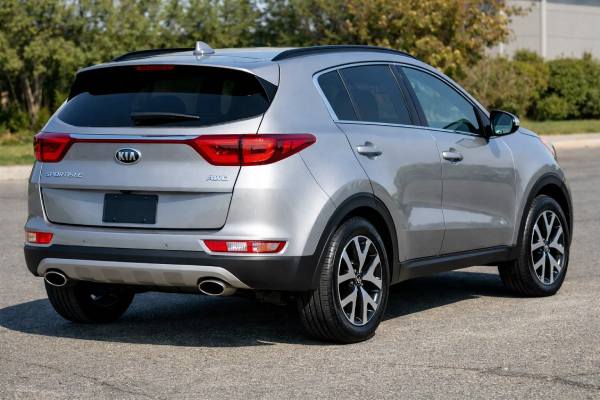
The facelifted Kia Sportage QL 1.6 T-GDi FWD sits in a useful middle ground: it is stronger and more relaxed than the basic naturally aspirated petrol model, but still simpler and lighter than the all-wheel-drive versions. For many buyers, that makes it one of the smartest used Sportage choices from the 2019–2022 facelift period. The G4FJ 1.6-liter turbo petrol brings 265 Nm of torque from low revs, the chassis uses a fully independent rear suspension, and the cabin remains practical for family use. One detail matters up front: many continental Kia documents list this engine at 177 PS, while some UK material shows 174 bhp. In everyday buying language, sellers often call both “177 hp,” so it is worth checking the spec sheet rather than assuming a typo. This guide focuses on what actually matters in ownership: the real mechanical package, equipment differences, service needs, and what to inspect before you buy.
Owner Snapshot
- Strong low-rpm torque makes this Sportage noticeably easier to drive than the base 1.6 GDi.
- Spacious cabin and a useful 491 to 503 L VDA boot make it a very practical compact SUV.
- The fully independent rear suspension helps it feel more settled than some cheaper rivals.
- Main ownership caveat: strict oil-service discipline matters on the turbo direct-injection engine, and used 7DCT cars deserve a careful low-speed test drive.
- Official turbo-petrol servicing is 10,000 miles or 12 months, whichever comes first.
Guide contents
- Kia Sportage QL facelift essentials
- Kia Sportage QL technical specs
- Kia Sportage QL trims and safety
- Reliability faults and recall checks
- Maintenance schedule and buyer tips
- Driving character and fuel use
- How it compares with rivals
Kia Sportage QL facelift essentials
The facelifted QL kept the same basic body shell and wheelbase as the earlier fourth-generation Sportage, but Kia revised the styling, updated the engine range, and improved the technology mix. For the 1.6 T-GDi petrol, the big story is that it remained the punchiest mainstream non-hybrid petrol choice in many European markets. It uses the Gamma-family G4FJ turbo engine, a 1,591 cc direct-injection four-cylinder with 177 PS and 265 Nm. Kia paired it with front-wheel drive in some markets as a 6-speed manual and, in others, as a 7-speed dual-clutch automatic, while all-wheel-drive versions were also available. That matters because many used-car ads mix FWD and AWD specs together.
This version makes sense for buyers who want a compact SUV that feels a bit more effortless than the entry engine without moving into diesel or more complex electrified hardware. The official figures show why: the FWD manual was quoted at 9.2 seconds from 0 to 100 km/h and 205 km/h, while some MY21 FWD 7DCT versions were listed at 8.9 seconds and 201 km/h. Those are solid figures for a family SUV of this size, and they help explain why the 1.6 T-GDi remains the enthusiast’s pick in the QL range.
The underlying package is also more sophisticated than some buyers expect. Kia’s technical material lists fully independent front and rear suspension, electric rack-and-pinion steering, and larger 19-inch brake hardware on GT-Line wheel packages. Dimensions stayed tidy rather than oversized, which is part of the QL’s appeal: it feels easy to place in town, but it still offers adult-friendly rear seating and a genuinely useful luggage area. Factory documents quote 491 to 503 liters of VDA boot volume for the 1.6 GDi and 1.6 T-GDi versions with the rear seats up, depending on whether the car has a spare wheel or tyre mobility kit.
For ownership, the headline strengths are easy to understand. You get a strong mid-range engine, a roomy cabin, Kia’s well-known long factory warranty when new, and a spec sheet that often included lane support, high-beam assist, driver-attention warning, and, on better trims, forward collision avoidance and blind-spot monitoring. The trade-off is that this is still a turbocharged direct-injection petrol crossover, so it rewards disciplined servicing more than the simpler 1.6 GDi. As a used buy, it is best approached as a well-rounded family SUV rather than a hot crossover: quick enough, practical, usually well equipped, and at its best when the service history is complete.
Kia Sportage QL technical specs
The most useful way to read the facelifted 1.6 T-GDi FWD Sportage is to separate what is fixed across markets from what varies by trim, wheel size, and transmission. The engine core, body dimensions, steering geometry, and most chassis hard points are stable. Performance, curb weight, towing, and fuel economy move around depending on whether the car is a 6-speed manual or 7DCT, whether it sits on 17-inch or 19-inch wheels, and which market brochure you are reading. The tables below focus on the exact FWD 1.6 T-GDi package and flag where factory documents show market variation.
| Powertrain and efficiency | Kia Sportage FWD (QL) 1.6 T-GDi |
|---|---|
| Code | G4FJ |
| Engine layout and cylinders | Inline-4, turbocharged, 4 cylinders |
| Valvetrain | 16 valves, 4 valves per cylinder |
| Bore × stroke | 77.0 × 85.4 mm (3.03 × 3.36 in) |
| Displacement | 1.6 L (1,591 cc) |
| Induction | Turbo |
| Fuel system | Direct injection |
| Compression ratio | 10.0:1 |
| Max power | 177 PS / 130 kW @ 5,500 rpm, commonly marketed as 177 hp and roughly 174 bhp |
| Max torque | 265 Nm (195 lb-ft) @ 1,500–4,500 rpm |
| Timing drive | Not stated in the open Kia market sheets reviewed |
| Transmission | 6-speed manual or 7-speed dual-clutch automatic, market-dependent |
| Transmission code | Not published in the open brochures reviewed |
| Drive type | FWD |
| Differential | Open front differential |
| Official mixed fuel use | Around 6.5–8.1 L/100 km depending on transmission, trim, and wheel package |
| Real-world highway at 120 km/h | Usually higher than WLTP; expect a meaningful jump over the official figure |
| Chassis and dimensions | Kia Sportage FWD (QL) 1.6 T-GDi |
|---|---|
| Front suspension | MacPherson struts, coil springs, anti-roll bar |
| Rear suspension | Fully independent rear suspension, double-wishbone style multi-link layout |
| Steering | Electric rack-and-pinion, 13.8:1 ratio |
| Turning circle | 11.0 m (36.1 ft) kerb-to-kerb |
| Brakes | Front 305 × 25 mm (12.0 × 1.0 in) ventilated discs on 16/17-inch wheels; 320 × 28 mm (12.6 × 1.1 in) on 19-inch wheels; rear 302 × 10 mm (11.9 × 0.39 in) solid discs |
| Most common tyre sizes | 225/60 R17 or 245/45 R19 |
| Ground clearance | 172 mm (6.8 in) |
| Length | 4,485 mm (176.6 in), or 4,495 mm (177.0 in) for GT-Line styling |
| Width | 1,855 mm (73.0 in) |
| Height | 1,635 mm (64.4 in), about 1,645 mm (64.8 in) with roof rails in some market sheets |
| Wheelbase | 2,670 mm (105.1 in) |
| Kerb weight | About 1,470–1,667 kg (3,241–3,675 lb), depending on gearbox and trim |
| GVWR | About 2,110–2,140 kg (4,652–4,718 lb), market-dependent |
| Fuel tank | 62 L (16.4 US gal / 13.6 UK gal) |
| Cargo volume | 491–503 L (17.3–17.8 ft³) seats up; 1,480–1,492 L (52.3–52.7 ft³) seats down, VDA |
| Payload | Roughly 470–640 kg (1,036–1,411 lb), derived from published kerb and GVWR figures |
| Performance and service data | Kia Sportage FWD (QL) 1.6 T-GDi |
|---|---|
| 0–100 km/h | 9.2 s for FWD 6MT in Kia EU technical data; 8.9 s for FWD 7DCT in MY21 Belgian data |
| Top speed | 205 km/h (127 mph) for FWD 6MT; 201 km/h (125 mph) for FWD 7DCT in MY21 Belgian data |
| Towing capacity | 1,600 kg (3,527 lb) braked for FWD 7DCT in MY21 Belgium; 1,900 kg (4,189 lb) braked was quoted for FWD 6MT in Kia EU technical data |
| Unbraked towing | 750 kg (1,653 lb) on many later-market sheets; some earlier data show 650 kg (1,433 lb) on the manual |
| Engine oil | 5W-30, ACEA A5 |
| Engine oil capacity | 4.0 L (4.2 US qt) |
| Official oil service interval | 10,000 miles or 12 months |
| Safety and driver assistance | Summary |
|---|---|
| IIHS | 2020 Sportage rated Top Safety Pick only with optional front crash prevention and specific headlights |
| Front crash prevention | Superior in IIHS vehicle-to-vehicle testing where fitted |
| Pedestrian front crash prevention | Advanced in IIHS daytime test where fitted |
| Child-seat ease | IIHS LATCH ease of use: Acceptable |
| Kia market equipment examples | ABS with EBD, ESC with downhill brake control, trailer stability assist, lane keep assist, high-beam assist, driver attention warning, speed-limit info, tyre-pressure monitoring, and on some trims FCA and blind-spot warning |
| Airbags | Twin front, front side, and curtain airbags in UK spec sheet |
| ISOFIX | Top tethers and anchor fixings listed in Kia UK specifications |
These figures come from a mix of Kia Europe technical data, a Kia Belgium MY21 price and spec sheet, Kia UK model specs, and official service documents. The key takeaway is simple: the engine fundamentals stay constant, but transmission, weight, towing, and fuel-use figures should always be verified against the VIN and the market-specific certificate of conformity.
Kia Sportage QL trims and safety
Trim naming varied by country, but the facelifted QL usually followed the same pattern: a lower trim on 16-inch wheels, a broad middle of 17-inch cars, and sportier-looking GT-Line versions on 19s. That matters more than it sounds. The 17-inch setup is often the sweet spot for buyers because it keeps the Sportage’s tidy steering and body control but avoids the firmer, noisier edge that can come with 19-inch tyres. GT-Line versions are easy to spot because they are 10 mm longer due to their bumpers, usually wear 245/45 R19 tyres, and add distinctive interior and exterior trim cues.
A useful ownership detail is that the powertrain menu did not stay identical across Europe. Some Kia technical releases showed the 1.6 T-GDi FWD with a 6-speed manual and reserved the 7-speed DCT more broadly for AWD, while later market sheets clearly list a 1.6 T 4×2 7DCT. In plain English, do not assume every FWD 1.6 T-GDi has the same gearbox just because the seller copied an ad title from another market. It is worth checking the build sheet, the handbook pack, or the physical selector and pedal layout before making a buying decision.
| What to look for | Typical clues |
|---|---|
| Lower and middle trims | 16-inch or 17-inch wheels, simpler seat trim, easier-running costs |
| Better-equipped mid trims | Lane keep assist, high-beam assist, driver-attention warning, speed-limit info, often the best value |
| GT-Line and upper trims | 19-inch wheels, GT-Line body styling, richer cabin trim, often JBL audio, LED lighting, and more ADAS depending on market |
| Quick identifiers | 225/60 R17 usually means the calmer daily-driver setup; 245/45 R19 often means GT-Line styling and firmer ride |
Safety equipment was competitive for the class, but buyers should think in terms of trim and year rather than just “Sportage equals safe.” Kia’s UK specification sheet lists ESC, downhill brake control, trailer stability assist, TPMS, lane keep assist, high-beam assist, driver-attention warning, and speed-limit info broadly across the range, while forward collision-avoidance assist and blind-spot collision warning were trim-dependent. Passive safety kit included twin front, front-side, and curtain airbags plus ISOFIX anchor points and top tethers. After repairs, especially windscreen replacement or front-end work, ADAS calibration history matters because camera-based lane and emergency-braking systems can be sensitive to setup.
Crash-test headlines need context. In the U.S., IIHS gave the 2020 Sportage a Top Safety Pick award, but only when the vehicle had optional front crash prevention and the right headlight setup. That is a strong result, but it is not a blanket statement covering every world-market trim. For this older QL-generation facelift, it is smarter to judge a specific used car by its actual equipment list, tyre condition, crash history, and whether its assistance systems still work correctly after any glass or body repairs.
Reliability faults and recall checks
The 1.6 T-GDi QL is not a perfect used SUV, but its reliability profile is more manageable than some buyers fear. The most important documented safety action affecting this generation is the HECU fire-risk recall on certain 2017–2021 Sportage vehicles not equipped with Smart Cruise Control. NHTSA’s consumer alert says the hydraulic electronic control unit circuit can short and trigger an engine-bay fire risk, and the factory remedy included updated fuse protection, with a software update for some electronic-parking-brake vehicles. Any used-car check should include a VIN recall search and dealer confirmation that this action was completed.
Beyond that official campaign, the day-to-day ownership pattern is mostly the normal set of turbo direct-injection concerns rather than one single fatal flaw. On poorly maintained cars, I would watch for cold-start rattles, rough idle after short-trip use, misfire under boost, oil-condition neglect, and the early signs of intake-valve carbon buildup as mileage rises. None of those automatically make the car a bad buy, but they do separate well-kept examples from cars that merely look clean on the surface.
On 7DCT cars, focus your test drive on parking-speed behavior. A healthy car should pull away cleanly and predictably. A tired or overheated one may show shudder, jerky engagement, or a reluctance to creep smoothly on hills and in stop-start traffic. That does not mean every dual-clutch Sportage is troublesome; it means the transmission is less tolerant of abuse than a traditional torque-converter automatic. If the seller says “they all do that,” take the comment as a warning sign, not reassurance.
Chassis wear is usually more ordinary. Listen for front-end clunks from top mounts, drop links, or bushings, check the rear suspension for tired links and bush wear, and inspect the brakes carefully on cars that have spent much of their life doing short urban trips. Light use can leave pads and discs corroded before they are actually worn out. Also inspect the underside and rear subframe area for corrosion, especially in wet or salted-road climates, and check for uneven tyre wear that might point to alignment issues or a recent curb strike.
For pre-purchase work, ask for:
- Full service history, not just stamped intervals.
- Proof of HECU recall completion.
- Recent oil-change records with the correct grade.
- Evidence of spark plug replacement at sensible mileage.
- Brake, tyre, and alignment invoices.
- A scan for stored engine, transmission, and ADAS faults.
- Confirmation that any replacement windscreen was followed by ADAS calibration.
The best examples are usually cars with boring histories: regular oil changes, no warning lights, no transmission excuses, and no gaps in dealer or specialist paperwork.
Maintenance schedule and buyer tips
Kia’s public service literature is clear on two key points for this engine family in the facelifted QL: the 1.6 T-GDi turbo petrol uses 5W-30 ACEA A5 oil, takes 4.0 liters, and carries an official 10,000-mile or 12-month service interval. That is a reasonable ceiling, but for long-term durability I would shorten oil changes on cars used for short trips, repeated cold starts, or heavy city traffic. Turbocharged direct-injection petrol engines reward fresh oil more than they reward optimistic servicing.
The open factory documents do not publish every fluid capacity, fastener torque, or workshop procedure for this exact variant, so a buyer should treat VIN-specific service literature as the final authority before major repair work. Still, a sensible ownership plan is straightforward and can prevent most expensive surprises.
| Item | Practical interval | What matters |
|---|---|---|
| Engine oil and filter | 10,000 miles / 12 months max; earlier if mostly short trips | Use correct 5W-30 ACEA A5 and do not stretch intervals |
| Engine air filter | Inspect yearly; replace around 20,000–30,000 miles | Earlier in dusty use |
| Cabin filter | 12 months or 10,000–15,000 miles | Helps HVAC performance and demisting |
| Spark plugs | Inspect by 40,000 miles; replace around 40,000–60,000 miles depending on plug type and use | Misfire under load often starts here |
| Brake fluid | Every 2 years | Cheap prevention for pedal feel and ABS health |
| Coolant | Verify by VIN and service manual; inspect condition yearly | Watch thermostat housing and seep points |
| Manual gearbox oil | Inspect for leaks; change earlier in hard use | Especially on tow or high-mileage cars |
| 7DCT service | Verify by VIN and workshop literature; inspect operation closely | Smooth take-up matters as much as paperwork |
| Tyres | Rotate every 6,000–8,000 miles | Uneven wear quickly changes how this car drives |
| Wheel alignment | Check yearly or after tyre wear appears | Essential on 19-inch cars |
| Timing components | No public replacement interval in the market sheets reviewed; inspect if noisy or if timing faults appear | Any chain noise deserves proper diagnosis |
| 12 V battery | Test from year 4 onward | Weak batteries can cause misleading electronic faults |
| Brakes and underbody | Inspect at every service | Especially on lightly used or winter-driven cars |
When buying, I would usually favor a clean 17-inch middle-trim car over a heavily optioned 19-inch GT-Line unless the higher trim is in exceptional condition. The 17-inch cars tend to ride better, cost less on tyres, and feel less exposed to pothole damage. I would also favor documented manual or 7DCT cars that have lived on open roads over urban-only examples, because repeated heat cycling and stop-start use are harder on both the turbo engine and the dual-clutch transmission.
My short buyer verdict is simple: seek evidence of careful servicing, insist on a calm and smooth test drive, and pay more for condition and records rather than for cosmetic trim. If those pieces line up, the 1.6 T-GDi FWD Sportage can be a durable and satisfying long-term family car.
Driving character and fuel use
On the road, the facelifted QL 1.6 T-GDi FWD feels more grown-up than sporty, but the engine gives it enough punch to avoid feeling heavy. The official torque plateau starts at 1,500 rpm, and you can feel that in normal driving: overtakes need less planning than in the base 1.6 GDi, and the car does not need to be revved hard to keep pace. The manual version’s factory 9.2-second 0–100 km/h run already feels brisk enough for the class, and the later FWD 7DCT figures explain why some market versions feel sharper than buyers expect.
The chassis is one of the Sportage’s quiet strengths. Straight-line stability is solid, the steering is easy to place, and the independent rear suspension helps the car stay tidy over broken surfaces. What changes the verdict most is wheel size. On 17s, the Sportage usually feels balanced and calm. On 19s, it looks better but tends to send more tyre noise and sharper impacts into the cabin. Braking feel is dependable rather than sporty, and the car’s compact dimensions make it easier to position in town than some later rivals that grew significantly larger.
Fuel use deserves realistic expectations. Official WLTP figures for the 1.6 T-GDi vary widely by wheel and trim, with FWD 7DCT listings spanning roughly the mid-6 to low-8 L/100 km range and manual cars also moving depending on specification. In real use, a careful driver in a 17-inch FWD car can often stay in the high-7s or low-8s mixed, while winter use, urban traffic, and steady 120 km/h motorway running usually push the number higher. That does not make the car thirsty for its class, but it does mean you should not buy one expecting diesel-like economy.
The transmission choice changes the character more than the raw numbers suggest. The manual feels honest and well suited to the engine’s torque band. The 7DCT suits drivers who spend more time commuting, but it asks for smoother throttle inputs at crawling speed and rewards a car that has not spent its life inching through traffic. For many buyers, the ideal Sportage is still the simple one: FWD, 17-inch wheels, a clean history, and no unresolved driveline quirks.
How it compares with rivals
Against its main used-market rivals, the facelifted Sportage 1.6 T-GDi FWD wins by being easy to understand. The Hyundai Tucson of the same era feels familiar underneath because it shares much of the same engineering, but the Kia often looks a little bolder and can feel slightly more tightly trimmed inside. The Mazda CX-5 is the sharper driver’s car and often has better steering feel, but equivalent petrol versions are usually naturally aspirated and may feel less effortless at low revs. The Volkswagen Tiguan feels more mature and expensive, though usually at a higher purchase and repair cost. The Nissan Qashqai is easier to park and often cheaper, but it does not feel as substantial. The Peugeot 3008 offers a more distinctive cabin, yet many buyers still trust the Kia’s long-term mechanical simplicity more.
The Sportage’s strongest case is not that it beats every rival on one number. It is that it avoids major weaknesses when bought carefully. It has better punch than many base petrol crossovers, a roomier cabin than some style-led alternatives, and a feature list that can be genuinely generous in middle and upper trims. It is also large enough for family duty without becoming cumbersome.
Its weaker points are just as clear. Official fuel economy is only average for a turbo petrol SUV, GT-Line wheel packages can make the ride harsher than necessary, and a neglected 7DCT example is not the sort of car you want to “take a chance on.” Buyers who want maximum economy should still look at diesel or hybrid alternatives. Buyers who want the sharpest handling should drive a CX-5.
For everyone else, the verdict is favorable. A well-kept Kia Sportage QL 1.6 T-GDi FWD is one of the more sensible compact SUV buys from this period because it blends usable performance, solid practicality, good safety tech, and manageable ownership risk. In used-car terms, that balance matters more than any single brochure figure.
References
- sportage-specification.pdf 2019 (Specification)
- Le Sportage – Kia 2021 (Price List and Specification)
- Engine Oil Grades and Capacities – Kia 2023 (Service Guide)
- 2020 Kia Sportage 2020 (Safety Rating)
- Consumer Alert: Important Kia Sportage and Cadenza Recall for Fire Risk | NHTSA 2021 (Recall Database)
Disclaimer
This article is for informational purposes only and is not a substitute for professional diagnosis, repair, or VIN-specific technical advice. Specifications, torque values, service intervals, procedures, towing limits, and equipment vary by VIN, market, model year, and trim, so always verify against official service documentation and the exact vehicle you are inspecting or repairing.
If this guide helped you, please consider sharing it on Facebook, X, or another social platform to support our work.