
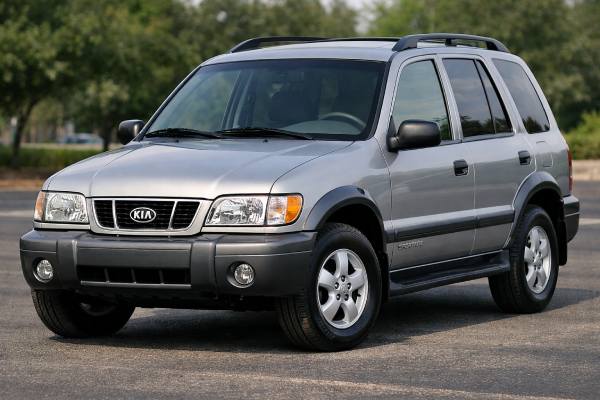
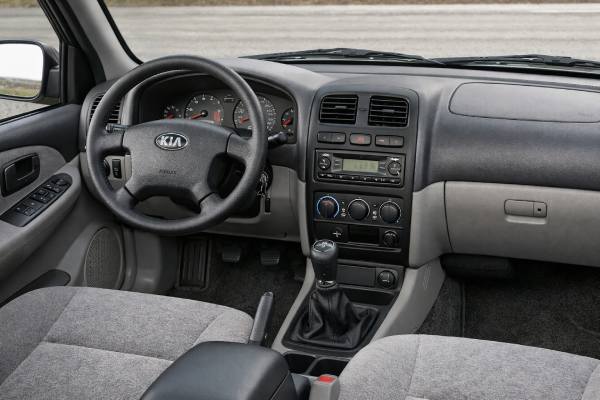
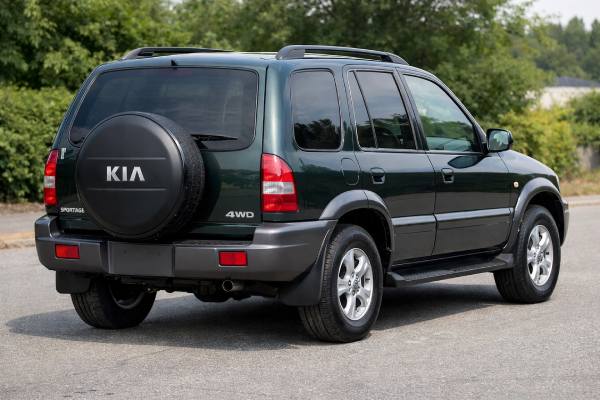
The facelifted 2000–2002 Kia Sportage RWD sits in a useful niche that has almost disappeared. It is a compact SUV with an old-school ladder-frame chassis, simple rear-wheel-drive layout, and a naturally aspirated 2.0-liter FE-family petrol engine that is easier to understand than many newer crossovers. In the 117 hp form covered here, it is not quick, but it offers honest mechanical simplicity, good visibility, and a rugged feel that still appeals to owners who want a budget-friendly utility vehicle they can maintain without specialist tools.
That said, this model now lives or dies on condition, not badge appeal. Rust, neglected timing-belt service, cooling-system wear, and tired suspension matter far more than brochure specs. The payoff for finding a good one is a straightforward SUV with genuine rough-road tolerance, compact outside dimensions, and lower complexity than the 4×4 versions sold alongside it in many markets.
Owner Snapshot
- Tough ladder-frame construction gives it better rough-road durability than many car-based rivals of the era.
- The RWD layout is mechanically simpler and usually cheaper to keep than comparable part-time 4×4 versions.
- Compact width, upright seating, and clear sightlines make it easy to place in traffic and on narrow roads.
- Corrosion around the chassis, fuel-tank area, and suspension mounts is the main ownership risk on older examples.
- A later Kia service schedule lists a broad interval of 9,000 miles or 12 months, whichever comes first.
Guide contents
- Kia Sportage NB-7 facelift
- Kia Sportage NB-7 specs and data
- Kia Sportage NB-7 trims and safety
- Reliability issues and service actions
- Maintenance and buying advice
- Driving and real-world performance
- How it stacks up against rivals
Kia Sportage NB-7 facelift
The first-generation Sportage was never a soft crossover in the modern sense. Under the facelifted 2000–2002 bodywork, the NB-7 remained a compact body-on-frame SUV with rear-wheel-drive architecture and optional part-time 4×4 in many markets. That basic layout explains both its strengths and its limitations. It feels tougher and more mechanical than a Honda CR-V or Toyota RAV4 of the same era, but it also rides, brakes, and protects occupants like an older design.
In FE-SOHC 2.0-liter form, the facelift Sportage was the practical end of the range. This 117 hp version was sold in several export markets as a lower-output alternative to the better-known DOHC 128 to 130 hp models. That matters when you shop for parts or compare online specifications, because catalog data often gets mixed between engines, body styles, and driveline layouts. The safe approach is to treat the 117 hp car as the simpler, lower-stressed petrol variant and verify details by VIN before ordering anything critical.
What makes this Sportage attractive today is not speed or modern equipment. It is the combination of compact size, genuine SUV underpinnings, and manageable mechanicals. The engine bay is easy to access, the suspension layout is conventional, and the RWD version avoids the added hubs, transfer case, and front driveline hardware that make four-wheel-drive examples slightly more expensive to sort.
The facelift also brought a tidier look, better trim finish in many markets, and a more settled ownership proposition than the earliest 1990s cars. Buyers could usually choose between a 5-door wagon and, in some regions, a shorter 2-door soft-top derivative. The 5-door is the sensible choice for most owners because it offers a longer wheelbase, better load space, and calmer road manners.
The real ownership story, though, is condition. A clean, well-serviced Sportage can still be useful and charming. A rusty or poorly maintained one can become a false economy very quickly. That is why the best way to understand the NB-7 facelift is as a simple utility SUV whose value comes from honesty and repairability, not polish.
Kia Sportage NB-7 specs and data
Because first-generation Sportage data varies by market, body style, and engine code listings, the figures below reflect the most common catalog values for the 2000–2002 facelifted 2.0-liter FE-family RWD model. Use them as a practical guide, then confirm VIN-specific numbers before service or restoration work.
Powertrain and driveline
| Item | Common figure for FE-SOHC 2.0 RWD |
|---|---|
| Code | FE-SOHC, often cataloged within the FE-family |
| Engine layout and cylinders | Front longitudinal inline-4, 4 cylinders, SOHC |
| Valvetrain | Usually listed as 8-valve for this lower-output version |
| Bore × stroke | 86.0 × 86.0 mm (3.39 × 3.39 in) |
| Displacement | 2.0 L (1,998 cc) |
| Induction | Naturally aspirated |
| Fuel system | Multi-point fuel injection |
| Compression ratio | Market dependent, commonly around 8.6:1 |
| Max power | 117 hp (87 kW) @ about 5,500 rpm |
| Max torque | 166 Nm (122 lb-ft) @ about 4,500 rpm |
| Timing drive | Belt |
| Transmission | 5-speed manual most common; 4-speed automatic in some markets |
| Drive type | Rear-wheel drive |
| Differential | Open |
Chassis and dimensions
| Item | Typical figure |
|---|---|
| Front suspension | Independent double wishbone, coil springs, anti-roll bar |
| Rear suspension | De Dion axle with coil springs |
| Front brakes | Vented discs, about 270 mm (10.6 in) |
| Rear brakes | Drums, about 250 mm (9.8 in) |
| Most common tyre size | 205/70 R15 |
| 5-door length / width / height | 4,435 / 1,764 / 1,695 mm (174.6 / 69.4 / 66.7 in) |
| 5-door wheelbase | 2,650 mm (104.3 in) |
| 2-door length / width / height | 4,025 / 1,764 / 1,650 mm (158.5 / 69.4 / 65.0 in) |
| 2-door wheelbase | 2,360 mm (92.9 in) |
| Kerb weight | About 1,365 to 1,500 kg (3,009 to 3,307 lb) |
| GVWR | About 1,900 to 2,060 kg (4,189 to 4,542 lb) |
| Fuel tank | About 53 to 60 L (14.0 to 15.9 US gal / 11.7 to 13.2 UK gal) |
| Cargo volume | Roughly 247 to 1,032 L for short body, up to about 640 to 2,220 L for 5-door, depending on method and market |
Performance, service data, and safety
| Item | Typical figure |
|---|---|
| 0–100 km/h (0–62 mph) | About 14.7 s manual; around 15 s automatic |
| Top speed | About 172 km/h (107 mph) manual; around 163 km/h (101 mph) automatic |
| Real-world highway at 120 km/h | Roughly 9.5 to 10.5 L/100 km in good tune |
| Engine oil | API SG 10W-30 originally listed; about 4.2 L (4.4 US qt) service fill |
| Dry engine oil capacity | About 4.7 L (5.0 US qt) |
| A/C refrigerant | R-134a; about 700 g (24.7 oz) |
| Key torque specs | Spark plugs 25–30 Nm (18–22 lb-ft); oil drain plug 30–35 Nm (22–26 lb-ft); tie-rod end nut 42–57 Nm (31–42 lb-ft) |
| Crash rating note | No widely cited Euro NCAP result for this exact variant; related 1998–2002 IIHS 4-door 4WD family test rated overall protection marginal |
| ADAS | None |
The most important takeaway is that the Sportage’s spec sheet tells only half the story. This is a modestly powered compact SUV with decent utility and old-fashioned mechanical honesty, not a numbers car.
Kia Sportage NB-7 trims and safety
Trim strategy on the facelifted NB-7 was less about luxury ladders and more about body style, driveline, and market packaging. That is why two apparently similar 2001 or 2002 Sportages can differ quite a bit in engine output, gearbox choice, wheel design, air-conditioning fitment, and brake equipment. For this 117 hp RWD version, think of the vehicle as the simpler, value-oriented side of the facelift range.
The most important split was 5-door versus 2-door. The 5-door wagon is the mainstream choice. It gives you the longer wheelbase, more stable load behavior, and far better practicality. The 2-door soft-top looks more distinctive and weighs less, but it has a shorter wheelbase, less cargo room, and a more abrupt ride. The 5-door also tends to be the smarter buy for modern use because parts support and body condition are usually better.
The second big split was 4×2 versus 4×4. The RWD 4×2 model is simpler and easier to inspect. It has fewer moving parts underneath, no transfer case to service, and fewer off-road-specific wear points. Related 4×4 trims brought stronger rough-surface ability and, in some markets, extra equipment such as selectable four-wheel drive hardware, different wheel packages, and optional ABS.
Quick identifiers matter when you are standing in front of a car:
- A true 4×4 will have extra driveline hardware underneath and usually a separate transfer selector or four-wheel-drive engagement system.
- The 2-door soft-top has the short wheelbase body and far smaller rear load bay.
- FE-SOHC lower-output cars often sit below DOHC versions in catalog listings, so engine-code confirmation matters more than trim badge wording.
Safety equipment was basic by modern standards. Front airbags were standard in later first-generation Sportages, and some market versions also advertised a driver knee airbag. Side-impact door beams, seat-belt pretension basics, and child-seat provisions were present in varying forms, but advanced protection technology was not. Stability control, side-curtain airbags, autonomous emergency braking, lane support, blind-spot monitoring, and rear cross-traffic alert were all absent because the platform predates that entire era of safety development.
That leaves crash performance as the key reality check. The related 1998–2002 4-door Sportage family received a marginal overall result in IIHS moderate-overlap frontal testing, with marginal structure performance. In plain terms, this is not a vehicle you buy for modern crash protection. It is a vehicle you buy because you value simplicity, low-speed utility, and repairable hardware, while accepting that passive safety standards have moved on dramatically.
Reliability issues and service actions
The facelifted Sportage is mechanically understandable, but age turns its weak spots into buying filters. Reliability is best viewed by prevalence and cost.
Common, usually low to medium cost
- Oil leaks from the rocker-cover gasket, cam seal, and front crank seal.
- Perished vacuum hoses and tired ignition components causing rough idle, misfire, or weak cold starts.
- Worn suspension bushes, ball joints, and wheel bearings, especially on rough-road cars.
- Cooling-system age issues such as cracked hoses, tired radiators, sticky thermostats, and weak fan operation.
These faults are rarely fatal on their own. They become expensive only when several have been ignored together.
Common and more serious
Corrosion is the big one. On this generation, rust affects chassis rails, body mounts, sills, arches, floor edges, and the fuel-tank area. Once corrosion reaches suspension mounting points or fuel-system hardware, the car moves from “old but usable” to “needs structural money.” Fuel smell around the rear underside deserves immediate attention because this model family saw documented concern around steel fuel-tank leakage and corrosion-related failures.
Occasional but important
Timing-belt neglect is the largest mechanical risk on the FE-family engine. Symptoms include unknown service history, belt age, noisy idlers, or water-pump seepage during inspection. Even when the engine is otherwise healthy, an overdue belt job lowers the value of the car because the buyer has to assume the full belt service is due immediately.
Transmission reliability is decent if fluids have not been ignored. Manual gearboxes are generally sturdy, though old clutch hydraulics and worn shifter linkages can make them feel worse than they are. Automatics are usually durable enough for the modest power level, but old fluid and heat can produce lazy shifts or flare.
Service actions and official problem history
Two official recall-type issues stand out in the late first-generation timeline. One involved front seat-belt buckles on affected 1999–2000 vehicles, where a false-latch condition could leave the belt unsecured. Another affected some 2002 vehicles with cooling-fan blade cracking. Both are worth checking because they are safety-related and easy to verify through paperwork and VIN history.
A useful practical insight with this Sportage is that there is very little software drama. It has none of the complicated ADAS calibrations or drivetrain-control layers seen on newer SUVs. When it runs badly, the cause is usually mechanical wear, a sensor fault, a vacuum leak, neglected fluids, or simple electrical age, not a deep control-module mystery. That is one reason enthusiasts still tolerate its dated design.
Maintenance and buying advice
The official broad service cadence published for later first-generation Sportage listings is 9,000 miles or 12 months, whichever comes first. On a vehicle this old, that is too relaxed unless the engine is in excellent condition and mostly used on gentle highway miles. A smarter ownership plan is preventive and conservative.
| Item | Practical interval | What matters most |
|---|---|---|
| Engine oil and filter | 5,000–6,000 miles or 6–12 months | Old engines benefit from shorter oil cycles |
| Engine air filter | Inspect every service, replace about 15,000–20,000 miles | Sooner in dust |
| Cabin filter | If fitted, inspect annually | Not all markets had one |
| Coolant | Every 2–3 years | Watch radiator and hose condition |
| Spark plugs | About 30,000 miles on standard plugs | Replace leads if weak |
| Fuel filter | About 30,000–40,000 miles if serviceable | Useful on neglected cars |
| Timing belt, tensioner, and idlers | About 60,000 miles or 5 years | Replace water pump at the same time |
| Auxiliary belts and hoses | Inspect every service | Replace at first cracking or noise |
| Manual gearbox and differential oil | 30,000–40,000 miles | Often ignored on older SUVs |
| ATF on automatic cars | 30,000–40,000 miles | Old fluid makes these units feel worse |
| Brake fluid | Every 2 years | Important on cars that sit |
| Brake inspection | Every service | Rear drums can hide neglect |
| Tyre rotation and alignment check | 6,000–8,000 miles | Helps spot bush and steering wear |
| 12 V battery test | Annually after year 4 | Weak batteries create false faults |
For decision-making, the core fluid and fastener data most owners need first is simple: API SG 10W-30 was the original oil callout in later Kia listings for this engine family, service-fill capacity is about 4.2 liters, spark plugs tighten to 25–30 Nm, and the drain plug to 30–35 Nm. Those numbers help you tell whether a workshop understands the car.
As a buyer, inspect in this order:
- Chassis and floor corrosion.
- Fuel-tank area, straps, lines, and smell.
- Proof of timing-belt replacement.
- Cooling-system pressure integrity.
- Front-end play in ball joints, tie rods, and steering hardware.
- Gearbox, differential, and prop-shaft noise on test drive.
- Electrical basics such as windows, locks, heater fan, and A/C.
The best version to own is usually a dry-climate 5-door manual with full service history and modest equipment. The one to avoid is the cheap example with visible rust, no belt proof, wandering steering, and a fuel smell at idle. Mechanically, these SUVs can last. Structurally neglected ones usually do not pay you back.
Driving and real-world performance
The 117 hp Sportage feels exactly like what it is: a compact ladder-frame SUV from the turn of the century. From the driver’s seat, the positives arrive first. Visibility is good, the cabin is upright, and the narrow body makes it easier to place than many modern SUVs. Around town, that gives the car a friendly, low-stress character.
Once moving, the old-school layout becomes more obvious. The ride is acceptable rather than plush, with more body motion than a car-based rival. The 5-door feels calmer and more settled than the short-wheelbase 2-door, especially over broken pavement. Steering is light enough for everyday use but not especially precise, and feedback is limited. The brake pedal does the job, yet repeated hard use reminds you that this is not a modern performance chassis.
The engine is willing, but it needs commitment. With 117 hp moving a fairly heavy utility vehicle, low-speed pull is adequate rather than strong. The manual gearbox suits the engine best because it lets you keep the FE-family four-cylinder in its useful range. The automatic makes the car easier in traffic but blunts already modest acceleration. Expect about 14.7 seconds to 100 km/h in a healthy manual and roughly a second slower in the automatic.
Real-world economy is reasonable for an older compact SUV, but not outstanding:
- City: about 12.0–14.5 L/100 km, or roughly 16–20 mpg US and 19–24 mpg UK.
- Highway: about 8.5–10.5 L/100 km, or roughly 22–28 mpg US and 27–33 mpg UK.
- Mixed use: about 10.0–12.0 L/100 km, or roughly 20–24 mpg US and 24–28 mpg UK.
At a true 120 km/h cruise, most healthy stock vehicles land in the upper half of that highway range. Bigger tyres, roof accessories, poor alignment, and tired ignition parts can move consumption noticeably in the wrong direction.
This is also a vehicle where condition changes the verdict. A tight example feels honest and usable. A worn one feels slow, loose, noisy, and older than its years. That gap is wider here than on many modern SUVs, which is why maintenance history shapes the driving experience so strongly.
How it stacks up against rivals
The facelifted Sportage makes the most sense when you compare it with the late-1990s and early-2000s compact SUV field, not with modern crossovers. Against period rivals, its personality is clear.
| Rival | Rival’s main advantage | Sportage’s main advantage |
|---|---|---|
| Toyota RAV4 | Better refinement, stronger safety image, tidier road manners | More traditional SUV feel and usually lower buy-in price |
| Honda CR-V | Better packaging, more polished ride, stronger everyday comfort | Simpler rear-drive architecture and more rugged mechanical character |
| Suzuki Grand Vitara | Strong off-road identity and compact agility | Often roomier as a 5-door and usually cheaper to buy |
| Land Rover Freelander | More sophisticated road feel when healthy | Simpler hardware and lower ownership risk |
The Kia’s strongest case is value. It often costs less than the best-known Japanese rivals, and the RWD version in particular avoids some of the extra complexity that comes with permanent or part-time four-wheel-drive systems. For a buyer who wants a light-duty utility vehicle, occasional rough-road use, and DIY-friendly maintenance, that simplicity still counts.
Where it falls behind is equally clear. It is slower than many rivals, less refined on the highway, and well behind them in crash protection. Cabin noise is higher, body control is looser, and materials feel more workmanlike than polished. If your priority is a quiet family car with a tall seating position, a CR-V or RAV4 is usually the better answer.
Where the Sportage wins is with owners who like honest mechanicals and do not need modern safety or refinement. It offers a kind of compact SUV ownership that has largely vanished: ladder-frame toughness, modest running costs, simple service access, and just enough performance to do the job. That does not make it the class leader. It does make it a distinctive alternative for the right buyer.
References
- Engine Oil Grades and Capacities 2023 (Service data)
- 2002 Kia Sportage 2002 (Safety Rating)
- Recall Campaign: Front Seat Belt Buckle Replacement 2004 (Recall Bulletin)
- 2002MY Kia Sportage Cooling Fan 2007 (Recall Bulletin)
- Fuel Tank Leakage 2006 (ODI Investigation)
Disclaimer
This article is for informational purposes only and is not a substitute for professional diagnosis, inspection, or repair. Specifications, torque values, service intervals, procedures, and fitted equipment can vary by VIN, market, body style, transmission, and production date, so always verify critical details against official service documentation for the exact vehicle.
If this guide helped you, please consider sharing it on Facebook, X, or other social platforms to support our work.