
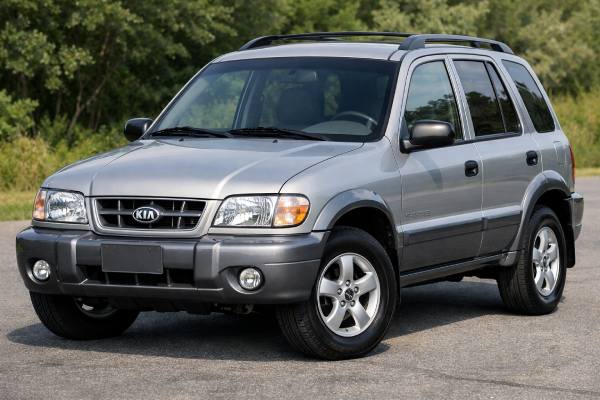
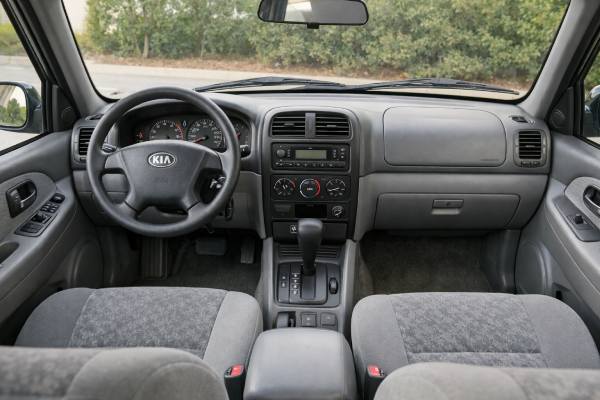
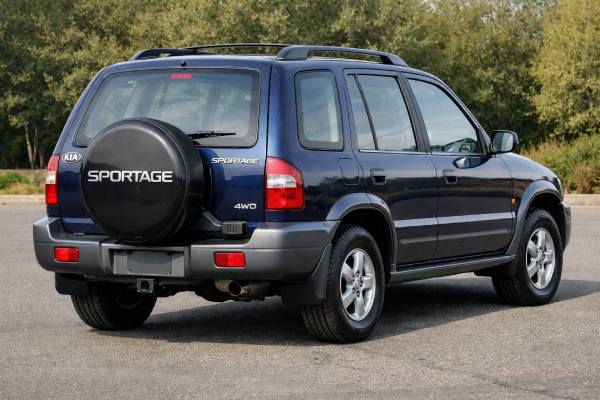
The facelifted 2000–2002 Kia Sportage RWD sits in an interesting place between a light SUV and a compact utility truck. It uses a simple body-on-frame layout, a naturally aspirated 2.0-liter FE-family DOHC four-cylinder, and rear-wheel drive on 2WD models, so it feels more mechanical and old-school than the car-based crossovers that followed. That is exactly why some owners still like it. It is easy to understand, usually easy to service, and light enough in RWD form to feel more responsive than the heavier 4WD versions.
Its appeal today comes down to honesty. The engine is modest but durable when the timing belt, cooling system, and fluids are kept on schedule. The downside is equally clear: crash protection is dated, refinement is basic, and rust or neglected suspension parts can decide whether an example is a bargain or a headache. For the right buyer, though, it remains a usable, characterful budget SUV.
Owner Snapshot
- Simple body-on-frame design makes inspection and mechanical work fairly straightforward.
- RWD versions are lighter and usually feel a bit cleaner on-road than comparable 4WD trims.
- The 2.0-liter DOHC engine is dependable when the timing belt and cooling system are kept current.
- Safety is the biggest compromise, especially compared with newer compact SUVs.
- Change engine oil and filter every 7,500 mi / 12,000 km or 12 months, or every 5,000 mi / 8,000 km in severe use.
Guide contents
- Kia Sportage NB-7 Basics
- Kia Sportage NB-7 Specs and Data
- Kia Sportage NB-7 Trims and Safety
- Reliability, Faults, and Recalls
- Maintenance and Buying Advice
- Driving Feel and Real Performance
- Rivals and Value Position
Kia Sportage NB-7 Basics
The facelifted first-generation Sportage is still very much a 1990s design, even in 2000–2002 form. Kia’s update mainly sharpened the styling, improved trim and equipment, and stretched the body over the earlier truck-based architecture. In RWD hardtop form, this matters because the facelift 4-door feels more useful than the short-body soft-top versions while keeping the same basic mechanical honesty. It is not a soft crossover. It is a compact SUV with a ladder-frame layout, a longitudinal engine, and rear-drive proportions.
That setup gives the Sportage a very specific ownership profile. Compared with later unibody rivals, it has more driveline hardware, more visible service points, and less chassis sophistication. Yet that can work in its favor. Access around the engine bay is decent, the suspension is conventional, and the 2WD version avoids some of the extra cost and wear points found in the 4WD models. For buyers who want a low-cost utility vehicle for light hauling, bad weather on proper tires, or simple weekend maintenance, that still has value.
The FE DOHC 2.0-liter engine suits the car’s mission better than its numbers suggest. With 130 hp and roughly 172 Nm of torque, it does not make the Sportage quick, but it is smooth enough when revved and generally easier to live with than some rougher small-SUV engines from the same era. The standard 5-speed manual is the transmission to seek if you want the best response and the lowest running complexity. The 4-speed automatic is more relaxed in traffic, but it dulls performance and tends to make the modest power output feel even smaller.
The key reason to buy this Sportage today is not speed or modern safety. It is value. A good example offers useful cargo space, a real 2,000-lb towing rating in many 4-door hardtop specifications, and a distinctly rugged feel for very little money. The reason to walk away is equally simple: poor maintenance, rust, or sloppy front suspension can quickly erase any price advantage. In other words, this is a better vehicle to buy on condition than on badge, year, or trim alone.
Kia Sportage NB-7 Specs and Data
For the facelift 2000–2002 Kia Sportage RWD 4-door hardtop, the core numbers are straightforward. Public data is fairly consistent on the engine, drivetrain, and major dimensions, while a few trim-dependent details such as curb weight, tire size, and exact equipment can vary by market and transmission. The table below focuses on the commonly cited North American facelift RWD configuration with the 130-hp 2.0-liter petrol engine.
| Category | Specification |
|---|---|
| Engine code | FE DOHC, commonly cataloged in service data as FE or FED family |
| Engine layout and cylinders | Inline-4, 4 cylinders, DOHC, 4 valves per cylinder |
| Bore × stroke | 86.0 × 86.0 mm (3.39 × 3.39 in) |
| Displacement | 2.0 L (1,998 cc) |
| Induction | Naturally aspirated |
| Fuel system | Multi-point fuel injection |
| Compression ratio | 9.2:1 |
| Max power | 130 hp (97 kW) @ 5,500 rpm |
| Max torque | 172 Nm (127 lb-ft) @ 4,000 rpm |
| Timing drive | Belt |
| Transmission | 5-speed manual standard, 4-speed automatic optional |
| Drive type | Rear-wheel drive |
| Differential | Standard rear differential, no mainstream evidence of an LSD on RWD trims |
| Suspension front | Double wishbone with coil springs |
| Suspension rear | 4-link rear axle layout with coil springs |
| Brakes | Front disc, rear drum |
| Wheels and tyres | 15-inch wheels; common facelift fitment is P205/75 R15 |
| Fuel economy, manual | 19 mpg US city / 23 mpg US highway |
| Fuel economy, automatic | 18 mpg US city / 21 mpg US highway |
| Dimensions and capacities | Value |
|---|---|
| Length | 4,326 mm (170.3 in) |
| Width | 1,730 mm (68.1 in) |
| Height | 1,651 mm (65.0 in) |
| Wheelbase | 2,649 mm (104.3 in) |
| Ground clearance | 201 mm (7.9 in) |
| Turning circle | 10.6 m (34.8 ft) |
| Kerb weight | About 1,410 kg (3,108 lb) for a 4-door RWD manual base model |
| GVWR | Market-dependent and not consistently published in open sources |
| Fuel tank | 60 L (15.8 US gal / 13.2 UK gal) |
| Cargo volume | 25.8 ft³ behind the rear seat in common 4-door hardtop listings |
| Payload | About 390 kg (860 lb) |
| Towing capacity | About 907 kg (2,000 lb) |
| Performance and service data | Value |
|---|---|
| 0–100 km/h | About 11.9 seconds with 5-speed manual |
| 0–100 km/h, automatic | About 12.9 seconds |
| Top speed | Not consistently published for every RWD trim; expect modest rather than sporty performance |
| Engine oil | API SG 10W-30; 4.2 L (4.4 US qt) |
| Coolant capacity | About 7.5 L (7.9 US qt) |
| Oil service interval | 7,500 mi / 12,000 km or 12 months normal use |
| Severe-use oil interval | 5,000 mi / 8,000 km |
Two notes matter here. First, this is an old-model platform, so exact tire spec, curb weight, and minor trim details can differ by transmission and market. Second, the powertrain is simple enough that real condition matters more than small brochure differences. A healthy 130-hp RWD Sportage should feel steady, clean in its rev build, and free of overheating, driveline clunks, or steering looseness.
Kia Sportage NB-7 Trims and Safety
The facelift RWD Sportage was sold in several body and equipment combinations, but the most practical version for most used buyers is the 4-door hardtop. It gives up the novelty of the convertible body, yet it offers the better everyday mix of cabin space, cargo usefulness, and weather sealing. In period U.S. listings, Kia offered both RWD and 4WD layouts, with manual and automatic transmissions, while some earlier trim naming became simpler by 2002. That matters because equipment changes near the end of production can make two outwardly similar trucks feel quite different.
On late hardtop models, buyers often got a better standard-equipment baseline than on earlier years. Air conditioning, alloy wheels, privacy glass, and improved audio features became easier to find on 2002 hardtops, even when the trim naming looked less layered than before. For used buyers today, the quick identifiers are practical ones: 4-door hardtop body, RWD stance, 5-speed manual shifter, 15-inch wheel package, and the absence of a 4WD selector. Inside, late trucks usually have slightly more polished trim than pre-facelift examples, but build wear can blur that difference.
Mechanically, the biggest trim split is not luxury equipment. It is drivetrain and transmission. The RWD model is lighter, simpler, and cheaper to maintain than the 4WD version because it lacks the transfer case and front driveline hardware. The manual also tends to be the more appealing long-term choice because it extracts the best from the modest engine and avoids aging automatic-shift behavior. If two vehicles are equal in rust, history, and price, the RWD manual is usually the smarter buy.
Safety is where the Sportage shows its age most clearly. Dual front airbags were standard on 1998-on models, which helped bring the vehicle closer to period norms, and some later models added seatbelt pretensioner and load-limiting improvements. Even so, there is no meaningful modern driver-assistance story here. You do not get automatic emergency braking, lane support, blind-spot monitoring, or current electronic crash-avoidance features. ABS availability could vary by market and trim, so a physical inspection matters more than assumptions.
The more important point is crash structure. By today’s standards, it is dated. The vehicle’s known IIHS moderate-overlap result for 1998–2002 applicability is marginal overall, which is the single clearest reason to treat this Sportage as an old utility vehicle rather than a family safety benchmark. Child-seat hardware and tether arrangements also vary by market and year, so buyers who need regular rear-seat child-seat use should verify anchor provision on the exact vehicle, not rely on generic trim descriptions.
Reliability, Faults, and Recalls
The facelift Sportage RWD can be dependable, but only when you judge it as a 20-plus-year-old truck-based SUV rather than a modern crossover. Its common problems are mostly understandable age-and-maintenance issues, not mysterious electronic failures. The challenge is that several of those issues affect safety or major repair cost, so the gap between a good one and a poor one is large.
Common, lower-to-medium cost issues include cooling-system aging, vacuum leaks, tired ignition components, sticky idle behavior, and oil seepage from old seals. The usual pattern is familiar: slight overheating in traffic points to a weak radiator, failing fan parts, aging hoses, or a thermostat that no longer opens cleanly. Rough idle or hesitation often traces to intake leaks, dirty throttle-body hardware, tired plugs and leads, or older sensors. Oil leaks are often manageable if caught early, but neglect can leave the lower engine, crossmember, and transmission bellhousing coated enough to hide bigger faults.
A second group of issues sits in the medium-to-high concern range. Timing-belt neglect is the main one. This engine is best treated as a strict timing-belt maintenance motor, not one to run on optimistic intervals. Front suspension wear is another. Ball joints, bushings, steering linkage wear, and alignment-related tire wear deserve careful inspection, especially on vehicles driven on rough roads or left standing for long periods. Rust compounds this. Even a fundamentally sound suspension design becomes a liability when corrosion attacks fasteners, brackets, frame sections, or control-arm mounting points.
Known service actions matter. There was an official recall campaign for front seat-belt buckle replacement affecting certain 1999–2000 Sportage vehicles because a false-latch condition could leave the belt unsecured. Certain 2002 models also had a cooling-fan recall because blades could crack and separate. In addition, NHTSA material tied to the 2002 Sportage examined front suspension upper ball-joint data, which is enough to justify a close visual and hands-on front-end inspection on any surviving vehicle. Even if an individual truck drives acceptably, loose or corroded suspension parts can turn a cheap SUV into an immediate repair case.
Pre-purchase checks should be practical and document-led. Ask for timing-belt proof, cooling-system work records, and confirmation that recalls were completed. Then inspect the truck cold and on a lift. Look for rusty frame areas, sloppy steering, cracked boots, uneven front tire wear, wet seals, noisy accessories, and signs of past overheating. A Sportage that starts cleanly, tracks straight, cools properly, and shows honest service history is usually a much better bet than a shinier example with no paperwork.
Maintenance and Buying Advice
The best way to own a first-generation Sportage well is to service it on time and keep the list simple. Period maintenance schedules for this platform are not relaxed, and that is a good thing. This is an older design with a timing belt, age-sensitive cooling parts, grease points and driveline fluids that matter, and suspension hardware that benefits from routine inspection. When buyers ignore that, repair bills stack up fast.
A sensible working schedule for the 2000–2002 RWD 2.0 looks like this:
- Engine oil and filter: every 7,500 mi / 12,000 km or 12 months in normal use. Drop that to 5,000 mi / 8,000 km for heavy city driving, frequent short trips, heat, dust, or towing.
- Timing belt: replace at 60,000 mi / 96,000 km unless you have strong, dated documentation showing a recent quality replacement.
- Air filter: inspect regularly and replace around 30,000 mi / 48,000 km, sooner in dusty use.
- Spark plugs: replace around 30,000 mi / 48,000 km.
- Fuel filter: replace around 30,000 mi / 48,000 km where fitted and accessible in your market configuration.
- Coolant: period schedules were relatively conservative, so do not treat coolant as lifetime fill. A full system refresh is wise if history is unclear.
- Manual gearbox, automatic fluid, and axle oils: inspect for leaks often and refresh more aggressively if the vehicle tows, sits, or has seen water ingress.
- Brake inspection: check pad or shoe condition, rotor and drum wear, hoses, and parking-brake function at every service.
- Tyres and alignment: rotate regularly and watch for front-end wear patterns.
- Battery, belts, and hoses: test and inspect yearly on an age-based basis.
Useful decision-making numbers include:
- Engine oil: API SG 10W-30, 4.2 L with filter.
- Coolant capacity: about 7.5 L total.
- Fuel tank: 60 L.
- Lug-nut torque: 100 Nm.
- Front lower ball joint to knuckle bolt: 118 Nm.
- Front lower control-arm bushing bolts: 280 Nm.
- Upper control-arm ball joint link to knuckle bolt: 48 Nm.
As a buyer, prioritize structure and history over trim. The best examples usually have a manual gearbox, dry engine bay, straight cooling history, and a rust-light chassis. The ones to avoid are easy to spot once you know the signs: wandering steering, clunking front end, overheating after idling, mixed old tires, damp carpets, and missing service proof for the timing belt. Long-term durability can be good if the chassis is solid and maintenance is current, but a neglected Sportage is rarely worth restoring unless the purchase price is extremely low.
Driving Feel and Real Performance
From the driver’s seat, the RWD facelift Sportage feels more like a small utility truck than a modern crossover. That is not a criticism. It simply tells you what to expect. The seating position is upright, visibility is decent, and the controls are generally honest and mechanical. The RWD layout gives the nose a slightly lighter feel than the 4WD versions, and that helps the truck feel a bit cleaner on turn-in, even if it never hides its ladder-frame roots.
Ride quality is acceptable rather than polished. In town, the suspension handles ordinary broken pavement well enough, but it does not isolate sharp ridges the way later unibody rivals do. At speed, straight-line stability is respectable if the alignment and tire condition are correct. A worn example, however, can feel busy, vague, or unsettled very quickly. That is why suspension condition matters so much on a test drive. Steering feel is on the slow, utility-focused side, and the brakes do the job without much sporting confidence. This is a vehicle that rewards calm inputs more than aggressive ones.
The 2.0-liter DOHC engine has a mild, usable character. There is no real low-rpm punch, so the best progress comes from letting it rev into the middle of the power band. With the 5-speed manual, that is fine. The gearbox suits the engine and keeps the truck feeling lighter than it is. With the automatic, the same engine feels flatter, and passing performance becomes noticeably less relaxed. A healthy manual RWD truck reaches 100 km/h in about 11.9 seconds, which is serviceable for its era but slow by current standards.
Real-world fuel use is exactly what the official numbers suggest: acceptable for an older truck-based SUV, but not especially low. Expect around 12.4 L/100 km in city use and 10.2 L/100 km on the highway with a manual, while the automatic usually lands closer to 13.1 city and 11.2 highway. At a true 120 km/h highway cruise, consumption usually trends toward the less favorable end of that range because the Sportage is not especially aerodynamic.
Load and tire choice change the verdict. With good road tires and a sensible load, the RWD Sportage feels predictable and easy to place. On poor tires, in heavy rain, or with a worn rear suspension, it feels old very quickly. The 2,000-lb tow rating is useful, but towing or carrying a full load makes passing slower and asks more from the cooling system and brakes, so condition is everything.
Rivals and Value Position
The facelift Kia Sportage RWD competed against a very mixed set of compact SUVs, and that remains true on the used market today. Its closest rivals are not always the ones with the most similar size. They are the ones that ask the same basic question: do you want a simple, affordable SUV with genuine utility, or do you want the most refined compact family vehicle your money can buy?
Against the first-generation Honda CR-V, the Sportage loses on crash-era polish, packaging efficiency, and everyday refinement. The Honda feels more car-like, usually rides better, and tends to make more sense as family transport. The Toyota RAV4 tells a similar story. It is usually tighter built, easier to recommend broadly, and stronger on resale. If you want the least risky all-round ownership proposition, the Japanese rivals still lead.
The Sportage fights back in different areas. It often costs less to buy, feels tougher in its basic structure, and offers a more old-school SUV character. Buyers who want a ladder-frame feel, easier underbody access, simple rear-drive hardware, and respectable light-towing ability may actually prefer it. In that sense, it sometimes lines up more closely with the Suzuki Grand Vitara or Chevrolet Tracker than with softer crossover-style rivals. Those trucks share some of the same appeal: compact size, simple utility, and a willingness to trade polish for mechanical straightforwardness.
Where does that leave the RWD Sportage today? It is best for buyers who value honesty over image. Choose it if you want a cheap utility vehicle, light tow rig, or second car that you can understand and maintain without excessive complexity. Do not choose it if safety performance, highway quietness, or modern daily-driver refinement sit at the top of your list. The verdict is simple: a good Sportage is better than its reputation, but only when you buy the right example. In poor condition, its age shows faster than the strongest rivals. In sound condition, though, it remains one of the more characterful budget SUVs of its time.
References
- 2002 Kia Sportage 2026 (Safety Rating)
- Engine Oil Grades and Capacities 2023 (Service Data)
- Recall Campaign: Front Seat Belt Buckle Replacement 2004 (Recall)
- 2002MY Kia Sportage Cooling Fan 2007 (Recall)
- Preliminary Evaluation (PE07-062) Peer Vehicle Data: MY 2002 Kia Sportage; Front Suspension Upper Ball Joint 2008 (Service Manual and Investigation)
Disclaimer
This article is for informational purposes only and is not a substitute for professional diagnosis, repair, or vehicle inspection. Specifications, torque values, service intervals, procedures, and equipment can vary by VIN, market, transmission, body style, and production date, so always verify critical details against official service documentation for the exact vehicle.
If this guide helped you, please share it on Facebook, X, or your preferred forum to support our work.