
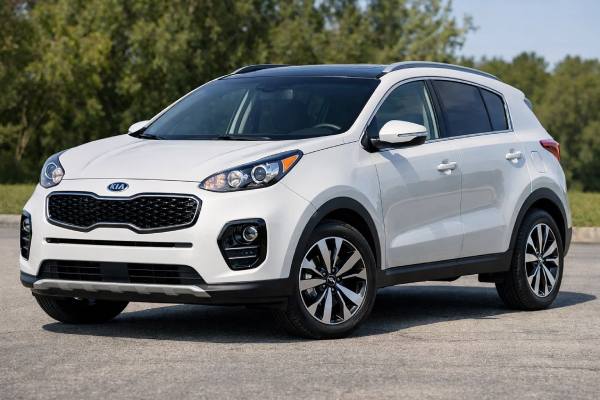
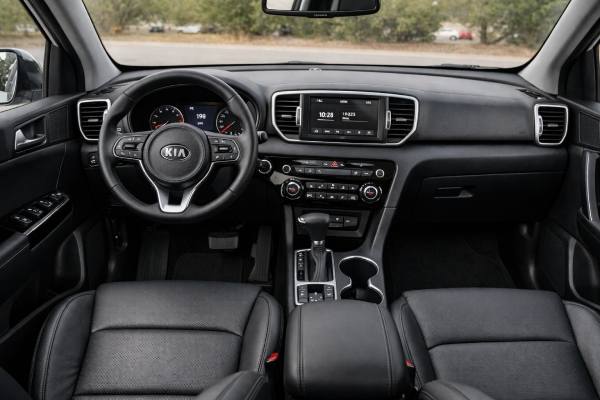
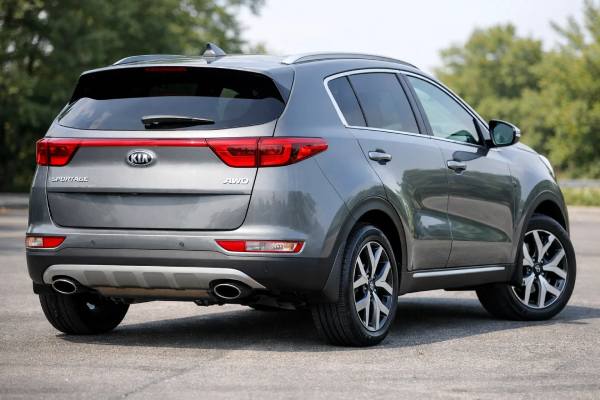
The 240 hp Kia Sportage QL front-wheel-drive turbo is the sharper edge of the 2016–2018 Sportage range. In practical terms, this exact G4KH 2.0-liter turbo FWD setup aligns most closely with the North American SX Turbo, which gives this version a clear identity: stronger midrange punch than the regular 2.4, a conventional 6-speed automatic instead of a dual-clutch, and a sport-tuned chassis that still works as a daily SUV. That combination matters because it shapes ownership just as much as performance.
Compared with the lower-output petrol Sportage, the turbo car feels more serious. It gets larger front brakes, firmer damping, 19-inch wheels in its common factory form, and more standard tech. The trade-off is equally clear. Direct injection, turbo heat, and higher running loads raise maintenance expectations, and the exact safety and service picture depends heavily on market and VIN. This is a rewarding Sportage when it is maintained properly, but it is not the version to buy on a thin history file.
Fast Facts
- The 2.0 turbo engine gives the QL Sportage genuinely strong midrange performance for its class.
- The 6-speed torque-converter automatic is usually easier to live with long term than some rival small-SUV dual-clutch setups.
- The stiffer QL body and sport-tuned suspension give this trim a more planted, more controlled feel than the standard petrol versions.
- Direct injection and turbo heat mean skipped oil services and cheap plugs matter more here than on the 2.4-liter model.
- A practical oil-service target is every 8,000–10,000 km or 6–12 months, depending on climate and usage.
Explore the sections
- Kia Sportage QL Turbo Snapshot
- Kia Sportage QL Technical Chart
- Kia Sportage QL Equipment and Protection
- Trouble Spots and Campaigns
- Service Plan and Purchase Tips
- Road Manners and Pace
- Sportage Turbo Versus Rivals
Kia Sportage QL Turbo Snapshot
The QL-generation Sportage was a major reset for Kia’s compact SUV. The body became much stiffer, cabin quality moved up, suspension tuning improved, and noise control took a real step forward. Kia stated that the new body-in-white used far more advanced high-strength steel than the previous model and delivered a major gain in torsional rigidity. For the turbo model, that stronger base mattered because the 2.0-liter G4KH engine finally gave the Sportage the performance to match its more serious road manners.
For this 240 hp front-drive version, the key attraction is the drivetrain mix. The G4KH is a 1,998 cc turbocharged direct-injection four-cylinder that makes 240 hp in FWD form and 260 lb-ft of torque from low in the rev range. Kia paired it with a traditional 6-speed automatic rather than a CVT or dry-clutch gearbox. That gives the car a more natural throttle-to-road feel than many compact crossovers from the same period. It also helps the turbo Sportage feel smoother in town and less awkward in stop-start traffic than some small turbo rivals with more complicated transmissions.
This version is not just an engine upgrade. Kia also gave the SX Turbo a firmer, model-specific suspension tune, 19-inch wheels, larger front brakes, paddle shifters, and a more upscale cabin and lighting package. In other words, the turbo Sportage is a proper top-trim derivative, not merely the standard car with extra boost. That shows up on the road. The steering is still light by enthusiast standards, but the body control is tighter, the front axle feels more anchored in medium-speed corners, and the car copes better with quick throttle changes than the lower-powered trims.
Ownership, however, needs more discipline than with the 2.4-liter non-turbo model. The G4KH uses direct injection, runs hotter, and places more stress on plugs, coils, oil, and cooling hardware. It is also the trim where neglected tyres and budget brake parts are most obvious, because the chassis can actually exploit decent rubber. A clean history matters here more than on the basic Sportage.
One important note on the 2016–2018 year range: public factory information for the exact 240 hp FWD configuration lines up most cleanly with the 2017 and 2018 U.S.-market SX Turbo, while 2016 reflects the QL generation’s rollout and early production period more broadly. That is why the hard specifications in this guide follow the factory data for that officially published turbo FWD match.
Kia Sportage QL Technical Chart
The table below reflects the closest official factory match for the 240 hp G4KH front-drive Sportage QL: the 2017–2018 SX Turbo FWD. Where Kia did not publish a figure for this exact trim, the row notes that clearly rather than guessing.
Powertrain and efficiency
| Item | Kia Sportage QL 2.0T FWD |
|---|---|
| Code | G4KH |
| Engine layout and cylinders | Inline-4, 4 cylinders, DOHC, 4 valves per cylinder |
| Bore × stroke | 86.0 × 86.0 mm (3.39 × 3.39 in) |
| Displacement | 2.0 L (1,998 cc) |
| Induction | Turbocharged |
| Fuel system | Direct injection |
| Compression ratio | 10.0:1 |
| Max power | 240 hp (179 kW) @ 6,000 rpm |
| Max torque | 353 Nm (260 lb-ft) @ 1,450–3,500 rpm |
| Timing drive | Chain |
| Rated efficiency | 10.2 / 9.0 / 11.2 L/100 km mixed / highway / city (23 / 26 / 21 mpg US; 27.6 / 31.2 / 25.2 mpg UK) |
| Real-world highway @ 120 km/h (75 mph) | Commonly around 8.8–9.8 L/100 km, depending on tyres, load, and temperature |
Transmission and driveline
| Item | Kia Sportage QL 2.0T FWD |
|---|---|
| Transmission | 6-speed automatic, torque converter |
| Transmission code | Kia public U.S. media materials do not list a gearbox code for this trim |
| Drive type | FWD |
| Differential | Open front differential |
| Final drive ratio | 3.320:1 |
Chassis and dimensions
| Item | Kia Sportage QL 2.0T FWD |
|---|---|
| Suspension, front / rear | MacPherson strut / multi-link |
| Steering | Motor-driven power steering, rack and pinion |
| Steering ratio | 14.4:1 |
| Turns lock-to-lock | 2.71 |
| Brakes | 320 mm (12.6 in) front disc / 302 mm (11.9 in) rear disc |
| Most common tyre size | 245/45 R19 |
| Ground clearance | 163 mm (6.4 in) |
| Approach / departure / breakover | 16.7° / 23.9° / 18.6° |
| Length / width / height | 4,481 / 1,854 / 1,646 mm (176.4 / 73.0 / 64.8 in, with roof rails) |
| Wheelbase | 2,670 mm (105.1 in) |
| Turning circle | 10.6 m (34.8 ft) |
| Kerb weight | 1,663–1,768 kg (3,666–3,898 lb), depending on equipment |
| GVWR | Verify by VIN/door label; not consistently published in public factory media |
| Fuel tank | 62.1 L (16.4 US gal / 13.6 UK gal) |
| Cargo volume | 869 L (30.7 ft³) behind second row / 1,702 L (60.1 ft³) behind first row, SAE |
Performance and capability
| Item | Kia Sportage QL 2.0T FWD |
|---|---|
| 0–100 km/h (0–62 mph) | Kia did not publish an official figure in the U.S. media specs |
| Top speed | Not officially published in the referenced factory material |
| Braking distance 100–0 km/h | Not officially published in the referenced factory material |
| Towing capacity | 907 kg (2,000 lb) braked / 748 kg (1,650 lb) unbraked |
| Payload | Confirm by VIN label; equipment dependent |
Fluids and service capacities
| Item | Kia Sportage QL 2.0T FWD |
|---|---|
| Engine oil | 4.8 L (5.1 US qt); use the correct full-synthetic grade for market and climate |
| Coolant | 2.8 L listed in Kia U.S. spec sheet for turbo engine system fill data; confirm service-fill procedure by VIN/manual |
| Transmission / ATF | 7.8 L total capacity; correct SP-IV-family fluid only |
| Differential / transfer case | Not applicable on this FWD model |
| A/C refrigerant | Confirm under-hood label before service |
| A/C compressor oil | Confirm under-hood label or service data before service |
| Key torque specs | Wheel nuts commonly 107–127 Nm (79–94 lb-ft) |
Safety and driver assistance
| Item | Kia Sportage QL 2.0T FWD |
|---|---|
| Euro NCAP | Broader QL platform was tested in Europe, but that is not a trim-identical match for this U.S.-spec turbo FWD |
| IIHS | Strong crash-structure results on the 2017 model page; exact headlight results vary by lamp set and remain important |
| Headlight rating (IIHS) | SX Turbo HID projector setup rated Poor on the 2017–2018 IIHS page |
| ADAS suite | AEB, forward collision warning, lane departure warning, blind-spot detection, rear cross-traffic alert, high-beam assist, and dynamic bending lights, with trim/year dependence |
The core takeaway is simple: this is a quick, well-specified compact SUV with honest factory numbers, useful towing ability, and a better-than-average chassis. But it is also one where buyers should not confuse “top trim” with “maintenance-free.”
Kia Sportage QL Equipment and Protection
For the 240 hp front-drive car, the baseline trim story is much narrower than on the 2.4-liter Sportage. In the factory data that matches this exact powertrain, the turbo engine sits in the SX Turbo grade. That means the buyer is usually looking at a fully loaded Sportage rather than choosing among multiple turbo trims. Standard SX Turbo equipment includes the 2.0T engine, 6-speed automatic, sport-tuned suspension, paddle shifters, 19-inch wheels, panoramic roof, upgraded infotainment, and distinctive exterior detailing such as satin trim, dual exhaust, and model-specific front-end treatment.
Quick identifiers help on the used market. Outside, the factory turbo FWD usually shows 19-inch alloys, LED fog lamps, dual exhaust, satin-finished exterior trim, and a more elaborate headlamp setup than LX or EX cars. Inside, it typically adds the larger touchscreen, navigation, D-shaped heated steering wheel, alloy pedals, leather trim, and a fuller driver-information display. Because this trim already sits at the top of the range, year-to-year changes are more about equipment detail than mechanical change.
The big 2018 update is worth noting. Kia made the electronic parking brake with Auto Hold standard on the SX 2.0 Turbo for 2018. Driver-assistance content also became clearer. In the 2018 overview, Kia lists autonomous emergency braking, forward collision warning, and lane departure warning as standard on SX, while blind-spot detection and rear cross-traffic alert are also standard on EX and SX. That is useful for buyers because it means a 2018 turbo FWD is more likely to have the safety kit many shoppers now expect.
Crash protection is a mixed story only because you need to separate structure from equipment. On the IIHS page, the QL Sportage performs well in the core crash tests that define the shell and restraint system. That is encouraging, and it fits Kia’s claim that the redesigned QL body is much stiffer than before. But lighting is the weaker point. On IIHS’s 2017–2018 page, the SX Turbo HID projector setup still earns a Poor headlight rating because of glare and visibility limitations. That means a well-maintained turbo Sportage can still be structurally safe while falling short on nighttime lighting performance by modern standards. Good bulbs, proper aim, and clear lenses matter more here than many owners realize.
Airbag count and child-seat hardware can vary by market, but the North American turbo cars generally bring the full modern package: front, side, and curtain airbags, ABS, ESC, traction control, a rear camera, and ISOFIX/LATCH child-seat mounting points. If the vehicle has had windshield replacement or front-end work, ask whether the camera-based systems were recalibrated correctly. A turbo Sportage with every warning light off but poorly calibrated AEB or lane systems is not truly “sorted.”
Trouble Spots and Campaigns
The G4KH turbo Sportage is more rewarding than the base 2.4, but it asks more from its owner. The best way to think about reliability is by issue type: some items are routine turbo-car wear, while others are campaign-related and deserve VIN-level verification.
Common and usually medium cost
- Spark plugs and ignition coils
Symptoms: stumble under load, rough idle, reduced boost feel, flashing check-engine light.
Likely cause: worn plugs or a weak coil, often accelerated by turbo heat and long service intervals.
Remedy: replace plugs with the correct heat range and test coils before they damage the catalytic converter. - Intake valve deposits
Symptoms: rough cold idle, off-boost hesitation, loss of crispness at part throttle.
Likely cause: direct injection does not wash the back of the intake valves with fuel.
Remedy: inspect intake cleanliness on higher-mileage engines and consider professional valve cleaning if symptoms build. - Oil seepage and PCV-related mess
Symptoms: oil smell, oily charge pipes, grime around valve-cover or turbo plumbing areas.
Likely cause: age, heat, and pressure cycling.
Remedy: fix minor leaks early and keep crankcase ventilation healthy.
Occasional but important
- Cooling-system weakness
Symptoms: coolant loss, sweet smell, weak cabin heat, temperature movement under load.
Likely cause: hose joints, thermostat housing, or water-pump seepage as the car ages.
Remedy: pressure-test promptly; a turbo engine punishes cooling neglect. - Automatic transmission quality drop
Symptoms: warm shift flare, delayed engagement, or inconsistent kickdown.
Likely cause: fluid that has stayed in too long, especially under heavy city use.
Remedy: correct fluid service and adaptation check before assuming hard-part failure. - Front suspension and wheel-bearing wear
Symptoms: hum, thump, vague turn-in, or inner-edge tyre wear.
Likely cause: potholes, large factory wheels, and cheap replacement tyres.
Remedy: inspect links, bushes, strut mounts, and hubs together.
Campaigns and safety actions
The highest-priority official item for later U.S.-market QL Sportage vehicles is the HECU fire-risk recall. The official recall report says that an electrical short in the hydraulic electronic control unit can increase the risk of an engine-compartment fire, and Kia’s remedy includes lower-amperage fuses plus a software update for EPB-equipped vehicles. Any buyer should verify completion by VIN and dealer history before purchase.
There is also a more conditional but still relevant recall history around the high-pressure fuel pipe. In recall 18V-907, Kia expanded coverage to certain 2014–2018 Sportage vehicles that had previously received engine replacement work; in those cases, the fuel pipe may have been damaged, misaligned, or improperly torqued during the engine replacement process, creating a leak and fire risk. For this turbo Sportage, that means one extra question matters: has this engine ever been replaced or majorly opened, and is the follow-up recall history documented?
The long-term durability outlook is decent when the car has had timely oil changes, good fuel-system care, and no unresolved campaign history. The danger zone is the usual used-turbo pattern: long oil intervals, generic parts, weak tyres, and a seller who cannot explain the service record.
Service Plan and Purchase Tips
For a used 2.0T Sportage, a practical maintenance plan matters more than the most optimistic factory interval. Turbo heat, direct injection, and heavier curb weight mean the smart owner services this car on condition, not on marketing language.
Practical maintenance schedule
| Item | Sensible used-car interval | Notes |
|---|---|---|
| Engine oil and filter | 8,000–10,000 km or 6–12 months | Shorter interval for short trips, hot climates, or repeated boost use |
| Engine air filter | Inspect every 15,000 km; replace around 30,000 km | Earlier on dusty roads |
| Cabin air filter | Every 15,000 km or 12 months | Cheap and worth doing regularly |
| Spark plugs | 60,000–75,000 km | Turbo GDI engines are hard on plugs |
| Ignition coil check | At every plug service | Replace weak coils before misfire damage spreads |
| Coolant | Refresh at about 5 years if history is unclear | Pressure-test system on older cars |
| ATF | 60,000–80,000 km in real use | Ignore “lifetime” language on an aging turbo SUV |
| Brake fluid | Every 2–3 years | Helps pedal feel and ABS/ESC health |
| Brake inspection | Every service | Inner pad wear and slider corrosion matter |
| Serpentine belt and hoses | Inspect every 30,000 km | Replace on cracks, noise, glazing, or seepage |
| Timing chain | No fixed interval | Inspect if cold-start rattle, timing faults, or dirty oil history appear |
| Tyre rotation | 8,000–10,000 km | FWD front tyres work hard |
| Alignment check | At least yearly | Very important on 19-inch-wheel cars |
| 12 V battery test | Yearly after year 4 | Weak batteries create false electrical complaints |
| Intake deposit evaluation | From about 80,000–120,000 km onward | Especially on short-trip urban cars |
Fluids and key numbers
- Engine oil capacity: 4.8 L
- Transmission fluid capacity: 7.8 L
- Fuel tank: 62.1 L
- Wheel nut torque: 107–127 Nm
- Fuel requirement: regular unleaded 87 AKI or higher, per Kia’s U.S. specification sheet.
For buying, start underneath and work upward. Check the subframes, brake lines, exhaust fixings, and lower suspension arms for corrosion or impact damage. Then inspect the engine bay for dried coolant, oil sweat around the cam-cover area, charge-pipe residue, and any signs of heat stress near the turbo. On the road, insist on a cold start. The idle should settle quickly, the gearbox should engage cleanly, and full-throttle acceleration should feel strong and even with no misfire, no smoke, and no sudden limp-home behavior.
Best cars to seek
- 2018 FWD turbo cars with complete records and confirmed campaign completion.
- Cars on good branded tyres with evidence of recent plugs, fluids, and brake work.
- Vehicles with original or properly documented windshield replacement if ADAS is fitted.
Cars to avoid
- Modified boost or intake cars without supporting maintenance records.
- Cars with cheap mismatched tyres on factory 19s.
- Any example with unresolved warning lights, unknown recall status, or unclear engine history.
Long term, this Sportage can be a satisfying ownable performance crossover. But it rewards preventive owners, not reactive ones.
Road Manners and Pace
The turbo FWD Sportage drives like the top trim it is. Around town, the extra torque is the first thing you notice. The engine does not need much throttle to move the car smartly, and the six-speed automatic responds in a more natural, more progressive way than many small-SUV transmissions from the same era. Step-off is smooth, midrange pull is strong, and normal passing maneuvers take less planning than in the 2.4-liter Sportage. That difference changes the character of the car more than the raw 240 hp figure suggests.
Ride quality depends heavily on expectations. The SX Turbo’s firmer damping and 19-inch tyres give it a more tied-down feel than the softer trims, but there is an obvious trade-off. Broken-city pavement comes through more sharply, and coarse-road tyre noise is more noticeable at highway speed. Even so, the QL platform’s stronger body helps the suspension do its job. The car feels solid rather than brittle, and it tracks cleanly on fast roads. Kia’s launch material emphasized the stronger body, revised steering mounting, and multi-link rear setup, and that engineering work is easy to feel from behind the wheel.
Steering feel is accurate more than talkative. The Sportage will not match a Mazda CX-5 for feedback, but it is stable, predictable, and easy to place. Front-end grip is decent on good tyres, and the turbo engine gives the car enough shove to make it feel lively out of tighter turns. Because this is FWD, traction becomes tyre-dependent in rain or when exiting junctions aggressively. A worn or budget front tyre set can make the car feel much less polished than it really is.
Official U.S. factory economy for the turbo FWD is 21 mpg city, 26 highway, and 23 combined, which converts to roughly 11.2 / 9.0 / 10.2 L/100 km. In real life, many owners see mixed figures around 9.5–11.0 L/100 km, with highway runs closer to the high-8s or low-9s if the tyres, alignment, and weather cooperate. Cold weather, short trips, and repeated boost use can easily push consumption above that.
Kia did not publish an official 0–100 km/h time in the reference material for this trim, but the car feels meaningfully faster than the naturally aspirated Sportage and strong enough to justify its premium position in the range. More important than the stopwatch is the way it delivers pace: quiet, smooth, and easy to exploit. That makes it a very usable fast family crossover rather than a harsh pretend-sport model.
Sportage Turbo Versus Rivals
The Sportage 2.0T FWD competes in an interesting corner of the compact SUV market because it blends strong performance with a conventional automatic. That sets it apart from several direct rivals.
Against the Hyundai Tucson of the same era, the Kia often makes the cleaner used buy for drivers who want turbo pace without a dual-clutch transmission. The two vehicles share much of their basic platform logic, but the Sportage turbo’s six-speed automatic gives it a more relaxed, more predictable daily character. The Tucson can feel lighter on its feet in some versions, but the Sportage usually wins on drivetrain straightforwardness.
Against the Mazda CX-5, the Kia has more easy midrange shove in turbo form than many non-turbo CX-5s from this period, but it does not beat the Mazda for steering feel or chassis delicacy. The Mazda is still the better driver’s tool. The Sportage fights back with a richer equipment level in equivalent top trim and a more effortless sense of pace in regular commuting.
Against the Honda CR-V, the Kia feels more overtly premium in top trim and noticeably stronger than the older naturally aspirated CR-V 2.4. The Honda counters with packaging, rear-seat cleverness, and a calmer ride on smaller wheels. Buyers who want the smoothest family appliance may still choose the CR-V. Buyers who want more punch and a more styled cabin often lean toward the Sportage.
Against the Ford Escape 2.0 EcoBoost, the Kia usually feels more mature in cabin quality and less nervous in the way it delivers its performance. The Escape can feel quicker on paper in some forms, but the Sportage often comes across as the more cohesive, less tiring long-distance companion.
That is really the Kia’s advantage. It is not the absolute best at any one thing, but it balances speed, equipment, structure, and everyday usability unusually well. For buyers who want a compact SUV that feels stronger and more upscale than the ordinary 2.4-liter class without stepping into a fragile-feeling transmission setup, the QL Sportage 2.0T FWD is one of the more convincing answers.
References
- 2017 Kia Sportage Overview 2016 (Overview)
- 2018 Kia Sportage Specifications 2017 (Specifications)
- 2018 Kia Sportage Features & Options 2017 (Features and Options)
- 2017 Kia Sportage 2017 (Safety Rating)
- Part 573 Safety Recall Report 21V-137 2021 (Recall Database)
Disclaimer
This article is for informational purposes only and is not a substitute for professional diagnosis, repair, or vehicle-specific service advice. Specifications, torque values, fluid requirements, service intervals, and repair procedures can vary by VIN, market, production date, emissions package, and installed equipment, so always verify against the correct official service documentation for the exact vehicle.
If this guide helped you, please consider sharing it on Facebook, X/Twitter, or another social platform to support our work.