

The Lamborghini 400 GT is the early front-engine V12 grand tourer that turned Ferruccio Lamborghini’s young car company from a bold idea into a serious Ferrari rival. It followed the 350 GT, kept the elegant Touring body style, and added the larger 3,929 cc Lamborghini V12 rated at about 320 hp. The requested 1965–1966 focus fits the launch and transition period: the short-run 400 GT “Interim” appeared before the better-known 400 GT 2+2, which most production records place from 1966 to 1968. Both matter because they define Lamborghini before the Miura changed the brand’s image. The 400 GT is refined, rare, fast for its era, and mechanically important because its four-liter V12 became a core Lamborghini power unit for years. For buyers and collectors, the real questions are originality, documentation, body condition, specialist restoration quality, and whether the car still feels like a usable Italian grand tourer rather than only a static concours object.
Table of Contents
- Why the 400 GT Matters
- V12, Chassis, and Key Specifications
- Production, Variants, and Authenticity
- Touring Design and Engineering Detail
- How the 400 GT Drives
- Maintenance, Restoration, and Known Risks
- Market Values and Buying Advice
Why the 400 GT Matters
The Lamborghini 400 GT matters because it proved Lamborghini could build a polished, high-speed V12 road car, not just a dramatic prototype or a boutique alternative to Ferrari. It also set the template for Lamborghini’s front-engine grand tourers: strong V12 performance, long-distance refinement, elegant Italian coachwork, and enough usability to make the car more than a weekend ornament.
The 400 GT sits directly after the 350 GT, Lamborghini’s first production model. The 350 GT had already shown that Ferruccio Lamborghini’s company could build a refined luxury GT with serious engineering. The 400 GT sharpened that idea. Its displacement rose to 3.9 liters, output increased to around 320 hp, and the car gained a more mature character. The early 400 GT “Interim” was essentially a bridge between the 350 GT and the later 400 GT 2+2, using the larger engine while keeping much of the earlier two-seat body format.
The better-known 400 GT 2+2 expanded the concept. Lamborghini wanted a grand tourer that could appeal to wealthy road users who valued comfort, luggage space, and occasional rear seating as much as outright speed. That mattered in the mid-1960s, when buyers in Europe and the United States were comparing Lamborghini not only with Ferrari but also with Aston Martin, Maserati, Iso, and high-end German and British GTs.
Carrozzeria Touring of Milan styled the bodywork. Touring’s work helped the car look restrained rather than aggressive. The 400 GT does not have the visual shock of the Miura, Countach, or Diablo. Its importance is quieter. It is the Lamborghini for the owner who values proportion, mechanical sophistication, leather, glass, metal switches, and a naturally aspirated V12 working through a manual gearbox.
The 400 GT also arrived at a turning point for the brand. Lamborghini was still new, but it was already moving quickly. The 350 GT established credibility. The 400 GT improved the formula. The Miura then pushed Lamborghini into the supercar conversation. Later front-engine cars such as the Islero, Espada, and Jarama grew from the same technical and cultural base.
Today, collectors care about the 400 GT because it is rare, historically important, and usable when properly sorted. It is less theatrical than a Miura but often easier to live with. It is more discreet than later wedge-era Lamborghinis but arguably closer to Ferruccio Lamborghini’s original idea: a fast, beautifully made grand touring car for adults who wanted engineering quality as much as drama.
The car also has strong concours appeal. Correct early Lamborghinis are difficult to restore, and the best examples show hand-built detail that later production cars often lost. A well-documented 400 GT with known ownership history, original colors, matching drivetrain, and careful restoration is not just a pretty classic. It is a cornerstone car from Lamborghini’s first chapter.
V12, Chassis, and Key Specifications
The key technical story is simple: the 400 GT used Lamborghini’s enlarged 3,929 cc front-mounted V12, paired with rear-wheel drive and a five-speed manual gearbox. It was built as a sophisticated grand tourer, not a race car with carpets.
The engine came from Lamborghini’s original V12 family, designed under Giotto Bizzarrini’s influence and later refined for road use. By the time it reached the 400 GT, it had become a smoother and more usable unit than the high-strung competition-minded original concept. The 3.9-liter displacement gave the car stronger torque and better flexibility than the 350 GT, which made it easier to drive quickly without constant gear changes.
| Item | Specification |
|---|---|
| Model focus | Lamborghini 400 GT and early 400 GT 2+2 transition cars |
| Production era | Launched in 1966; early transition period often tied to 1965–1966 context |
| Layout | Front-engine, rear-wheel drive grand tourer |
| Engine | 60-degree Lamborghini V12 |
| Displacement | 3,929 cc |
| Induction | Six Weber twin-choke carburetors |
| Power | About 320 hp / 320 CV at 6,500 rpm |
| Torque | Commonly quoted around 276 lb-ft / 375 Nm |
| Transmission | Five-speed manual |
| Fuel capacity | 87 liters on the 400 GT 2+2 |
The V12 used an aluminum alloy block and heads, double overhead camshafts, and carburetion typical of high-end Italian performance cars of the period. Six Webers mean good throttle response when properly tuned, but they also mean the car needs careful setup. A poorly synchronized carburetor bank can make an expensive V12 feel rough, lazy, or difficult to start.
The chassis followed the grand-touring pattern of the 350 GT rather than the mid-engine layout that would soon make the Miura famous. The front-engine packaging gave the 400 GT a long hood, a relatively airy cabin, and enough space for real luggage. The 2+2 model added occasional rear seats, which were useful for children or short trips but not comparable to a modern four-seat coupe.
The suspension was independent, using coil springs and telescopic dampers. That was advanced for a luxury GT of the period and helped the car combine high-speed stability with more comfort than many harsher exotic cars. Braking came from four-wheel discs with servo assistance, a major requirement for a car capable of serious autobahn and autostrada speeds.
| Area | Detail |
|---|---|
| Body design | Carrozzeria Touring of Milan |
| Body material | Early cars carried over more aluminum influence; 400 GT 2+2 bodywork moved to steel for durability and production practicality |
| Wheelbase | 2,550 mm, commonly quoted for the 350 GT, 400 GT Interim, and 400 GT 2+2 |
| Suspension | Independent suspension with coil springs and telescopic dampers |
| Brakes | Disc brakes on all four wheels with servo assistance |
| Steering | ZF worm-screw type steering, period-correct rather than modern rack-and-pinion feel |
| Wheels and tires | Period 15-inch fitment; 205 VR 15 Pirelli Cinturato-type tires are commonly associated with factory-style setups |
Period performance figures vary because road tests used different cars, conditions, tires, and measurement standards. A healthy 400 GT was generally a 150-mph-plus grand tourer, with strong acceleration for a 1960s luxury coupe. The point is not only the numbers. The more important fact is that the car could cover long distances at high speed while remaining civil enough for road use.
Production, Variants, and Authenticity
The most important buying distinction is between the short-run 400 GT “Interim” and the later 400 GT 2+2. Both use the 3.9-liter V12 idea, but they differ in body configuration, cabin layout, production numbers, and collector identity.
The 400 GT Interim is the rarer bridge model. It kept the earlier two-seat character of the 350 GT but received the larger four-liter-class V12. Production numbers are generally cited in the low twenties, with some sources separating a small number of aluminum-bodied examples. Because these cars sit so close to the 350 GT, buyers must be careful about exact identity, chassis history, and any later mechanical or body changes.
The 400 GT 2+2 is the more familiar production version. It added rear seats, revised roof and rear bodywork, a changed cabin, larger luggage capacity, and a more production-friendly steel body. Lamborghini’s own historical summary gives total 400 GT production at about 250 units, while many specialist references break that into a small Interim run plus roughly 224 examples of the 400 GT 2+2.
| Version | Main identity | Collector relevance |
|---|---|---|
| 400 GT Interim | Early two-seat transition model with the enlarged 3.9-liter V12 | Very rare and close to the 350 GT in appearance and construction |
| 400 GT 2+2 | Revised grand tourer with occasional rear seats, altered roofline, steel bodywork, and improved usability | The main production 400 GT variant and the version most buyers encounter |
| Flying Star II | One-off Touring shooting brake show car based on 400 GT mechanicals | Historically fascinating but not representative of normal buyer-market 400 GT values |
| 400 GT Monza | One-off special-bodied car connected to the early 400 GT platform | Special-case collector car outside normal production comparisons |
Authenticity matters more on a 400 GT than on most modern exotic cars because these were hand-built, low-volume vehicles. Small differences are normal, but undocumented changes can hurt value. A correct car should be checked against factory records, ownership history, restoration invoices, body numbers where applicable, engine number, gearbox details, and original color and trim information.
What documentation should prove
A serious 400 GT file should do more than show a few recent service receipts. Strong documentation usually includes:
- Chassis number and engine number records
- Factory delivery information where available
- Original exterior color and interior trim
- Ownership chain, especially if the car moved between countries
- Restoration photographs, invoices, and specialist names
- Evidence of body repair quality
- Carburetor, ignition, cooling, brake, and suspension work
- Any Lamborghini Polo Storico certification or archive research
Matching-numbers status is important, but it is not the only factor. A matching engine in a poorly restored or badly corroded car does not automatically make it a good buy. Likewise, a car with a known replacement component may still be valuable if the history is honest, the work was done correctly, and the car presents as a coherent, usable example.
Factory colors and interiors also influence value. Period-correct metallics, deep blues, silvers, reds, greens, and tan or tobacco leather interiors can be very appealing. The highest-value cars tend to be those that combine originality, attractive specification, documented restoration, and strong mechanical condition. A poor repaint in a fashionable color is less desirable than a correct original color restored to a high standard.
Touring Design and Engineering Detail
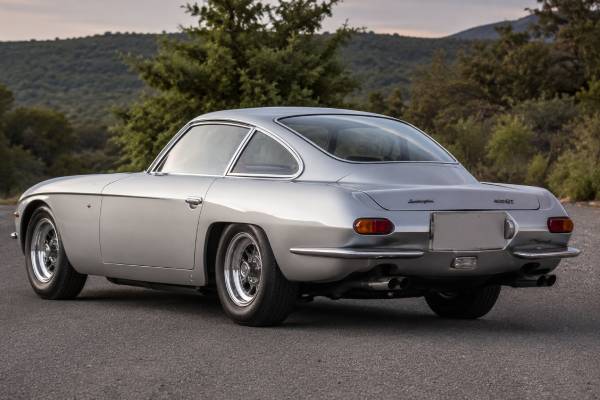
The 400 GT looks restrained because Touring designed it as an elegant high-speed car, not a poster supercar. Its appeal comes from proportion, glass area, long-hood balance, and hand-built detail rather than vents, wings, or theatrical doors.
The basic shape evolved from the 350 GT. The hood is long, the cabin sits rearward, and the roofline flows into a clean rear deck. The 400 GT 2+2 changed the formula to make room for rear passengers. Lamborghini raised the roofline slightly at the rear, revised the rear window, changed the trunk area, and adjusted the cabin layout. The clever part is that the car still looks balanced. The extra practicality does not destroy the original grand touring stance.
The front end is one of the easiest ways to identify the later 400 GT 2+2. The car gained four round headlights instead of the earlier oval-style treatment. That gave the nose a more modern and more technical look. It also improved lighting, which mattered for a car intended to travel fast after dark.
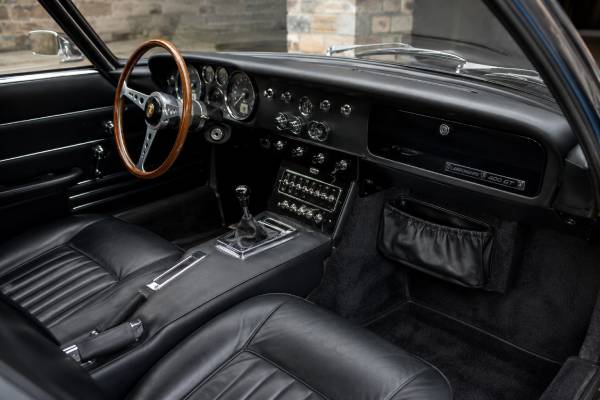
Inside, the 400 GT is a classic 1960s Italian GT: thin pillars, a large steering wheel, analog instruments, leather, chrome details, and a dashboard that feels designed by people who cared about both style and function. The cabin is not spacious by modern standards, but it has a sense of occasion. The 2+2 rear seats are best seen as occasional seats or extra trimmed luggage space. They add charm and usability, but they do not turn the car into a full family coupe.
The engineering choices show Lamborghini’s early priorities. The engine sits in front, but the car was not designed as a soft luxury cruiser. It had a sophisticated V12, independent suspension, five forward gears, disc brakes, and enough refinement for long-distance travel. The result was a car that could run hard across Europe without feeling crude.
The sound is central to the experience. The V12 does not have the later Countach’s wild intake-and-exhaust drama, but it has a complex, mechanical voice. At low speed, it sounds busy and expensive: carburetors breathing, valve gear working, exhaust pulses layered tightly together. At higher rpm, it becomes smoother and harder-edged. A correctly tuned car should feel crisp, not woolly.
The body construction also explains today’s restoration challenges. Touring’s craftsmanship is beautiful, but hand-built Italian bodies require skilled metalwork. Panel gaps, door fit, hood fit, and trim alignment can tell a buyer a great deal about a car’s past. A shiny paint finish alone means little if the structure underneath has poor repairs, hidden corrosion, or stressed mounting points.
How the 400 GT Drives
A good 400 GT drives like a fast, refined 1960s V12 grand tourer: smooth once warm, strong in the midrange, stable at speed, and more relaxed than its exotic badge might suggest. A tired one can feel heavy, hot, vague, and expensive within the first mile.
The engine needs proper warm-up. Cold oil, carburetors, old ignition components, and long intake paths all affect behavior. Once the car is warm and tuned correctly, the V12 should pull cleanly and build power with a smooth, rising note. It is not a low-rpm muscle engine. It rewards revs, but the larger displacement gives better flexibility than the earlier 3.5-liter car.
Throttle response depends heavily on carburetor condition. Six Webers can be wonderful when synchronized and jetted correctly. They can also expose weak ignition, stale fuel, vacuum leaks, tired linkages, and poor adjustment. A 400 GT that spits, hesitates, or smells heavily of fuel may not be “just old.” It may need careful fuel-system and ignition sorting.
The five-speed manual is a major part of the car’s appeal. The later Lamborghini-designed synchromesh gearbox in the 400 GT 2+2 is generally considered a real improvement over earlier arrangements. Shifts should be deliberate, mechanical, and satisfying, but not brutal. Second-gear behavior when cold, synchro quality, bearing noise, and clutch take-up all deserve attention during inspection.
Steering is period-correct, not modern. At low speed, the car needs effort. On the move, it should settle into a clear, stable feel. The long hood and front-engine layout make the car feel like a grand tourer rather than a small sports car. It is happiest flowing down open roads, not darting through tight urban traffic.
The ride can be surprisingly comfortable when the suspension is fresh. Independent suspension and a long-legged setup help the car cover distance well. Worn bushings, old dampers, tired springs, incorrect tires, or poor alignment can ruin that character. Because many cars are driven sparingly, rubber age often matters as much as mileage.
The brakes are adequate when properly rebuilt and adjusted, but they need to be judged by 1960s standards. Pedal feel, servo operation, flexible hoses, calipers, and fluid condition are all important. A 400 GT should stop confidently, but it will not feel like a modern carbon-ceramic supercar. Repeated hard use on mountain roads will reveal weak maintenance quickly.
Visibility is generally good by exotic-car standards. The cabin has more glass and less intimidation than later Lamborghinis. Heat and noise vary by car. Restored examples with fresh insulation, correct seals, and properly routed exhaust systems can be pleasant. Poorly restored cars can cook the cabin, smell of fuel, and drone at speed.
The best way to understand the 400 GT is not as a primitive supercar. It is a serious gentleman’s express. Its magic is the combination of V12 response, hand-built cabin atmosphere, elegant road presence, and the feeling that Lamborghini was still trying to beat Ferrari by building a better grand tourer, not merely a louder one.
Maintenance, Restoration, and Known Risks
The main ownership risk is not routine servicing; it is the cost of correcting decades of age, poor restoration, corrosion, missing trim, and neglected V12 systems. A cheap 400 GT can become the most expensive one in the market after the first major inspection.
The engine itself is strong when cared for, but it is complex and expensive. It has twelve cylinders, multiple carburetors, four camshafts, long timing chains, and many parts that require specialist knowledge. Compression, oil pressure, cooling behavior, valve-train noise, smoke, crankcase breathing, and service history all matter.
The fuel system deserves close attention. Old tanks, lines, pumps, filters, carburetor seals, and linkages can cause difficult starting, rough running, leaks, or fire risk. Modern fuel can also be hard on older rubber components. A buyer should assume that any long-stored car needs a thorough fuel-system review before regular use.
Cooling is another major area. A V12 grand tourer creates serious heat, and many cars spend years being driven only briefly. Radiator condition, water pump health, thermostat operation, fan function, hoses, clamps, and coolant passages need inspection. A car that behaves well during a five-minute idle test may still overheat after a long climb or hot-weather traffic.
Electrical issues are common in old Italian GTs, especially after amateur repairs. Brittle wiring, tired grounds, incorrect relays, weak charging, aged switches, and non-original accessories can create frustrating faults. The goal is not to modernize everything blindly. The goal is to make the original-style systems safe, reliable, and understandable.
Body and chassis condition can dominate the entire ownership equation. Steel-bodied 400 GT 2+2 cars can hide corrosion in lower panels, sills, floor areas, wheel arches, door bottoms, trunk sections, and areas around mounting points. Earlier aluminum-influenced construction brings different repair challenges, including electrolytic corrosion and complex panel shaping.
Inspection areas that matter most
A specialist pre-purchase inspection should focus on:
- Chassis straightness and evidence of accident repair
- Sill, floor, rocker, wheel arch, trunk, and lower body corrosion
- Door, hood, and trunk fit
- Correct trim, glass, lights, bumpers, and handles
- Engine number, gearbox number, and factory identity
- Compression, leak-down, oil pressure, and cooling behavior
- Carburetor condition and fuel leaks
- Gearbox synchros, clutch, differential noise, and driveline vibration
- Brake servo function, calipers, lines, and master cylinders
- Suspension bushings, dampers, ball joints, and steering play
- Wiring condition and charging performance
- Restoration invoices and photographic evidence
Parts availability is better than it once was because Lamborghini Polo Storico supports classic models with archive, certification, restoration, and original spare-parts work. That does not make the car inexpensive to repair. It means a serious owner has a better path to correct work than owners had years ago. Specialist labor remains essential.
Restoration quality varies widely. Some cars were restored when values were lower, using methods that no longer meet today’s expectations. Others have been cosmetically refreshed for sale without deep mechanical work. The best cars usually have detailed invoices from known marque specialists and photographs showing the work before paint, not only after.
Upgrades require judgment. Electronic ignition, improved cooling fans, discreet air conditioning, modern fuel hoses, and better insulation can make a 400 GT more usable. But heavy modifications, incorrect interiors, non-original colors without documentation, poor wheel choices, or modernized dashboards can reduce collector appeal. Reversible improvements are usually safer than permanent changes.
Market Values and Buying Advice
The smartest 400 GT purchase is the best-documented, best-restored, most honest car you can afford. Buying a weak example because it is cheaper rarely works with a hand-built V12 Lamborghini.
The market treats the 400 GT as an important early Lamborghini, but not in the same price universe as the most desirable Miuras. That creates an interesting position. The car is rare, historic, and mechanically special, yet it can still look undervalued compared with better-known Italian V12 icons. Values depend heavily on version, condition, originality, colors, documentation, and restoration quality.
Recent public data shows a wide spread. Some auction results sit in the lower-to-middle six-figure range, especially for cars with questions, older restorations, less ideal presentation, or weaker market timing. A freshly restored, highly documented, attractive example can be estimated much higher, especially when the car has original colors, known specialist work, and strong provenance.
Currency also matters. UK, European, and US auction results do not convert perfectly because taxes, import costs, registration, buyer premiums, and local demand change the real ownership cost. A car bought cheaply overseas may not remain cheap once shipping, duties, recommissioning, and corrective work are included.
What drives value
The strongest value factors are:
- Correct identity as an Interim or 2+2
- Matching or well-documented original engine and gearbox
- Factory color and trim confirmation
- Known ownership history
- High-quality restoration by a respected specialist
- Solid body structure with no hidden corrosion
- Correct Touring details and complete trim
- Strong mechanical health
- Lamborghini Polo Storico documentation where available
- Attractive, period-correct color combination
- Evidence that the car has been driven and maintained, not only displayed
Mileage matters less than condition and history. Many 400 GT odometers are difficult to interpret after decades of repairs, restorations, and international moves. A low displayed mileage with weak records is less persuasive than a well-maintained car with honest use.
Cars to seek and cars to avoid
Seek a car that starts cleanly, warms properly, holds temperature, shifts well, tracks straight, stops confidently, and comes with a thick file. The body should fit correctly, the interior should look period-correct, and the engine bay should show careful maintenance rather than hurried detailing.
Avoid cars with vague identity, missing numbers, weak paperwork, heavy corrosion, poor panel fit, fuel smells, overheating, gearbox noise, brake imbalance, or recent cosmetic work over unknown structure. Also be cautious with cars advertised using broad language such as “older restoration” without proof. That can mean anything from a high-quality rebuild to paint over tired metal.
A proper buying process should include three steps:
- Confirm identity and records before emotional inspection.
- Pay for a marque-specialist inspection, including compression or leak-down testing where appropriate.
- Budget for recommissioning even if the car is presented as restored.
Long-term collectability looks strong because the 400 GT is tied directly to Lamborghini’s origins. It has the early V12, Touring design, rarity, and historical importance collectors like. It is also usable enough to appeal to owners who want to drive, not only display, their cars. The risk is that restoration costs can outrun market value if the starting car is poor.
For an enthusiast, the 400 GT offers something later Lamborghinis cannot: the feeling of the brand before the visual drama became the main story. For a collector, it is a low-volume early V12 Lamborghini with serious engineering and growing recognition. The right example is not just a classic Italian GT. It is one of the cars that made Lamborghini credible.
References
- Lamborghini History – 400 GT | Lamborghini.com 2026
- Lamborghini Polo Storico | Lamborghini.com 2026
- 1966 Lamborghini 400 GT 2+2 by Touring | Sealed June | RM Sotheby’s 2026 (Auction Listing)
- 1967 Lamborghini 400 GT 2+2 by Touring | St. Moritz 2023 | RM Sotheby’s 2023 (Auction Catalog)
- Price Guide: Lamborghini 400 GT [UPDATED 2026] 2026 (Market Data)
Disclaimer
This article is for informational purposes only and is not a substitute for professional diagnosis, repair, valuation, or pre-purchase inspection. Specifications, torque values, service intervals, restoration procedures, and correct parts can vary by chassis number, market, equipment, production change, and individual vehicle history. Always verify details against official service documentation, factory records, and a qualified Lamborghini classic specialist before buying, servicing, restoring, or modifying a Lamborghini 400 GT.
If this guide helped you, please share it on Facebook, X/Twitter, or your favorite enthusiast community to support our work.