

The Lamborghini Fenomeno is a Few-Off V12 plug-in hybrid supercar built for the very top of Lamborghini’s collector market. Introduced in 2025, it sits above the Revuelto as a limited-production design and engineering statement rather than a regular model-line replacement. The core formula is unmistakably modern Lamborghini: a naturally aspirated 6,498 cc L545-family V12, three electric motors, all-wheel drive, carbon-fiber structure, extreme aerodynamics, and a combined output officially rated at 1,080 CV, or 795 kW.
Its importance comes from more than power. The Fenomeno celebrates 20 years of Lamborghini Centro Stile, continues the Few-Off bloodline that includes the Reventón, Veneno, Centenario, Sián, and Countach LPI 800-4, and shows how Lamborghini intends to preserve the V12 in the hybrid era. For owners and collectors, the main questions are not ordinary used-car concerns. They are allocation, provenance, specification, battery health, software status, carbon condition, and long-term factory support.
Table of Contents
- Where the Fenomeno Fits in Lamborghini’s Few-Off Line
- V12 Hybrid Specs and Core Hardware
- Production Run, Versions, and Personalization
- Design, Aero, and Signature Technology
- Road, Track, and Sensory Driving Character
- Maintenance Risks and Long-Term Care
- Market Position, Inspection, and Buying Advice
Where the Fenomeno Fits in Lamborghini’s Few-Off Line
The Fenomeno is Lamborghini’s modern Few-Off flagship: rarer than a normal series-production supercar, more extreme than the Revuelto, and built mainly for selected clients who already understand the brand’s collector ecosystem. It is not a replacement for the Aventador or Revuelto. It is a limited-run halo car that uses Lamborghini’s V12 hybrid direction as a canvas for design, exclusivity, and technical experimentation.
Lamborghini’s Few-Off tradition began with the Reventón in 2007. That car established a formula the company has repeated carefully: take the brand’s current flagship architecture, reinterpret it with a more radical design, limit production sharply, and offer the result to a very small circle of customers. The Sesto Elemento, Veneno, Centenario, Sián, and Countach LPI 800-4 each served a similar purpose. They were not mass-market products. They were rolling statements of what Lamborghini wanted the world to remember.
The Fenomeno continues that line but with a different context. Earlier Few-Off models mostly pushed design, lightness, or limited hybrid assistance. The Fenomeno arrives after Lamborghini has committed its top models to electrification, so it has to prove that a plug-in hybrid V12 can still feel dramatic, emotional, and collectible. The result is a car that blends old Lamborghini values with new hardware: natural aspiration, high revs, scissor doors, all-wheel drive, carbon construction, electric torque vectoring, and a level of software control that older V12 Lamborghinis never had.
The launch timing also matters. Lamborghini Centro Stile was established as the company’s in-house design center in the mid-2000s, and the Fenomeno was created to mark its 20th anniversary. That gives the model a clearer historical anchor than many limited editions. It is not just “another special Lamborghini”; it is a design anniversary car built around the company’s most powerful V12 hybrid package.
Its place in the model family is simple:
- Revuelto: the regular V12 plug-in hybrid flagship and the technical base for Lamborghini’s modern HPEV era.
- Fenomeno coupe: the ultra-limited Few-Off expression of that V12 hybrid formula, with a more extreme design, bespoke aero work, and track-focused hardware.
- Fenomeno Roadster: the open-top evolution, even rarer and tuned around the special aerodynamic needs of a roofless car.
For collectors, the Fenomeno matters because allocation itself becomes part of the car’s story. A normal exotic can be ordered, optioned, and later traded. A Few-Off Lamborghini is different. The original owner list is small, cars often remain in long-term private collections, and any later sale is shaped by privacy, factory relationships, and provenance. Mileage, condition, and options still matter, but access matters even more.
The Fenomeno also has brand significance because it is one of the clearest answers to a difficult question: how can Lamborghini keep the V12 relevant when emissions rules, electrification, and hybrid systems are reshaping supercars? Lamborghini’s answer is not to make the V12 quieter or less central. Instead, the Fenomeno puts the engine at the heart of the car and uses electric motors to add response, traction, torque fill, and control.
That is why enthusiasts pay attention even if they will never buy one. The Fenomeno is a preview of values that may influence future Lamborghinis: sharper software-based chassis control, more active electric torque management, more intense aerodynamic packaging, and a design language that pulls classic Lamborghini shapes into a cleaner, more technical form.
V12 Hybrid Specs and Core Hardware
The Fenomeno’s defining hardware is its V12 plug-in hybrid powertrain: a 6.5-liter naturally aspirated engine assisted by three electric motors for a combined official output of 1,080 CV. In plain terms, it is a high-revving V12 supercar with electric front-axle drive, torque vectoring, regenerative braking, and short-distance electric capability.
The exact horsepower wording needs care. Lamborghini gives the combined figure as 1,080 CV and 795 kW. In metric-to-mechanical conversion, that is about 1,065 hp, although many casual descriptions round or label the car as “1,080 hp.” For accuracy, the official figure is best treated as 1,080 CV.
| Item | Specification |
|---|---|
| Engine family | L545-family naturally aspirated V12 |
| Displacement | 6,498 cc |
| Configuration | 60-degree V12, dry-sump lubrication |
| Combustion-engine output | 835 CV at 9,250 rpm |
| Combustion-engine torque | 725 Nm at 6,750 rpm |
| Electric motors | Three permanent-magnet electric motors |
| Electric contribution | 245 CV combined |
| Combined output | 1,080 CV / 795 kW |
| Transmission | Eight-speed dual-clutch automatic |
| Drivetrain | Plug-in hybrid all-wheel drive |
The V12 is the emotional center of the car. Unlike turbocharged hypercars that use boost pressure to create large torque numbers at low rpm, the Fenomeno’s engine is designed to rev, breathe, and build drama. Its peak power arrives very high in the rev range, which matters because it preserves the sharp, rising character Lamborghini buyers expect from a flagship V12.
The electric side is not just about economy. Two motors at the front axle give the car electric all-wheel drive and allow fine control of front-axle torque. A third motor is integrated around the rear powertrain layout and works with the V12 and dual-clutch gearbox. Together, the motors help fill torque gaps, improve launch response, support regenerative braking, and help the control systems adjust the car’s balance in real time.
| Area | Fenomeno coupe |
|---|---|
| 0–100 km/h | 2.4 seconds |
| 0–200 km/h | 6.7 seconds |
| Top speed | Over 350 km/h |
| Weight-to-power ratio | 1.64 kg/CV |
| Chassis concept | Carbon-fiber monofuselage with Forged Composite front structure |
| Brake system | CCM-R Plus carbon-ceramic brakes |
| Wheels | Single-nut forged wheels |
| Tires | Bespoke Bridgestone Potenza performance tires |
The carbon structure is just as important as the engine. Lamborghini uses the term monofuselage for its carbon-fiber passenger cell and front structure concept. The idea is to create a very stiff central body, reduce weight, and give the suspension and aero systems a more precise foundation. In a car with this much power, stiffness is not only about lap times. It affects steering response, brake feel, suspension consistency, crash performance, and the way the cabin resists squeaks and flex over time.
The braking package is another major technical point. The Fenomeno uses CCM-R Plus carbon-ceramic brakes rather than ordinary carbon-ceramic discs. These are motorsport-influenced components designed for high thermal stability, repeated deceleration, and track use. That does not mean they are maintenance-free. It means they are built for a higher performance window, and inspection quality matters more than on a normal road car.
Fuel consumption, emissions, and electric range should be handled carefully because official type-approval data can vary by market and may not be finalized at the same time in every region. For buyers, the more useful practical point is that the Fenomeno is a plug-in hybrid with a high-voltage battery, complex thermal management, and several control modules that need proper factory diagnostic support.
Production Run, Versions, and Personalization
The Fenomeno is collectible from day one because production is extremely limited: 29 coupe units were announced, followed by a 15-unit Roadster. That makes the car rarer than many earlier Lamborghini limited editions and puts originality, allocation history, and factory documentation at the center of long-term value.
The coupe is the primary 2025 launch version. It carries the cleanest connection to the Centro Stile anniversary and the first public presentation of the Fenomeno concept. The Roadster expands the line with an open-top body, but it is not simply a roofless copy. Removing the roof changes airflow, cooling, rollover protection, cabin turbulence, and the way the engine area is presented visually. For that reason, the Roadster has its own aerodynamic solutions and a different collector profile.
| Version | Production | Key identity | Performance focus |
|---|---|---|---|
| Fenomeno coupe | 29 units | Centro Stile anniversary Few-Off coupe | Maximum top-speed and closed-body aero performance |
| Fenomeno Roadster | 15 units | Open-top Few-Off V12 hybrid | Open-air driving with bespoke stability and cooling solutions |
Because this is not a normal production Lamborghini, the concept of “trim levels” does not really apply. Buyers should think in terms of body style, build slot, factory specification, Ad Personam details, and documentation. A Fenomeno’s individuality comes from color, exposed carbon choices, interior materials, stitching, seat configuration, wheel finish, brake-caliper finish, exterior accents, and any factory-approved special-order details.
Important specification areas include:
- Exterior paint and livery: launch-style colors may have extra recognition, but one-off factory colors can be more desirable if documented.
- Visible carbon fiber: finish quality, pattern consistency, and factory originality matter.
- Wheel and tire package: single-nut wheels and correct tire specification are part of the car’s identity.
- Brake system: CCM-R Plus condition and original fitment should be documented clearly.
- Interior materials: carbon racing seats, carbon door panels, Corsatex-style technical upholstery, Carbon Skin details, and custom stitching influence character.
- Factory personalization records: Ad Personam paperwork matters because future buyers need to separate original factory choices from later changes.
- Market configuration: lighting, emissions labels, charging equipment, infotainment settings, and homologation details can vary by region.
For authenticity, buyers should treat the Fenomeno more like a modern collectible than an ordinary exotic. The build sheet, order documents, factory correspondence, original purchase invoice where available, service invoices, delivery photographs, accessories, keys, charger equipment, manuals, and any owner-event material can all strengthen provenance.
Matching-numbers language is less straightforward on a modern hybrid supercar than on a classic Miura or Countach. The important point is still originality, but it involves more systems: engine identity, gearbox identity, battery pack records, control-module replacement history, software versions, carbon body panels, and factory-coded options. Any major component replacement should be supported by Lamborghini dealer or factory records.
Special care is needed with delivery-mile cars. Low mileage can help value, but a hybrid hypercar that sits unused can still develop problems. Batteries age, tires age, seals dry, fluids degrade, and software updates can be missed. A 100-mile car with poor storage history may be less attractive than a lightly used car with perfect climate-controlled storage, annual service, battery maintenance, and complete records.
Design, Aero, and Signature Technology
The Fenomeno’s design is meant to look like a distilled Lamborghini: lower, sharper, longer-tailed, and more technical than a standard flagship. The visual drama is not decoration only; the body shape, air intakes, diffuser, rear wing, cooling paths, and cabin proportions are tied directly to the car’s aero and thermal needs.
The front end uses a strong Y-shaped graphic theme, a carbon-fiber splitter, and large racing-inspired air intakes. The Y motif is a familiar Lamborghini signature, but the Fenomeno stretches it into a cleaner and more graphic shape. The result is less cluttered than some older limited Lamborghinis, yet still extreme enough to be instantly recognizable.
From the side, the most important feature is the long, continuous line running through the body. It gives the car a longtail look and visually separates the cabin from the lower aero surfaces. This is not just styling. Longtail proportions help high-speed stability, manage airflow around the rear body, and make the car look more planted. Lamborghini has also linked the Fenomeno’s side profile to the idea of a single center-line silhouette, one of the brand’s long-running design themes.
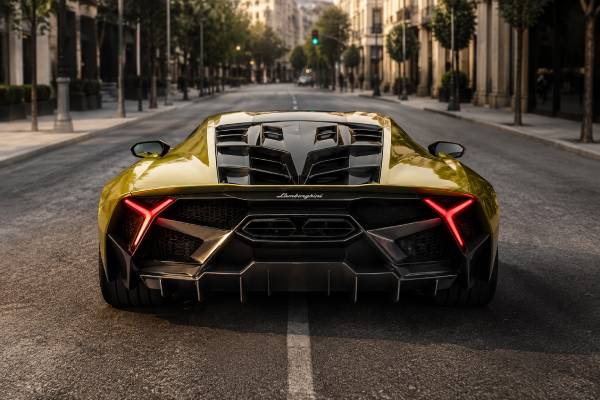
At the rear, the car becomes even more technical. The diffuser, exhaust outlet treatment, vertical Y-shaped light signature, rear wing, and body cutlines all work together to make the back of the car look wide, deep, and functional. The rear is also where the V12 hybrid layout has to be managed most carefully, because cooling, exhaust heat, battery packaging, gearbox temperature, and aerodynamic extraction all meet in the same area.
Carbon structure and materials
The Fenomeno uses Lamborghini’s modern carbon-fiber construction philosophy. The core structure is carbon-intensive, and the front structure uses Forged Composite, a chopped-carbon material Lamborghini has used in advanced applications for years. For the owner, the benefit is low weight and rigidity. For a buyer, the risk is repair complexity.
Carbon panels and structures do not age like steel or aluminum. They do not rust, but they can suffer impact damage, delamination, heat-related finish issues, poor repairs, or hidden damage beneath paint and clear coat. A pre-purchase inspection should include paint-depth readings where useful, visual carbon inspection, underbody checks, mounting-point inspection, and factory diagnostic scans after any accident claim.
Aerodynamics and cooling
The Fenomeno’s aero package has two jobs: keeping the car stable at very high speed and feeding enough air to the brakes, engine, radiators, hybrid system, and rear bay. A 1,080 CV-class plug-in hybrid creates heat in several places at once. The engine, gearbox, brakes, battery, inverters, and electric motors all need thermal control.
That is why aero details matter so much on this car. Splitters, channels, vents, intakes, diffusers, and spoilers are not cosmetic add-ons. If a carbon aero part is damaged or replaced with a non-original part, the issue is not only value. It can affect cooling, balance, and high-speed behavior.
6D sensor and chassis control
One of the Fenomeno’s key technology points is the 6D sensor system. In simple language, it measures the car’s movement in several directions at once: acceleration and rotation across the main vehicle axes. That gives the control systems a clearer view of what the car is doing in real time.
The value is not that the car “drives itself.” The value is that the brakes, torque vectoring, hybrid system, and stability logic can respond with greater precision. In a car this fast, small adjustments matter. Electric torque can be added or reduced quickly, front-axle behavior can be shaped, and braking stability can be improved when the system understands pitch, roll, yaw, slip, and grip conditions more accurately.
Cockpit and sensory details
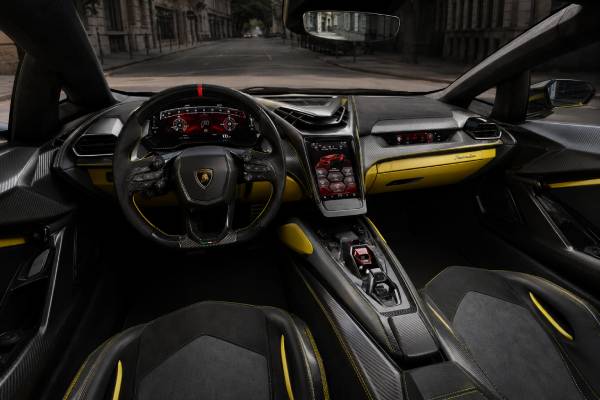
Inside, the Fenomeno follows Lamborghini’s “feel like a pilot” philosophy. The driving position is low, the displays are digital, and the structure around the driver is meant to feel focused rather than lounge-like. Carbon racing seats and carbon door panels reduce visual weight and reinforce the idea that this is a collector hypercar with track intent.
The most important sensory feature remains the V12. Electric motors make the car quicker and more controllable, but the engine sound defines the emotional character. The combination of natural aspiration, high revs, intake noise, exhaust tuning, and hybrid torque support should make the Fenomeno feel more immediate than a purely combustion V12 at low speed while still building to the classic Lamborghini top-end drama.
Road, Track, and Sensory Driving Character
The Fenomeno should feel brutally fast but not old-fashioned: electric torque helps it launch and respond, while the V12 gives it the sound and high-rpm emotion that define a flagship Lamborghini. The key driving difference from older V12 Lamborghinis is that the hybrid system can shape traction and response instead of simply adding power.
From a standstill, the car’s 0–100 km/h time of 2.4 seconds shows how much the all-wheel-drive hybrid layout helps. A naturally aspirated V12 alone would struggle to put this much power down cleanly on road tires. The front electric motors and torque management systems give the Fenomeno a more controlled launch, especially when the tires are warm and the road surface is good.
At higher speeds, the V12 becomes more dominant. The engine’s peak power arrives high in the rev range, so the car should feel increasingly intense as speed rises. This is one reason Lamborghini buyers still value natural aspiration. A turbo engine often feels strongest in the mid-range. A Lamborghini V12 creates a rising sense of urgency, and the Fenomeno’s electric motors help fill the lower and middle parts of the power curve without erasing that character.
The eight-speed dual-clutch transmission is also important. Older flagship Lamborghinis used automated single-clutch gearboxes that could feel violent, dramatic, and sometimes awkward in traffic. The dual-clutch unit gives faster, smoother shifts and better low-speed manners. In normal driving, that should make the Fenomeno easier to move through cities, garages, and event traffic. In hard driving, it should deliver near-instant upshifts without the heavy interruption older cars were known for.
Steering feel will depend strongly on tires, alignment, drive mode, road surface, and tire temperature. The Fenomeno’s front electric motors can influence how the front axle behaves, so it may feel more agile than its size and power suggest. This is one of the main advantages of electric torque vectoring. Instead of relying only on mechanical differentials and brake-based correction, the car can actively help rotate, stabilize, or pull itself out of corners.
The brakes should be extremely powerful, but owners need to understand the difference between road feel and track durability. Carbon-ceramic brakes often feel best when warm, and motorsport-derived systems can make some noise, dust, or low-speed texture that would surprise drivers used to luxury cars. The CCM-R Plus setup is designed for repeated high-energy stops, but it still needs correct pad material, proper bedding, careful inspection, and cooling time after heavy use.
On track, the Fenomeno’s biggest strengths should be acceleration, high-speed stability, braking endurance, and corner-exit traction. Its biggest limitations will be the normal limits of a high-value, high-complexity hypercar: tire cost, brake cost, heat management, insurance restrictions, and the risk of expensive carbon damage from curbs or debris. It may be technically capable of serious track work, but many owners will use it sparingly because the car’s rarity makes every mile and every stone chip more consequential.
On the road, the Fenomeno is likely more usable than its appearance suggests, but only within exotic-car limits. Visibility, ride height, tire width, parking clearance, speed bumps, steep ramps, and heat soak still matter. The front lift system, if fitted or configured for the market, should be treated as an essential tool rather than a convenience. Owners should also remember that wide high-performance tires can tramline on poor roads and lose performance sharply in cold or wet conditions.
The best way to understand the Fenomeno is not as a quiet plug-in hybrid or a raw analog supercar. It is a digitally managed V12 weapon. The electronics are there to make its power usable, not to make it ordinary.
Maintenance Risks and Long-Term Care
Fenomeno maintenance is less about ordinary reliability ratings and more about protecting a rare, high-voltage, carbon-bodied V12 hybrid from neglect, poor storage, incorrect service, and undocumented repairs. Because the model is new and extremely limited, long-term failure patterns are not yet established, so buyers should focus on system health, service discipline, and factory support.
The main ownership risk is complexity. The car combines a high-revving V12, dual-clutch transmission, three electric motors, a high-voltage battery, power electronics, regenerative braking, carbon-ceramic brakes, advanced chassis sensors, active software controls, and expensive carbon bodywork. Each system may be durable when maintained properly, but diagnosis and repair require specialist equipment and Lamborghini-trained technicians.
Powertrain and hybrid-system care
The V12 needs correct fluids, warm-up habits, and service intervals matched to official documentation. High-revving dry-sump engines do not reward neglect. Oil quality, coolant condition, air-filter condition, and leak checks are basic but critical. Any abnormal start-up noise, misfire, overheating, oil-pressure warning, or repeated fault code should be investigated quickly.
The hybrid system adds a second layer of care. Battery state of charge, charging habits, storage mode, battery temperature, inverter condition, and software updates all matter. A car stored for long periods without proper battery maintenance can develop expensive issues even if the odometer barely moves.
Important checks include:
- high-voltage battery health report from factory diagnostics
- charging-system operation
- coolant circuits for battery and power electronics
- inverter and electric-motor fault history
- warning-light history and stored codes
- software update status
- recall or service-campaign completion
- correct storage charger or maintainer use
Brakes, tires, and suspension
The CCM-R Plus brakes should be inspected by someone who understands carbon-ceramic systems. Visual appearance alone is not enough. Disc thickness, disc surface condition, pad material, heat marks, chips, cracks, sensor readings, and service records all matter. A car that has done private track days may still look pristine in photos but carry heavy brake and tire wear.
Tires are a major safety and value item. The Fenomeno uses bespoke high-performance Bridgestone tires, and replacement should match Lamborghini approval. Age matters even when tread depth looks good. On a car capable of more than 350 km/h, old tires are not acceptable display items for real driving.
Suspension inspection should include dampers, lift system operation where applicable, bushings, joints, wheel bearings, alignment, wheel damage, and evidence of curb strikes. Single-nut wheels require correct tools and torque procedures. A tire shop that treats the car like an ordinary performance coupe can cause very expensive damage.
Carbon body and underbody condition
Carbon repair quality is one of the biggest long-term value factors. The lower aero surfaces, front splitter, side skirts, diffuser, brake ducts, wheel-arch edges, and underbody panels are vulnerable to road debris, ramps, and track curbs. Even small damage should be documented and repaired through proper channels.
Buyers should look for:
- scrape marks under the splitter and diffuser
- mismatched carbon weave or clear-coat finish
- paintwork that does not match factory records
- replaced panels without invoices
- loose aero fasteners
- heat damage near exhaust outlets
- signs of improper lifting
- evidence of front-end grounding
Electronics and software
Modern Lamborghini ownership is software ownership. A Fenomeno should be scanned with official diagnostics before purchase and after any major service event. The scan should check powertrain, battery, braking, chassis, body, infotainment, charging, and safety modules. Intermittent warnings can be more important than the seller suggests because they may point to sensor, voltage, cooling, or software issues.
The 6D sensor and integrated braking systems are part of the car’s dynamic foundation. Any chassis-control warning, brake-by-wire issue, calibration problem, or unexplained stability-control fault should be treated seriously. These systems are not accessories; they help manage the car’s speed and mass.
Storage and low-mileage problems
Many Fenomenos will live in climate-controlled collections. That is good, but static storage still needs a plan. The car should be run, charged, moved, inspected, and serviced according to factory guidance. Tires should not sit under load indefinitely. Fluids should not be ignored because mileage is low. The high-voltage battery should not be left in an unhealthy state of charge.
For collectors, the ideal car is not simply the one with the lowest mileage. It is the one with the best preservation routine, strongest documentation, cleanest diagnostic history, and most original condition.
| Area | Why it matters | What to verify |
|---|---|---|
| Hybrid battery | High replacement cost and storage sensitivity | Battery health, charging records, software status |
| Carbon brakes | Very expensive wear item under track use | Disc condition, pad condition, heat history |
| Carbon bodywork | Value depends heavily on originality and repair quality | Panel fit, weave match, repair invoices |
| Software modules | Controls powertrain, braking, charging, and dynamics | Factory diagnostic report and update history |
| Tires | Critical at extreme speed and hard to substitute correctly | Date codes, approved fitment, storage condition |
Market Position, Inspection, and Buying Advice
The Fenomeno sits in a market where public price guides are of limited use because cars were allocated privately, production is tiny, and early resale activity is likely to happen away from ordinary listings. The correct buying approach is to treat the car as a documented collectible asset first and a used exotic second.
Because the coupe run is only 29 units, supply is almost nonexistent. The Roadster’s 15-unit production makes it even more restricted. Early owners are likely to be established Lamborghini clients, and many cars may stay in collections for years. If a car appears for sale soon after delivery, the reason for sale, transfer restrictions, tax position, warranty status, and factory relationship context all need careful review.
Value will be shaped by several factors:
- Body style: the Roadster is rarer, but the coupe has the original launch identity.
- Mileage: delivery mileage can help value, but only if storage and service history are excellent.
- Specification: launch colors, unique Ad Personam work, exposed carbon, and tasteful factory options can add appeal.
- Documentation: factory build records, delivery material, service invoices, and owner provenance matter heavily.
- Condition: carbon damage, repainting, track wear, and brake use can affect value quickly.
- Market region: taxes, homologation, import rules, and local registration can change the real cost.
- Factory support: warranty, service-plan transferability, and Lamborghini dealer access are essential.
A serious buyer should not rely on photos, mileage, or seller reputation alone. The inspection should be performed through an authorized Lamborghini dealer or a specialist with direct access to factory diagnostic tools and hybrid-system knowledge.
A practical pre-purchase process should follow this order:
- Confirm the car’s identity, build number, market, and original supplying dealer.
- Review factory build specification and Ad Personam documentation.
- Check warranty, service-plan, recall, and campaign status.
- Run a full diagnostic scan, including hybrid battery and chassis-control systems.
- Inspect carbon bodywork, underbody panels, wheels, brakes, and tires in person.
- Verify charging equipment, keys, manuals, accessories, and delivery materials.
- Review insurance, import, tax, registration, and storage requirements before agreeing terms.
The best examples to seek are original, fully documented, correctly stored, and serviced on time even if mileage is low. A small amount of careful exercise mileage should not automatically hurt the car if it proves the systems have been kept healthy. Conversely, a static delivery-mile car with old tires, weak battery maintenance, missed annual checks, or incomplete documents should raise concern.
Examples to avoid include cars with unclear export history, missing factory paperwork, unexplained paintwork, undocumented carbon replacement, unresolved warning lights, incomplete charging equipment, or signs of track use that are not reflected in the price. Also be cautious with cars advertised mainly through hype language and no technical records. With a Fenomeno, the paperwork is part of the car.
Long-term collectability looks strong because the model has several durable ingredients: very low production, V12 power, hybrid-era significance, Centro Stile anniversary status, Few-Off lineage, and extreme performance. The main uncertainty is how future collectors value early plug-in hybrid hypercars as battery systems age. Cars with complete factory support and documented battery care should be better positioned than cars kept as static trophies.
For an owner, the smartest strategy is preservation without neglect. Keep the car original, maintain it through Lamborghini channels, document every service action, store it correctly, protect vulnerable carbon areas, keep software current, and avoid modifications that cannot be reversed. For a buyer, the smartest strategy is patience. With only a handful of cars in existence, the right Fenomeno is worth waiting for; the wrong one could be extremely expensive to correct.
References
- Lamborghini Fenomeno | Lamborghini.com 2025
- The ‘Few Off’ Lamborghini Fenomeno 2025
- Automobili Lamborghini Unveils Fenomeno at The Quail 2025
- Fenomeno Roadster: Lamborghini’s most powerful open-top 2026
- Lamborghini Fenomeno wins the Red Dot: Best of the Best 2026 2026
Disclaimer
This article is for informational purposes only and is not a substitute for professional diagnosis, repair, inspection, or valuation. Specifications, torque values, service intervals, software requirements, charging procedures, and repair methods can vary by VIN, market, equipment, and factory updates. Owners and buyers should verify all technical details against official Lamborghini service documentation and consult qualified Lamborghini technicians before maintenance, repair, purchase, or track use.
If you found this guide useful, please share it on Facebook, X/Twitter, or your preferred automotive community to support our work.