
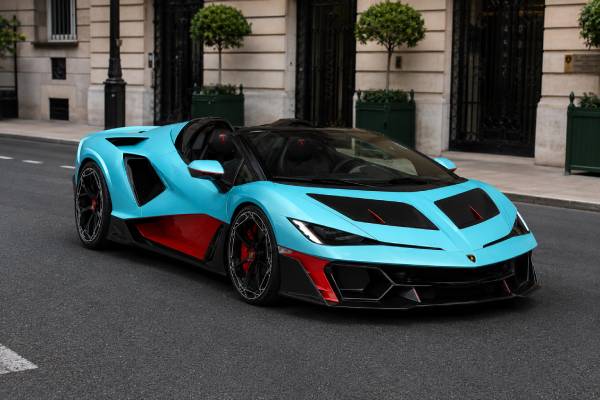
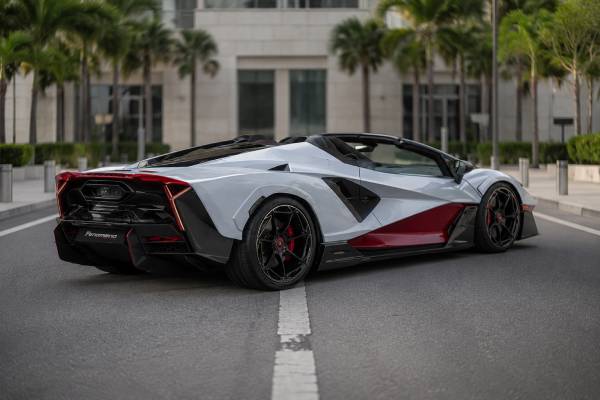
The Lamborghini Fenomeno Roadster is the open-top version of Lamborghini’s ultra-limited V12 hybrid Few-Off model, launched for 2026 as one of the rarest modern Lamborghinis. It uses the L545 6.5-liter naturally aspirated V12, three electric motors, a plug-in hybrid battery system, and all-wheel drive to deliver an official combined output of 1080 CV, equal to roughly 1065 mechanical horsepower. The Roadster matters because it combines three things Lamborghini collectors care about most: a naturally aspirated V12, a tiny production run, and a dramatic open cockpit. It also marks a key point in Lamborghini’s shift from pure combustion flagships to High Performance Electrified Vehicles, while keeping the sound, theater, and design language that made the brand famous.
Table of Contents
- Why the Fenomeno Roadster Matters
- V12 Hybrid Specs and Hardware
- Production Run, Versions, and Options
- Aerodynamics, Chassis, and Cabin Details
- How the 1080 CV Roadster Drives
- Maintenance Risks for a V12 HPEV
- Market Position and Buyer Checks
Why the Fenomeno Roadster Matters
The Fenomeno Roadster is important because it is Lamborghini’s most exclusive open-top Few-Off model and one of the first collector-grade V12 Lamborghinis built around a plug-in hybrid system. It is not simply a roofless Revuelto or a styling package; it is a limited-production statement car built to show where Lamborghini design, aerodynamics, and electrified V12 performance are heading.
The Roadster follows the Fenomeno Coupé, which appeared as a 29-unit Few-Off model celebrating 20 years of Lamborghini Centro Stile. The Roadster goes further into collector territory, with only 15 units planned. That number places it in the same emotional category as earlier Few-Off Lamborghinis such as the Reventón Roadster, Veneno Roadster, Centenario Roadster, and Sián Roadster.
The model name also fits Lamborghini tradition. “Fenomeno” means phenomenal in Italian and Spanish, and Lamborghini links the name to a bullfighting story, as it often does with its most dramatic cars. For collectors, the name matters less than the combination of specification and timing. This is a V12 Lamborghini from the early hybrid era, built before the market fully knows how to value electrified analog theater.
The Fenomeno Roadster also sits at an interesting point in Lamborghini history. The Aventador generation ended the pure non-hybrid V12 flagship line. The Revuelto introduced Lamborghini’s new V12 HPEV architecture. The Fenomeno Roadster then uses that new technical base as the foundation for something rarer, sharper, and more visually extreme.
For enthusiasts, its importance is simple: it keeps the naturally aspirated V12 alive while adding electric torque, torque vectoring, and short-range electric drive. For collectors, the appeal is different: tiny production, factory-built rarity, a flagship powertrain, and strong links to Lamborghini’s Few-Off tradition. Cars like this usually spend more time in climate-controlled storage than on public roads, but their value is tied to the fact that they are still real, engineered, functional performance cars.
The key ownership point is that the Fenomeno Roadster should be treated as a low-volume hypercar, not as a normal used exotic. Provenance, allocation history, factory specification, battery condition, software records, and paint/interior originality will matter as much as mileage.
V12 Hybrid Specs and Hardware
The headline specification is a 6.5-liter naturally aspirated V12 combined with three electric motors for 1080 CV of total system output. In horsepower terms, that is about 1065 hp, though many listings and search titles describe it as 1080 hp because Lamborghini’s official figure is given in metric CV.
The combustion engine is the L545 V12, a dry-sump, 60-degree, 6498 cc unit from Lamborghini’s latest V12 family. In Fenomeno tune, the engine alone produces 835 CV at very high rpm, helped by a redesigned valvetrain, high-flow breathing, and the same general architecture that made the Revuelto’s V12 lighter and more compact than the older Aventador engine.
| Item | Specification |
|---|---|
| Model | Lamborghini Fenomeno Roadster |
| Internal identifiers | LB835 series reference; L545 V12 engine family |
| Production period | 2026–present |
| Body style | Two-seat open-top Few-Off roadster |
| Engine | 6.5-liter naturally aspirated V12, 60-degree, dry sump |
| Displacement | 6498 cc |
| Engine output | 835 CV at 9250 rpm |
| Engine torque | 725 Nm at 6750 rpm |
| Electric motors | Three: two front-axle motors and one rear motor integrated with the transmission layout |
| Battery | 7 kWh lithium-ion plug-in hybrid battery |
| Combined output | 1080 CV / 795 kW, about 1065 hp |
| Transmission | 8-speed dual-clutch automatic |
| Drivetrain | Hybrid all-wheel drive with electric front axle torque vectoring |
| 0–100 km/h | 2.4 seconds |
| 0–200 km/h | 6.8 seconds |
| Top speed | More than 340 km/h |
| Brakes | CCM-R Plus carbon-ceramic system |
| Road tire sizes | 265/30 ZRF21 front, 355/25 ZRF22 rear |
The hybrid layout is central to the car’s character. Two electric motors sit at the front axle and can drive the front wheels, recover energy under braking, and help adjust torque side-to-side. A third electric motor works with the rear drivetrain and the eight-speed dual-clutch gearbox. This layout gives the Roadster all-wheel drive without a conventional front propshaft, which helps packaging and allows the car to use electric control for traction and cornering balance.
The plug-in hybrid battery is not there to turn the Fenomeno into an economy car. Its real purpose is instant torque fill, low-speed electric movement, regenerative braking, and sharper response when the V12 is building revs. The result is a car that should feel more immediate at low and medium speeds than an older naturally aspirated V12 Lamborghini, while still delivering the top-end drama of a high-revving twelve-cylinder engine.
The chassis uses Lamborghini’s carbon-fiber “monofuselage” idea, with multi-technology carbon fiber in the main structure and Forged Composite elements in key front and structural areas. This matters for both stiffness and crash-energy management. A roadster has to deal with the loss of a fixed roof, so rigidity and airflow management become more difficult than on the coupé.
The official roadster page does not publish every dimension, curb weight, fuel capacity, or brake disc size. That is common with very limited Few-Off models. Buyers should avoid using copied database figures unless they can verify them through Lamborghini documentation, homologation paperwork, or the car’s factory build file.
Production Run, Versions, and Options
The production story is one of the strongest reasons collectors will chase the Fenomeno Roadster. Lamborghini scheduled only 15 roadsters, compared with 29 coupés, making the open model the rarer body style.
The Fenomeno line is part of Lamborghini’s Few-Off program, not a regular production model line. That means allocation, specification, and factory relationship matter. These cars are usually offered first to established Lamborghini clients, often before the wider public sees the car. By the time a Few-Off Lamborghini appears in public, the best cars are normally spoken for.
Coupe versus Roadster
The Fenomeno Coupé and Fenomeno Roadster share the same broad V12 hybrid concept, but they are not identical in market character.
| Area | Fenomeno Coupé | Fenomeno Roadster |
|---|---|---|
| Production | 29 units | 15 units |
| Body style | Closed two-seat Few-Off model | Open-top two-seat Few-Off roadster |
| Combined output | 1080 CV | 1080 CV |
| Top speed | More than 350 km/h | More than 340 km/h |
| 0–100 km/h | 2.4 seconds | 2.4 seconds |
| Collector angle | Original closed Few-Off design manifesto | Rarer open-air version with unique aerodynamic work |
The Roadster loses the coupé’s fixed roof and uses different upper-body aerodynamic solutions. Lamborghini redesigned several functional surfaces to maintain downforce, stability, cooling, and cockpit comfort. The windshield spoiler, speedster-style rear humps, rollover structures, and engine-cover airflow are all part of the roadster-specific package.
Factory specification and personalization
A Fenomeno Roadster should be judged by factory configuration, not just mileage. Most examples will be highly personalized through Lamborghini’s bespoke channels, and the difference between a brilliant spec and a difficult spec can affect future liquidity.
Important factory and collector details include:
- Original exterior color and whether it is a launch-style or one-off Ad Personam finish.
- Interior material mix, including carbon fiber, Corsatex by Dinamica, Carbon Skin, stitching, and trim accents.
- Wheel finish, tire selection, and whether track-focused tire equipment was delivered with the car.
- Carbon exterior details, aero trim, and painted lower-body contrast areas.
- Factory documentation, order records, delivery book, certificates, invoices, and accessories.
- Whether all original equipment, battery charging items, covers, tools, keys, and presentation items remain with the car.
Special-order cars can be more valuable when the specification is tasteful, historically linked, or clearly documented. They can be harder to sell when the color combination is too personal or when modifications break factory originality. On a 15-unit Lamborghini, originality is not a detail; it is part of the asset.
Identification and authenticity
The buyer should match the VIN, build documentation, engine identification, body specification, and Lamborghini dealer records. Because the Fenomeno Roadster is so rare, a clean paper trail should exist from allocation to delivery. Gaps are a warning sign.
For modern Few-Off Lamborghinis, authenticity means more than “the car is real.” It means:
- The VIN corresponds to the exact Roadster build.
- The factory color and interior match the build file.
- Any post-delivery paint protection, film, tint, or cosmetic change is documented and reversible.
- Software and service records are available through the official Lamborghini network.
- High-voltage battery data can be checked by an authorized specialist.
- No accident, transport, or storage damage has been hidden behind cosmetic repair.
Because so few cars exist, buyers should expect Lamborghini dealer involvement in any serious purchase inspection.
Aerodynamics, Chassis, and Cabin Details
The Fenomeno Roadster looks extreme because its shape is doing real work. Lamborghini redesigned the open car’s airflow so it could keep high-speed stability and cooling without the coupé’s roof and air-scoop behavior.
The front end uses sharp surfaces, large intakes, and a low wedge form that continues Lamborghini’s design DNA. The side view is dominated by deep air channels, strong sill treatment, and a long, low cabin line. The rear is where the car becomes especially dramatic, with large diffuser work, active wing behavior, high-mounted exhaust treatment, and visible powertrain framing.
Roadster-specific airflow
The main engineering challenge is airflow over and behind the cockpit. Removing the roof changes pressure around the windshield, cabin, engine cover, and rear wing. Lamborghini addressed that with an additional spoiler on the windshield, revised upper surfaces, speedster humps, and integrated rollover structures.
The windshield spoiler helps direct air over the occupants and toward the engine bay. That matters because the naturally aspirated V12 needs reliable cooling under high load, and the Roadster cannot rely on the same roofline as the Coupé. The rear structures also need to reduce turbulence and wind noise without looking like bolt-on safety hoops.
The result is not a relaxed grand touring roadster. It is closer to a roofless prototype-inspired hypercar, built around cooling, downforce, stiffness, and drama.
Carbon structure and body materials
The chassis uses a carbon-fiber monocoque philosophy with Lamborghini’s multi-technology carbon-fiber construction. Forged Composite is used in structural areas where short-fiber carbon material helps strength, shaping, and energy absorption. This construction is one reason Lamborghini can make an open-top car with enormous performance targets while keeping the body rigid enough for precise suspension behavior.
The roadster body also has to manage thermal load. The V12, electric motors, battery, braking system, and power electronics all create heat. The deep intakes, underbody work, diffuser, engine cover openings, and brake-cooling paths are not decorative extras. They control temperatures during road and track use.
Cockpit and controls
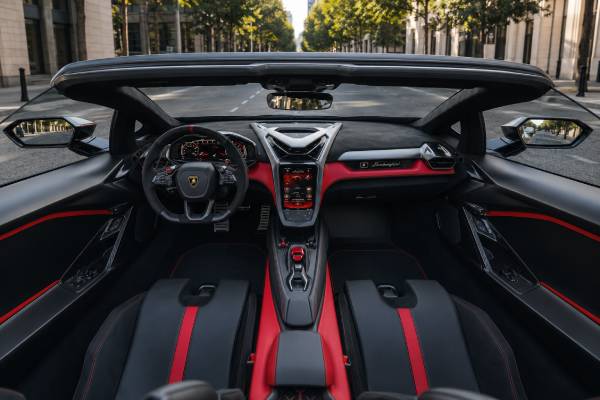
The cabin follows Lamborghini’s “Feel Like a Pilot” idea. That means a low seating position, digital displays, haptic controls, aviation-style switchgear, and heavy use of carbon fiber and technical materials. The cockpit is meant to feel focused rather than soft or traditional.
Important interior features include:
- Carbon-backed performance seats shaped for high cornering loads.
- Three-screen digital interface with performance data.
- Hexagonal graphics and design details that echo Lamborghini’s exterior language.
- Haptic and aviation-inspired controls that reduce ordinary dashboard clutter.
- High-grip technical upholstery materials rather than only traditional leather.
- Open-air exposure to V12 intake and exhaust sound.
The Roadster’s appeal is sensory. In a closed hybrid supercar, some of the electrified smoothness can make the car feel more controlled than wild. In the Fenomeno Roadster, the open cockpit brings back sound, vibration, air movement, and occasion.
How the 1080 CV Roadster Drives
The Fenomeno Roadster should feel brutally fast, but not in the simple old-school way of a large V12 overpowering the rear tires. Its hybrid system, all-wheel drive, active controls, and tire package are designed to make 1080 CV usable with far more precision than earlier limited Lamborghinis.
The first difference from an older V12 Lamborghini is low-speed response. A naturally aspirated engine usually needs rpm to deliver its best power. The Fenomeno’s electric motors fill that gap. From low speed, the car can deliver instant torque before the V12 reaches its strongest rev range. That should make the Roadster feel explosive out of corners and startlingly quick in short bursts.
At full throttle, the car’s personality should change as the V12 climbs. The electric system helps launch and midrange response, but the emotional peak is still the engine. The L545’s character is high-revving, sharp, and theatrical, with maximum power arriving near 9250 rpm. That is rare in an era of turbocharged engines and heavy sound filtering.
Acceleration and launch behavior
The official 0–100 km/h time is 2.4 seconds. That number is supercar-fast, but the more revealing figure is 0–200 km/h in 6.8 seconds. That shows the Roadster is not just quick off the line; it continues pulling hard at high speed.
Launch performance depends on tire temperature, road surface, battery state of charge, and the car’s control strategy. On cold tires or dusty pavement, even advanced all-wheel drive cannot overcome physics. On warm tires and clean pavement, the hybrid system should make launches repeatable and extremely controlled.
Steering, cornering, and braking
The front electric motors are not only about acceleration. They also help torque vectoring, which can sharpen turn-in, stabilize corner exits, and help the car put power down earlier. The 6D sensor and integrated brake-control logic give the car more information about pitch, roll, yaw, grip, and acceleration than an older mechanical setup.
The CCM-R Plus brakes are a major part of the driving experience. Carbon-ceramic brakes can feel firm and highly resistant to fade when hot, but they are expensive and sensitive to condition. On track, brake temperature, pad choice, and cooling matter. On the road, owners should avoid judging brake health only by mileage. A low-mile car can still have heat-cycled or damaged discs if it has seen track use.
The manually adjustable racing shock absorbers suggest a more serious setup than an ordinary roadster comfort suspension. That brings benefits and drawbacks. The car should feel controlled and accurate at speed, but owners should not expect soft grand touring compliance on poor roads.
Open-air character
The Roadster’s open cockpit makes the car more dramatic than the Coupé at normal speeds. You do not need to be near top speed to feel the engine, exhaust, airflow, and mechanical presence. That is important because most owners will rarely use the car’s full performance.
Visibility and usability will still be pure Lamborghini. The nose is low, the rear body is wide, and the cabin is shaped around drama more than easy parking. Front lift, camera systems, careful route planning, and patience are part of using a car like this in the real world.
On mountain roads, the Roadster should feel dense, wide, and incredibly urgent. On a track, tire temperature and brake management will define how much of the performance can be used. In a city, the plug-in hybrid system and dual-clutch gearbox should make low-speed movement easier than an older single-clutch Aventador, but the car remains a rare, expensive, attention-heavy machine.
Maintenance Risks for a V12 HPEV
The Fenomeno Roadster’s ownership risk comes from complexity, rarity, and replacement cost, not from ordinary reliability concerns. A 15-unit V12 plug-in hybrid Lamborghini needs specialist care from the start, even if it is barely driven.
The main rule is simple: maintain it as a high-voltage hypercar, store it like a collector car, and inspect it like an asset. Low mileage does not remove risk. In fact, very low use can create problems with batteries, seals, tires, fluids, brake surfaces, and software readiness.
Powertrain and hybrid system
The L545 V12 is a highly stressed, high-rpm engine. It should be warmed properly, serviced on time, and kept on correct fluids. The dry-sump system, cooling circuits, intake paths, and exhaust heat management all need careful inspection.
The hybrid side adds more items:
- High-voltage battery state of health.
- Charging history and storage charge habits.
- Cooling performance for battery and power electronics.
- Electric motor fault codes or inverter-related warnings.
- Software updates applied through the official network.
- Regenerative braking calibration and brake blending behavior.
- Condition of charging hardware and high-voltage safety systems.
Battery health is one of the biggest future value factors. A weak or poorly stored battery could be costly and may reduce buyer confidence even if the car looks perfect.
Gearbox, brakes, suspension, and tires
The eight-speed dual-clutch gearbox should be more refined than older Lamborghini automated manuals, but it is still part of an extremely powerful hybrid drivetrain. Any hesitation, warning light, fluid leak, overheating message, or harsh engagement should be investigated by a Lamborghini specialist.
The carbon-ceramic brakes deserve careful measurement, not a casual glance. Buyers should check:
- Disc surface condition.
- Heat damage or oxidation.
- Pad thickness and type.
- Caliper condition.
- Brake fluid age.
- Track-use history.
- Any vibration, pulsing, or noise beyond normal carbon-brake behavior.
Tires are another major issue. Ultra-high-performance tires age even when tread remains. A Fenomeno Roadster sitting in a collection on original tires may look pristine but still need replacement before serious driving. Buyers should check date codes, sidewall condition, flat spotting, and whether the correct Lamborghini-marked tire specification is fitted.
Suspension inspection should include damper condition, adjustment hardware, lift-system function if equipped, wheel alignment records, and signs of underside impact. Low carbon-bodied Lamborghinis often suffer from splitter and undertray damage during transport, delivery, or careless driving.
Body, electronics, and storage
Carbon-fiber damage can be difficult to detect and expensive to correct. The inspection should include the front structure, underbody, side sills, splitter, diffuser, engine cover, rollover structures, and mounting points. Paint protection film is useful, but it can also hide paint repairs, edge lifting, or poor detailing work.
Modern Lamborghini electronics are deeply integrated. A serious inspection should scan all control modules and confirm that there are no stored high-voltage, drivetrain, suspension, brake, battery, camera, ADAS, or infotainment faults. Software version history matters, especially on a new hybrid platform.
Good storage practice should include:
- Correct battery support for both low-voltage and high-voltage systems.
- Climate-controlled storage.
- Regular fluid temperature cycling as recommended by specialists.
- Tire-pressure management and movement to prevent flat spots.
- Protection from moisture, rodents, and ultraviolet exposure.
- Dealer-documented annual checks even when mileage is minimal.
For long-term value, official Lamborghini service history is essential. Independent exotic specialists may be skilled, but for a 15-unit HPEV Few-Off car, buyers will strongly prefer factory network records.
Market Position and Buyer Checks
The Fenomeno Roadster sits at the very top of the modern Lamborghini collector market because it combines limited production, open bodywork, V12 drama, hybrid technology, and factory Few-Off status. Its market is not normal used-car retail; it is a private, allocation-driven, relationship-based collector market.
Because Lamborghini does not publish a simple global transaction database for these cars, any value range should be treated carefully. Publicly discussed prices for such Few-Off Lamborghinis can reflect allocation cost, taxes, market rumor, resale restrictions, buyer status, and private negotiation. The safer statement is that the Roadster belongs in the multi-million-euro hypercar tier and that real values will depend heavily on specification, delivery timing, restrictions, and provenance.
What drives value
The best examples will be original, complete, documented, and carefully stored. Mileage matters, but it is not the only factor. A delivery-mile car with poor storage, missing accessories, weak battery data, or unclear ownership history may be less attractive than a slightly used car with perfect records.
Strong value factors include:
- One-owner provenance from new.
- Factory paint and interior in desirable or historically meaningful colors.
- Full Lamborghini dealer service record.
- Complete delivery accessories, books, covers, keys, charging equipment, and documents.
- Clear factory build specification.
- No paintwork, accident history, transport damage, or carbon repair.
- Correct tires and documented brake condition.
- Healthy high-voltage battery report.
- No unresolved software campaigns, recalls, or warning codes.
- Sensible storage history with climate control and battery maintenance.
Weak value factors include:
- Missing documentation.
- Undisclosed paintwork.
- Non-factory cosmetic changes.
- Track use without brake and tire records.
- Poor battery storage.
- Expired or unclear warranty coverage.
- Export/import paperwork issues.
- Spec choices that are very personal and hard to resell.
Buyer inspection checklist
A serious buyer should not inspect a Fenomeno Roadster like a normal exotic. The check should be planned before the car is moved, and it should involve Lamborghini network access.
| Area | What to verify |
|---|---|
| Identity | VIN, build sheet, delivery records, allocation history, and correct Roadster documentation |
| Powertrain | V12 service records, oil history, cooling-system checks, fault codes, and warm-running behavior |
| Hybrid system | Battery state of health, charging records, inverter and motor diagnostics, and high-voltage safety status |
| Gearbox | Shift quality, software status, leaks, clutch behavior, and stored transmission faults |
| Brakes | Disc condition, pad wear, heat damage, fluid age, and evidence of track use |
| Tires and wheels | Correct Lamborghini-marked tires, date codes, wheel damage, and alignment history |
| Carbon body | Splitter, underbody, sills, diffuser, engine cover, rollover structures, and repair evidence |
| Electronics | Full module scan, software updates, display function, camera function, and warning history |
| Completeness | Books, keys, charger, covers, factory accessories, certificates, and original delivery items |
Examples to seek and avoid
The best car to buy is a fully documented, original, low-mileage example with clear Lamborghini service history, complete accessories, and a specification that future collectors will understand. A tasteful Ad Personam configuration can be a positive if it is striking without being too personal.
Avoid cars with unclear title history, missing factory documentation, undocumented export movement, paintwork that cannot be explained, warning lights, battery uncertainty, or claims that the seller cannot prove. Also be careful with cars advertised too quickly after delivery. Some Few-Off contracts may include resale restrictions or relationship issues that can complicate a transaction.
Long term, the Fenomeno Roadster has strong collectability because it is rare, open, powerful, and tied to a turning point in Lamborghini’s V12 history. The biggest unknown is not whether enthusiasts will care. They almost certainly will. The unknown is how future buyers will value early high-performance hybrid hardware as the cars age. That makes battery documentation, software support, and official service history especially important.
References
- Lamborghini Fenomeno Roadster | Lamborghini.com 2026
- Fenomeno Roadster: Lamborghini’s most powerful open-top 2026
- The ‘Few Off’ Lamborghini Fenomeno 2025
- Lamborghini LB744: new benchmark for hybrid super sports cars 2023
- Defeat Time: Lamborghini’s Commitment to Timeless Excellence 2025
Disclaimer
This article is for informational purposes only and is not a substitute for professional diagnosis, repair, valuation, or factory inspection. Specifications, torque values, service intervals, battery procedures, software requirements, and repair methods can vary by VIN, market, equipment, and production update. Always verify details against official Lamborghini service documentation and have any Fenomeno Roadster inspected by an authorized Lamborghini dealer or qualified specialist before purchase, storage, or repair.
If you found this guide useful, please share it on Facebook, X/Twitter, or your preferred automotive community to support our work.