
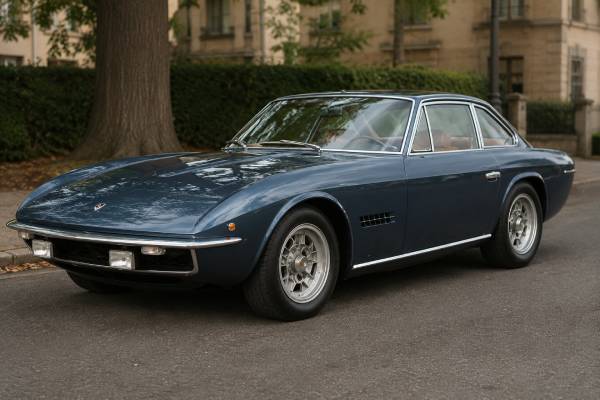
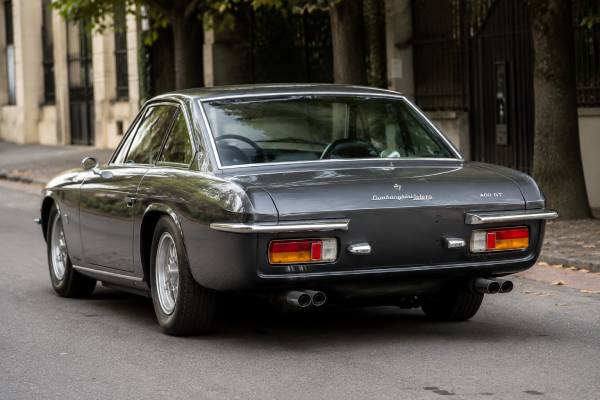
The Lamborghini Islero 400 GT is one of the most discreet early Lamborghinis, but it is also one of the most revealing. It shows what the company wanted to be before the Countach image took over: a maker of fast, refined, front-engine V12 grand tourers for drivers who valued power, comfort, and engineering more than spectacle. Built in tiny numbers from 1968 to 1969, the Islero replaced the 400 GT 2+2 and shared much of its proven mechanical base, including Lamborghini’s quad-cam 3.9-liter V12 and five-speed manual gearbox. Its restrained Marazzi body made it less famous than the Miura and Espada, yet that same restraint is why collectors now look at it closely. A good Islero feels elegant, muscular, and surprisingly usable. A poor one can be ruinously expensive. This guide covers the car’s history, specifications, variants, engineering, driving character, maintenance needs, restoration risks, and current buying priorities.
Table of Contents
- Why the Islero Still Matters
- V12, Chassis, and Core Specifications
- Production Numbers, Islero S, and Authenticity
- Marazzi Design and Front-Engine GT Engineering
- How the Islero Drives on Real Roads
- Maintenance, Restoration, and Ownership Risks
- Values, Inspection Priorities, and Buying Strategy
Why the Islero Still Matters
The Islero matters because it is the last truly understated early Lamborghini GT before the brand’s styling language became sharper, lower, and more theatrical. It sits between the Touring-bodied 350 GT and 400 GT on one side and the Espada, Jarama, Miura, and later wedge-era Lamborghinis on the other.
Lamborghini introduced the Islero in 1968, at a difficult but creative moment for the company. The Miura had already changed the sports-car world with its mid-engine layout, and the Espada was about to give Lamborghini a bold four-seat grand tourer with dramatic Bertone styling. The Islero had a different job. It was meant to keep the traditional front-engine 2+2 GT buyer in the showroom: the person who wanted a hand-built Italian V12 coupe with real speed, good road manners, and a calmer visual presence.
The car replaced the 400 GT 2+2, whose elegant Touring body had become hard to continue after Carrozzeria Touring collapsed. Lamborghini turned to Carrozzeria Marazzi, a small coachbuilder formed by former Touring people. The result was not a flamboyant concept car for magazine covers. It was a practical, low, glassy coupe that kept the familiar long-hood, short-deck proportions and wrapped them in cleaner, flatter late-1960s lines.
That conservative appearance hurt the Islero’s fame when new. Buyers who wanted drama could choose the Miura or Espada. Buyers who wanted a more established badge often looked at Ferrari, Maserati, or Aston Martin. Today, the same quietness works in the Islero’s favor. It is rare, mechanically serious, and tied directly to Lamborghini’s first-generation V12 identity.
The Islero also has a useful role in Lamborghini history. It proves that the company did not begin as a poster-car brand. Ferruccio Lamborghini’s early idea was a fast, refined GT that could cross Europe with confidence. The Islero is one of the purest expressions of that idea: front-mounted V12, independent suspension, manual gearbox, leather cabin, and enough civility to use on real roads.
Collectors value the model for several reasons:
- Rarity: total production was only about 225 cars, with roughly 125 early Islero 400 GT examples before the Islero S.
- Mechanical importance: it uses the classic Giotto Bizzarrini-derived Lamborghini V12 family in front-engine GT form.
- Usability: compared with a Miura, it is less dramatic but easier to see out of, cooler in concept, and better suited to relaxed touring.
- Concours interest: the best restored examples appear at major concours events because the model is rare and visually elegant.
- Underdog appeal: it remains less obvious than a Miura, Countach, or 350 GT, which makes it attractive to collectors who like depth over fame.
The Islero is not a motorsport icon and should not be judged as one. Its importance is in the road-car story: a hand-built V12 Lamborghini made at the moment when the company was expanding quickly, experimenting boldly, and still learning how to build cars in small numbers.
V12, Chassis, and Core Specifications
The Islero 400 GT uses Lamborghini’s 3,929 cc quad-cam V12, a five-speed manual gearbox, rear-wheel drive, independent suspension, and four-wheel disc brakes. The headline output is often given as 340 CV at 7,000 rpm, though English-language auction and catalogue sources may quote 320 or 325 bhp depending on rating method and market context.
That power-number variation is important for buyers. It does not usually mean the car has a different engine. It usually reflects different measurement standards, period reporting, or whether the source is discussing the early Islero, the 400 GT 2+2, or the later Islero S. The later Islero S is normally quoted at 350 CV, helped by detail engine and breathing changes.
| Category | Specification |
|---|---|
| Production years | 1968–1969 |
| Body style | 2-door 2+2 grand touring coupe |
| Layout | Front-engine, rear-wheel drive |
| Engine | 3,929 cc 60-degree V12 |
| Valve gear | Double overhead camshafts per bank, two valves per cylinder |
| Induction | Six Weber twin-choke carburetors |
| Output | Commonly quoted at 340 CV at 7,000 rpm; some period and auction references quote 320–325 bhp |
| Transmission | 5-speed all-synchromesh manual |
| Brakes | Four-wheel disc brakes with servo assistance |
| Suspension | Independent front and rear suspension with wishbones and coil springs |
| Wheelbase | 2,550 mm |
| Approximate length | 4,525 mm |
| Approximate width | 1,730 mm |
| Approximate height | 1,300 mm |
| Approximate weight | About 1,315 kg, depending on trim, equipment, and source |
The V12 is the center of the car’s appeal. It is not a lazy large-displacement engine. It is a sophisticated, high-revving unit for its era, with four camshafts, twelve cylinders, and six carburetors that need careful setup. When healthy, it gives the Islero a wide performance band: flexible enough for touring, but sharp and musical as the revs rise.
The chassis follows Lamborghini’s early GT thinking. A steel tubular frame carries the body, with independent suspension at both ends. This mattered in the 1960s because many powerful GTs still used older rear-suspension layouts. Lamborghini wanted speed, but also stability, ride quality, and composure on fast roads.
The gearbox is also part of the car’s character. A five-speed manual was a serious specification in the late 1960s, especially in a long-distance GT. It lets the driver keep the V12 in its best range without making the car feel frantic on the highway.
Performance figures vary, but a healthy Islero 400 GT is generally described as a 250 km/h-class car, with 0–100 km/h acceleration in the mid-six-second range under favorable period-test conditions. Those numbers should be treated as period claims rather than guarantees. Carburetor tune, ignition condition, compression, tire choice, axle ratio, and driver sympathy all make a large difference in a car this old.
Production Numbers, Islero S, and Authenticity
The Islero is rare enough that identity, documentation, and originality matter as much as mechanical condition. A buyer should know whether the car is an early 400 GT or the later Islero S, and whether its chassis, engine, body, interior, and paperwork still tell the same story.
Most references place total Islero production at about 225 cars. The usual split is roughly 125 early Islero 400 GT examples and about 100 Islero S examples. Exact counts can vary slightly depending on how a registry treats prototypes, delayed registrations, and market-specific cars, but the main point is clear: every Islero is scarce.
The standard Islero 400 GT arrived first. The later Islero S, introduced in 1969, brought higher quoted power, detail styling changes, and improved trim. It is not a completely different car, but it is distinct enough that collectors inspect it as its own version.
| Item | Islero 400 GT | Islero S |
|---|---|---|
| Production period | 1968–1969 | 1969 |
| Approximate production | About 125 cars | About 100 cars |
| Engine output | Commonly quoted around 340 CV, with some sources listing 320–325 bhp | Commonly quoted at 350 CV |
| Exterior identifiers | Cleaner early body details | Often identified by revised vents, larger hood scoop, and detail trim changes |
| Collector focus | Early purity, rarity, and 400 GT connection | Higher-output specification and final-development appeal |
Documentation is especially important because Isleros were hand-built, low-volume cars, and many have had complicated lives. A strong file may include factory correspondence, registration history, old invoices, restoration photos, import paperwork, Lamborghini Polo Storico certification, previous concours records, and records from known marque specialists.
Matching numbers are valuable, but the subject needs nuance. Some cars have had engine work, replacement blocks, or an original engine stored separately. A car with a replacement engine is not automatically poor, but the value changes if the original engine is missing, unstamped, undocumented, or separated from the car without clear evidence.
The most desirable examples usually have:
- a known chassis number and engine number with credible documentation
- original or correctly restored body details
- period-correct interior materials and instruments
- correct carburetor type and major mechanical components
- documented restoration work, not just fresh paint
- a continuous ownership trail, especially for early European or U.S. delivery cars
- verification from a respected Lamborghini specialist or Polo Storico
Paint and trim originality can be complicated. Lamborghini would build cars to customer taste, and older restorations sometimes changed colors to suit the market. A color change is not fatal if the work is excellent, but original colors and interiors normally help value. The best approach is to verify the original build specification, then judge whether the present condition respects it.
Buyers should also watch for cars described loosely as “400 GT Islero” or even titled by a year that does not match build timing. Registration practices in the 1960s were not always tidy, and some cars were titled after import or first sale rather than build date. That does not automatically indicate a problem, but it should be understood before purchase.
Marazzi Design and Front-Engine GT Engineering
The Islero’s design is valuable because it makes a V12 Lamborghini look almost modest. Its body hides serious performance under a clean, glassy, formal shape that suits long-distance touring better than visual theatre.
Carrozzeria Marazzi played the key role in the Islero’s body and assembly story after Touring’s collapse. The company had links to Touring personnel, which helps explain why the Islero feels like a continuation of the early Lamborghini GT idea rather than a complete break. The shape is lower and more angular than the 400 GT 2+2, but it keeps the same basic promise: a refined Italian coupe for fast travel.
The design is easy to underrate in photographs. In person, the Islero has a low hood, slim pillars, a broad glass area, and a purposeful stance. It is not as sensuous as a 350 GT and not as radical as an Espada, but it has a quiet tension. The long hood tells you where the V12 sits. The cabin is set back enough to look sporting, yet the roofline remains practical for a 2+2.
Body and packaging
The Islero’s body was hand-finished, and that matters when inspecting one today. Panel gaps, door fit, hood alignment, and trim symmetry should not be judged like a modern production car, but they should still look honest and consistent. Poor fit can mean old accident damage, corrosion repair, weak restoration work, or incorrect reassembly.
The cabin is more usable than the car’s low shape suggests. The Islero was never a family car in the modern sense, but it offered rear seats, luggage space, and enough visibility to work as a genuine GT. That practical side is central to its identity.
Cooling, sound, and sensory character
The front-engine layout gives the Islero a different feel from the Miura. The V12 is ahead of the driver, so the sound comes through the firewall, the intake tract, and the exhaust in a more traditional GT way. You hear carburetors, mechanical valve gear, and exhaust rather than the mid-engine roar behind your shoulders.
Cooling is a major engineering and ownership theme. A front-mounted V12 with carburetors, a compact nose, and 1960s electrical equipment needs a clean radiator, healthy fans, correct hoses, good water-pump function, and careful bleeding. Many cars have been upgraded discreetly with better fans or improved wiring. Those changes can be sensible if they are reversible and neatly done.
Interior details
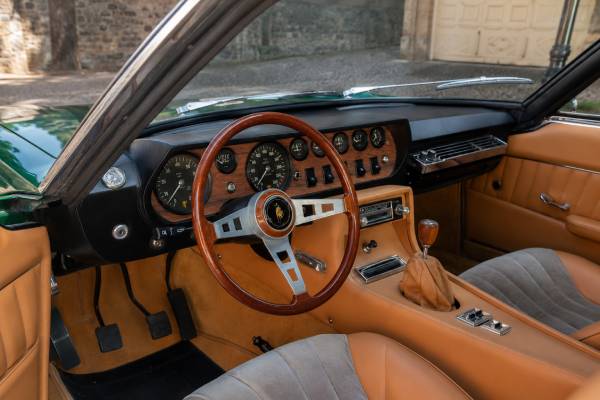
The Islero cabin should feel like a late-1960s Italian GT: leather, clear instruments, a wood-rim or period-style steering wheel depending on specification, and a dashboard layout focused on the driver. It is more restrained than an Espada and less glamorous than a Miura, but that restraint is part of the appeal.
Interior restoration can be harder than buyers expect. Seats, door panels, switches, gauges, carpets, and small trim pieces may be unique or hard to source. A car with a tired but complete original interior can be more attractive than one with a shiny but incorrect retrim.
How the Islero Drives on Real Roads
A sorted Islero drives like a fast, mature 1960s GT: strong, mechanical, stable, and more relaxed than its Lamborghini badge might suggest. It is not a modern supercar, and it should not be forced to behave like one.
The engine is the main event. At low revs, a well-tuned V12 should pull cleanly without coughing, loading up, or smelling heavily of fuel. As revs rise, the car becomes more urgent and more vocal. The best examples feel smooth but alive, with a layered sound from the carburetors and exhaust.
Carburetor condition makes a huge difference. A poorly set-up Islero can feel flat, lumpy, hot, and difficult in traffic. A properly synchronized car feels flexible and expensive, as it should. Before judging any Islero’s performance, make sure the ignition, plugs, fuel pressure, carburetor balance, and valve clearances are correct.
The five-speed gearbox should feel mechanical rather than light. Cold shifts may need patience, and second gear should be treated with respect until the oil is warm. Worn synchros, clutch drag, or poor linkage adjustment can make the car unpleasant. A good gearbox does not feel modern, but it should not grind, jump out of gear, or require force.
The steering and brakes are period-correct. At parking speeds, the car can feel heavy. On the move, it becomes more natural, with enough feedback to place the front end accurately. The disc brakes are capable for road use when rebuilt and adjusted correctly, but they do not have modern bite, anti-lock control, or repeated track-day endurance.
Ride quality is one of the Islero’s strengths. It was built as a grand tourer, not a stripped sports car. On correct tires and fresh suspension bushings, it should flow along fast roads without the nervousness sometimes found in short-wheelbase sports cars. Tired dampers, old tires, worn bushings, or incorrect alignment can make the car feel vague and heavier than it should.
The Islero is happiest on open roads, fast A-roads, mountain passes, and long-distance touring routes. It can handle city driving, but heat, clutch effort, fuel smell, and low-speed steering effort are part of the experience. Owners who expect modern convenience will be disappointed. Owners who enjoy warming a car properly and driving with mechanical sympathy will understand it quickly.
The biggest driving difference is between a restored car and a merely shiny car. Paint can make an Islero look expensive, but it cannot hide weak compression, tired suspension, a dragging clutch, bad carburetion, or old tires. A truly sorted Islero feels cohesive. An unsorted one feels like a collection of expensive problems moving in the same direction.
Maintenance, Restoration, and Ownership Risks
The Islero is not unreliable when restored and maintained correctly, but neglect is expensive because almost every major system is specialist work. The safest ownership approach is preventive maintenance, detailed records, and inspections by someone who knows early Lamborghini V12 cars.
The engine itself is robust in concept, but it is not tolerant of careless service. The V12 needs correct oil, clean cooling, proper ignition, accurate carburetor setup, and regular checks for leaks, noise, and overheating. Long storage is often worse than use. Cars that sit can develop fuel-system varnish, stuck carburetor floats, dry seals, weak pumps, corroded cooling passages, and electrical faults.
Common mechanical priorities include:
- Fuel system: old tanks, lines, pumps, filters, and carburetor seals can create running problems and fire risk.
- Carburetors: six twin-choke Webers require skill, patience, and proper synchronization.
- Ignition: points, coils, distributors, leads, and plugs must be healthy before carburetor tuning makes sense.
- Cooling system: radiator condition, fan operation, hoses, thermostat, expansion tank, and water pump are crucial.
- Lubrication: oil leaks are common, but heavy leaks, low pressure, or metallic noise need immediate investigation.
- Clutch and gearbox: clutch hydraulics, synchros, bearings, and linkage wear can be costly.
- Brakes: calipers, hoses, master cylinder, servo, and handbrake mechanisms must be inspected, not assumed safe.
- Suspension: bushings, ball joints, dampers, springs, and alignment affect both safety and value.
Body and chassis condition can be even more important than engine condition. Engines can be rebuilt by specialists if the budget allows. Correct body restoration can be slower, harder, and more uncertain because panels, trim, and exact shapes are not easy to replace.
Inspect carefully for corrosion in the sills, floor edges, wheel arches, lower door sections, front structure, rear valance, battery area, windscreen surrounds, and suspension mounting points. Also inspect for accident damage. The low nose, long hood, and hand-built body make poor repairs expensive to correct.
Restoration quality varies widely. A restoration done decades ago may still look good in photos but hide old filler, tired wiring, incorrect materials, or mechanical shortcuts. A recent restoration may also be risky if it was cosmetic rather than mechanical. The invoices matter: look for who did the work, what was disassembled, what was replaced, and whether the car was tested after completion.
Originality and upgrades require judgment. Discreet improvements can make an Islero easier to use, especially modern cooling fans, improved relays, electronic ignition hidden inside a period-looking distributor, better fuel hoses, and carefully chosen high-speed tires. But heavy modification can hurt value if it changes the car’s character or removes rare original parts.
For ownership planning, assume the following:
| Area | Why it matters | Best buyer response |
|---|---|---|
| Engine health | V12 rebuilds are specialist, time-consuming, and costly | Get compression/leak-down data and inspect oil pressure, noises, and records |
| Body corrosion | Hand-built repair work is difficult and expensive | Inspect underneath, inside cavities, and around glass and suspension points |
| Trim completeness | Small Islero-specific parts can be harder to source than mechanical parts | Prefer complete cars, even if cosmetic restoration is needed |
| Carburetor setup | Poor tuning can mimic deeper engine problems | Use a specialist familiar with Weber-equipped Lamborghini V12s |
| Documentation | Identity drives collector value | Verify chassis, engine, ownership, restoration, and certification records |
The best Islero maintenance strategy is simple: use the car regularly, keep fluids fresh, fix small leaks before they become big ones, keep the cooling and fuel systems clean, and do not let general exotic-car shops learn on the car at your expense.
Values, Inspection Priorities, and Buying Strategy
The Islero market is thin, so condition and provenance matter more than guide values. One excellent car can sell far above average, while a needy car can become expensive even if the purchase price looks attractive.
As of mid-2026, public market data places ordinary Islero values broadly in the low-to-mid six figures, with stronger restored or highly documented cars reaching much higher. Recent public results show a wide spread: driver-quality or less celebrated cars can trade around the $175,000–$275,000 zone, while excellent restored examples with strong provenance can move into the $300,000–$450,000 range or beyond. Exceptional concours-quality cars may exceed normal guide logic because so few comparable examples exist.
The Islero is still usually cheaper than the most famous early Lamborghinis, especially the Miura and 350 GT, but it is no longer an obscure bargain. The buyer pool is smaller, yet more informed. Serious collectors know that a rare front-engine V12 Lamborghini with correct documentation is not easy to replace.
Value is driven by several factors:
- Version: early 400 GT purity versus Islero S performance and final-development status.
- Originality: original colors, interior, engine, gearbox, and body details help.
- Condition: a fully sorted mechanical car is worth more than one with fresh paint and hidden needs.
- Documentation: Polo Storico certification, ownership history, restoration photos, and invoices add confidence.
- Completeness: missing trim, instruments, wheels, or unique body pieces can be a major problem.
- Restoration quality: respected specialist work is worth more than generic restoration.
- Color and presentation: tasteful original colors usually age better than speculative color changes.
- Event history: concours awards or known collector ownership can add interest.
A pre-purchase inspection should be more detailed than a normal used-car check. It should include identity verification, road testing, cold start, hot restart, compression or leak-down testing where possible, borescope inspection if concerns exist, lift inspection, brake and suspension inspection, cooling-system pressure check, charging-system test, and careful review of documentation.
Before buying, answer these questions:
- Does the chassis identity match the paperwork, registry information, and restoration file?
- Is the engine original, replacement, rebuilt, or undocumented?
- Does the car start cold without excessive smoke, noise, or fuel smell?
- Does it hold temperature in traffic and after a hard road test?
- Does the gearbox shift cleanly when warm?
- Are the body gaps consistent, and is there evidence of corrosion or accident repair?
- Are the rare trim pieces present and correct?
- Who maintained it, and are they credible for early Lamborghinis?
- Was the restoration cosmetic, mechanical, or truly comprehensive?
- Can you afford the first two years of sorting after purchase?
The best cars to seek are complete, documented, regularly exercised examples that have already had the expensive work done by known specialists. The cars to avoid are incomplete projects, cars with vague engine stories, cars with shiny paint over unknown metalwork, and examples that have bounced between dealers without meaningful service history.
Long-term collectability looks strong, but not because the Islero will suddenly become a Miura in market behavior. Its appeal is more specialized. It is rare, historically important, elegant, usable, and mechanically tied to Lamborghini’s founding V12 identity. That combination should keep good cars desirable, especially as collectors continue to look beyond the obvious poster models.
The smartest Islero purchase is rarely the cheapest one. Buy the best-documented, most complete, most honestly sorted car you can find. In this market, paying more for the right example is often cheaper than restoring the wrong one.
References
- Lamborghini History – Islero | Lamborghini.com 2026 (Manufacturer History)
- Lamborghini History – Jarama | Lamborghini.com 2026 (Manufacturer History)
- 1968 Lamborghini Islero 400 GT 2023 (Auction Catalogue)
- Lamborghini Islero – Base Model Market – CLASSIC.COM 2026 (Market Data)
- LAMBORGHINI ISLERO S 400 GT DRIVER’S HANDBOOK MANUAL Pdf Download | ManualsLib 1969 (Driver’s Handbook)
Disclaimer
This article is for informational purposes only and is not a substitute for professional diagnosis, repair, restoration planning, valuation, or legal purchase advice. Specifications, torque values, service intervals, procedures, equipment, and original build details can vary by VIN, market, production date, and individual car history. Always verify critical information against official service documentation, factory records, specialist inspection findings, and the specific vehicle being assessed.
If this guide helped you, please share it on Facebook, X/Twitter, or your favorite enthusiast community to support our work.