

The Lamborghini Reventón is best understood as the car that turned a Murciélago-based supercar into a modern Lamborghini collectible. It was not built to start a normal model line. It was built as a design weapon, a technical showcase, and a reward for the brand’s closest clients. Under the skin, it uses familiar V12 Lamborghini hardware: a 6.5-liter naturally aspirated engine, permanent all-wheel drive, a steel-and-carbon structure, and the dramatic proportions of the Murciélago LP640 era. What makes it special is everything layered around that foundation: the fighter-aircraft body, the numbered production, the digital cockpit, the matte Grigio Reventón finish, and the fact that it effectively started Lamborghini’s modern “few-off” tradition. For collectors, the Reventón is a provenance car. For enthusiasts, it is one of the clearest links between the Countach-style wedge and the Aventador design language that followed.
Table of Contents
- The First Modern Lamborghini Few-Off
- V12 Specs, Chassis, and Performance Data
- Production Numbers, Roadster, and Identification
- Fighter-Jet Design and Engineering Details
- What the Reventón Feels Like to Drive
- Maintenance Risks and Ownership Reality
- Market Values and Buyer Inspection Guide
The First Modern Lamborghini Few-Off
The Reventón matters because it created the template for Lamborghini’s later ultra-limited collector cars. Before the Sesto Elemento, Veneno, Centenario, Sián, and Countach LPI 800-4, the Reventón showed how Lamborghini could use proven V12 hardware as the base for a more exclusive design-led statement.
Lamborghini presented the Reventón at the 2007 Frankfurt Motor Show, during the Murciélago LP640 period. The car sat above the regular Murciélago range, not because it was radically more powerful, but because it was more exclusive, more theatrical, and more carefully positioned. It was a million-euro supercar before taxes when new, and all customer cars were allocated quickly.
The name follows Lamborghini tradition. Reventón was the name of a fighting bull, and the word also carries a sense of burst, explosion, or intensity in Spanish. That fits the car’s character. It is sharp, compact in visual mass, military in mood, and much less decorative than the Murciélago it shares mechanical DNA with.
Its historical importance comes from three things:
- It was Lamborghini’s first modern “few-off” production car, with only 20 coupés built for customers.
- It previewed design ideas later seen in the Aventador, especially the hard-edged nose, angular lighting, deep intakes, and aircraft-style surfaces.
- It showed how Lamborghini’s Centro Stile could create a collectible car around design, rarity, and brand myth rather than a pure racing program.
The Reventón is not a homologation special and not a track-focused lightweight in the usual sense. It is closer to a factory concept car made road-legal and delivered to a tiny group of clients. That is why collectors treat it differently from a normal Murciélago LP640. A Reventón’s value is tied to originality, numbered identity, accessories, documentation, and factory condition as much as mileage or performance.
Today, the Reventón sits in an unusual position. It is modern enough to be usable with specialist support, but rare enough that every sale matters. It is also old enough for age-related issues to matter: tires, fluids, clutch wear, electronics, seals, batteries, and carbon-ceramic brake condition can all affect the buying decision. As a collector car, it rewards careful preservation. As a driver’s car, it still delivers the raw sound and force of Lamborghini’s pre-hybrid V12 era.
V12 Specs, Chassis, and Performance Data
The Reventón coupé uses a 6.5-liter naturally aspirated Lamborghini V12 producing 650 hp at 8,000 rpm and 660 Nm of torque at 6,000 rpm. The engine is closely related to the Murciélago LP640 unit, but the Reventón’s specification, calibration, and presentation make it feel like a more exclusive expression of the same V12 family.
| Category | Specification |
|---|---|
| Production period | 2007–2009 era, with coupé launch in 2007 |
| Body style | Two-door coupé with scissor doors |
| Layout | Longitudinal mid-engine, all-wheel drive |
| Engine | 6.5-liter naturally aspirated 60-degree V12 |
| Displacement | 6,496 cc |
| Bore x stroke | 88 mm x 89 mm |
| Maximum power | 650 hp / 478 kW at 8,000 rpm |
| Maximum torque | 660 Nm / 487 lb-ft at 6,000 rpm |
| Transmission | 6-speed E-Gear automated manual |
| Drivetrain | Permanent all-wheel drive with viscous coupling |
| 0–100 km/h | 3.4 seconds |
| Top speed | About 340 km/h / 211 mph |
The engine is a classic Lamborghini V12 in the best sense: large displacement, no turbochargers, high revs, a wide torque curve, and a sound that dominates the experience. It uses dual overhead camshafts, four valves per cylinder, variable valve timing, and multipoint fuel injection. The character is linear rather than boosted. It builds from a heavy mechanical pull into a hard, metallic rush near the upper rev range.
The E-Gear transmission is an automated single-clutch manual, not a modern dual-clutch gearbox. That distinction matters. It shifts with more drama and interruption than a current supercar gearbox. In normal driving, it can feel mechanical and occasionally abrupt. At speed, with the throttle open, it gives the kind of forceful gear change many owners associate with the late-2000s Lamborghini character.
| Area | Specification |
|---|---|
| Frame | High-strength tubular steel structure with carbon-fiber components |
| Bodywork | Carbon-fiber body panels with selected steel exterior panels |
| Suspension | Independent double wishbones front and rear |
| Steering | Power-assisted rack-and-pinion |
| Front tires | 245/35 ZR18 |
| Rear tires | 335/30 ZR18 |
| Front brakes | Carbon-ceramic discs, about 380 mm |
| Rear brakes | Carbon-ceramic discs, about 355 mm |
| Wheelbase | 2,665 mm |
| Length | 4,700 mm |
| Width | 2,058 mm |
| Height | About 1,135 mm |
| Kerb weight | About 1,665 kg |
The Reventón is wide, low, and heavy by modern carbon-tub hypercar standards, but it is not soft. Its performance depends on big naturally aspirated power, all-wheel-drive traction, wide rear tires, and carbon-ceramic braking. It belongs to the last era when flagship Lamborghinis felt physical, noisy, and mechanically demanding rather than software-smoothed.
Production Numbers, Roadster, and Identification
The Reventón coupé was built in a tiny run of 20 customer cars, with an additional factory museum car commonly described as 0/20. That numbering is central to its collector value, and any serious buyer should treat the car’s number, paperwork, accessories, and service record as part of the car’s identity.
Every Reventón coupé was intended as a special object, not a broad personalization exercise. Unlike many modern Ad Personam Lamborghinis, the coupé is most closely associated with one core visual specification: matte Grigio Reventón exterior paint and an aircraft-inspired interior using dark leather, Alcantara, aluminum, and carbon fiber. This consistency helps the model’s identity but makes originality especially important. A repainted, retrimmed, modified, or incomplete car loses some of what separates a Reventón from a custom Murciélago.
The Roadster followed in 2009 and is related but not identical. It used a more powerful 670 PS version of the V12, was built in an even smaller run of 15 cars, and carried additional open-top structural and safety considerations. This article focuses on the 650 hp coupé, but buyers often compare both cars because they sit in the same collector family.
What should match on a correct car
A Reventón inspection should confirm more than the VIN and mileage. The car’s collector identity depends on the whole package:
- Numbered plaque between the seats or in the correct interior location.
- VIN, title, import records, and factory documents that support the car’s history.
- Original manuals, leather cases, factory accessories, car cover, and Reventón-specific luggage or bag where supplied.
- Service invoices from authorized Lamborghini dealers or highly qualified V12 specialists.
- Paint, trim, wheels, carbon panels, glass, lighting, and interior displays consistent with factory specification.
- No undocumented aftermarket exhaust, engine tuning, suspension changes, or non-original cosmetic changes.
The Reventón is also a market-specific car. U.S., European, Middle Eastern, and Asian-delivered examples can differ in compliance details, lighting, paperwork, and registration history. Import status matters. A car with clear customs records, continuous ownership history, and correct title documentation is easier to sell later than one with fragmented records.
Mileage deserves careful interpretation. Ultra-low mileage can help value, but a car that has sat for many years can need expensive recommissioning. A lightly used, correctly serviced car may be safer mechanically than a delivery-mile car with old tires, tired seals, weak batteries, sticky hydraulics, outdated fluids, and little evidence of regular exercise.
For collectors, the best Reventón is not simply the lowest-mile example. It is the car with the cleanest story: original finish, complete accessories, matching documents, known ownership, careful storage, regular service, and no need to explain away gaps.
Fighter-Jet Design and Engineering Details
The Reventón’s design is the main reason the car exists. Lamborghini took the Murciélago’s proportions and transformed them into a sharper, more aircraft-like shape that made the regular LP640 look almost rounded by comparison.
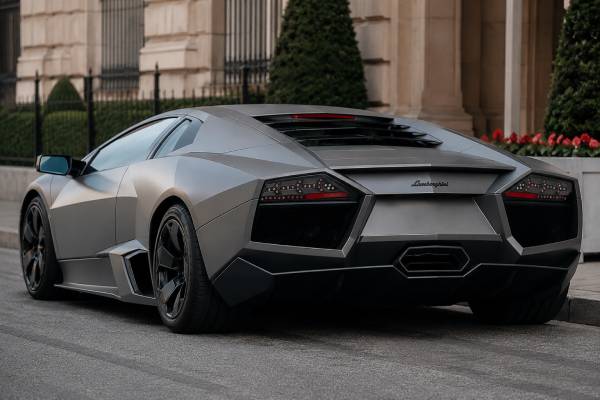
The body’s theme is clear from every angle. The nose has hard cuts, deep intakes, and a pointed center form. The sides use flat planes, strong shoulders, and large cooling openings. The rear is wide, technical, and almost weapon-like, with heat-resistant lighting and aggressive venting. Lamborghini’s official story connects the car to aeronautical inspiration, and the link is not subtle: the Reventón looks more like a stealth aircraft surface study than a traditionally sculpted Italian supercar.
Its most important design details include:
- Matte Grigio Reventón paint: a grey-green metallic finish that gives the car a military look without bright show-car color.
- Scissor doors: a core Lamborghini V12 signature carried over from the Countach lineage.
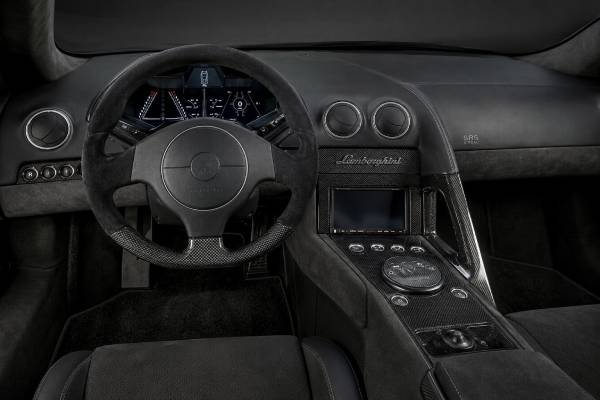
- Digital TFT instrument display: a three-screen cockpit that can switch between a conventional gauge look and a more aircraft-style display.
- G-force meter: a theatrical but memorable feature that reinforces the aviation theme.
- LED daytime running lights: one of the Reventón’s forward-looking details for the period.
- Heat-resistant rear lighting: needed because of the exhaust and thermal load in the rear section.
- Active rear spoiler: a functional aerodynamic feature that changes position depending on speed.
The car also matters because it previewed Lamborghini’s next design era. The Aventador did not copy the Reventón, but it clearly developed the same language: Y-shaped lighting ideas, sharper surfaces, larger intakes, more technical rear styling, and a stronger fighter-aircraft attitude. In that sense, the Reventón is not just a limited Murciélago. It is a design bridge between the old V12 wedge tradition and the modern Lamborghini flagship shape.
Engineering hidden beneath the drama
Under the dramatic body, the Reventón remains a serious mechanical package. The longitudinal V12 sits behind the cabin, the all-wheel-drive system helps launch traction, and the wide rear tires put meaningful rubber on the road. The steel tubular structure with carbon-fiber components reflects Lamborghini’s late-Murciélago engineering, before the Aventador moved to a full carbon-fiber monocoque.
That older structure gives the Reventón a different kind of appeal. It is not the lightest or most advanced Lamborghini by today’s standards, but it feels mechanical and analog in a way later cars do not. The steering, clutch behavior, heat management, gearbox action, and engine sound all remind the driver that this is a high-output V12 machine from before the hybrid and dual-clutch age.
The design is not just decorative, either. The body manages cooling for a large engine in a tight rear compartment. The active aero helps stability at high speed. The wheel and brake package supports serious performance. The cockpit layout gives the driver a sense of occasion before the engine even starts.
That blend of real function and deliberate theater is the Reventón’s signature. It is not subtle, but it is not empty styling. It is a Lamborghini doing exactly what Lamborghini does best: turning engineering into drama.
What the Reventón Feels Like to Drive
The Reventón drives like a Murciélago-era V12 Lamborghini with more visual intensity and collector pressure attached. It is fast, loud, wide, physical, and far less effortless than a modern dual-clutch supercar.
The engine defines the experience. At low rpm, the 6.5-liter V12 has enough torque to move the car easily, but it never feels lazy or isolated. The sound is mechanical and dense, then sharper as the revs climb. Above the midrange, it starts to feel properly exotic: the intake noise hardens, the exhaust note stretches, and the car pulls with the smooth violence that made naturally aspirated Lamborghini V12s famous.
The E-Gear transmission shapes the rhythm of the drive. It is not as smooth as a modern dual-clutch gearbox and should not be judged like one. In town, it can feel deliberate. The driver needs to be smooth with throttle inputs, avoid creeping in traffic, and understand that clutch wear is real. On an open road, the gearbox makes more sense. Full-throttle shifts hit with drama, and the interruption between gears becomes part of the experience rather than a flaw.
The steering is heavier and more talkative than many current supercars. The front end has all-wheel-drive confidence, but the car’s width and rear mass are always present. On narrow roads, placement takes concentration. On faster roads, it feels planted and stable, especially once the tires are warm. Cold tires, old tires, or incorrect tire fitment can change the car dramatically, so serious driving should never happen on aged rubber.
The ride is firm but not race-car harsh by exotic standards. The Reventón was built as a road car, not a stripped track tool. It can cover distance, but it asks for patience in cities. Visibility is limited, the nose is low, the rear is broad, and tight parking spaces are stressful. Heat, noise, clutch behavior, and ground clearance all make slow urban driving the least natural use case.
Where it feels strongest
The Reventón is at its best on open roads where the engine can breathe and the chassis has space. Fast sweepers, clean mountain roads, and wide highways suit it better than tight city streets. The brakes are strong when healthy and properly warmed, but carbon-ceramic condition should always be respected. Replacement is expensive, and surface damage, impact marks, or poor pad history can turn a dream purchase into a major bill.
On track, the Reventón is capable but too valuable and too rare for casual hard use. Heat, tires, brake wear, gravel damage, and clutch wear all carry collector consequences. Owners who want repeated track use are usually better served by a less rare Lamborghini or a modern track-focused car. The Reventón’s best role is occasional, careful, high-quality driving: enough use to keep it healthy, not enough abuse to compromise originality.
Maintenance Risks and Ownership Reality
A Reventón should be maintained like a rare Murciélago LP640-based V12 exotic, not like a normal used car. The biggest risks are age, inactivity, clutch wear, electronic faults, expensive brake and tire items, carbon-body repair complexity, and missing documentation.
The engine itself is robust when serviced correctly, but the surrounding systems need attention. Cooling hoses, seals, gaskets, fuel-system parts, ignition components, sensors, and exhaust-related heat shielding all age. A low-mile collector car can still have time-based deterioration. Storage quality matters as much as mileage.
The E-Gear system is one of the main inspection areas. Buyers should request a diagnostic readout from a Lamborghini dealer or qualified specialist. The clutch reading, shift calibration, hydraulic behavior, and fault history are all important. A car used for repeated low-speed maneuvering, display loading, photography, or city driving can wear its clutch faster than mileage suggests.
Carbon-ceramic brakes are another major ownership risk. They can last a long time in careful road use, but damage and wear are expensive. A pre-purchase inspection should check disc thickness or condition using the correct method, pad material, surface chips, heat damage, and any history of track use. Never judge carbon-ceramic brakes by a quick visual look alone.
Areas to inspect carefully
A proper inspection should include:
- E-Gear clutch and hydraulics: clutch wear reading, shift quality, pump behavior, actuator leaks, and stored fault codes.
- Engine health: compression or leak-down where appropriate, oil leaks, misfires, cooling behavior, service history, and exhaust condition.
- Cooling system: radiators, fans, hoses, coolant age, and evidence of overheating.
- Fuel system: smell of fuel, aged hoses, tank-area inspection, and any market-specific campaigns or updates.
- Carbon and body panels: stone damage, cracks, previous repainting, panel alignment, underside scrapes, and non-factory repairs.
- Suspension and steering: worn bushings, dampers, alignment, hydraulic lift function where fitted, and uneven tire wear.
- Brakes and tires: carbon-ceramic disc condition, pad life, tire age, tire specification, and wheel damage.
- Electronics: TFT displays, warning lights, battery drain, immobilizer, sensors, air-conditioning, lift controls, and infotainment functions.
- Interior originality: Alcantara wear, carbon trim condition, switchgear, instrument modes, and correct Reventón-specific details.
- Accessories and records: manuals, cases, service invoices, factory accessories, charger, car cover, and ownership trail.
Parts availability can be difficult because the Reventón combines Murciélago mechanical components with rare body, trim, lighting, and interior parts. Mechanical parts may be more obtainable than Reventón-specific cosmetic parts, but even Murciélago-era items can be costly and slow to source. Body damage is especially serious because repair quality affects both safety and collector value.
Originality versus upgrades is a major decision. Some owners like exhaust upgrades because they increase sound, but a Reventón is not the best candidate for heavy modification. Aftermarket exhausts, ECU tunes, non-original wheels, lowered suspension, or retrimmed interiors may reduce appeal to serious collectors. Reversible changes are still changes, and buyers should ask for original parts.
A well-kept Reventón should be serviced on time, stored on a proper battery maintainer, driven enough to keep seals and systems healthy, and inspected by people who know Lamborghini V12 cars. The ownership goal is not simply to avoid breakdowns. It is to preserve a rare factory artifact while keeping it mechanically alive.
Market Values and Buyer Inspection Guide
The Reventón market is thin, so public sale results matter more than generic price guides. Recent public coupé results have sat around the high-$1-million to low-$2-million range, while private asking prices can vary widely depending on mileage, location, taxes, provenance, and how complete the car is.
The best examples are usually not traded often. Many sit in major collections, and when they do appear, buyers focus on story as much as price. A one-owner car with very low mileage, complete accessories, Lamborghini service records, and no modifications can command a premium. A car with missing items, unclear import history, accident repairs, non-original paint, or patchy servicing should be discounted heavily, even if the odometer is low.
| Value factor | Why it matters |
|---|---|
| Original paint and trim | The model’s identity is tied to its factory visual specification. |
| Numbered identity | The production number supports authenticity and collector interest. |
| Mileage | Lower mileage helps, but only when supported by proper storage and service. |
| Service history | Dealer or specialist records reduce mechanical uncertainty. |
| Accessories | Manuals, cases, covers, and Reventón-specific items strengthen completeness. |
| Ownership chain | Known long-term ownership is easier to trust than fragmented history. |
| No modifications | Collector buyers usually prefer factory condition. |
| Mechanical readiness | A car needing clutch, brake, tire, or recommissioning work carries real cost. |
Buyer checklist
A serious buyer should follow a collector-grade process:
- Confirm the car’s numbered identity, VIN, title, import paperwork, and ownership history.
- Compare the car’s specification with factory records and known Reventón details.
- Review every service invoice, not just the stamped book.
- Commission a Lamborghini V12 specialist inspection before negotiating final price.
- Obtain E-Gear clutch data, fault scans, brake condition findings, tire dates, and battery health notes.
- Inspect the underside, front splitter, wheel edges, carbon panels, lighting, and rear heat-affected areas.
- Confirm all original accessories, manuals, keys, cases, covers, and Reventón-specific items.
- Budget for recommissioning even if the car presents well.
The cars to seek are original, complete, documented, and exercised carefully. The cars to avoid are the ones with vague stories: recent cosmetic work with no explanation, missing factory items, non-original exhausts without original parts, undocumented clutch replacement, old tires, warning lights, or “collection storage” used as an excuse for skipped maintenance.
Long-term collectability looks strong because the Reventón has all the right ingredients: naturally aspirated V12 power, tiny production, clear historical role, dramatic design, and direct connection to Lamborghini’s modern few-off strategy. It is also more visually significant than a standard Murciélago and less common than most later special Lamborghinis.
The main risk is not demand disappearing. The risk is buying the wrong car at the wrong price. In a market with so few transactions, a single expensive repair, missing accessory set, or title issue can matter. For the right buyer, the Reventón is not a normal supercar purchase. It is a piece of Lamborghini design history that happens to have a 650 hp V12 behind the seats.
References
- Lamborghini Reventon – Scheda Tecnica, Foto, Prestazioni 2026
- Lamborghini Reventón: the first few-off 2019
- Recall Campaign 2026 (Recall Database)
- 2008 Lamborghini Reventón Coupe | Monterey 2022 | RM Sotheby’s 2022
- 2008 Lamborghini Reventón Coupé | Munich | RM Sotheby’s 2022
Disclaimer
This article is for informational purposes only and is not a substitute for professional diagnosis, repair, appraisal, or pre-purchase inspection. Specifications, torque values, service intervals, inspection procedures, market equipment, and repair requirements can vary by VIN, market, production detail, and equipment. Always verify details against official Lamborghini service documentation and use qualified Lamborghini specialists for maintenance or evaluation.
If this guide helped you, please share it on Facebook, X/Twitter, or your favorite automotive community to support our work.