

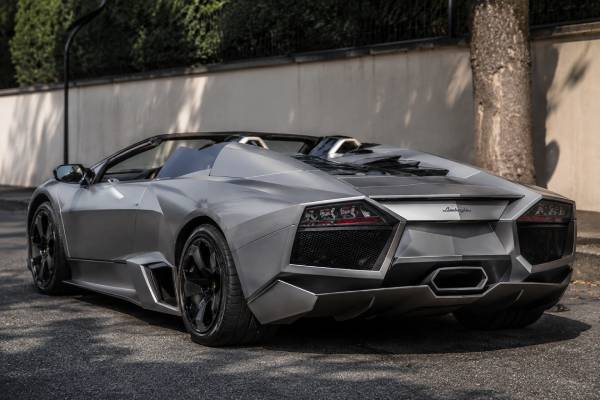
The Lamborghini Reventón Roadster is one of the rarest modern V12 Lamborghinis: a 15-car open-top special built at the end of the Murciélago era, powered by a naturally aspirated 6.5-liter V12 and wrapped in fighter-jet-inspired carbon-fiber bodywork. It was not a clean-sheet hypercar, and that is part of its appeal. Under the dramatic skin sits proven Murciélago architecture, but the Reventón Roadster adds a sharper visual identity, a more exclusive production run, a model-specific cabin, and the drama of open-air V12 driving. For collectors, it matters because it helped define Lamborghini’s modern “few-off” strategy before the Veneno, Centenario, Sián, and Countach LPI 800-4. For enthusiasts, it matters because it captures an old-school Lamborghini formula at its peak: a huge naturally aspirated V12, all-wheel drive, scissor doors, brutal noise, and theatrical design with almost no apology for practicality.
Table of Contents
- Why the Reventón Roadster Still Matters
- V12 Specs, Chassis, and Performance Data
- Production Numbers, Options, and Authenticity
- Fighter-Jet Design and Open-Top Engineering
- How the Reventón Roadster Drives
- Maintenance Risks and Specialist Care
- Market Values and Buyer Inspection Guide
Why the Reventón Roadster Still Matters
The Reventón Roadster matters because it turned the Murciélago platform into a collectible design statement, not just a faster version of an existing supercar. It was Lamborghini showing that ultra-limited bodywork, dramatic storytelling, and factory rarity could become a major part of the brand’s future.
Lamborghini revealed the Reventón coupe in 2007, then followed with the Roadster at the 2009 Frankfurt Motor Show. The coupe was already rare, with 20 customer cars generally cited, but the Roadster was rarer still, with only 15 examples built. That makes it scarcer than many later limited-production Lamborghinis and far less common than the Murciélago LP 670-4 SuperVeloce that donated much of its high-output V12 character.
The car sits in an important historical slot. It arrived near the end of the Murciélago’s life, before the Aventador introduced a carbon monocoque and a new-generation V12. The Reventón Roadster therefore belongs to the final chapter of Lamborghini’s older V12 architecture: steel-tube structure, carbon body panels, viscous all-wheel drive, single-clutch e-gear transmission, and a naturally aspirated engine descended from the classic Lamborghini V12 bloodline.
It also previews the company’s modern few-off business model. Before the Veneno, Centenario, Sián, and Invencible, the Reventón showed how Lamborghini could use an existing flagship platform as the base for something far more exclusive. Buyers were not paying only for extra speed. They were paying for design, rarity, access, and a factory-built object that felt closer to a concept car than a standard production model.
For collectors, the Reventón Roadster’s appeal rests on several points:
- Only 15 Roadsters were built, making supply extremely tight.
- The car has direct links to the Murciélago LP 670-4 SuperVeloce powertrain era.
- Its design language influenced later Lamborghini styling.
- It was sold new at a very high price, above ordinary Murciélago levels.
- Most examples were kept as collection pieces, so mileage and originality matter heavily.
For enthusiasts, the reason is simpler: it looks outrageous and sounds magnificent. The Reventón Roadster is not subtle, efficient, or easy to hide. It is a Lamborghini in the old poster-car sense, with a huge V12 behind the seats and scissor doors that still feel special even among modern supercars.
Its reputation today is different from when it was new. Early critics sometimes called it expensive for a Murciélago-based car. Collectors now view that same fact differently. The Reventón Roadster is one of the last analog-feeling, naturally aspirated V12 Lamborghinis before the Aventador generation changed the structure, electronics, and driving character of the flagship line.
V12 Specs, Chassis, and Performance Data
The Reventón Roadster uses a 6.5-liter naturally aspirated Lamborghini V12 rated at 670 CV/PS, or 493 kW, with factory performance of 0–100 km/h in 3.4 seconds and a 330 km/h top speed. In British horsepower terms, the output is about 661 bhp, so “670 hp” usually refers to the metric horsepower rating.
| Category | Specification |
|---|---|
| Production years | 2009–2010 |
| Body style | 2-door, 2-seat roadster |
| Layout | Longitudinal mid-engine, all-wheel drive |
| Engine | 6.5-liter naturally aspirated V12 |
| Displacement | 6,496 cc |
| Power | 670 CV/PS at 8,000 rpm |
| Torque | 660 Nm |
| Transmission | 6-speed e-gear automated manual |
| Drivetrain | Viscous-coupling permanent all-wheel drive |
| 0–100 km/h | 3.4 seconds |
| Top speed | 330 km/h |
| Dry weight | 1,690 kg |
The engine is the defining mechanical feature. It is a 60-degree V12 with dual overhead camshafts, four valves per cylinder, dry-sump lubrication, and a very high-revving character for such a large naturally aspirated unit. Dry-sump lubrication matters because it lets the engine sit lower in the chassis and helps maintain oil supply during hard cornering. The result is not just more reliability under load, but also a lower center of gravity than a conventional wet-sump layout would allow.
The gearbox is Lamborghini’s single-clutch e-gear automated manual. It is not a modern dual-clutch transmission. That distinction matters for buyers and drivers. The e-gear system uses hydraulic actuation to operate a conventional clutch and gearset, so shifts feel mechanical and sometimes abrupt, especially in aggressive modes. It can be exciting when driven hard, but it can also be clumsy at parking speed or in stop-start traffic.
The all-wheel-drive system is also very much of its period. Under normal conditions, the car feels rear-biased, but a viscous coupling can send drive forward when the rear tires lose grip. This gives the Roadster more traction than a rear-drive V12 exotic, but it does not make it feel like a modern computer-managed torque-vectoring supercar. Tire condition, alignment, and driver inputs still matter enormously.
| Item | Data |
|---|---|
| Length | 4,700 mm |
| Width | 2,058 mm |
| Height | about 1,132 mm |
| Wheelbase | 2,665 mm |
| Front tires | 245/35 ZR18 |
| Rear tires | 335/30 ZR18 |
| Suspension | Double wishbones front and rear |
| Brakes | Large ventilated discs with ABS |
| Fuel capacity | 100 liters |
The chassis uses the Murciélago family’s steel and carbon construction rather than the full carbon monocoque later used by the Aventador. The body panels are largely carbon fiber, while the structural base relies on a stiff central shell and reinforced open-top structure. Lamborghini stated that the Roadster required only modest reinforcement over the coupe because the underlying structure was already very rigid.
The Reventón Roadster’s performance figures remain serious, even by modern standards. Many newer supercars are quicker from rest because of dual-clutch gearboxes, turbocharged torque, hybrid boost, and launch-control systems, but the Roadster delivers speed in a more physical and dramatic way. The numbers do not fully explain the experience of a 6.5-liter V12 pulling past 8,000 rpm behind your shoulders.
Production Numbers, Options, and Authenticity
The most important production fact is simple: Lamborghini built only 15 Reventón Roadsters. That number dominates authenticity, market value, and buyer due diligence more than any conventional option list.
The Roadster was not a normal Murciélago variant with broad dealer stock and wide configuration choice. It was a highly controlled limited-series car sold to selected clients and collectors. Factory specification was therefore much narrower than on a normal production Lamborghini. Most cars are associated with the model-specific satin grey exterior known as Grigio Reventón and a dark, aircraft-inspired interior trimmed in Alcantara, leather, carbon fiber, and aluminum.
The Roadster should be understood alongside three closely related cars:
| Model | Role | Collector relevance |
|---|---|---|
| Murciélago LP 640 Roadster | Main production open-top V12 flagship | Mechanical base and ownership comparison |
| Reventón Coupe | Original few-off Reventón model | Earlier, less powerful closed-roof counterpart |
| Murciélago LP 670-4 SuperVeloce | Lightweight high-output Murciélago | Powertrain-era and performance reference point |
Documentation is central to any Reventón Roadster purchase. A strong car should have a complete factory book pack, original service book, warranty card where applicable, keys, accessories, charger, tools, and any model-specific delivery items. Some examples have been described with special flight-case-style presentation material and engine certification documents. On a car this rare, missing original items are not minor details; they affect confidence, provenance, and resale.
Chassis-number and build-record verification should be done through Lamborghini or a highly respected marque specialist. A normal used-car inspection is not enough. A buyer should confirm the car’s identity, factory configuration, market of delivery, service history, ownership chain, paintwork, body-panel condition, and whether any factory campaigns or market-specific issues apply.
Factory options are less important than condition and completeness, but specification still matters. Collectors prefer cars that remain close to original delivery condition. Desirable traits include:
- original Grigio Reventón paint in excellent condition
- correct grey Alcantara and leather interior materials
- original carbon-fiber exterior panels without damage or heavy refinishing
- factory-correct wheels, brakes, lighting, and cabin displays
- complete presentation accessories and service records
- low but exercised mileage, rather than long-term neglect
- clear export, import, tax, and registration history
Avoid assuming that lower mileage always means a better car. A Reventón Roadster that sat unused for years can need expensive recommissioning. Tires age, fluids absorb moisture, seals harden, batteries fail, fuel systems deteriorate, and hydraulic systems can become troublesome. A lightly used, well-serviced car with clear records may be healthier than an ultra-low-mileage static display car.
Market-specific equipment can also matter. Cars delivered in Europe, Switzerland, the Middle East, or other regions may differ in documentation, lighting compliance, emissions paperwork, speedometer display, registration history, or tax status. Importing one into another country can be costly and slow, especially if the car has been stored, exported, or re-registered several times.
For authenticity, the best rule is to treat the Reventón Roadster like a modern collectible, not a used supercar. Provenance, factory paper trail, original materials, and expert confirmation are part of the car’s value.
Fighter-Jet Design and Open-Top Engineering
The Reventón Roadster’s design is valuable because it looks like a concept car that escaped into customer hands. The sharp surfaces, aircraft-style details, exposed carbon themes, and open cockpit make it one of the clearest links between the Murciélago era and Lamborghini’s later angular design language.
Lamborghini’s Centro Stile designers drew inspiration from modern military aircraft. The result is not a soft or flowing roadster. It is all wedges, blades, intakes, and geometric planes. The nose has an arrowhead shape, the side intakes are pulled forward, the sills are broad, and the rear looks more like a piece of machinery than a conventional sports car tail.
The Roadster keeps Lamborghini’s scissor doors, which are more than a styling party trick here. On a low, wide V12 car, they also help with access in tight spaces. They reinforce the flagship Lamborghini identity that began with the Countach and continued through the Diablo, Murciélago, Aventador, and later V12 models.
The lighting design is another key detail. The front uses bi-xenon lighting with LED elements, while the rear uses LED lamps arranged in a technical, aircraft-like graphic. These details may sound common now, but in 2009 they gave the Reventón Roadster a futuristic look that separated it from the standard Murciélago.
Carbon body and open-top structure
The Roadster’s bodywork is made largely from carbon fiber, with the underlying structure derived from the Murciélago family. The open roof changes the visual balance of the car. Without the coupe’s fixed roofline, the rear deck becomes a long, flat, dramatic surface with glass sections showing the V12 below.
Behind the occupants are pop-up rollover bars designed to deploy quickly if the car senses a rollover risk. This system is important because the Reventón Roadster is not just a show car; it is a road-legal, high-speed open car capable of extreme performance. The rear structure also carries a horizontal wing-shaped element and high-mounted brake light, adding to the aircraft theme.
The removable roof arrangement is best treated as weather protection, not as something that turns the car into a refined all-season convertible. Like many exotic roadsters of its era, the Reventón is happiest when driven open in good weather. Owners should be realistic about wind noise, cabin heat, storage limitations, and the care needed when handling roof components.
Cockpit and driver interface
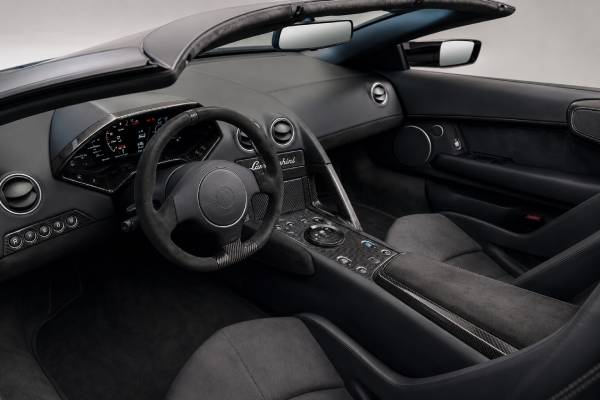
Inside, the Reventón Roadster feels more special than a standard Murciélago because of its instrument design and materials. The dashboard uses carbon fiber, aluminum, Alcantara, and leather, while the instrument display has aircraft-inspired TFT screens. The graphics were part of the car’s identity when new and remain important for originality today.
The driving position is low, wide, and dramatic. Visibility is better forward than rearward, and the car’s width is always present in the driver’s mind. The central tunnel is substantial because of the drivetrain layout. The cockpit is not built around daily comfort or storage convenience; it is built around the event of operating a very rare V12 Lamborghini.
The design still works because it is functional enough to be believable. The intakes feed real mechanical needs, the carbon body saves weight, the open rear deck displays the engine, and the cabin makes the driver feel like part of the car’s theater. It is dramatic, but it is not merely decorative.
How the Reventón Roadster Drives
The Reventón Roadster drives like a late Murciélago turned up for drama: fast, loud, wide, mechanical, and demanding compared with newer dual-clutch supercars. Its greatest strength is not effortless speed; it is the sensation of a large naturally aspirated V12 working hard in an open cockpit.
Throttle response is immediate by modern turbocharged standards. There is no boost delay and no electric torque fill. The engine builds power in a clean, rising line, with the sound becoming harder and more metallic as revs climb. At lower revs, the V12 feels muscular but not lazy. At high revs, it becomes the reason the car exists.
The e-gear transmission shapes the whole driving experience. In relaxed driving, it can feel dated. Shifts may be slow or head-nodding if the driver treats it like a torque-converter automatic. It works best when the driver cooperates: lift slightly on part-throttle shifts, be decisive with throttle inputs, and save the most aggressive shift behavior for open roads or track-style use. In Corsa mode, the gearbox feels more violent and exciting, but that sharpness can increase clutch wear if used carelessly.
Steering is heavy compared with many modern supercars, especially at low speed. Once moving, the car feels more natural. The front end gives useful feedback, but the Reventón Roadster is still a wide, heavy, all-wheel-drive V12 machine. It prefers smooth inputs and commitment rather than nervous corrections.
The ride is firm, but not absurd for an exotic of this era. Tire choice and age make a large difference. Old tires can make the car feel harsh, vague, or unpredictable. Fresh, correct-spec high-performance tires help the chassis feel more secure and reduce the temptation to blame the suspension for problems caused by rubber.
Braking performance is strong when the system is healthy, but buyers should assess pedal feel, disc condition, pad condition, brake-fluid age, ABS behavior, and any vibration under load. Many cars have spent long periods in storage, and lightly used brakes can still need serious attention if corrosion, glazing, or age-related issues are present.
On a mountain road, the Roadster is dramatic rather than delicate. It has enormous grip, but its size and value discourage casual heroics. On highways, it feels more at home, where the V12 can stretch and the all-wheel-drive stability gives confidence. In cities, it is more difficult: wide body, limited rear visibility, low nose, hot cabin, single-clutch gearbox, and constant attention from everyone nearby.
As an open car, it adds another layer of sensation. The intake and exhaust sounds become more vivid. The driver feels more exposed, more connected, and more aware of heat, smell, and mechanical noise. That is exactly what many collectors want. The Reventón Roadster is not trying to isolate the driver from the machine. It is trying to make every short drive feel like an occasion.
Maintenance Risks and Specialist Care
The Reventón Roadster is mechanically related to the Murciélago, but ownership costs sit in a higher category because of rarity, carbon bodywork, trim uniqueness, and collector-grade expectations. The safest ownership strategy is regular specialist care, careful storage, and no deferred maintenance.
The V12 itself is strong when maintained properly, but it is not cheap to service. Fluids, ignition components, cooling-system parts, belts, hoses, gaskets, and engine-access labor all cost more than ordinary performance-car owners expect. Age is often a bigger issue than mileage. A 2010 car with very low kilometers still has old rubber, seals, electronics, and fluids unless they have been replaced on schedule.
The e-gear system deserves special attention. Clutch wear depends heavily on driving style, traffic use, setup, and calibration. Reversing uphill, creeping in traffic, and repeated low-speed maneuvering can accelerate wear. A specialist inspection should check clutch life readings where possible, hydraulic actuation behavior, shift quality, warning lights, and service history. A clutch replacement on a V12 Lamborghini is a major job, and a Reventón buyer should budget accordingly.
Cooling and fuel systems also matter. The car has a large engine in a tightly packaged rear bay, and many examples sit unused for extended periods. Inspect hoses, radiators, fans, expansion tanks, coolant condition, fuel lines, fuel pumps, and any evidence of leaks or heat damage. Any smell of fuel, coolant staining, or unexplained temperature behavior deserves immediate investigation.
The front-lift system, suspension components, and steering system should be checked carefully. The car is low and wide, so underbody contact is common if drivers are careless. Look for scraped front carbon, damaged undertrays, worn suspension bushings, leaking dampers, tired ball joints, and uneven tire wear from poor alignment.
Carbon-fiber body repair is one of the largest ownership risks. The Reventón-specific panels are not like ordinary Murciélago replacement parts. Damage to the nose, sills, rear deck, vents, or carbon trim can be difficult and expensive to correct properly. Poor repairs hurt value, especially if paint texture, panel gaps, weave, or finish do not match the factory standard.
Electrical and display systems should not be ignored. The aircraft-style TFT instrument cluster is part of the car’s identity. Any screen faults, pixel issues, warning lights, battery-drain problems, alarm faults, or control-module errors should be diagnosed before purchase. Modern collectible Lamborghinis rely on electronics that may be costly to source and program as parts age.
A practical maintenance checklist should include:
- annual fluid and safety inspection, even with low mileage
- brake-fluid replacement based on time, not only distance
- tire replacement based on age and condition
- battery maintenance with the correct charger
- clutch wear and e-gear calibration checks
- cooling-system pressure and leak inspection
- lift-system operation and hydraulic leak inspection
- underbody and carbon-panel inspection after transport or use
- verification of recalls, campaigns, and software updates by VIN
- detailed service invoices from Lamborghini dealers or known specialists
Storage quality is also part of maintenance. The car should be kept in a dry, climate-stable environment, connected to a suitable battery maintainer, protected from UV exposure, and exercised correctly. Long static display periods may preserve mileage but can harm seals, tires, fluids, and mechanical systems.
Owners should avoid non-reversible modifications. Exhaust changes, aftermarket wheels, carbon add-ons, altered suspension settings, retrimmed interiors, and non-factory electronics may reduce collector value. If upgrades exist, the original parts should accompany the car. On a 15-unit model, originality is usually worth more than personalization.
Market Values and Buyer Inspection Guide
The Reventón Roadster sits in the modern collectible Lamborghini market, not the ordinary used-supercar market. Recent public auction context places strong examples around the seven-figure range, with exact value depending on mileage, provenance, tax status, location, completeness, and buyer demand at the time of sale.
A 2025 RM Sotheby’s Milan sale recorded a Reventón Roadster at €1,580,000, giving the market a useful recent public marker. Other auction appearances have shown that estimates can be ambitious and that rarity alone does not guarantee a sale at any price. The buyer pool is small, informed, and sensitive to details.
Value is driven by more than mileage. The best cars combine low mileage with evidence of proper care. A delivery-mile car that needs recommissioning, has missing accessories, or carries unclear tax status may be less attractive than a slightly higher-mile car with perfect records and a clean ownership chain.
The main value factors are:
| Value factor | Why it matters |
|---|---|
| Originality | Factory paint, trim, wheels, carbon panels, and equipment are critical on a 15-car model. |
| Documentation | Books, service records, certificates, accessories, and delivery material support provenance. |
| Mileage | Low mileage helps, but only when backed by maintenance and healthy mechanical condition. |
| Condition | Paint, carbon fiber, interior displays, brakes, tires, and underbody condition strongly affect confidence. |
| Ownership chain | Clear, low-owner history is more desirable than fragmented international movement. |
| Tax and registration status | VAT, import duties, export rules, and registration eligibility can affect the real purchase cost. |
A buyer should start with identity. Confirm the VIN, chassis records, factory build details, original market, original color and trim, and whether the car is one of the 15 Roadsters. Then move to condition. Check carbon panels under strong light, inspect panel gaps, look for repaint signs, measure paint where appropriate, and examine the underside for scraping or repair.
The mechanical inspection should be done by a Lamborghini dealer familiar with Murciélago-era cars or an independent specialist with proven V12 experience. It should include a diagnostic scan, clutch data, e-gear function, brake condition, suspension and lift operation, cooling-system pressure test, tire-date check, road test, and review of service invoices.
The paperwork inspection is equally important. Review:
- original sales paperwork where available
- service book stamps and matching invoices
- warranty card or delivery documents
- import and export documents
- registration history
- tax or VAT status
- accessory inventory
- battery charger, tools, keys, books, and presentation items
- any factory or dealer correspondence
- insurance or accident records where available
Cars to seek are original, complete, regularly maintained, and clearly documented. Cars to treat carefully are those with missing accessories, unclear service gaps, repaint without explanation, long storage with no recommissioning invoices, dead displays, e-gear faults, clutch uncertainty, accident history, or complex cross-border tax status.
Long-term collectability looks strong because the Reventón Roadster has the right ingredients: extreme rarity, Lamborghini factory origin, V12 power, dramatic design, few-off historical significance, and direct connection to the end of the Murciélago era. The main risk is liquidity. A rare car can still take time to sell, and the final price depends on finding the right collector at the right moment.
For the right buyer, the Reventón Roadster is not a rational performance purchase. A newer Lamborghini will be faster, easier to drive, and more usable. The Reventón Roadster’s value is in scarcity, theater, and historical position. It is a modern Lamborghini collectible that feels like a rolling concept car, yet still carries the raw mechanical drama of a naturally aspirated V12 flagship.
References
- Reventón Roadster 2026 (Manufacturer History Page)
- Lamborghini Murciélago LP 670 SuperVeloce – Technical Specifications 2026 (Manufacturer Technical Page)
- Check for Recalls: Vehicle, Car Seat, Tire, Equipment | NHTSA 2026 (Recall Database)
- 2010 Lamborghini Reventón Roadster | Milan | RM Sotheby’s 2025 (Auction Result)
- Lamborghini Reventon Roadster (2010) – pictures, information & specs 2009 (Press Information Archive)
Disclaimer
This article is for informational purposes only and is not a substitute for professional diagnosis, inspection, repair, valuation, or legal advice. Specifications, torque values, service intervals, recall status, import rules, and repair procedures can vary by VIN, market, equipment, and factory update history. Always verify details against official Lamborghini service documentation, factory records, and a qualified Lamborghini specialist before buying, servicing, or restoring a Reventón Roadster.
If this guide helped you, please share it on Facebook, X/Twitter, or your favorite car community to support our work.