
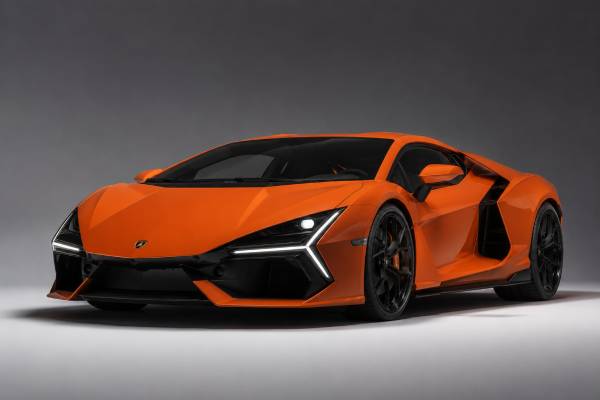
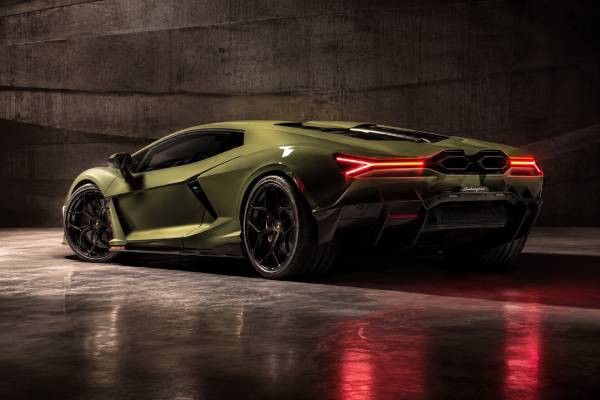
The Lamborghini Revuelto is the V12 flagship that replaced the Aventador and reset Lamborghini’s supercar formula for the hybrid era. It keeps the brand’s naturally aspirated 6.5-liter V12 as the emotional center, but adds three electric motors, a compact 8-speed dual-clutch gearbox, electric front-axle torque vectoring, and a new carbon-fiber structure. The result is not a quiet efficiency car with a big badge; it is a 1,015 CV, roughly 1,001 hp, plug-in hybrid supercar built to make the V12 faster, sharper, and more usable.
For buyers, the Revuelto matters because it is the first series-production Lamborghini V12 plug-in hybrid and the first clean-sheet successor in the flagship line since the Aventador. For enthusiasts, it matters because it shows how Lamborghini plans to preserve sound, drama, and naturally aspirated character while meeting modern performance, emissions, and usability demands.
Table of Contents
- Lamborghini’s New V12 Era
- Revuelto L545 Specs and Hybrid Hardware
- Production, Options, and Identification Details
- Carbon, Aero, and the Driving Interface
- How the Revuelto Feels on Road and Track
- Maintenance, Reliability, and Hybrid Ownership Risks
- Market Values and Smart Buying Checks
Lamborghini’s New V12 Era
The Revuelto is Lamborghini’s first full-production V12 plug-in hybrid flagship, and its job is simple: move the brand beyond the Aventador without losing the madness that made the Aventador worth remembering. It was unveiled in 2023 as project LB744, ahead of Lamborghini’s 60th anniversary, and sits at the top of the range above the Huracán successor line and the Urus family.
Its importance comes from the way Lamborghini chose to electrify. The company did not replace the V12 with a smaller turbocharged engine. Instead, it developed the L545 naturally aspirated 6.5-liter V12, rotated the powertrain architecture, moved the gearbox behind the engine, placed a lithium-ion battery in the central tunnel, and used electric motors to add all-wheel-drive response and torque vectoring.
That makes the Revuelto a bridge between two eras. It continues the lineage of Lamborghini V12 flagships that runs from Miura, Countach, Diablo, Murciélago, and Aventador, but it also introduces the brand’s HPEV idea: High Performance Electrified Vehicle. In practical terms, HPEV means the hybrid system is tuned first for performance, response, traction, and chassis control, not for long electric range.
The car’s reputation is already tied to several firsts:
- First Lamborghini series-production V12 plug-in hybrid.
- First Lamborghini V12 flagship with an 8-speed dual-clutch gearbox.
- First Lamborghini with a carbon-fiber front structure integrated into the main chassis concept.
- First flagship Lamborghini to use electric front-axle torque vectoring.
- First Lamborghini V12 road car rated at more than 1,000 metric horsepower.
Collectors care because first-of-kind Lamborghini V12 models tend to become historical markers. Early Countach, Diablo, Murciélago, and Aventador examples all became reference points for their eras. The Revuelto has a similar role, but with an added layer: it may become one of the most important cars in the transition from pure combustion exotica to electrified high-performance cars.
Owners care for a different reason. The Revuelto is not a limited numbered special in standard form, but it is a high-demand flagship with heavy personalization, long allocation pressure in many markets, and early-production scrutiny. Specification, provenance, service history, warranty status, and recall completion will matter more than simple mileage when cars move through the secondhand market.
Revuelto L545 Specs and Hybrid Hardware
The key technical point is that the Revuelto uses one combustion engine and three electric motors as one performance system. The V12 provides the sound and high-rpm drama; the electric motors fill torque, power the front axle, add torque vectoring, and allow limited electric-only movement.
| Category | Specification |
|---|---|
| Model | Lamborghini Revuelto, project code LB744 |
| Engine code | L545 V12 |
| Engine type | Naturally aspirated 6.5-liter V12 |
| Displacement | 6,498.5 cc |
| Bore x stroke | 95 mm x 76.4 mm |
| Compression ratio | 12.6:1 |
| Combustion-engine output | 825 CV at 9,250 rpm |
| Combustion-engine torque | 725 Nm at 6,750 rpm |
| Combined output | 1,015 CV / 747 kW, about 1,001 hp |
| Hybrid layout | Two front electric motors plus one rear motor integrated with the gearbox |
| Battery | 3.8 kWh lithium-ion pack in the central tunnel |
| Transmission | 8-speed transverse dual-clutch automatic |
| Drivetrain | Electrified all-wheel drive |
| 0–100 km/h | 2.5 seconds |
| Top speed | More than 350 km/h |
The L545 engine is more than an updated Aventador unit. It is lighter, more powerful, and packaged differently. Lamborghini rotated the V12 compared with the Aventador layout and placed the new dual-clutch transmission transversely behind it. This frees the central tunnel for the battery, which helps keep mass low and central.
The hybrid system is compact but complex. The two front motors power the front wheels and allow torque vectoring, which means the car can send different amounts of electric torque to each front wheel to help turn-in and stability. The rear motor can act as a starter-generator and assist the V12, depending on drive mode and battery state.
| Area | Specification |
|---|---|
| Frame | Multi-technology carbon-fiber monocoque with Forged Composites front structure |
| Body | Carbon fiber body, aluminum doors, thermoplastic bumpers |
| Suspension | Front and rear double wishbone with Lamborghini Magneride dampers |
| Steering | Electric power steering with rear-wheel steering |
| Brakes | Carbon Ceramic Brakes Plus |
| Front brake discs | 410 x 38 mm, 10-piston calipers |
| Rear brake discs | 390 x 32 mm, 4-piston calipers |
| Standard tires | 265/35 ZR20 front, 345/30 ZR21 rear |
| Optional tire sizing | 21-inch front and 22-inch rear combinations available |
| Wheelbase | 2,779 mm |
| Length | 4,947 mm |
| Width excluding mirrors | 2,038 mm |
| Height | 1,161 mm |
| Dry weight | 1,780 kg in EU MY26 specification |
The official electric range is modest, and that is intentional. The Revuelto is not designed to be a long-range EV. Its electric ability is mainly useful for quiet starts, emissions-restricted areas, low-speed movement, reverse operation, torque fill, brake-energy recovery, and front-axle control.
Production, Options, and Identification Details
The Revuelto is a series-production flagship rather than a fixed-number limited edition, but individual cars vary heavily because Lamborghini buyers usually use the personalization program. For the market, the most valuable cars will not simply be the lowest-mileage examples; they will be the cleanest, best-documented, best-specified cars with desirable colors and no unresolved service issues.
The standard body style is the coupe. Lamborghini has also used special-edition and regional tribute approaches, such as the NA63 theme for North America, to add rarity through design, color, and trim rather than mechanical changes. Future open-roof or track-focused derivatives would naturally change the collector picture, but the standard coupe is the baseline car against which later variants will be judged.
Important identification points include:
- LB744 project identity: Used during development and still useful when discussing early technical material.
- L545 engine: The new naturally aspirated V12, not a carryover Aventador engine.
- Three-motor PHEV layout: Two front motors and one rear motor integrated with the transmission.
- Central tunnel battery: A key packaging change compared with older V12 Lamborghinis.
- 8-speed transverse dual-clutch transmission: A major mechanical identifier.
- Carbon monofuselage: Carbon-fiber core with advanced front structure.
- Y-shaped lighting and exposed V12: Major visual identifiers.
Factory options and personalization matter because many Revueltos carry large option totals. Common high-value areas include exterior carbon fiber, visible-carbon packages, wheel designs, brake-caliper colors, contrast roof or body details, special paint, interior stitching, seat materials, audio upgrades, ADAS packages, telemetry-style technology, and Lamborghini Accessori Originali equipment.
For collectors, factory documentation should match the car exactly. A strong file should include:
- Original order sheet or build specification.
- Window sticker or market-equivalent price document.
- Warranty and battery-warranty paperwork.
- Service-plan status.
- Recall completion proof.
- Paint-protection-film and detailing invoices, when fitted.
- Any Ad Personam correspondence for special colors or interior details.
- Tire, brake, and battery-condition reports for low-mileage resale cars.
Color is a serious value factor. Loud launch-style colors, historic Lamborghini shades, matte finishes, and rare Ad Personam combinations can add appeal, but they also narrow the buyer pool. A bold specification may sell at a premium when fresh, yet a timeless, well-balanced specification can be easier to resell when market heat cools.
Carbon, Aero, and the Driving Interface
The Revuelto’s engineering is special because its hybrid system, carbon structure, aerodynamics, and software all work together rather than sitting as separate headline features. The car is not just a V12 with electric assist; it is a new control platform for Lamborghini’s flagship behavior.
The carbon structure is central to that change. Lamborghini calls the main architecture a monofuselage, using a carbon-fiber passenger cell and a front structure made with Forged Composites. Compared with older mixed-material structures, this gives the Revuelto a stiffer and lighter foundation for suspension, crash performance, and steering response.
Aerodynamics are active and highly integrated. The rear wing has multiple positions and works with the drive modes. Cooling is not treated as a separate problem; it is built into the surface language. Front airflow helps brake cooling, rear ducts help feed thermal needs, and the exposed V12 becomes part of the visual design rather than something hidden under a conventional decklid.
The styling follows Lamborghini tradition without copying it. The single center line, wedge stance, scissor doors, Y-shaped lighting, wide rear haunches, and high-mounted exhausts all connect the car to Countach and Aventador ideas. The difference is in the surfacing: the Revuelto looks cleaner and more technical, with negative spaces and air channels doing real work.
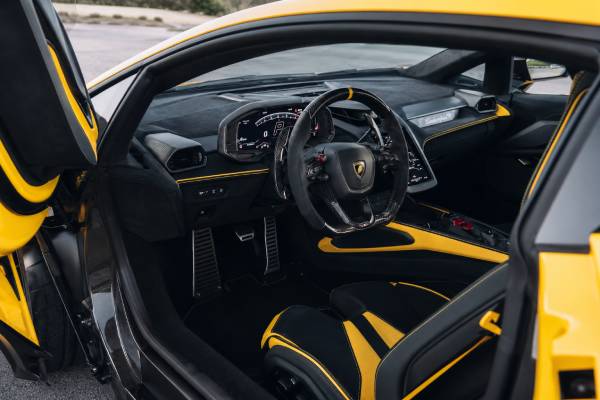
Inside, the biggest shift is the driving interface. The cockpit still feels theatrical, but the controls are more software-led. The driver uses steering-wheel rotors to combine four main drive personalities with hybrid modes:
- Città: Urban use, electric operation where possible, comfort-first response.
- Strada: Daily and highway use with smoother damping and power delivery.
- Sport: Sharper response, louder V12 character, more playful balance.
- Corsa: Track-focused calibration with maximum performance available.
- Recharge, Hybrid, and Performance: Hybrid strategies that change battery use, regeneration, and electric boost.
Together, these settings create 13 driving combinations. That matters because the Revuelto has to do more than older V12 Lamborghinis. It must creep quietly through a city, manage battery state, support high-speed stability, preserve brake performance, and still deliver a full-power launch with the V12 screaming near 9,500 rpm.
The sound is also engineered as a core feature. The electric motors make the car quicker at low speed, but the V12 remains the emotional event. Its high-rev response, intake path, and exhaust character are part of the reason the Revuelto feels like a continuation of the flagship line rather than a clean break from it.
How the Revuelto Feels on Road and Track
The Revuelto feels faster and more immediate than the Aventador because the electric motors fill the low-rpm gaps that naturally aspirated engines usually leave open. The V12 still builds toward its peak in a dramatic way, but the car no longer depends only on revs and gear selection to feel urgent.
From a stop, launch control gives the car the kind of instant thrust expected from a modern hybrid hypercar. The front electric motors help pull the nose, the rear axle receives V12 and electric assistance, and the dual-clutch gearbox shifts far faster and more smoothly than the Aventador’s single-clutch automated manual. That gearbox change alone makes the car feel more modern in traffic, on mountain roads, and under full throttle.
The steering character is defined by several systems working together: electric power steering, rear-wheel steering, front e-axle torque vectoring, and active damping. At low and medium speeds, the car feels smaller than its width suggests. At high speed, the rear steering and aero help calm the platform. The driver still needs to respect the car’s size, tire width, and performance, but the Revuelto is less intimidating than its numbers suggest.
On road, the best modes depend on the situation. Strada is the sensible default for long drives because it keeps the V12 present without making every input feel aggressive. Sport is the emotional road setting, where throttle response, sound, gearbox behavior, and chassis movement feel more alive. Corsa belongs on track or very open roads because it prioritizes response and performance over relaxation.
The brakes are extremely powerful, but buyers should understand the hybrid effect. Regenerative braking contributes to deceleration and battery recovery, while the carbon-ceramic hardware handles serious stopping work. Pedal feel in modern electrified supercars can differ from older purely hydraulic systems, so a test drive should include gentle stops, hard stops, and repeated braking from speed.
Tires strongly shape the experience. A Revuelto on fresh, correct high-performance summer tires will feel sharp and secure. A car on aged, cold, mismatched, or winter tires will not show its true behavior. Because the car uses huge staggered tire sizes and has torque vectoring systems that rely on predictable grip, tire age and specification are not small details.
Usability is better than old V12 Lamborghini stereotypes suggest. The cabin has more room than the Aventador, the dual-clutch gearbox is smoother at low speed, the nose-lift system is important for real roads, and ADAS availability helps in traffic. Still, it remains a very wide, low, expensive car. Parking garages, steep ramps, poor roads, and inattentive traffic are part of the ownership reality.
Maintenance, Reliability, and Hybrid Ownership Risks
The Revuelto is too new for long-term reliability patterns to be fully proven, so the smart ownership approach is prevention, documentation, and authorized-specialist oversight. The car combines a high-revving V12, high-voltage hybrid hardware, carbon-ceramic brakes, active aero, advanced suspension, ADAS, and software-controlled vehicle dynamics, which means small problems can become expensive if ignored.
Lamborghini’s maintenance support is a major part of the ownership case. The Revuelto includes a 3-year vehicle warranty, an 8-year high-voltage battery warranty up to the stated mileage limit, and a 5-year scheduled-maintenance program in many markets. Buyers should verify the exact warranty, battery coverage, and maintenance terms for the specific VIN and country.
The main areas to inspect are:
- Hybrid battery condition: Check state-of-health reporting, charging behavior, warning messages, and whether the car has spent long periods unused.
- Cooling systems: The V12 and high-voltage components rely on dedicated cooling. Any coolant smell, warning, or low-level history deserves investigation.
- Dual-clutch transmission: Low-speed behavior, shift quality, launch history, and software updates matter.
- Carbon-ceramic brakes: Inspect disc surface condition, pad life, chips, heat marks, and replacement-cost exposure.
- Tires: Confirm correct size, brand specification, date codes, tread depth, and whether the car has run track days.
- Lift system and suspension: Check nose-lift function, damper behavior, leaks, noise, and uneven ride height.
- Active aero: Confirm rear-wing operation and absence of faults.
- Electronics and software: Scan all modules, check infotainment behavior, ADAS calibration, camera function, battery-charging logs, and over-the-air update status.
- Body and carbon structure: Inspect for underbody strikes, incorrect jacking, repaired carbon, paintwork, and poor paint-protection-film removal.
Early recalls and service campaigns are especially important on a car this complex. U.S. recall filings have included issues such as door gas-spring support pin tightening on some 2024–2025 cars and a rearview-camera software condition affecting a small number of vehicles. A clean pre-purchase inspection should confirm all applicable recalls by VIN, not by model year alone.
Common ownership mistakes include treating the Revuelto like a normal used exotic rather than a high-voltage flagship. Do not buy without a Lamborghini dealer or recognized marque specialist scan. Do not assume a nearly new car is issue-free. Do not ignore old fuel, weak low-voltage batteries, outdated software, or tires that look new but are heat-cycled or aged.
Storage is another cost driver. A Revuelto should be kept on the correct battery maintainer, stored in a dry and stable environment, run through proper warm-up cycles, and serviced by time as well as mileage. Low mileage helps value only when the car is exercised and maintained correctly. A delivery-mile car with old fluids, flat-spotted tires, unresolved updates, and weak batteries can be worse than a carefully used example.
Market Values and Smart Buying Checks
The Revuelto market is still young, so values are driven by allocation pressure, specification, mileage, and confidence more than by mature collector pricing. New U.S. pricing starts in the low-to-mid $600,000 range before heavy options, while well-specified cars can carry sticker prices far above that. On the secondary market, asking prices and auction results commonly sit higher for desirable, low-mileage, heavily optioned examples, though weak specs or complicated histories can trade lower.
The long-term collectability case is strong, but not because every Revuelto will become rare. The stronger argument is historical importance: it is the first Lamborghini V12 plug-in hybrid, the first new-generation flagship after the Aventador, and a major technical reset for the brand. The best long-term examples will likely be early, highly documented, excellent-condition cars with strong colors, tasteful options, and continuous authorized service records.
Value is most affected by:
| Value factor | Why it matters |
|---|---|
| Specification | Paint, carbon packages, wheels, interior trim, and Ad Personam details can strongly affect desirability. |
| Mileage | Low mileage helps, but only when supported by proper maintenance and healthy battery condition. |
| Warranty status | Coverage reduces risk on hybrid, electronic, and powertrain systems. |
| Recall completion | Unresolved campaigns create safety, resale, and registration concerns. |
| Service records | Complete Lamborghini dealer records are more valuable than vague seller claims. |
| Condition | Paint, carbon trim, underbody, wheels, tires, brakes, and interior wear all matter at this price level. |
| Ownership history | Single-owner, properly stored cars usually inspire more confidence. |
A serious inspection should follow this order:
- Confirm VIN, market specification, warranty, service plan, and open recalls.
- Match the build sheet to the car’s paint, wheels, carbon, interior, ADAS, and accessory specification.
- Scan all control modules with factory-level diagnostic equipment.
- Check high-voltage battery health and charging behavior.
- Inspect brakes, tires, wheels, suspension, lift system, and active aero.
- Inspect the underside, carbon structure, front splitter, cooling ducts, and jacking points.
- Review paint-depth readings, paint-protection film quality, and any body repair evidence.
- Test drive through low-speed, highway, braking, charging, and drive-mode behavior.
The examples to seek are clean-title, no-stories cars with complete documents, attractive factory options, low but believable mileage, current software, fresh tires, and no unresolved warning lights. The examples to avoid are flipped cars with missing records, unusually cheap cars with vague explanations, cars that have sat unused without proper maintenance, and cars with underbody damage or unclear hybrid-system status.
For enthusiasts who want the experience rather than a museum piece, a lightly used, well-maintained car may be the smartest buy once early premiums settle. For collectors, the best target is a highly specified early coupe in a landmark color with full provenance and no deviations from factory condition. The Revuelto is likely to remain important because it marks the moment Lamborghini electrified the V12 without surrendering the V12 itself.
References
- Revuelto | Lamborghini.com 2026 (Official Model Page)
- Lamborghini LB744: new benchmark for hybrid super sports cars 2023 (Manufacturer Technical Release)
- Lamborghini _REVUELTO_DIGITAL_BROCHURE_EN_2026_WCAG 2026 (Official Brochure)
- Part 573 Safety Recall Report 25V477 2025 (Recall Database)
- Part 573 Safety Recall Report 26V053 2026 (Recall Database)
Disclaimer
This article is for informational purposes only and is not a substitute for professional diagnosis, repair, valuation, or pre-purchase inspection. Specifications, torque values, service intervals, warranty terms, recall applicability, and repair procedures can vary by VIN, market, production date, software version, and equipment. Always verify details against official Lamborghini service documentation and have any Revuelto inspected by an authorized Lamborghini dealer or qualified specialist.
If this guide helped, please consider sharing it on Facebook, X/Twitter, or your favorite car community to support our work.