

The Lamborghini Sián FKP 37 is the bridge between Lamborghini’s naturally aspirated V12 past and its electrified future. It is not a plug-in hybrid, not a quiet efficiency exercise, and not a normal Aventador variant with a styling package. It is a limited-production V12 hypercar that uses a 48-volt electric motor and a supercapacitor to sharpen response, fill torque during shifts, and make the most powerful production Lamborghini of its era feel even more immediate.
For collectors, the Sián matters because it combines very low production, bespoke Ad Personam specification, V12 drama, and first-of-its-kind Lamborghini hybrid technology. For enthusiasts, it matters because it previews the electrified direction that later V12 Lamborghinis would take while keeping the old-school sound, proportions, scissor doors, and sense of theatre that made the Aventador generation so memorable.
Table of Contents
- Why the Sián FKP 37 Matters
- V12 Hybrid Specifications and Key Data
- Production, Versions, and Factory Options
- Design, Engineering, and Signature Features
- How the Sián Drives and Feels
- Maintenance, Reliability, and Ownership Risks
- Market Values and Buying Advice
Why the Sián FKP 37 Matters
The Sián FKP 37 matters because it was Lamborghini’s first production hybrid and one of the final few-off models built around the Aventador-era L539 naturally aspirated V12. It showed that electrification could improve response and performance without softening the character buyers expected from a flagship Lamborghini.
Lamborghini revealed the Sián in 2019, with customer deliveries beginning around the end of 2020. Its name comes from the Bolognese word for lightning, a clear nod to the car’s electric assistance and sharp visual identity. The “FKP 37” suffix honors Ferdinand Karl Piëch, born in 1937, the former Volkswagen Group chairman whose leadership helped bring Lamborghini into the modern Volkswagen-Audi era.
The Sián sits in Lamborghini’s “few-off” line, above normal series-production models and alongside ultra-limited cars such as the Reventón, Veneno, Centenario, and later Countach LPI 800-4. It is based on the Aventador architecture, but it is not merely a rebodied Aventador SVJ. Its purpose was to introduce a new hybrid idea, test buyer appetite for electrified V12s, and give collectors a landmark model before the brand moved toward a fully hybridized supercar range.
Its historical importance rests on five points:
- It was Lamborghini’s first production car with hybrid assistance.
- It used a supercapacitor rather than a conventional lithium-ion traction battery.
- It kept the 6.5-liter naturally aspirated V12 as the emotional center of the car.
- It was produced in extremely small numbers.
- It previewed styling and technical themes that carried into later Lamborghini flagships.
The Sián also arrived at a key moment for the market. By the late 2010s, Ferrari, McLaren, Porsche, and other high-end manufacturers had already proved that hybrid systems could belong in hypercars. Lamborghini’s answer was different. Instead of chasing electric-only range or heavy battery capacity, the company focused on low weight, fast charge and discharge, instant boost, and a more violent driving character.
That makes the Sián a transition car with genuine collector meaning. It is not the last naturally aspirated V12 Lamborghini, and it is not the first full hybrid Lamborghini in the modern plug-in sense. Its role is more specific: it is the first production Lamborghini to combine a V12 with electric boost, and it does so in a way that feels very Lamborghini. It uses electricity not to hide combustion, but to make the V12 experience faster, louder in effect, and more dramatic.
V12 Hybrid Specifications and Key Data
The Sián combines Lamborghini’s 6,498 cc L539 V12 with a 48-volt electric motor integrated into the gearbox, producing a combined 819 CV, or 602 kW. The electric system is designed for response and shift-fill rather than silent driving range.
| Category | Specification |
|---|---|
| Engine | L539 naturally aspirated V12 |
| Displacement | 6,498 cc / 6.5 liters |
| Engine layout | Mid-mounted, longitudinal |
| Combustion engine output | 785 CV at 8,500 rpm |
| Electric motor | 48-volt motor integrated into the gearbox |
| Electric motor output | 34 CV |
| Combined output | 819 CV / 602 kW |
| Energy storage | Lithium-ion supercapacitor |
| Transmission | 7-speed ISR automated manual |
| Drivetrain | Electronically controlled all-wheel drive |
| Rear differential | Mechanical self-locking differential |
| 0–100 km/h | Under 2.8 seconds |
| Top speed | 355 km/h for coupe; over 350 km/h for Roadster |
| WLTP combined consumption | 19.23 l/100 km for coupe |
| WLTP combined CO2 | 447 g/km |
The engine is closely related to the Aventador SVJ’s V12, but Lamborghini uprated it with items such as titanium intake valves and revised calibration. The V12 remains the dominant part of the car’s personality. It revs to the high end of the tachometer, delivers its biggest drama near the top, and sends the kind of mechanical vibration and intake noise that a heavy battery-electric system would have muted.
The hybrid system is the important difference. A conventional hybrid usually carries a battery sized for range, emissions reduction, or repeated electric assistance over longer periods. The Sián’s supercapacitor is different. It stores less energy than a large battery but can charge and discharge very quickly. Lamborghini used that advantage to provide immediate boost and to smooth the torque interruption during shifts from the single-clutch ISR transmission.
The 48-volt electric motor is mounted in the gearbox, so its assistance goes directly to the wheels. This matters because the Sián’s electric boost is not just a background system. It helps during low-speed maneuvers, launches, and gear changes. In a normal Aventador, the ISR gearbox can feel brutal because power delivery is interrupted during shifts. In the Sián, electric torque helps reduce that gap, making the car feel more urgent and more polished without removing the dramatic single-clutch feel completely.
| Area | Details |
|---|---|
| Core structure | Carbon-fiber monocoque with carbon-intensive body construction |
| Suspension | Pushrod suspension with magneto-rheological dampers |
| Steering | Lamborghini Dynamic Steering with rear-wheel steering |
| Brakes | Carbon-ceramic braking system |
| Aerodynamics | Active aerodynamic elements and temperature-reactive rear cooling vanes |
| Doors | Scissor doors |
| Seats and trim | Highly personalized Ad Personam interior treatment |
The Sián’s technical story is not about efficiency in the everyday sense. Its WLTP consumption and CO2 figures are still extreme because this is a naturally aspirated V12 hypercar. The hybrid system is mainly a performance tool. It adds response, fills torque, supports low-speed operation, and gives Lamborghini experience with high-current electrified systems before the later Revuelto generation.
Production, Versions, and Factory Options
The Sián is rare by design: Lamborghini built 63 coupes and 19 Roadsters, for a total of 82 cars. The production numbers are part of the model’s identity, with 63 referencing Lamborghini’s founding year, 1963.
There are two main body versions:
| Version | Production | Key Difference |
|---|---|---|
| Sián FKP 37 Coupe | 63 units | Fixed-roof few-off model with electrochromic roof detail and full coupe body treatment |
| Sián Roadster | 19 units | Open-top version with the same 819 CV system output and even lower production |
The coupe is the main Sián FKP 37 model and the version most closely tied to the original launch. The Roadster followed as an even rarer open-top interpretation. Mechanically, the two are very similar, but the Roadster changes the visual and ownership experience because the cabin is more exposed to the V12 sound and the body style carries additional rarity.
Every Sián was configured through Lamborghini’s Ad Personam personalization program. That means no two cars should be treated as interchangeable. Paint, exposed carbon, livery treatment, wheel finish, brake caliper color, seat material, stitching, embroidery, interior inserts, and small owner-specific details can all affect desirability. Some cars use loud launch-style combinations with gold or copper accents. Others use darker exposed carbon or one-off paintwork to create a more technical, stealthy look.
Factory options and personalization areas that matter most include:
- exposed carbon-fiber body elements
- full or partial carbon packages
- special Ad Personam paint
- shaded paintwork or custom liveries
- wheel finish and center-lock-style visual treatment
- carbon interior packages
- contrast stitching and embroidered details
- unique seat and dashboard color combinations
- special leather and material selections
- owner-specific personalization details
For collectors, documentation is as important as the specification itself. A Sián should have its original factory order details, Ad Personam specification records, warranty and service history, books, accessories, charger or battery-support equipment where applicable, and proof of authorized Lamborghini servicing. Because these cars were expensive, bespoke, and usually bought by major collectors, missing documentation is a warning sign even when mileage is low.
Identification should focus on VIN, factory build documents, original sales paperwork, service records, and Lamborghini dealer verification rather than internet descriptions alone. A car advertised as “one of 63” or “one of 19” should still be checked carefully, especially if it has changed countries, been stored for long periods, or moved through brokers.
The best examples are not simply the lowest-mile cars. They are cars with clear provenance, original finishes, no accident history, no unresolved campaigns, correct factory records, and a specification that buyers can understand quickly. A heavily personalized Sián can be more valuable if the specification is beautiful and well documented, but a polarizing color combination may narrow the buyer pool.
Design, Engineering, and Signature Features
The Sián looks important because it blends classic Lamborghini wedge themes with future-facing lighting, cooling, and aero ideas. Its design is dramatic, but most of its drama has a technical purpose.
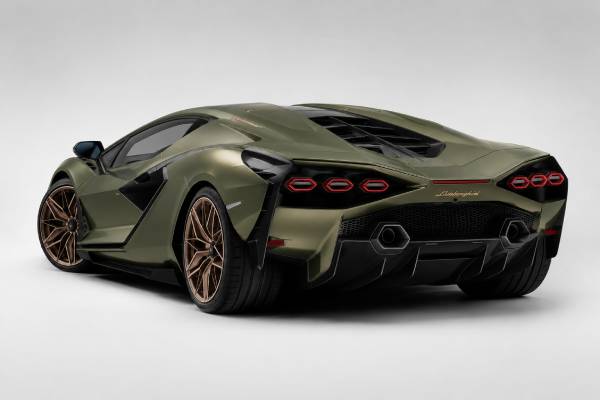
The body follows the low, angular Lamborghini supercar template: cab-forward stance, sharp nose, huge side intakes, scissor doors, wide rear haunches, and a high-mounted visual mass around the engine bay. The influence of the Countach appears in the hexagonal rear lamps and the periscope-like roof theme, while the Y-shaped lighting signature points toward Lamborghini’s more recent concept and production design language.
The most interesting exterior feature is the use of smart-material cooling vanes at the rear. These flaps react to exhaust heat and open without conventional electric motors or sensors. That choice suits the Sián’s philosophy: advanced technology used in a light, theatrical, mechanical-feeling way. It also gives the car a detail that can be explained and appreciated at concours, collection viewings, and specialist inspections.
The carbon-fiber structure is central to the car. Like the Aventador family, the Sián uses a carbon monocoque, which keeps the body stiff and weight controlled. The hybrid equipment adds complexity, but Lamborghini designed the supercapacitor system to avoid the mass penalty of a larger battery. The result is a car that feels more like a sharpened V12 flagship than a heavy electrified grand tourer.
Hybrid system character
The supercapacitor system is the Sián’s defining engineering feature. A supercapacitor can accept and release energy very quickly, which suits short, intense bursts of assistance. In the Sián, braking energy charges the system, and the stored power is used for acceleration support and shift smoothing.
This system does not make the Sián an electric commuter. It is not designed to drive long distances without the V12 running. Its value is in response. It makes the car feel more alert at low speeds, more immediate from standstill, and less interrupted during hard gear changes.
Aero and cooling
The Sián uses active aerodynamics, large intakes, a serious rear diffuser, and heat-driven cooling features. These are not decoration. The V12 produces major thermal load, and the body must manage airflow around the engine bay, brakes, and rear structure while keeping the car stable at very high speed.
The rear of the car is especially important. The hexagonal lamps, open surfaces, cooling paths, and aero details make the Sián look more like a concept car than a normal production model. That is part of its appeal. It has enough Aventador DNA to feel familiar, but enough unique surfacing to stand apart in a collection.
Cabin and sensory appeal
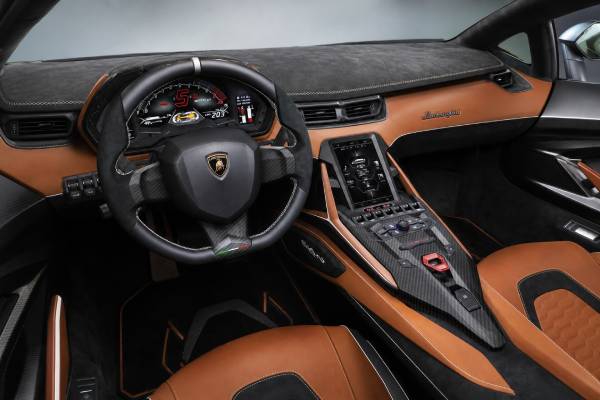
Inside, the Sián uses an Aventador-based architecture but with more special trim and modernized interfaces. The seating position is low, the view forward is theatrical, and the scissor doors still define the entry experience. The interior is not spacious or quiet in the way a luxury GT cabin is. It is a cockpit built around occasion.
The sound remains one of the main reasons to care. The V12 dominates the experience with a hard-edged, naturally aspirated note that rises with revs. The electric system may be the headline innovation, but the Sián’s emotional identity still comes from air, fuel, combustion, exhaust, and mechanical speed.
How the Sián Drives and Feels
The Sián drives like a more immediate, more polished, and more collectible expression of the Aventador formula. It is still wide, loud, low, and demanding, but the electric assistance makes the powertrain feel sharper in moments where a normal single-clutch V12 Lamborghini can feel abrupt.
From a standstill, the Sián’s launch is violent but controlled. All-wheel drive gives strong traction, and the electric motor helps the car respond before the V12 reaches its most dramatic upper-rpm range. The official 0–100 km/h time of under 2.8 seconds does not fully explain the sensation. The more memorable part is the way the V12 keeps pulling as speed rises, with the electric system supporting rather than replacing the combustion engine.
The gearbox is an important part of the character. The 7-speed ISR automated manual is not as smooth as a modern dual-clutch transmission. In many Aventador variants, that is both a flaw and a feature. It gives dramatic, physical shifts, but it can feel clumsy in traffic. The Sián’s electric motor helps fill torque during shifts, so the car feels more fluid without losing the old Lamborghini punch.
Steering response is quick, helped by Lamborghini Dynamic Steering and rear-wheel steering. At low speeds, the rear-steer system helps make the car feel less impossible in tight spaces. At higher speeds, it adds stability. Even so, the Sián is not a small car. Drivers must respect its width, low nose, limited rear visibility, and expensive carbon bodywork.
Ride quality depends heavily on road surface, tire condition, temperature, and drive mode. The magneto-rheological dampers give the car a broader operating range than older supercars, but this is still a hypercar on performance tires. On smooth roads, it can feel composed and surprisingly usable. On poor city streets, the driver becomes very aware of the low splitter, wide body, and replacement cost of every exposed carbon detail.
The brakes are powerful, but buyers should understand carbon-ceramic behavior. They can feel different when cold, and their condition cannot be judged by a quick glance alone. Proper inspection requires measuring wear, checking for chips or heat damage, and reviewing how the car was used. Track use, repeated hard stops, or poor storage can turn a low-mileage car into an expensive service case.
On a mountain road, the Sián is fast enough that restraint matters. The car’s size and speed mean it needs room. It rewards smooth inputs, warm tires, and clear sightlines. On track, it offers huge speed and drama, but it is not a cheap car to run hard. Tires, brakes, fluids, and carbon body risk make most owners treat it as a special-event car rather than a regular track tool.
In normal driving, the Sián is usable only by hypercar standards. It can crawl, park, cool itself, and cruise, but it is not relaxing like a Bentley or as easy as a modern dual-clutch supercar. The driving position, sound, heat, visibility, and attention from other people make every journey feel like an event. That is exactly what many buyers want.
Maintenance, Reliability, and Ownership Risks
The Sián should be treated as a low-volume hybrid V12 hypercar, not as a normal used Lamborghini. Its biggest risks are not ordinary wear alone; they are storage problems, hybrid-system condition, carbon damage, software updates, incomplete documentation, and lack of specialist familiarity.
The L539 V12 is a known Lamborghini engine family, but the Sián’s application is rare and highly specific. Routine service should be handled by an authorized Lamborghini dealer or a specialist with direct Aventador and limited-series Lamborghini experience. Even basic work can require correct diagnostic access, lifting technique, service procedures, and parts sourcing.
Key ownership areas to inspect include:
- annual service history and time-based maintenance
- hybrid 48-volt system condition
- supercapacitor and related control electronics
- gearbox calibration and shift quality
- clutch wear data and usage history
- front lift operation, if equipped
- suspension damper behavior
- rear-wheel steering function
- carbon-ceramic brake disc and pad condition
- tire age, tire model, and matching set condition
- cooling system performance
- battery support during storage
- infotainment, camera, and control-module updates
- recall and service campaign status by VIN
Low mileage can be good, but it can also hide storage-related issues. A Sián that sat for long periods without proper battery maintenance may need expensive electrical diagnosis. Hybrid components, 12-volt systems, sensors, and control modules dislike neglect. A car that was exercised regularly, serviced correctly, and stored on proper support equipment may be healthier than a delivery-mile car that spent years as static décor.
The 48-volt system deserves special attention. Because the Sián’s hybrid layout is uncommon, buyers should not accept vague statements such as “everything works” without diagnostic proof. Ask for dealer inspection, fault-code scans, software status, and written confirmation of any needed updates or repairs.
Carbon bodywork is another major cost driver. The front splitter, side intakes, rear aero pieces, and exposed carbon panels can be very expensive to repair or replace. Paint protection film may help, but it can also hide chips, poor repairs, or edge lifting. A specialist should inspect panel alignment, fasteners, underside scraping, prior refinishing, and any mismatch in carbon weave or lacquer finish.
Carbon-ceramic brakes require careful inspection. Replacement costs can be high, and visual appearance alone is not enough. Check disc thickness, surface condition, pad life, and any signs of track heat. Tires also matter because old, hardened, or mismatched tires can ruin the driving experience and create risk at speed.
The ISR transmission and clutch should be checked through diagnostic data, not just a short test drive. Clutch wear depends on driving style, low-speed maneuvering, hill use, and launch use. A car used mainly for display may still have clutch stress from repeated loading, unloading, and tight-space maneuvers.
Because the Sián is a collectible, originality matters. Upgrades that might be acceptable on a normal Aventador can hurt value here. Exhaust modifications, wrap damage, non-factory carbon parts, aftermarket electronics, or undocumented repairs should be treated carefully. The best ownership approach is preservation, correct servicing, and reversible protection rather than modification.
Market Values and Buying Advice
The Sián market is thin, global, and highly specification-sensitive. Public coupe sales in 2025 and 2026 have generally appeared around the low-to-mid $2 million equivalent range, while Roadsters are rarer and can command much higher asking prices.
That does not mean every Sián is worth the same. With only 82 total cars, a single sale can shift perception. Currency, taxes, buyer’s premium, location, import eligibility, specification, mileage, and seller motivation all matter. A public auction result may look lower than the original headline price, but it may not capture private trades, option-adjusted cost, taxes, or the premium attached to the best configurations.
Value is driven by:
- coupe versus Roadster body style
- mileage and use pattern
- original Ad Personam specification
- color desirability
- exposed carbon condition
- factory option content
- one-owner or low-owner provenance
- authorized dealer service history
- complete books, tools, accessories, and records
- market location and import status
- absence of accident or paintwork history
- current hybrid-system health
- resolved recalls and service campaigns
The Roadster should remain the scarcer version, with only 19 units built. The coupe, however, has the original launch-model importance and the stronger connection to the Sián FKP 37 name. For long-term collectability, both matter, but the best coupe may be more desirable than an average Roadster with weak history or a difficult specification.
Buyer inspection checklist
A serious Sián purchase should start with documentation before inspection. Do not spend time debating color and mileage until the paper trail is clear.
| Priority | What to Confirm |
|---|---|
| Identity | VIN, build number context, original selling dealer, and factory specification |
| History | Ownership chain, registration countries, import documents, and tax status |
| Service | Annual servicing, Lamborghini dealer records, software updates, and campaign completion |
| Hybrid system | 48-volt system health, fault-code scan, supercapacitor-related diagnostics, and battery support history |
| Body | Carbon condition, underside scraping, paint readings where suitable, panel alignment, and repair evidence |
| Drivetrain | Clutch wear data, gearbox behavior, cooling performance, and leaks |
| Consumables | Tire age, brake condition, fluids, and storage-related deterioration |
| Accessories | Books, keys, charger or maintainer equipment, covers, tools, and original delivery items |
Examples to seek
The safest cars are usually original, low-owner examples with attractive specifications, complete records, and recent Lamborghini dealer inspection. A car with a known collection history, careful storage, and a documented service file is worth paying more for.
Seek cars with:
- original paint and carbon finish
- no accident history
- clear Ad Personam documentation
- tasteful and desirable color combinations
- recent annual service
- current diagnostic report
- complete accessories
- no unresolved hybrid or software issues
Examples to avoid
Avoid cars with vague ownership history, missing records, inconsistent mileage, unresolved warning lights, poor paint-protection-film installation, non-factory modifications, or any sign of rushed brokerage. Also be careful with cars advertised only through social media, cars held in countries with unclear tax or import status, and cars that cannot be inspected at an authorized Lamborghini facility.
The Sián’s long-term collectability looks strong because it has the right ingredients: first hybrid Lamborghini, V12 engine, few-off status, extreme design, and very limited production. The main uncertainty is not whether the car is important. It is how future collectors will value early hybrid tech compared with the last purely combustion V12s and later, more advanced hybrid flagships.
The best buying strategy is simple: buy the best-documented car you can, not merely the cheapest or lowest-mileage one. A Sián is too rare and too complex for bargain hunting. The right example should feel clear, traceable, inspected, and complete before money changes hands.
References
- Lamborghini SIÁN FKP 37 | Lamborghini.com 2020 (Technical Specifications)
- Lamborghini Sián Roadster – Technical Specifications, Pictures, Videos 2020 (Technical Specifications)
- Lamborghini Sián FKP 37: the first Hybrid Few-off 2019 (Manufacturer News)
- Recall Campaign | Lamborghini.com 2026 (Recall Lookup)
- 2021 Lamborghini Sián FKP 37 | Monterey 2025 | RM Sotheby’s 2025 (Auction Result)
Disclaimer
This article is for informational purposes only and is not a substitute for professional diagnosis, repair, valuation, or pre-purchase inspection. Specifications, torque values, service intervals, software status, campaign requirements, and repair procedures can vary by VIN, market, equipment, and production details. Always verify important information against official Lamborghini service documentation and have any specific vehicle inspected by a qualified Lamborghini dealer or specialist.
If you found this guide useful, please share it on Facebook, X/Twitter, or your preferred automotive community to support our work.