

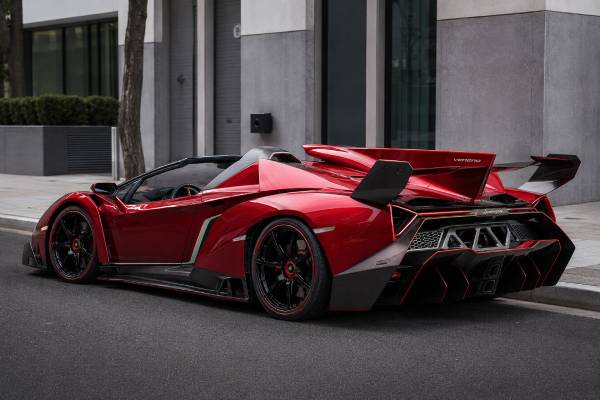
The Lamborghini Veneno Roadster is not a normal open-top supercar. It is a roofless, nine-car, V12 “few-off” Lamborghini built around Aventador hardware but clothed in some of the most extreme road-legal bodywork the brand has ever released. Its value is not only in speed, although its 6.5-liter L539 V12, 750 hp rating, all-wheel drive, and 355 km/h top speed place it firmly in hypercar territory. Its real pull comes from rarity, drama, and timing. It arrived during Lamborghini’s 50th-anniversary era, before hybrid V12 flagships changed the brand’s character, and it turned the Aventador platform into a rolling aero sculpture. For collectors, the Veneno Roadster is a documentation-sensitive asset. For enthusiasts, it is a wild example of what Sant’Agata builds when design, carbon fiber, and naturally aspirated sound are allowed to dominate every decision.
Table of Contents
- Why the Veneno Roadster Matters
- L539 V12 Chassis and Key Specifications
- Nine Roadsters, Options, and Authenticity
- Carbon Aero and Open-Top Engineering
- How the Veneno Roadster Drives
- Ownership, Maintenance, and Known Risks
- Market Values and Buying Checks
Why the Veneno Roadster Matters
The Veneno Roadster matters because it is one of the clearest examples of Lamborghini using a road car as a design and engineering statement. It was not built to fill a normal model slot; it was built to celebrate the brand’s 50th-anniversary period and to show how far the Aventador platform could be pushed visually and aerodynamically.
The Veneno coupe appeared first in 2013, based on Aventador LP700-4 architecture but tuned, lightened, and wrapped in bodywork that looked closer to an endurance-racing prototype than a showroom supercar. Lamborghini then followed with the Veneno Roadster for the 2014 build year. Only nine roadsters were produced, compared with the tiny coupe run of four cars, including the factory-retained example.
The Roadster sits in Lamborghini’s “Few-Off” family: cars made in very small numbers for top-tier clients and collectors. That group includes machines such as the Reventón Roadster, Centenario Roadster, Sián Roadster, and later ultra-limited V12 projects. The Veneno Roadster is especially important because it came before electrification, before rear-wheel steering became common on the V12 cars, and before the Revuelto changed Lamborghini’s flagship formula.
Its place in Lamborghini history is unusual. It is newer than classic icons such as the Miura, Countach, and Diablo, yet it is already treated like a collector-grade object rather than a used exotic. That is because the Veneno Roadster combines several value drivers in one car:
- A naturally aspirated 6.5-liter V12 from the Aventador family.
- A one-year, nine-car production run.
- A roofless body with no conventional removable top.
- Factory-built carbon-fiber construction and race-inspired aerodynamics.
- Strong connection to Lamborghini’s 50th-anniversary celebration.
- Extreme design from Centro Stile Lamborghini.
- Known chassis-level provenance on cars that have appeared publicly.
The Veneno Roadster also represents a turning point in Lamborghini’s visual language. Earlier limited cars, especially the Reventón, drew from fighter-aircraft themes. The Veneno pushed harder toward motorsport-style aero: huge openings, blade-like surfaces, a dramatic central fin, and a large rear wing. Later Lamborghini specials became more sophisticated in their aero and hybrid systems, but the Veneno remains one of the rawest-looking factory cars the company has made.
For buyers, this history matters because the car is not valued like a standard Aventador derivative. It is valued like a numbered, factory-built modern collectible. Mileage, service history, factory delivery documents, ownership chain, color specification, and originality can move the market more than ordinary condition grades.
L539 V12 Chassis and Key Specifications
The Veneno Roadster uses a tuned version of Lamborghini’s L539 6.5-liter naturally aspirated V12, paired with a 7-speed ISR automated manual gearbox and permanent all-wheel drive. The key numbers are simple: 750 hp, 0–100 km/h in about 2.9 seconds, and a top speed of 355 km/h.
The engine is closely related to the Aventador’s V12, but the Veneno received engine breathing and exhaust changes to reach 750 CV. It is not turbocharged, supercharged, or hybrid-assisted. Its character comes from displacement, revs, throttle response, and the short, hard-edged sound of a large naturally aspirated V12 mounted behind the cabin.
| Category | Specification |
|---|---|
| Model | Lamborghini Veneno Roadster |
| Model year covered | 2014 |
| Engine code family | L539-derived Lamborghini V12 |
| Engine type | 60-degree naturally aspirated V12 |
| Displacement | 6,498 cc |
| Bore x stroke | 95.0 mm x 76.4 mm |
| Fuel system | Multi-point injection |
| Maximum output | 750 CV / about 740–750 hp depending on rating convention |
| Maximum torque | 690 Nm |
| Transmission | 7-speed ISR automated manual |
| Drivetrain | Permanent all-wheel drive |
| Structure | Carbon-fiber monocoque with aluminum subframes |
| Body material | Carbon-fiber-reinforced polymer panels |
| Suspension | Pushrod suspension with horizontal spring and damper units |
| Brakes | Carbon-ceramic brake system |
| Wheels | 20-inch front, 21-inch rear |
| Tires | 255/30 ZR20 front, 355/25 ZR21 rear |
| Dry weight | About 1,490 kg |
| Power-to-weight ratio | About 1.99 kg per hp |
| 0–100 km/h | About 2.9 seconds |
| Top speed | 355 km/h / 221 mph |
The “L539” reference is important because it ties the Veneno Roadster to the Aventador-generation V12 rather than the older Murciélago engine family. The L539 was a clean-sheet Lamborghini V12 introduced for the Aventador, and it brought a lighter, more compact, higher-revving layout than the long-serving Bizzarrini-derived V12 line.
The Veneno Roadster’s gearbox is also central to its character. The ISR transmission is not a dual-clutch unit. It is a single-clutch automated manual designed for fast, forceful shifts rather than seamless luxury-car smoothness. At low speed it can feel mechanical and abrupt. At full load it gives the car a dramatic, physical shift event that suits the Veneno’s wild personality.
The chassis follows Aventador principles: a carbon-fiber passenger cell, aluminum front and rear structures, mid-mounted engine, and all-wheel drive. The pushrod suspension places the spring and damper units horizontally, a layout drawn from racing practice and used to manage packaging, response, and mass placement.
This specification makes the Veneno Roadster more than a styled Aventador. It shares the platform, but the power increase, aero package, limited build, carbon bodywork, and roofless structure create a different collector profile and a sharper emotional identity.
Nine Roadsters, Options, and Authenticity
The Veneno Roadster was built in only nine customer cars, so identification and provenance matter as much as mileage or condition. A real buyer should treat every car as an individual artifact with its own factory file, ownership chain, specification, service history, and public record.
Lamborghini announced the Roadster as a true open car rather than a conventional spider with a folding or removable roof. The public debut was staged with theatrical intent, on the Italian naval aircraft carrier Cavour in Abu Dhabi. That launch matched the car’s design language: part road car, part fighter-jet fantasy, part race prototype.
Factory personalization also plays a large role. Lamborghini showed the car in a red finish associated with the model, but buyers could specify colors and interior details through the company’s high-end personalization channels. Known cars have appeared in dramatic combinations such as matte black with bright contrast accents. Because there are so few cars, the market can recognize individual chassis by color, trim, mileage, public sales, and owner history.
Production and version basics
| Version | Production context | Collector note |
|---|---|---|
| Veneno Coupe | Introduced for Lamborghini’s 50th-anniversary period | Four total cars are widely recognized, including the factory-retained example |
| Veneno Roadster | Built during 2014 | Nine roadsters built, all highly collectible and individually traceable |
The Roadster did not have normal trim levels. There was no base model, performance package, luxury package, or track package in the way a series-production car might offer them. Instead, value rests on original configuration and individual order details.
Important authenticity items include:
- The VIN and chassis identity matching factory records.
- Original exterior color and interior trim confirmation.
- Factory invoice, delivery file, certificate, and order documentation.
- Original books, tools, keys, covers, and accessories.
- Lamborghini service records from authorized or recognized specialist workshops.
- Confirmation of recall and campaign completion.
- Evidence that visible carbon-fiber parts are original and undamaged.
- Provenance from known collections, public displays, or major auction catalogs.
The Veneno Roadster’s lack of a roof also creates a special inspection point. Any claim about weather protection, storage equipment, or delivery accessories should be checked against the factory file for that specific chassis. Because owners often store these cars rather than drive them regularly, a complete accessory set can become part of the car’s value story.
Market-specific equipment differences are less important than documentation and originality. A U.S.-delivered or Middle East-delivered example may have differences in compliance details, lighting, labels, emissions equipment, or paperwork, but the larger question is whether the car remains as delivered and whether any later changes were performed by Lamborghini.
Low mileage is desirable, but it is not enough by itself. A 300 km car that has aged on old tires, stale fluids, and neglected batteries can need expensive recommissioning. A slightly higher-mileage car with clean service records, original paint, and complete factory documentation can be more reassuring.
Carbon Aero and Open-Top Engineering
The Veneno Roadster’s body is designed to manage air first and impress people second, even though its visual impact is impossible to ignore. Nearly every surface is there to feed cooling air, reduce lift, add downforce, or keep the car stable at very high speed.
The front end uses a sharp, arrow-like form with large channels and aggressive splitter surfaces. The body sides are deeply cut to manage airflow toward the engine bay and rear aero. The rear is dominated by a large wing, dramatic diffuser treatment, and open surfaces that expose heat and structure rather than hiding them behind smooth luxury-car panels.
The central fin is one of the car’s signature details. It visually links the cockpit to the rear wing and gives the car a prototype-racer look. It also reinforces the sense that the Veneno was not styled like a traditional convertible. It was drawn as an open-top aerodynamic object around a carbon structure.
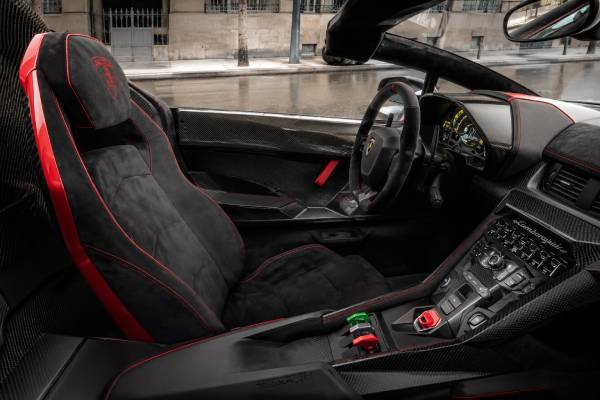
Carbon fiber is not only decorative here. The monocoque forms the main safety and stiffness cell. The body panels are carbon-fiber reinforced polymer. Inside, Lamborghini used exposed carbon surfaces and its Carbon Skin material in selected cabin areas. This matters because the Veneno’s cabin is not meant to feel like a soft grand tourer. It feels closer to a display of materials and structure.
The open-top layout required additional reinforcement compared with the coupe. Roadsters often need more structural support because the roof no longer helps the body resist twisting. Lamborghini kept weight under control through the carbon monocoque and carbon panels, but the Roadster still carried more mass than the coupe.
Why the design feels so extreme
The Veneno Roadster looks wild because it rejects most normal road-car visual habits. It does not use clean, relaxed surfacing to look expensive. It uses tension, edges, openings, and blades to look purposeful.
Key design and engineering features include:
- A wedge profile that connects it to Countach and Aventador lineage.
- Large front and side openings for cooling and aero flow.
- A full-width rear wing for high-speed stability.
- A central fin that gives the car a Le Mans prototype feel.
- Exposed carbon-fiber surfaces that emphasize structure.
- Scissor doors inherited from Lamborghini V12 flagship tradition.
- An open cockpit that makes the V12 sound and heat more immediate.
The engine packaging is pure modern Lamborghini flagship: V12 behind the occupants, transmission integrated into a compact rear-drive structure, and front drive assistance for traction. Cooling demands are serious because the car has a large naturally aspirated engine, tight bodywork, and very high performance targets. That explains the vents, openings, and aggressive rear treatment.
The exhaust character is central to the experience. Unlike hybrid hypercars that layer electric boost over combustion, the Veneno Roadster is all engine, intake, gearbox, and exhaust. The open cabin makes the mechanical sound a larger part of the car’s appeal, especially under load.
How the Veneno Roadster Drives
The Veneno Roadster should feel fast, loud, stiff, and theatrical rather than calm or effortless. It has the numbers of a modern hypercar, but its personality comes from a naturally aspirated V12, a single-clutch gearbox, and an open cockpit with no normal roof to soften the experience.
Acceleration is immediate once the V12 is awake in its rev range. The engine does not deliver turbocharged low-rpm shove in the modern sense; instead, it builds with revs and gets more urgent as it climbs. That rising response is part of the appeal. The driver feels the engine working harder, breathing faster, and becoming more aggressive rather than simply receiving a flat wave of boosted torque.
The ISR gearbox gives the car a different feel from a dual-clutch supercar. In gentle driving, shifts can feel deliberate and slightly clunky. In the more aggressive drive modes, the shift action becomes faster and more violent. Enthusiasts often see that as character. Buyers who expect modern dual-clutch smoothness need to understand the difference before judging the car.
Steering feel is heavy by ordinary standards but appropriate for a wide, all-wheel-drive V12 car on enormous tires. The Veneno Roadster’s front tires are wide, and the car’s aero surfaces and low stance make it feel serious even at moderate speeds. It is not a small, delicate sports car. It is a wide, expensive, low-clearance machine that needs space, temperature, and driver attention.
Ride quality depends heavily on road surface and tire condition. Carbon-tub Lamborghinis can feel rigid over poor roads, and old tires can make them harsher, noisier, and less predictable than they should be. A properly serviced car on fresh correct tires will feel sharper and safer than a museum-kept car on aged rubber.
Braking performance is strong, but carbon-ceramic brakes need careful interpretation. They can feel different when cold, and their condition is not judged only by how much pad appears left. Disc thickness, surface condition, chips, cracks, heat marks, and service history all matter. Replacement costs are high enough that a brake inspection can affect the economics of a purchase.
Visibility is typical of extreme Lamborghinis: dramatic forward view, limited rearward view, wide body, low nose, and a need to know where the corners are. Parking, loading ramps, and city traffic are more stressful than the acceleration figures suggest. The car is road legal, but it is not casual.
On track, the Veneno Roadster has the power, brakes, and aero attitude to feel spectacular, but most owners will avoid heavy track use because of value, tire cost, brake cost, and repair risk. A few controlled demonstration laps are one thing; repeated hard sessions are another. For collectors, evidence of heavy track driving should trigger a deeper inspection of tires, brakes, underbody, suspension, gearbox behavior, and bodywork.
Ownership, Maintenance, and Known Risks
The Veneno Roadster’s reliability picture is best understood as Aventador-based mechanical risk plus ultra-rare body and trim risk. The engine and drivetrain are related to known Lamborghini hardware, but the carbon exterior, limited-production parts, and seven-figure collector status make every problem more serious.
The L539 V12 itself is generally robust when serviced correctly, kept on proper fluids, warmed up carefully, and not abused with poor maintenance or questionable modifications. The larger risk is not a simple engine failure pattern. It is the cost and complexity of anything around the engine: cooling, exhaust, sensors, access, electronics, and rare surrounding components.
The ISR gearbox and clutch need special attention. Low-speed maneuvering, repeated launches, and heavy traffic can increase clutch wear. A buyer should ask for clutch wear readings where available, check shift quality in multiple modes, and inspect service records for gearbox calibration or related work.
High-priority inspection areas
| Area | What to check | Why it matters |
|---|---|---|
| Carbon bodywork | Chips, cracks, repairs, panel gaps, underside damage | Replacement parts are rare and costly |
| Monocoque and subframes | Accident signs, lift damage, mounting points | Structural repair can affect value and safety |
| ISR gearbox | Shift quality, clutch data, warning lights | Clutch and transmission work is specialist-only |
| Carbon-ceramic brakes | Disc condition, pad life, cracks, chips, heat marks | Brake replacement can be extremely expensive |
| Tires | Date codes, correct sizes, flat spotting, storage marks | Old tires can make a low-mileage car unsafe |
| Lift system | Operation, leaks, fault codes, service history | Low noses and steep ramps make the lift important |
| Cooling system | Leaks, fan operation, hose age, radiator condition | Heat management is critical on a V12 hypercar |
| Electrical systems | Battery health, modules, warning lights, scan data | Stored exotics often suffer battery-related issues |
| Recall status | EVAP campaign completion and VIN-specific records | Open safety work can affect use, import, and value |
The known EVAP-related recall affecting Aventador-derived cars is especially relevant. The concern involved fuel vapor handling under certain overfilling and operating conditions, with risk increased by improper fuel vapor treatment and potentially by non-approved exhaust changes. For a Veneno Roadster, the inspection should confirm that any VIN-applicable campaign was completed by an authorized Lamborghini dealer.
Age-related deterioration is a quiet risk. These cars often sit in collections. Low mileage reduces wear, but it does not stop tire aging, battery decline, seals drying, fluids aging, or fuel-system issues. A car that has only covered a few hundred kilometers may still need recommissioning before serious use.
Parts availability is a major ownership issue. Common Aventador-related mechanical parts may be easier to source than Veneno-specific body, trim, aero, and interior pieces. Damage to a front splitter, rear diffuser element, wheel, wing component, or custom trim piece can become a long and costly process.
Owners should avoid non-factory exhausts, ECU tunes, cosmetic drilling, aftermarket carbon pieces, and reversible-looking modifications that still leave marks. On a normal supercar, a tasteful exhaust might not destroy value. On a Veneno Roadster, originality is part of the asset. Any modification should be documented, reversible, and ideally accompanied by the original parts.
Market Values and Buying Checks
The Veneno Roadster sits in the top tier of modern Lamborghini values, with public auction history showing multi-million-dollar results and estimates. Its market is thin, private, and heavily dependent on the specific chassis, so buyers should think in terms of provenance and risk rather than ordinary price-guide averages.
When new, the Roadster was priced at several million euros before taxes. Since then, public transactions and major auction appearances have shown that the best cars can command far more than ordinary Aventador-based limited editions. One public Bonhams sale reached CHF 8.28 million in 2019, while an RM Sotheby’s Paris 2020 example carried a multi-million-euro estimate and did not sell publicly. More recent private and online-market activity has kept the Veneno Roadster visible as one of the most valuable modern Lamborghinis.
The safest way to read the market is not to assume a fixed number. With only nine cars, one transaction can look like the whole market, but it may simply reflect a special color, special provenance, low mileage, legal urgency, seller motivation, or a buyer determined to secure a specific chassis.
What drives value
The strongest Veneno Roadster examples usually have:
- Extremely clear factory documentation.
- Original paint and trim.
- Low but believable mileage.
- Complete service records.
- Confirmed recall and campaign completion.
- No accident history or structural repair.
- Original wheels, brakes, aero parts, books, keys, covers, and accessories.
- Desirable color and interior specification.
- Known ownership history without legal or title complications.
- Public catalog history from a respected auction house or major collection.
Cars to be cautious about include examples with missing factory paperwork, unclear import history, long storage without service, old tires presented as “new because mileage is low,” aftermarket exhausts without original parts, paintwork that cannot be explained, carbon repairs, or inconsistent mileage records.
A professional purchase process should be slow and document-heavy. The buyer should not rely on photos, social media history, or the seller’s description alone.
A sensible pre-purchase process is:
- Confirm the VIN and identity against factory or authorized Lamborghini records.
- Review the original order, invoice, delivery documents, and accessory list.
- Confirm ownership history and title chain.
- Verify mileage through service records, inspections, and public appearances.
- Inspect paint, carbon panels, underbody, suspension, brakes, wheels, and tires in person.
- Scan all control modules with Lamborghini-capable diagnostic equipment.
- Confirm clutch, gearbox, lift-system, and brake condition.
- Verify recall and campaign completion by VIN.
- Check that any modifications are reversible and original parts are included.
- Price the car after estimating recommissioning, transport, tax, storage, insurance, and future service costs.
The Veneno Roadster’s long-term collectability looks strong because it has the right ingredients: rarity, factory origin, V12 power, dramatic design, anniversary-era significance, and public recognition. Its risk is not lack of demand; its risk is condition sensitivity. A compromised example can be hard to correct because parts, expertise, and originality are so important.
For the right buyer, the Veneno Roadster is less a car to cross-shop against normal hypercars and more a modern Lamborghini artifact. It delivers huge sound, huge theater, and huge rarity. The best purchase is the car with the cleanest story, not simply the lowest mileage or the loudest color.
References
- Veneno Roadster – Technical Specifications, Pictures, Videos 2014 (Manufacturer Specifications)
- Lamborghini Few Off Roadster: Emotional, Limited and Open 2026 (Manufacturer History)
- Part 573 Safety Recall Report 17V-073 2017 (Recall Database)
- 2015 Lamborghini Veneno Roadster | Paris 2020 | RM Sotheby’s 2020 (Auction Listing)
- 2014 Lamborghini Veneno Roadster sold at Bonhams The Bonmont Sale (2019) – CLASSIC.COM 2019 (Auction Result)
Disclaimer
This article is for informational purposes only and is not a substitute for professional diagnosis, repair, valuation, or pre-purchase inspection. Specifications, torque values, service intervals, recall applicability, diagnostic procedures, and equipment can vary by VIN, market, and individual factory build. Always verify details against official Lamborghini service documentation, dealer records, and a qualified specialist inspection before buying, servicing, or operating the vehicle.
If this guide helped you, please consider sharing it on Facebook, X/Twitter, or your favorite enthusiast community to support our work.