

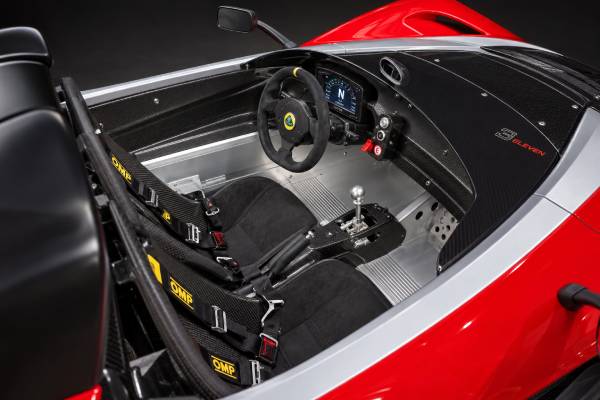

The Lotus 3-Eleven 430 is the closing chapter of the Type 123 story: a lighter, more powerful, more aerodynamically loaded road car created as 3-Eleven production was winding down. Announced in February 2018, it paired a 430 hp supercharged 3.5-litre V6 with a 920 kg quoted dry weight, a six-speed manual gearbox, revised J-hook brakes, and an aero package capable of 265 kg of downforce at maximum speed. Lotus called it the fastest road-legal model it had put around Hethel at the time, with a 1 minute 24 second lap.
Its rarity needs careful explanation. Lotus originally announced a limited series of 20 cars, while the company’s current heritage page lists the 3-Eleven 430 under 2019 with a production volume of 13. For an owner or buyer, that makes factory identity and individual history more important than broad market assumptions. This guide focuses on the 2018–2019 430 specification, including the factory data inconsistencies that matter when checking tires and chassis options.
Table of Contents
- Why the 430 Is More Than a Power Upgrade
- 3-Eleven 430 Factory Specifications
- How Lotus Found the One-Minute-24 Hethel Lap
- Using the Adjustable Chassis Without Losing the Baseline
- Heat, Wear, and Track-Day Maintenance
- What to Inspect on a Rare 430
- Road Use, Ownership, and Long-Term Fit
Why the 430 Is More Than a Power Upgrade
The 430 is best understood as a final engineering package, not as a 3-Eleven with another 20 hp added. Lotus changed the engine calibration, body construction, aerodynamics, brakes, and detail specification together, then validated the result around its Hethel test circuit.
The engine remained the familiar Lotus-developed version of Toyota’s 2GR-FE-family 3,456 cc V6, mounted transversely behind the cockpit and driving the rear wheels. For the 430, the supercharged and charge-cooled unit produced 430 hp at 7,000 rpm and 440 Nm from 4,500 rpm. That was only part of the gain. The quoted dry mass fell to 920 kg, five kilograms below the preceding Road model, while maximum-speed downforce rose by 44 kg to 265 kg.
Those changes moved the car’s balance of capabilities. More power improved acceleration and extended maximum speed to 180 mph (290 km/h), but the higher rear wing, longer front splitter, front lip, flat floor, and diffuser were there to make the extra speed usable. Lotus published a 1:24 Hethel lap, two seconds quicker than the previous 3-Eleven and 0.8 second quicker than the Exige Cup 430. A lap time cannot be separated from tires, weather, driver, and test conditions, but it still shows what the factory was trying to achieve: a road-registrable car that behaved like a highly developed track machine.
The 430 also has a different rarity story from the earlier car. The 2018 launch announcement said the final edition would be limited to 20 vehicles worldwide and offered at a UK launch price of £102,000 including VAT and on-road costs. Lotus’s current heritage page now records the 3-Eleven 430 as a 2019 production model with a volume of 13. Rather than treating either figure as a reason to speculate about surviving cars, a buyer should use the factory build record, VIN, invoices, and original specification to establish what a particular example actually is.
Visual clues include exposed-weave carbon flanks, the rear wing mounted 50 mm higher, an extended splitter and front lip, an oval exhaust finisher, and a red supercharger cover. The cockpit adds a carbon driver’s seat, four-point harness, and 430-specific TFT graphics.
The useful distinction is therefore not simply “430 hp versus 410 hp.” The final edition combined power, mass, aero balance, braking hardware, and rarity into its own factory specification, so it should not be treated as a modified standard 3-Eleven.
3-Eleven 430 Factory Specifications
The 3-Eleven 430 is a petrol internal-combustion car with a mid-mounted, supercharged V6, rear-wheel drive, and a six-speed manual transmission. It is an open-cockpit road car with a carbon-fibre shell, 48 L steel fuel tank, and lightweight lithium-ion battery. The tables use the 2018 factory technical specification while flagging two internal inconsistencies: rear tire size and the status of adjustable anti-roll bars.
| Specification | Factory data |
|---|---|
| Powertrain type | Petrol internal-combustion engine |
| Engine family | Toyota 2GR-FE family, Lotus-developed 3.5-litre V6 |
| Displacement | 3,456 cc (3.5 L) |
| Construction | All-aluminium, water-cooled, 24-valve V6 |
| Induction | Edelbrock supercharger with integral intercooler |
| Maximum power | 430 hp (436 PS) at 7,000 rpm |
| Maximum torque | 440 Nm (325 lb-ft) from 4,500 rpm |
| Transmission | 6-speed manual with gearbox cooler and aluminium precision-shift mechanism |
| Differential | Torsen-type limited-slip differential |
| Engine oil control | Motorsport baffled sump |
| Fuel tank | 48 L steel tank |
| Specification | Factory data |
|---|---|
| 0–60 mph | 3.1 seconds |
| 0–100 km/h | 3.2 seconds |
| Maximum speed | 290 km/h (180 mph) |
| Quoted dry weight | 920 kg (2,028 lb) |
| Power-to-weight ratio | 467 hp per tonne using quoted dry weight |
| Downforce at maximum speed | 265 kg total: 100 kg front, 165 kg rear |
| Factory Hethel lap | 1 minute 24 seconds |
| Specification | Factory data |
|---|---|
| Chassis | Anodised extruded aluminium, epoxy bonded and riveted |
| Suspension | Unequal-length, fully independent double wishbones |
| Dampers | Öhlins DFV one-way adjustable |
| Anti-roll bars | Eibach tubular front and rear bars; the launch option list separately priced adjustable bars |
| Brake calipers | AP Racing four-piston front and rear |
| Front brake discs | Two-piece grooved, ventilated J-hook, 332 × 32 mm |
| Rear brake discs | Two-piece grooved, ventilated J-hook, 332 × 26 mm |
| Driver aids | Lotus-tuned ABS and six-position adjustable traction control |
| Position | Wheel | Tire data in Lotus material |
|---|---|---|
| Front | 18 × 7.5J forged aluminium, 10-spoke | 225/40 R18 |
| Rear | 19 × 9.5J forged aluminium, 10-spoke | 275/30 R19 in the technical table; 275/35 ZR19 in the release prose |
Lotus’s own document gives 275/35 ZR19 in the narrative but 275/30 R19 in the formal table; period road testing also reported 275/30 R19. Use the individual car’s build information, tire placard, wheel fitment, and service documentation when replacing tires.
| Specification | Factory data |
|---|---|
| Body | Carbon-fibre shell with part-exposed weave side sections |
| Aero package | Higher carbon-spar rear wing, extended splitter, front lip, flat floor, rear diffuser |
| Roll protection | MSA-approved roll cage for national use |
| Driver seat | Carbon-fibre seat with 4-point harness |
| Display | Full-colour TFT with road/track modes and 430 splash graphics |
| Battery | Lightweight lithium-ion |
| Lighting | LED daytime running lights and rear lamps with integrated indicators |
| Option | Published UK retail price | Why it matters on a used car |
|---|---|---|
| Adjustable anti-roll bars | £1,000 | Confirms that launch literature did not describe option status consistently |
| Öhlins TTX two-way adjustable dampers | £2,500 | Changes the suspension from the standard one-way DFV arrangement |
| Titanium exhaust | £5,500 | Useful provenance point when checking an original build |
The 920 kg figure is a dry-weight claim, not a fully fuelled, ready-to-drive measurement. It is useful for comparing factory variants quoted on the same basis, but less useful when a rival manufacturer uses a different weight standard.
How Lotus Found the One-Minute-24 Hethel Lap
The 1:24 Hethel claim came from a system-level upgrade: the 430 could accelerate harder, brake with more repeatability, and carry more high-speed load than the preceding road version. Focusing only on the extra 20 hp misses why the final car was quicker.
Aerodynamics made the biggest visual change. Lotus raised the straight-cut rear wing by 50 mm, re-profiled its end plates, lengthened the front splitter, added a front lip spoiler, and continued to use a flat floor and rear diffuser. The factory claimed 265 kg of downforce at maximum speed, split 100 kg at the front and 165 kg at the rear. That total was 44 kg higher than the earlier car’s maximum-speed figure.
Those numbers do not mean the car produces 265 kg of downforce everywhere. Aerodynamic load rises strongly with speed, so a fast corner can feel very different from a slow hairpin. The practical consequence is that a driver should not use the confidence gained in high-speed aero-supported sections as a reason to over-commit in low-speed bends where the car relies much more on mechanical grip.
The brakes were also revised. The 430 used two-piece grooved and ventilated J-hook discs with AP Racing four-piston calipers at both ends. The front discs are 332 × 32 mm and the rears 332 × 26 mm. Lotus described the J-hook design as improving initial bite and debris clearance while reducing distortion and vibration. On track, that matters because consistency after several hard stops is more valuable than impressive pedal feel for one braking zone.
The driveline supports the same goal. A low-inertia single-mass flywheel, six-speed open-gate manual, and Torsen-type limited-slip differential keep response immediate and power delivery controllable.
Michelin Cup 2 tires complete the package, but their grip depends heavily on temperature, water, age, and heat-cycle history. Their dry-track ability should never be assumed on a cold or wet road.
The quoted lateral acceleration potential of up to 1.5 g should be read in the same context. It demonstrates the envelope Lotus engineered, not a target for public-road driving and not a promise for an older used car on aged tires or altered alignment. The factory result depends on the car being mechanically sound and set up as intended.
Using the Adjustable Chassis Without Losing the Baseline
The safest and fastest way to work with a 430’s adjustable hardware is to preserve a known baseline and change one thing at a time. More aggressive settings are not automatically better, especially when the car may have optional dampers or bars that differ from the standard build.
Standard factory technical data lists Öhlins DFV one-way adjustable dampers. Lotus also offered Öhlins TTX two-way dampers as a paid option, and period testing included cars equipped with them. That distinction matters because a setup note for a TTX-equipped 430 cannot simply be copied onto a DFV car. Two-way dampers separate more of the compression and rebound adjustment; they also provide more ways to make the car worse if changes are made without a clear goal.
The anti-roll-bar documentation is even more reason to inspect the actual car. The launch press-release prose calls the Eibach front and rear bars adjustable as part of the standard specification, yet the same document’s option table charges separately for “Adjustable anti-roll bars,” while the technical table merely identifies Eibach tubular bars. A build sheet, original invoice, part identification, and workshop documentation are better evidence than assuming every 430 left Hethel with identical adjustment hardware.
Traction control is more straightforward. Lotus described six positions: five pre-set intervention levels corresponding to 1%, 3%, 6%, 9%, and 12% slip, plus off. The system gives an experienced driver a way to match intervention to conditions rather than treating stability assistance as a simple on/off switch. On a cold day, unfamiliar circuit, or recently purchased car, beginning with greater assistance is the sensible approach. “Off” is not a performance upgrade by itself.
A useful setup method is disciplined rather than dramatic:
- Record the current damper positions, bar settings if fitted, tire sizes, tire age, alignment data, and cold starting pressures before changing anything.
- Bring the car, brakes, and tires up to temperature progressively rather than using the opening laps as a qualifying run.
- Change a single variable and describe the problem you are trying to solve, such as excessive entry understeer or poor traction over bumps.
- Compare behavior over several consistent laps, not one unusually fast or slow lap.
- Return to the baseline if the change produces mixed effects or makes the car nervous away from the corner that prompted the adjustment.
Aero settings should receive even more respect. The rear wing and front splitter are balanced parts of a package. Altering one end without understanding the other changes high-speed balance, and damage to a splitter or underfloor can also matter. For a road car, intact factory aero in known alignment is a better starting point than cosmetic experimentation.
Heat, Wear, and Track-Day Maintenance
Track use does not make a 3-Eleven 430 fragile, but it compresses wear and inspection into a much shorter time scale. A good maintenance routine is built around heat exposure, fluid condition, consumables, and post-event inspection rather than waiting for an annual service date to reveal everything.
Start with the engine and cooling system. The V6 is supercharged and charge-cooled, and the 430 adds a motorsport baffled sump to help oil control during sustained cornering. A baffled sump is not permission to ignore oil level. Check the level by the approved procedure, investigate any unexplained consumption or leakage, and keep records of oil and filter changes that reflect actual use. Cooling hoses, radiators, the supercharger/intercooler circuit, drive components, and visible connections deserve inspection because a small issue becomes more serious when the car spends long periods at high load.
The gearbox has its own cooler, so changes in warm shift quality or clutch take-up deserve diagnosis rather than being dismissed as “race-car character.”
Brakes require their own event-based checks. Inspect the J-hook discs for cracking, abnormal heat marking, scoring, and wear in accordance with the service limits, and inspect pad thickness rather than judging pad life through the wheel. Brake fluid that has absorbed moisture has a lower boiling margin, so a car used hard needs fluid condition managed for its operating environment. After a hot session, use a cool-down lap and avoid trapping unnecessary heat in the brake system when parking.
Tires and wheels deserve more attention than tread depth alone. Cup 2 performance can decline through age and repeated heat cycles even when legal tread remains. Look for pickup, shoulder tearing, cuts, flat spots, and signs of running outside a sensible pressure window. Inspect the forged wheels for impact damage and check for vibration or runout after curb strikes. A rare car is not protected from ordinary track consumables simply because it covers few road miles.
Suspension inspection should include damper leaks, rod damage, loose hardware, play at joints, and evidence that setup changes have been made carefully. If the car has optional TTX dampers or adjustable anti-roll bars, keep a written setup record. That makes it possible to distinguish a developing mechanical fault from a handling change caused by yesterday’s adjustment.
During storage, use charging equipment compatible with the installed lithium-ion battery rather than assuming a conventional charger is suitable.
Finally, inspect the parts that make the 430 visually special. The extended splitter is vulnerable to ramps and curbs; the flat floor and diffuser can collect impact damage; exposed carbon can show chips, abrasion, or repair work. Aero-body damage is not merely cosmetic if it changes mounting integrity or geometry. Photographing the underside and leading edges after purchase creates a useful baseline for future inspections.
For a low-mileage 430, maintenance records should therefore describe use, not just dates. A folder showing circuit days, fluid changes, brake and tire replacement, alignment work, damper service, and repairs tells a buyer much more than a sequence of annual stamps with no detail.
What to Inspect on a Rare 430
A 430 should be bought on identity, condition, and documentation in that order, with mileage treated as supporting evidence rather than the whole story. Its tiny production run makes originality valuable, but a carefully maintained track-used car can be a better purchase than an apparently untouched example with undocumented storage or repairs.
Begin with identity. Confirm the VIN against the registration record and Lotus documentation, then look for evidence that the car was built as a 3-Eleven 430 rather than upgraded later to resemble one. The workshop documentation identifies the 430 as a distinct final-edition specification and records characteristic items such as the carbon body treatment, revised splitter and lip, higher wing, J-hook brakes, satin-black wheels, carbon interior pieces, and 430-specific equipment. Original order paperwork is especially useful for options.
The announced-versus-recorded production numbers make this documentation important. Lotus said 20 cars would form the limited series in 2018, while its present heritage page lists a production volume of 13 and a production year of 2019. A seller’s numbered plaque, marketing claim, or statement about rarity should not replace factory history for the actual VIN.
Next, inspect the carbon and aluminium structure carefully. The 3-Eleven’s body panels can be replaced or repaired, but evidence of a hard impact may extend into mounting points, suspension pickups, floor sections, or the bonded aluminium chassis. Poorly matched weave, inconsistent finish, disturbed fasteners, non-original sealants, overspray, or fresh underbody coating deserve explanation. Specialist inspection is justified because cosmetic repair can hide the scale of a previous incident.
Minor splitter scraping is different from bent mounts, floor or diffuser deformation, or chassis damage. Stone chips on exposed carbon are normal for a driven car; cracking or delamination warrants specialist diagnosis.
Brake condition can reveal use better than the odometer. Disc surfaces, pad wear, caliper condition, and fluid history should agree with the seller’s account; track use is acceptable when the consumables and maintenance evidence support it.
Then inspect the suspension and options. Determine whether the car has standard one-way Öhlins DFV dampers or optional TTX units. If adjustable bars are fitted, identify whether they are factory-option parts or later additions. Ask for damper-service invoices and alignment sheets. A seller who can explain why a setting was chosen and provide the baseline is giving you more useful information than one who simply says the car has a “track setup.”
Tires need exact checking because the factory launch document itself conflicts on rear size. Read the fitted sidewalls, compare all four dates and specifications, examine the vehicle information, and confirm suitability before ordering replacements. Mixing assumptions from a generic tire site with a rare car’s wheel and chassis setup is avoidable risk.
A cold start and full road test should also show stable running, no fluid loss or warnings, clean selection of every gear, consistent clutch take-up, and no unexplained driveline knocking.
Reversible, documented upgrades are easier to accept than altered aero, drilled bodywork, improvised wiring, or unverified engine tuning. Retaining the original parts is valuable on a model this scarce.
Road Use, Ownership, and Long-Term Fit
The 3-Eleven 430 makes sense for an owner who wants a road-registerable track experience and accepts that comfort, weather protection, and convenience are deliberately secondary. It is not a conventional supercar with a harsh suspension package; it is an open, lightweight machine whose road usability comes from chassis quality rather than luxury equipment.
There is no conventional windscreen-and-roof environment separating the occupants from weather and debris. Long journeys require planning around rain, temperature, luggage, hearing protection, and secure storage. The low body and exposed aero also make steep ramps, speed humps, rough surfaces, and careless parking more consequential than they are in an ordinary sports car.
Yet period road tests found more compliance than the visual aggression suggests. That is a familiar Lotus strength: firm control without making every bump a punishment. The manual shift is central to the appeal, and the combination of low mass, unfiltered steering feedback, and a naturally immediate supercharged response creates involvement at speeds well below the car’s 180 mph maximum.
On public roads, cold or wet Cup 2 tires and low-speed conditions provide far less of the grip implied by the track figures, so the adjustable traction control should be treated as a useful margin rather than an obstacle.
Ownership costs are also shaped more by condition and use than by annual mileage. Tires, J-hook discs, pads, damper servicing, alignment, specialist inspection, and carbon-body repair can matter more than fuel economy in the real budget. A car used for several track days may need more attention in one season than a lightly driven example needs in several years. Conversely, long storage can create its own issues with battery condition, fluids, tire aging, and seized or corroded components.
For long-term value, preserve the original invoice, build information, service records, setup sheets, tire and brake invoices, photographs, spare keys, and removed original parts. On a 430, that paper trail answers future questions about factory options, repairs, and track maintenance.
The final-edition status should not turn the car into a display object unless that is what the owner wants. The 430 was engineered around circuit capability, from its baffled sump and gearbox cooler to its brakes, aero, Cup 2 tires, roll cage, and traction-control settings. Used properly and maintained with evidence, track mileage is consistent with the car’s purpose.
What separates the 430 from the earlier 3-Eleven is not simply a faster specification sheet. It is the way Lotus concentrated the last development of the Type 123 into one limited road model: 430 hp, 920 kg dry, a manual gearbox, substantial aero load, and a factory 1:24 Hethel lap. For the right owner, that combination remains the reason to seek the final evolution rather than a more comfortable or more powerful car with less connection to the driver.
References
- Lotus 3-Eleven – Stripped back thrills | Lotus Cars 2026 (Manufacturer Heritage Page)
- Final evolution – the new Lotus 3-Eleven 430 2018 (Manufacturer Media Information)
- Lotus – 3-Eleven – Workshop Manual – (2018) 2018 (Workshop Manual)
- Lotus 3-Eleven 430 review – Lotus’ formidable track car knowhow distilled 2018 (Road Test)
- The 3-Eleven 430 is now the fastest ever street-legal Lotus 2018 (Launch Coverage)
- Lotus 3-Eleven 430: ‘the quickest street-legal Lotus yet’ 2018 (Launch Coverage)
Disclaimer
This article is for informational purposes and is not a substitute for professional diagnosis or repair. Specifications, torque values, service intervals, and procedures can differ by VIN, market, fitted equipment, and later updates, so use the official service documentation for the individual vehicle before carrying out maintenance or setup work.
If this guide helped you understand the 3-Eleven 430, please consider sharing it on Facebook, X/Twitter, or with another Lotus enthusiast to support our work.