


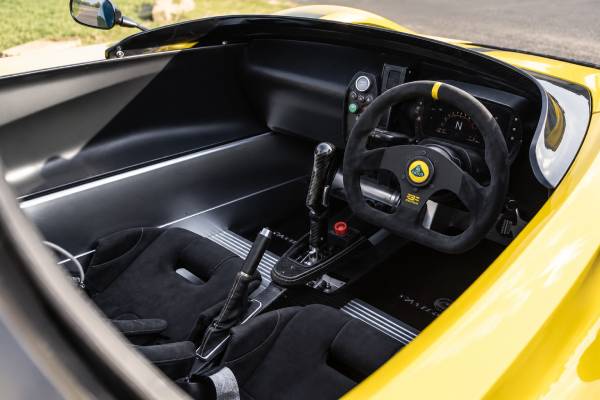
The 410 hp Lotus 3-Eleven Road is the version to understand if you want the open-cockpit Type 123 without drifting into the very different Race model or the later 430. Built around Lotus’s bonded-aluminium philosophy and a supercharged 3.5-litre V6, it combines a 925 kg quoted dry weight with a six-speed manual gearbox, a Torsen-type limited-slip differential, serious aerodynamics, and almost no weather protection. That makes it less like a conventional sports car and more like a road-registered track tool.
The numbers are only part of the story. The 3-Eleven’s appeal comes from low mass, immediate controls, high mechanical grip, and an unusually direct connection between driver and chassis. Those same qualities also make condition, setup, and maintenance history unusually important when buying one used. This guide focuses specifically on the 410 hp Road car built for the 2016–2018 period, separates it from the 460 hp Race specification, and explains the specifications, engineering, track-use care, inspection points, and ownership trade-offs that matter most.
Table of Contents
- Identifying the 410 hp Road Car
- Production Road Car Specifications
- Why the Engine, Gearbox, and Aero Work
- How It Behaves on Road and Track
- Maintenance for a Track-Biased Road Car
- Used-Buying Inspection Priorities
- Who the 410 hp 3-Eleven Suits
Identifying the 410 hp Road Car
The key point is simple: the car covered here is the 410 hp Road version, not the 460 hp Race car and not the 430 hp final evolution. That distinction matters because the transmission, suspension specification, fuel system, aero, weight, legal use, and maintenance expectations can all differ.
Lotus unveiled the 3-Eleven at Goodwood in 2015, but the earliest launch material carried development figures that changed before customer production. The later production technical sheet lists the Road car at 410 hp at 7,000 rpm and 410 Nm, with a 925 kg dry weight, a 3.3-second 0–60 mph claim, and a 174 mph (280 km/h) top speed. Those are the figures to use for the 2016-production Road specification rather than the earlier 450 hp development number.
The Type 123 designation also helps separate the 3-Eleven from Lotus models that donated concepts or components. It uses a transverse, mid-mounted supercharged V6 and rear-wheel drive, but the 3-Eleven is not simply an Exige with its roof removed. Its open body, aero package, roll structure, cooling arrangements, TFT instrumentation, and track-focused setup make it a purpose-built derivative.
The Road and Race cars are easiest to confuse in advertisements because both can wear large wings, harnesses, Cup 2 tires, removable steering wheels, and track equipment. The Race version, however, was built around a 460 hp specification, a six-speed sequential transmission, a larger FIA fuel cell, more aggressive aero, and a lower quoted dry weight. A Road car with optional track equipment does not automatically become a Race model.
For a used buyer, establish the car’s identity before judging modifications or price. Match the VIN and factory paperwork to the Road specification, then document any later Lotus Motorsport parts, aftermarket changes, or Race-derived upgrades. On a low-volume car, provenance is more useful than assumptions based on appearance.
A concise Road-versus-Race check helps prevent the most common specification error:
| Specification | 410 hp Road | 460 hp Race |
|---|---|---|
| Maximum power | 410 hp | 460 hp |
| Maximum torque | 410 Nm | 525 Nm |
| Quoted dry weight | 925 kg | 890 kg |
| Transmission | 6-speed manual | 6-speed sequential with paddle shift |
| Fuel system | 48 L steel tank | 70 L FIA FT3 fuel cell |
| Downforce at 240 km/h | 150 kg | 215 kg |
That comparison is especially useful when reading old advertisements, because some sellers and data sites combine equipment from both columns. The safest approach is to start with the factory Road specification and then treat every different component as a documented option or later modification.
Production Road Car Specifications
The 410 hp 3-Eleven is a conventional petrol ICE vehicle mechanically, but its execution is highly specialized: a supercharged 3,456 cc V6 sits transversely behind the occupants and drives the rear wheels through a close-ratio six-speed manual. The useful numbers are the finalized Road-car figures, because mixing in Race or 430 data can produce a specification that never existed from the factory.
| Specification | Value |
|---|---|
| Powertrain type | Petrol internal-combustion engine |
| Engine | Toyota 2GR-FE family, Lotus-tuned 3.5-litre V6 |
| Displacement | 3,456 cc (3.5 L) |
| Construction | All-aluminium, water-cooled, 24-valve V6 |
| Induction | Edelbrock supercharger with integral intercooler |
| Maximum power | 410 hp at 7,000 rpm |
| Maximum torque | 410 Nm (302 lb-ft), published from 3,000 to 7,000 rpm |
| Fuel tank | 48 L steel tank |
| Specification | Value |
|---|---|
| 0–60 mph | 3.3 seconds |
| 0–100 km/h | 3.4 seconds |
| Maximum speed | 280 km/h (174 mph) |
| Quoted dry weight | 925 kg (2,039 lb) |
| Downforce at 160 km/h | 65 kg |
| Downforce at 240 km/h | 150 kg |
| Specification | Value |
|---|---|
| Transmission | Sports-ratio 6-speed manual with oil cooler |
| Drive | Rear-wheel drive |
| Differential | Torsen-type limited-slip differential |
| Chassis | Lightweight extruded and bonded aluminium structure |
| Front suspension | Fully independent double wishbones |
| Rear suspension | Fully independent double wishbones |
| Dampers | Öhlins one-way adjustable on the base Road specification |
| Anti-roll bars | Fixed Road-specification bars; adjustable hardware was available in track-oriented configurations |
| ABS | Lotus/Bosch tuned anti-lock braking system |
| Specification | Value |
|---|---|
| Front wheel | 18 × 7.5J forged aluminium |
| Rear wheel | 19 × 9.5J forged aluminium |
| Front tire size | 225/40 ZR18 |
| Rear tire size | 275/35 ZR19 |
| Road tire choices | Michelin Pilot Super Sport or Pilot Sport Cup 2, depending on specification |
| Brake calipers | AP Racing four-piston calipers |
| Brake discs | Two-piece grooved and ventilated, 332 mm front and rear |
| Specification | Value |
|---|---|
| Body concept | Open-cockpit, lightweight composite/carbon construction |
| Wind protection | Aeroscreen rather than a conventional windscreen |
| Roll structure | Integrated road roll cage; MSA-oriented specification was offered |
| Driver display | Full-colour TFT with road/track display modes |
| Driver restraint | Four-point harness on the Road specification |
| Passenger provision | Passenger seat and harness available depending on configuration |
| Electrical system | Lightweight harness and lithium-ion battery |
The dry-weight figure deserves emphasis. Dry weight is not the same as a ready-to-drive curb or kerb weight with fluids and fuel, so it should not be compared directly with a rival quoted under a different measurement standard. The same caution applies to power-to-weight claims calculated from dry mass.
Why the Engine, Gearbox, and Aero Work
The 3-Eleven is fast because its systems reinforce one another rather than because any single number is extraordinary. The supercharged V6 gives immediate response, the manual driveline keeps the driver directly involved, and low mass lets the brakes, tires, suspension, and aero do more with less energy.
The 2GR-FE architecture is familiar from other Toyota- and Lotus-related applications, but the 3-Eleven installation is not a generic engine swap. Lotus paired the V6 with an Edelbrock supercharger and integrated intercooling, then packaged it in a car designed for sustained high-load use. A broad published torque plateau means the car does not need turbo-style boost building before it responds. On road or track, throttle position translates into acceleration with little delay.
The close-ratio manual is equally important. The Road car’s six-speed transmission, oil cooling, and Torsen limited-slip differential create a very different experience from the Race car’s paddle-operated sequential gearbox. The manual may be slower in an absolute racing sense, but it makes the Road model more interactive and easier to enjoy away from a stopwatch. It also makes clutch condition, shift quality, linkage adjustment, and gearbox noise important points during a used-car inspection.
Aerodynamics become increasingly relevant as speed rises. Lotus quoted 65 kg of downforce at 160 km/h and 150 kg at 240 km/h for the production Road specification. That is enough to change high-speed balance in a meaningful way, but it also means ride height, splitter condition, wing configuration, and underbody integrity matter. A badly repaired splitter or altered rake is not merely cosmetic on a car whose stability was developed around a functioning aero package.
The body and chassis follow the same logic. A bonded and extruded aluminium structure provides stiffness without the mass of a conventional steel shell, while the sparse bodywork minimizes what Lotus had to accelerate, brake, and support. The result is a car whose 410 hp feels much more intense than the same output in a 1,500 kg coupe.
This systems approach is also why indiscriminate modification can make a 3-Eleven worse. More power without cooling margin, different tire diameters without checking balance, or aggressive suspension changes without correcting alignment can undermine the coherence that made the standard car effective.
How It Behaves on Road and Track
Expect the 410 hp Road car to feel more physical and exposed than a normal road-going supercar, but less crude than its appearance suggests. Contemporary testers repeatedly noted the speed and steering detail, yet also found the suspension unexpectedly compliant for something so track-focused.
At low speed, the lack of conventional insulation dominates the experience. There is no normal roof, no full windscreen, and very little separation from induction noise, stones, airflow, or weather. Getting in and out requires more planning than in an Elise or Exige, particularly when harnesses and a removable wheel are fitted. The payoff is visibility and immediacy: little bodywork blocks your view, and the car’s responses arrive with little filtering.
On a fast road, the standard manual Road version has an advantage that does not appear in lap-time tables. Its 410 hp is already more than enough to work the rear tires hard, while the manual gearbox gives the driver something meaningful to do at legal speeds. The supercharged engine can be short-shifted on torque rather than constantly chased to 7,000 rpm.
On track, the priorities change. Tire temperature, pressure growth, brake temperature, fluid condition, alignment, and damper settings begin to matter as much as peak output. The supplementary manual treats Michelin Cup 2 tires as dry-track-biased equipment and warns that aquaplaning risk rises on wet roads or circuits, especially as tread wears. That is useful ownership guidance, not a minor disclaimer.
The Road car also benefits from a usable baseline suspension setup. One-way Öhlins dampers give meaningful adjustment without the extra variables of a multi-way race damper. For most owners, a known healthy baseline is preferable to copying an aggressive setup from another car. Driver weight, fuel load, circuit surface, tire choice, and temperature can all change what works.
Braking is similarly sensitive to use. The AP Racing system has huge capability in a 925 kg dry car, but repeated high-speed stops create heat that must be managed. A proper cool-down lap, avoiding the parking brake while the rear system is heat-soaked, and inspecting pads and discs after hard use can prevent expensive problems.
The best way to enjoy a 3-Eleven is therefore not to chase a single “ultimate” setup. Keep the car mechanically consistent, make one setup change at a time, record hot tire behavior and damper settings, and return to a known baseline when conditions change.
Maintenance for a Track-Biased Road Car
Treat maintenance according to how the car is actually used, not according to its annual mileage alone. A 3-Eleven that covers 2,000 km of track work may need more attention than one that travels several times that distance on gentle road drives.
The supplementary manual is unusually useful because it addresses the stresses created by track use. It advises frequent engine-oil level checks during circuit running and stresses keeping the level toward the upper mark when exploiting maximum cornering capability. That matters because sustained lateral acceleration can expose lubrication weaknesses that ordinary road use never reveals.
A sensible owner routine includes the following:
- Check the engine-oil level before a track day and during the day, especially after sustained high-load sessions.
- Inspect the supercharger/charge-cooling circuit, coolant level, hoses, and visible connections for leaks or deterioration.
- Examine brake pads, disc surfaces, fluid level, calipers, and flexible lines before and after hard circuit use.
- Give the brakes a genuine cool-down period instead of arriving in the paddock and immediately clamping a hot parking brake.
- Check forged wheels for impact damage or runout and inspect tires for heat damage, cuts, shoulder wear, and age.
- Inspect the front splitter, rear diffuser, undertray, and wing mountings after curb strikes or off-track moments.
- Keep the lithium battery correctly maintained during storage rather than allowing repeated deep discharge.
The factory documentation also calls for wheel runout checks at tire changes or on a short distance interval in hard use, and it provides explicit wear limits and inspection procedures for track hardware. Those details show why a generic “annual service” stamp is not enough evidence on a car that may have lived at circuits.
Consumables can become a large part of ownership cost. Cup 2 tires, high-friction brake pads, discs, brake fluid, alignment work, and damper servicing are not defects; they are part of using a lightweight track car as intended. The warning sign is deferred maintenance, not the fact that parts have been replaced.
Storage deserves equal attention. Moisture, old fuel, undercharged batteries, seized adjusters, corroded fasteners, flat-spotted tires, and stale hydraulic fluid can damage a lightly used collector car. A documented car that has been exercised and maintained methodically can be a better purchase than a low-mileage example that has spent years dormant.
Track use should leave a paper trail
A 3-Eleven with circuit history should have more documentation, not less. Useful records include dated fluid changes, brake-pad and disc replacements, damper servicing, alignments, tire purchases, wheel repairs or replacements, and notes showing when high-load components were inspected. Even informal setup sheets can be valuable if they establish that changes were deliberate and reversible rather than random.
The original Road-car literature explicitly contemplated non-competitive track-day use, while distinguishing it from timed or competitive running for warranty purposes. That historical wording no longer gives a used buyer warranty protection, but it shows how Lotus expected owners to use the car: circuit driving was normal, provided the car was maintained appropriately. A seller who treats any track use as something to hide is therefore less reassuring than an owner who can explain where the car ran, how it was prepared, and what was serviced afterward.
Pay attention to time as well as mileage. Harnesses, tires, hydraulic fluids, batteries, and some motorsport safety equipment age while the odometer stands still. Ask for manufacturing dates on tires and restraints, not just tread depth or appearance. If a car has spent long periods in storage, budget for recommissioning rather than assuming low mileage means low maintenance needs.
For exact fluids, torque values, intervals, and procedures, use the documentation tied to the car’s VIN and fitted equipment. Road, Race, and later 430 hardware can differ, and many cars have accumulated Lotus Motorsport or aftermarket parts over time.
Used-Buying Inspection Priorities
Buy condition and provenance before color, mileage, or a long options list. The 3-Eleven is robust enough to be used hard, but track history makes the quality of maintenance and repair work far more important than on a conventional weekend sports car.
Start with identity. Confirm that the car is genuinely the 410 hp Road specification, then compare its current hardware with the factory build information. Pay particular attention to cars advertised with Race parts, “430 upgrades,” remapped ECUs, alternative supercharger pulleys, non-standard wings, or suspension conversions. Modifications are not automatically bad, but undocumented combinations create uncertainty.
Next, inspect the structure and aero. The bonded aluminium chassis should not be treated like a steel monocoque that can be casually pulled, welded, and repainted after a heavy impact. Look for inconsistent panel fit, damaged bond lines, distorted suspension pickup areas, fresh underbody coatings, repaired floors, cracked composite panels, and evidence of repeated curb contact around the splitter and diffuser. A specialist familiar with Lotus bonded structures should assess anything suspicious.
The suspension deserves hands-on scrutiny. Check wishbone bushes and ball joints for play, inspect dampers for leakage, confirm adjusters move correctly, and examine anti-roll-bar links and wheel bearings. Uneven tire wear can point to aggressive alignment, bent components, or simply a neglected setup; the cause matters more than the symptom.
Brakes tell a story about use. Surface condition, heat checking, disc wear, pad taper, damaged bleed nipples, and dark fluid can reveal whether track preparation was systematic. Ask what pads and fluid are installed and whether the owner kept records of track-day inspections.
On the powertrain, demand a cold start if possible. Listen for abnormal mechanical noise, watch for warning messages, confirm stable temperatures, and inspect the supercharger and charge-cooling plumbing. The manual gearbox should select cleanly without baulking once warm, and the clutch should engage consistently without slip or judder.
Finally, inspect the safety equipment as equipment, not decoration. Harnesses, seats, removable steering-wheel mechanisms, extinguisher systems, and roll-cage additions may have age limits or certification requirements for organized motorsport. A road-legal car is not automatically compliant with the rules of a particular track-day organizer or competition series.
A pre-purchase inspection by a Lotus specialist is money well spent. This is a rare car where one unseen chassis repair, tired damper set, or neglected braking system can outweigh a seemingly attractive purchase price.
Who the 410 hp 3-Eleven Suits
The 410 hp Road car makes the most sense for someone who wants a genuine track-biased Lotus but still values a manual gearbox and road usability. It is not the sensible choice for weather protection, luggage, commuting, or effortless long-distance travel.
Its strongest case is balance. The 430 is faster and rarer, while the Race car is more specialized, but the original Road version sits in an appealing middle ground. It has enough performance to feel extraordinary, fewer competition-only compromises than the Race model, and a manual driveline that suits both road and circuit driving.
The car also rewards owners who enjoy mechanical involvement beyond driving. Tire management, brake cooling, alignment, damper settings, battery care, and post-track inspection are part of the experience. If that sounds like inconvenience, an Exige or Emira is likely easier to live with. If it sounds like part of the hobby, the 3-Eleven is unusually satisfying.
Do not buy one on the assumption that rarity removes the need for use. Mechanical condition still depends on temperature cycles, fresh fluids, exercised components, and competent servicing. Conversely, do not reject a car merely because it has been on track. A well-documented track car maintained by a specialist can be healthier than a neglected static collection piece.
The final decision should come down to three questions: is the car authentically the specification being advertised, is its structural and mechanical condition strong enough for the intended use, and does its history show disciplined maintenance? If all three answers are yes, the 410 hp 3-Eleven remains one of the clearest expressions of Lotus’s lightweight road-and-track philosophy.
References
- Lotus 3-Eleven – Stripped back thrills | Lotus Cars 2026
- THE NEW LOTUS 3-ELEVEN 2016 (Technical Specification)
- The all new Lotus 3-Eleven 2015 (Manufacturer Media Information)
- 3Eleven Supplementary Manual V3 06SEPT16 2016 (Supplementary Manual)
- Lotus 3-Eleven pricing and specification confirmed 2016
- Review: the Lotus 3-Eleven, Norfolk’s fastest car ever 2016
Disclaimer
This article is for informational purposes and is not a substitute for professional diagnosis, inspection, repair, or motorsport preparation. Specifications, torque values, service intervals, fluids, setup data, and procedures can vary by VIN, market, equipment, and later modifications, so verify all work against the official service documentation for the individual car.
If this guide was useful, please consider sharing it on Facebook, X/Twitter, or another enthusiast community to support our work.