
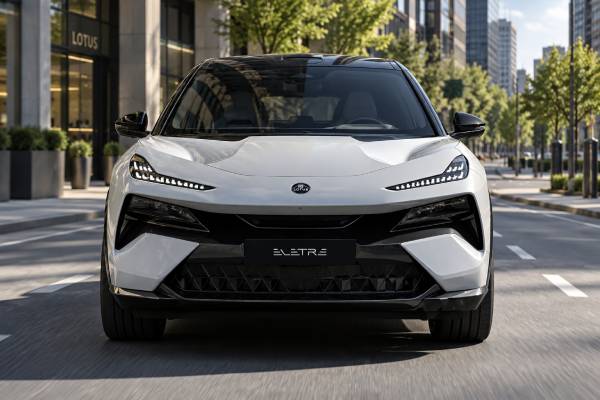
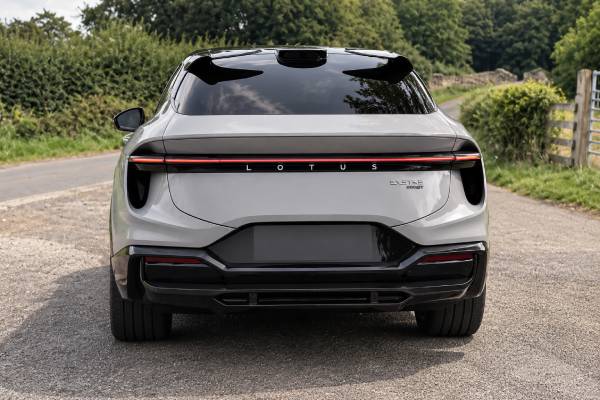
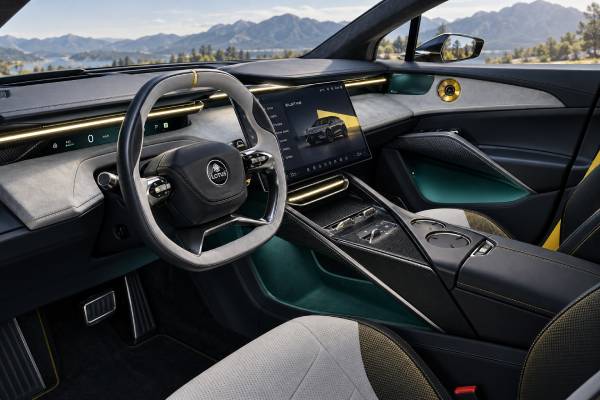
The Eletre 600 GT is aimed at drivers who want the 450 kW powertrain but plan to use the car as a serious long-distance luxury EV rather than as a rolling demonstration of maximum acceleration. It uses the 450 kW dual-motor all-wheel-drive branch of the Type 132 platform, with 710 Nm of combined torque and an 800 V electrical architecture built for very rapid DC charging. This guide concentrates on grand-touring equipment and everyday usability rather than extra propulsion output. It also separates verified family-wide engineering facts from equipment that can vary by country, wheel package and production date. That distinction matters with the Eletre because Lotus has revised naming and specifications across markets, and even horsepower figures can differ depending on whether a source uses metric horsepower or brake horsepower. The safest approach is to identify the exact car by VIN and factory build data, then judge its battery, charging, software, suspension, tires and options as a complete ownership package rather than relying on the badge alone.
Table of Contents
- The 600 GT as the long-distance sweet spot
- Mechanical specification and EV hardware
- Grand touring performance rather than headline speed
- Comfort, cabin features and motorway use
- Charging routine and range management
- Keeping a high-mileage 600 GT healthy
- Buying advice for GT shoppers
The 600 GT as the long-distance sweet spot
Grand touring changes the priorities. The motor output matters, but seat comfort after three hours, wind and tire noise, charging-stop duration, luggage use and driver-assistance behavior matter more. The 600 GT has enough performance that passing traffic is rarely a planning exercise; the more meaningful test is whether its specification suits the journeys the owner actually makes.
The strongest GT purchase is usually not the car with the largest wheel option. Smaller factory wheels can improve ride compliance, reduce tire cost and often help efficiency. Buyers attracted to the visual impact of 22- or 23-inch wheels should price replacement tires before purchase and inspect the inner shoulders carefully, because a heavy, powerful AWD EV can hide expensive wear.
A GT buyer should test the car on the type of road used most often. At urban speeds almost every Eletre feels quiet and effortless; at motorway speed wheel choice, tire pattern, seat support and driver-assistance calibration become much easier to judge.
Mechanical specification and EV hardware
Mechanically, the 600 GT stays with the 450 kW dual-motor system. Its reason for existing is not a new motor layout but a more touring-oriented specification built around the same fast-charging 800 V foundation.
| Specification | Value |
|---|---|
| Powertrain type | Battery-electric vehicle (BEV) |
| Motor layout | One electric drive unit at each axle |
| Electrical architecture | 800 V class high-voltage system |
| Battery | 112 kWh class traction battery (Lotus market literature; verify gross/usable labeling for the exact car) |
| Drivetrain | All-wheel drive |
| Specification | Value |
|---|---|
| Maximum power | 450 kW (603 hp as specified for this assignment) |
| Maximum torque | 710 Nm (524 lb-ft) |
| Drive | Dual-motor all-wheel drive |
| Reduction gearing | Single-speed front and rear |
| 0–100 km/h | about 4.15 s, market specification dependent |
| Top speed | about 250 km/h, market specification dependent |
| Specification | Value |
|---|---|
| DC charging | Up to 350 kW CCS on compatible infrastructure |
| AC onboard charging | Up to 22 kW in markets/configurations that support it |
| DC rapid-charge claim | Lotus has advertised roughly 400 km / 250 miles of added range in about 20 minutes under favorable conditions |
| Regeneration | Adjustable regenerative braking |
| Charge planning | Navigation and app functions can support charging-route planning and battery monitoring |
| Specification | Value |
|---|---|
| Length | 5,103 mm (200.9 in) |
| Wheelbase | 3,019 mm (118.9 in) |
| Height | about 1,630 mm (64.2 in) |
| Width | 2,135 mm with camera mirror system in early published target specification |
| Body | Five-door luxury performance SUV |
| Seating | Four- or five-seat layouts have been offered, depending on market and configuration |
| Specification | Value |
|---|---|
| Front suspension | Multi-link |
| Rear suspension | Five-link / multi-link |
| Springing | Air suspension |
| Damping | Continuous Damping Control adaptive dampers |
| Steering | Electric power steering |
| Torque management | Brake-based torque vectoring; additional active chassis systems depend on trim/options |
| Specification | Value |
|---|---|
| High-voltage battery | Check state-of-health diagnostics, charging history and warning logs |
| Tires | Inspect inner and outer shoulders; large staggered performance tires are costly |
| Brakes | Check disc condition, corrosion and friction-brake operation despite strong regeneration |
| Software | Confirm current vehicle software and completion of applicable campaigns |
| 12 V system | Verify auxiliary-battery health because low-voltage faults can disable high-voltage vehicle functions |
Grand touring performance rather than headline speed
For GT use, acceleration is a convenience tool. The 710 Nm torque output makes overtaking decisive, but the car’s real strength is being able to add speed without downshifts, engine noise or much driver workload. That relaxed response suits long trips better than a setup that demands constant interaction.
For a GT, repeated motorway stability matters more than launch drama; look for vibration, wandering or power warnings after sustained driving.
Drive modes change response, steering weight and chassis behavior, but they cannot compensate for poor tires. Correct load and speed ratings, matching axle pairs and appropriate pressure are basic safety requirements on a vehicle with this much torque.
Inspect discs after long-distance use because motorway regeneration can leave the friction brakes relatively underused.
Comfort, cabin features and motorway use
Check aero and body hardware for quiet operation at speed, where small defects can create wind noise during long journeys.
Test navigation, audio, seat comfort functions and assistance systems for at least a meaningful drive, not a five-minute demo.
Ride height and damping should remain composed with passengers and luggage, not just on an empty showroom test.
Choose the rear-seat layout that fits touring companions and luggage needs; comfort should not compromise useful capacity.
For this 600-series grand-touring trim, the practical point is grand-touring equipment and everyday usability rather than extra propulsion output. That should guide which options are worth paying for and which are only attractive on a showroom specification sheet.
Charging routine and range management
For a GT, charging stops should be treated as part of journey design. Use the navigation system to arrive with a lower state of charge, choose sites with multiple high-power stalls and keep enough reserve to reach a backup charger if the first site is busy or unavailable.
Rapid charging is successful when stops are predictable and short enough for the itinerary, even if peak power varies by site.
Destination AC charging is especially valuable for a GT because it can refill the car while occupants sleep or work.
Cold-weather planning should include battery and cabin preconditioning where available. In hot climates, parking and charging conditions also matter because the thermal-management system may need to devote energy to keeping the pack within its preferred temperature range.
Keeping a high-mileage 600 GT healthy
High-mileage GT use makes alignment, tire rotation where permitted by staggered fitment, cabin filtration and brake condition especially relevant. Frequent motorway miles are mechanically easy in some respects, but they can conceal gradual tire wear and stone damage.
High-mileage care should emphasize alignment, tires, cabin systems and charging reliability.
Use the exact GT wheel package and market specification for service data because touring cars are often heavily optioned.
For a used GT, battery condition should be judged alongside accumulated high-speed mileage and charging history.
Buying advice for GT shoppers
For a 600 GT, look for evidence of careful long-distance use: even tire wear, clean windscreen and paint, stable charging behavior, no steering vibration and a complete service history. Test the seats and assistance systems for at least an hour if touring comfort is a priority.
- Confirm the VIN, original market and advertised 600 GT specification before discussing price.
- Review campaign and software history with special attention to long-distance usability.
- Inspect wheels and tires for damage or wear that could affect motorway comfort and high-mileage wear.
- Cycle the air suspension and test the car on both smooth and broken pavement.
- Verify normal AC charging and complete a DC rapid-charge test when practical.
- Operate every fitted camera, assistance function, seat, climate and infotainment feature.
- Review battery diagnostics, warranty position and repair history before final payment.
GT mileage should be read in context. Long motorway distance can be mechanically gentle, so service records, tire wear, seat condition and charging reliability reveal more than the odometer by itself.
What makes a grand tourer work
A good grand tourer reduces fatigue rather than simply covering distance quickly. In the Eletre 600 GT, that means seat support, low cabin noise, predictable driver assistance and fast charging all matter as much as acceleration. During a test drive, spend time at a steady motorway speed and pay attention to tire roar, wind noise around the glass, steering corrections and how naturally the seat supports shoulders and thighs.
The GT badge should also encourage a practical equipment check. A beautiful four-seat rear cabin may be ideal for two regular passengers, while a five-seat bench is more useful for families. Premium audio matters to some owners far more than exterior carbon trim. The correct specification is personal, so compare real use rather than brochure hierarchy.
Long-distance charging is a systems problem
The Eletre’s 350 kW peak charging capability is only one part of a fast journey. A charger must have the correct voltage and current capability, the battery should be at a favorable temperature, and the state of charge should be low enough for the pack to accept high power. A busy site with one unreliable stall can waste more time than choosing a nominally slower location with six dependable chargers.
For touring, route resilience is therefore valuable. Keep a backup charging site within comfortable range, avoid arriving nearly empty at an isolated charger and consider amenities if passengers need food or restrooms. The fastest theoretical stop is not always the best stop for the people in the car.
Tire and alignment checks for motorway cars
Long motorway use can be gentle on brakes but hard on tires if alignment is slightly wrong. A small toe error can scrub the inner shoulder over thousands of kilometers while the visible outer tread still looks healthy. Run a hand across the tread when the tire is cool, inspect the inside edges with a light and ask for alignment records if the car has recently received new tires.
Steering vibration at speed deserves investigation rather than being dismissed as a wheel-balance nuisance. Bent rims, tire damage, poor balancing or alignment problems can all create vibration, and each matters on a heavy EV that routinely carries high speed with little drivetrain noise to mask it.
The GT value equation
A well-specified 600 GT can be the most rounded Eletre because it avoids paying for the 900’s extreme acceleration while still feeling special enough for long journeys. The strongest used example is one whose options support touring, whose tires and wheels are healthy and whose charging history demonstrates reliable fast-charge behavior. Mileage alone should not dominate the decision.
Planning a real 600 GT journey
A useful route plan begins with the first charging stop, not the full claimed range. Choose a site that can be reached with comfortable reserve under expected weather and speed, then identify a backup nearby. Multiple reliable stalls and easy access are usually more valuable than a single charger with a slightly higher advertised peak.
Before departure, precondition the cabin while plugged in and set navigation early enough for the car to prepare the battery if supported. Carry the charging cable required for destination charging, especially when staying at hotels or workplaces where rapid charging is unnecessary. Slow overnight charging can replace a large amount of energy with no waiting time for the driver.
During the trip, watch consumption trends rather than the raw range number. Headwinds, rain and cold can move consumption quickly. If the predicted arrival reserve is falling, reducing speed modestly is often the easiest way to recover margin.
After the trip, review what actually mattered. If passengers complained about ride quality, wheel choice may be more important than another luxury package. If charging stops were consistently short and reliable, the GT’s core engineering is doing exactly what a long-distance EV should do.
Destination charging can change the GT equation
A 600 GT owner who regularly stays at hotels, offices or second homes should investigate destination charging rather than relying only on rapid chargers. Even a modest AC supply can replace substantial energy during a long stop, reducing both cost and the need for a dedicated charging break the next day. Carry the correct cable for the markets you travel through and confirm access rules before arrival. When planning international trips, check connector standards, charging-network authentication and roaming support as carefully as route distance. Grand touring works best when charging happens while the occupants are already sleeping, eating or working. That is often more valuable than chasing the highest possible DC number at every opportunity.
Additional ownership perspective
For frequent travelers, route familiarity eventually becomes part of the car’s value. Save dependable charging locations, note which sites have good lighting and amenities, and keep more than one network or payment method available. Software routing is useful, but experienced owners also develop a personal map of reliable stops. That reduces uncertainty when weather or traffic increases consumption. The 600 GT is at its best when its rapid charging, quiet cabin and strong range are supported by a travel routine that makes the technology feel ordinary rather than something that must be managed constantly.
One more ownership consideration
A touring buyer should also inspect windshield condition and camera calibration. Long motorway mileage can produce stone chips, and replacement glass may interact with forward-facing assistance sensors. A clean repair history is preferable to unexplained glass replacement, especially when lane and adaptive-cruise functions depend on accurate sensor alignment.
What to inspect after years of touring use
A 600 GT with substantial motorway mileage can still be an excellent used car, but its wear pattern will differ from an urban example. The front body, windshield and mirrors may show stone impact damage. Seats and steering-wheel trim can reveal long hours behind the wheel even when the odometer is not extreme. Tires may look evenly worn yet be close to replacement simply because high-speed distance accumulates quickly.
Charging history can be equally informative. Frequent rapid charging is not automatically harmful because the battery-management system controls temperature and power, but repeated charging complaints or interrupted sessions deserve investigation. Ask whether the owner relied on one network or encountered the same problem at multiple sites. A fault that follows the car is more concerning than a single unreliable charger.
Touring buyers should also test assistance systems on a longer drive. Adaptive cruise, lane functions, navigation and head-up information may seem minor in a short demonstration, yet they strongly influence fatigue over hundreds of kilometers. A GT is worth paying for when the whole travel experience works smoothly, not merely because the seats look luxurious in a showroom.
Final practical note
Before buying a GT for serious distance, inspect practical travel details that brochures rarely emphasize. Confirm the charging cable fits the storage area neatly, test the tailgate with the luggage you normally carry, and check whether the rear-seat arrangement leaves enough space for passengers plus bags. Sit in the driver’s seat for longer than a showroom visit and experiment with steering-wheel and seat positions. Small ergonomic compromises become noticeable after hours on the road. A true grand-touring specification should make repeated long journeys easier, not simply look more luxurious at the start of one.
References
- Lotus Eletre – The Electric Hyper SUV | Lotus Cars 2026
- Lotus Eletre – Explore Models | Lotus Cars 2026
- Lotus Eletre | How it Drives | Lotus Cars 2026
- Lotus Eletre – Specs, Features and More | Lotus Cars Netherlands 2026
- Lotus Eletre Handbook for Drivers | Lotus Cars 2026
- Lotus Charging | Lotus Cars 2026
Disclaimer
This article is for informational purposes only and is not a substitute for professional diagnosis, repair, or vehicle-specific service information. Specifications, torque values, maintenance intervals, charging behavior, software functions, and procedures can vary by VIN, market, production date, wheel package, and equipment. Verify all service work and technical values against official Lotus documentation for the exact vehicle.
If this guide was useful, please share it on Facebook, X/Twitter, or your preferred automotive community to support our work.