
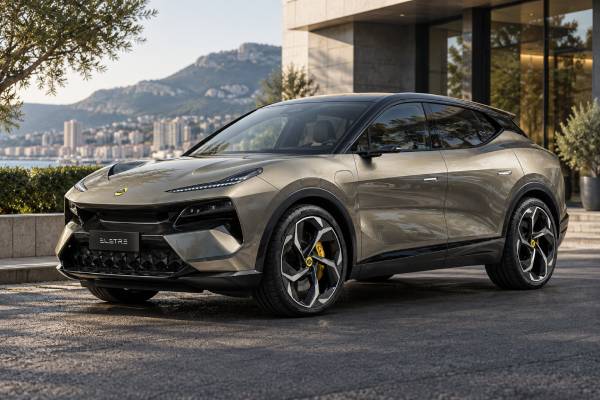
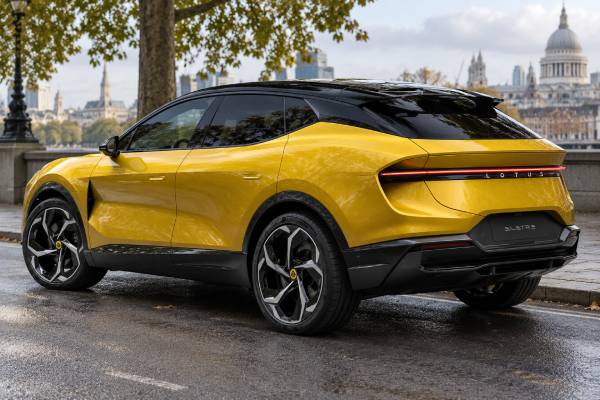
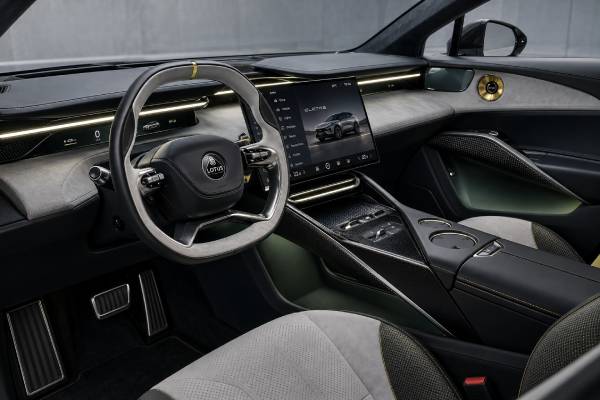
The 2025 Eletre 600 Touring is the range-focused member of the Chinese-market 600 family. Its headline number is not acceleration—although 450 kW, 710 Nm, and all-wheel drive still make it a very fast SUV—but an official 700 km CLTC range, the highest listed figure among the 2025 Eletre 600 trims. It uses the same 112 kWh battery capacity as the Luxury and Executive, so the extra certified distance comes from configuration choices rather than a larger energy store. That makes the Touring an especially interesting case for buyers who value efficiency, lower running friction, and five-seat practicality. It also makes wheel, tire, and equipment specification more important than usual: a heavily modified Touring on larger wheels may no longer deliver the characteristics that justified the trim in the first place. For an export buyer, the familiar warning still applies. Chinese-market charging hardware and connected services must be verified in the destination country. The Touring is potentially the best Eletre for distance, but only if its original efficiency-oriented configuration and software ecosystem remain intact.
Table of Contents
- Why the 600 Touring exists
- Technical specification and 700 km rating
- How to preserve its efficiency advantage
- Fast charging and road-trip planning
- Five-seat practicality and towing
- Service, tires, and long-distance wear
- Buying a used or exported Touring
Why the 600 Touring exists
The Touring prioritizes rated range within the 450 kW Eletre family. Its 700 km CLTC certification exceeds the 650 km Luxury and 640 km Executive, while keeping the same basic motor output and battery capacity.
That makes it a useful reminder that EV range is not determined by battery size alone. Aerodynamics, wheel and tire resistance, curb mass, ride height, climate loads, and calibration all contribute. A trim can go farther with the same nominal 112 kWh pack if it wastes less energy.
The Touring still delivers roughly 4.5-second acceleration to 100 km/h, so “range-focused” does not mean slow. Its advantage is that the performance reserve is paired with a specification intended to stretch each charge farther.
Technical specification and 700 km rating
The 600 Touring is a battery-electric, dual-motor, all-wheel-drive SUV on Lotus’s 800-volt architecture. It uses a single-speed reduction drivetrain and a 112 kWh ternary lithium battery in Chinese-market data.
| Parameter | Specification |
|---|---|
| Maximum output | 450 kW / 612 PS |
| Maximum torque | 710 Nm |
| Motors | Front and rear |
| Drive | AWD |
| Transmission | Single speed |
| Battery | 112 kWh |
| Parameter | Specification |
|---|---|
| CLTC range | 700 km |
| 0–100 km/h | About 4.5 seconds |
| Top speed | About 258 km/h |
| Seats | 5 |
| Height in some 2025 Touring listings | Approximately 1,630 mm |
| Parameter | Specification |
|---|---|
| Length | 5,103 mm |
| Width | 2,019 mm |
| Wheelbase | 3,019 mm |
| Body type | Five-door large SUV |
| Parameter | Specification |
|---|---|
| Architecture | 800 V class |
| Fast-charge benchmark | 10–80% in about 20 minutes under suitable conditions |
| Battery thermal management | Active liquid control |
| Domestic connector | Chinese-market standard; verify compatibility if exported |
| Parameter | Specification |
|---|---|
| Frunk | 46 L on common Eletre architecture |
| Five-seat rear cargo | 688 L on common configuration |
| Maximum rear cargo | Up to 1,532 L with rear seats folded |
| Braked towing | Up to 2,250 kg where homologated |
The 700 km number should be preserved as a CLTC certification figure. It must not be relabeled as WLTP or treated as a guaranteed real-world range.
How to preserve its efficiency advantage
The Touring’s range advantage can disappear if an owner changes the very items that helped produce it. Oversized wheels, non-efficient tires, low tire pressure, roof accessories, and unnecessary cargo all increase energy use.
Tires are the most practical place to start. Use the correct size, load rating, and an appropriate low-resistance performance tire rather than choosing solely for appearance. Very wide performance rubber can improve grip but usually adds rolling resistance. Keep pressure at the vehicle-specified value, checking when tires are cold.
Alignment is equally important. A small toe error can create continuous scrub over hundreds of kilometres. That wastes energy and destroys expensive tires at the same time. If consumption rises after a pothole strike or wheel replacement, alignment deserves inspection.
Speed has a larger effect than many drivers expect. The energy needed to overcome aerodynamic drag rises sharply as speed increases. Reducing cruising speed modestly can add meaningful range without changing the vehicle at all.
Climate use is another variable. Precondition the cabin while plugged in when possible, especially in winter. That lets grid power handle some initial heating or cooling instead of consuming stored battery energy immediately after departure.
Fast charging and road-trip planning
The Touring’s best long-distance strategy combines efficiency with short high-power stops. A 700 km certification figure is helpful, but a driver does not need to extract every possible kilometre from the pack if charging is fast and well planned.
Use rapid chargers where the car can exploit its high-voltage architecture. Arrive with the battery warm and at a relatively low state of charge. Leave when charging power has tapered enough that continuing no longer saves time compared with driving to the next stop.
Public-charger reliability still matters. Build backup sites into a long route, especially with a China-market import whose connector solution may limit station choice. An adapter that works at one charger brand should not be assumed to work everywhere.
For home use, the Touring rewards regular overnight charging. A driver who begins each day around the preferred daily charge limit rarely needs to think about full-pack range. The large battery then becomes a buffer for unexpected trips rather than something to cycle from 100% to nearly empty.
Five-seat practicality and towing
The Touring keeps a five-seat cabin, which makes it more versatile than the four-seat Executive for families. The long wheelbase provides generous rear legroom, while the common Eletre five-seat cargo layout offers useful luggage capacity and a small front compartment for cables.
For long trips, distribute luggage carefully. Heavy cargo changes tire load and can affect consumption. Check tire-pressure recommendations for a fully loaded vehicle rather than using the lightly loaded setting by habit.
The Eletre platform can be homologated to tow up to 2,250 kg braked, but towing conflicts directly with the Touring’s range mission. A tall caravan can more than erase the efficiency advantage gained by trim optimization. Plan charging around trailer-accessible sites and expect shorter intervals.
Roof boxes create a similar aerodynamic penalty. If the goal is maximum range, use the internal luggage volume first and remove external carriers when they are not needed.
Service, tires, and long-distance wear
A Touring used as intended may accumulate mileage quickly, so maintenance should focus on wear that scales with distance. Tires, alignment, wheel bearings, suspension joints, cabin filters, wipers, and brake condition can matter more than age-based engine service that an EV does not have.
High annual mileage also makes charging-port condition important. Inspect pins, seals, locking mechanisms, and the cable area. Repeated public charging exposes the inlet to dirt, rain, and mechanical wear.
Brake discs can still corrode even on a high-mileage EV because regenerative braking handles much of the routine deceleration. Use periodic firm friction braking when safe and inspect surfaces at service.
Battery degradation should be judged with diagnostics, not rumor. A high-mileage pack can remain healthy if thermally managed and sensibly used. Ask for a state-of-health report where available and compare actual charging behavior over time.
Buying a used or exported Touring
A genuine Touring should be verified through its original 2025 Chinese specification and 700 km CLTC certification. Do not assume any 450 kW five-seat Eletre is a Touring merely because the seller uses the word “long range.”
Check whether efficiency-oriented wheels and tires remain fitted. Aftermarket 23-inch wheels may make the car look more aggressive but change ride, range, and replacement cost. If original wheels are included, their presence can improve both usability and resale value.
Inspect the underbody, battery enclosure, air suspension, brakes, tires, roof, and all driver-assistance hardware. Then perform a diagnostic scan and charge test.
For an exported car, confirm local charging, app access, navigation, OTA support, and warranty recognition. The Touring’s greatest strength is easy distance; anything that makes charging difficult defeats that advantage.
For buyers who prioritize travel over rear-seat extravagance or ultimate acceleration, the 600 Touring may be the most logical 2025 Eletre. It combines full 450 kW performance with the highest official CLTC range in the Chinese lineup and retains five-seat practicality.
Range-focused wheel and tire decisions
A Touring buyer should resist the temptation to copy the appearance of a 900-series car if maximum range is the reason for choosing this trim. Large, heavy wheels increase rotational inertia and often require wider tires, which can raise rolling resistance and aerodynamic disturbance.
The best setup is the one Lotus homologated for the Touring’s efficiency mission. If the car has aftermarket wheels, ask for the originals. Weighing and measuring aftermarket wheels can be informative, but do not assume a lighter wheel is automatically better if offset, load rating, tire shape, or aero design is wrong.
When replacing tires, compare efficiency labeling where available but do not sacrifice load capacity, wet grip, or speed rating. A 2.6-tonne-class performance SUV needs tires engineered for its mass and torque.
Building a realistic 700 km expectation
The 700 km CLTC figure represents standardized testing, and most drivers will not reproduce it on a high-speed intercity route. Rather than applying a fixed discount, break the trip into conditions. Urban sections may be relatively efficient because speeds are low and regeneration is frequent. Motorway sections consume more because drag dominates.
Weather can shift the result again. A strong headwind effectively increases air speed over the vehicle even if road speed is unchanged. Heavy rain adds rolling resistance and forces HVAC use. Cold temperatures increase heating demand and reduce battery efficiency until warmed.
The Touring remains valuable even when real range is far below 700 km because its large battery and rapid charging work together. The trim’s advantage is not a promise to avoid charging forever; it is the ability to travel farther between stops or reach the same destination with a larger reserve.
How to compare the Touring with the Luxury
If both trims are available at similar prices, decide whether extra equipment or extra certified range matters more. The Luxury may offer richer comfort features, while the Touring’s simpler or more efficient configuration supports the highest CLTC number.
List the options actually present on each car. A highly optioned Touring can overlap a Luxury, and a poorly documented Luxury may not justify its premium. Compare wheel sizes, seats, audio, driver-assistance hardware, interior trim, and warranty—not just badge names.
For frequent long-distance drivers, range can be more valuable than features used occasionally. For urban owners with reliable home charging, the difference between 650 and 700 km CLTC may matter less than seat comfort or cabin specification.
High-mileage Touring inspections
A Touring is likely to attract drivers who cover distance, so higher mileage should not automatically disqualify a car. Evaluate how the kilometres were accumulated. Long motorway trips can be easier on suspension and brakes than short urban operation over potholes, even though the odometer rises faster.
Look for stone chips, windscreen pitting, seat wear, and steering-wheel shine that align with high motorway mileage. Check wheel bearings and tire noise, because continuous high-speed use can reveal wear. Inspect the charging inlet closely because frequent rapid charging means more connector cycles.
Ask for charging history if the owner tracks it. Frequent rapid charging alone is not proof of battery damage; thermal management is designed for it. What matters is battery health, temperature management, and whether faults or abnormal degradation are present.
Road-trip emergency planning
Carry more than a charging cable. A tire repair kit, inflator, warning equipment required by local law, and roadside-assistance details are important because the Eletre may not carry a conventional spare wheel. Know the vehicle’s towing and recovery procedure before a breakdown occurs.
Do not allow an untrained operator to lift or tow the car incorrectly. The high-voltage battery and AWD drivetrain make recovery procedures important. Keep the handbook accessible offline in case there is no mobile signal.
For an imported Touring, also carry documentation for any charging adapter and the contact details of the supplier. A failed adapter can leave the car unable to use an otherwise functional charging station.
Efficiency diagnostics when consumption rises
If the Touring suddenly uses more energy, check simple causes before blaming the battery. Verify tire pressures, inspect alignment and tire wear, remove roof accessories, check whether a brake is dragging, and compare similar routes at similar temperatures.
Software updates can also change displayed consumption or climate strategy. Record energy use over several trips rather than relying on one journey. A headwind or cold snap can create a dramatic one-day change.
If the increase persists, a workshop can inspect thermal-management behavior, wheel alignment, brake drag, drivetrain faults, and battery data. The Touring’s range focus makes it particularly easy for an owner to notice small efficiency changes early, which can be useful for preventive maintenance.
Verifying that a car is truly the 700 km Touring
Because the 450 kW drivetrain appears in several Eletre trims, a Touring should never be authenticated by power output alone. Start with the VIN, production date, original Chinese invoice or build record, and the certified configuration associated with the 700 km CLTC figure. Then compare the car’s wheels, seating layout, battery specification, and option content with those records.
This matters particularly when a used car has been modified. A Touring wearing large aftermarket wheels may still be a genuine Touring, but it will no longer reproduce the configuration that earned the range headline. Conversely, a Luxury cannot become a Touring merely by fitting efficiency-oriented wheels and adding a badge. Preserve the distinction between model identity and owner modifications.
For resale, retain the original wheels and charging accessories if they have been replaced. A future buyer interested in the Touring is likely to value the ability to return the vehicle to its range-focused factory configuration.
Fast-charging tactics on long motorway trips
The quickest road trip is not always the one with the fewest charging stops. Because high-voltage batteries generally accept their highest power over only part of the state-of-charge window, two shorter well-timed stops can beat one session that waits for the battery to crawl toward 100%. Route planning should consider charger reliability, amenities, weather, and the next available backup as well as nominal kilowatt rating.
Arrive at a rapid charger with enough reserve to reach an alternative site if the chosen unit is occupied or offline. Use the car’s navigation or battery-preparation function where supported so the pack approaches the charger at a suitable temperature. In winter, a high-power charger cannot force a cold battery to accept energy faster than its protection strategy allows.
Record a few real journeys during the first months of ownership. Note speed, temperature, wind, starting percentage, arrival percentage, and energy delivered. Those observations become more useful than a generic range calculator because they describe the exact car, tires, routes, and driving style.
Towing and roof loads can erase the range advantage
The Eletre’s towing capability can make the Touring attractive for trailers, but aerodynamic drag changes the energy calculation dramatically. A tall box trailer, boat, or caravan can reduce range far more than its mass alone suggests, especially at motorway speed. Plan the first towing trip conservatively and confirm that charging sites can physically accommodate the combined vehicle length.
Do not exceed the homologated towing, tongue-load, roof-load, or accessory limits for the exact market specification. The presence of a towbar is not proof that the installation is approved or correctly coded. Inspect mounting points, wiring, and trailer-light operation, and confirm that any driver-assistance changes expected during towing occur normally.
Roof boxes and bicycles have a similar aerodynamic effect. If the Touring was purchased specifically for maximum distance, remove external carriers when they are not needed. The efficiency benefit costs nothing and can be larger than small differences between driving modes.
Reading battery health in context
A Touring’s high range makes battery condition especially important to buyers, but dashboard distance estimates are not a state-of-health test. The estimate reacts to recent consumption, temperature, route type, and climate use. A car driven rapidly before the viewing can display a low number even when the battery is healthy; a carefully driven car can display an optimistic one.
Seek diagnostic evidence from a qualified source and ask what the reported state-of-health value actually measures. Review fault history and inspect the pack enclosure from below for significant impacts or repairs. Then perform a charge session. Smooth communication and sensible thermal behavior are useful evidence even though a single session cannot certify the entire battery.
Compare energy consumption over a known route rather than relying on one acceleration-heavy test drive. If two similar Touring cars are being considered, normalize tire pressures, climate settings, temperature, and route as much as practical before drawing conclusions.
When the Touring is preferable to a richer trim
The Touring is strongest for an owner who repeatedly uses the Eletre’s distance capability. That may be a rural driver with sparse charging, a business traveler who values fewer stops, or a family that takes long holidays. In those cases, efficiency-oriented equipment is not a “base model” compromise; it is the feature that best serves the mission.
A Luxury can be the better purchase for shorter journeys if its added cabin features are used every day. Likewise, an Executive suits owners who prioritize two rear passengers rather than five-seat flexibility. Comparing trims by list price or perceived hierarchy alone misses why the Touring exists.
The right used Touring therefore has three qualities: documented identity, a configuration that still supports its efficiency objective, and charging that works reliably where the owner travels. Those factors matter more than cosmetic upgrades that reduce the very advantage the trim was designed to provide.
Efficiency checks after purchase
Use the first few weeks to establish a baseline for the Touring. Confirm cold tire pressures, reset the trip computer, and record consumption over repeated routes at similar speeds. Unexpectedly high use may come from low pressure, aggressive alignment, unsuitable replacement tires, roof accessories, heavy climate demand, or simply high motorway speed.
Change one variable at a time before assuming the battery is at fault. A documented baseline also makes later deterioration easier to recognize. If consumption suddenly rises after tire work or suspension repair, the timing can point directly toward geometry or rolling-resistance changes rather than an electrical problem.
References
– SEC Filing 2026 – Lotus Eletre – Explore Models | Lotus Cars 2026 – Lotus Eletre | How it Drives | Lotus Cars 2026 – Lotus Charging | Lotus Cars 2026 – Lotus Eletre Handbook for Drivers | Lotus Cars 2026 (Owner’s Manual) – Lotus partners with Bosch and Mobilize to give customers access to over 600,000 European charging stations – Lotus Cars Media Site 2024
Disclaimer
This article is for informational purposes and does not replace professional diagnosis or repair. Specifications, torque values, service intervals, charging standards, and procedures vary by VIN, market, and equipment. Verify the specific Touring against official Lotus service documentation.
If this range-focused guide was useful, please share it on Facebook, X/Twitter, or another EV community to support our work.