
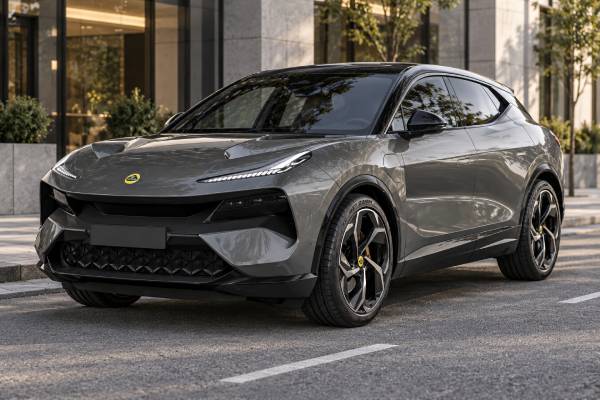
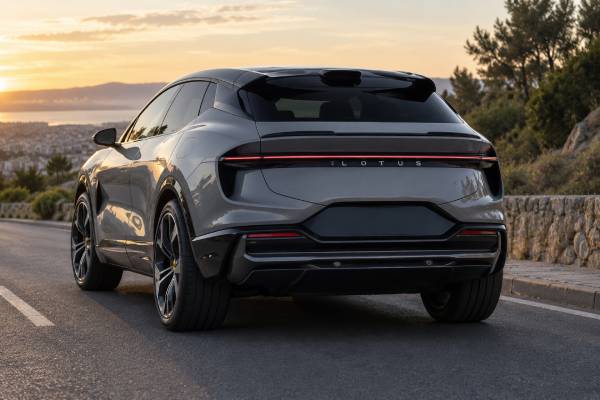
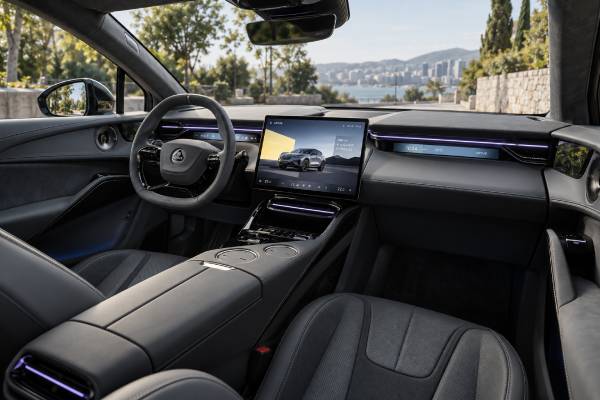
The 2025 Eletre 900 Executive combines the two most expensive ideas in the Chinese Eletre range: the 675 kW high-performance drivetrain and a four-seat executive cabin. It is therefore not simply an R with a new badge. The 900 naming reflects Lotus’s revised model hierarchy, while the Executive specification adds rear-seat luxury and equipment that increase weight and reduce certified range. Chinese-market data lists 918 PS, 985 Nm, a 112 kWh battery, roughly 535 km CLTC, four seats, and a curb weight around 2,690 kg. Acceleration remains extraordinary at about three seconds to 100 km/h, supported by dual motors, all-wheel drive, and the two-speed rear transmission used by the high-output Eletre family. Yet the most expensive problems on a used 900 Executive may be unrelated to acceleration: executive-seat electronics, air suspension, large brakes, wide tires, regional software, charging compatibility, and bespoke equipment can all carry substantial repair costs. Buyers should treat it as both a super-SUV and a complex luxury limousine.
Table of Contents
- 900 Executive identity and positioning
- 675 kW specifications and technical data
- Two-speed performance and thermal behavior
- Executive rear cabin and equipment
- 535 km CLTC range and charging
- Maintenance, tires, brakes, and suspension
- Buying, importing, and valuation checks
900 Executive identity and positioning
The 900 Executive is the high-performance luxury flagship of the 2025 Chinese Eletre range. It pairs the 675 kW drivetrain with four-seat executive accommodation, making it distinct from both the 600 Executive and the 900 Performance version.
The “900” family replaces the earlier R/R+ naming logic with a number that signals 900-plus metric horsepower. The underlying peak output is 675 kW, equivalent to about 918 PS and about 905 bhp in British mechanical horsepower.
Its lower 535 km CLTC rating compared with the 900 Performance’s roughly 560 km figure is consistent with the Executive’s equipment and mass. Buyers should not assume the difference indicates a smaller battery; both use the 112 kWh-class Eletre pack in 2025 Chinese data.
675 kW specifications and technical data
The 900 Executive uses two high-output electric motors, all-wheel drive, and a two-speed rear reduction unit. The system is designed for extreme acceleration without giving up the Eletre platform’s high-speed and fast-charging capabilities.
| Parameter | Specification |
|---|---|
| Maximum output | 675 kW / 918 PS |
| Maximum torque | 985 Nm |
| Motors | Dual, front and rear |
| Drive | AWD |
| Rear transmission | Two-speed |
| Battery capacity | 112 kWh |
| Battery chemistry | Ternary lithium/NMC in Chinese data |
| Parameter | Specification |
|---|---|
| CLTC range | 535 km |
| 0–100 km/h | About 3.0 seconds |
| Top speed | About 265 km/h |
| Seats | 4 |
| Listed curb mass | About 2,690 kg |
| Parameter | Specification |
|---|---|
| Length | 5,103 mm |
| Width | 2,019 mm |
| Height | 1,636 mm |
| Wheelbase | 3,019 mm |
| Parameter | Specification |
|---|---|
| Electrical architecture | 800 V class |
| High-power DC charging | Approximately 350 kW class on Eletre architecture |
| Published 10–80% benchmark | About 20 minutes under suitable conditions |
| Connector | Chinese-market standard on domestic cars; verify for export use |
| Parameter | Specification |
|---|---|
| Suspension | Adaptive air suspension |
| Steering | Electric power steering; rear-steering equipment depends on configuration |
| Braked towing reference | Up to 2,250 kg where homologated |
| Common 22-inch tire sizes | 275/40 R22 front; 315/35 R22 rear |
Four-seat packaging can change luggage figures relative to a five-seat Eletre. Use the individual 900 Executive’s homologation documents rather than automatically applying five-seat cargo capacities.
Two-speed performance and thermal behavior
The 900 Executive can deliver supercar-like acceleration while carrying four adults in luxury, but maximum output depends on the high-voltage system being within its preferred temperature and state-of-charge window.
The rear two-speed unit helps solve a classic EV gearing compromise. A shorter ratio supports very strong launch acceleration, while the taller ratio allows the rear motor to operate more efficiently at high road speed. Shifts are automatic and integrated with motor torque control.
Repeated launches create substantial heat. Battery coolant, motor coolant, inverter temperature, gearbox temperature, and tire temperature all matter. The control system can reduce output to protect hardware, so a brief drop in peak power after repeated abuse is not automatically a defect.
For a used-car inspection, avoid judging the drivetrain only from one dramatic acceleration run. Listen for abnormal gear whine, clunks on torque reversal, vibration under power, or warnings after the car is fully warm. A 30-minute mixed drive reveals more than a ten-second launch.
Executive rear cabin and equipment
The four-seat cabin is what separates this car from a conventional 900 performance model. Two individual rear seats prioritize passenger comfort and create more electronics, actuators, trim, and climate hardware to inspect.
Test every powered adjustment, heating, cooling, massage function, rear console control, audio zone, USB/charging point, sunshade, reading light, and climate outlet fitted. If there are rear displays or dedicated control screens, check for dead pixels, touch response, account restrictions, and software language support.
Seat mechanisms should move quietly and stop consistently. A seat that hesitates, loses memory, or rubs against the console may have a calibration or mechanical issue. Executive trim pieces can be expensive or difficult to source outside China, so cosmetic condition matters more than on a simpler five-seat car.
The four-seat arrangement also affects resale. It is ideal for chauffeur use or owners who value two rear passengers, but it narrows the audience among families needing three rear seating positions.
535 km CLTC range and charging
The 535 km CLTC rating is the trade-off for combining maximum performance with maximum equipment. It is not poor for a 675 kW, 2.7-tonne-class SUV, but it should not be compared directly with WLTP or EPA figures from another market.
At fast motorway speeds, practical range can be much lower. Large wheels, wide tires, winter conditions, and repeated acceleration further increase consumption. Owners who want long-distance efficiency should use moderate cruising speed and the smaller approved wheel package where possible.
Fast charging is what keeps the 900 Executive viable for touring. The 800-volt architecture can accept very high power, but the battery needs to be warm and the charger must be capable of supplying the required voltage/current. A cold battery or a shared charging cabinet can cut power dramatically.
For an exported Chinese-market car, charging compatibility should be demonstrated before purchase. High power makes adapter quality even more critical; a solution must handle communication, locking, current, temperature monitoring, and legal safety requirements, not merely fit the socket.
Maintenance, tires, brakes, and suspension
The 900 Executive should be budgeted like a high-performance luxury vehicle, not like an economy EV. It has fewer engine-service items, but tires, brakes, suspension, electronics, and cosmetic components can be expensive.
Wide performance tires can wear quickly under 985 Nm of torque. Inspect all four across the full tread and confirm the correct load/speed ratings. Mismatched rear tires are a poor sign on a vehicle with this output.
The friction brakes may be heavily used on a performance-driven car or underused on a chauffeur-driven one. Either extreme can create cost. Look for heat checking, scoring, vibration, corrosion, and uneven pad deposits.
Air suspension and any active anti-roll or rear-steering equipment should be tested through their operating range. A vehicle that has sat unused can develop air leaks or low-voltage issues even at modest mileage.
Battery and drivetrain cooling systems deserve strict attention. Maximum acceleration and maximum fast-charging speed both depend on thermal performance. Persistent limitation messages, coolant leaks, or unexplained charging taper should be investigated rather than accepted as normal.
Buying, importing, and valuation checks
The 900 Executive’s high price makes documentation especially important. Verify the original 2025 Chinese trim, 675 kW output, 535 km CLTC certification, four-seat layout, option list, and first-registration history.
Inspect for accident repair around sensor-rich bumpers, lidar housings, windscreen, roof, and battery underbody. A collision can require both body repair and expensive ADAS calibration. Ask for calibration invoices after any relevant work.
Run a full diagnostic scan, test every executive-cabin function, and perform both AC and DC charging. Confirm app access, maps, OTA updates, and local service support if the car has been exported.
Battery state of health should be measured where reliable diagnostics are available. Do not infer health from a range estimate on the dashboard; recent high-speed driving can lower the estimate even with a healthy pack.
The 900 Executive is the Eletre for a buyer who wants everything at once: nearly 700 kW of performance, four-seat luxury, dramatic technology, and fast charging. That combination is compelling, but it also means there are more expensive systems to verify. A carefully documented, fully functioning example is worth substantially more than a superficially cheap import with uncertain software or charging support.
Why the 900 Executive is more than a renamed R
The 675 kW powertrain connects the 900 Executive to the earlier Eletre R, but the 2025 Chinese product structure changes how the car is configured and used. The four-seat Executive package adds equipment and weight, and its 535 km CLTC rating reflects a different homologated configuration from the performance-focused versions.
A buyer should therefore avoid assuming that every R part, software package, or range figure applies automatically. Mechanical components may be shared, but the rear cabin, trim, control modules, and market software can be distinct.
The later naming also affects resale searches. Some marketplaces may list the car under R+, 900, or 900 Executive depending on translation. VIN-based identification is much more reliable than keyword searches.
Performance consumables at 675 kW
Full acceleration places enormous load on tires. Even with sophisticated traction control, 985 Nm can accelerate wear, especially on the rear axle. Check tread depth often and avoid waiting for the legal minimum because wet-weather performance can decline earlier on wide performance tires.
Brake costs depend on specification. If the car has upgraded lightweight or carbon-ceramic hardware, replacement prices can be substantial. Inspect rotors for chips, heat damage, or surface issues and confirm whether any specialized service procedure applies.
Wheel damage deserves attention too. A 23-inch wheel with a low-profile tire has limited protection against potholes. Repeated straightening can weaken a wheel, while a welded repair may be unacceptable depending on location and local rules.
Rear-passenger comfort under extreme acceleration
A four-seat executive interior changes how performance should be used. The car may be capable of approximately three seconds to 100 km/h, but repeated maximum launches are uncomfortable for passengers and can turn a luxury journey into a demonstration ride.
Smooth driving requires progressive accelerator input and anticipation. Use regeneration settings that allow passengers to remain settled and avoid abrupt lift-off. Chauffeurs should prioritize consistency over maximum energy recovery if a strong one-pedal response makes occupants pitch forward.
Seat belts, head restraints, and seat positions should be adjusted correctly before using high performance. The rear seats may recline, but the safest position and available restraint geometry should follow the handbook.
Heat management during fast driving and fast charging
The same thermal system has to support several demanding tasks: cooling or heating the battery, maintaining motor and inverter temperatures, conditioning the cabin, and preparing the pack for rapid charging. A hard drive immediately followed by a high-power charge can therefore create a significant thermal workload.
The car is designed to manage this automatically, and fans or pumps may continue operating after parking. That can be normal. What deserves attention is a persistent warning, repeated charge limitation in suitable conditions, coolant loss, or unusual noises from pumps and fans.
Owners should not block cooling openings with accessories or allow debris to accumulate around active aero and heat-exchanger areas. After body repairs, verify that shutters, ducts, and undertrays are correctly installed because airflow management affects both efficiency and thermal performance.
Buying one for chauffeured service
Commercial or professional passenger use changes the buying priorities. Rear-seat condition, climate reliability, charging downtime, and warranty support may matter more than a perfect exterior. Calculate whether the car can complete a typical workday with planned charging breaks.
Fast charging is a major advantage, but a fleet or chauffeur operator should identify reliable stations near common routes and consider depot charging. Repeated public charging at peak tariffs can erode operating-cost advantages, while home or depot electricity may improve them substantially.
Commercial use also increases seat, door, and climate cycles. Inspect rear door handles, powered seats, USB outlets, and trim more often than a private owner might. Small failures can directly affect passenger experience.
Valuing a used 900 Executive
A used flagship should be priced according to supportability, not merely original MSRP. A heavily discounted import can be poor value if the rear electronics are region-locked, the charging standard is inconvenient, or local dealers will not perform warranty work.
Conversely, a well-documented car with proven local charging, transferable warranty, updated software, and complete original equipment can justify a premium. The expensive systems have already been demonstrated rather than left as buyer risks.
Compare tire age and condition, brake wear, battery health, suspension operation, and executive-seat functions in monetary terms. A car that needs tires, brakes, and a rear-seat module immediately may be thousands more expensive than its advertised price suggests.
First month of ownership
After purchase, create a technical baseline. Have the car scanned, record battery health data, update software through an approved route, inspect alignment, and measure tire tread. Test the fastest available compatible DC charger when the battery is warm and at a suitable state of charge.
Learn how the two-speed drivetrain behaves in different modes so normal shifts are not mistaken for faults. Familiarize yourself with suspension height limits, towing/recovery procedures, and the location of emergency information in the handbook.
Finally, configure charge limits and climate schedules around actual use. The 900 Executive is most enjoyable when its complexity becomes routine rather than mysterious. Good setup and documentation turn a spectacular specification sheet into a manageable daily vehicle.
Choosing between 900 Executive, 600 Executive, and a performance-focused 900
The 900 Executive makes sense only when a buyer values both halves of its character. The four-seat rear cabin targets chauffeured or highly comfort-focused use, while the 675 kW drivetrain supplies acceleration that is unnecessary for that job. If one half will rarely be used, another Eletre may be the more rational purchase.
The 600 Executive keeps the dedicated four-seat idea but uses the 450 kW drivetrain. For owners who spend most of their time carrying rear passengers smoothly, that is still extremely rapid and may better align with range and tire priorities. A performance-focused 900 or earlier R, by contrast, can be a better fit for an owner-driver who wants the high-output hardware but does not need an executive rear arrangement.
Do not infer equipment solely from the 900 badge. Verify the seating layout, wheels, brakes, interior package, and original Chinese trim documents. Translation across export marketplaces can collapse distinct versions into one category, and the VIN-linked build information is more reliable than a listing title.
Supporting a China-market 900 after export
A high-output import magnifies the importance of local technical support. Before purchase, identify who can scan the battery, inverter, motor, suspension, braking, and driver-assistance systems; who can obtain VIN-correct parts; and who can deal with software or account problems. A conventional workshop may be excellent at tires and brakes yet unable to resolve a regional control-module issue.
Charging should be proven with the actual destination hardware. Separate AC and DC compatibility, inspect any adapter or conversion equipment for rating and heat damage, and perform a real public rapid-charge session if possible. The 900 Executive’s ability to accept high charging power is only useful when the connector, communication protocol, battery temperature, and charger all cooperate.
App access and OTA behavior are equally important. Transfer account ownership before the sale is complete where the system permits it, verify remote controls, and record the installed software versions. Avoid casual regional flashing because a 900 Executive contains many interconnected modules; an incomplete conversion can create faults that are much harder to diagnose than a missing map service.
Four-seat luggage planning
Executive seating can change the relationship between passenger space and cargo flexibility. Buyers who frequently carry four adults with large suitcases should test that scenario physically. Published luggage volume is useful, but wheel-arch shape, floor height, parcel-shelf position, and any limitations on folding the executive rear seats determine whether the space works for airport transfers or touring.
Check the front luggage compartment as well. It can separate charging cables or smaller bags from the main cargo area and prevent dirty cables from being placed beside passenger luggage. Keep emergency charging equipment accessible rather than burying it below the heaviest cases.
If the car will be chauffeur-driven, consider how often the driver must load heavy cases over the rear sill and whether protective liners can be installed without obscuring sensors or damaging trim. Small operational details matter in a luxury vehicle that may complete several passenger journeys each day.
Battery and thermal-system scrutiny on the high-output model
The same 112 kWh class of battery must support both long-range cruising and very high discharge power. That does not mean a 900 Executive is inherently fragile, but it makes thermal-system condition important. Check for coolant warnings, unusual pump or fan noise, persistent power limitation, and evidence of leaks around accessible cooling components. Diagnostic history can reveal intermittent thermal faults that are invisible during a short viewing.
During the road test, begin gently and confirm that the car reaches normal operating condition before requesting strong acceleration. Performance that is limited at very low state of charge or with a cold battery can be protective behavior. Persistent derating at a healthy charge level and suitable temperature deserves investigation rather than being dismissed as “how EVs work.”
A DC charging session provides another thermal-system observation point. Watch for stable charging and normal changes in fan or pump activity. Charge power should taper as conditions demand; repeated abrupt session failures or warning messages are more important than whether a single peak matches an advertised maximum.
Protecting value on a complicated flagship
Flagship equipment raises the cost of neglect. Keep alignment records, tire invoices, battery diagnostic reports, software service documentation, accident-repair photographs, ADAS calibration evidence, and proof of charging-hardware compatibility. A thick, orderly history file can separate a trustworthy imported 900 Executive from an otherwise identical car that leaves every question to the next buyer.
Use high-quality repairers for wheels and bodywork. A poorly straightened 23-inch wheel, incorrectly aimed sensor, or mismatched paint repair can become a recurring problem. If special brake hardware is fitted, establish its inspection criteria and replacement cost before wear becomes urgent.
Finally, insure the vehicle for what it actually is. Give the insurer the VIN and four-seat 900 Executive specification and ask how battery underbody damage, glass with sensor hardware, imported parts, and long repair delays are handled. Ownership is easiest when the expensive edge cases have been considered before one of them occurs.
References
– SEC Filing 2026 – Lotus Eletre – Explore Models | Lotus Cars 2026 – Lotus Eletre | How it Drives | Lotus Cars 2026 – Lotus Charging | Lotus Cars 2026 – Lotus Eletre Handbook for Drivers | Lotus Cars 2026 (Owner’s Manual) – Lotus launches charging solutions for electric vehicles – Lotus Cars Media Site 2023
Disclaimer
This article is for informational purposes and is not a substitute for professional diagnosis or repair. Specifications, torque values, service intervals, software functions, charging equipment, and procedures vary by VIN, market, and equipment. Verify the exact 900 Executive against official Lotus documentation.
If this flagship Eletre guide was useful, please share it on Facebook, X/Twitter, or another automotive community to support our work.